Design is about Understanding Different Complexities - Felix Lee - S1 - Episode #1
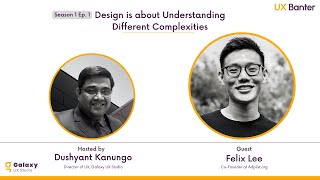
This is a transcript of a UX Banter podcast episode (host Bhushan) with guest Felix Lee, co-founder of ADPList. Felix recounts ADPList's origin during the COVID-19 pandemic (starting as a Google spreadsheet), its rapid global growth (early counts ~30 mentors/200 mentees to a platform with thousands of mentors), and the platform's mission to democratize mentorship. He describes his personal journey—from two years in the army after high school to becoming a designer and startup founder—and credits discipline, persistent upskilling, and indirect mentors (e.g., Steve Jobs, Lee Kuan Yew) for shaping him. Key themes: mentorship culture and volunteers, surprises about human generosity, design as problem-framing ("it's not all design"), the primacy of data-driven approaches (use data → research → design), and the importance of diversity for global product fit. The episode ends with personal rapid-fire questions, plans for an ADPList India event (Bangalore, tentative mid-year), and a closing note about Felix learning to say no while still prioritizing giving back.
Questions this video answers
Started during the COVID-19 pandemic as a Google spreadsheet (early volunteer-run list).
About 30 mentors and about 200 mentees in the first year/early days.
Over 6,000 mentors from 90 different countries.
Enlisted in the army in the late 2010s (reported as late 2018) and served for two years.
Chapters
Foreign. Hello everyone and welcome to the new episode of UX Banter Podcast. This podcast is presented by Galaxy UX Studio and powered by Galaxy Weblinks. Vasudev Kutumbakam is a phrase in Sanskrit that means the world is one family. Our guest of today's episode is a firm believer of the same. He co founded AdPillest with a vision to inspire powerful conversations and collaborations among members of the design community worldwide to change the world together with creativity. He is an engineer, ex army man, design lead and an entrepreneur who believes in constantly reinventing the way we experience and communicate with the world. Please welcome the co founder of Adplist, Mr. Felix Lee.
Thank you so much Bhushan for having me here.
It's a pleasure sir to you know, having you on board and I was really apprehensive about whether or not to first approach you and then whether you will join us and you know, I can just tell you that how happy I am to, you know, just having this face to face conversation with you.
Thank you.
So I believe this goes onto the roots of the entire mentorship platform. I mean that is the purpose of it, right? That you get to speak with people who are leaders in the industry and getting the opportunity to be able to speak with one another.
Yep. You know, I think it's exciting to be able to do this on a day to day basis these days.
So if we start the conversation, you know, your short to famous adplist the way that it has become the biggest of the community brands in the design industry. So what is the story behind adplist?
You know, I think, you know, when we think about ADP list, it was really started during the pandemic where you know, people were getting laid off from jobs and you know, people were just looking for jobs and you know, you know, we started off as a very humble Google Excel spreadsheet online, right. Where you know, you just put your names inside and that's it. And we started with barely 30 mentors, barely 200 mentees about a year ago. And it was mainly in Singapore and the U.S. you know, where I'm based at, you know, but today, truly it has grown so global, you know, today 80 please is on a mission to democratize mentorship and to bring mentorship access to the world with over 6,000 mentors from 90 different countries. Wow. So many mentees, you know, so many mentees from everywhere from you know, US to Canada to, to India, which is our second largest, you know, community. I'm truly excited, you know, that the story has evolved itself from just wanting to help people to really, truly, you know, connecting people to share knowledge with each other. I think it's, it's an incredible, you know, adventure that we're all going on together with, you know, mentors like yourself and everyone, you know, that's just watching this thing unfold is just truly magical.
Absolutely. And one of the things or anecdote that I, you know, I always think about whenever I think about ADP list is so far, India has been in the soft power for quite some time. I mean, we do develop a lot of software and the engineers come out, but the designers in India, they never actually get their due because design generally happens either in Silicon Valley and then we just have to follow everything that has been used there because for UX to happen, you have to have the users present there. And since the target markets are generally US or UK or generally west in general. So having to have that practice run or the seat at the table, if you say, was quite hard to get by and with edible is getting that opportunity, you know, connect with the world and saying that we are not just the followers, but we do understand the community. As people started to communicate with the designers across the world, it turns out that we are not far off. We are, we are in the same boat, basically.
Yep, 100%. You know, like when, when you think about, you know, when you think about the world in totality, you know, we're so much alike than we are different, you know, in the things we do, in the way we do things, in the way we speak. And, you know, the reason why 80 please is so global today is because, you know, like, I'm from Singapore, I'm now in the US and you're in India. Like we're able to communicate, you know, where there's no barrier at all, essentially. And, you know, you know, we have been able to have been fortunate to make that happen on such a global scale. You're able to see that it transcends culture, transcends background, transcends language, you know, transcends what you do. And I think it's truly, truly a community by itself.
Great. So I'm going to ask one question that not many are aware that you were in the army that I started the conversation or in the introduction, I said, so from an army man to a designer, and from a designer to a successful entrepreneur with this startup, I mean, how the journey has been, I mean, it's like 360 transformation from where somebody started and where somebody is, how is that, how does that feel? What is the view from the top?
Yeah. Thank you. You know, I think I'm still a little bit of weight to the top, and I'm working my best every day. You know, one of the things that, you know, in the Army, I enlisted into the army in 20, in the late of 2018. So, you know, after my high school days, you know, I went to the army for two years. I spent my time there. And, you know, back then, I think I was 20 years old. And so it was incredible, you know, coming from a background where you are just, you know, trying to create things. And then now in the army, it's a totally shift of environment for me, as you imagine, because, you know, in the army, you have to follow rules. You know, you. You have to follow strict routines, you have to be disciplined, you have to be, you know, taking care of your friends, so on and so forth. And, you know, in Army, I. I went through a lot of tough things. You know, I was a very different, you know, I was a very different individual in Army. And what I meant was that, you know, a lot of. A lot of people in the army, you know, after the army, they wanted to go study college, you know, so and so forth. And for me, I just wanted to do amazing things. I just wanted to be able to do some. Some amazing work for the world. You know, I didn't care much about. About. About, you know, sort of like those social requirements in a sense. And so for me, I had a tough time in the army because I was so different from everyone else. And I spent my weekends working on side projects while people go for parties. And obviously during the days, on the weekdays you spend your time training in the Army, I think it taught me a lot about discipline. It. They taught me a lot about self management, you know, time management, you know, when it's extremely rough, you know, when you have five days of training and then you have the weekends to yourself, and you gotta ask yourself, you know, what do I wanna do on this weekend? And for me, in the two years of Army, I only had one very focused goal, was that I wanted to be the best designer that I could be in these two years. So every weekend I was gonna go out there, I was gonna talk to people, I was gonna get mentored by people. I was gonna, you know, learn how to design even more. I was gonna work on projects. I was so focused these two years on just getting my design skills, my design sense up. And it was incredible because, you know, I was able to do that, and I got jobs and you Know, thereafter, I was sort of like invited to join a startup as one of their founding designers. So for me, it was an incredible journey. Even at two years into the founding design of GoTrade, today they are like the Robin Hood of Southeast Asia. And I left that company and I started adplist. So I would say that it's been quite a sort of like, fascinating journey. Coming from a totally different background to being a founder, I think that's, that's actually what makes me, you know, human. That's what makes me, I think, so different is just the world that I've seen on the other side.
Yeah, absolutely. Because life experiences are combined together when we are putting into action. That is something that brings the character of people. Whenever we go through some different experiences which are quite different from the other side of the angle, they are definitely going to work out. So when we say that that journey path, I mean, it is. It wasn't. I don't think that you just woke up one morning and said, I want to do this thing and that thing. So, of course there must be somebody or somebody mentoring you in those days or, you know, up till this path. Do you think that you. You had mentors, good mentors who actually guided you to the path?
Yeah, you know, I think that's a great question. I think a lot of my mentors are very indirect, you know, you know, to sort of inspire me. They are very indirect. You know, I look at, you know, people like, you know, let's say Steve Jobs, right? Like, he's one of my earliest, you know, I think a lot of people use Steve Jobs, but I'm still going to use it anyway because it's the true story that, you know, I was, I was, you know, I was so deeply inspired by the way he look at the world. And, you know, I think Steve was one of them. And then we look at, you know, we look at things like, I mean, you know, things like how Apples. Apple is being built today as a company. It's just. It's just on a whole new. On a different level. So for me, you know, Steve was such an inspiration to me because of the way he lived his life. The other. The other sort of like, you know, the other sort of like, inspiration that I have is actually the founding prime minister of Singapore. I'm not sure if, you know, you know, him, his name is Lee Kuan Yew. You know, he. He founded Singapore in 1965. And, you know, back then, Singapore is like a. Think of it like a tier, tier 3 village in India. It's like, you know, that's all you have. And you know, he saw and he led the development of Singapore from a small startup, you know, that means it like a small startup, to a huge country that represents so many ASEAN countries around the world today. And he did it in one lifetime. And you would struggle to find, you would struggle to find anyone who has founded a country, a country, not a company, but a country, and be able to see a country thrive in your lifetime is extremely, extremely rare. And so for me, you know, that was done within 50 years, you know, less than that probably. And you know, from a third world to the thriving first world today, it was done less than 30 years. And for me it was like that represented a very significant sort of like leadership qualities, vision, you know, like a visionary that I think I, you know, extremely admire. You know, it's, you know, if people don't know him, they should go and read it because it's, you know, I think Singaporeans like myself, like, we know that he's smart, we know that he's extremely, extremely great. But I think that we don't understand exactly how great is this greatness because it's, it's unthinkable sometimes. You know, it's absolutely rare. Yeah. So yeah, these two are my greatest inspiration.
That's true. Political willpower actually is required to make the change if you want to. Otherwise you can just, you know, leave the country as it is and you can go years and nothing happens. And those things are true. I mean it is great to have those mindset of change to bring the better of the community, the bring the betterment of the country or the field that you are working with, the. They have to be achieved with constant persistent that actually follows one individual. So one question which I have which is I don't think that if anybody has asked you. So we do understand that what was the idea how a deep list is, was supposed to form the way it is? Are there any surprises along the way that you discovered that oh, this thing I didn't expect to happen, but it has happened as a happy surprise. So are there any things for you that you know, really surprising in the end?
I think the surprises that comes along the way is, is truly how fundamentally good majority of the human being can be. And in fact, you know, most human beings can actually be, you know, when you think about, you know, mentors like yourself who is willing to, you know, set up 30 minutes time each week to meet people, you know, you deserve to call yourself a mentor because you are willing to have 30 minutes. I mean, 30 minutes is not a lot per week. And you are willing to have that 30 minutes with someone. And I think that is something that I wouldn't say surprises me. I would say, like, it. It truly showed me, like. Like how big this can be, you know. And, you know, it is not just happening in India, right? It's not just happening in Singapore. It is happening in the US as well, where you have mentors like that. And it's. And it's incredible to see it unfold. You know, that's one of the things that surprises me in a way. The other one, you know, I think it's how, you know, it relates to the first one is how ready people are to contribute to a mission that is bigger than themselves. You know, ADP list wouldn't be here today without the earliest people who had believed in us and wanted to continue and want to continue to help us. And some of them do it on a. On a voluntary basis. You know, they do it on a voluntary basis. And for me, you know, you kind of got to be extremely grateful for that. You know, it's. You know, it's done out of their time and out of their goodwill, and they want to be able to pay it forward to community. So that's something that I never expect because, you know, in Singapore, whenever you do something, you expect to be paid as well. So I think when people come in here and say, hey, Felix, can I volunteer to be a designer for you? Can I volunteer to be a sort of like, programmer? You know, you see, like, wow, this is something different. So I think that's very, you know, that's very refreshing. I think these are. These are. That. That surprises me. The rest, I think, are just lessons that I have to learn, you know, along the way. So they're not. There are no big surprises just yet. But I think humans are always surprising each other.
So trust humans and you will get the best out of them. The humanity is there. So let me tell you just one small anecdote about, you know, when I joined adplist, the idea was that I will share some ideas if I can mentor people. And I started getting bookings in the first weeks, and it was going okay because I think when you do first couple of sessions, you realize that most of these questions are common. The format generally. Well, not always, but there is a format to it. There is a pattern in which people have those troubles and questions. So I finally compiled a document and I share it with each of my mentees that here are the things you should follow as a common share that I give it to them because generally they come for portfolio reviews, CV reviews and all that. So I was having this conversation with my boss about that. How do we grow the studio that we have? So as a part of Galaxy Webblings, we said we need to set up entire UX design studio and how to grow. And I'm like, I have no idea because this is something that I haven't done. And in India this is a big deal to, you know, set up an entire auxiliary unit. I said, wait a second, I know somebody might come to help. So I went to adplist and became a mentee there and I booked couple of people and surprisingly, when they actually started talking about what the brand of a studio should be, how what are the characteristics that you should follow and if you can, you know, just set the vision, tell everybody what you're doing and then get on with it and do you, you should have a mission and a vision and all that. I said I knew all that, but why did I try it ever? So I did that after a couple of months. Then I went back to the same mentors and I thanked them. And then they said that your goals are still very aud. The big goals that you have made. Now there are the four things that you can do to even get even better. And to tell you the truth, I started with 20 people at the beginning of COVID when the team was. And now the team is about 70 professionals. And the way the whole thing has turned out is just mind blowing. I mean, just, you know, getting the idea. And here is a success story that I can tell you. And that is why the one of the reasons that we are really excited that this conversation having with you means a lot to me personally. Okay. With that, I have some fun questions to ask. Go for it.
Yeah, I'm, I, I, I'm already, I'm all ready for that.
Okay, so in our UX banter podcast, here's the first question for you. Which is your favorite holiday destination?
Wow. Thailand.
Thailand. Okay, Thailand. One person, dead or alive, you would like to grab a drink with.
The Kuan Yew? Yeah.
Okay. Favorite TV show of all time.
Oh, man, this is tough. I would say it's Pokemon. That is a classic. I love Pokemon.
So yeah, I would have said Doraemon.
Or Shinchan or the Japanese film. Yeah, good.
Yeah. But to think about it, DuckTales would have, you know, been in the, in the zone somewhere. Exactly. So one day in your life, you would like to relive.
Oh, I Like, to. I want to. Oh, this is a good question. I want to relive the. The day where I was, you know, I represented Singapore to compete internationally for sports. So I was in a. Speed skating. I was in the speed skating sort of like team for Team Singapore. So I represented Singapore for sports as well.
This is another aspect of you that we didn't know. And.
Yeah, so I would want to. I would want to stand at that starting line again. I think that adrenaline, when you feel the crowd, the starting line, and the judges calling your name and when you're about to compete for your country, I think that is irreplaceable. So I want to do that again.
Ladies and gentlemen, Please note that Mr. Felix Lee has another side of him which is an international sports person. And that should come to as no surprise that with all the things that he has achieved, the only thing which is remaining is if he has starred in any movies he's in. He's in us. So Hollywood, watch out.
Another Hollywood should watch out. Yes.
On the flight, would you prefer to sit on the window side?
Oh, no, I would say. Oh, man, this is a. This is a freaking tough one. I would say. I would say. If I was younger, I would say window, but for now, I would say else for the sake of. For the sake of convenience.
Okay. And one book that you really, you know, like, which has big influence on.
You, I think there is this book that I always immediately thought of. It's called To Pixar and Beyond. It's about the first CFO of Pixar writing his experience about the early days of Pixar working with Steve Jobs and the Pixar team as well. It's extremely sort of like different and humbling perspective just learning about, you know, how Pixar it's came to be. So I think that's. That's the part where I think that's the book that I think everyone should highly recommend.
Nice one. To Pixar. And beyond that, I'll definitely, you know, order it as soon after this one and should try and cover in the coming podcasts. So what is your favorite phone app?
Oh, my favorite phone app these days seems to be the Notes. Because every time I have a conversation with someone, I would somehow find inspiration out of the conversation and I would write it in my notes. So I think Notes is a good one.
Books or movies?
Movies.
Okay. And the last question for this section is that if you were a superhero, what would your superpower be?
I've never thought of that, actually. I think I Would say that time travel, I think would be a good one. Time travel.
So you'll be able to travel in the past or in the future.
I think traveling back to the past is kind of my thing. Not because I want to think about the past, but I think it's fascinating to understand how and why things come to be. And then you understand that. And I think there's always a quote that goes that history always repeats itself. And if you don't understand history, you don't understand the future. So for me, I think history is always extremely important.
So in one of your articles about the UX fallacy, you mentioned something that I can quote, which is it's not all design. Can you tell us more about that?
Yeah, 100% is not all design. I think, you know, I think the fallacy of UX is that people tend to think that it solves problem through good experience and usability. I think, you know, and I think that's a problem, right? We have a lot of people who can, who can do the work, but not a lot of people who can think. And it's a rare commodity these days, you know, you always kind of got to start from the problem to work backwards and working into the experience. And then the technology, I think sometimes people have that mixed up, you know, they. Some people start from the technology and they think like, you know, I want to do blockchain, then I work backwards from there. But it's not, you know, you gotta start from the problem. And for me, the reason why I said design doesn't solve everything in a way is because, you know, if you don't understand the most fundamental problem about what you're solving, essentially it's just going to be a design. If you look at the first version of adp, list is the best example of this statement. We started as an Excel spreadsheet, It's a Google spreadsheet. What design is there? There's no design. There's no typical UI design or whatever. It's not that design, but it solves the problem. And we understood the problem that you were solving. And so for me is that, you know, design is much more about understanding the world in many different complexities as compared to just, you know, trying to design like an app or something. I think that's the beautiful part about design. And I, and I often say that I don't just design like ui, UX or whatever. Like, you know, sometimes I would design home, sometimes I would design so far, you know, I would draw and I would design certain things because you know, all these are the part of design, you're solving a problem. So I think, you know, design in itself is not so much about, you know, what you think it is, but rather what problem are you actually trying to solve, you know, that is so valuable sometimes it doesn't even require design.
Right. Extremely well put. I mean, you know, this is something which is going to be the takeaway from this session. Anybody who is going to listen to this podcast, I think this is where we hit, hit the meat, actually. You are, you are all for data driven designs. That is something that you're all for that. So can you just tell us the importance that how does it plays the bigger role in coming up with the end solution?
Yeah, I think as a lot of designers that I've met kind of like to think that design and design and, you know, design and let's say design and data or design and business is two different things. Or some people like to think that, oh, if I'm serving my users, I cannot benefit the business, or if I benefit the business, I cannot benefit the users. I think it's a flawed thinking. You're hired by the business to, to design for the business. The moment you start thinking that, oh, like, you know, everything is just for the users. I think that's one of the common traps that I think people fall into, which is wishful thinking, right? People like before that trap, like what Elon Musk has said. And I think it's really true in that way because when you think about data itself, it actually gives you the direction of where your design can be. One of the things is that a lot of designers, they don't like working with data. I say that the best designers spend 70 to 80% of their time on data and then they design the rest of the 30 to 30, 20 to 30%. The reason why I say that is because they look at the data and they say, okay, the company goal is to maybe get more users to check out something like check out on the E Commerce Store. Now it seems like the users are not checking out as much. What is the reason? I look at the data and I see, okay, it's not checking out as much. And I see that the data shows that there is a part of the user flow that is broken, right? Like people are dropping off specifically. And so then that data guides me to go and talk to the users and say, hey, I saw that there's a, you know, like I look at the data and whatever, but you don't tell them and you say, oh, what's happening here, right? And you can understand. And then you design for an improvement and iteration for that. Then you launch out the product again. And if you look at this very simple example, first of all, you're benefiting the business, right? Second of all, you're going to benefit the users because they are stuck at some point of the process. You're helping them make it easier now. And if you think about the whole process that I just talked about, it didn't start off with like, I want to design something. It started off with data. It started off with simply looking at the data. And my point is that, you know, there's so many designers that don't start there. They start somewhere in the way bottom end of that. And then after that when they design, then they look at the data, which is not the way that you want to do it. You should let data first give you some signs and hints about what's going on. And then you talk to your users and then you then design for something. Design is always the last thing. So I spend so many time just looking at Excel sheets and talking to people just because it's, you know, it guides you to the way you want to build a certain product.
So in general, if you, if you think about it, what you said makes total sense. If you just put it with, you know, if I have to put another pain to it, that is like designer's rule. From the point when we were asked to design a mock up or something, it has changed completely. We come to the design at the very end. But looking at the data and the requirement, the business analysis side of it, understanding what the screen is actually doing and you know, when you are clicking on something, what happens the before the use cases, everything has to be understood before anybody touches the computer. So that has, that has actually added a lot of responsibility on anybody who is sitting in the designer's chair. A lot of context awareness is required. A lot of understanding of the business side is also needed. We can't just blindly walk into the room and say, yeah, here is a design just like it or not. But that also benefits us in another context that now we can say that the seat at the table is not that high. We can actually claim that we are here to stay. Last question. And before we are going to call it a show, which is about diversity. You are in San Francisco right now.
Yeah, I mean, San Francisco right now. Yes.
Okay. So in San Francisco there is a lot of, you know, the diversity in the mix as well. There is, you know, very happening Chinatown. I love that place. And also there are companies where male, female, black, they all come together to do this amazing innovative software designing and development and all the other creative industry are based out of it. So the same thing is with Adplist. You have like what, 60% female staff, 40% of other, you know, the individuals which are, which are there. And I think it is important to have a company that sort of an outlook when they're actually growing. So in terms of user experience, design, how much of an exposure, as you were talking about in the beginning, that because of the military you got a different perspective to things. How much diversity plays a bigger role in you being the best designer out there or your agency or company, leveraging that responsibility and inclusiveness to become better?
Yeah, for sure. You know, I think, you know, we, when we think about, you know, when we think about sort of like diversity, I think diversity is something that, you know, I was actually quite confused in the earlier stage of my career, if I'll be honest with you. You know, I was thinking like, you know, why the need to have like diversity when, when, you know, when you can just hire the best people, you know, the best people. Sometimes it's not diverse, right? I mean, sometimes it might be just all Chinese, sometimes it might be all Indian, sometimes it might be all, you know, American, so on and so forth. And, and then later, then I realized that, you know, when you want a diversity, it's not much of like, you know, just getting the best people, but being intentional about, first of all, opportunities that are given. Second of all is about the, the perspective that you bring inside. You know, today, you know, ADPISS is so global because our, our team is so global. You know, you have people in the us you have folks in India. I'd love to invite some, you know, some of you, all of you in fact, to our India meetup very soon. Like we are throwing an event in India, but I'll tell you more about that. But you know, like diversity from India, you know, us, Singapore, Australia, so and so forth into adp Africa as well. When you get that, you don't just get a diversity of like cultures and, you know, so on and so forth and like genders as well, but you get a diversity of perspective. And I think that, you know, it's always healthy to have that perspective challenged. And you say that, hey, look, I think we should do it this way. And someone comes in and said, no, I don't think we should do it this way. Maybe I, we can do it the other way. Or someone comes in and said, yeah, I agree with you, I think we should do it this way. And it's powerful because if your views can actually transcend and convince a very broad perspective of group of people, it's very likely that your product is able to serve the world. And for me, I felt like that is a good representation of ADP list today. You know, is that because it's so diverse, you're able to serve people of so many different backgrounds.
That's great to hear. And I'm all for the inclusiveness the way that you explained to it. Again, it goes back to the point that having different life perspectives, understanding the problem from a different angle, different set of glasses, that you can actually now judge the problem because somebody is representing in the same room and if we give the seat at the table, that is the inclusive design. In the end, whatever you are creating, it has included not it is it not just benefits the individuals but the businesses as well. I mean in India there was a great mistrust about e commerce products at the beginning of time. So it turned out that they decided that how do people do mail order here? And there is a thing called VPP on which you can order something in postal service. So the order would come and you need to get that parcel, you need to pay to the post office and you get the, get the parcel. So what Indian E commerce back in the day in 2002 and three they started off was a thing called cash on delivery or cod. In short. And whenever I tried to explain people in UK or US they didn't understand what cash on delivery model was. And trust me, to this day, when Amazon decided to come to India about five, six years ago and they have to adopt to that model. Now imagine ordering something on Amazon and delivering only when you open the product, you are satisfied with it and then you are actually handing the money.
Yeah, yeah.
That's the, the cultural side of it that you have to understand that how the market actually behaves. Unless you understand that you, you can't survive you, you're not going to win if you are just, you know, blindly applying the international models to every single market.
Yeah, 100%. You know, I think when you, when you look at the world in a way that, you know, for the way that it is, I think it's extremely powerful just because, you know, you get the perspective of so many different, you know, parts of the world and you kind of in a way like piece the puzzle together. And I think it's, it's actually very beautiful if you can see it you know, I think, you know, when you're able to connect the dots, it's extremely, extremely magical and beautiful. It's, it's, it blows my mind sometimes when you see it.
Yeah, it does, definitely. So what are the plans for the India visit? I've been following the Slack channel and everybody is talking about it and I'm really excited that that is going to happen. So have you chalked out any dates for it?
Yeah, you know, we, we are planning something in San Francisco right now. I mean, while I'm here, you know. But the, the, the one in the, in, in India, I believe India in Bangalore and probably Bangalore would be the first one. We are going to have like, sort of like a larger event scale type where we, you know, gather not just mentors but the friends of mentors or even mentees as well can come by. So it's going to be a huge one. It's going to be a huge sort of like event by itself. It's not even a meetup. I would say it's going to be an event of sorts. So, you know, just stay tuned and see. Yeah, there's no timeline, but I think we can expect it to be, you know, middle of this year in, maybe in June or July. It's going to be nice.
It can be a conference style arrangement where we can actually gather together, have some talks and speakers and all that. I would love to, you know, participate in anything that happens. I will keep an eye out in the Slack group and I'll get connected with the India reps and hopefully that when those things come happen, Galaxy would like to play a bigger role in the mix of things.
Please, let's do it.
Absolutely. So, Felix, thank you very much for being a sport and joining us in the small talk that we wanted to have this conversation for you with. And I remember that you posted something on LinkedIn that your primary goal now is to start learning to say no to things. And that had me really worried that what happens if we just as I don't want to do it.
No, I mean, you know, like, you know, like I say, I think saying no is much more of like things like, oh, do you want to join this, do you want to join like this company? Or like, do you want to work on this new thing? I think these are those things. But you know, I'm always saying yes to giving forward. You know, I'm always saying yes to giving back. I think this is what my dad has taught me. This is what I want to teach the world as well. And so for me. You know, giving back to the community, community is always like a yes for me. So, yeah, I'm glad to be here today.
And we are glad and absolutely delighted to have you as our guest. So with that, that comes to the conclusion of this episode. Thank you very much once again for joining us. And folks, stay tuned. In the short period of time each week, we are going to come back with another guest on this talk, which would be, you know, they have very large shoes to fill in because with great Mr. Felix Lee as our first guest, that is a very long path or road ahead where we are going to walk. So thank you and have a great day ahead. Bye.