In this episode of the AI Cookbook Podcast, hosts Jeff Hassemer and Nate Lamos discuss the rapid emergence of agentic search and its implications for website design, highlighting Google’s incremental rollout via Spark and the more advanced capabilities demonstrated by Astra and GPT that can schedule services like plumbing. They stress that businesses must clearly display offers, pricing, availability, and embed booking links and AI chat agents to stay visible in AI-driven search, which they claim is now surpassing traditional blue‑link search. The conversation shifts to a new ChatGPT feature that lets developers share live, AI‑built tools with clients before publishing, enabling faster feedback loops for agencies building custom tools. They note the potential for similar rapid iteration from other models such as Claude. HubSpot’s recent AI upgrades are examined: an AI‑driven invoice‑ranking tool that prioritizes unpaid invoices, an MCP (model‑centric plugin) that lets users query analytics directly from ChatGPT or Claude, and an AI‑search visibility dashboard that reveals only 1.2 % of local businesses appear in AI search results. The hosts argue that SaaS platforms like HubSpot will democratize AI capabilities that were previously expensive (e.g., $5k/month token spend for in‑house customer‑service bots). A brief legal segment warns that businesses are now legally responsible for the outputs of their AI systems, citing emerging state bills in Colorado and California and emphasizing disclosure requirements. Finally, the hosts provide four concrete takeaways: (1) prepare sites for agentic search with service pages, pricing, booking links, and AI agents; (2) agencies should build narrow, client‑facing AI tools and pilot them with a few clients; (3) integrate AI with HubSpot or similar SaaS to operationalize workflows; (4) query major LLMs (ChatGPT, Gemini, Perplexity) for the top five customer questions and ensure the business is cited in AI answers. They also advise listing every customer‑facing AI touchpoint and adding appropriate disclosures. Overall, the episode paints a picture of a fast‑moving AI landscape where early adopters can secure a multi‑year advantage, but warns that many businesses are still unprepared for the shift.
Chapters
This takes a minute. Come on, baby. Come on. Hello, welcome to the AI Cookbook Podcast. This is Jeff Hassemer, and I'm here with my partner, Nate Lamos. All right, Nate, you ready to go today?
Absolutely.
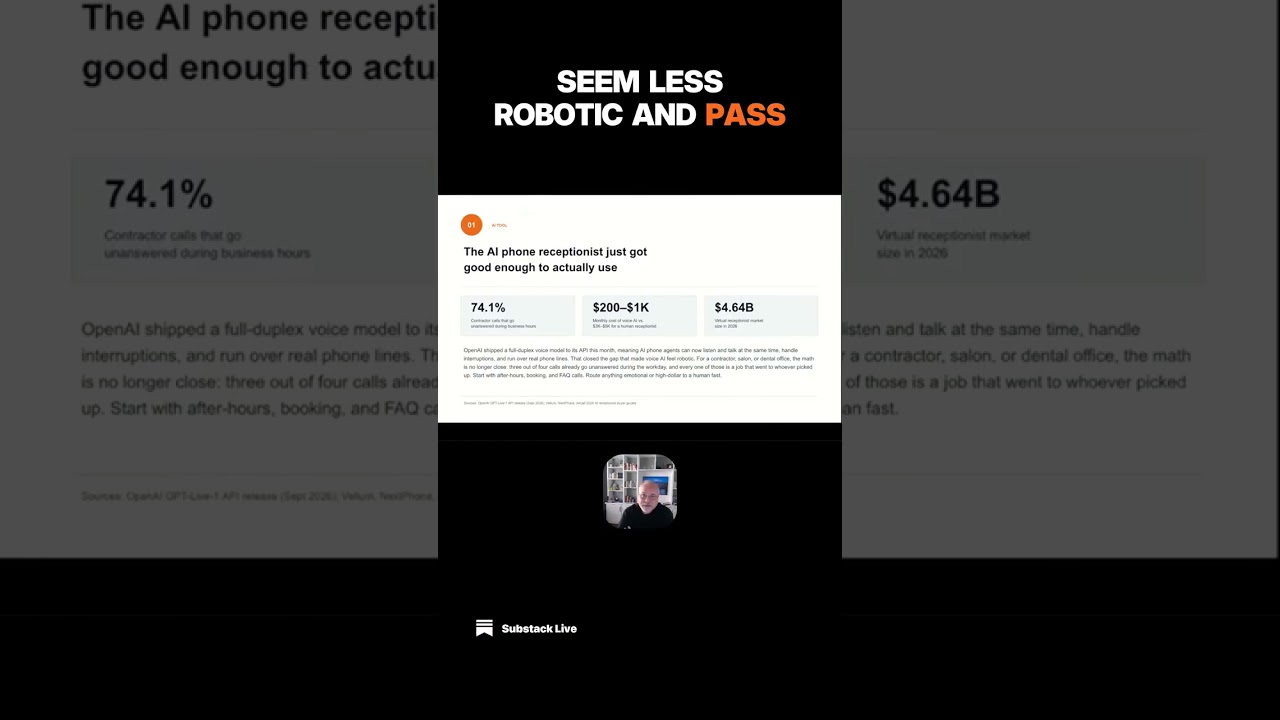
Cool. All right, so first off, agentic search is here. Um, Google is currently— I think Google's doing a slow roll of this. They're adding hotel booking, flight tracking, points comparison, things like that within their, within their agentic search capability through Spark. Um, but if you look at what just came out with Astra and GPT they're doing the full monty where you could say things like, hey, book me a plumber, come at my house by 4 o'clock today because I have a leak kind of thing going on. And that's going to drastically change how every site needs to be designed and everything coming, coming within that. So you need to state your offer clearly, your price range, your availability. You have to have a booking link on your site. You probably should have an AI agent on your site to make sure that you can handle what's coming. It's not here now, but probably within the next 6 months, it'll be prolific. What do you think, Nate?
Absolutely. We've been saying this for a while, and now, you know, the more the time goes by, the more people start to believe it because they see it. But in this particular story, I just keep telling people, this is such a better experience as a consumer truly think about it yourself, shopping for something outside of what your business is, this is the type of experience you'll love as a consumer, which means it's going to happen, it's going to be very robust, and you have to adjust your business to it.
Yeah, and I have to tell you, you know, with the number of audits that we do, um, during the week, not— none of— nobody's ready for this. Yeah, it's unbelievable. Um, so here's, uh, something else new. So you can now hand a client a live AI-built tool without publishing it. This is pretty interesting. So ChatGPT is getting very aggressive about this kind of thing where you can create a tool and then name people outside that workspace to come in and view it before you publish anything live within that environment. So I think for agencies that are doing any vibe coding or, or building custom tools for people That distance between idea and feedback happens really, really quickly now.
Yeah, awesome, awesome beta testing loop.
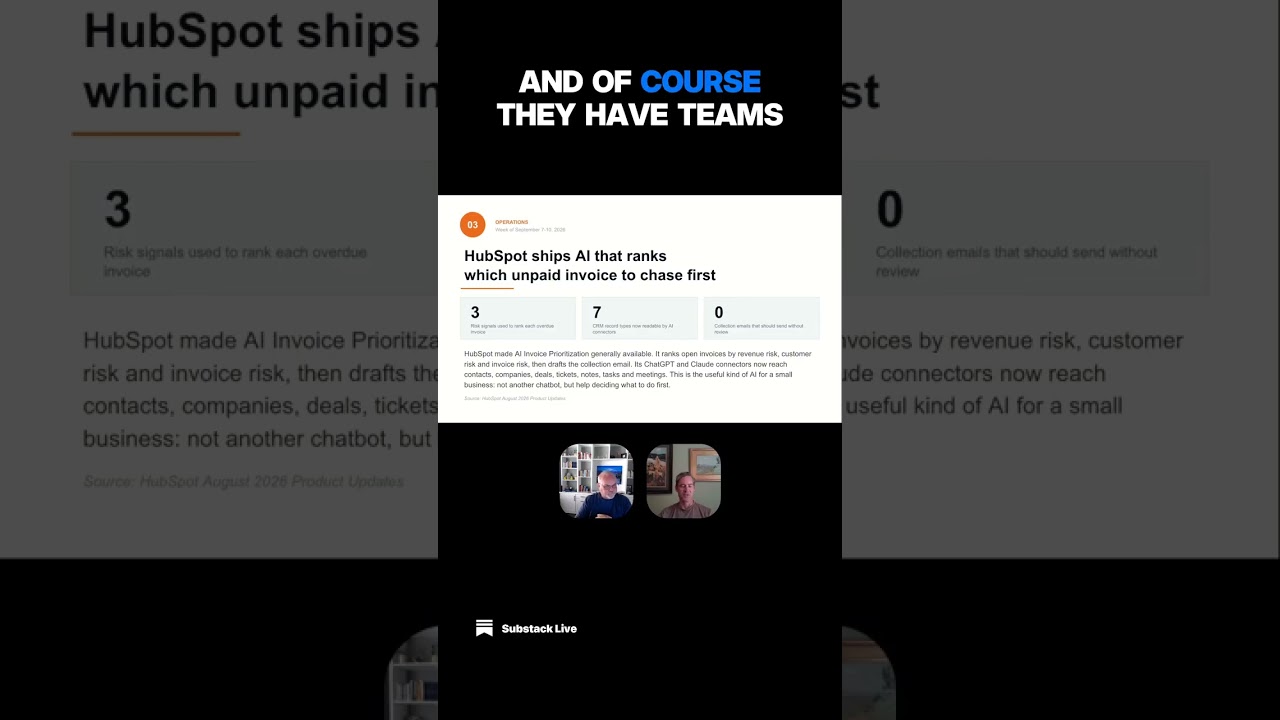
Yeah, for sure, for sure. Yeah, this looks, um, this I think is going to be pretty interesting. It'll be interesting to see if, if Claude comes back on this too and does something very quickly around it. But yeah, that's kind of cool. Um, HubSpot's been busy this week. They've shipped an AI ranking tool Um, or sorry, they've, they've embedded AI into their tool now where it will actually figure out which unpaid invoice to chase first.
Yep.
Um, throughout that environment, they've also added a, um, an MCP to ChatGPT and to Claude that allows you to go ahead and access right into the system and just ask it questions about your analytics and things like that.
Yeah, this, this in particular, um, I have friends in the enterprise space and of course they have teams that have been building these things bespoke. Um, and one in particular told me that they're spending on just on the customer service side of this $5,000 a month in tokens, um, to, to run the same type of functionality. So then I see HubSpot releasing these things, I'm like, oh, this is brilliant, this is exactly— yeah, it's going to replace a lot of those people who are doing it in-house because it'll be so much cheaper. But obviously it'll just bring this to the masses who already use HubSpot.
Yeah, I think that's right. And I actually think the secondary story to this is those who thought SaaS was dead are wrong, right?
And I, I mean, I wrote off HubSpot. I'm like, what are they going to do, right? Where are they going to go? It's too easy to recode what they have. But, um, yeah, you start to look at these types of use cases and you start to understand, oh boy, they're gonna get really deep into organizations now.
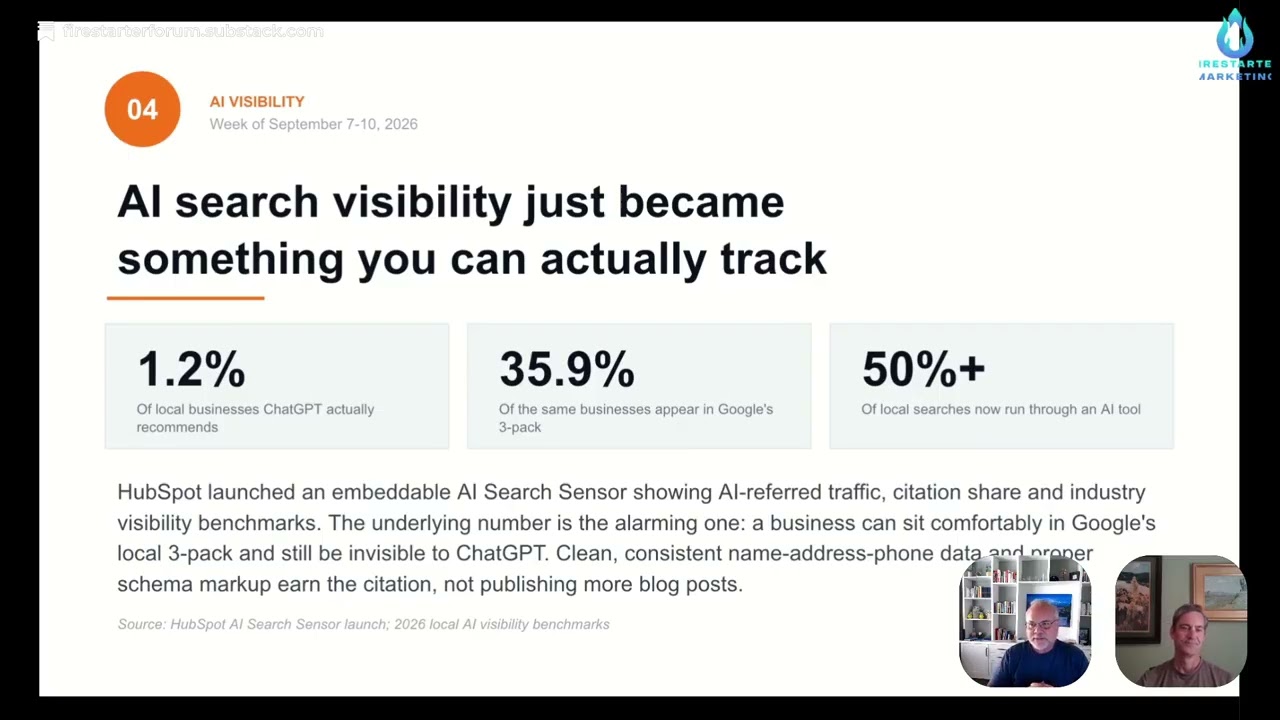
Yeah, exactly. They're just gonna— because I mean, who's gonna move their data, right? Yeah, on that, especially if you're big. But, but what's cool is HubSpot, you know, comes down for a free version too, and, and the small businesses can get to this, um, very easily within that environment. So the other thing that they did is they brought in AI search visibility, um, that you can actually track inside of that. So HubSpot did the embeddable AI search Google Analytics actually has this as well now, so we're starting getting— we're starting to finally get good metrics on are you showing up in AI or not. The bad news is only 1.2% of local businesses are actually showing up in, uh, in AI search, and that is a problem for your local business. Even if you were in the 3-pack on the, on the calendar, that doesn't necessarily mean you're showing up for AI search.
Yeah, and that 1.2 is the key. It's, um, we're in this period of time— I don't know how long it's going to last, but it's, it's brief, um, where you have so much opportunity to be that first 5%, that first 10%. And once whatever that threshold is hit, there's gonna be a whole lot of other stuff that has to be done. But it's just wide open right now. This is just—
Well, if you remember, we saw this at the beginning of SEO too. People who reacted to search Yep. Had a 10-year lead on everybody else.
Yeah.
And all this. And, and, you know, what we're finding too with our clients is those that have done this and are stuck at the top are not getting pulled back, right? Like, there's not replacements on these questions. They are owning all that spot in AI, and it's bringing in real value for them. Um, you know, Kurt told me you got 5 leads from GPT the other day.
That's awesome. Just in a day.
Yeah, yeah, yeah, it's pretty cool. Um, all right, so finally, we usually do a little bit of legal things. So you are now responsible as, as the business, um, for what your AI does. So there's a lot of bills coming. Um, the most prolific happened here in Colorado, California, and it basically makes sure that, that, you know, you— whatever your AI produces, you're responsible which I think is important, right?
Absolutely.
Um, and so, you know, don't sleep on the legislation on this and make sure that whom you're working with and whatever you're creating with AI, um, is meeting legal guidelines of what you're doing on a regular base— a regular basis on this. So, um, you know, as— and I think AI legislation is going to be all over the map for a little bit while this— because the stuff is moving so fast and governments can't keep up.
Yeah.
But, uh, this is something I think just to pay attention to. Do you have anything to add on that?
No, I, I think you're right. It's like we've seen this cycle before, um, over our careers. So it's going to be over-legislation that contradicts previous legislation. It's going to be a mess for a while before it standardizes. So, but again, it's, you know, if you're, if you're the business who's putting the stuff out there, you're the one that is legally culpable for whatever happens out of it. So you have to pay attention to it. You have to make sure that everybody you're working with is paying attention to it.
True, true. So if I had takeaways for this week, um, number one, make sure that your site is ready for agentic search. Make sure you've got a service page, you've got pricing on there, you've got a booking link, you've got an AI chat agent on there. Um, they're all affordable, but if you're not doing it, you're not going to be seen in search, in AI search anymore. Um, and by the way, AI search is now the dominant search capability out there. Um, it's surpassing Google's Blue Link search, uh, because you've got Google AI in there. So I wouldn't sleep on this if I were a small business owner.
Absolutely.
Um, you know, number 2, if you're an agency, think about building a narrow narrow client-facing tool this week and give it to 3 clients and see what happens. Um, learn from that and you can move quickly on building tools. Um, number 3, um, HubSpot and other tools are now allowing you to really start to operationalize your business with AI. So if you're left behind on that, or you have HubSpot, connect your AI up to it and start to ask it questions. You'll You'll see some real value out of that. Then, um, number 4, um, you know, ask ChatGPT, Gemini, and Perplexity the 5 questions your best customer is asking about you. And if you're not cited, you've got some work to do.
Yep.
Right. And finally, um, list every customer-facing AI touchpoint and make sure that you have disclosures on, on the work that fits the laws that you're, you're going to be under. Um, pay attention to what's going on in that, in that world. Most, most of them right now are disclosure laws. Basically, if you've created it with AI, you need to say you created it with AI, which is good business practice anyway.
Absolutely.
Anything to add?
Talking to AI, tell 'em you're talking to AI. That's exactly it.
That's right. That's right. So I think that's all we got for, um, for this week. And, uh, hopefully this is valuable to you and you can catch us anytime at firestartermarketing.ai. Take care.