Chicago Marathon 2022 | Running a Sub 3 Hour Marathon Training & Racing Recap | MAF Training
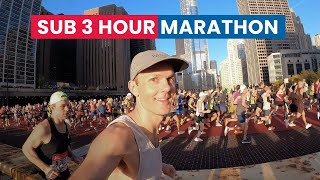
Floris Gierman ran 2:52 at Chicago 2022, a masters personal best at 40, using 10 years of low-heart-rate MAF training plus targeted speed work. He held back through mile 20, took Precision Hydration gels every 20-25 minutes with salt pills, and accelerated hard in the final 10 kilometers to break three hours.
Chapters
All right, here we go. Chicago Marathon 2022.
So many people.
I heard that the GPS signal is going to be somewhat tricky, so definitely going to be running by effort, holding back at the beginning over here. Yeah, see how this goes.
Super stoked, super thankful.
Just coming out of the tunnel, the GPS watch jumped from 6:30-minute miles to 9-minute miles. Definitely a bit of GPS difference. Really got to pay good attention here today. Running some potholes.
Yeah, keep going!
All right, Chris Anderson here going for 2:53. That's right, or 2:55. 2:53. 2:53, you're your qualifier.
Little bathroom break. There you go.
Yeah, yeah, you got all of it. 10 miles in, and it is 1:06:45-ish, so we'll be running about 6:40, 6:45 per mile. So far going really well. Nice little warm-up. Only 16.2 more to go. Incredible race day experience. It's the halfway point. My GoPro died, so a little phone video clip that is super bouncy that will probably make you carsick. Anyways, 1:27:30-ish, 20-ish, so things looking good. Look at these crowds! Come on, come on! 20 miles into the race, feeling actually surprisingly good. It's, uh, what a race day experience. So, so many people. About to home stretch back. I haven't been filming much cuz I'm actually racing. And, uh, yeah, let's see if we have some energy left to pick up the pace a little bit out here. So far so good. Wow, I had to turn the head around because then I could finish faster. That was incredible. I literally just got through to finish.
So yeah, I really didn't film anything from mile 20 to the finish line. My GoPro had already died, I didn't want to fumble with my phone, and I just wanted to race, pick up the pace, and run faster those last several miles. So in this video, I want to talk a little bit more through my actual race day strategy, so pacing, nutrition, gear-wise, and I'll also talk a little bit more about my training for the Chicago Marathon and just some high-level thoughts looking back at this all. My goal for the race was to finish healthy and strong, and if possible, run a sub-3-hour marathon. So that was kind of high-level what I was going for, and I wanted to start relatively conservative. About 3 and a half months ago, I had an accident, uh, while running in the mountains, and I actually had to get my appendix removed, and I was in the hospital for for 3 days. So I didn't run for about a month. It took me a full month out of my training block. So this is why I didn't want to take a crazy amount of risk. It was really my goal to run the first 20 miles just under sub-3-hour pace. So what I did is I ended up printing a pace chart, one for 2:55 and one for 2:57. I know the GPS signal with all the tall buildings and with the tunnels is quite off, and so I did like some manual lapping, but sometimes it's nice when you're like 10 miles in or 15 miles in or 20 miles in to be able to look at like an estimate of what pace you're gonna be at. So my goal was to get from the start line to mile 20, and then so 32K in, then reevaluate. Was I still feeling good, or was I able to actually push through a little bit further and pick up the pace from there? Because I've been there at races too. Once you get to the later stages, you fully have to slow down significantly. So played— wanted to play it quite conservative and then reevaluate from there. So on race day, how things actually unfolded was minimal wind. Yeah, there was a bit of wind, but not much. The temperatures were very nice. It was in the mid-40s to mid-50s, so that was good. Like, the conditions were perfect to run a fast race. So when I started out, the first 10 miles felt rather comfortable. Like, the heart rate was under control. The heart rate was really— I was in the high 140s, low 150s. But still, I kind of saw where my effort level was, where my breathing was, and I knew I wanted to just hold back to that mile 20 point. Even coming through the first half at 1:27:30 or 1:27:20, I was like, all right, I'm on pace for about a 2:55 marathon, potentially faster. At that point, I knew that things were starting to click, but I've also seen plenty of people starting to pick up that pace in, in that section and then later on blowing up big time. So I still kept on running further, knowing that at some point cardiac drift will start kicking in, and who knows, temperature might start picking up, the wind might start getting a little bit more. So from mile 13.1, 15, 20, it, it felt good. It was just clicking away the miles, and I had so much fun because I wasn't like running at an incredible high intensity. It was still well within my comfort zone, um, I was actually able to take in the entire race day experience and look around me, see all the people. And then when 20 miles came through and I saw, I was like, all right, we're on track now for whatever, 1:54:30 if we keep going at this pace. Let's actually start picking it up a little bit more. At that point, I started seeing quite a few different people fade Well, I still felt rather strong, and at that point started running— instead of running like 6:40, 6:35, started going for like the 6:30s, and that felt rather good. So then 6:25s, then 6:20s, 6:15s, and really being able to run mile 24 at 6:15 and still feeling relative in control. Like, yeah, at that point the breathing was hard, your legs are starting to feel tired. The amount of energy that was out on the course. It was incredible. I felt so thankful to be able to run there, to be able to run healthy and to be surrounded by other people, not having the wheels fall off, but actually taking the entire race day experience. And then running through like mile 25, I believe was 6:17-ish. At the end, you get to mile 26. There's still like a little bridge to come up, which feels like Mount Everest at that point. Um, it's still like digging deep. You see the signs, 400 meters, 300 meters, going around the corner, and then like truly like giving it all of your energy at that point. That might have been my absolute favorite race day experience, that last 6 miles or 10K from mile 20 to the finish line, and then especially those last few miles running fast, running controlled, and yet still having to dig deep. But not feeling like you're completely depleted and you have to slow down a lot. Like everything went according to plan on race day. And that is— that, that's pretty rare. And it's one of those things to celebrate. Like, yes, I took a lot of— I put a lot of thought and effort into my training and also my race day execution. I've done several different races that did not go according to plan. So yeah, I played it maybe rather safe today. But for me to get to the finish line healthy and strong after like having a big break in my training cycle for about a month, being out in the early stages of the training cycle, and then now being able to run and finish in a 2:52, that felt like mission accomplished. I had so much fun running those last 6 miles and just running comfortable, running controlled, running fast for me, like 6:15 is fast, it's a high effort. I could no way at this current fitness level be able to hold that. Yes, my personal best is a 2:44, but that was also 8 years ago at the Boston Marathon, and I simply haven't been putting in that much training volume as I have before some of those, uh, personal bests. So yeah, this was my master's personal best. I recently turned 40, and this is my first marathon as a 40-year-old. And God, sounds, sounds so old to be in the Masters category, but it's, it's the reality. And I think this is just where it's getting started. Aerobic development takes many years, and I've been at mostly low heart rate training for about 10 years now, still seeing how much joy and benefit I'm receiving personally from it. Has like— it's something that works well for me, and I see that it works quite well for people around me as well. Running mostly at a low intensity in training and then adding in some speed work at the right time is, uh, definitely beneficial there. So let's talk through race day nutrition. For breakfast, I actually had 2 eggs, I had a banana, and had a coffee with some heavy cream. That works once again for me, so I've repeated the exact same thing 15 minutes before the race started, I took one of my gels. I ran this race with Precision Hydration gels. Half of them were with caffeine and half of them were without caffeine. And so this one is 30 grams of carbs, 120 calories. And so I started 15 minutes before the race, and then I started taking them every 20 minutes, sometimes even every 25 minutes, so 20 to 25 minutes. And this might seem excessive, and this is kind of an interesting one. When I interviewed Kilian Jornet on the podcast recently and I was talking through nutrition with him, he was talking about everything that he was taking in during UTMB for basically a 20-hour period. He was just putting so much food in his face through a variety of different sources. But I just realized that the amount of carbs that he was taking in was anywhere from 80 to 100+ grams of carbs per hour. In the past, I've taken gels every 30 minutes, sometimes every 25 minutes. I've never had any discomfort from my stomach, and so I actually figured, let's actually increase it, because sometimes towards the end of a marathon, I feel like I'm running a little bit low on energy. This time I started playing around a little bit. At the beginning it was more like every 25 minutes, and then later I increased the frequency a little bit more and then alternating the gels without caffeine and then with caffeine and then without. And then towards the end had a little bit more of the caffeine. So in total, I definitely had quite some caffeine. I think it was 4 and 4. But yeah, I felt mentally alert. I was so, so present when I was running. It was kind of an interesting experience from that perspective. One more note about race day nutrition is I don't really rely on aid stations much other than for water. And the main reason is I've had some challenges where they ran out of like gels or they ran out of some of the drink that I was relying on or whatnot. At this point, like, I just know what I'm training with and it works well for me. And so there's gonna be minimal changes on race day. It's just going to be basically the same as in your training runs. And so it worked out well for me. The other thing, on every gel that I actually carry with me, I just tape a salt pill on the back there so that when I take a gel pack out, I can easily rip off the salt pill and just take it in, and I can down it with a gel because they're quite thin. Um, and then if there's an aid station, I will drink some water afterwards. But yeah, so that worked out really well. So you don't have to fumble with trying to find a salt pill, whatever. Here's the race day gear that I used. The race shoes that I used are the Nike Alphafly, so the carbon plated shoes, and I really love these shoes for race day. I can definitely tell a significant difference versus the non-carbon plated shoes, and my daughters actually helped me customize these to the black colorway here. On the left you can see flat me, and on the right is how I actually carried everything with me on race day. The shorts that I'm running in are the Path Project's Grave PX 7-inch shorts, and these have 4 zipped pockets. So I'm able to fit 6 gels in my left pocket, then 2 gels in my right pocket, plus the GoPro with the little handle in there. Then in the back pocket, I have my iPhone 13 Pro with a phone case., and then the credit card ID in the separate right pocket as well. Below the shorts, I wore my Path Projects Lynx PD baseliner, the 8-inch, and even with the full pockets, you really never experience chafing. That's why I really like this baseliner-short combination. For the running socks, I use the Stance Performance Tab Socks. For the watch, the Coros Apex Pro, the Garmin heart rate monitor chest strap, and I prefer the chest strap actually over the optical heart rate monitor. Then the PATH Project's Andy's Tank Top, which is super lightweight. And then to keep the sweat out of my face, I was using the PATH Project's Muir Running Cap. Most of my training miles have been at a relative comfortable pace, like low heart rate. And once I started recovering more, once I started feeling my aerobic pace was improving again, I started adding in some speed work at that point. The thing is, I see too many athletes who want to run a personal best just go hammer out high-intensity miles. And as much as I think high-intensity miles are good at the right time in your training, I don't think that the high-intensity miles are gonna get you through mile 20, 32K into a marathon strong. You need to first develop that aerobic base well, start adding in some speed work at the right time, get familiar with race day pace, or even faster than race day pace. Get comfortable with being uncomfortable. So it's all this puzzle pieces falling into place, but not right away start hammering in on all of the speed work over there. Build that foundation first, um, and then start plugging in some of the speed work there. A few more takeaways from this training cycle. The overall training volume wasn't that high. It was about 55 miles to 60 miles at peak. At the early stages, like I mentioned, I didn't run for about a full month. It was nice to be able to gradually build up training volume, but I only had about 3 months left. So I really did focus during that time quite a bit on sleep, on rest, on recovery, on like eating well and still trying to stay active but not necessarily building up the training volume too crazy. But 55 miles to 60 miles, mostly at low intensity felt right. And then I started adding in some speed work. We were training in 80-degree weather, 90-degree weather, and then going out and racing at low temperatures definitely helped. I even spent some time in the sauna getting ready, in the ice bath, and I really enjoyed that. It's relaxing to me, and I absolutely did that this training cycle again. The other thing is, to this training cycle, instead of running more, running more, training more, I just ended doing things with my family, all sorts of different things that don't necessarily add to the overall running training volume, but it's still being active. It's riding your bike, it's playing pickleball, it's hiking, whatever it is that brings you joy. And I've definitely started doing some more of that this training cycle too. One thing I want to share in closing is about intensity discipline, because I think it doesn't only come down to training. Like, yeah, I'm a big fan of low heart rate training, and to put in many comfortable miles, but then adding in at the right time of your training cycle some more speed work. And so whether that's once, twice a week, started to add in some speed work and being pretty specific with what kind of speed work you're adding in there for your specific race coming up. Intensity discipline is not only important in training but on race day as well. And I see quite some people going through all of the right moves in training, and then coming out on race day and absolutely blow it by going out way too fast. And so there is something to be said about holding back at the early stages of a race to some extent, feeling that those miles are rather comfortable, knowing that you can go faster, but actually dialing it back a little bit so that when you get to the later stages of a race, you can still continue running strong or even finish a little bit faster over there. And so in this training cycle, I actually ended up running 3 of my long runs, the 20-milers, with the first 15 miles at MAF, so at low heart rate, actually at the lower end of my MAF zone, and then the last 5 miles, so 8K, I actually finish it at marathon pace or faster. And those are such good confidence builders before race day. Like, yeah, they're not easy, but when you learn how to hold back and then later on finish strong, I think it becomes easier on race day. To hold back in those early stages as well. And then going over to race day, that's that same thing. I passed a lot of people in the later stages of the race. However, in the early stages of the race, I was getting passed by a lot of people. But I think this is where, like, you have to get your ego in check at some point and just being okay with this is my race plan. I'm okay if people go faster. I'm not trying to keep up with other people. I'm running my race. And this is what I had in the, in my plan, and this is what I'm going to try to execute. And so yes, I was getting passed by hundreds of people in the early stages of the race, but then I felt like in the later stages of the race that I was able to start passing people again. And that indirectly gives you energy again as well over there. I will say this was the funnest race day experience ever. Is it funnest? Funnest? The most fun race day experience ever. And that was purely running through the streets of Chicago, seeing all of the spectators, seeing all of the other runners crushing it around me as well. Yeah, it was just very special. The third world major for me. Um, now I'm really excited. Just signed up for the London Marathon. Hopefully I get in one year. Um, then still got Berlin and Tokyo to go as well. If you haven't ran the Chicago Marathon yet, I can highly recommend it. It is absolutely worth the medal. It was my goal to finish strong and healthy, and that goal was accomplished. To anyone else running any marathon soon, I'm wishing you all the best in your training and racing, and hope to see you out there on the road or on the trails.
Bye now.
More from Floris


Ryan Hall 2.0 on Strength Training For Runners, Lifting Heavy & Trail Running




You’re Doing Zone 2 Wrong (Even If You Think You’re Not) | Scott Johnston Round 2


How to Build an Unstoppable Aerobic Engine (Even If Starting From Zero) | Scott Johnston


Stress Is Killing Your Running (The Relax Fix You’re Missing) with Dr Kasim Al-Mashat

When things get hard, say this, it (works in any race) #jeffpelletier #running #ultrarunning