Finally able to run a Sub 3 Hour Marathon | Running the Boston Marathon 2020 with Duc Tran
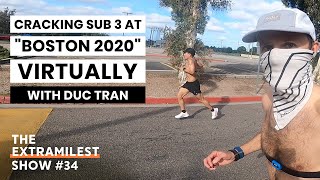
Duc Tran, 44, went from repeatedly bonking in half-marathons to running a 2:56:12 marathon by switching to low-heart-rate training. When Boston 2020 was cancelled, he ran a solo marathon on race day with coach Floris riding alongside, proving that patient aerobic base building and listening to your body works.
Chapters
This is where the race really starts. The first part is just a warm-up. How you feeling, Dirk? I'm good.
Game face is on. Oh, oh, oh, I can't believe it.
Welcome to another episode of The Extramile Show. My name is Floris Geerman, and let's talk about running today. In particular how to become a stronger, healthier, and happier runner. And wow, the last few weeks over here and the last few months absolutely has been a wild ride, I think, for everyone over here with this whole pandemic situation happening. And I think everyone's running world has been turned upside down as well. And what I'm truly seeing is two different approaches here, is I see some runners who continue to actually train as if race date is happening And I see some other runners actually adjusting that training, doing more of a base building approach, maybe not that much speed work or no speed work, maybe not that much long running either. But at the other hand, the group that is actually continuing to train as if their race is happening are running all sorts of virtual races or all sorts of different solo adventure runs. And I've seen anything from like a 1-mile, I've seen the 5K, 10K, half marathons, marathons. Recently I've seen people doing even ultras. I've seen the Goggins Challenge, David Goggins. I've seen the Backyard Ultras. And a special shout out actually to one of our Extramile listeners. His name is Walter Lineger. He's a 68-year-old runner from Switzerland, and he listens to the Extramile podcast. And he actually told us he was going to train for his first 100K run, and he actually just completed that. So mad respect there. Today on the podcast, I'm talking to Doug Tran. He's a 44-year-old runner, actually from my own city over here in Irvine, California. And he comes more from a CrossFit background, CrossFit triathlon, and then getting into running. And he was always really much into the no pain, no gain mentality. And then he tried to continuously improve his race performances in the half marathon and the marathon, but he kept bonking really hard and he kept pushing it to an extent that he ended up in the medical tent several times. And then eventually he decided he wanted to try a few different approaches, and he actually reached out to me about low heart rate training. We went for a few runs here because he lives local, and he actually said he truly wanted to run a sub-3-hour marathon. And so he just didn't know how to structure his runs. He didn't know how to go about the base building, how to truly integrate speed work, and also how to pace himself with the right pace and the right heart rate on race day. So I actually talked to him and he ended up deciding to join the Marathon PR program. And then from there on, he started training and his training went well and he was gonna run the Boston Marathon. And then a few weeks beforehand, all of a sudden the marathon got canceled. And this is when he made the decision to actually continue training like we talked about, like some of these other athletes. And he actually ended up setting up a self-support bordered run around the same date as the Boston Marathon. And I have much respect for his effort over there. So since he lives in the same city, I actually decided to join him. So the first 20 miles I rode my bike right next to him, and the last 10 miles— actually, oh no, the last 10K, so last 6 miles, I ran with him. And yes, of course we kept our distance, we had the face mask, and it was like 10 feet or 12 feet in between. Uh, but yeah, it was very fascinating to see all of the effort that he put into training and how things were coming together on race day as well. So today in this episode, he's actually sharing all of the different lessons that he learned, some of the frustrations, some of the challenges, and how actual race day unfolded for him as well. Before I forget, I do want to mention real quick is that recently I added a bunch of different stories from different members in the Marathon PR program. And often I'm asked, like, is this program right for me? And so here I get about 10 or 15 different stories that are recently added to the Marathon PR program page, and it actually gives a background of different runners, different lessons, different things that they are learning and how they are progressing as well. Anyone from in their 20s, 30s, all the way to 50s, 60s, 70s, different genders, different race goals, from finishing a first marathon all the way to running a sub-3-hour, sub-2:40.
2:45 hour sub-2:45 marathon right there.
So anything in between. So if you want to find out more, check out extramiless.com/marathon. Without further ado, I hope you enjoy my conversation with Duke Tran. I do. Happy to have you over here on the Extramiless Show to share your story.
And I want to congratulate you with running your first sub-3-hour marathon in these very special circumstances last week. First of all, I want to check in. How's your marathon recovery going?
Uh, it's, it's going well. I mean, uh, actually remarkably well. I mean, usually, um, you know, first of all, thank you for having me on your show. I'm kind of nervous, but at the same time excited. Um, you know, I, I usually coming off a race, I, I'm can barely walk down the stairs or whatever for at least a week. You can still feel the pain, but Um, you know, within— I mean, I felt it after the run, but it wasn't anything near through, you know, like my past experience. Um, within a day, I mean, Tuesday, I felt, uh, kind of fully recovered. But, you know, I know you text me and say, you know, give it a rest for a week. I said, all right. Uh, you know, I gave it a rest. Um, so, you know, I, I feel like I can run again for sure. Yeah. Wow.
Yeah. So this was basically the day before the actual Boston Marathon. You ended up continuing your training cycle up to the day of that you were going to run Boston 2020. Obviously the race was canceled and you decided to, uh, to still go ahead and run it in a solo way. And I absolutely want to take a deep dive into your training cycle and how the race unfolded, what your strategy was and your execution. But before we do, I think it will be very helpful for the listener to understand you a little bit more. So your background as an athlete and some of your personal life as well, if you can share a little bit of that, that'd be great.
Yeah, sure. You know, I'm, uh, I'm 44, um, father of two, uh, an 8-year-old daughter and a 3-year-old son with a lot of energy. Um, and of course my better half. I mean, Without her, you know, I wouldn't be who I am today. But yeah, I have— I'm a partner in a firm. I kind of, you know, run my own business with fantastic partners. So full-time job. Yeah, and yeah, I do have a bit of a history in, you know, running, and I was prior to this, I was doing a lot of triathlons. So, you know, it's not like I'm new to the sport, but that's a bit of my background. So, you know, and obviously, you know, having a family and a full-time job, it is quite a challenge to kind of maintain the training volume that is to kind of achieve this, but What it really comes down to is you just kind of have to prioritize certain things. I think you just have to be really laser-focused on executing. Either do it early in the morning or late at night, whatever you have to kind of do. But yeah, it's not perfect for sure. I get in trouble once in a while here and there, uh, which, you know, ask for forgiveness. Um, but, uh, all in all, it is, uh, it is definitely a juggling act. Um, but my priorities has always been and will always be, you know, family and work first, you know. Uh, what I'm doing with the running is, is, is, you know, essentially, you know, a hobby and I really enjoy doing it. And, you know, this process or this new approach has actually made me enjoy running even more. So it's no longer a chore to try to hit a certain amount of mileage or a time. It's just figuring out when I can run and how I can do it while still maintaining my other priorities.
Yeah. What was, um, because I understand that you, you did CrossFit previously as well, right? So there was like the CrossFit approach and then the marathons, the triathlons, the combination of things.
Yeah. You know, so, you know, I've, I think was back in 2008 when I started CrossFit and, um, it is intense. I could tell you, I mean, I got into it and I stuck with it for, I think at least a year, year and a half to 2 years, and I got honestly super strong. I felt my core, everything. I mean, it was really intense, but what happened is I kept on going 5 days a week early in the morning, and I got injured, so I had to actually back off because it's CrossFit. I think you got to be really careful because it's very explosive movements. But at the same time, I think it's just one of those things where I think I was young at that time and I could handle that impact, but I also grew from it so that I did have a good, you know, a good amount of time in CrossFit. And then from there, I You know, I dabbed into, uh, running my first half marathon, uh, and then I can't tell you the story, but I was completely broken. I, I cramped all over the place.
And so when was this? Like, what, what year was this?
Uh, that was—
how old were you?
2010, uh, a half marathon, Long Beach. So I, I honestly— I mean, you could ask my friend, but I could— I was holding on to a lamppost because any movement I would cramp. I literally— my ear was cramping. So it's just, uh, I, I probably needed somebody to kind of— I remember my friend actually carrying me back to the car.
You always remember that.
Wow.
Yeah, yeah, that's rough. And so that was the first half marathon. What made you— what made you decide to sign up for a full after that?
Well, you know, here's the crazy thing. It was always a bucket list. So I had a group of friends, really just close, nice friends. They went to Arizona and they kind of volunteer to sign, you know, you volunteer there so you can have the best chance to kind of sign up for the full Ironman. So actually that was the start of my Ironman. Um, but I was actually here. I wasn't there. And they text me, Duke, jump on the website and sign in. Now it's open. So I didn't even think about it. Um, but I knew I always wanted to do an Ironman because that was a bucket list. And so I jumped on a computer and, uh, literally went at it and I said, hey guys, it's not working. I can't get in. It feels like the, um, so I was at it for almost 10 to 15 minutes just trying to log in and lo and behold, I got in and, uh, got, uh, admission into the race and just paid for it. And there you go. So I did my first, um, full Ironman, uh, in 2011. And the crazy part of this, and it, it is crazy and very naive, is that was my only triathlon race was a full Ironman. So I had no coach. I didn't know how to swim. Uh, I mean, of course I knew how to bike, but I didn't know how to bike, uh, you know, uh, technically, uh, just to, just to clarify the distances in an Ironman swim, bike, and run for those who are familiar? Yeah. Yeah. So the swim is 2.4 miles, uh, and then you transition to the bike, which is 112. And then after that you transition to the run, which is a full marathon.
So was it, was your full, your first full marathon was during an Ironman?
Yes.
I did not know that.
Wow.
That is a one, one interesting experience. And so how did that end up unfolding?
That first, first one, the first one. So here's the funny thing. And I, the first one was probably, um, the best Ironman for me as far as how I came off of it towards the end. I had no coach. I mean, I just followed the volume that my friend was doing. They had some plan and just would swim with them, bike with them, and run with them. No metrics, no nothing, just following their plan. But I was so nervous going to that race, so I, you know, I just held back a lot because deep in, honestly, going into that first race, I never knew if I could even finish it, to be quite honest. So I think because of the nervousness and just, just the unknown. Yeah, I've never done even a bike ride 112, uh, and having to put all 3 sports together I don't, don't get me wrong, I was pretty tired and I was pretty, you know, pretty banged up, but compared to my other Ironmans, I came off it pretty well. So, you know, after that race, you know, I said I'll never do it again, but that's funny, you know, you go back and you do it again.
So what did you notice over the years as you started doing more Ironman? Like, what were some of the times that you able to get down to and what, what ended up happening with your marathon-specific only races as well? Like, how did that evolve over the years?
So I didn't do a marathon by itself until 2017. So I stayed with, um, uh, doing triathlon, uh, up to 2016. You know, the overall sense of my progress is I say that because I was able to continue the volume and train, I got faster. I did get faster. But, you know, I got injured, you know, and then you take a rest and then you can't train. But the more and more I kept with it, the consistency, you know, my time did improve. So if my memory serves me right, my first Ironman I did 12 hours 52, and then my next one was like 11:50 something, and then the next one was below 11s, and finally my last one I went like 10-something, 10 hours 40 or something like that. It did improve, but the common thread was great, as you can see the progress. But really, I— you, you don't know the— like, the 2015 Ironman, when I finished that, I was— was probably one of the worst experience for me because I was completely broken. I went into the medical tent after. I had 3 IV bags. I was completely out. I probably should have never pushed myself to that limit. It probably was dangerous. But at that point I was, I don't know the right word, but maybe demoralized because I put in all this training, but I just couldn't figure out how to maintain speed across that distance. And then I said, you know what, I'm going to come back again 2016. And I did better. I got an amazing result for me, but still part of me felt that I just felt like I was Not, not to say I'm capable. I felt like I could have done it in a way that was more successful. The injuries were still there, you know. I mean, the one thing that, that was a major difference between my training now and then is I've never felt more energized and injury-free and wanting to race. That's the key thing, wanting to race. Like, you know, you come off a training plan and you just don't know. You're nervous, but you just don't have that slight confidence. But I'm not trying to be overconfident here, but you know, on, you know, leading into the marathon I just did with you, um, I was nervous for sure. There's a lot of uncertainties go through your mind, but Back, part of me felt really confident because all the stats during the training, all the results that I got, just felt really— it just reinforced everything and just kind of built my confidence the right way. So I just like did things during the training that I felt I think I, I think I can go the distance. I just don't know what would happen after mile 20. I remember telling you that, you don't know what would happen after mile 20.
That's always the big unknown, right? You could try, you could train up to mile 20 usually and get a bit of an idea what it's like until, until race day. And yeah. So what were some of these previous marathons for you like, like you have, you have ran some strong marathon times even before your sub-3 that you just ran. What were some of those experiences like? And I believe you ran Boston as well already.
Yes. Yeah, I did. And so after 2016, my last Ironman, I, I, you know, I, I think the component for me to kind of like get better because I always wanted to go back to Ironman and do a better race. But I just felt that my running wasn't strong enough, you know. Even in the last Ironman, I bonked mile 13, and I remember I said, this is it, I'm gonna be walking the whole race. And I remember even my friend kind of just say he was there kind of like pushing me, but I, I, uh, kind of reset. And luckily after eating a lot of bananas and grapes and drinking Cokes, I did everything I could. Um, and honestly it, it worked. I was able to, uh, come back and start running a 9-minute pace and just finished the race, you know? Um, but the marathon that I did finish was like a 3— I forgot, like a 3:55 or 3:54, uh, something like that. So I did finish the race. Um, so I decided after 2016 that I was going to, uh, I just wanted to see how fast I can go just running a marathon. And I did train, but I trained based on the, uh, the Garmin heart rate, like zone 1, zone 2, zone 3. And the zones that are in Garmin is honestly quite different. It's a lot higher than math. But I— the surprising thing is I did a downhill race up in North Bend, Washington, and I did very well, I think, for the time, and I was very happy. I qualified for Boston. I forgot what I ran. I ran like a 3:06 or something. But I remember my friend that I visit there, he— I was completely broken, like my legs are cramping up. I had to sit down for a while. It took a while for me to recover. I mean, he literally kind of piggybacked me home to his house. And then, you know, I was probably— it took at least 2 weeks. Before my legs felt okay.
Seems to be a common theme here between your half marathon in Long Beach, your Ironman there, now this marathon, your friend having to carry you.
Yeah, you know, I think I can suffer for sure, that's a side, but you'll start to see that I think the sort of evolution in my training So, you know, once I did that marathon, I went to Boston 2018, and that year the weather was just fantastic, you know, 38 degrees, raining, a lot of wind.
Typical Boston, except for this year when the race is canceled.
Yeah, yeah, this year the weather was epic, right? It was perfect. Yeah, um, that was a tough race for sure. Uh, again, I went into medical tent. Uh, I was, uh, I couldn't stop shaking. I mean, I've never ran in 38-degree temperature while it was raining, so I'm just happy that I finished that race. So I, I went back and I did another marathon, and I did the same course because I felt I had the best chance to qualify. Um, but my time didn't improve a lot. It went from like a 3:06 to like a 3:04, so 2 minutes. And I, again, I came off of that marathon, I was, again, my legs were shot. Um, you know, I was still happy with the time because I, I still improved, right? Um, But part of me felt a little bit disappointed because I felt like, you know, after a year and some, I thought I could crack the 3. So, you know, the same— it's this barrier. So I, right after that, I recovered and I had another race, another marathon. Well, I'm sorry. I went back to Boston. So right after that, I went back to Boston, 2019. So I did Boston again, and I had, uh, yeah, I had a great time. Um, 3:06, uh, 3:07 or 3:06, um, right there. I, I remember in 2019 running Boston, right where Heartbreak Hill is, cresting that hill I cramped up and I literally had to walk to the side and stretch. And it felt like forever, but I look back at it, it was only like a minute that I stretched. And, um, right at 21, I think you start going downhill. So thankfully it was a downhill. So I started to go downhill, uh, and I was able to finish the race. Um, Again, you know, now being realistic about that race, I don't think I would have been able to crack the 3 hours even if I didn't cramp. I just didn't have the fitness. I could feel it, you know, I was— yeah, I just felt it even after mile 21 if I didn't cramp or not. I just probably I would have got another minute or two, but I would not been able to crack the 3-hour that day. So again, I came off of that race, I felt okay. I was limping around with my friend, you know, still not feeling fresh or anything. I mean, you're not supposed to feel fresh, but I'm just saying like I was a kind of broken. I mean, walking down the stairs and it was just really difficult. I, um, not like this last race when I did with you. I mean, I ran my fastest race, uh, and I think I even told you I could run more miles after that.
Um, so, so what, like, how did you— so your Boston was your last marathon in 3:06, 3:07?
So that was— no, it wasn't my last marathon. So, um, a friend of mine signed up for another race. Oh yeah.
Yeah.
And he, he, it was, uh, it's called Mountain to Beach. I said, oh great, I love downhill races. You know, I'll take any advantage. So, um, you know, I thought like, hey, maybe, you know, and it was a I think 5 weeks later, and honestly, it was the wrong decision to run that race. I don't— I thought my fitness would carry through. It didn't. I did that race, even— I just felt horrible even the first 3 miles. I just feel like I was just trying to catch my breath the whole way. And the whole race, I was struggling the whole way. That was my fastest marathon, and I think partly due is because it's downhill, and that was a 3:02 I ran. Um, kind of the same theme again. I, I was kind of broken after that. So after that, I really, uh, I just had to reassess how am I gonna move on with my training and At that point, I kind of discovered you. I kind of understood math a little bit. So I, you know, I took a break and I think right around when I started back up, right around that's the end of summer there, you know, that's when I really kind of took, took it seriously. So, okay, my training cycle is gonna start to be to begin for Boston. And that's where I really did look into math training, and I kind of stumbled on you on YouTube and Shraddha, and that's when I, you know, kind of reached out to you, sent you an email, and then that's where it all started. Yeah.
What were those first like experiences like with you with math training? Like all of a sudden you decided to change your training approach around a bit. What was that like?
Those first runs? It was tough because I, I, I thought my low heart rate or zone 2, I was going by, I was basing it off of the Garmin, which If I remember correctly, it was Zone 2, it was like 146 and above, which is way high if you took the principle of the 180 minus your age per math. So once I realized I had to do that, and the funny thing is I didn't want to accept it because I was running 9 minutes 9:30s, and it is a— I don't know, a blow to the ego, but it's just something that you're just not used to doing, right? Running slow, that slow.
What were your training paces before that?
So even my easy run was 8:30s, but I kind of looked back at my easy run, so I I typically like to run like 7:30. I felt like that was a good cadence, but, um, just kind of looking back at my heart rate at those times was like in the 150s. So definitely way above math. Um, but you know, I, I felt good. I could handle 10 miles and whatnot. Um, but now realizing, you know, everything that I've gone through, I might kind of put those miles as junk miles. It's just, just getting your mindset really have to change, and you really have to embrace, uh, the principle of math. You, you kind of have to. So for a long time, you know, even in the beginning steps, I didn't start your base training yet, so I kind of, you know, I did my own research about math and started to run with it and I said, "Wow, this is tough." But then again, I said, I'm looking back to all my races, all my results, I said, "You know, I want to improve." So, you know, it's just one of those things where, you know, you kind of have to grow up and embrace something and really kind of put aside everything you think you know. And that's what I did. So, you know, when I first talked to you, I did a few things that you, you kind of told me. I changed my Garmin setup. I made a heart rate alarm. I only focus on time and heart rate when I run. Um, it was tough in the beginning for sure. I, I, I, I gotta admit, I mean, there's times where I, you know, I broke my heart rate and I ran faster because, you know, I just like, oh man. But anyway, eventually, um, deep, you know, deeper into the training path, I, I, I, I just embraced the whole thing. I kind of gave up just trying to fight with it. And I think that was the turning point because I think you, you, you, you have to build your aerobic system correctly. And in order— and correct me if I'm wrong— and in order to do this, and this is from my experience, you really have to train in that zone. And that's when all the magic, all the building happens. When your, you know, your fibers, your skeletal structure, your ligaments, everything, your capillaries, that's when it really starts to grow. So that's what I've learned from just kind of listening to your podcast with Dr. Phil Maffetone and others. And, you know, people don't realize that once you build your aerobic system correctly. And for you, I think it was 3 months. I think I put a little bit more time into it, maybe 4 months, but it was about roughly 3 months when I got your plan and I really gave it the honest, call it try, sticking to the low heart rate math approach. Uh, once I felt like Once the aerobic system was built, it could absorb the higher intensity, and then that's when you really start to see the benefits in the training. That's when you start to see you're running faster at the same effort, and that's where you, obviously, every month you do your math test, right? And it didn't happen until after 3 months of it, so you can see You know, your mind's playing with you, right? And you know, it comes down to that word again, being patient. And for everybody, really being patient is a key. But not only that, this approach teaches you how to be patient. You know, you think you're patient, but it actually rewrites the word. It gives it a different meaning. Um, and then you, you start to embrace it because once you start to get the results, uh, it's such a great feeling. Yeah. Yeah.
It is an interesting one. How sometimes when you do end up like lowering the intensity of your runs, especially during that base building period, that you are able to handle a higher training volume. Which still stresses the body in some extent, but at least it taxes it less and you're able to handle more, more volume that way. And then indeed, once eventually you're able to handle solid amount of training, you've gradually built into that. And then when the body is ready, you start integrating some of that speed work. That's when a lot of magic can happen indeed. And it was fascinating to see also your progress over time because I've seen some of your math tests and maybe you can share some of the data from that because that would be interesting to hear too.
Yeah, so, you know, after close to, uh, 3 months of base training, I did my, uh, well, that was 2 months, I did my, uh, first math test was actually on the track with you.. And my max heart rate is at 141, and I think I average an 830, somewhere around there. And you know, I honestly deep inside of me, I felt like, oh man, it's a little slow. I thought I would get a better test. So anyway, But the remarkable thing is like only 3 months later, I did my last math test. And this is already getting into the marathon-specific training for sub-3. It went down to over a minute at 1:41. So, you know, 7:20-something. I mean, my low— my best mile is probably like a 7:16 or something like that. I don't remember. But I was like blown away. I mean, I'm running at the same effort, but a minute faster.
Um, how did that feel like in like some of those miles where you're running at that rather lower intensity, still relative faster pace towards, towards your goal marathon pace?
It felt very comfortable. Uh, Almost to the point where it just— I could feel like I could just keep on running for a very long time. Um, you know, never at a point that I— any mass run that I've done in the training, like towards the, uh, the deeper part of the training plan, that I felt, uh, tired. I mean, I could literally run every day.
Yeah.
You had speed work on Wednesdays and that was actually the harder effort. Usually your Sundays are more for testing the tempo long runs, but on your Wednesday they were more speed specific. So, you know, I think it's a misnomer to think that math is all about running slow. I think the one thing I did learn is, yes, the base training is super critical. You kind of have to nail that, and if you don't do the base training correct, it's almost a disservice to the entire approach because you're not getting your aerobic system built correctly. But once you build it correctly and your body is learning how to tap into not the immediate energy, you know, the glucose, right, but more your body fat, you start to be more efficient at your running. I mean, it's— that's why I think what I had to wait almost 3 months to see any gain. And then once the gain started to come, it came really fast. Yeah, in 3 months, you know, from my first math test to my 5th math test, I got faster in more than a minute. And honestly, that 5th math test, I was just blown away. So like paid off. Yeah.
And I do, I do see it quite frequently actually that some people like plateau or even regress for, for a bit first before they start progressing. And it's, it's challenging to like continue to run at a lower intensity if you're not sure if it's going to work or not, if you're not sure, is this the right approach?
And.
Like that's a lot of people would think that way. And some people might be able to continue training that way and other people might throw in the towel. And like at some point, I think, especially when you're running that much slower than what you used to, or even when you have to go from running down to walking or walk breaks or any of those kinds of things. This is why I do think the questions come up as well. Is this right? Is this the right heart rate to be training at? Is this the right formula?
The short answer to that, honestly, yes, it is the right approach. And especially for me, um, after years and years of running, um, I know that I got a fast marathon for me, a fast marathon result, but I literally could not go past that. Um, And I've never felt more injury-free and healthier as a runner. And then running now is totally different. Like, I don't really care about pace anymore. I mean, it's a pure enjoyment just to run because I think the bigger benefit of math training for me, it's not just, you know, getting faster. But there's a bigger benefit here. And honestly, you know, just from diving into a little bit deeper and listening to Dr. Maffetone and yourself and just all the teachings around it on a more scientific level, you just become a healthier athlete. You know, I did a test towards the end of your It's one of the, the tougher tempo runs in your sub-3 plan. And it's— man, I ran— the pace turned out to be where I ran a 1:30 half marathon. But here's the remarkable thing: zero water, zero nutrition, and I felt fine. I wasn't even feeling hungry after the run. Like, as if I, you know, usually at that pace, and I remember running at that pace for a race, I needed like popping Goos left and right, drinking water. Uh, just, you know, I mean, I was just like, wow. Yeah.
Well, let's take a deep dive into the actual race then. Like, so So actually let's transition because all of a sudden this entire pandemic happened and you were training for Boston. Yes. All of a sudden Boston was canceled. What went through your mind? Like how did you adjust your training and did you know right away you wanted to still run some kind of self-supported race or was this more of a, like, let's continue the training? How was, how was your mindset towards that?
I gave it a lot of thought and I, you know, obviously we never knew that, uh, you know, around December, even in February, if the race was going to be canceled. And I was already deep into my training and, you know, I'm one of those. So my mindset has always been, you have one life to live, right? And, um, and of course you're not trying to take unnecessary or risky risks. You know, you're, you're You're trying to be safe at the same time. And I think I have been very, you know, responsible through this whole pandemic and, you know, just this really sad situation that we're in. But I know when you asked me if you— if I wanted to do a self-supported race, just to run it myself and see what would be the result after my training. I wasn't sure yet. Yeah, to be quite honest. And, um, but then I gave it a lot of thought and I said, you know what, I'm going to do this. I'm not getting any younger and I've already put in all this hard work. So, you know, I think it was 3 weeks to race day is when I made that decision. I kept at my training, and luckily I was able to find areas where I could run where there's really no people and run uninterrupted. And that, I think that was key, you know. In your training, I think a lot of people don't realize you have to run uninterrupted. You, you can't stop When you do that, that's when you really start to understand your body. So, you know, early in the training, the thing that I didn't do right was I stopped, right? And you get to rest, your heart rate kind of resets. But the key is actually you have to run continuously without stopping. So then you can see if you're gonna have heart rate drifting and all these other things, right? And where your body responds to in the deeper miles. But yeah, I made, I made that decision and I, you know, started to plan out the route with you so that I can run continuously without stopping. And, you know, we woke up early in the morning, 4 in the morning, got there early, and 4 3, 2, 1, go!
What was it like for you? Because you started— and just for those listening, I want to clarify a little bit. Like, Duke and I live in the same city. So like probably 6 months ago, he reached out to me with a few questions and we ended up going for a few different runs. And from there on, we just started talking more frequently and you actually ended up enrolling in the, in the Marathon PR program. And so from there we ended up talking quite frequently. Um, and so it worked out really well that you actually lived in the same city. And that way we were able to, to talk a little bit of, all right, what are you thinking for the day itself? But guide us through, like, what was your route and what did you go into it pacing-wise and how did the race day unfold for you?
Priorities, just eating right, getting plenty of rest. Usually like the day, the night of, you don't really sleep well, and for me, I really don't sleep well, you know, obviously get nervous. So slept very well Friday night. Saturday, it was what is, you know, I think I got like 3 hours sleep. Right. So, um, very simple. My nutrition is very simple. I try to keep it as simple as possible. I had oatmeal and bananas and that's it. Um, uh, one goo about an hour before, so it gets into the system. And then the, the whole race strategy was to, at the first 18 miles or 20 miles, to manage my heart rate and my pace and then see where I land, right? I mean, the goal is always to keep a pace that I could break 3. We kept, we put a little buffer in there about, you know, 5 to 10 seconds, but I also ran by feel a little bit. So where areas I could take advantage of going a little bit faster down the hill, I did. But I still watched my heart rate. So the range of my heart rate was, you know, where I wanted to start off was 150 to roughly 162. Because, you know, during my training, I kind of kept those ranges as my barometer. I think I did okay up to around mile 18-ish. And then, you know, um, 18 to 20, I don't know what happened to my heart rate. My heart rate started to go a little wacky. It shot up to like 240. So I think the battery went out or something.
It was like, yeah, 240, you'll be back in that medical tent again. Yeah.
So I was like, oh no, what's going on? So I looked at you and then you, you said something very calm. And he said, "Duke, at this point, honestly, heart rate is out the window." What you kind of need to focus on was just sticking, holding to your pace, running as relaxed as possible, and holding form. So that's what I did.
20 miles in.
20!
Whoo!
Only 6 miles to go.
You know, I was in my mind the whole time, I was like, how am I gonna feel up to mile 20? And then mile 20 came around, I'm just like, man, I feel fantastic. And I just kept on running. And mile 22, okay, it's gonna hit mile 22, it's gonna hit. So mile 22, it didn't hit.
How are the energy levels?
Good. Yeah, yeah, just playing it safe. Yeah, of course. Today is just to break 3 hours, nothing more. Just— I mean, yeah, but I wanna, you know, that's the biggest goal. And it came around to like mile 24, I said, hey, of course I'm gonna pick up the pace. So, and I, I kind of picked up the pace after that, and, uh, Not, you know, I think I could have gone harder. I had a lot more in the tank, but I, you know, but the first goal for this, you know, really amazing target was just to break 3 hours.
You're a man, Florian! You got it, man!
Oh my God! Oh, I can't believe it. I did it, bud. I would have never been able to do this without you. I mean, seriously, thank you, Flores. Oh man, this is, uh, after 3 strong years of running, 4 marathons, and finally I broke High five, social distance. He's the best social distance supporter.
He really is. You did all the heavy lifting. Yeah, yeah, I have to. So I only ended up running the last 6 miles with Duke, and honestly, I was like struggling, especially when he picked up the pace at the end. I couldn't believe he was able to pick up the pace still. That last mile, man, I had a hard time hanging on.
Look, I'm still walking. This is unbelievable. Seriously, I don't have to walk like this and smile after a marathon, man. I can like dance. I feel like I could run another 2 miles, no problem. Yeah, just so happy that I was able to do that. But you know, as all of us, we do have our competitive juice. We always think that, oh man, we could go faster. Last day, right? So, you know, finishing and feeling that fresh and having, having that much more, I guess, energy in the legs, I just— is so rewarding. I, I think that alone, um, just puts this whole training to another level for me.
What was your time, your final time you came through?
The final time based on Strava was 2 hours 56 and 12 seconds, something like that. So yeah, I mean, that's amazing, honestly. Way under the 3. I mean, honestly, going just 2 hours 59 minutes, I would have been happy. Okay, so, but to go at that time and still feel fresh, I mean, feel the way I did, and it only took almost a day and a half to recover. You know, I just did a nice easy bike ride yesterday and I feel 100%.
Yeah. And this is now we're recording this exactly one week after you, you ran it. So that is, that is impressive.
Absolutely.
And then the one part that I found interesting is, so the first 20 miles, I ended up riding my bicycle next to you, uh, not next to you. We kept our fair distance and I had the mask on and I was on the other side of the street. It was just more. To be a part of the experience, really. Um, and then there were no cars around, which was perfect because it really was at 6 o'clock in the morning or something. It was on a Sunday and it was during the lockdown. So that was that part. But then after 6 miles, you ended up getting to a section where you had some family members actually set up an aid station for you. Can you talk a little bit more through that?
Because I thought that was so special. Yeah, so I asked one of my niece to kind of just put a little table there and put some cups out with water and Gatorade. You know, bless them, I mean, waking that early up and dragging them out on a Sunday, but yeah, so I had a little transition and about 100 feet away we put a trash can. I don't think I hit it, but I would put a trash can. The intent was to, when I'm running around that loop, um, and I did that loop for a reason is because I, I knew that, um, there was no traffic and that I could run continuously. Um, so yeah, I mean, uh, I had like a little aid station there on the side, uh, that kind of helped me along the way. Yeah.
Good. Can you, can you talk a little bit more about some of your, your training and racing tools? Like what were some of your, your your watch, your heart rate monitor, your nutrition? What were some of the things that you used?
So my watch is a Garmin, I think it's a 945. It's more watch than you need for running. It's really a triathlon-specific watch. So, but I mean, obviously my background came from that. Um, it really has all the bells and whistles. So I did that. And the one thing about heart rate that worked well for me was the Garmin. And Garmin has two types of heart rate monitor, the running one and the, the strap on one. You mean the chest strap? I'm sorry, the chest straps. Yeah, yeah, yeah, yeah. Um, the optics On the watch never seems to be— yeah, exactly. It just never seems to be accurate. I mean, I remember days that I would be just jogging and my heart rate is in 160. I said, I don't think that's quite accurate. So the heart rate strap is really important. I think that gave probably the most accurate reading. I mean, there are times that, I mean, obviously I wish it didn't happen because I really wanted to see my heart rate at the deeper miles, but it ran out of battery, so that's why it shot up to 240. For running shoes, it was interesting. I've always been a Hoka fan, and I've started off with Hoka, and you know, obviously they're somewhat the cushion revolution of shoes, right? But so it changed. I think my, my entire running skeletal system got stronger during this process. I could never run in non-Hoka cushion shoes, so I was experimenting a little. So on the longer and bigger training miles, the easy miles, I would use my Hoka shoes, and But on tempo days or faster days, I would actually use the Nike shoes, the 4% or the Next%. And yeah, they do live up to their hype. So it's almost like a hack or something. I did feel— so I mean, the thing about those shoes is I think you have to be at a certain pace. For me, what I did feel is at a higher pace, it felt a lot smoother. They're not your running easy shoes because of the drop, so you're going to have to run a little bit faster to get the right cadence. That's what I felt, and then it did feel a lot smoother when I was at my faster pace.
So that is what you ran your marathon in?
Yeah, so what I did decide to run it in was the 4.0 percent, not the next percent. So I ran and yeah, I felt really good.
Good. What was it? Can you share? Because at some point you did some experiments on the track with different shoes at the same heart rate.
Yeah. Can you talk about that a little bit more? Yeah. So I, I usually run, um, with the Cliftons. As my racing shoes way back when, and I did my math tests with the Cliftons, and then I did it with the Next%, and wow, that's what I said, oh man, the shoes is pretty remarkable. I think the gain was roughly 5%, so 5% over the time of a marathon Man, that is, that is quite a huge chunk of gain. So same effort, same heart rate, I did the same thing warm-up and a 5-mile math test with 2 different shoes. And I forget the amount of seconds, but I did remember it was close to 5% per mile.
Wow. Yeah, that is, that is quite a difference right there. I still have never run with them. It's, um, I don't know. I don't know what it is. I just haven't yet.
Like it's, yeah. I mean, just to run and, and, and kind of feel the experience maybe.
Right. Yeah. At the other hand, I don't know if it is the coughing up that much money for a pair of shoes or if it's been the colorway that some of these shoes have come out with. Or are they more like, yeah, I honestly don't, don't know what the reason is. So, but I, then again, like it's funny whenever you go to one of these races, like the front corrals and even in the back, like I see so many of the Nike shoes. It's pretty, pretty fascinating actually to look at it.
It is. And I began to look at it in my last half marathon. I was like, wow, all these pink and lime green shoes, I say, wow, I mean, they gotta— there's gotta be something to it. And I was fortunate, I have a client that's very close to Nike, and bless his heart, he sent me a few Nike shoes as gifts. And I knew nothing about Nike, honestly. It was in my closet for literally 3 months. And I finally decided to give it a test. And that's when I actually told you, it's like, oh my God, this is a hack.
That's funny. So I want to kind of conclude over here and just, there's a few last questions that I do think are important to ask you. So out of this whole training and racing experience that you have from previous races and from this last training cycle and race as well, Like, what are some of your key takeaways out of all of this?
Well, I mean, for races, I, um, the key takeaway is always, you know, for me, I think planning is really important so that when it comes down to execution, it's easy. So I mean, people say Don't be too nervous. Be nervous because that's a sign that you either are unsure and you want something more, and I think from that you actually prepare more. You go into it looking at every aspect to make sure you plan it out correctly. I mean, for me, the overarching success here is just discovering MATH. You know, I forget what it stands for. It stands for max aerobic function. Yeah, I know, I understand. For me, it's most amazing find, right? So that's what I was gonna get to. And it's, of course, it has nothing to do with Dr. Philip Maffetone. I found that out. But honestly, it's really embracing that principle of training. And you, in order to do it right, you do have to just sort of give it The honest try, like be honest with yourself throughout the entire training. Um, I mean, I know it, it, it, it could be very difficult because you always used to run at a certain pace. Um, yeah, you know, people get caught up with the whole Strava thing and making sure that they ran a good segment or something. I mean, I know we all kind of get into that and I, I get that excitement too. But if you go into this training, you're going to have to kind of reset your mindset. And, you know, I'm glad I was able to do that. And now going through the entire exercise in this process, this journey, is quite rewarding. And the bigger benefit, it's not just that you're getting faster. You're getting to be a healthier athlete. It teaches you how to be more patient with your growth, and honestly, it brings the fun back into the sport. I can run every day and not feel injured, right? And I think that's key, right? I mean, we are all getting older. So, you know, I hope that we can continue to do this, you know, 10 years from now, whatever you want to do, but I feel that this approach will allow that. And it has nothing to do with pace. I mean, the proof is in the pudding. I know I use that slogan, that saying a lot, but I am much older now than I was 7 years ago, right? And I'm faster and more healthier. So I mean, I— that in itself kind of explains everything. The thing is being patient, being consistent, and also being a good listener. Because everybody's different. Everybody's math— I believe everybody's math process will be different. We're not all built the same, but you have to kind of be a good listener because it's not going to be perfect. You are going to maybe endure some injuries, who knows. You know, some are, you know, born with genetics that You know, luckily they're just talented and they have this amazing genetics, but some are not. But with that combination, I think you, you'd be able to find the right results with this approach.
Well said. When you look back at your training cycle, There was one part that I found worth mentioning here because all of a sudden, like you were doing certain training volume and you were feeling really good and you were feeling so confident that you decided, let's see how the body feels when I run more than 100 miles in one week.
Yeah. Yeah.
What, what happened there and how did that turn out for you?
Yeah, I know. Uh, well, I was hoping that you didn't bring that up, but, uh, yeah, of course I gotta bring that up. Yeah, I did take a right turn on the training plan there, you know. Um, I don't know, man. I was feeling amazing that week, so I kept on running like 16 miles day after day, and I got to a point where, you know, I just told myself, what's what will my body feel like? Because I've never hit 100 miles. And it's not like I was looking at my training plans like, ah, the next week is— because your training plan is based on time and heart effort, you know, heart rate. We don't look at distance. So I really didn't look at distance, but at that week I just felt so good. And I finished off like, I think 103 miles. And that last run was actually a tempo run with you up in the hills. Uh, that felt fantastic, but you know, I had to, you know, re reset myself after that and really follow the plan after that.
And, you know, I think it went back down to like 60 or 70 miles, but yeah, it is one of those where I've, I've personally done it myself as well, where Oh, you're in a training cycle and things feel good. And then all of a sudden you just decide like, oh yeah, let's go one more long or let's go one more. Like, and before you know it, your training volume increases way more than— it's a gradual buildup at that point. And sometimes you can get away with it, but sometimes you also got to watch out that you don't take too much out of the tank that the following week you'll beat up. Or if you have to do some speed work the following week, all of a sudden you're already like the stress levels are getting too high. So yeah, it's this fine dance with learning to listen to the body and adjusting accordingly and not push it too hard too soon either.
Yeah, I think I got lucky there, you know, that I didn't come off it getting injured or anything. And obviously, you know, I had somebody remind me of that. Yeah.
So do you have, do you have any race goals for you? Is there anything down the horizon at this point? Obviously racing is a little bit unknown, what's gonna happen right now the rest of the year, like even with Berlin just being canceled and some of these other races. Is there anything bigger picture for you?
Um, you know, I obviously Boston is still there and I don't know if it will still happen in September. That's, I think that's when they rescheduled it. So I'd love to go back to Boston and still try to hit my goal there. That would be the next step. And you know, honestly, I'm kind of at this point just, I don't have a training plan, which is kind of nice. So at this point it's just, just to run and enjoy and and stay fit, right?
So yeah, yeah, right on. Do you have any closing thoughts, any recommendations for other athletes looking to improve their endurance performance?
Yeah, where to start? I mean, this approach— and I think you use the word holistic And that's key. It's not a one fit all. And you do have to look at the details. You know, I mean, it's not just about running at below MAP or at your MAP. It's about looking at a lot of things. And I think, I think you've really done a great job, honestly, with your program. And this is not me just saying it, but it's because I've was able to get this result by listening to all your videos. You, you, you know, focus on nutrition, making sure your stress levels are good, listening to yourself, right? Because everybody's built differently. I think that's— we don't do that enough. We have to be honest with ourselves in our training. We have to know when to back off. We have to know when to do certain things to maintain a healthy body, whatever it may be— stretching, running, core exercise, the proper nutrition, sleeping. Again, I think you touched a lot on sleeping, and I was— I didn't take that seriously enough, but Now I see sleep is such a very important component. So, I mean, you can do all the heavy lifting in your exercise and your training, but if you don't recover well, I think that's where 50% of the battle is, is learning how to recover, and so that the body eventually can absorb all of this training. I mean, you can go out hard all the time and your body's not absorbing this training, it will turn into injuries. And that actually will set you back even further. So for me, I just erased everything I knew, followed the base training, and then got into the marathon-specific training. And then from there, try to be as a good listener to the process. And I remember reaching out to you saying, hey, I'm feeling this, what is it? And you kind of gave me advice and I took it. I took it to heart and I really paid attention to it and all those little details kind of add up. It's not one thing, it's all of it, I think, to be really successful.
Yeah, I appreciate you sharing that. And it has been such a joy to actually see you taking this entire approach and like going through the entire experience. And the reason why I also decided to go with you on race day, because I do pace people from time to time. Like I was out at the New York Marathon pacing like Matthew over there for a project for Strava. It was like his first marathon that he was ever running. And just seeing what people go through on the marathon, I get so much joy out of that as well. Like, it's one thing to run yourself, but then to actually be there from beginning to end. Um, and with you obviously going for a sub-3-hour marathon, I'm no way in sub-3-hour marathon shape. So that's why I decided to bicycle, to ride the first 20 miles and then only run the last 6 miles with you. 6 miles, it was borderline for me to keep up with you. And it was even there challenging at the end where you decided like, oh, I'm going to take off. And I believe that last mile was like 6:30 or 6:20 or something like that. I was hanging on for dear life there, but just, just seeing what you were going through, like in training, and then also seeing how you actually still ended up deciding like, hey, I'm gonna take this entire situation for what it is. I've put in the months of training. And I am actually going to race. And I truly do see two different camps here. I see some people deciding like, all right, my, my race is canceled. I'm going to take a step back and I'm going to like just try to train some consistency here and there. And I also see other people actually like, all right, I'm going to continue training. And I, there's no one size fits all. What's good. What's right. Like I respect each and every side of this and just seeing How you still ended up being able to train consistently, even though there's all these other things going on with the situation, with the home front, with the business, with all of these different things, still be able to train consistently, keep the mind calm, and then going out on race day and executing. That's like, this race you're going to remember for the rest of your life. And that's, that's just one of those. And I was very thankful to be a part of that.
So, I mean, honestly, Forrest, thank you, uh, for everything. I mean, you tagging along and, uh, you know, for 20 miles and running the last 6, I couldn't ask for more. I mean, I've never felt any training plan or program, uh, so thorough and so much support. I mean, you, you've really set up something great. You know, you have your calls, you have your Facebook, you have your Strava, all this, and it's never felt at any given point where I hit a wall or something that I didn't— I couldn't ask a question. That made the difference for me. And, you know, you're lucky that I'm in the same city as you, so I honestly took advantage of that. But coming off a a plan, a training plan. And of all my years coming off a training plan and feeling motivated to race, that has a lot to be said there. A lot of times, you know, all my training, I come off it and I'm just like, oh, I have this nagging pain. I remember flying up to Seattle and my friend's like, why are you always complaining? I said, oh, it's hurting, you know. And I got a race coming up in 2 days, but this, I just, uh, felt very confident going into nervous, but confident.
And I thought that was a really good point you mentioned earlier too, about the race nerves being like actually something, something good. And I 100% agree with that as well. The part of going into a race and being nervous, that is actually indeed the body getting ready. The body preparing itself, the mind preparing itself, like, all right, it's like going to war. It's like getting ready for race day. And that's, that's like a healthy stress to some extent as well. Like, yeah, of course you can stress out too much and it could negatively impact you, but that's why I see it so many times that the night before I have the same thing, like a night before a race, I have poor sleep. And that's why a few days prior to a race, it's so important to focus on that sleep indeed. Yeah, that's a great execution right there. Where can people find out more about you?
Um, honestly, only Strava. I'm, uh, I don't have a Facebook, uh, probably because I just don't have a lot of time. Uh, it's just not that I'm anti, uh, yeah, Strava. I mean, um, I welcome anybody to follow me. I I try to be as transparent in my training.
Um, yeah, perfect. I'll make sure to link to that as well in the show notes. And, uh, yeah, I want to say thank you very much for sharing your story. I look forward to, uh, we can go for a normal run again further down the line.
Yeah, absolutely. Stay here, of course.
Yeah. All right. We'll talk soon again.
Have a good one. Oh, you too.
Thank you. Thank you for tuning in. More information about the Marathon PR program can be found at www.extramileus.com/marathon. And I just added 15 new stories from different members of the program where they truly share their experience, their reason for joining, some of their lessons, some of their key takeaways. And these are athletes of all different levels. These are anywhere from beginner, advanced, intermediate, different age ranges, anywhere from 20s, 30s, all the way to 60 and beyond. And all going after different goals as well, whether that is wanting some more structure and some more guidelines in their workouts, running a first marathon and completing it, running sub-5, sub-4, sub-3, or qualifying for the Boston Marathon. It's all in there. So more information can be found at extramilest.com/marathon. And I want to wish you and your family all the best in the coming weeks and months, let's focus on truly what we can control. So getting some daily exercise, proper nutrition, getting enough sleep, enough hydration, and truly being kind to ourselves and to others as well. Be patient and have fun out there on your runs. Cheers guys, see you next time!
More from Floris


Ryan Hall 2.0 on Strength Training For Runners, Lifting Heavy & Trail Running




You’re Doing Zone 2 Wrong (Even If You Think You’re Not) | Scott Johnston Round 2


How to Build an Unstoppable Aerobic Engine (Even If Starting From Zero) | Scott Johnston


Stress Is Killing Your Running (The Relax Fix You’re Missing) with Dr Kasim Al-Mashat

When things get hard, say this, it (works in any race) #jeffpelletier #running #ultrarunning