From Overweight To Sub 3 Hour Marathons
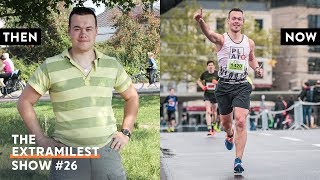
Dutch runner Jeroen Pieter van der Vliet went from 110 kg McDonald's manager to running Berlin in 2:51. He built up to 150 km weekly mileage using Maffetone low-heart-rate training, kept hard workouts minimal, and fuels every 7-8 km with SIS gels during races.
Chapters
Hello everyone, welcome to another episode of The Extra Mileage Show. My name is Floris Geerman and today I'm speaking with fellow Dutchman Jeroen Pieter van der Vliet, or in English we can just say Jeroen Pieter. He has been going through a very fascinating journey. Many years ago he was working at McDonald's as a floor manager and over there he gained quite a bit of weight. Actually, he was overweight to about 110 kilos, which is 242 pounds. Over the years years, he was able to improve his health and pick up more sports in a variety of different ways, and he was able to lose weight and improve his overall fitness. He was able to run 8 marathons so far, 4 of which have been sub-3-hour marathons, and he just ran the Berlin Marathon in 2 hours and 51 minutes. He made slow progressions over time, and so we're going to talk through some of this because his first run was very short and very slow, yet Yet over time, he showed what worked and what didn't work for him, and he shares that today. There are no sponsors for this podcast, but I do want to mention our Marathon PR Training Program. This is an online course with about 8 hours of new videos and many different training schedules as well, both for base building and for the actual 18-week training cycle for a marathon as well. And this goes into many different areas, not just the running, the low heart rate training with some high heart rate optional workouts as well, but it also covers the other elements from nutrition to ways to lower your stress levels to mindsets to different strategies, heart rate based for specific races as well. And it has been fascinating to see. We've only launched this program about 3 and a half months ago now, and just hearing some of the success stories across the board has been amazing. I, I hear these stories from people who are actually saying like, I found a true love for running again because of the program, or I was I was just in New York and I saw one of our members over there. He ran a 32-minute PR. He improved from a 4 hours and 50 minutes all the way down to a 4 hour and 18 minutes in just a 3 and a half month time span. And he is far from improving, far done from improving at this point. So it's been fascinating to see all of these different things happening in the program right now. If you would like to find out more, you can check out extramilest.com/marathon and I'll make sure to leave link in the show notes as well. Moving on to the interview, I hope you enjoy my conversation with Jeroen Pieter.
And we are live! Welcome to the Extra Mileage Show, Jeroen Pieter.
Thank you.
First of all, I will have to say I love your pink headphones.
Yes, thank you. The iPhone headphones don't work. Yeah, it's okay.
No, so this is a new episode, a new experiment, and I got a new microphone microphone, so we're testing that one out, and you got some beautiful pink headphones, so we're ready to roll.
Good.
You've been running for several years, and I'm very excited to dive into your entire journey over here because you've come quite a long way, and I was very stoked to see that you just ran another personal best at the Berlin Marathon, 2:51. You haven't always been running those kind of times and you have improved a lot over the years. So maybe we can just go all the way back in time to where it all started, when you got into running. And, and also I know the weight loss is a big part of your journey as well. So maybe you can tell us a little bit more from the beginning.
Yes, I, um, I played soccer in my youth and, um, when I was 17 years old, I think, uh, I stopped playing soccer and I just go working. And at a moment, well, I was working as a floor manager at a big yellow M known as McDonald's. So I didn't work out, I did eat not healthy, so I gained weight. At the moment I thought this is the moment to start doing some exercise again.
What was your weight, what was your weight at that point?
At that point it was 110 kilograms, you can convert it.
Yes, it's about 242 pounds.
Yes, a lot.
Well, surely more than what you have become at this point? Like, I see now that you've become a very strong, like, slim runner from that perspective. So yeah, very curious to hear how you, how you did all of that.
Yes. Um, I started playing soccer again. I was a goalkeeper. Um, so I didn't have much, um, fitness level. I want to get fit for the new season. And I started running, and the first 5 kilometers were very hard, very slow. And yes, and I improved running. I did longer distances, but not on meth at that time. So I improved running, and yeah, a couple of races I did, I think in 2013, I did like 20 to 30 races in a year, so that's quite a lot.
You went from one extreme to the other extreme right there. Yes, yes.
And the races I did were 5Ks, 10Ks, and at the point I did a half marathon. And yeah, so I started running, and I think in 2015 I stopped playing soccer and go to fully running 4 or 5 times a week.
When was it that you ended up running your first marathon or sign up for your first marathon? What year was that?
2015 also.
Okay, tell us about that experience.
Yeah, I didn't know what to expect from my marathon, my first one. It was in Amsterdam and I thought I was like 3 hours and 30 minutes. That was my goal. I have to start something. So I had a couple of half marathons done. But yeah, that was my first marathon in Amsterdam. I like marathons in the fall because you can train better for it in warm conditions and the temperature is getting lower when your race is done. So I trained, I think, 20 weeks to it. 60 to 20 weeks, I think. I was not really on a strict schedule, but I was running 4 or 5 times a week. And yeah, I did the longer runs also, like 30Ks and a 30K race to prepare.
Okay.
Yes.
And then how did the actual race itself work out?
Yeah, it was a nice race and nice weather also, and I don't know really much about it anymore because I had 7 other marathons in my legs this time, but I know the start and the finish, and I can see my race on Garmin or Strava. Yeah, it did go well. I had a belt on my belly for drink and for my gels.
Oh, like the fuel belt. Yeah, yeah.
I didn't know that you get that much in the race already with drink, and I didn't know how I had to do that. Um, but it was a good for experience and I liked it very much and the race went well. Um, and, uh, the time was 3 hours and 17 minutes for first, uh, for first one.
3 hours 17. That's very impressive for a first marathon.
Yeah.
And, and it probably had helped that you had done quite a few other races in shorter distances before that. Including several half marathons as well. So at least you were to some extent familiar with race conditions. But then again, a lot of marathon first-time marathoners get in trouble around the 20-mile point. So being able to finish in that time is very respectable. Absolutely.
Yes.
And then from there on, how did the journey continue? Because you ended up running several more marathons and shaving off quite a bit of time after that. Like, what ended up changing in the training, or did you continue doing what you already did?
Or— I was continuing doing what I already did. I did another half marathons and 10Ks, and I think in 2016 I had 40 races, even more than 2015.
Wow.
And I decided to run Amsterdam again. For the second time in 2016. It's the, the year after my first one. That's the, the finish in the Olympic Stadium. It's, uh, it's very nice.
Yeah, definitely. Uh, that's a fun last lap to run over there, um, through having all the spectators and yeah, that's in the park.
Maybe you know it.
Oh yeah, no, I've ran it myself in 2014 or '15. So that was a, that was a really fun race experience. Absolutely. What, what were some of the things that you have learned throughout some of these training cycles? Like what were some of your key takeaways and what do you think some of the other people listening can, can learn from that as well?
Well, I was still not training on meth then. Um, But I think endurance running is key to have a good performance. There are some schedules that you can run, for example, 14 kilometers in a week per training, but I don't think that will work enough. Maybe for starters, but for endurance athletes, you need mileage, I think. So I did a lot, like then I did the mileage.
So what was your training volume like? What would you running? What amount of kilometers or miles would you be running?
Since 2017, I run 2 marathons a year. So that's my cycle. And, um, I start with 50 kilometers a week and I progress to, uh, maximum, uh, 150, uh, with my last marathon.
Right on. That's some solid mileage right there. So you will be running, what is that like 8 to 10 hours a week towards your peak?
Is that correct? Yes. Yes, I think so.
Yeah. Like you were just talking about some of the lower volume schedules working possibly for some beginner marathoners, but as you want to continue improving, that volume plays a role. It seemed, because even when I'm looking into your Strava, it really did seem the volume increasing over time, right? How about your actual paces or your heart rate and your intensity? Can you talk a little bit more about that?
Yes. Um, let's talk about math then. Uh, in 2017, um, I was running the training for the Valencia marathon. And, um, that point I was noticing, uh, searching online for, um, sub-3 sub-3-hour marathons to improve because I had done Madrid in April of 2017 and that was my hardest marathon ever at the moment. Yes?
Yeah, why was that the hardest marathon? Was that because the temperatures in Spain get up really high or was it other Other reasons?
The temperature was one. Two was that the elevation in the marathon was quite high and the temperature was, I think, 28 degrees. So it was very hot to run. And I did not the mileage for a sub-3 marathon. I noticed later. So, but I went, I started out for a Châteauroux marathon. So it was a breakdown. I think from 20 kilometers, it was tough, but sometimes a walking break, I managed to finish in 3 hours and 30 minutes.
Right on. So then from there it was back to the drawing board again. Yes.
Let's see what's, what's happened there and how to improve my marathon times, um, um, um, with running. And I came across, uh, extra milers, um, uh, website to run a sub-hour, 3-hour marathon. And that's where the journey starts.
Oh, that's where the journey continued to some extent.
Yeah, yes, yes. And in your article, it's mileage and Mefton method is key, and so I improved my marathon times. Uh, my goal in Valencia was a sub-3-hour marathon and I managed to run a 2:57.
Right on. So what was your, what was your changes in training like? What heart rate were you training at before and what was your new training cycle looking like? How much of the runs were you doing aerobically? How much of that was higher intensity? Did you do much of a base building? Tell us a little bit more about that big change that happened throughout that.
Yeah. I calculated my, uh, max heart rate. Uh, and at that time I was 30 years old. And so 150 is my max heart rate. I still train on that heart rate and that's going fine. Before, I was training a little slower than I used to train, so when I started with MAF, I had to speed up my pace. That's a lot different than other people that running on MAF.
That's it. Yeah, that, that is an interesting one. You're, you're one of the few people actually has to speed up in order to hit their MAF pace, which is interesting.
Yeah, I think I ran 5:40 before per kilometer, and now I train— or in 2017 I trained at 5:10, I think.
Okay. Do you feel you have to work hard for that, or do they still feel like comfortable workouts for you?
They are comfortable workouts, definitely, yes. I can run the day after my long run, for example, and I can run 5 times a week.
Do you happen to know what your max heart rate would be?
I don't know exactly.
No, it's totally fine. But that was one where sometimes there's some outliers too who have exceptionally lower max heart rate or some other people who might be able to have a 200+ max heart rate and can sustain that for a longer period of time. So sometimes there's obviously outliers.
Yeah, I think it's between 185 and 190.
Okay.
My max heart rate. I was talking about it with a colleague today and his max heart rate was above 200 to 210, 212, something like that.
Wow.
Yeah, and he asked me if MOF is the right way to train for him, so I don't know exactly if if it's working for him or it will work for him.
Yeah, and I think, I think there's, there's a few different ways to look at that part. I think that the 180 formula works well for the majority of people. However, there's, like I mentioned earlier, there's the outliers on, on both ends of the spectrum where if your max heart rate is going to be 200 or higher than that, as much as Dr. Phil Maffetone mentions that there's not always a direct correlation between max heart rate and your aerobic zones. I do believe that if, if you're easily able to maintain 200 or you have a max heart rate of 205 or 210 or whatever it might be, that calculating the 180 minus age with some adjustments might actually give you a number that, that might be lower than when you go to a medical lab and you test it that way. And this is also to some extent where Zach Bitter talked about this as well in our conversation, what he, he does look to some extent at max heart rate and adjust the formula from there. And, and this is where I think it's a formula. It's, it's good that that is one data point, but yet I still do from time to time, even with myself, look at some other data points as well, where after you've ran at, at MAF for a few different years, I've noticed that it becomes harder and harder for me to do all of my workouts at MAF as well. So many of mine are at MAF minus 10 or MAF minus 15.
Yeah.
That's purely so you can, so you can go out the next day again. And if you would be hammering fast miles every time at a max, max aerobic heart rate, that might not always be the case.
Yes. I noticed it too, uh, this year, um, that some of my runs are lower heart rates than, uh, my max heart rate. Yeah. That's beneficial.
Yeah. So, so how much higher intensity workouts did you end up doing throughout your different training cycles then?
Um, if you look at, um, my last training cycle. And that's the Berlin Marathon. It's countable on one hand, I think, to all my training workouts.
Wow. So very small amount.
Very small amount. Some tempo runs. And I think in the later stadium of my training cycle, I added some intervals. Sessions, that info sessions are thousands of meters or 1600 meters, um, on the track. Um, but not, not much, not much.
Can you give some more specific examples of those workouts? So if let's say you would do the 1600 meters, so like basically you go to a track to do mile repeats. What kind of intensity would you do that at? Would you look at pace? Would you look at heart rate? How much time recovery do you do in between? Just curious to hear what that would look like for you.
Yes. Um, when I do the long interval sessions, um, I, um, try to do them on a marathon pace to get used to the marathon pace you want to run. And I did rest, I think, 200 meters, so that's, that's not much, but enough time to recover for me. Before Mephthon method, I start— I did run several interval sessions, not a week, but more and more than what I do now. My last training cycles, let's say from 2017, there are not much interval sessions.
And then how many of those would you do if you would do like the mile repeats? Would you do 4 of them, 3 of them, 6 of them?
The mile repeats, I think I did 4 or 5.
Okay.
Often, yes.
What about some of the tempo runs? Would you do any longer runs or fast finish runs or any of those?
The tempo runs are shorter runs, but for example, math plus 5 or math plus 10, but not in long runs, just a 10K or something like that. I see something of your runs or others that improved with long runs and at the end, some tempo kilometers or mileage. At the moment, I think that's a little bit hard for me to do. Yeah, maybe I just must try it.
It, it, it is an interesting one. So I think the one you're referring to here is you run the first 75% of your workout at or below MAF, and you keep it pretty mellow. And at the last 25%, so let's say you go out for a 2-hour run, the first 90 minutes you run at, at, for me, 143 heart rate or whatever it might be. If you go below it, like 135,, and then the last 30 minutes, last 25%, you would be running at marathon pace or marathon pace minus 9 seconds per kilometer or minus 15 seconds per mile, which it, it teaches you how to hold back at the beginning of a race and to have that energy left in the tank for the later stages. And those runs are not easy. Those can be very challenging, especially if you go at marathon pace or faster than marathon marathon pace after you've already been running for 90 minutes. And you can obviously do these shorter as well. You don't have to go for a 2-hour run, even if you do it for an hour run and you do 45 minutes and 15. But yeah, I've, I've personally found them to replicate race day pretty well without wrecking yourself of having to put a 20-mile hard on your body. And, and sometimes those runs can still be hard. Previously bonked on them as well. I have a, I have a little video on YouTube where I actually go out and I kind of underestimate how tough some of those can be. And this is why I think sort of these training runs are good where you go out there and you experiment with what is working and what is not. But, but then again, even what you're describing of just going out there and running at a MAP plus 5 or plus 10 and just becoming familiar of what it is like to run at a higher intensity. It's definitely good, good preparation right there.
So yes, what I also do is, uh, some races at marathon pace, like a 30K. Uh, that's my preparation for the marathon. Here are some nice 30K races and it must fit in the schedule. Training cycle, but, um, mostly of the time it will fit or I make it fit.
And so, so do you go into a race like that of, I'm going to race it at marathon pace, or do you, do you try to go slower or faster? What's your strategy for those?
Uh, the strategy for those is, um, that I go for marathon pace. Uh, if we speak about a 30K race, um, a half marathon race, um, it's a little bit faster. Yeah. So, uh, yes.
Yeah. So those are definitely like harder, challenging training runs, but they will get you in a really good shape and kind of a good checkup in the middle of your training cycle as well, I'm sure. And a confidence booster if it goes okay.
Yes, and I have, for example, 30K in Amsterdam. I run that slower than my actual marathon, but that's, that's okay because, you know, you have to taper well, and for that 30K you can't taper well because you're in your training cycle.
Yeah, yeah. And I think you have your A races and your B races, and the Bs are more to experiment with things and to test things. And yeah, I totally know what you mean with that. And yeah, I think you can push yourself harder throughout your A races too. You can give it your all, where during a B race, if you give it your all, you might take much longer to recover again. So yeah, yeah. What, what else did you Did you do— so you, you ended up running the 2:57 marathon, but still you were able to shave it down a few more times and you had a few setbacks as well where you didn't always hit your goal. What were some of the different things that, that you continued to do throughout that, like not only running-wise but even like nutrition-wise or strength training-wise, or what were some of the other elements of your training?
If you look at the difference between Valencia Marathon and the Berlin Marathon, mileage was, was one key that I changed, and like nutrition, I eat the last 2 weeks of the marathon preparation more fats than, um, in my training schedule.
Okay.
In what sort of way fats and what kind of mileage difference was that?
Um, the fats that I take are almonds, avocado, um, eggs, uh, that's, that sort of things and seeds. And the mileage, um, I think Valencia Marathon was peak week, uh, 100 kilometers. And in the Berlin Marathon, I peaked at 115, I think.
Okay. So you did, did increase training volume by almost 10 miles from one cycle to the next there.
Yes. And, and also a couple of weeks, uh, at, uh, 100K plus in the Berlin Marathon. So that makes a little bit difference. To improve my, um, marathon time, I think. Yeah.
Okay, good. And for the rest, that was still mostly at low heart rate training with some speed work sessions and some races leading into it then, right? Yes. Okay. Yes. That's correct. Curious to hear here, you, you said like, so the last 2 weeks you, you increase your fat intake. What is your reason for only doing that the last 2 weeks? Versus doing that throughout a whole training cycle?
The whole training cycle I eat fats also, but less than the last 2 weeks. I don't know exactly why I did this my last and before preparation, my Cologne marathon. I started with that. I think I have read it somewhere, only I don't know where anymore. So yeah, I've tried it and it was good and I think it improved it, but I don't know for sure.
Okay, well, it looks like you found something that's working. I, I, so I, like, I'm, I'm just like you where I'm experimenting with a lot of different things and sometimes you, you experience something and it works and sometimes it doesn't work. But yeah, it's, it's one of those things where if you, if you find like, oh yeah, I've, I've been able to train well with it and typically it works well on race day as well, even though sometimes some things in training work at a lower intensity and then I prefer to experiment with it at a higher intensity sometimes too, because it might react differently again.
So, yeah, maybe it was, uh, the book, um, from, uh, Patrick Fitzgerald, uh, Racing Weight. Okay. It's an interesting book to read. Yeah. You, you've read it also?
I've not read that one. I've read several of his other ones. He has written several good books.
So yeah, the 80/20 book, I recommend that as well.
Yep. That one, that one is a good one. I like that book. I will say I've had a few people bring up to me how they use the 80/20 approach and the 20% high intensity was still too much for them. And I can recognize that in some cases as well, where I think it's very individual and also depends on where in your training cycle you are with getting that up to 20%. Um, but yeah, there's a lot of good insights in that book. I like that one as well.
Yeah.
Yeah. Cool. Talk to me a little bit more about strength, mobility, flexibility. Do you do any of that or are you just running?
You know, I'm smiling already. Um, actually I have, did not, um, do any strength training, mobility or something like that. So there is maybe an improvement for myself to do more strength and mobility training. What I did is on the track at my club, we did some technique running skills, skipping, like that. But I do not train much at the track because, because we train on math. That's, that's why I don't train a lot at the track. Sometimes for a math test, it's ideal for math tests, the track training, but overall I don't train a lot.
Yeah. Okay, right on. Have you experienced any— like, so after you go through a training cycle like this, and sometimes during your higher training weeks, right, what, what are some— like, so, so you don't do necessarily mobility or, or flexibility or any of those. Are there any things that you do to recover well and to be able to run well the following week again? Is there Like, is there anything there? Uh, no. Like for, for, for example, do you take hot Epsom salt baths? Do you take any cold showers or ice baths, or do you do foam rolling or any of that? Or you're, you're more focused on the running component mostly?
Um, mostly on the running component. Um, uh, with longer runs, I I do drink and eat after my long run directly, like sometimes chocolate milk, sometimes I take a protein powder. What I take as a supplement is magnesium pills. Okay. And that's the only one I take. And that's—
do you take that daily?
Do you take that daily? Daily, yes, especially in my training cycle.
And what have you noticed, anything in particular for that, or?
I did notice something. I think it has something to do with recovery also. Um, some strength and VEX, and that's it, I think.
Okay. The chocolate milk is an interesting one because I think a lot of the guys in the UK that I've had on the podcast have brought up milk or chocolate milk as well, post-workout. That seems to be, uh, quite a common, common thing.
So it has some sugar, but enough sugar for your post-race or post-workout meal.
Mm-hmm. And it tastes good.
Yeah, sure. Absolutely.
When you go through actual race day, right? So let's say you've trained at your specific heart rate of 150 or below, and then come race day, what is your strategy going out of the door? Because I get that question quite frequently, like, oh, what, what heart rate or what pace should I be racing at? How do you go about that? Do you purely look at, I have this time goal that I want beat, or do you do look at, you let your heart rate go for a certain, certain zone?
Um, that's a good question. And indeed, um, in my, um, spring marathon in this year in Zurich, um, I managed to do also 2:57, but that's another subject. Our marathon, but I had my heart rate strap on my body, but after 2 kilometers already, it slipped down to the bottom, so I had no idea what, what heart rate I was running at. So I decided to run Berlin without a heart rate monitor. Okay. The optical on my watch is not good enough, still not good enough. So actually I do not race on heart rate marathon. So I do know what pace I can get. I wanted a PR, personal best, at Berlin that was 2:53. So I want to go faster than that. So I managed, and it was quite fast, I think. I started in Berlin, and it went very well, and I think from 34-35 kilometers, it's I had some troubles, but, uh, it's, it's like seconds. It was minor, minor, slow, slow, but yeah, it's, it went very well.
Were there any challenging spots that you had to push yourself through? Like when you started going slower there, was, or were you able to maintain?
All right. I saw, I saw the course profile. I watched that before the race, of course. And between 26 and 13 kilometers is a little bit up, a little bit of elevation. Um, that was the hardest part, I think. But Berlin is a flat course, of course. It's not like Madrid or another marathon, but, um, yes, that was the hardest part to maintain there, my pace.
How do you go about challenging spots in your race? Is there anything you tell yourself, or do you— like, how do you overcome challenging spots, both, both in actual races but even on, on days that you don't feel like training?
Yeah, you, you tell yourself you, you have trained for it and you can do it, you can do this, and you know after the race you can rest and you have to go now and you know you can do it and yeah, that's the main part and if you are, if you have troubles in the race, you can adjust maybe your nutrition in the race itself. And of course, uh, your, um, your wife, wife, or your girlfriend or something like that. You think about that.
Yeah. And all those things will give you the energy to carry you to the finish line. Exactly. I think that's a very valid point that, that one right there of like discomfort is temporary and you're, you're almost going to get there. Like you, you've worked so hard for this and now just now it's time to execute and push yourself just that little bit harder. And I think discomfort is one of those things that you can to some extent become familiar with. And I think in some races, the more you race, I think over time you kind of know where your boundaries are too. And it's this fine dance with how hard you can push it there. But yeah, it's, it's not a territory you get into that frequently. Um, but then being able to push yourself through it's—
yeah, you, you have, you have to get the experience with it also. Uh, I've run, uh, 8 marathons now. Um, and 4 of them were sub-3-hour marathons and one slight above, uh, 3:01. So, uh, you know, at the point this is what I need to have a sub-3-hour marathon, and you know what points are going to be difficult. So experience is something to, uh, to keep in mind.
Yeah, yeah, absolutely. What were you using for gear? Like, what, what shoes were you running in? What, what other gear? What nutrition? What was race day like for this last Berlin Marathon?
Um, I have not the Nike shoes. No, I, uh, the, the, the last race I did run on the Altra, um, Race. Okay. So the zero drop shoes.
Yep. Quite a, quite a light shoe as well.
That one.
Yeah.
Yeah. It's, it's very nice shoe. Normally with all the shoes I, in a marathon race, I did get black toenails, but this shoe is very light and yeah, I did have no trouble with it at all. It was very, very good. I was in doubt when I chose the shoes to go with a marathon with these shoes, but I did it and I trained with it also. So yeah, it was very nice. That's good. Before these shoes, I did the Essex shoes.
There's, there's so many different shoes out there. It's, it's, it's fascinating to see, um, how many different athletes are running in, in those Nike shoes. At the beginning, like, I was just in the New York Marathon, but then even before that, a few weeks, uh, ago, I was in Chicago as well for the marathon. And yeah, that's a whole other deep, deep topic to dive into.
But yes, we are not gonna discuss it here.
Yeah, that's a, that's a long one. But yeah. Um, what about actual race day nutrition? What works well for you over there?
Yes, I, I, I trained with, um, my gels that I always take, uh, for last couple of years, and that are the SIS Go gels from SIS, Science in Sports. I did take one before the race, just 5 minutes before the race, and in the marathon itself, I did take 5 of them every 7, 8 kilometers, I take one. And I only use water. I take water from the organization, from the event, and that works well for me. And I had no problems with, for example, 36 kilometers or so.
Good. Do you take any salt tablets or do you take anything electrolyte or the SIS is all that you need to get in what you want to get in?
Uh, this is all what I need. Um, before the race, a couple of hours before the race, I do take caffeine pills, a couple.
Um, that will get you, uh, that will get you going.
Yes. Yes. They hold on for a couple of hours, I think. And, um, yeah. That's something, that's not a supplement I take before the race.
Good. Do you normally drink caffeine or do you drink coffee during the day?
Normally, um, normally, uh, maximum 1 or 2 cups a day. Okay. Uh, the rest of it is tea or water. Yeah.
Yeah. So, so then taking, uh, taking a few of the caffeines, I'm surprised you actually take it that far before your race. Um, and not, not throughout the race, because I assume the SIS doesn't have any caffeine in it, does it?
Um, no, they have some special ones with caffeine, but I don't, I do not use it. Um, I've not trained with it, so I, I do not take it on race day. Yeah. But it, it, it is something that I could use, uh, in other than the newest, uh, marathons. Argue it is something to experience with.
Okay.
Yeah.
Yeah. I, on one of my previous long training runs that I did a few weeks ago, I took all the gels without caffeine and I noticed like about 10 miles in, I was like, oh yeah, I could use some caffeine right now. I felt like my, my mind was kind of getting a little bit out of it, a little bit tired. I was like, yeah, I'm going to try next time to probably an hour in or so just start taking a gel with some caffeine just to keep the mind clear as well. Because I think especially in some of these races where you have a certain pace you want to be pushing for, I've noticed if at some point your mind is kind of wandering, all of a sudden I look at my watch and my pace has gone down quite a bit because I'm not kind of pushing it anymore. And, and so yeah, kind of keeping the mind in whatever sort of way, fresh air, it's good to experiment with.
So yes, indeed.
Tell me a little bit more. So I do think one fascinating part, just looking at your story, is so 8, 9 years ago, when you were working at McDonald's, things were not very active, you got into playing soccer more, you had lost a bunch of weight, and you started running and ran a lot more. How did, how did your weight change over time? Was that gradually it just became less, or did you see a pretty significant drop once some things turned around? I think this is a topic that is quite interesting for some people actually listening here as well, because I think the combination of nutrition and exercise obviously does have magical effects. But I would love to hear your your thoughts on this since you have gone through it all?
Yes, well, when I was starting with workouts again, playing soccer again, I did notice my nutrition. I was getting healthier food, but also there I didn't know exactly what to do. You have to experience more and more with it. My weight dropped a lot, but I gained also. So it was something like, yeah, a yo-yo effect. But at a certain point I did manage how to manage that. I didn't gain a lot weight anymore. After marathon, I gained weight again because I enjoy life and after marathon you train less, so you see that your weight is gaining. With my last marathon in Berlin, I noticed that my weight was gaining less. I had a full recovery week and I, at Sunday after my marathon, I get back to training again.
So you had a shorter break, it sounds like, from from some of the previous cycles?
Yes, previous cycles I trained the week after directly and that was hard to do and the next weeks I had less mileage because my legs weren't still recovered and in my training cycle now, one fully rest week, and I thought I can do 50K again in a week, and I can. So that's something I have noticed.
Yeah, I do like those parts as well when you finish a race and you actually, you've trained hard you've gone through the whole experience and then actually taken a week off and whether you do some walking or some swimming or some biking, but actually just giving the body a break from, from not just the running component, but even the mental break. I think it's a really healthy part of a training cycle and it's a good one to recharge again and get re-energized for the next cycle again whenever that starts. But that's, uh, that's good. What's, um, so now you've done Berlin. What's, what are some of your future goals from here? Like what, what do you want to accomplish? Because I know you're far from done and you're, you're very methodical about, all right, I got a spring marathon, I got a fall marathon. I'm sure you have plenty of different goals.
What's, uh, what's next for you? Next is Barcelona Marathon in March.
Um, that would be a beautiful one. That's a beautiful city to run through.
I hope so. I hope so. I have run there a half marathon already a couple of years ago and, um, I was a little bit injured, but it was a nice one to run. But my spring marathons are not that good as my fall marathons, I have to say. You train in cold and probably you must run in the heat. And with a fall marathon, you have— you train in the heat and you have— you race with some colder conditions. And that's, that's that part I like. I like to run when it's some other outside. The temperatures are dropping now, so we have to go in to do long pants and long shirts again. So, um, it's harder to get outside for me.
Yeah. How do you, how do you mentally, like, throughout some— so you live in Holland. It does get cold, windy, dark throughout some of these winter months, then training for a spring marathon, how do you mentally go about it? Do you have any tips or strategies that work well for you to consistently still put 5 or 6 days of running in a week?
Yes. I don't like running in the dark. And I run from my work to home when it's light, or I have a work break run like this afternoon. I did a 9K workout today. Oh, nice. Nice, nice. And my work is in a nature environment, so it's very nice and beautiful to run there. And I run in the weekends also, so I try to run when it's light and bright outside. Sometimes it's not possible, but I try to manage lighter— when it's light outside.
Yeah, yes, yeah. Growing up myself in Holland, it was raining quite a bit during the winter months. And occasional snow. How do you go about those? Do you— anything mentally there that works well for you?
I think you have to go outside, and despite rain or something else, you have to prepare yourself for going out. When, when I go out and it's not raining, it's okay. And if I work out when it's, when it's going to start to rain, when I'm running again, when I run, I've no problems with that, but if it's already raining and you have to go outside, that's so hard to do, but yes, it's, you have to go outside and then it's no problem when you are going outside.
Just get started.
Exactly.
Yeah. Sometimes I remind myself too that it's all mental training at that point. And then on race day, you don't know what's going to happen. It could be raining the whole way. So it's another good training element you're getting out of the way for race day there too.
In Berlin, I had some rain at the last part. I was happily to do 2 hours and 51 minutes, um, because, uh, it's going— it went, it rained the whole time after that.
Yeah, that's, that's rough. If you're running for 5, 6 hours on the course, you definitely, uh, start cooling down quite a bit.
Yeah.
Right on. Do you— what, what about any long-term goals? Do you have any other races on the horizon past Barcelona?
Uh, after Barcelona, I want to do a full marathon again, um, in 2020, next year. Um, I don't know exactly yet which one it will be, like Amsterdam again or Dublin or Valencia. I don't know, but I, I have a great goal, I think, uh, the magical, uh, border of two 2:45. I, uh, nice.
That's a good, solid goal right there.
Yeah. I have seen your schedule on the 2:45, uh, 2:44. Have you run in Boston?
I think. Yeah, that was a few years back. That was a, that was a fun one for sure.
Yeah. So I, I gonna try it. For Barcelona, we're going moving out soon, so there's less time to train, I think, the next couple of months. So Barcelona is just for fun, maybe a sub-3-hour marathon. The focus is on the full marathon. Good, good, good. And 2021, we— I have the idea to run all 6 majors. In one year.
It's going to be such an incredible experience.
I think. Yes. Yeah.
That will be, uh, I mean, all of them are such diverse races and just having been at a few of them back to back now, again, just seeing the energy, um, on the course and seeing the amount of people out there, you're going to have such an incredible time and purely to run them all in one year too. That's going to be a logistical mission and you got to work through how to properly recover as well. Given that you've already run 40 races in a year, that wouldn't be a problem for you. But if you're actually racing them, that, yeah, it's a whole nother element again. Yeah.
Marathons are different than a 5K or 10K.
We'll see. Yeah. Good. Good. Good. Well, in the audience, there are a lot of people listening, looking to improve their running in whatever way they can, like to become a stronger, healthier, happier runner. Do you have any other takeaways, any tips for people looking to improve?
Yes. Be consistent with your mileage. Have a good schedule, plan it out with your environment, with your family. So build your mileage, do what you can do, and plan your runs. I plan my runs weekly, or I have a big schedule for the whole marathon. And it can change, it can change on the way to the marathon itself. You have appointments that's coming through or something like that. But so I schedule my week-to-week planning to see what room I have for running that week. So I schedule my runs.
And, and you adjust that frequently or that is pretty set in stone for you?
I adjust that frequently, I think. Uh, sometimes I feel my legs are tired. Well, then you do some less kilometers, um, and you have You're recovered well, you do some more kilometers. Yeah, I look in the week, and if your mileage in the week is okay, it's, it's gonna be okay, I think. And yeah, build up to your peak weeks, not too much, of course, but building up nicely.
Yeah, I think that's another very good one. I do see quite a few people building it up too rapidly where they go from 3 hours a week, 4 hours a week, 8 hours a week. And yeah, it's indeed like putting on the brakes a little bit and gradually, even though you feel like at the end of the week, like I could have done more, it's all still the base building stages and gradually building that up over time. Is so important.
So yeah, and with nutrition, you can eat healthy all day long, but you have to enjoy your life. So in eating, you can have also an 80/20 rule. For example, I eat, for example, also chocolate in the evening, or we're going out for dinner it's, it's, it's possible with your schedule. Yeah.
Yeah. You know, I think, I think that's very well said. And yes, as much as there's like, yeah, you can be super strict about all of this. And at the end of the day, it's also you end up going to a birthday party or you end up going through some of these things. And even sometimes when I'm surrounded by my kids, yes, I will eat a bit of cake, but more out of a social setting and not necessarily like I would be plowing away all cake on my own if I'm sitting here solo. But yeah, I think it's that fine balance between doing what works well and what— yeah, to what extent you want to do that. Absolutely. Good. Do you have any other closing words? Anything else that you want to share with the audience?
Share marathon things on extra mileage to communicate with each other for tips or something like that. It's, uh, good to, good to know what others, other people think about it. And yeah, yeah, there's, there's a lot of conversations happening in there.
So I didn't even mention this yet, um, but yeah, Jeroen is one of the admins in the Extra Mile Facebook group as well. And we've grown to, I think, 2,500 people at this point. A lot of conversations happening in there. It's sometimes even hard to keep up with it, but great, great questions and support and updates from runners all around the world. So for anyone who wants to check it out, it's the Extra Mile Facebook group, and you will find Jeroen in there. You will find Xaba and myself, many other runners from around the world trying to help each other out. So definitely It's a good point right there. So awesome. Where can people find more about you, Jeroen? You have your Strava, correct?
That you post Strava. I do the most on Strava. Um, I've got Garmin, of course. Um, uh, Facebook. That's yes. Instagram. I put also.
Cool. Perfect. I'll make sure to link to all of that in the show notes as well. So. Good stuff. Thank you very much, um, Jeroen, for sharing all of your insights. Um, I'm sure if there's any follow-up questions that people will know how to find you also through the Facebook group and other channels. But yeah, and enjoy, enjoyed hearing all this, and it's been great seeing all of your progress over the, over the years, and I can't wait to see what's, what's coming up next year in 2021 as well. Alright, good stuff, Jeroen. Thanks. We'll talk soon again. Thanks a lot. Alright, have a good one.
Bye. Thank you for listening.
I hope you enjoyed this conversation.
More information about the Marathon PR program can be found at extramilest.com/marathon, and this includes an actual breakdown of the course with all of the different videos and the different type of training schedules.
That you can expect as well.
Also, all of the show notes from today's podcast can be found at extramilest.com/26.
So that's the number 26, and there will be links in there also to the different Facebook groups, the different books and materials that you mentioned in this podcast as well. So if you have any questions at all about the show, please please let us know in the comments on YouTube, or you can join the Facebook group and ask it directly to Jeroen or myself as well.
All right, you guys have a good one.
Later.
More from Floris


Ryan Hall 2.0 on Strength Training For Runners, Lifting Heavy & Trail Running




You’re Doing Zone 2 Wrong (Even If You Think You’re Not) | Scott Johnston Round 2


How to Build an Unstoppable Aerobic Engine (Even If Starting From Zero) | Scott Johnston


Stress Is Killing Your Running (The Relax Fix You’re Missing) with Dr Kasim Al-Mashat

When things get hard, say this, it (works in any race) #jeffpelletier #running #ultrarunning