How John Achieved a Sub-3:30 Marathon: Training Tips & Techniques
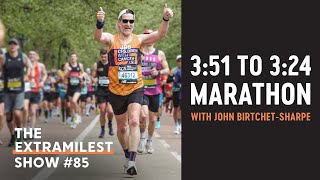
John Burchett-Sharp went from a broken arm and sedentary life to running sub-3:30 marathons in five years using low-heart-rate training, extensive zone-2 mileage, and strict recovery protocols. He monitors sleep and HRV, does hill strides and strength work, and treats rest days as mandatory. His advice: consistency beats intensity, and sleep matters as much as the miles.
Chapters
Just be happy with yourself. Be happy with the journey you're on. Nobody's looking at you. Nobody really cares about what your Strava time is. The most important person that you're running for is the person that you look in the mirror. And just be honest with yourself and love the journey you're on.
Welcome to another episode of the Extra Miler Show. My name is Floris Geerman. Today's conversation, I'm sitting down with John Burchett-Sharp. He's one of the members of our Personal Best Running coaching program, and he has improved significantly over the last 5 years. He went from being quite out of shape and overweight to shaving off significant time from his marathons, eventually even running more than a 20-minute personal best and continuing to improve over time, even qualifying for the Boston Marathon by more than 12 minutes, 11 or 12 minutes, which was awesome to see. In this conversation, we're talking about low heart rate training, about how to balance family life with work life, with the running, and a lot of the lessons learned from John over the years as he continued to improve. This conversation is brought to you by Element, a delicious electrolyte drink mix. We're in the middle of summer right now, and this weekend I was out in Palm Springs area. I went out for a run and super hot. We're like 110 Fahrenheit, it's like 42-43 Celsius in the middle of the day. So I went out for an early morning run, but even at that point it was still quite hot. What I do in these cases when it's really hot out, I end up putting some of the electrolyte drink mix packages by Element into my water bottles, and it makes a significant difference. So I ran for about an hour and a half, put in two different packages in two half liters, and I went through both of the bottles over that time. And it makes— yeah, I notice it hydrates the body well, it keeps the energy levels up, and even post-run I feel energized still. Sometimes after a long run, the following day I would feel that I have a headache or a little bit sluggish, and that is not the case if I'm taking in enough electrolytes. Recently they came out with a sparkling water too, which I sometimes drink before or after my runs. Right now, LMNT is offering my listeners a free sample pack with any order. That is 8 single serving packages free with any LMNT order. This is a great way to try all 8 flavors or share LMNT with a salty friend. Get yours at drinklmnt.com/flow. I hope you enjoy my conversation with John Burchett-Sharp. I want to kind of go back to the beginning of your running journey because you have been running for about 5 years now. You've learned a lot along the way. Like, can you describe a little bit more with how it first started out with your running? Like, why did you first get into running and how did that kind of go along the way or some of the things you learned along the way?
Right. Okay. I first got into running. It was a suggestion from my wife. And the reason is that I used to do another sport. I used to cycle and I had a bad accident and it was the third accident. Which broke my humerus. If you look, you pick it up in the camera and it goes back. It shattered. It's also about an inch and a half, like smaller than this.
So it's rough.
Yeah, it's kind of bad. I had it and in the end I had an external scaffold for nearly 2 and a half years. But that's brilliant. It's an old Russian method of building bones and it allowed me to go to the gym at least. And that because I was able to go to the gym and do light work, I think I did rowing and a lot of stuff like that, it allowed blood flow to get into the area, which allowed repair because normal surgery, including using, you know, they have that chemical now that they mix with your bone marrow and stuff to try— that wouldn't work. It basically was— it was the third break and your bone goes like marble and the blood vessels die off. So anyway, it was really good, but I could never— basically I couldn't race again. I can't break the arm again. So I was in an emotional doldrum. I'm a husband, I'm a family guy, I'm a worker. I always had more, I've always needed more. It's not enough, I need more. And my out was at that time for nearly 10 years of cycling. Yeah, that was my freedom. Because as a child I had asthma quite bad and so I never ran. I The idea of run was wheezing, psychological, you know, wheezing and that bloody copper taste. And no, no, I didn't want to do anything to do with that. But my wife said, well, why don't you go try run? And my stepdaughter's dad had just done the Ironman. Yeah. So I'm in my 40s, in my late 40s. And I, I thought, oh, that's really kind of cool. But of course I'd have to run. And then my younger sister who lives over in California, started doing something called the Spartan Races. I don't know, obstacle course racing. A guy called Joe runs it over there, Spartan Races. And she was doing really well. And it kind of inspired me between that and Fiona's suggestion to, you've got to do something because unfortunately, I'm one of those people that if I don't do anything, I get fat. And I'd gone from when I was cycling, at the time, I'm going to try to convert it to pounds that you understand. I went from about 170 pounds to about 222 pounds in a 2-year period.
Right on. And this was after you stopped cycling?
Yeah. And that's just eating normal. I don't eat cookie dough and things like that. I mean, I eat, I like food, you know, I cook, so I like food, but it wasn't usually amount. My big weakness is bread. I like bread, especially bread.
You're so Euro.
Yeah, I know, I know. Anyway, I get that. So I, yeah, I was really, really stuck. I went to the gym and I started weight training. And, and like I said, doing this thing, it helped. And in 2015— sorry, so my accident was in June 2013. In 2015, I got my scaffolding off and I was able to do, um, stuff. I got a personal trainer and started doing— and I've always, even from a young kid, I build muscle quick. I'm more rugby shape, or not quite American football rugby shape, than, than soccer player shape. It's just my nature. Um, so I, um, yeah, I started weightlifting weights and stuff like that, and then I started doing the running machine for my cardio. And before and then after, and around that whole time I'm doing that, so a year, but I didn't lose any weight. I just got more solid. I got more cut. I lost body fat, but I was getting big.
It is so interesting you're saying this though. I will get back to it in a minute, but I— so with skateboarding, I broke my left wrist 6 times. I have like a bunch of pins in it and all that stuff. And literally one of the main reasons I didn't really get into strength training early on was that it— my left wrist would always hurt if I would be doing certain exercises. It would always hurt to a point that I really had to build it up gradually and really slowly but surely strengthen it with a lot of one-arm exercises and all the support muscles.
Yeah, yeah, it's weird. You have to think about that, and this has kind of helped me with my fit my current regime, muscle regime, with running because I think it's important. So when I visualize, I don't know if it really means anything, I'm not into spiritualism or anything like that, but I visualize building the muscles around the knees and around the ankles. And touch wood, besides that hip problem that introduced me to you, I've never had any problems since. So Yeah, so anyway, I did the gym. Let's go back because I skip around. I did the gym. Ashley was doing really well, starting to medal and stuff in age group for the Spartan thing. I thought, well, I'll give it a go because, you know, I'm a strong lad, so I can do it. And I can't run very well, but I'll just, you know, give it a go. And I did. So I did the first one with a sprint, and I traveled all the way up to Scotland, and the sprint is only 5K. And I shouldn't, for all the people, I'm not trying to brag, but for if you're a regular runner, you know, 5K, that's a park run. You know, that's, it's for 3 miles is, is a start sort of thing. So a 5K, oh, killed me. 20 obstacles. But I did it. I did it. I did it. You know, and I, I kind of like the mud bath and the jumping over the fire and it's a little pricey. The Spartan stuff isn't cheap, but I did it and I thought, well, my goal. Okay, what I'm going to do is this. Now, 2 seconds. This is what, this is what I wanted. Yeah. And this is called a trifecta. Yeah. And it's doing all 3 of their distances, their main distances. So it's, that's a half marathon basically with 30 obstacles. Uh, that is, I think, 10K with 25, and that is a sprint, which is a 5K with 20. And but you have to do it in a year and you get a medal and you get invited to. So that's what I want. 2019, that was my focus and I did that. Yeah, I did it and it was, it was good. However, the weaknesses with the arm really showed. I could do well and I think, like I said in the last time, I did the half marathon one and I think I came 10th for age group. But the problem is how it works is that for every obstacle you miss, you have to do 30 burpees and they're military burpees. So it's jump and then down and press and stuff, which funny enough, I do. That's one of my main fitness routines now. But then I had to do it and that slows you down because even if you're fit at doing it, it's still 2, 3, 4 minutes. And I was giving them— well, in that last one, I ended up giving them 120 burpees because anything got to do with monkey bars, my arm just— it's not weakness. My arm, I mean, I could do loads of pull-ups or, you know, but it just won't go over that. And so I thought, what am I going to do here? And then I saw that he had something called the Trail Series. And then I started— that got me looking at running and stuff. And I thought, well, I don't have to do their Trail Series. I'm in the UK. There's trail running all over the place. So I started just going out and hitting the local roads and we've got local hills. We've got something called the Pennines in Britain, which is like a spine of high hills. We don't really have mountains, a little bit in the Lake District, a bit in Wales and a bit in Scotland, but we do have high hills. And what we do have is extreme gradients. Yeah. So we might— we won't have 10,000 feet, but what we will have is 25 to 30 vert. Yeah.
Much like shooting straight up.
Like, yeah. So I started running that, but it was always high. Yeah, I don't think during that time, looking back on it now, I don't think I ever got past 9-minute miles. And that's not a target. It shouldn't be a target, much like speeding. It shouldn't be a target. I'm just telling you with reflection, I was always close to wheezing, you know, at that time. Now I don't have that. It was childhood asthma. By the time I was 16, it was over. But I always got to that feeling because that in my head at the time, I thought, that's working. That's when I'm working. If I'm not, you know, if I'm not at the point where I'm coughing my guts up at the end of it, then I'm not doing it right. You know, and then, you know, that's it.
And that is, that is, that is a very interesting observation though, that you can see that now, because I think a lot of people have that understanding still of like, you're not working out unless you're breathing heavy, unless you're putting in a hard effort, unless you come back and you feel like you're dying. Like that whole no pain, no gain mentality that we often talk about. It's a very, very, very common understanding of, of athletes, not just in the beginning phases, even in the later phases that people—
I agree. And from— so there is a psychological— well, for me, and people, I guess, like me, there is a psychological benefit of that feeling. And I'll tell you why, because I hated running. And that is the drive. And I don't really, even though I love to run, between me and you, I don't know. The part of me still hates running, but it's a love-hate relationship. Do you know what I mean? I love the endorphins. I love the views that I can see. I love the fact that I could get up now and I could go run 20 miles to Liverpool. I could actually do that if I wanted to. And of course I'd be, you know, complaining, you know, tired and calling the wife, can you pick me up, blah, blah, blah. But I can do that now. That's something I never thought I could do, you know, and that, that is an amazing thing. Or we could take it easy and we'd go 100, I bet. And I'm saying to you as well, because you're a regular and not just— I mean, loads of us runners, if we wanted to and say, you know what, we're not going to go past 12-minute miles. Yeah. And we're going to stock up on food and we're going to start in Blackpool. So that's one, that's the West Coast. And we're not going to stop until we get to Whitby. That Whitby is where Dracula is in Yorkshire. Yeah. And, and, and we'd all do it. We'd all be crazy. We might be wet and tired and cold and stuff like that, but we, it's just absolutely amazing. And at the same time, I can't stand it. I hate it. It's a really strange thing, but that's the motivation. You know, and there's an element of it. I'm not a David Goggins type person. I've had my own journey. That's how he deals with his own journey. But there are elements of his psychology and elements in his literature that he wrote that I understand. And that's one of them, is that for me, my motivation, I need to be kicking my own butt.
And just going back to the love-hate part of running, I think many athletes can relate to that. And Brandon Lennart, one of the guys I had on the podcast podcast recently from Sami Rad. He wrote that book, I Hate Running and You Can Too. And, and I thought it was so clever because yeah, there's, there's elements of joy in it and there's elements of challenge and there's tough parts. And sometimes like you really get down and like both mentally, physically, but then you're sometimes able to find a second round of wind and then you feel on top of the world again. And sometimes that can happen multiple times throughout a run. And sometimes there's a period of time that things just don't click, and several days or several weeks or months even that the training doesn't go according to plan. But then it's so easy to beat yourself up, to like be really down about it. But this is why I think the whole approach of being kind to yourself in training and not destroying yourself, but actually going back to getting some of those smaller wins again, like being a little bit more gentle on the intensity or taking some times off, that when, when that energy level comes back again, that wind in the back, you're able to push it again. And like, it's that ebb and flow that I think is very important there.
And I go down— I, I, you would've looked at some of my stuff because I know you, you research things, and I've taken polarized training to the extreme, as you probably see. I mean, I will run at 115 beats a minute, you know, like, you know, I, I don't care because I, I'm lucky enough. And this is where the math came into, because it's enabled me to move in a consistent pattern while keeping an extremely low heart rate. And if I feel I need it, then I will, I will drop, drop real down, because what I'm doing is, is that accumulation, building that cake, as people say, isn't it? For eating it later.
What was your first experience with low heart rate training like? When did you come across it and how was that like for you? Those early—
I'll tell you, because I gotta mention it because he had a profound effect in my early days and it would be wrong. There's a lot over here now. He's famous now in Britain, a guy called Chris Ford. Yeah, 40 runs and stuff like that. Now, in the early days of the 40 runs, they weren't that big. I actually got in touch with Chris. You have to do a charity run up a mountain and back for a children's charity. And the reason I did is that I'm not antisocial at all. I used to be a real socialite when I was younger, but the nature of my job and what I do means that I've kind of gotten a little bit that way. You know, I'm kind of a homebody. I run on my own. I don't even listen to music or anything. I just like being in my own thoughts. And I was a bit intimidated by the whole running club system over here, which in Britain, the running club is— the running club, how it works. And now I understand it. I'm much more comfortable with it. But we don't have the collegiate system you guys have over in the US. So to the running, the people go that are into athletics and stuff, they go through the club system. Okay, now being a later person, a later weighty person, for I don't want to insult people, but you know, someone who's a bit more padded and definitely can't run very quickly, I was really intimidated. And Chris's ethos was very much the everyday runner, still is, Yeah. And I felt comfortable within that group learning how to— anyway, I was running. Unfortunately, at the time, I was still pushing it though. Chris is a qualified coach and he gave me some basic pointers and stuff like that. And I was training for Manchester Marathon. I did Manchester Marathon just under 4 hours. Yeah, but I didn't know my nutrition properly. I didn't listen properly. To some of the instructions he was giving me. So I had to go to the toilet during the time, and that's very uncomfortable. 5, 6 miles, needed to go to the toilet. And what made it worse is that the porta-johns, what they call the portaloos, yeah, when I got to the one that I got to, there was construction workers using it. Oh, sorry, mate. So I'm having to wait while people are running past me. Yeah. Anyway, so yeah, I got it. I missed the target of what I was after, which was 3:45, but Yeah, that was fine. Anyway, I carried on running on the plan, the basic plan, and now I'll have to be honest with it, Chris wasn't my coach. He was a friend and he gave me advice, and I had a few sessions. I did have a few paid sessions, but he was my coach. So my positives or my negatives weren't directly down to me. Yeah, um, anyway, I was pushing speed quick. I needed— I wanted to do Edinburgh. I wanted to do Edinburgh. I think it was like 6, 7 weeks after Manchester. So I had no downtime, didn't give myself any downtime. At this time, I'm 50 years old. Yeah. I'm 50 years old. And at that time, I was about 200 pounds. Yeah. So I'm— anyway, within 2 weeks, I go try to run a 7-minute mile. Yeah. And I'm been training at 8:45, 9-minute miles. Oh, I get this weird pinch in my, my hip. What's going on? I ignore it. I'm in vapor flies. Oh, I can go faster. It gets worse and worse. It, it knackered me. I had to go to physio and stuff like that, and I thought, well, I can't do this. I had 4 weeks, 4 or 5 weeks where I couldn't run. I'd already bought the hotel for Edinburgh and stuff like that, so we ended up going to the holiday, me and Fiona, and I watched some of the 4D people and some other people I know run, but I was just, you know, out of it. And I thought, oh no, I've done it again. I can't run. And the same, it really brought me low. Not the normal, oh, you're injured, you're out. I had no idea because I have no idea about running. And I thought I'd done the same thing as the arm. I thought, I can't cycle. I know what I'm going to do. I'm going to get fat playing PlayStation for the rest of my life. That's my idea. I was really depressed. And again, Fiona is far more rational than I am. And she's saying, John, go to a physio, you know, just go to a professional because I'm trying all this stuff and I bought a gun and I'm going to do all this stuff and it's not getting better. And I'm going out after, like, after 4 days rest thinking there's going to be a change. So I went to the physio and my brother-in-law had bought me 2 books. The 2 books— 2 seconds— the 2 books that he got me was this and this, and I couldn't run.
So what, what, what, Born to Run and the Methadone Method?
And the Methadone Method. Yeah. So I had these two books to read. I don't know, I'm never going to be able to read again, run again. But, uh, they're the two books, and that's how I got introduced to the Methadone Method. And it was a strange thing. So when I started getting back, it took about 5 weeks of doing regular physio training, and some of those exercises I still incorporate now, um, to, to get back and running. But I didn't go back to running the same way. I basically shredded any plans, any online plans, all that stuff. I shred it. And, and Chris, God love him, and it works for loads of people, but I, yeah, put his stuff all in the bin. I'm starting afresh. Yeah, I'm starting afresh, and it's going to be Manchester the following year. And that's the thing. And I was watching YouTube, a huge feature of— YouTube is my television, yeah, or definitely was.
Same for me as well.
Yeah, everything, everything and anything, yeah. Anything got to do with athletics or running, stuff like that, I wanted it all. I wanted to understand everything. And I saw— this was summer, so this was end of May— and I saw Kofusi's recap of his LA Marathon, and it nearly brought me to tears because I understood the thing. And I saw two people with him. I'm thinking at the end, pushing them through, I'm thinking, who are these people? What's going on? These must be his best mates. These are— this is brilliant. This is, this is amazing. And it's through there I found the Extra Mile List, your, your productions. And then through there I found the program. I'd already started putting Maffetone Method into balance, uh, in a sort of a run-walk thing. Not Jeffing, not doing the Jeff thing, but making sure everything was just calm, uh, using the— at that time, I think my math score was up to 129. Sorry, I think it was 129. Yeah, one, something like that.
So that was, that was 180 minus your age without any adjustments.
Simple adjustments, just, just that. Yeah. And I thought, no, I did cheat a little bit because I should have minus 5. And I thought, well, my injury wasn't operational. I don't have any cold. My HRV is fine and all that sort of stuff. Maybe I can get by. And I got by. And basically, I think in June, late June, so about 6 weeks later, I got onto the program and just started using your program for the base. And I stuck to it pretty religiously. It's weird though, because the body changes. It goes ups and downs. So initially, because I was already on track, I saw quite a few bit of improvement and then it dropped. Yeah, it dropped. And I was thinking, am I, am I fudging it? Was I fudging the improvement? Because there was a few times where I did an Adidas shoe called the Takumi Sen 8. Yeah, well, I think they're up there too, but it's a great shoe. Yeah, but doing a math test in that, it's a big difference from using my GOAT 14, you know.
No apples to apples on that.
Exactly. So there's, you know, you can fudge it. And I'm thinking, what am I doing? What am I doing? And that's when I started coming to the realization that— and again, nothing— I speak— I know, you know, Ed and the Fault Runner, I speak to, you know, by Instagram and stuff. They're all great people. I love the running community. It is amazing. I think I mentioned something when we were chit-chatting is I could not— you or me could not do a private message on Instagram to Taylor Swift and expect a response. Yeah, but I can guarantee you at least, uh, 1 out of 5, I could ask something of a, uh— in fact, I've got a video of Stephen Scullion with Paul saying, John, have a great marathon, get on with it. What other, what other sport or thing can we do that in? I mean, that is amazing. I've got that, you know, that's saved in the Gold Dust. But the fact is that, you know, I— there are people that— Matt Fox is— I've had chats with him before. I'm nobody, you know, I'm a 55-year-old, you know, broken British stroke American, you know, somewhere in a small town up in the northwest of England. But people will reach out, and that including yourself, and we can have chats because we're all human and we all love the same pastime and we're all striving to be the best we can within the envelope that we have. And that's, again, sorry, I'm jumping around.
No, and I think that's the beauty of the running community, though. And I remember when the reason why I wanted to have this chat with you, too, is that you've learned a lot of things along your way. You've gone through several different challenges. You've overcome challenges. You have improved in your health. You have improved in your running. But also, Like, we would see each other quite frequent on Zoom. You would just come in and like we would have a chat. Sometimes you'd be in there and you would just give us an update of this is, this is what's going right in training, or this is what I'm struggling with at this point, or this didn't go according to plan. Or like, even looking through the Facebook group, some of the posts in there, it's like, all right, I just almost blew up in this race, or here I hit the wall. And then like at another part again, like this this is what actually went right. And I think it is more relatable, I feel, for people listening to hear that sometimes from someone who is in a similar situation as them, who has a full-time job, who have kids, who have, who have other things going on and who are trying to run, versus some elite runners whose main focus is to improve in their running. And that's why I think hearing input from different angles is very helpful there.
So yeah, well, I, I have to, I have to admit Um, there's, there's two— I've got a couple of factors. I, I treat myself— I don't— I do the best to not have an ego in any way, shape, or form. And the shattering of my right arm, it helped a lot with that because basically it taught— at that time, I'm going to be honest, it took all the fight out of me. I couldn't scrap anymore. I couldn't strong-arm. I couldn't do the masculine thing anymore. Because I had a shattered right arm, I wasn't going to exactly be Mr. Tough Guy in life. And there was an element, especially from my upbringing, there was an element of naturally being aggressive when I faced obstacles. You had to deal with it a different way. So throwing the ego out the way, there was two very important things. One is, like I said, how I started. The 40 Runs group did my start and initial thing for the first year. Really helped from a psychological point of view. And I'll always, even though I moved on, I'll always be grateful for Chris and the guys, the gang of them, Alan and those guys, because they started me out. Next was the Personal Best program, which I will be a member for the rest of my life. And as you know, even though I might do— go there, go— I'm always going to be a contributor and stuff like that. It's just so important. And I think definitely for people who are not traditional runners. And I can't— but for people, I— when I mean they start late in life, or you come from a medical problem background, or you were overweight, or anything like that, using Maffetone and using some of the 20/80 principles and stuff like that, the program and your training guides, you know, is so important for establishing a good strong base. And that helps so much in running. And I'm not trying to blow your head up, Floris. I'm just being honest.
No, no, no, no, no.
Like, and then the final key for me was a guy called Paul Frary that I think I mentioned to you, who's a guy my age, who's an ex-British athlete. And that was the cherry on top. And we talked about this. We talked about the cherry on top. I think I'd been a year into the Maffetone Method. And, at that time, I was a strong, I'd say, 7:45 runner. And, I was at the point where I could take that 7:45 longer if I wanted to. In fact, I'd probably give the comrades a really good hit because my fitness is a weird one. I'm not the fastest probably because I started late where some of my twitch muscles already died. However, I seem to be able to hold it for a long, long time. And if you look at my time, even Paul said, he said I was like a clock. If you looked at my London time, where all along it's the exact same time, it's consistent all the way. In fact, isn't the first mile and the last mile exactly the same? I think so. The first segment and the last segment. And I could have gone another 5 miles at that rate. And it's because I, but I think it was 7:48 anyway I was talking to you. And you said about the speed training. Now, what I'm rubbish at, especially because of work and other things, I'm rubbish at setting my own setups. And I knew I needed something. And the local specialist running store, the guy is an ex-pro and he took me under his wing. And I said, yes, but I'm a math runner. And the personal best, of course. And I think most, besides maybe what's his name, the guy that is coaching Caffuzzi at the moment. He doesn't like Maffetone. It's like a swear word for him.
But, uh, oh, is it Seth DeMoor?
No, no, no, not Seth. The, the guy, he's Sandy, his girlfriend Sandy. He's a great runner. Um, he, he does that anyway. He's not into the Maffetone thing, but he doesn't. But, but most athletes, it's what they're used to anyway. They were— most athletes are 80/20, so you could call them Maffetone, you could call it Zone 2, it doesn't matter. What Maffetone does is without a VO2 max test, without doing your lactate blood thing, it gives you a good strong range to do your, your, your, your steady or easier work. Yeah. And then it, as you know, mine now, it's weird. Cause I went tested again. We talked about it and it's so nearly spot on. It's nearly spot on. I think I'm, I'm, I think under the MAF thing, I might've been 131., and I think I'm 133. But look how close that is.
It's really weird. It's nice when it lines up like that, even though it doesn't always line up for everyone, even those with a higher max heart rate or some of the older athletes in particular. But I'm curious to hear. So you went back to the same marathon a year later?
I did.
Yes. Tell us a little bit more about the difference after going through low heart rate, adding in some higher intensity the right time.
I did the race. I don't think I did a negative split, but I think I managed to— it was a huge difference. I didn't know what time I was running. I don't— I match— I look at heart rate. I don't look at times. I won't have paces on my— I cut that. I don't— there's not one race I've done ever done a pace. Now, I've had pacers. I've had Paul Pace for 2 races., and I did really well, but, um, I never look at pace myself. I just look at heart rate where I don't allow myself to go over a certain limit. So I didn't know how I was doing. I saw Paul at 10 miles and he goes, go on, you're doing great. I said, all right. He knew I did a 3:51, you know, so we didn't, we were just looking at 3:30. And I think I ended up going, in fact, I forget the time. Let me just head check. I did a 3:29:37. So, wow. Yeah, you know, in one year, that was a big difference. And I'm still, I was still 197 pounds, you know.
So that was what, 20+ minutes off your previous one?
Yeah, that was huge. Yeah, yeah, I couldn't believe that. It was a big difference. So that was a big jump. I might even have another big jump, but that was a big jump. You always have a big, a big jump. That was, yeah, it was huge. It was huge. And I don't think my heart— for me, you got to be careful with heart because we all have our different things. So you talking about your heart limits, but I don't think— so say I don't think my heart rate ever went— so take your top of your zone 2, your Maffetone, whatever it is. I don't think my heart ever went 18 beats higher than that. Yeah. So I think I was 148. Something like that, all the way pretty much through. I might have sprinted at the end. I have this thing, I like to sprint. Sorry, the one thing I was kind of good at when I was younger because I was always kind of well-muscled, yeah, was I was good at the 200 meters. So, I got a kick. Even now, I can get down to around 5:15 or something like that. And, that's after years of nothing on my strides. In fact, Paul has me do hill strides. All my strides on the Sauftoday are hills. Because I'm too close to injury. I'm going to pop something if I do on a straight, you know.
So last time I did, I did. Yeah, go on. Yeah, that surely gets your heart rate up quicker, that's for sure.
It certainly does. Yeah, but it's a way of building that mind. Well, you know, we've talked, you've talked about it in the program before. It's a way of building your muscles and your fascia without pushing it really for things to snap because at my age, it doesn't matter that I do the kettlebells and the burpees and stuff. It can just go, I'm tired and something snaps and that's me out for a year. So I've gotta be careful.
Yeah. You gotta be careful. And I think hearing you say that you only went up about 18 beats over your zone 2 on race day, that's quite low indeed. And it will be interesting if you would've had heart rate data from when you just got started in running. I'm pretty sure your max heart rate was quite a bit higher and has come down a bit over time as you started doing more and more zone 2 training as you got more fat adapted too.
Well, I do say, you know, you get people and you get it more than me because you're famous or within the running world, you're well known. But the one place that I do do a lot of posting on, and you'll probably see, is Instagram. I got a lot of followers. Not Instagram. No, not that. No, no, that's social media.
Strava.
I've got a lot of followers on Strava. And I get a lot of people saying, oh, you've done this at such heart rate. That's amazing. How do you do? What's the secret? And the first thing I say to them is I say, well, you do realize, first of my age, and my range is now I've never pushed it to the full max. I haven't. So I don't know what it is. However, I got a feeling it's in the mid 160s. Yeah. I've got a feeling simply 'cause when I really do push it up hills and then push it again, it never really goes over 163. You know, I had one strange thing on an ultra I did a couple of years ago that said it went to 200 and something, but that was probably the heart stock going nuts. You know, that's not accurate. But my resting heart rate is 136, is about 36, 37.
Wow.
So super low. So my range is, My range is no different than other people's. It's just a little bit lower.
You know, it's— well, plus, plus you have cycled for a decade and you've put in quite a bit of cycling. I assume that you didn't do that at the highest heart rate either, that you would have to chill out on the bike.
I think they've changed now. I think they're looking at the same polarized training, but back then zone 3 was, um, the main focus. Um, You know, that was the push. That's the thing where you could maintain.
That's interesting. Zone 3 versus zone 2, because I'm seeing a lot of people, like, in particular on the longer rides, just quite like hanging out in the zone 2 zone as well.
Yeah, no, that's what I said. That's a, that's a difference in 15 years of training. Back then it was all about being able to maintain zone 3, which was probably about 29 miles an hour in a to 30 miles, you've been in the chain gang and this one slips. I don't think it's going to slip like that. Anyway, yeah, so you could push it, that could get you close to 40. But on your own with a normal bike, not one of them things, at 28, 29 miles an hour, you were doing a good rate of knots at that. And that might try and keep that heart in zone 3 at the time.
When you look back now, John, at what you know now from running and what you knew when you first got into it 5 years ago, What is some advice to your younger self or to other people listening just getting into running?
First, the speed will come. Be patient. Patience is the biggest, it's the most important thing. Whether they go down the route we did with marathons or whether they're doing a traditional thing with a coach with lots of different reps and overs and unders and all that sort of stuff. Really patience. Don't rush to get where you need to get. You will get there. Also, we're capable of more than we think we are. That's another thing. Don't set a roof on your ambitions. Forget that. Keep it loose. What I do is I keep it kind of thinking, yeah, I keep it loose. Yeah, I have an ambition. But if I don't actually make that time, I'm not that bothered because you know what, I'm going to do it again. I'm going to do it later. It's going to happen. Just, yeah. Does that make sense? I know it's not black and white what I'm telling you, but it's—
It absolutely does. And I'm glad you're saying that because I think a lot of people think too small, but they think very short term too.
Short term. And then that's the society we're in at the moment. We can't help it. We've got the same— and this is not where we're going to solve the world's problems, but we've got the whole— there's too much short-termism now. And you think of the strongest structures, not just athletes, the best athletes, but also the strongest companies, the strongest societies in history. It's all been long-term. Even if they're thinking about their grandkids and their great-grandkids, they're not thinking about what they can get at it. What about me? You know, and you kind of need to kind of do that with your training too, because we've already said in 10 years' time, I'm not going to be the same physical human being I am now. So what I'm doing for me right now is not for a 55-year-old. Oh, isn't that great? I'm rushing to be a good athlete when I'm 60 and be a masters runner. It's— wouldn't it be nice to be able to walk briskly at 74 years old, 75 years old? You know, we've got the lakes in England, you guys have got the mountains up, and then the Sierra Nevadas. Wouldn't it be great to still be able to go up there and enjoy it? And, and that is why I'm doing what I'm doing now. That is the main— the other things, they're just nice markers on the way up.
Yeah, so there we go. It's, it's, it's spot on. And I think as long as we can see it that way and kind of takes the pressure off too, where it's not— it does— when, when we can set goals 3 years out, 5 years out, 10 years out versus, versus next week, next month. I see, I see a lot of people— I literally got an email the other day from someone who said, Floris, how much would you charge me to make me a plan so that in 3 months I can run this race in this time? This is what I did last time. And I was like, I don't think we're the right fit for each other. Like, it, it really is like Time is just one of the elements. It's like, let's focus on rephrasing that as in like, let's be a healthy, strong athlete. Yeah. And zoom out some of our timeline. And of course you might surprise yourself what you're able to do in 3 months, but don't have that expectation of like, you either make it and you're, it's good, and you fail and it's not good. It's like, no, let's, let's, let's gradually improve over time and be patient in that process.
You're gonna— I'm gonna remind myself that sometimes. I was so ashamed of my performance last Sunday because I thought I'd let Paul down. You know, basically, he came out to pace me. I thought— and, you know, you know yourself because you have— you've got a lot of friends in the running community. To have somebody who definitely used to get paid a load of money to pace really, you know, superstar-type people to just come out of the goodness of his own heart. I don't know. I couldn't afford just to pace me. I mean, I know we're old. We're friends. So he didn't need to, but he did. And to let him down, to drop those couple of minutes, and I just felt so bad. And he was just so cool about it. I said, I'll do it next time. I've got a big— my goal race is Cardiff. I'm starting something called the Super Half Series. Now, something in Europe that's starting to happen, there's 6 half marathons in wonderful places, and Cardiff is the first one. Cardiff is the capital of Wales. That's the first one. And besides Boston, which is of course going to be in April, and I know you're a big marathon guy, I can't afford to do— I'll be honest, you know the thing that you've just finished?
The World Majors?
Yeah, the World Majors. I can afford that. So Boston's always been my thing because Boston's the one you can't cheat at. And sorry, I don't mean cheat, but you know what I mean. You need to hit a time. Yeah, you can't— oh, unless you're an influencer. Let's be honest, influencers get magic tickets, you know.
But well, I, I really didn't get those, I could tell you that much.
Yeah, you had to do all of it sub-3s and you still didn't get them.
After, after 10 years, I ended up just paying the full fee through like a travel agency to get it done.
Yeah. No, I can't afford to do Tokyo and maybe one day I'll do Chicago on my way because I'll, you know, I'll go to the States. I see my family every couple of years. But New York was a big expense and Boston is going to be done on the cheap. Basically, my wife's not coming and I'm going to do— we don't have standbys, but I'm going to do the cheapest flight possible. And, you know, I'm a member of the Tracksmith here club, so I'll get my free bus to the end and all that sort of stuff. And that's fine. I'm not saying it's, you know, there's a lot of great races. You don't need to be wealthy, you don't need to do any major to do great marathons, just where you live, we live. But I won't— Boston will probably be my last of the major marathons. But I think perhaps it's easier for me, it's all in Europe. You're talking about— I don't want to be an advertisement for them, but places like Lisbon and Valencia and Berlin, and, you know, it's going to be great. I can, me and the wife can come, we can have a day off each side of the weekend and we can make it an end and a half. Doesn't beat you up like the marathon.
Yeah, you can actually still walk after.
And of course you can, even if you do a hard one. You know, I came back, I didn't exactly get into the housework, but I wasn't far off after that one where I done, I think I did 93 minutes, which is only a minute and a minute and 10 seconds off my, my personal best. So I, you know, I pushed it. I mean, the first 5 miles was under 7, and for me, so that was kind of your pace, and for me, that's a big, that's a big thing, you know. That's where we're aiming to be able to do the 13.1, and that's what I'm going for.
So that would be a really nice, nice series to go after, especially, and those are all awesome places to travel to.
Wonderful places, exactly. And that's Well, this is where I'm showing the fact I'm middle-aged. Me and my wife, we love walking around and looking at all the wonderful places. In fact, I did the worst thing ever after New York. For people that don't know, I did the New York Marathon last year, and I think I already qualified for Boston then, but only by a minute, and I didn't trust it, so which is why I needed to crack it properly in London. But I did New York, we went over there, and what did I do the day after the marathon? We got a taxi to Ground Zero, and I was staying in the Upper West Side up by the observatory, up that way up in Central Park. We ended up walking back. So for people that don't know, that must be about 8, 9, 10 miles. But we didn't just stop there. We went to go see Friends, you know, where Friends was shot, and we ate at the little cafe below Friends, and we did all that, the Empire State Building, stuff like that. So I got hobbled.
And that's more than an active recovery. That's like a full-on another adventure.
I couldn't walk for 4 days after. I ended up picking up an injury at the side of my foot. My foot was going, what are you doing? Because, of course, I already had those Mizuno— I ran the race in the Mizuno Rebellion Pros, which are like the weird— amazing in one respect, but they're a bit interesting for how your footfall goes. And then to walk later, yeah, that was a lesson I will not do again. Yeah.
And now you have been able to increase your buffer with Boston. You now have a, what, a 13-minute buffer or something for Boston?
11 and a half, 12 minutes. Yeah. It's something like that. Yeah. I'm definitely going to get in there for the, the B55. Yeah. I'm going to really enjoy that race.
Oh, you're going to have a blast, but I'm going to love the race.
I'm going to run that race for the run. Does that make sense? I'm not going to run that race to try and kill anything. And stuff like that, even though where I live is perfect for Boston. Most— we have— I'm really lucky within a 10-mile area, there are some extremely good trail runners and runners in this area, and it's because it's lumpy. So where— if you ever look at my— just my normal run, I'll do 200, 300 feet just in a normal, you know, my more early morning 10K because it's lumpy. It's all up and down. There's no— we don't have— we don't have a mile of straight. Flat here. And we don't have any tracks in the local area. You've got to travel 20 miles to get a track and it's not easy. It's, uh, you just, we don't have the high school system with the tracks and all that.
So it's nice when you can train similar, similar elevation profiles and similar hills and whatnot to where you're going to race in particular for a race like Boston coming up.
So we have a, we have a 280 foot hill, not far off. In fact, I ran it up today. I ran up today for the warm-up. It takes about 2 miles to get there. And what you do, there's a loop, which is a 4-mile loop. So, for the people that run Boston and stuff like that, we'll do that loop. So, you can do, you know, 12 miles, you've got that many hundred, you got— and so, you just keep on going 24 miles. And that's usually the longest you get up to. 24 miles, and by then you've done 1,200 feet, you know, 1,300 feet, and you've done your— I used it for New York. That's why I could carry on. I didn't stop. You just could carry on running, you know.
And then all of a sudden you experience a bridge in New York or a hill in Boston, and it's not that bad when you've done plenty of hill training.
It's still bad, but exactly, you just carry on. And New York was a real eye-opener for me. I was really surprised. Some people that I— based on looks, you'd think You know, they, they're super runners. They must be flying by there. And then of course you've got Thomas's wife Meg, and she's smiling and laughing to everybody, nearly running a 3, you know. Yeah, that destroyed me. I was at mile 16 when they caught up to me, and, and for, for a while we were running the same pace. And, uh, I think it's that tough bridge before you get to the corner where everybody's shouting And to watch those two, Megan and Megan, and, and they're just smiling and laughing and saying hello to everybody. And I'm going, oh my word, my hips are going, whoa, no. I love it. I love it. And I gotta shout out, you know, you know, he gave me— Thomas, um, again, he's famous in the running world and I'm a nobody. He ended up giving me a coat when I got to— because I was flying from England, I couldn't get to New York until the last day of the And by then they didn't have any jackets left. They didn't even have any tops left. I think they gave me a women's extra large that I've given to charity. And I was really upset. That's all I wanted. I like my jacket and I like my medal. I don't care about any of the other paraphernalia, but I like my jackets, my medal. And we were in the same pen, or I was talking to Chris and he knows Chris and he was saying, he goes, oh, I'll give you a jacket. And didn't he? He left me a New York jacket at the Hyatt Hotel that he was staying at. So I went on my— that trip that I did from Ground Zero up, we stopped in and I got my jacket. And again, what we were talking about, the running community, I'm a nobody. You know, I don't even like the big huge runs they do because there's too many people. And to just— it's just— and you know what, I kind of did the same now. I always get rid of my running well with at least 150 miles, and I'll give them to friends that I know might not make— because with us being old, with me being 55, I have a decent wage, and I'm very lucky for that. But I remember being in my late 20s, early 30s, and not having a decent wage. And there are people that can really make use of those shoes better than I can. So I try to turn it around the same way. Absolutely.
And I think Thomas and the whole Believe in the Run crew, I have a lot of respect for those guys, Robbie, Megan, all of them. They do what they do. I think they're bringing a lot of positive vibe to the running community and even examples like this, that's just awesome to hear.
Yeah. And I'm never going to be— I don't hero worship anybody. Yeah. I told you, we all go to the same toilet, mate. We're all human. Yeah. 100%. We all have different experiences. Nobody's better than anybody else. However, when people are in that position and don't take on some sort of elitist approach, that's big points for me. That's real points. And again, it's something about the Personal Best program that I really like because there's people from all walks of life, but we're all one community when it comes to the chats. And it doesn't matter which country we're from. No matter what age we are, what level we are at running, that when we're talking, you know, there we— I'm funny that way. And that's Paul Frary, God loved the man. This guy that he didn't need to, but he paces me, you know. I mean, he just talks to me as a human being and we have a good friendly relationship. And I just like real people. And I've met a lot through the through the running community, and hopefully I'll continue to. No.
And I think here's the one thing for anyone listening is the whole part of what you described earlier when you're just getting into running and you might feel out of shape or you might not feel like a runner or you feel intimidated by a running group almost. You might be surprised how open arm and welcoming most running groups are. And when you actually go out there and you're moving, you're active, you're trying your best, and you're not being an a-hole, like you're just being friendly to people. Yeah, yeah. You might be surprised how open-armed and welcoming everyone is. And when you ask questions as a beginner, yeah, you will see that there's a lot of people willing to help out with it. And, and don't feel intimidated about that. I think the more we can take a beginner mindset and drop the ego, the easier we'll make it for ourselves. It's often our own ego our own embarrassment and our own thoughts about what other people are going to think.
Everyone is busy with their own—
exactly, I agree with you. Everyone is too busy thinking about their own shit and stuff. People don't think about you from that perspective. So just drop all of that and just do your thing.
And like, because I've been there and now I can say that now I'm 5 years in and I'm starting to becoming, uh, or starting to realize the potential of a human being and what we can do and how amazing all our bodies are. But it wasn't that long ago, hop, skip, and a jump. And definitely with being my age is that it would only take me 6 months of not doing anything to get back there again. Because that is— we have to be realistic about biology and about physics and those things. We can't be a lie. And the one thing I've noticed, there's a couple of things. One is it's extremely hard to lose weight at my age, even eating well and stuff. It's extreme and very easy to gain it. And another thing is there is definitely a quick drop-off. I need more, I need more time to recover now. So I have, I'm strict that I will have 2 days a week off. Yeah, I won't. I can't do a 6-day even. I need to have that 7th day. Now, I will do yoga or Pilates or something like that on one of those days, but I need to have time off every so often. And I get a strong improvement then by having more time. I get a strong improvement. And even the Garmin, which is sometimes weird because obviously it has its own algorithms and stuff like that. Or the Chorus is another one. I've got Chorus Strap and stuff. They have the different algorithms. If they're showing improvement by you taking more rest, then what that says, hmm, what's going on there? Yeah. Like the program, I'm actually getting the 7 hours sleep for the first time since I was about 8 years old. I'm getting 7 hours of sleep at night. Unfortunately, it does mean that I have to get to bed by 9:30. Because my body still wants to get me up at about 4:50 every morning. So what I've had to do is go to bed earlier to get that time in. Other things, alcohol is not a friend to running and to health. And I'm not telling anybody not to drink because I've done bloody everything, everything besides heroin I've done in my life. Yeah, but I'm being honest with you. And this is where the COROS and the Garmin devices are really good because they monitor HRV.. And that is one of the few metrics that I really pay attention to. And you have— go out and have a couple of pints or have a couple of shots and then go to bed that night and see what happens to your HRV. This weekend I was at a family event and I had a couple of ciders. It was down in Hereford. That's one of the famous places for— we have alcoholic cider over here. It's not a pop drink, it's alcoholic, hard cider you call it. And anyway, I had a couple of ciders. And my heart HRV hasn't dropped that low since I've had a COVID shot. It was that much of a drop. Yeah. Now, the difference is the following day it was up. My personal HRV is usually around 60-ish. Yeah. But we all have differences. Anybody who has it really low or really high, do not take that. We all have completely individual HRV scores. But yeah, it dropped to something like 41 or something like that. It was absolutely— So alcohol is a no-no. Sleep is important. And it's all the typical older things that you have to worry about. I do a lot of pre-run. Pre-run, I do— I got this and it's free app, so I'm not selling anything. There's this thing on Apple called Bend and it has a pre-workout routine and a post-workout routine. And I do them. I do that. So it's some you know, stretching your typical kicks and all that malarkey, but there's also your knee twists and all those arm things and all that. And I do that before a run, even a math run or even a zone 1 run. I will do the warm-ups and they're there. That's important. And that's an older thing. So I'm just trying to think of all the important things I picked up that has to be done to—
Yeah. I think the one you touched on, like, earlier, like, that now for the first time you're sleeping 7 hours a night. I don't think people understand. I don't think people realize how much of a difference that can make in your running performance. No. Like, and, and once you start seeing sleep as training and not feeling guilty to sleep 7, 8 hours a night, because I just see people like, ah, then I can't do this, that. It's like, that is part of your training. See that as training for running, training for health, training for life, just to be able to handle it all.
Another very important thing, and this is tied in with— you'll understand this— and this is to tie in with consistency is so important. It's to tie in with what we were talking about. Patience is— and it doesn't matter what age, or what level you are. But if you— I mean, if all you want to do is go run 5Ks twice a week or do parkrun, you know what, nothing wrong with that. That's a wonderful thing. And the— look, I don't partake, but a lot of friends of mine do the parkruns in the UK, and I'm sure you have something similar in places. And that's wonderful if that's all you want to do, and that's joy, and I'm all— God bless you, and I'm not going to mess around with that, and I don't want to. But if you're after improving either your health or your performance or something like that, consistency is so important. I am like, I'm not, okay, maybe I'm a bit anal retentive. I'm not saying like, be like me. I'm too analytical and I'm too much like a clockwork. Yes, you are. No, I know, I know. I'm, I'm not saying people that the, but, um, is that, that consistency is so important. It really is. Just get out there and get it done. Just get it down. You know, I mean, and we can't use the same map. My map of my improvement, and because it's an ongoing project, as you know, it's going to end when I'm 60, isn't the same as yours. Yeah. So, for me, that works. I do 5 runs, 2 are performance-based, 3 are what you call math or below. Yeah. And even the performance one might be mixed.. And, and that might only become performance as I'm getting closer to a race. I, so it could be just a long run at, at your zone 2 or, or whatever like that. But of course that improves. So it gets weird. One thing I'm starting to creep into, and it, and I know you've talked about in the past, is I'm getting to the point that when I'm, I'm getting close to 8-minute miles, not quite there yet, but I'm getting close to when I'm in my zone 2 at the, at the upper edge, that's tiring on the old legs. I'm getting to the point where that's not— I was thinking about today, I was getting— because I did 2 really kind of relaxed up to the hill, and then I kind of sped up. And I'm going about 8:05, something like that. And I'm thinking, I'm getting down to about mile 6, and I'm thinking, this is tough. This is supposed to be a chill, and it is a chill run, but even chill runs are starting to get a little tough. So people that are on the journey, be warned. It gets to the point where it's—
Yeah. Yeah. And I think it also depends to some extent what running volume you're doing. Like, if there's someone running twice a week, indeed, you can get away with higher, like, higher intensity and still recover. Yet when you're running 5 days a week, you already do some speed work as part of that, and then you're doing some low intensity. But even then, yeah, it's that fine balance. But here's, here's the interesting thing though, and I do respect this from your perspective when seeing your journey over the last few years and going back to some of the previous Facebook posts that I've seen you put in there, put in the group. At one point you wrote like, ah, I was feeling off and I actually decided to take a week off from running. Yeah. Which I think that part, a lot of people are so afraid to lose fitness after, after not running for 1 or 2 days where it's like sometimes the body needs to recharge. Sometimes you just need to step back and allow that recovery part.
Yeah, it needs what I mean, we're not doctors, neither of us are doctors, but I'd call it deep healing type of thing. And it might be a psychological thing. It might be a small level of cells, but yes, that deep healing.
It's funny because after I finished the London Marathon, I'd done 5 marathons in the last 16 months. And all of them I pushed it decent to a point that I needed proper recovery after that. Like, after London, I just felt tired, exhausted, wasn't very excited for road running for several weeks. I was like, let's just recharge. Like, let's— I didn't have another race on the calendar, so what I actually ended up doing was just going on some trail hikes in the morning for sunrise, go play some pickleball with the family, start lifting some more like, yeah, doing some more strength training in the gym, like just mixing things up. And sure enough, last week I felt really excited to run again. So on Tuesday I went for a nice 10-miler on the trails. I actually pushed it pretty hard. I was in Palm Springs this week. It was freaking 35 degrees or something. It was like dry, hot. Yeah, it was like, yeah, it got up to 43 in the afternoon. And so what whatever that was, 112 Fahrenheit.
No problem with that lovely white complexion you've got.
Well, so we ended up running early in the morning, but still, like, just following your intuition of what excites you. And like, certain, certain stages, that's— it's gonna change over time too. And not be too married to your same routine, your same running route, your same days, but mixing things up and following, following your excitement.
Running is our main focus, but it's not— it's only part of the journey. There's so much more and so more attributes and stuff like that. And I gotta say, the buzz you get from it though, when that run, that hits it, there's nothing else like it. There is not. Well, I can guarantee you guys, there's not an artificial substitute. Yeah, that there's nothing better than that. It's probably similar to the pump that weightlifters get and the adrenaline of the win for those people that are lucky enough to win or something like that. But there's nothing healthy, extremely healthy than that, that you get.
Any closing thoughts? Any other advice for recreational runners looking to become a stronger, healthier, happier athlete out there?
Just be happy with yourself. Be happy with the journey you're on. Yeah. You've got nobody, nobody's looking at you. Nobody really cares about what your Strava time is. Nobody, no, the most important person that you're running for is the person that you look in the mirror and just be honest with yourself and love the journey you're on. That's, that's my closing.
Nothing else than that. Okay. That was spot on. That was really good. I like that. I think Yeah, the way we see ourselves, and, and even earlier what you were saying, like, it's so easy to beat yourself up and be kind to other people, but to actually be kind to yourself and like to be patient and consistent and, and be happy with the journey you're on, that, that's spot on, man. John is awesome, and I really appreciate how honest and open he is to share his different experiences. To learn more about the Personal Best program a running coaching program that John is also a part of, check out pbprogram.com. It's an awesome supportive community. Many of our podcast guests from the Extra Mile Show are actually a member of this community as well, and it's really nice to see how everyone is helping each other out. Runners of all different levels there coming together. So yeah, that is pbprogram.com. I would love to hear from you What was your favorite lesson, takeaway, or quote from this episode? Please let me know in the comments on YouTube. All right, have fun out there on your runs. Bye now.
More from Floris


Ryan Hall 2.0 on Strength Training For Runners, Lifting Heavy & Trail Running




You’re Doing Zone 2 Wrong (Even If You Think You’re Not) | Scott Johnston Round 2


How to Build an Unstoppable Aerobic Engine (Even If Starting From Zero) | Scott Johnston


Stress Is Killing Your Running (The Relax Fix You’re Missing) with Dr Kasim Al-Mashat

When things get hard, say this, it (works in any race) #jeffpelletier #running #ultrarunning