How to Run a Sub 3 Hour Marathon & Boston Marathon Qualifier with Jay Motley | The Extramilest Show
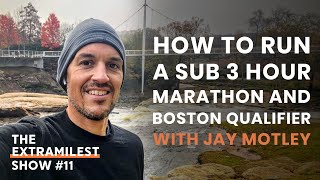
Jay Motley went from struggling with his health to running a sub-3-hour marathon and qualifying for Boston using MAF heart-rate training. He built up mileage gradually, trusted data-driven pacing, and learned that consistency and realistic volume matter more than intensity.
Chapters
But this time when I hit mile 18, I felt great, and I had held back a lot during the race, and some guys had gone out a good bit faster than me, and then thankfully that's the point where I started to reel a lot of people in, and honestly that was so fun and something I had not ever done in a race before, and you know, I could see them up in front of me, and I could just— I had a lot left in the tank at that point that I'd never had before.
It was a great feeling, and you know, to come through and feel good at the end of a race and to be able to to PR in that way was amazing.
Hello everyone, welcome to the Extramilest Podcast. My name is Floris Gierman and today we're talking to Jay Motley. He is one of our Extramilest Facebook group members and he has had the goal for a very long time to qualify for the Boston Marathon. He tried it for many different marathons but he wasn't able to hit the qualifying time. Until recently when he changed his entire training and racing approach and he was able to go from a 3:11 marathon all the way down to a 2:50 and qualify big time for Boston. So we're talking about all of the different learnings throughout his whole training cycle and his racing strategy. And he brings up a lot of good points for other listeners who are looking to qualify for Boston or run a super fast marathon as well. This episode is brought to you by PATH Projects. It is my favorite running apparel out there. I use it from head to toe, and one of my favorite parts is the running shorts with a lot of different pockets. So if I go out on a longer run, it has all the pockets to hold whether it's gels, car keys, credit cards, all of these different things. So check them out at pathprojects.com. One more thing, all of the show notes are going to be available on my website extramilest.com with a lot links to all of the articles mentioned in our podcast as well. I hope you enjoy my episode with Jay Motley.
Cool, perfect. That seems to work well. Where are you located?
Uh, right now I'm actually where I— in my hometown where I grew up in Tennessee.
Ah, right on. Nice.
Yeah, so I'm at my, I'm at my dad's house for the holidays.
Ah, that's good. You guys are out there for a bit.
Yeah, yeah, but I live in, um, Greenville, South Carolina. Right on. So yeah, so we're here through the holiday, and then my wife's family is from Boston, so we're going to Boston after Christmas. So we got a lot of travel ahead.
That's exciting. Talking about Boston, it looks like you just ran an amazing race and you qualified for the very first time for Boston.
Oh yeah.
Maybe we can start out over there for a while because I found it quite fascinating, your journey. It sounds like you have run for several different years, right? And then you had a few marathon experiences, and some of it went well, some of it didn't really go according to plan. Maybe we can start out there for a little bit.
Yeah, perfect.
Yeah, I started running back in college, actually. I got, I got a little overweight in college and started having high blood pressure and went to a family friend. I mean, I was 20 years old and I was at the grocery store or something and saw that my blood pressure was up and I was like, what's going on with this? So I talked to a family friend that was a doctor and he kind of went through all the questions with me asking, you know, trying to figure out if there was some cause. And then he finally just said, you know, you're overweight. If you lose the weight, this will probably get better and you won't have to be on medicines the rest of your life. And that was like a total wake-up call and a shock for me. I had no idea.
What year was this? How old were you at that point?
So I was 20 at the time and in college, so that would have been—
I was born in '98, so that probably would have been what, 2008?
Maybe 2007, something like that.
And yeah, up until that point, it kind of snuck up on me. I didn't know that I was overweight. I had, I had no clue. And thankfully I had the— had my blood pressure checked, and I had this, this physician that was open and honest with me enough to kinda say like, "Hey, you need to get on top of this. You're young. If you don't change something here, you're gonna be on medicine the rest of your life and not be doing great." So that's kinda where it all started for me. At that point, it was a wake-up call for me. So I changed my diet, started trying to eat less. And at that point, I didn't know a whole lot about anything, but I used just calorie control and calorie restriction to kinda, drop some weight, and I started exercising. And so that's where I started running. And for me, it was way back then, and the only goal was really just to be as healthy as I could and to lose some weight and get back to a normal weight and try to get rid of the blood pressure. So lo and behold, over a, over a few-month period of time— I can't remember exactly how long, maybe 6 months or so it took— but I lost about 50, 55 pounds.
Wow.
Yeah, I was able to get back to my pre-college weight, which was a normal healthy BMI, healthy weight, and that's kind of where I've maintained and been able to maintain it ever since.
That's, that's quite a bit of weight to lose over a 6-month period. How did you— like, what was your weight beforehand and what was it after?
So the highest I remember seeing was right about 203 on the scale, and After that, I was able to get down to about 155 and stayed. The way I did it after that, and it may have taken longer than 6 months, it's so long ago now I can't remember exactly how long it took to drop it off. It may have been more like a year. But once I got down to my final kind of goal weight, I was able to say, "All right, now you— I don't want to ever go back to where I was." The way I did it for myself was I set a sort of range, a 10-pound range, and I said I'll weigh myself frequently enough, and if I ever get to the edge of that range, I'm gonna have to cut back what I eat and make sure I never go out of that range. And thankfully, over all these years, I've been able to maintain it. And over time, I've learned some more about health and lifestyle, and I ended up going to medical school after that and becoming a physician. I'm an anesthesiologist physician for training, but then also I've more recently become certified and boarded in lifestyle medicine.
Wow, so it has completely impacted your life in all sorts of elements.
Yeah, oh, it completely has, it completely has. I'm— I've been learning as much as I can about our lifestyle choices and how they affect our health and our life, and I became so passionate about it 'cause of the way it affected my life that I wanna get out there and try to help spread the word to others as well.
Yeah.
So that was kinda— that's kinda the short story of how I came into running. And honestly, it's interesting in that it was just a way that I thought at the time, not really knowing much about anything, it was like, "Okay, this is the way I can get some exercise and I can try to lose this weight and get—" get back healthy again. And, you know, thankfully he was right. Everything reversed itself. I didn't really end up having blood pressure forever, and all that got fixed. And the rest is history. So at that time, I was just running, you know, a little bit here and there. And somehow I decided, well, maybe I should try to train for a marathon. And so the first one I started training for, and the first one I ended up running, was in 2008. April 2008, and it was the— at that time it was called the Country Music Marathon in Nashville, Tennessee. And I must have been in med school at the time, like maybe in the first year of med school. And, you know, oddly enough, I remember being in Nashville a few years earlier for a college event, and they happened to be running the race the same weekend I was there in the hotel. I remember seeing all the runners before I was a runner and thinking, how could they do this? How can they run that far? Ironically enough, that was the marathon that was my first one a few years later.
Isn't it funny how indeed when you have never consistently trained or when you have never put in the time and effort, you can never even visualize going that far? And yet once you start a training cycle and slowly but surely start building things up, your body gets used to things rather quickly and you can actually build up that mileage and it starts feeling more and more doable as you progress in your training. Exactly, exactly.
It's like one of those things that at the time, you could have asked me that day and I would have said, "That is impossible. I could never run that far." And then, you know, as your training builds up and as you start to do it, you realize like, "Oh, I really can do this." It's amazing how it happens. Absolutely.
How did that first training cycle go for you? Did you follow some type of training plan? Did you wing it? Did you do it on your own?
Yeah, I followed a training plan. I was living in Charleston, South Carolina at the time, and there was a pretty okay running community there, so I think I was able to kind of tap into some runners there, and I remember doing some group runs with some folks, and I think I probably hunted around on the internet and I might have found a Hanson program, and I might have trained on like a beginner kind of— I think I probably picked a beginner marathon training program, and I remember having it printed out. But I didn't know what I was doing at all. I didn't know, you know, anything about running. I didn't know how to like to find water on the long runs or how to take nutrition on the long runs or, you know, where to put it or how to carry it or any of that. I just didn't know at all what I was doing. But I went out and, you know, I tried to do the plan as best as I could at the time, and I trained. And in hindsight, I was, you know, pretty underprepared going into the marathon and didn't know what I was getting into. And even though I'd done the program, I didn't know how to race at all. And, you know, I wasn't fully prepared, but I, you know, I got through it. I survived. Ended up running 3:35, I think, for that one. That's very good for a first marathon. Oh, thanks. Yeah, I was, I was very happy with it, but it didn't come easily and it was painful. I, you know, about mile 18 on that race, I just crashed and hit a wall and I started having cramps and I was walking for a good bit of it. It was, it was really, really painful and experience. And I remember, I remember crossing the finish line and feeling so proud and so relieved and so happy that I'd done it because I felt like I had just gone through this terrible experience because, you know, I was—
I could barely move, I was cramping so bad. And there were some, a few nice runners that were out there that saw me in trouble and they kept encouraging me like, you got this, you're alright, you know, you can, you can make it.
But those last 6 or 8 miles I remember just being, you know, tortured.
In hindsight, now that you have trained more, looking back at that marathon, what were a few of the things that you think you did wrong or you could have improved on throughout that training cycle and throughout that race?
Yeah, I mean, now having trained more and learned more and having recently completed this one using MAF training, I'm a full, full believer in the way that that using math for runs leads to a great race.
You're faster. You get faster at a heart rate and an effort level that's maintainable and nice. So I would train more like I did for this race now had I been able to talk to myself back then.
I think I was doing a big bulk of my runs too fast.
At the time, I probably had this mindset that, okay, the hardest you can go on every training run is gonna be what builds up your muscle and builds up your strength. So I had this run that said, go run 6 miles today or 8 miles today. And so I probably did each one of those as hard as I thought I could at that effort. And so I was probably constantly fatigued and exhausted and not able to give my best when I needed to actually do a hard workout and probably wasn't fully recovering either.
Probably didn't do enough miles. I would say for sure back in those training plans, I probably never peaked out at enough miles, and so I was probably underprepared.
Do you remember what your training miles were for those initial marathons?
You know, I think I probably peaked out maybe around 40 miles in a long—
in my longest week.
Back then, 40 or 45 miles. I can't remember exactly, but I don't remember, but it certainly wasn't as many as I did for this training.
Yeah, and then fast forward, what were some of your marathons afterwards?
Yeah, so after that, the next one I ran was probably Marine Corps Marathon, and I ran that with a friend who had never run a race before, so that was a different experience altogether. 'cause I ran that one a good bit slower. And that one was actually enjoyable. And so that taught me that I could run that far and enjoy the run. And so I knew something was off because I came out of that one at the end, it wasn't torture, I felt great, I had a lot of fun, and I'd run a lot slower with him. So that one we maybe did 4:20 or something like that. And I was just with my best friend, you know, trying to hang with him, make sure that he got through the race and had a good time.
And I had a blast at that one as well. And I trained some going into that as well, but I didn't train to race it. I trained to just, you know, go out and complete it. And I had fun with that one, but it certainly wasn't fast.
It was kind of just like, almost like what you do for a training run or a long run.
And, you know, that should have given me some hints back then that, hey, there's something going on here.
That you could actually enjoy a marathon as well instead of it being a sufferfest.
Right, right, exactly.
That there's a way to go out and enjoy it and not have to suffer through the whole thing. Then I did that one and then I did one in our hometown in Greenville. I had a similar problem with that one. I tried to train. I wanted to go fast. I think by that point I was like, "All right, let me see if I can qualify for Boston.". So we have one there. It's pretty hilly, pretty hilly course, but not terrible. It's a manageable course, but I used another training program for that one, and I don't remember. I think I used Furman first a couple of times.
I don't know if you're familiar with that, but that's the one that's kind of built around running less to run faster, and I think it's set around 3 runs a week.
And they're all really high-intensity, hard, hard runs, every single one. I would say they're almost like 100% effort on each run.
And I went into— with the Firm and First program, I went into every run dreading each run because— each training run because I knew that it was going to be a sufferfest. And whether it was my tempo work for that or the long run or the—
or the track work is kind of how they build their, their 3-up, and then you're supposed to kind of, you know, cross-train in between. But each one, I was tired going into the other run, and I remember still just being sore and fatigued and saying, oh, I got to go out and do another one of these hard runs today.
Um, so that's what I used to train.
My mileage didn't get up very high in that either because I was only doing 3 runs a week.
And in that marathon, the two that I used Furman first for was Greenville, and I did maybe a 3:18, and then New York City a few years later, and that was back in 2014, New York City, and I did maybe 3:11. So it was, it was a PR, and I was, you know, I was seeing some progression in my running.
But both of those, I had the same issue toward the end of the race. I got fatigued, I had some cramping, and wasn't able to finish the race strong. And certainly on both of them, I trained on Furman First for a certain pace and a certain time, like that's how they prescribe it.
So I was training for a 3:05 in New York, and I was only able to do a 3:11.
So, um, you started off with that 3:05 goal pace, in mind, right? And then at some point around mile 18 or 20, you got in trouble, right?
Exactly. So, you know, my— I was maybe 34 at the time, 33. So my Boston qualifier back then was a 3:10. And so I said, all right, I'll train for a pace, for a goal pace. I'll train for a 3:05 to try to give a little wiggle room and see if I can kind of get under that number for Boston qualifier. And so then, you know, each race or each kind of training run was prescribed, I guess, by that program to try to get you ready for a 3:05.
And I stuck to the plan really, you know, pretty strictly, and I ran each training run. But I wasn't prepared to do it because I had a pretty decent day weather-wise in New York and just Didn't happen that day. So, yeah, I remember getting to mile 18 in that race because I was just getting ready to cross the bridge back into Manhattan, and I kind of felt some cramping in the back of my hamstrings, and I started to feel fatigued, and I knew, I was like, this is not going to be good.
You know, kind of the same problem again that I'd had in some some of the other marathons. Yeah, and that race in particular, actually, I think I ended up going into rhabdo, or if not rhabdo, like pretty close.
I was sore and barely able to walk for about a month after that race. Wow, that's quite a while. Yeah, yeah, it was nothing like any of the other races I've had where you have your normal soreness for a few days afterwards and then it kind of wears off.
Yeah, that one I pushed to try to get sub 3:10 with everything that I had, and, you know, I think I suffered for it a little bit too.
I pushed a little too hard and definitely, definitely, you know, had kind of broke my body down a bit, and I think I had, you know, a little, a little rhabdo.
And then, so that was 2014. Coming out of a race like that after you've given it several tries? What was next after that?
Yeah, well, I was pretty dejected after that race, honestly, because I had trained with the program. I thought it was kind of going to get me there. I trained hard. I felt like I'd put it all— put in a lot of good work, and then it was frustrating not to be able to hit my goal and not be able to run like I I had wanted to and trained, and then honestly, the way that I was sore afterwards, I was thinking, you know, this is not healthy what I'm doing to my body. If that's the result of trying to Boston qualify, and I'm in a place where I'm really not functional for a month afterwards, then maybe this isn't what I should be doing, and maybe this is not a healthy way to train and run. And so, yeah, I went through a period of time—
that was 4 years ago— I went through some time after that I was married and my wife had, as a young girl, developed colon cancer. And so we had some big health issues for a while. She was pregnant with my daughter who's now 5 and doing great, but she had some health issues and so our life kind of became devoted to her treatment and trying to help her out. And so running took a little bit of the back burner for the next, 3 or 4 years in some ways, especially training for races. I've always kind of loved running because it gives me a chance to be outdoors and clear my head and think, and in some ways it's like so therapeutic.
So I was still doing runs for that reason.
I was probably doing 10 to 20 miles a week, something like that. I'd go out and run 3 miles at a time just to kind of stay healthy, stay in shape, you know, but wasn't thinking about running as a, as a racing or as a sport or anything. It was more just for my life and sanity and happiness.
And so, you know, for the, for that period of time, like after that race until this past summer, that's kind of what running had been.
You know, some weeks I might not run at all, but most weeks I would run 2 or 3 days a week, a couple miles, no GPS watch, just shoes and shorts and go out the door and be outside.
And then, yeah, something—
But at that point, were you hammering miles out the way you were training? Or like, not mileage-wise, but I mean, pace-wise, were you running that fast, or were you kind of slowing down the pace at that point a bit?
No, I think at that pace, at that time, I was probably slowing down the pace a little bit. I would say at that point I wasn't hammering them out. I would probably just go and jog it. I don't know if it was conversational pace or not. It was probably a little bit faster than conversational pace, but each day would be different. It was probably mostly by feel. Like, if I went out one day and I felt like I needed a fast run or I wanted to kind of go a little faster, I might run fast, but there was definitely no real, like, agenda or plan or anything with any of the runs. I would sort of just go out and exercise, but they would— in hindsight, those runs were probably like, um, faster than math, like probably like not quite conversational zone, zone 3, but not full effort sort of stuff either. Yeah, probably is what— where I was in a lot of those. I would probably be running, you know, hard, what I thought would make kind of get me out of breath and make me You know, break a little sweat, but, but not, not race pace or anything either.
Yeah, right. And yeah, and then you decided to sign up for a next marathon at some point.
Yeah, something clicked this summer, and I had been running off and on kind of the same way that I was, just light runs, and just hit me again that, hey, I I'm in a place in life now where I can put the time back into it. You know, my daughter— for a while it was just my daughter and me, and so I was a single dad for, for a lot of years after my wife passed away, and that changed the way that I was able to run. You know, I, I wasn't able to get up in the morning anymore and like head out of the house because, you know, there she was in bed asleep and I couldn't leave her there. And so I had to sort of figure out a new way to like make all that work. But by the summer, life had changed. I'm remarried and I have a way to get out and put in the time that I need to put in to do some training. And yeah, it clicked that, hey, I want to try to train again and see if I can qualify for Boston.
And so a lot of time had passed, but unfortunately my qualifying time had dropped in that period of time.
So all of a sudden, 4 years had passed and it had gotten to be even a more difficult goal. So now I— It was 3:10 when I trained for the New York Marathon, and then they switched it this summer, so I guess I needed a sub-3:05.
And so I was okay with that.
I said, "Alright, at least I know what it is.
I know what I have to go with." And so, yeah, so I remember kind of searching the internet, and I found your article. I thought, "Well, if it's sub-3:05, maybe I should just try to go sub-3." It's like, maybe I'll— if I can do it, if I can train and figure out a way, I can check 2 boxes. I'll kind of check the sub-3 box, and that'll be enough to qualify, hopefully. Which article was that?
Was that the one that I wrote when I ran my first sub-3?
Yep, that's the one I found. Yeah, when I searched it, that's the one that came up. You know, I think you might have titled it "How I Ran a Sub-3 Marathon" or Or how to train to run a sub-3.
Yeah, something along those lines. Right, right.
And so I found that one and I read the article and everything you said in there just, you know, even me not knowing the full exercise physiology, it just made so much sense that, you know, if you train in an aerobic zone and you get faster at an aerobic heart rate that made sense to me. I wasn't going to have to suffer through all these runs, that I could get fast at a pace that was going to be manageable and fun and sustainable and maintainable throughout the whole race. I'd never heard that before and I never even thought about being able to run that way.
It all just clicked. At that point, then I found your blog. And I really started kind of digging in deeper and reading as much as I could about it.
And thankfully you had posted a lot of stuff on there and a good many of your older runs and sort of saw where you started training and then where you were right before the race. And I found that to be really, really helpful too, to be able to see those. So, you know, thanks for putting those on there. Yeah, that was, that was enough to, to say, all right, I can, I can visualize now how this is going to go through the training and I can see I can see where I should be and how you can get faster going this way. At that point, I was like, "Well, let's give it a go." How were those initial runs?
You ended up buying a heart rate monitor, I assume, and you ended up having to go out and run according to a certain heart rate. How did that whole experience go for you?
That was a real learning experience for sure. It was interesting at first. I went out and bought a Garmin. I'd had some older models, but I was like, "Alright, I'm gonna train, so let me get a new one." And I got the one with the optical heart rate, I think the 235. And I went on and tried optical the first few, and I realized that for me it wasn't gonna be responsive or accurate enough to train through the whole cycle that way. I kind of found that it was giving a lot of spikes and up and down. It wasn't always accurate. And I have kind of tanned skin, and they had mentioned that maybe with tanner skin that it can be a little even more difficult to read. So then I pretty quickly after the first few runs grabbed a strap, and luckily a friend of mine had a Wahoo TICKR, so he said, "Why don't you just use mine?" I said, "Thanks, yeah." And so I took his over, and that paired right up with the watch. And so I started using that. And those first few runs, I was amazed how much I had to slow down. Which was like an eye-opener in a lot of ways. I was fully committed to it at that point, so I was like, "All right, if I need to slow down, I'm gonna slow down." This was the summer in the South in Greenville, so it was nice and hot and humid like our summers tend to be. I learned quickly how that affects heart rate too and how big a difference that makes. Truly, I think that was one of the biggest changes for me with this plan compared to everything else is that any other plan I'd done prescribed a pace and it didn't factor in temperature, grade, elevation, anything about your course. If I was going to hold the pace that the run prescribed on another training plan, I had to run whether it was 80 degrees or whether it was like 50 degrees at the same pace.. And training with heart rate and training with the MAF method showed me, you know, how much different the effort level is based on the grade and the temperature and even the day and, you know, how you feel. And there's so many factors that can go in. So yeah, so I slowed down at first, slowed down a lot, walked up some hills for sure. And, but I just kind of hung in there. So I tried to follow everything that I'd seen online about the training and spent about that first month or even 2 months not going over my, my math rate. And I spent a lot of time trying to decide what the right one to go with because I'd seen the formula and I knew that I had been running for years and I hadn't had injuries, I didn't get sick that often. So I didn't know whether to take 180 minus my age and just stay there, or whether I should add 5 because I've been running for a while. I wasn't sure what to do and I ended up adding 5 and did mine at 148. And so I did most of my training at 148, which would have been 37, you know, minus 180 plus 5. And so then, you know, I did my best to set an alarm on my watch. When I hit 148, it would ding, and I was like, oh, I gotta slow down even more. And, you know, I'd slow down.
And so I think a lot of those first miles were probably like 8.5-minute miles, 9-minute miles, which, you know, before, if I'd gone out to run, I probably would have been just doing 7:30s or something like that, which would have, you know, been way, way over math and And to pause real quick, so basically what we'll, what we'll do is we'll add, um, because there might be some listeners to this podcast and some viewers to the video as well who don't have much experience with math at all. So what I will do is I'll make sure to link to the show notes of how you can calculate your correct training heart rate. Um, and that way if people want to try this approach as well, They can just follow this article on Dr. Phil Maffetone's website, and it explains exactly how you can calculate this. And, and as you said, there are certain factors that are being taken into account over here, like whether you've been training for X amount of years, what your age is, if you have had any colds or sicknesses. And, and that's quite interesting that it indeed, like you said before, it doesn't just look at this pace you gotta hit by this date or this many miles. It more takes a holistic approach and that's what I kind of liked about this whole training method, that it takes into account how you're actually, how you're doing, how you're developing, and from there on you train accordingly.
Yeah, exactly, that's what I've loved about it as well.
Yeah, alright, and so you did your first MEF test on a track as well where you warm up for 15-20 minutes, then you run for 5 miles. How did that first math test go for you?
Right, yeah, that was perfect.
That first one was probably back in August this summer, and so luckily there's a high school that's just about 2 miles from my house. It's maybe 1.75 miles or something, so it's great actually. So I can just kind of go out from my house, jog real slowly, kind of warm up nice and easy, and by the time I get there, I do one lap around the track and I've hit 2 miles. And for me, that's a good warm up, and it's also just a nice round number so that my next mile I know can be, you know, can be the math test. And so I went out and did that first math, and that was August, first part of August, and I think I was 7:22 for the first mile. And then 7:45 average for 5 miles on the track. And I was doing 1:48, and at that time, I wasn't sure if I was supposed to average 1:48, and, you know, or if I was supposed to try to not go over 1:48. And so I think I might have done it a little fast compared to what I would have done now, which is not go over 1:48. I think I let it drift a little above, and maybe did some 1:49 and 1:50. So, you know, I think if I look back at my averages there, a couple of miles might have been 1:49 or 1:50 average for those. And so, I would say that math test is a little bit, you know, overestimates my speed and like my fitness at that point based on what I would have done now. And I think, you know, it might have been even 10 seconds or so different. Per mile. But yeah, that's where I got on the first one, and I think that kind of taught me some too about, you know, that it's a bit of a learning process as you go along and kind of figuring out, figuring out math and, you know, how to set your alarm so you, you know, and are you trying to average, are you trying to not let it go above that? And, you know, it took me a little bit of time to kind of get a lot of those details. But, you know, over time I was able to figure them out and, and By the end, I feel like I had kind of read enough and seen enough comments from other people and looked at enough people's training online to get an idea of kind of how I would do it. I think in some ways it's the consistency too and just at least using the same approach each time so that you can compare apples to apples when you're looking at your progress.
Yeah, absolutely. I think you make a good point over there. That question comes up quite often about average, or do you just look at your current heart rate at that point? The funny part is sometimes if, let's say, you go out and you're warmed up and you start an actual test, if you start with 100 beats a minute and for the first half a mile, and then you run 180 beats a minute, although your average might be 140, you have redlined for half your mile. And like, so at the end of the day, what I How I usually do it, and same as what you're saying, is try to lay some foundation so it's at least consistent every time, is I've set my heart rate alarm on my watch at the highest end of my math pace. So for me at this point it's 144, so I set an alarm at 144, and from there on I will, once the alarm beeps at 144, I'll just slow down. So sometimes I look down and it might hear the alarm and I see 145 or 146, I just slow it down and bring it down to let's say 142, 143, and just— so I'm usually in that 141 to 144 kind of zone, and then it averages out pretty close to the 144.
Yeah, yeah, and that's what I kind of figured out by the last MAP test. I was doing a very similar thing where I would set it at the high number, and then, yeah, when it would beep, I would slow down and it would drop a few beats below.
That worked a lot better. That heart rate alarm is nice because you don't have to always look down on your watch, otherwise you're constantly looking at your watch to see what your pace is, and now you can kind of just focus on the running and you'll hear it when you go over it.
Right, and a lot of my runs are in the dark. I do a lot of my runs first thing in the morning before I go into work, and so it's hard to see the watch. You have to hit the light each time, and so it's nice to have that alarm set so that you don't have to constantly watch it and Yeah, especially in the dark too. It's nice.
Yeah. And so how did your pace, your aerobic pace, progress over your training period?
Yeah, so if we go off that first test on the track, it was 7, you know, 7:22 first mile, 7:45. The next test after that, that was when I was sort of in this range just saying, well, do I add the 5? Do I not add the 5? And so I ran that next MAP test at 143. And so then that one, actually, because I was keeping a lower heart rate, actually ticked up a bit. But I was, I was already faster, you know, but I'd run it at 5 beats lower on average on the track. But I was able to see that by September I'd already seen some progress because it was about the same pace as it was a month before, but at a 5-beat lower heart rate. And so that's kind of, that was a month or a month and a half into it, having done no real anaerobic runs at that point at all. It was just all, all math or less. And that's when I knew I was getting faster. And so it was really, it was really kind of nice positive reinforcement that the test is nice, I can see this, I can see some results, and like, let's just keep going. And yeah, so then the one after that in October, it started to cool off a lot, and that helped, no doubt. And so all of a sudden, you know, it was a perfect weather morning, it was 50 degrees, there was no wind, and that October math test was, was much faster. And pretty much after 2 and a half months, I dropped, you know, 30 or 40 seconds I think it was maybe in the upper 6s at that time, 6:45 or 6:50, so I'd maybe even dropped 45 seconds a mile. And so that was really reinforcing then.
And so— How were you feeling? How was your body feeling? Because you were running slower miles than you were used to in previous training cycles, but from my understanding, you were increasing your training volume, right? You were running some higher mileage. How did that feel?
Exactly. It felt great, actually. It was really great. I had basically no soreness. Each day I woke up, I was excited to get the run in and excited to get out there and run. And, you know, they were all fun. And I was building my miles slowly, so I didn't have a specific training program or plan this time. I knew I kind of wanted to get miles up. I thought in the mid-60s would be a nice way to peak out. And so I had started around 30, 30 miles a week and then was just slowly adding miles. And so by that time in October, I was probably doing 50-mile weeks maybe. I would do, I'd do a couple of higher mileage weeks and then drop back and then, you know, add more miles. So I had added a good bit of volume by that point and, and was just feeling great, feeling really great. I, it's the first training cycle I've gone through that I haven't gotten cold or any sickness throughout the whole thing. I had minimal soreness the whole time, you know, some, but for the most part I felt great.
That's good. And then you already knew your marathon was coming up in December, so when did you start adding some speed work to the equation?
That was probably, um, in October. I would have to look back at Strava to see for sure on the runs, but I would say, you know, early fall I started adding some speed work. It was maybe after 2 months of MAP training. So if I started it in late July, then probably by September, something like that, October, I probably started adding in maybe one, one little in one of my runs a week. And those first ones weren't on the track. They were just sort of built into a run that I was already doing. So I might run for a little warm-up, and then I might do a few miles at MAF, and then maybe add in a few kind of higher heart rate miles in the middle, maybe 15 or 20 minutes. And then I would kind of have a plan in my mind so that I could finish up a couple miles from home, and then I would have 1 or 2 miles to cool down. On the way back to the house. And that was basically how I built in the first speed work that I did. And it was, I tried to kind of heart rate direct that too, as much as possible. If my math was 148, then I would try to have those miles be right around maybe 160 heart rate, 165. And I don't know really why I picked that number. I think I was trying to find something that was gonna be above race pace, but not, full-out sprint or above race effort, but not a full sprint. And so I started doing that there, and I would add about 1 a week. And so that was maybe 20 minutes a week or so, but I was doing probably 6 hours of running at that point. So it wasn't a whole lot of time at all out of math range.
The rest of it, the other 6 hours or so was all just, you know, and you were still, still aerobically progressing when you would do a MAF test on a monthly basis. You still saw progress?
Yeah, so I had progress all the way through each, each one. Toward the end, the last— so October, November, December were the last 3 I did, and those were, those were all pretty much the same. I will say, you know, I changed variables with each one, and so that makes it a little difficult to compare and the temperature changes each time and the weather changes, so those have effects as well. But the third one, I was gonna be racing in the Vaporfly 4%, and so I had just gotten those in, so I did my October math test in those, and I was like, oh, just break these in, see what they're like. And I was like, wow, these— maybe these are fast shoes.
You got sucked right into it, huh?
Yeah, I know, I got sucked into the marketing or whatever, but I I've been told they don't have a whole lot of miles in them until they kind of lose their kick, so after that I put them away. My 4th math test in November, I put on just the shoes that I was training in, some other ones, and so I don't know if that had any factor or not, but that math stayed pretty much the same as the month before. I could also watch a lot of the training runs that I was doing. That weren't math tests, and I was able to over time start to get a feel just based on the efforts that I was giving out there on, on routes that I usually would run. And I could see, I could see progress all throughout that, um, that I was getting faster. And you know, the Garmin has that built-in VO2 max function that I, I don't know if I take it to be an accurate measure of VO2 max, but it's— I think it's probably a pretty good way to see progress as well. And so, you know, that, that was progressing as well, and it would, it would keep thinking that I was having a higher VO2 max. So I was associating with that with, well, hey, I must be on average running faster at a given heart rate.
Um, and so those were all, all positive signs.
Did you eventually go to— did you add more speed work further into the training cycle?
Yeah, I did, but not a lot.
I didn't end up doing a whole lot of speed work this cycle, but toward the end I was—
some weeks I would do twice a week. That was probably the most that I did, and it would be, right, maybe even 3 runs a week.
So some runs I would do, maybe a Tuesday I would do a track day, and then Thursday morning I have a group of guys that run with, that leave from a local Starbucks, and they, they're faster than me. All of them are, they're a real fast crew.
And so they're always going out there and getting some pretty decent miles in. So for me it was a good— for them it was probably a pretty easy run, but for me it was a good way to kind of get up to that, maybe kind of a threshold type run. And so I would do that once a week on Thursday mornings with those guys. Sometimes on the weekend I would build in 15 or 20 minutes of fast finish miles on a long run. I would do a math long run and maybe mile 12 through 16 would be a little faster, and then I would just finish up the last 1 or 2 miles slower. That would be basically a November-December range. That would be the— The way that I was training then was math run, maybe a day on the track, another kind of math run, run with those guys from Starbucks fast, and then math through the weekend.
Yeah.
So you still ended up running 5, 6 days a week then in total, right?
Yeah, I was running 6 days most weeks. I think one week I might have run 7 in there. I was having so much fun, I didn't want to take a day off and ended up peaking out about 70 miles, about 5 weeks out from the race. And that week I think I did 7 runs that week. And yeah, the race that I did in Hawaii was a bit interesting in that it was a net downhill race. And so I was going around the area too, and thankfully we live at the base of the mountains in North Carolina, so I was able to find some hills. Able to find a pretty good course over there to train on some downhill miles too, because I thought that might present sort of unique challenges. And, and so yeah, a few times I was able to go and find a course where I was net downhill and practice some of those runs as well.
How did, how did your actual taper go? Like you were saying, you were peaking at about 70 miles 5 weeks out. And then from there on, you started building up.
Yeah, I started to taper from there, and the taper went pretty well. I think, like, you know, post-race analysis, there's a few things I'll change for the next training cycle. And, you know, you learn and you do a few things. You know, life comes in the way sometimes, like with everything with us, and I had to have a little endoscopy that was a standard scheduled thing that comes up every 3 years. That came up and it was right before the end of the year. So I took that in early December, and I wouldn't advise doing that in a training cycle. You know, they want you to fast for a couple days leading up to that, and I was still trying to figure out, okay, well, how do I fast, how do I do this procedure, and then how do I get the runs in as well? And so I ran one day what was a pretty easy, a pretty easy run for me at that point. It wasn't much, but it was on a day that I was fasting leading up to the procedure. And I realized when I got done, I wasn't gonna be able to eat and take in any kind of calories or nutrition. And I was like, oh, I might have made a mistake here. And sure enough, that night I was really, really sore. The next day I was sore. And I'd never kind of, throughout the whole training, I'd never had any soreness. So I think I probably had a bit of muscle breakdown after that race. And that might have hampered my training a bit. And I think I probably started to taper a little early. I think if I had done it again, I would have kept, kept my intensity up on my runs. I think I slowed some of them down even, you know, well beyond MAF and maybe cut my miles a little early because I was, I was not feeling terribly fatigued doing MAF training throughout the whole thing. So if anything, I would have, I would have kept those the intensity up just a little bit more leading into it. But all in all, it was good and the taper went well too. Just kind of, you start to notice that you feel sluggish and you just want to run and you kind of have to force yourself to hold back a little bit.
That is, and I think there's so much to be said about the taper period because everyone focuses so much on training and then you have the actual race, but I think that period of once all of a sudden you have so much more time available And what do you do with yourself? And just that part of— I almost see it like you're, you're a very happy dog in a cage who wants to play, but you're not allowed to play. And you just have to hold yourself back until training day becomes— and even until race day. And even on race day, you have to hold back the first 13 miles because you're going to be— you see everyone around you going fast and all you want to do is run. Yes, it's, it's all about that patience of holding back, and that's not easy for sure.
Right, right. Yeah, it's so much about patience. And you know, like you said, like, all you really want to do is just get out there and run, and you just have to tell yourself, all right, I'm gonna hold back. I need to do this, and that way I'll be fully ready to go on race day.
Yeah. Yeah, for me, sometimes even just going on a walk or going on a hike or on a bike ride kind of uses somewhat different muscles, but some the same, and you're still outside. It's good for the brain to kind of keep active that way.
Oh yeah, oh yeah, I found myself doing lots of walks during that taper period, just kind of just to be outside and get outdoors and get some fresh air.
Yeah, exactly. Talk to me about your, your race. What was your strategy going into it, and how did it work out on race day?
Well, I had the last math test and math First mile there was a 6:34, and I had a 6:38 average. So kind of going off stuff that I'd seen posted and kind of suggestions from other people that had math raced, and you and other folks, I thought, all right, so I should be able to do 6:30, so maybe within 10 seconds less than the 6:34. And that kind of gave me a little bit of a goal, or like an idea of where I could be pace-wise. If the weather was the same. And I ultimately decided to try to use heart rate to race, and I think, you know, you put a nice post on there when you did the Boston run about how you had planned like a heart rate zone for the first part through the middle and then kind of saving up a little for the end. And I ended up doing some, some of that as well. So I wanted to stay 145 to 150 for the first 5 miles or so, and then I thought, you know, miles 5 through 20, if I can stay in the 150s— one, you know, 150, 155 for the first part, and then 155 to 160 for the last. That was, that was a goal there. And then by mile 20, I thought, all right, I'll, I'll save it up. And then for the last 10K, if I can just stay, you know, I would let myself kind of drift over 160 there and finish finish with what I have left. That went pretty well, but I figured out some stuff on race day that's surprisingly different than when you're at home and you're just doing your normal long run or math run or whatever. I think there was some excitement, some anticipation for the race, and I take off from the starting line and run, which was a pretty good warm-up kind of slow mile for me. But my heart rate was already in like the 150s. And, uh, you know, any other day it probably would have been 130s, but I think there was a lot of just excitement and fun. So I had to kind of had to do some thinking on the fly and say, well, you know, am I, am I just excited here, or is this, you know, is this a difficult effort that's kind of causing my heart rate to be up? And, uh, I pulled back a little bit at that point in the first mile just, just to be sure because I wanted to to make sure. And then, you know, after a few miles, I think some of that pre-race excitement kind of wore off and I was able to settle into more of a normal, more of a normal cycle inside. Then I was able to kind of fall back into my pre-race plan, kept those first few miles in the, in the 140s. And then, yeah, and so that's kind of what I was thinking a lot of the race. There was a smaller race, maybe 150 people. That ran, and so there weren't a lot of like pace groups to fall into, or, but there were a few runners that were kind of right around the same pace as I was, and so I was able to find a nice group of 2 people to kind of tag along with. There was some wind, and so it was nice for us to be able to share some of the time in the front and kind of stay out of the wind when we could, and Yeah, I ended up watching, watching my heart rate and using the heart rate as a guide for the race day and just was gonna see what kind of pace that would end up giving me. And obviously I had it set so that every mile it would show me what my last pace was for the mile, and I had an average pace on the screen, so I knew where I was pace-wise as well. And thankfully, the training had paid off, and it was starting to look early on in the race like I was like, you know, these are looking good. These numbers were looking good early on.
And so— So what were your mile splits throughout the race? Was it according to what you had in mind or was it different?
Yeah, it was what I had in mind. I started, you know, I knew that sub-3 would be 6:50, 6:51, something like that was what I needed to do to go there. And so, you know, that was my goal, sub-3. And so I kind of planned, all right, well, let's just like work our way into the race. We can let the first one be 7:05, 7:10, something like that. And so that's what that first mile ended up being. And then the next mile was maybe a little faster but still above 6:50. And then through the middle part of the race, I think my mile, it started getting a lot faster. I was maybe 6:47, 6:20, and then the bulk of them in the middle were 6:20s. So I think looking here, it looks like by mile 4, I was 6:25, 6:23, 6:09. So through the bulk of the middle part of the race, those miles, they picked up, and I was keeping my heart rate right around where I wanted it to be. And so it was a great feeling at that point to know that I had done all this training and not really knowing how it was gonna work out in the race, but starting to see early on in the race that I was able to kind of hold a heart rate that was gonna be maintainable for a long time and hitting some paces that I wanted to hit.
And then you knew at some point mile 18, mile 20 was gonna come around. How did that part in the race feel for you?
Yeah. It was always in the back of my mind because that's the point of time in all the previous marathons where I'd started to cramp, I had lots of pain, I slowed down and kind of hit the wall that everybody talks about. But this time when I hit mile 18, I felt great, and I had held back a lot during the race, and some guys had gone out a good bit faster than me, and then thankfully that's the point where I started to reel a lot of people in, and honestly that was so fun and something I had not ever done in a race before.. And I could see them up in front of me and I could just— I had a lot left in the tank at that point that I'd never had before. And so I was able to start reeling in some people and going past them and, you know, gave them some congrats on the way by. I told them, you know, hang in there, that you're almost there, but then also just kind of kept going. And it felt good. Had a little bit of technical difficulties. I doused myself with some water. It was It was a bit of a hot day there. We were running down from elevation to the base, so we started at maybe 50 degrees, 55 degrees and humid. And it's Hawaii, so it's tropical. By the time we got to the bottom, it was sunny and humid and 75. So warm day, not what we like as runners, maybe 45, 50-degree temp. And so by the end, I was taking in as much water as I could. I was trying to stay cool. 'cause it was getting hot and I was seeing it, my heart rate too. And I doused myself with some water and it caused my heart rate monitor to malfunction. And at that point it was not picking up very accurately for the rest of the race.
And so I kind of, thankfully I was able to like, I'd anticipated, I knew that there might be some problems along the way and I wasn't so focused in on that. And I ran the rest by feel. You know, if I had it to do again, I probably like didn't hold back quite enough. Yeah, I think I, I let— I pushed a little too hard after the half marathon point and maybe like let my heart rate get up a little bit, gave a little too much effort. And, uh, the last 2 miles of this one were tough, like real tough. 2 or 3 miles, I, uh, I was pretty much giving full effort at that point, and I was seeing my mile splits, um, trickle back, I think.
Last couple miles might have been 7:20, 7:25, something like that.
And, you know, so I definitely like hit that heat at the bottom and, and bonked a bit, but nothing like I'd done in the past. I didn't have any cramping. I was able to still run, and honestly, I was really happy considering, considering how warm it had gotten and that I was able to kind of to keep that pace. I was I was really happy and felt like I was training for it.
So it was good. Yeah, it was really good. What, what was your final time that you got through to finish?
So final time at the end was 2 hours and 50 seconds, or 50 minutes and 50 seconds, so 2:50:50. Incredible. That's quite a PR right there. It was amazing, amazing. I mean, way beyond what I ever dreamed that I would, you know, I was thinking best case, like, all right, 2:58, 2:59, something like that. And then to see 2:50:50, I was just like, this is great. It was a 20-minute PR. I was able to get second place overall in the whole race, which I had no idea. My daughter asked me before I went, she's like, Daddy, are you gonna win the race? I was like, no, no, no, no. I have no plans of winning this race, sweetie. I just wanna accomplish something for myself. And, but, you know, surprisingly, I was able to get 2nd place overall too. So that was a nice cherry on top. But, yeah, it was a great feeling. And, you know, to come through and feel good at the end of a race and to be able to PR in that way was amazing. And I, you know, I give all the credit to the training method. It's like is just night and day from what I've done in the past.
It is quite a 180-degree going from the lower mileage and the higher intense to, to indeed like slowing down. But the one part when, when I listen to your story over here, as you have progressed as a runner, it also seems you've become a lot more aware of what's happening in your body, and you've become a lot more aware of the importance of listening to yourself throughout your training. And just from an outsider looking in, that seems to have made quite a bit of an impact for you as well.
Yeah, there's no doubt. I learned a lot about that throughout this time. There was a race, a run that I went out during training, and I remember my hip started hurting in a way that it hadn't. Those pop up sometimes as runners, or you'll have a little something when you're running, and we all know those kind of come up sometimes, and usually if it's nothing, it'll go away. But in this run, it didn't really go away. And so, you know, I said, you know what, I'm just gonna stop today. There's no reason to do anything crazy. Stopped the run right there. I walked home and, you know, started thinking, and I realized that the shoes that I was in had 470 miles or so on them, and I, you know, I think they were at the end of their life. And I switched out to a different pair of shoes, a new one with a lot of life left in them. I went running the next day and things were better. And I have no way to know for sure it was the shoes, but it's little stuff like that, like kind of listening to the body that in the past I might have just pushed through it or thought, hey, you're not running hard enough, or you need to push through the pain. And this time I did a lot more kind of listening to my body. Added in some yoga throughout too, and so I did a fair amount of yoga training and yoga practice throughout just to try to add a little strength component, flexibility, but also, you know, mentally and, and kind of centering. I think a lot of that came into the race as well. I thought they teach you a lot in yoga to go back to your breathing and when times got tough in the race, or if there were periods of times where it was hot, or I was having a tough part, I would kind of go back and think about my breathing and get back into that. And that was nice too, that was helpful. So it was a lot more kind of listening to cues in my own body that I hadn't done in the past when I raced or when I ran.
Yeah, and not being too hard on yourself. And eventually, yeah, when you're not too hard on yourself and you listen to yourself that way, you avoid injuries and eventually you might progress slightly slower, but as soon as you get an injury, you're back like 4 or 8 weeks in your training cycle. Exactly. And eventually now you can have an injury-free training cycle and you can have a lot of fun and energy while doing it.
Yeah. That's awesome to hear. Yeah, yeah, it's great. I mean, it's amazing to go through the whole thing injury-free and and having fun. That was a huge change from times in the past.
What would you do different for your next training cycle and for your next race? Is there anything else that you feel would make sense for you to do differently?
Yeah, I'm actually thinking now, trying to figure out what the next race is going to be and trying to dial that in, so I'm thinking those exact thoughts right now. I'd love to see I can keep progressing with math. As far as volume goes, I'll— as long as I can tolerate it without taking too much time from the family and from work and other commitments, I think the volume was good and it was manageable. I'll peak a little bit differently. I think I'll peak closer to the race, and I'll try, try seeing if I keep that intensity and that mileage up maybe to more like 2 or 3 weeks out from the race, if that has any difference. Other than that, I don't really know. I'll, I'll have to watch my MAF test and see if I keep progressing, and if they keep getting faster and faster, then I'll keep going. You know, if I hit plateaus, I might try adding in more speed work or tinkering with things here or there to see if I can kind of keep seeing progress on the math test. But as long as I'm seeing progress, I'm just gonna keep doing the same thing.
Yeah, that sounds like you have the right approach right there. You found something that works really well for you, and that's awesome. I'm so excited for you that you qualified for Boston and that you're gonna be out there in 2020. Boston is an amazing race, and when I ran it, I could not compare it to any other race I'd previously previously run. The amount of people that come out to the sidelines and cheer everyone on, it's quite incredible that way. The energy, I've never ever experienced anything like it.
Oh, I can't wait. Yeah, I'm so excited. You know, it's been that dream since I've been a runner to be able to qualify and make it. So, you know, I thank you for putting the information out there and for, you know, Putting it out in a way that it's easy to understand and easy to see how to translate it into your own running and your own training. And that for me was really helpful to have that. And it's amazing to see success. I'm, I'm really excited for Boston 2020. I can't, I can't wait. My wife's— my wife grew up there, and so that's her like hometown. All her family still live up there, so we'll have a place to stay and a lot of folks cheering us on. And hopefully, yeah. I'm kind of pushing a few other friends and kind of putting a bug in their ear, hoping to get a few more friends to train and qualify, and we have some company up there running it as well.
Oh, great. Yeah, what I will do as well, there's several people from the Extramile group going out there as well who qualified for it, so I can even— and I might be out there myself as well, probably not running it this year, but what I will do anyways is I will set up a little group run if anyone wants to get together from the group. That will be, uh, it'll be fun too, leading up to it.
I'd love it.
So for any of the listeners that want to qualify for Boston as well, or that want to run a marathon PR or a sub-3-hour marathon, what are some of your main tips? Or like, there've been quite a few people like yourself who have tried to reach certain goals but that are just not there yet. Do you have any parting words of advice for them?
Yeah, I think consistency was a big role for me. I mean, looking back at all that I'd done in the past and then, you know, how I think I was able to get there this time, I think being comfortable and committed to doing the math runs, you know, understanding that there's going to be certain days that you're going to be slower and that's okay.
Stick with it.
You know, trust the fact that if you keep doing your math training that it's going to get faster and it's going to get better because I had those days where I was like feeling like maybe I was even getting slower, but it was very short-lived and then, you know, a day or two later I would get back out there and stay with my math runs and they would get faster. So I would say consistency. You probably need enough volume, I think, you know, being realistic about if you're going to have a goal like Boston Marathon qualifier or something, you're gonna have to probably put in a pretty decent amount of miles, but for me, doing them the way that we did with MAP training was fun and there was nothing that was exhausting or tiring about it. And so I would say expect that you're gonna have to put in some miles and be consistent with your runs and just kind of trust that you're gonna get faster over time and that it works. And before you know it, you're running at the same effort that you were 5 or 6 months ago, but you're just so much faster at that same effort. It's like magic. It's really like magic.
Yeah, it definitely is. Very well said. Well, I really appreciate your time and you sharing your race experience. What I will do is I'll share a link to your Strava just so people can look back at your training as well. Sure. And so they can see how you progressed throughout training and how your race went as well.
Yeah, sure. Yeah, please look at it, see where I messed up and see where I did some things right. I tried to post in there too when I rode in on runs, just even for my own knowledge to see like, okay, I did something today that I would switch and make a little different or something like that.
Yeah, and the more we do that, the more we progress, and I think as long as we keep celebrating even some of those runs runs that don't always go according to plan, they're all learning experiences.
So yeah, yeah, exactly. That's, that's how I feel about it.
I learned from some of my big mistakes that I made too.
So yeah, absolutely. All right, thank you very much. I appreciate it, and we'll, uh, we'll hopefully talk soon again.
Thanks, you too. All right, see ya.
Bye. Hope you enjoyed this episode of The Extramilest Show. This podcast was brought to you by PATH Projects. It's the only running apparel that I use every single day, from running hats to running shorts, baseline trainers and running shirts as well. Check them out at pathprojects.com. For all of the different articles mentioned by both Jay and myself, check out my website extramilest.com. This has all of the show notes and different links in there. And I would love to hear from you. What was one of the key things that you took away from this podcast? Please let me know in the comments. Thanks and have a great rest of your day.
More from Floris


Ryan Hall 2.0 on Strength Training For Runners, Lifting Heavy & Trail Running




You’re Doing Zone 2 Wrong (Even If You Think You’re Not) | Scott Johnston Round 2


How to Build an Unstoppable Aerobic Engine (Even If Starting From Zero) | Scott Johnston


Stress Is Killing Your Running (The Relax Fix You’re Missing) with Dr Kasim Al-Mashat

When things get hard, say this, it (works in any race) #jeffpelletier #running #ultrarunning