How To Run Fast and Reach Big Goals, with 2:49 marathoner Julianne Dickerson
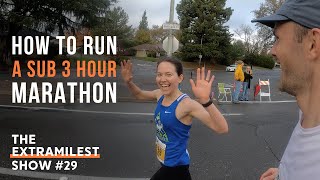
Elite marathoner Julianne Dickerson ran a 2:49 marathon through consistency, progressive overload, and Chi Running technique. She prioritizes sleep and nutrition, cuts digital distractions, keeps a simple training log, and does single-leg strength work. She also emphasizes finding mentors, peers, and mentees in your running community.
Chapters
It's very, very natural for your brain to kind of go into dark places when you're at that point in a race. And it's very, very easy to let your— it's very easy to feel like you're doing very poorly and I'm hurting very bad. I must be doing badly. Um, but you don't know that. You can't know that. It's like one thing I try to tell myself at that point in the race is like, Maybe this is what doing well feels like and try very hard not to judge the effort of the race during the race. Like you're going to be in a bad place mentally. Leave the— there's plenty of time to analyze the numbers later. Don't do that. Just focus on the task at hand and keep, keep pushing.
Hello everyone. In today's episode of the Extra Mileage Show, I'm interviewing Julianne Dickerson from Anchorage, Alaska. She's a very strong runner, both in trail running and in road running as well. And recently she set out a goal to run her first sub-3-hour marathon, and she didn't just run it in 2:59. No, she skipped the entire 2:50s and she finished the CIM Marathon in 2:49 for her first sub-3-hour marathon. Um, I will have to say I'm incredibly happy for her, and I'm also quite proud as well. About 6 months ago, she enrolled in the Marathon PR program, and I was very happy that I could play a small role in her journey as well. And in today's episode, we're going to take a deep dive into her training, into her mindset of actually getting ready for race day, and overall execution on race day as well. And she shares a ton of great insight and tips along the way. I don't have any sponsors for this Extra Mile podcast, but if you would like to check out more information about my marathon marathon PR training program. You can check it out at extramilest.com/marathon, and I'll make sure to link to that as well. One note before we dive in is if you're watching this video on YouTube, you will probably notice that throughout the video there are several still shots of Julianne in there, and that's actually because we had some technical issues where all of a sudden the video wouldn't flip from me talking to when Julianne would start talking. It would still show my face. So instead of seeing my face the entire time while I'm listening, I actually just put a photo of Juliane on there. But then from time to time, you will start seeing her talk as well when the camera flipped over. So I do apologize in advance, but it was still a very natural, good conversation, and I wanted to make sure that I share that with you guys. More information on all of the different show notes from today's episode can be found at extramilester.com/29. I hope you enjoy my conversation with Juliane Dickerson. So this is mile 16. 3 AM, we're going to get a shot.
Hi!
Do you want to get on the Extra Mileless Podcast? I would love to.
All right.
Okay. So here I'm officially asking her to join the podcast. So, and now save your energy and run strong. I'll see you at the finish. Hello, Julianne. Welcome to the Extra Mileless Show. It's very nice to have you on here.
Thank you, it's good to be here.
Yeah, absolutely. Let's talk for a little bit about our running journey together because we just ran CIM and we were not starting at the same time. However, we did meet somewhere along in the middle and I would definitely want to take a deep dive into our CIM race experience over there, especially with you coming from behind, running next to me for a little bit and then fly and taking off and running a very strong race over there. So definitely very excited to talk more about that.
So yeah. Um, I remember, I actually remember seeing you in the starting corral and I saw you, you went off faster than I was willing to a little bit ahead of me, even in the inside the corral. And I remember thinking at the time, like, oh man, I'm really glad that he didn't tell me what his goal was. Cause I would have. Been really nervous. And so I didn't know if I would see you or not, but I kept looking for you throughout the race.
And sure enough, we met around mile 16. Yeah, I definitely want to take a deep dive into your actual marathon training, into your actual race experience. And I think just for the listener at home to get a better understanding of you, it would be great to take a step back first and talk a little bit more about your actual running, how you got into running, where you currently live, how your training is. Would love to hear a little bit more there.
Yeah, I guess I've run pretty much my entire life. When I, I didn't run competitively until my mid to late 20s. Running was, as a kid, it was something I did for, for play and for exploring. As I got a little bit older, I would run to the end of the street and back or to my best friend's house, which was like 4 miles. So I was old enough. When I got to, I became a teenager and got to college, running was a way that I liked to spend time with friends. For me, I enjoy connecting with people like while doing another activity and I really liked running. And so I like throughout my entire life, I feel like I've always been looking for running buddies. It's a way that I really enjoy socializing and spending time with other people. It was also a way that I liked to cope with, cope with stress or the typical drama that teenage girls go through. Like I'd go for a run whenever I was upset or if the weather was nice. In college, when school was stressful, I would go for a run, or I was, I was traveling with some friends for a semester and we would go run in the mornings before class. It was just something that I did because I enjoyed it. And because if I was stressed, I could go out, go for a run and come back. And somehow it always, when I came back, the problems always seemed smaller and more manageable. And I just like cleared my head and I could get a focus on whatever the task was. Throughout all of those years, running was never something that I focused on for performance. Like school was always more my, more my focus. Uh, when I got to college, a couple of years in, a, my friend's little brother signed up for a marathon and people were like, oh, Julianne, you run, you should go run the marathon with Andrew. And. I think I had participated in a 5K at that point. So naturally, so naturally I said yes. This is like, maybe I have like free grain.
That's a good natural transition there. 5K to marathon.
Yeah. I, I met a guy at like waiting for the porta-potties at the start of the race and ended up telling him, I can't remember the exact conversation, but telling them that I had never run a half marathon. And he kind of gave me a weird look. We, we completed the marathon. Uh, it's my first one. It took me 4 hours and 8 minutes. Uh, it was in, it was in Memphis, Tennessee. It was close to where I was going to college. And I couldn't walk for about like going downstairs was excruciating for about 2 weeks. So I don't necessarily recommend the 5K to marathon.
Jump. There is something about building up, building up the stages for a little bit, but I do have to say that does sound quite recognizable though. Even, even if you do build it up, some of those first races were just quite, could be quite painful there too.
It was very, very painful. And, but for some reason, um, apparently it was a good experience because I kept doing them every semester after that for the rest of college. Not always a full marathon. Um, the next semester I did do a full marathon and recruited more friends instead of just 2 of us. There was maybe 6, some people doing the full, some people doing the half. This time it was in Nashville and it was about 85 degrees. And I had a miserable experience. I, I'm from Alaska. I don't do very well in the heat. And so yeah, it was, it was awful. So from then on, I mostly did half marathons. Um, I guess so about, I guess about Alaska. So I grew up in Kenai, Alaska and spent a lot of time, um, hiking also as a kid in the mountains around, around Alaska. Left for 7 years. That's when I kind of got into the marathon, road marathon phase. And then I moved back after grad school 7 years later. So now I live in Anchorage a lot.
What is running like these days in Anchorage? Because I look at your Instagram or your Strava sometimes and I see beautiful trail running photos during the summer months. But then right now I see quite a bit of snow going on there. And even I looked on the temperature the other day and it was 0 Fahrenheit, which I believe is -18 Celsius. So tell us a little bit more. How do you, how do you deal with that training-wise? Like during the summer months is one thing, but then during the winter months, how do you go about it?
In the winter months, there's a couple of different things that I use to try and maintain consistency. It's very, very easy in the summer to do— there's so beautiful and so many trail options. It's very, very easy to do more than you should and to support that. It's really important to sort of maintain some sort of volume during the winter. A couple of things that I do, um, I do do some triathlon training, so I'll do a little bit of swimming, a little bit of biking as to supplement. And there's really great communities here. There's a couple of trails that stay beat in through the winter. Um, so I would say First, uh, camaraderie. So finding other people who are willing to meet you at 0:30, which is some point in Alaska, and go— there's basically two trails here in Anchorage that stay beaten through the winter that even if in the dead of winter you can usually still get to the top. It's kind of repetitive, but you always know there's going to be other people there. There's a group, Thirsty Thursday Crew is what They always meet at 5:30 on Thursdays and you go and run Near Point. And then there's a different group that always meets at noon on Sundays for Bird Ridge. So there's at least 2 mountain runs that, you know, you're going to go and find other people who are crazy enough to go bundle up and suffer. It's kind of like a, like a shared suffering.
Yeah. That's a good way of going about it. And I think having it on those consistent days probably helps as well. Right. We have it end on Thursday and on Sunday, you kind of can always look forward to those specific days that you're going to be group running.
Yeah. Um, habits are very helpful. So I tend to do, like, I'm always going to do a mountain run Thursday night. I'm always going to do a mountain run Sunday afternoon. Um, I know that I'm always going to go do speed work in the dome on Wednesday nights. I know I'm always going to swim Tuesday, Thursday mornings, as long as I'm not like traveling for work. And just having those, yeah, like set days and set times that you can kind of like set up your week and have some— it really helps with consistency not to have to think about like, oh, what am I going to go do Thursday morning? I already know what I'm going to go do Thursday morning.
Is there much treadmill running involved for you? Like when the weather is that extreme?
Um, oh, actually I forgot something. Yeah, I, I did finally cave and I bought my own treadmill. Um, this spring I was using one at the, at the rock gym last winter. Um, because in this, in the summers, so we talked about marathons, but in the summers right now, my, my main focus has been mountain running. So I try to do a lot of, um, vertical. And so I'll actually just walk, um, set the treadmill, the one that they had at the rock gym. The reason I went to that one is it went up to 30% incline. And I w— it was positioned at the window that you could just watch the little rock climbers. And I would go set the treadmill at 30% and just literally walk. And the rock gym opens at 6:00 AM and there's only one treadmill. So I would get there at 5:55. The guy was always annoyed at me and be the first person in the door, walk straight to the treadmill, set my stuff on the treadmill.. And I finally gave up and bought my own. But yeah, I, one of the, there's, so there's yes, treadmill. Um, and recently now that I've done more road running in the last few, switched back to more road running last few months, I do run flat on the treadmill also, instead of just walking and climbing. There's also this building that runners in Anchorage, uh, love to hate. It's called the Dome. And it's basically this like huge, um, it's actually, it's this huge bubble building and the walls are actually held up. No, I'm serious. The walls are held up by like air pressure inside the building. Oh wow. Big white mushroom or marshmallow looking building. And it has a full-size track. It's actually a little bit bigger than full-size because they have a full-size soccer field inside that. And so really there's always soccer games going on or people hitting baseballs. Thankfully there's nets down around where people hit baseballs. It's still kind of terrifying, but it's a really great resource that you can go and have somewhere warm to do track workouts or just run easy and get out of the cold. While it is great group suffering to go run in the cold a couple of days a week, it's nice to not have to do that every single day.
Yeah, but, but at least when you're in the dome, like that, that blow-up building, it does have sidewalls and stuff, so you're free from snow and rain, right?
Yeah, it's 65 degrees or—
ah, excellent, excellent.
Good. And we, we love to complain about it, but it's really great.
Yeah, no, I, I can imagine. And then the other thing that I find fascinating from there is that your days are quite short in the winter months, and then in the summer where you can run until really late at night or very early in the morning. You got a lot of daylight. Like, how is summer running for you over there then?
You, uh, I've been trying to build up volume for like the last 4 or 5 years now, and I've still never gotten to a point where I'm capable of handling as much volume as what you could There's so much to do in the summer and so many cool races and yeah, you could go and do mountains every single, every single day.
Yeah.
No, I still, it's always, it's always this like a game of like trying to like get yourself to do enough in the winter to be able to handle the summer. But then in the summer, it doesn't matter how much you do. You always have to hold back.
Yeah. And so when, when looking at your journey, it has been It's been fascinating because you have a tremendous amount of hiking and trail running experience, and then you started focusing on some faster marathons. Can you talk a little bit more about how that transition was for you, for going from like training on steep terrain, and then actually you were quite focused on racing in, in, in the mountains as well, and then all of a sudden transitioning? How was that for you?
Started focusing a lot more on heart rate training and heart rate zones. And when I'm more specifically fit for the mountains, it's easy for me to go hike at like 145 beats per minute or so. And it's just what I would do for like an easy endurance type, type of hike. Um, that would be like MAF, a little bit less than MAF for me. When I first switched to running. Roads, it would— running at that same heart rate felt very, very difficult. And it took some time to like kind of build up like comfort with running fast on flatter ground to where I was capable of training at, training comfortably at 145 beats per minute. And it, it, it, it trained my body, transitioned over time, but I noticed I would go out and run and it felt very uncomfortable even to be in the 130s, which seems like it's maybe opposite of what most people would say.
It really sounds indeed quite the opposite over there because you have spent so much time at lower intensity because you would be going out on the trails for 2, 3, 4 hours or plus. And then all of a sudden you're going indeed to road and just that probably the cadence, the turnover, the intensity over there, because I've noticed it the other way around as well, I used to be really into road running and then my first experience is going to a trail was reversed from that where I would be going to the trail, I would be running at a road speed and all of a sudden, like after a few minutes, I would get so incredibly tired because your heart rate would shoot up with any kind of hill that was going on and you would have to get forced to almost slow down to get to a comfortable intensity again.
But yeah. So I'm actually seeing a little bit of the reverse now. I'm because of CIM, I'm a little bit behind where I normally would be for my, or where I was last year, at least for my mountain training and walk, walking on the incline treadmill feels harder than I remember now that I've spent a lot of time flat running. And now it's very, very easy for me to go and run flat at like a MAF type effort, whereas, um, hiking on an incline or walking on an incline treadmill at that same effort, like right now feels difficult. So it's interesting. It's interesting how the, um, the fitness transitions.
Yeah. So let's, let's talk some more about your actual training cycle because I've, I've had a quite close look. You were, you were part of the Marathon PR program. But before that, obviously you already had several marathons and quite a bit of trail running experience under your belt. Like, how— like, what kind of training volume were you doing to get ready for CIM? Like, you ran a 2:49 there, so you ran an incredibly fast time. You weren't initially even aiming for a time that was that fast. Like, can you, can you talk a bit more about what was your mindset going into this training cycle and how did things kind progressed throughout?
Um, when I, when I started the training cycle, I started training for CIM right after I ran a trail marathon. Um, the trail marathon was in Fairbanks, Alaska. It's maybe up, I think, 4,000 feet of elevation gain. And there's some like technical trail sections. That one, it took me like 3 hours and 27 minutes.
And that's very, very good with that much elevation in it as well.
Yeah, I was happy. I was very, I was happy with the result. It was a good, it was a good result. Um, I think it was 4th, 4th for the day. Um, but it was also 13th overall. Uh, so the, the women's field was, was pretty strong this year, but I was very happy with that result. I can't remember what I was aiming for, but it was a good result. At that point, late September, I started training for CIM, which was December 8th of the same year. And I really wanted to break 3. I think it just sounded like a really good round number to shoot for. And it sounded really hard. I didn't know, I didn't, didn't know what would be, what would be possible. So I decided to use the, there's some different, different training plans I had been using for Equinox. And then I decided to start kind of in the middle because I had 18 weeks left. No, 10 weeks left. I had 10 weeks left from Equinox until CIM. So I jumped in kind of in the middle of the marathon PR training program and used one of the recovery weeks after Equinox. Um, thanks for helping me sort that out. And I knew from the training I had been doing in the summer that I would be capable of handling the amount of training time because this summer I started tracking my training time a little bit more in detail. Of what was recommended for a 3-hour marathon. And I did, I thought 3 hours would be very, very hard. So I did all of the training. I did all of the cross-training. I did all of the strength training. It's like, I'm not leaving anything to chance. I'm going to give this as best of a shot as I can. Um, I tried to be careful that even though the time was something that I knew I was capable of, that I wasn't increasing my mileage too quickly. As I switched to flatter terrain, um, actually following the times in the training plan, I accidentally ran 87 miles one week, uh, which was, uh, I was lucky. It was probably too much of an increase in mileage for me at that time. So I'm glad that it went, glad that it went okay. That's still a very, very big week.
Yeah. That is a lot of volume right there.
And it worked. Um, I would go and run my, my 40 minutes or my 80 minutes, whatever, whatever the plan was that day. Um, the speed workouts, there's a, there's a group here in town that, um, Alaska Endurance Project that meets on Wednesdays. So I would substitute some of that actually worked out perfectly because the training plan written with speed workout on, on Wednesday. So once that group started up for the winter, I would substitute those on Wednesdays and then pretty much followed the, the long run training plans as written on the weekends. So sometimes a quality long run, sometimes a math test. Um, I did see pretty significant progress on the, um, the math results. So there was an improvement there beyond, um, just transitioning from mountain to flat running. Um, in right before, I think I did do one math test right before Equinox. So this would have been, I think it right, right before, I think it was September that it was like a 728. And then I missed the next one because of work in November, the drop down to a 710. And then in December down to a 7:05. And actually that, that math test where it was a 7:05, I had 2 miles that were like 6:59, like just below 7. And that was really, really exciting because I never had a math test with anything that started with a 6.
So I remember when you updated us about that and where you were just sharing the excitement of like, this is really working. We're heading in the right direction, something like that. And yeah, that was, it's really, that's what I sometimes think is, um, once you start seeing that part click as well, like it almost is another confidence booster that you're heading in the right direction. And especially if some of those things line up and you're starting to peak at the right time before race day, like all of that, you just go into race day feeling confident and then it's a matter of executing. But at least you've done the groundwork then.
That was, that was a huge confidence boost. Um, another one was there's, I think my, my favorite workout in the program was a fast finish long run. So it was, I can't remember, maybe, maybe 2 hours around MAP. I think I was running like 7:11 pace for like 16 miles and then drop down to something fast but sustainable. For 6— I can't remember how it was written exactly if it was by time, but I decided to do 6 miles and I ran the first one and it was like a 6:24. And you know, it's going to be on Strava and you don't want to like, sometimes once you start a workout too fast, you want to like hold onto that pace because you know, you're not supposed to start a workout too fast. So I was like, well, I don't want to post times that are slowing down. So I'm going to see if I can hang on to it. And I did. And I ran at least that fast for the 6 miles after running 16 miles, um, at a more reasonable pace. And then realized, okay, I, if I could hold on to a, like a 6, something in the 6:50 range for a couple of more miles, that that workout would have gotten me to a 3-hour marathon. So that was really cool. And it also, that gave me a lot of confidence that it would be okay to start out at a reasonable pace in the first half of the marathon. And that you can make up a lot of time because like a 7:11 pace is not fast enough to run a 3-hour marathon. But with that workout, I would have, if I had been able to maintain 3-hour pace just at the end of that workout, it would have been good enough. It's like, okay, so I can start at something. Oh, earthquake.
Weird. Um, really? All of a sudden I see like the screen, like moving.
Wow.
I wouldn't expect that to happen to me here in California.
Yeah. Um, distracted. Where was I? So you can make up a lot of time. And I read there was a different book that I used for training for Equinox. And they, they talked about that if you, for any piece of the first half of race that you run, if you run 1 minute too fast on the first half of the race, that it will likely cost you 2 minutes on the back half of the race. And so I. Wanted, and I love the idea of being able to like run well at the end of a race. I don't always do that well, but that workout in particular motivated me like, okay, I want to be able to go out at something strong but reasonable and then race well at the last third of the marathon.
So let's talk about race day. Let's just talk about the race week and then kind of going into the actual race day. So you guys. Flew in with a whole crew from Alaska. I saw you guys at the race expo and like you already flew in a few days beforehand, right?
I did. Um, I flew in with my friends, uh, Ryan Beckett and Ryan Cox, who were both racing that day. Um, several other Alaskans were, um, Michael and Sam and Sam, and I'm sure some others that I'm like blanking on at the moment were there also. And then, um, and my husband flew down also and it was great. We, we did fly down, I think Thursday before the race. It was kind of just a couple of days to relax. I was worried we'd be bored, but I think maybe being bored the day before the race was not a bad thing.
Yeah. It's kind of like that, kind of that calm before the storm, trying to relax while being excited at the same time. We had a good shakeout. Run. We had a little group run with Andy Hooks and some of our other friends that all came out. That was, that was fun by the sketchy American River.
Yeah, all the, the tents along the river. I was glad that we were in a, in a solid group. I think there was like 8 or 9 of us or something. It was a good showing.
It looked so beautiful. I tried to set up this group run and it looked so nice on the photos of the American River in Sacramento. And then when we got there, it was tent camp city and I kind of underestimated and it just looked a lot different in those photos of what we saw in real life. But oh, I'm glad we all survived. We had a good, good shakeout run over there.
Yeah. I hadn't researched it. I had no idea where we were going. So I did notice all the tents, but I guess I just didn't think that much of it.
Yeah. We're all good. And then race morning, guide us through it. How did it unfold from there?
Okay. So I have routine. Um, race morning is always, um, sweet potatoes and fried eggs and 2 cups of coffee 3 hours before the race. So you have to wake up early, but once you have a routine and you know, it works, you just gotta, you gotta stick with it. And let's see, my husband and our, the other friends who were cheering with him, Karina and Amanda, drove us to the— because you start out of CIM and run back. So they drove us to the McDonald's like a mile and a half from the start line. And then you have to take a bus. Well, it'd be probably, it would have been faster just to jog from the McDonald's to the starting area. And we jog around a little bit and looking around and there's Nike Vaporflys.
So many pink shoes and green.
Yeah. So we get over into the corrals and I'm with, I'm with the Ryans and they drop me off and they go up ahead. Cause they're going to start with faster people. And I look down and I'm not, I'm not a road runner and there's Nike, Nike, Nike, Nike, Nike. Oh, one pair of New Balance and me, and I'm wearing Innov8s. Which is really more of a mountain running shoe, but I just have to have like a flat pair of trainers and I know that I can run in them without getting injured. And that's what I did all of my training in. And that's what I just decided to race in. There's probably a much more sophisticated way to pick race shoes for road marathons.
Well, here's the thing you trained with it and it worked well. And so why would you change anything on race day? Right? Like if it ever worked well, I'm a very firm believer of not trying new things on race day. Same here.
Absolutely. Stuck with that. Um, the guy, some of the guys that were talking in front of me said they were going to start at like a 6:43 pace or no, no faster. And I was like, okay, that sounds good. Um, and it was, I think they were all shooting for 2:50 and I was like, oh, that's way too fast, but I'll try to hang with them for the first mile. So at least I don't go out. Way too hot. And it was perfect. The guy like looked down and checked his watch, like literally every 3 steps. And so I just ran right behind him for the first mile. And after like 3 miles, I decided they were going too fast. So I let them go. Um, I think I did pass 2 out of 3 of them later in the race.
No way. Oh, that's cool. So how did, how did the first half of the race feel to you? Did it feel like comfortable? Did it feel like you had to hold back? Did you feel like you were going out hard?
Well, mostly comfortable. Yeah. Um, I, I was shooting for when I ran, I like to race by, by heart rate. So I kind of have an idea of most of the races I do are shorter, honestly. So I know what I can hold for like a 1-hour race or similar distances. Equinox was a good test because I knew I averaged a 171 heart rate for 3.5 hours. So like, okay, at least if I stick to that for the first half of the marathon, I know I'm not going to bonk. I didn't quite hold to that. I think I ran at like a 172, 173 for about the first first half and, and then started giving myself a little bit more room.
Um, and then mile 16 came around.
And I was thinking like, okay, I'm going to, maybe I had let myself get to like 175, 176 at that, at that point, halfway, halfway I got there and I was like, well, I kind of hurt a little bit. But not that bad. And Ryan said I was supposed to feel good at halfway. So I don't know, maybe this is about where I'm supposed to be.
And meanwhile, I started out rather quick at that marathon. And I probably in hindsight underestimated the shape that I was at with a few different things that happened on race day. So I, I kind of went out at a 2:45 pace, like whatever it was, like just 6-minute mile, a little bit slower than that. Okay. And like after 4 miles, I knew it wasn't my race and I started slowing down, started slowing down. And then all of a sudden I'm running, running, running. And around mile 16, I'm just recording a little video, talking into the camera. And all of a sudden, hey, that's Julianne. And sure enough, it was so awesome to see you coming from behind, running next to me. We had a little conversation. That's why I actually asked you to come on the Extra Mileless Podcast. And you actually agreed.
And you actually agreed.
And you looked still very strong while I was suffering at that point. And we chatted for a bit. And I think I said something along the lines of like, 'Come on, go, don't waste any energy and go for it or finish strong' or something like that.
And I was glad. I think I was, I think I was, I can't remember. I think I was going to try to wait till mile 18 to like increase the effort again. And then you said like, 'Go finish strong.' And I got really motivated and I was like, okay, I'm going to. So I went ahead and started, like, I ran like quite a bit faster for like the next 6 miles after that. Like there was quite a few down in like the 6:20, 6:19-ish pace per mile. And then mile 23, just, it started to hurt.
And how did you get through it? How do you get through spots like that when you're in unknown territory? You've never raced at that pace before. How do you get through that, that, that spot that you can't really train for that much?
Um, this race in particular, I had a Disney song stuck in my head. Which one? Frozen. So we'd gone to see Frozen with our buddy Jacob like a week prior. And there's the, like, Into the Unknown, the song on the Frozen video. And so I had like that playing in my head. It's like, I've never done— okay. Okay. So you get to mile 20 of marathon. Or, you know, lap 4 of a mile, like, you know, that point, that last bit of the race. And especially a marathon, because how often do you get to run 26.2 miles at marathon pace? If you're like, almost never, like most people, maybe twice a year, if you're doing like a lot of marathons and that's your focus. So being at mile 20 of a marathon. At marathon pace is very, very special. Like you can't waste that. Like you have, like it hurt. Yeah. It's supposed to hurt. Racing hurts. Racing well hurts a lot. And so one thing that I try to tell myself is when I get to that point, it's very, very natural for your brain to kind of go into dark places when you're at that point of a race. And it's very, very. Easy to let your— it's very easy to feel like you're doing very poorly and I'm hurting very bad. I must be doing badly. Um, but you don't know that. You can't know that. It's like one thing I try to tell myself at that point in the race is like, maybe this is what doing well feels like. And try very hard not to judge the effort of the race during the race. Like you're going to be in a bad place mentally. Leave the— there's plenty of time to analyze the numbers later. Don't do that. Just focus on the task at hand and keep, keep pushing. Um, another, another trick, um, not for that point in the race, but just for racing in general. Um, this is from, it's called Endure by Alex Hutchinson. Uh, it says perceived exertion, or what we'll refer to as your sense of effort, isn't just a proxy for what's going on in the rest of your body. Uh, it's the final arbitrator. The only thing that matters. If an effort feels easy, you can go faster. If it feels too hard, you stop. This may sound obvious, but it's profound because as we'll discover, there are a lot of ways you can alter your sense of effort and thus your apparent physical limitations. Without altering what's happening inside your muscles. So like there's, there's a difference between reality and how you feel, and how you feel is kind of, it's not always the same as reality. And you can actually change how you feel based on your, your thinking and your mindset, like if you're, if you're out running with friends, running feels a lot easier sometimes than if you're out running by yourself or if it's a race. Okay. So here's another example. Say you're in a train, you're doing your training and you think, oh my gosh, how do I ever race at this pace for the full distance? When in training, it feels so, so hard, but then suddenly the gun goes off and the race starts.. And oh, it's suddenly very, very easy to race at that effort and to get your heart rate up to race effort, like race mode clicks in, you're, you're motivated. Um, a lot of times if it's in the middle of a race and I'm trying to like run a hard, consistent effort, I'll pick the person in front of me. If I know that there's someone who's an appropriate speed for me and try to think like, okay, how, how easy can I make this pace feel? Um, or like smiling during the race, um, playing Disney songs in your head while you're in the middle of a marathon, listening to— I liked listening to the other runners' conversations and they were telling like, uh, jokes about vapor plots during the race. Classic.
I think the point you just made is very, very spot on about how you think about the perceived effort. And, and I think in your body you have all these natural systems that, that are in place just to protect you. And some of those, like, sometimes you feel like, oh, you're in so much pain or you're in so much discomfort. And when you look at it in perspective, you can to some extent move that discomfort barrier when you change your mindset as well. Like, where it feels like you're at 90% of discomfort, but actually it's, it's only 40% and you can push so much further through that. It's just more the fine line of to what extent is it safe to do that? And some people like can even override that discomfort so many times that it does get in a bad spot.
So yeah. Yeah. Um, well, is it, there's a, a coach here in town, I guess, used to tell the kids like, go as hard as you can. Don't worry. You'll, you'll pass your body. You'll pass out before anything bad happens. Yeah, no, it's, it's, I think especially if you're not, I, there's probably a thing as racing, racing too much. Your brain is the limit, not your, not your body. Like you're, it's, it's your, it's your, you're the one holding you back now. Yeah.
Yeah. It's, it's an interesting one that way. Sometimes even in a marathon, I think when you're at, when you're feeling really, really good and you're feeling like your discomfort level is a 1 out of 10, realizing that that can quickly go to a 7, 8, or 9 out of 10, like a few miles later, sometimes that kind of preps your mind mentally as well, that it's not going to be that comfortable for the rest of the entire race as well. It's, uh, it's, it's another one sometimes helps. Tell me about the last few miles then. So mile 23 came around, mile 24.
You, oh gosh, just trying to hang on at that point. I was very grateful that it was only, it only hurt for about, it only really hurt for about the last 3 miles. Oh, maybe means I didn't go hard enough. Um, I, around mile 20 or low, low 20s there, I would pass a couple of girls and one of their friends that was there cheering for them started to say like, oh, you can go for it. Like 2:50 is still possible. And at this point, So my, like, if everything went like, I really wanted to break 3 and I knew from training that I was capable of that. Um, 2:55 sounded like a really good goal because that would be, um, like a top 10 result for Alaskan women for road marathoning. And I was like, that would be, that would be really awesome. And based on training and like previous runs at shorter distances. If everything went absolutely, absolutely perfect, 2:53, I thought was what, like best absolute possible result. But at this point, like I went out at a 2:55 pace-ish, I think. And I knew I was going to break that. And I knew I should be able to break 2:53 at this point also. So it's helpful. There's nothing interesting about things, you know, you can do. It's better to have a goal where you're going to like drag everything. It's very, very satisfying to finish a race and collapse at the finish line. Like I would almost rather finish a race with a bad time, knowing I had spilled my guts on the course, then get a good time, but know like, yeah, that wasn't that hard. So I'm like, okay, what time can I shoot for that? It's going to like, I'm going to hit the finish line and collapse. It's like, all right, maybe, maybe that's possible. I don't know, which is exactly what you want. You want something that isn't so pick a goal that's not so unreasonable that you have no chance of hitting it. It's like a goal, but don't pick a goal that you know you can do. You want something that's going to like be very, very hard that you might be able to get. And so I decided, okay, I'm going to try for 2:50 and started— it started to get harder and harder to hold on to the pace. I'm not actually sure if I did the math that well at that point. And you're just— there was one bridge that you go over and you're like, aha, that's that bridge that people were talking about. And it wasn't that bad. A lot of hills in Alaska. There was a sign for, uh, let's see, what was it? 1 mile to go. Maybe it was 1 mile to go. And I remember maybe it was 800. No, it was 800 to go. It was 800 to go. And I remember looking at my watch and thinking that it was impossible that I would have to run like Faster than I had been running the whole course to be able to still break, um, still break 2:50. And I don't know, I just kept running anyway and then got to, and it was in the wrong place or I did math wrong. I don't know. And got to the 400 and thought, okay, wait a second. No, this might, this might be possible. And decided just to, to go for it. And you, you know, the gun goes off. I didn't know where I came around and saw the sign. There were like 200 left and I didn't, I knew it was close and just tried to like dump everything that I had into that last bit. I couldn't remember exactly. You could see the time, but I didn't know how far behind I was from the my chip time from the gun time. And I think it was like 30 seconds or something, but my chip time ended up being a 2:49:52. So it was enough, but I didn't even actually know when I crossed the finish line if I had made it or not. But it was weird. Cause I hit one mile, one sign. It was like, there's no way this is possible. And then I hit another sign. I was like, Ooh, this might be possible, but I don't want to do the math too carefully because if it's not, I don't want to know. I just want to Go for it just in case.
And how did that feel crossing that finish line?
Really good. Uh, it really good in the, like, I, I feel like I raced well. I feel like I was, you know, that the collapse at the finish line sort of like I, I never gave up and like, it's, it's, you kind of know as only the rate you as the racer know whether you raced well or whether you could have given more during the race. And I, my friend, um, Annie Connolly, who does a bunch of Sunday bird run hikes with me, she did a, she was really inspirational for me for this race. Um, she went and did a, um, I don't, I don't remember the distance, maybe 25K, but that doesn't sound long enough. Maybe it was, I can't remember, went and did a long race and gave up during the race and it haunted her for a year. And she went back the following year and did the 100K and didn't quit. And before I went and did CIM— and that was like a big, big distinction that she made was she knew that she gave up the first time and then she went back and did the longer, harder distance and raced, raced, didn't give up, didn't slow down the entire way. And so that was another thing I was using to like motivate myself during the race is don't quit. You told Annie that you weren't going to quit and to really just race well and pour yourself out onto the—
Yeah, it is such a nice feeling when you're able to hold back at the beginning and finish like that. With some of your last miles actually being some of your strongest. And I'm sure that you, you must have passed several people in those later miles as well then.
Um, yeah, mostly I think only a couple of people passed me in the second half of the race.
Yeah.
Well, it was, it was a couple of good people to run with, but there are that we would go back and forth a bit during the last, the last half But mostly are people that second half.
Yeah. Right on. What was your, um, race nutrition and hydration strategy like? Like, did you take everything on the course or did you bring anything with you?
Um, I like the— Clif makes some, um, blocks, race nutrition blocks. Um, I like the ones with sodium in them. So my, my favorite flavor is I get the salted watermelon. It's something that I've used for mountain races. It works for me. I did also drink the, the Nuun powder on the race. Um, pretty much, pretty much every time that fluids were offered, I would, I would drink that. I also carried with me a couple of little maple syrup packets. I'm blanking on the name of the company that makes them right now. Um, and there was, they had a little bit of salt added and some of them also had like a coffee flavor and caffeine. So I maybe I took, maybe I think maybe I had 2 of the coffee syrup packets and maybe 2 sleeves of the, the Clif Blocks towards the end of the race. I did also take some of the, the goo packets. I was very, very done with anything. I actually, I really like real coffee, but any coffee-flavored goo I want nothing to do with for a while.
So what do you think when you look now back at your training, your, your training cycle and actual race performance, what do you think had the biggest impact to achieve such an amazing result over there? Like, Was there anything in particular that you think stood out over there, or was it a combination of things? Or like, how important is the training volume overall in this whole picture?
Just curious to hear. Um, consistency, very, very much. And volume for me for 2019 was a huge factor, not just for CIM, but for the summer mountain racing season as well. Um, having a huge volume at low intensity allowed me to have like a very, very strong aerobic base. So in— I wasn't racing as much going up into CIM as I do in the summer. So I don't quite have a comparison, but if you back up to like the summer mountain racing season, I was doing about doubled the volume of what I had been doing the previous year, uh, both in terms of mileage and elevation. And also a lot of that volume was at a lower intensity. Doesn't mean I didn't do speed work. I still did speed work to prepare for the races, but I noticed that having a really, really solid foundation and also making sure to work to maintain that foundation throughout the race season, it allowed me to recover very, very quickly from races. So I can think of a race that's maybe an hour, hour and a half. In previous years, I would have been wrecked for 4 or 5 days. Whereas this year, um, I'm doing double the amount of like easy training and I was able to recover from those same races in maybe a day or two. Like go for an easy run the next day and be back at a workout 3 or 4 days later. You need, you need the volume to be able to have that, have that foundation to absorb the hard workouts and recover from the hard workouts and the hard races. And in order to do that without, without injury, you need to be working at that volume consistently over time. It's, it's really beneficial if people will just be patient and like slow down a little bit and train at the level that you're at consistently week after week after week. And like gradually, gradually increase the volume and increase the, increase the pace. You're going to get to a much, much higher end result. Than where you're going to get to. If you sharply increase your training volume, get injured and get a setback, then you basically have to start all over again. Whereas if you had slowed down and be patient, you in the long— it's, it, it's slower at the short term, but you get a much, much better result in the long term. Yeah.
Well said. You've previously shared with me that you're quite a note-taker, that you write quite a bit in your journal. What, what, how do you go about this process? Like, uh, what, what sort of, like, first of all, why do you journal and in what sort of way do you go about this?
Um, so I keep, I keep two. One is a, um, a hard copy journal and the other one is an Excel training log. So hard copy, these are what I like. I use the Moleskine. I usually put stickers on them. And sometimes I like to put, if I have a high level of like what I want my training to be, I know I bookmarked it, hang on. Okay. So for CIM, for example, here's marathon PR program in one-page format. So I had my, what week it is, what day of the week, how many minutes, is it speed work? Is it strength? Is it cross-training? Is it like low aerobic? And rinse and repeat. But I had like a one-pager of like, okay, here's what I'm doing. Here's the day. Here's what I'm doing. I, I know ahead of time what I need to do on this day about once a week. I'll put together like a, like a one-page summary of what I will, just a little grid of what my workouts were that week. And then when I get to, usually I'll do this in first, first thing in the morning, like I'll get to the office, go to morning meetings and sit down. It takes 10 minutes or less. And I like to keep a gratitude journal. And I'll write down whether, and it doesn't have to be, it's not training related necessarily. It might be something just life related, but it's one of the things that I find really beneficial to help me keep like a good, a good mindset. Um, so that's my, I don't know. I've always liked journaling.
That's what I do.
Same here. Quotes. I'm absolutely obsessed with quotes. So all of them have like, from whatever I, I read a lot of books and I save a lot of quotes. So I always write down quotes in my journal. And so that, that's journal version. My training log, I keep in Excel and I'll record, uh, sometimes I'll put in like a quick amount so I can hit whatever my like volume goals are for the week ahead of time. But then after I do the workout, I'll go in and I record If it's, um, like the amount of time that I spent doing, doing the workout, the mileage covered, the vertical covered since mountain training is a big, big piece for me. Um, I record my average heart rate for the workout, max heart rate for the workout, and then the time that I spent in each of the different heart rate zones.
Um, And you grabbed this, you grabbed this info from Strava or just from your actual workout data?
Um, from Garmin. So I use a, um, Fenix 5S. Um, it's a little overkill for just, just running, but it has other features I like for triathlon stuff. And I'll pretty much always— they have an HRM tri Is there one of their heart, um, chest strap heart rate monitors? That one, the blue one. That's the one. And I'm pretty much, if I'm doing anything at all, I'm wearing that. And I will, so I'll just go into the Garmin app and it has a time per heart rate zones. It has some, you could go and get tested and get something a little bit more accurate and it It has different estimates if you're swimming versus biking versus running. I don't worry about it that much. I just take whatever those numbers are, pop them in my spreadsheet. And that way I kind of have an idea week to week and also in the different seasons, what percentage of time I'm spending in more of like a below MAP. So it'd be like kind of zone 1, zone 2 versus racing. Or doing interval or speed work of some sort, which would be more in zone 4 or zone 5. Um, I do, I tend to do a, what I think is a pretty high percentage, uh, low. A lot of weeks it'll be even 95%, sometimes more in just zone 1 or 2. Um, the extreme other end for me would be like maybe I do 12% zones 4 and 5 if I had speed workout plus a long race that week.
Yeah. Yeah. Well, and it's, it's different too, because sometimes when I see you going into the mountains, it's, it's not always for like an hour. It can be 2, 3, 4. Like I've seen you going on some really long adventures too, but then obviously the intensity is quite a bit lower. So yeah, I can, I can see how that percentage overall would would get rather low.
A lot of it ends up being honestly even, um, like lower than, lower than zone 1, which is if you're just looking at, if you're trying to get the max training result for the least amount of time, it may not be beneficial, but sometimes I'm not in the mountains for the most ideal efficient training results. I'm just in the mountains because I love being in the mountains. And I love adventuring with people and I guess it has to be worth it. You have to, you're not going to improve if you don't enjoy, enjoy what you're doing. So, I mean, this is like, I want to keep doing this for, for years that the last 5 years have been since that's kind of when I started racing, I guess. Been wonderful and I want to do this for another 10 or 15 years. And so if you're going to do something for a long time, you have to love it.
And that's the, that's the biggest thing. Like you have to enjoy the workouts. And even when I, it's one thing to go run on, on a flat terrain, but sometimes also when I go with my friends on the trails, like you don't even notice that you're running. You're just catching up with friends. And you ended up spending 2 or 3 hours on a trail. It's, yeah, it's nice when that happens.
Yeah. And you're, and you're getting great training from it and it's, it's enjoyable and it's sustainable and you, you want to go back and it's adding to your life. It's not, it's not just a, it's not just about like racing is, is fun. And yes, I love having big goals and what. Everyone should have big goals. Maybe not. I don't— not everyone should have big running goals, but it's very enriching to your life to have things that like you're really excited about and really passionate about and like really working towards and going for. Um, running is one of those things for me, especially, especially running in the mountains. Um, and I don't know that that's appropriate. For everyone, but I think everyone should have that in some aspect of their life.
Um, I got off track. No, it, it helps having those goals, like, surely. And I think too, in the short term, a lot of people underestimate, like, or actually overestimate what they can accomplish. But in the long term, with, with consistent work towards it, But having that clear goal in mind, you can accomplish so much more than you think. It's just purely being able to say no to other things and focusing very rigorously on a few of these bigger things.
Yeah, people are much, much more capable than they— like, focused, intentional On anything, you're going to make progress. People, people think people are so much more capable than what they, what they realize. It takes, it takes focus and it takes, I think, like you said, saying no to other things, but like, so for example, if you choose running as something that you want to focus on, um, like your body has an amazing, amazing ability to adapt, um, given enough time. And it's, you just, you have to progress. You have to be, like you said, consistent, and you have to progress at a rate slower, progress your training at a rate slower than what your body is capable of adapting to. And for me, I find that's often not even my aerobic system necessarily. Like I find that. It takes my joints and ligaments longer to adapt and what I could progress aerobically if my, that musculoskeletal system could stand the training, but it can't. So you do what you can, hopefully within a limit that you don't set yourself back and you just have to be patient. And like you said, it's, it's good to have goals. Reasonable goals in the short term, something that's going to be hard, but that you're capable of. And then really, really ridiculous goals.
Yeah. I will never, I will never forget, like in, when I really got into running in 2013, there was this, and I first started getting into Strava and there was this Strava segment in Long Beach and it was about half a mile. And I think the time on that, that the number one guy or girl had on that segment was, I think, a 5:45 minute mile pace. And I tried to run it, right? And I think I must have ran it like average pace was probably like 7, 7 minutes or something like that, maybe 6 and a half. And I was like, I remember posting something on Strava like, how in the world is it possible to run that fast? I couldn't picture being able to run. I believe, yeah, maybe the segment was around in 5:30 minute mile or something something. And sure enough, like, at that point I couldn't even visualize what that would be like. Yet if you do realize that with slow progress over time— and sure enough, like, 10 months later I went back and I got that segment. But yeah, like, it took a long time to even, like, wrap my head around it. And gradually over time you improve a little bit and you become faster and faster, and then You're able to accomplish so much more. Again, it's, it's quite fascinating.
I think what you said there is really key. The, the, the piece about like wrapping your head around the ability, like in your example, to run that, that 5:45 mile. And you said you were running like a 7-something before then. Yeah, probably. Okay. So if you're, when you can run a 7-minute mile, running a 6:55 mile sounds very, very hard if you think you're, if you think that your limit is where you're at. But if you can wrap your mind around like, okay, if I do the training, maybe my, my limit out there in the future somewhere isn't a 6:55 mile. Maybe my limit is a 5-minute mile or something much, much faster. Then suddenly the idea of hitting your goal, which is a 5:45 mile for that segment. Feels a lot easier than the 6:55 mile, or, you know what I'm trying to say? Like if you, oh yeah, you can, you can think of like, okay, the long, the long-term potential is way out there. It's easy to progress. Like you give yourself, like give yourself permission to improve if that's what you're putting the time and the work into.
And, and that's the same with, I think if people truly want to qualify for Boston, but they might be far off from that goal at this point. Don't tell yourself you're never going to get there. Tell yourself it might— like, if I truly, truly want this, what is, what is that going to look like in 12 months, 18 months, 24 months of consistent training? And I think you actually shared with me previously something along the lines of, like, the question is not is it possible, but rather do you want it? Like, you, you Told me that one.
Yeah, I think I stole that. I think I stole that from Jerry Ross, maybe, uh, one of the coaches here in Anchorage, but yeah, he says, um, I'll have to apologize if I'm misquoting it, but yeah, the question isn't, isn't if it's possible, but rather do you want it? And if I think most people are, if, if it's some, if it's something that you want and you say no to the other things You align your life and to, to progress in that way. I think pretty much everyone's capable of qualifying for the Boston. I think you should be— when you set goals, I think you should know the cost of those goals. I don't think it's beneficial to say I want to go qualify for Boston, but I'm not going to do the things that it's going to take to allow my body to adapt. If you're gonna set a big goal, awesome, yes, but know, know the cost of the goal that you're setting and learn, become a student and learn what things do I need to change. Like maybe do you need to be sleeping 8 hours a night? Do you need to be eating, eating real food and fruits and vegetables? Do you need to be doing your mobility? Do you need to be consistently putting in your training and People are capable, but you're going to be saying no to other things to hit those, hit those goals.
Yeah, I think one other fascinating change is just how much of a distraction society we live in right now with social media, with Netflix, with the amount of emails and interruptions that The amount of— like, it seems that it became— becomes harder and harder to focus, and that people just get easier and easier distracted. Like, the attention span these days has become shorter and shorter. And this is like— I, I read about it more in that whole book, like, Digital Minimalism, which basically talks about being very conscious about how you use social media. And that, that has kind of made a change for me as well in that focus perspective, it can be a huge, huge time suck. Absolutely.
I remember I had one moment, I think I was— I like to take 20-minute naps and I set my timer for, for 20 minutes to take my nap. And I, I swear I opened Instagram, I closed Instagram and suddenly 9 minutes of, 9 minutes of my nap timer was gone. I was furious. Cause I was like, I didn't spend any time. I swear. I didn't want to spend any time on there and half my nap was gone. You don't even, I feel like you don't even realize how much.
You just get sucked into this vortex. 9 minutes is a lot of time. No, the vortex of distraction is real. Like the YouTube recommendations that keep coming up are really appealing to click on, even though I know I shouldn't click on them. So yeah, it's one of those. What recommendations would you give your younger self? Like, is there anything, like, if you would have to go back to you being 20 years old, just getting into, like, wanting to start to do some marathons, is there anything that you would recommend high level there?
Um, I think some of the best advice that was, uh, that I had heard, that I heard that would have been really great to know back as like a younger runner, as they— I'm stealing from this from Jerry Ross again, there's that consistency is what ultimately leads to success and just building up. Yeah. Just that, that again, that idea of like gradual progression and consistency over time. And I would also, one thing that I wished I had Kind of along those, that same vein of consistency. I wished the first 3 marathons that I did and the mess of half marathons, I never kept any sort of training log or notes. And I found it very, very useful now to have a record of, um, to have a, have a written plan that you're following for whatever you're training for. That's. You know, methodical, specific to the event that you're trying to train for and progressive in some way. And then to also have a log of what you actually have, a written plan and have a log of what you're doing. Write them down. And I prefer, I know a lot of people like to use like Strava to track their training and I, it helps me a lot personally to actually write down and record. Myself. I feel like I'm more accountable that way. And it should be— do you need a big fancy Excel spreadsheet? No. Um, but it should be appropriate for the person and something that is actionable and something that you're actually— that complicated is great, but it needs to be something you're actually going to use. So make it simple enough that that you use it.
Yeah, yeah, yeah. I want to be respectful of your time. I know we've been talking for a bit. I got two more questions over here. Like, you, you mentioned that you read the Chi Running book and also that you listen to the Chi Running podcast with Danny Dreher. And can you talk a little bit more about how, like, you've mentioned a few times things about mindfulness in your running Can you explain a little bit more, like, how you go about that in your actual training?
Yeah, fantastic book, highly, highly recommend Chi Running. It seems like whenever I read that book, my running somehow miraculously improves, and I don't know how that works, but I need to read the book again.
Oh, it's a fantastic book, I agree.
You're— I noticed after I read it, I'm much more aware of like my posture throughout the day. If you have good posture throughout the day, it'll be easier to maintain good posture while you're, while you're running. Um, it helps me really think about, I think this is kind of where I got that idea of how during racing, like how can I make a certain pace feel easier? Or how can you use, like, while you're running, how can you try to use gravity to do more of the work for you and try to like play around with, uh, if you're leaning forward, just, just a tiny, tiny bit for accelerating. And I started paying attention more to my, my cadence while I was running and was able to make some, um, improvements in that from like one Mid 170s to now, I usually run in the mid 180s is what seems to work well for me. Um, focusing on your, your breathing. And I noticed that it's easier to be more relaxed breathing if it's during, during easy runs, not during racing, not during intervals necessarily, but to breathe through your nose while you're running. That was something interesting to work on for a while. And yeah, he gives a lot of really, um, like practical tips that you can do to try and improve your, improve your running form and improve your efficiency. And I've found them to be that I still have a long, long way to go. I do not by any stretch have great running form, but, but I found it to be very beneficial already.
Yeah, no, same here. Like, and even sometimes if it's the little tweaks, the little tweaks of like paying attention to your cadence or opening your stride slightly more, focusing a little on your lean, or yeah, all of these little tweaks can just help optimize the actual running economy and makes you just run a bit more efficient, which all the little bits start adding up over the duration of a 10, 20, or 30 26-mile run.
So yeah. And it kind of gives you something to do and to focus on while you're, um, I sometimes it's, I enjoy running more thinking about like thinking about my form, thinking about that rather than listening. I don't really like listening to music while I run too much. Sometimes yes, but this is a nice alternative.
Yeah, absolutely. Right on. Do you have any other recommendations for runners looking to improve? We have a lot of different listeners from all around the world of different levels, anywhere from beginners to those like you looking to break the sub-3-hour barrier. Do you have any other recommendations?
I think, I think that pretty much, pretty much covers it. Maybe I've gotten a lot of benefit from doing. I've added in strength training in recent years, and I think that's a worthwhile, worthwhile addition. And I guess, yeah, find— figure out what— if running is important to you, what— find a way to keep enjoying it and keep loving it for, for years on end.
And set those goals high. Yes. Awesome. That's good. I do, I do just have to ask you, tell me a little bit more about the strength training, because I know like I would want to know, but others want to know as well.
Okay, sure. Um, so it's not, I've been using, there's, there's a group here in town, um, AK Athlete, one of my Friends Noel is the— does the strength coaching. And it's 2 to 3 times a week. And there's some, some like agility and jumping focus and some strength focus. A lot of like single, single leg work that is kind of helpful for the mountains in particular. And It's, I go 2 times, 2 times a week for about 45 minutes to an hour. Sometimes a third group workout on Sundays, but not every week.
And once again, doing it in a group dynamic, in a group atmosphere is motivational as well to get out there.
I'm sure those, the group, the group workouts always feel like they take about 15 minutes, whereas the solo workouts, you feel all 45 minutes to an hour.
Totally, totally know what you mean.
So I guess that would be advice. Like if there's something that you don't have like particular expertise in, uh, I would say, okay, there's, there's 3 types of people that you need in your, in your life or running or otherwise. Um, you need mentors. So people who, A, if you have a big goal, like find someone who's done that before and learn from them. Um, Or if you have no, someone who has a particular skillset like strength and conditioning that I don't have, um, go and find someone who does and learn from them. You need that type of person. Um, you need people for the camaraderie piece. Like you need other people who are in a similar place that you are, that are heading in the same direction as you are, that are willing to be the ones that are going to show up at that. 0 degrees Fahrenheit, it's dark outside. When race day comes, we're going to look back on this day and say, well, it's raining, but it's not as bad as that one workout. You need people who are crazy enough to show up and do those runs with you and walk with you through the journey. And then you also need to give back and be mentoring someone else along the way. Who's maybe younger than you, maybe a newer runner. And kind of help them along as well as they're following the same journey that you're on.
Yeah. Well, thank you for sharing your journey and for, uh, for letting us know all of the different things that you have learned along the way. Where can, um, where can people find out more about you? I think you post on Strava quite a bit.
Yeah, I'm on, I'm on Strava. Um, Julianne Dickerson. And I probably— there's most, most of my stuff is on Strava, not, not all, but probably 70+ percent is on there. And I'm also on Instagram. Uh, I think it's, uh, Jules Dickerson and I'm on Facebook as well. Uh, and I'm on the Marathon PR Facebook group.
Perfect. I'll make sure to link to all of that in the show notes as well. So thank you very much for taking the time. Really appreciate it, and we'll, uh, we'll continue the conversation again soon, I'm sure.
Thank you. I've enjoyed being a part of the community.
All right, we'll talk soon. Bye now. Thank you for watching and listening. I hope you enjoyed today's conversation. I would love to hear from you. What was one lesson or one key takeaway from today's episode? Please let me know in the comments. And if you would like to find out more information about the Marathon PR program, you can find this at extramilest.com/marathon. Several more podcasts in the works, so make sure to check back soon, and I hope you have fun out there on your runs. All right, have a good one. Later.
More from Floris


Ryan Hall 2.0 on Strength Training For Runners, Lifting Heavy & Trail Running




You’re Doing Zone 2 Wrong (Even If You Think You’re Not) | Scott Johnston Round 2


How to Build an Unstoppable Aerobic Engine (Even If Starting From Zero) | Scott Johnston


Stress Is Killing Your Running (The Relax Fix You’re Missing) with Dr Kasim Al-Mashat

When things get hard, say this, it (works in any race) #jeffpelletier #running #ultrarunning