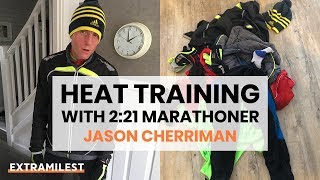
Heat acclimation training on a treadmill in layers can replicate the physiological benefits of altitude training in two weeks. The protocol involves stacking base layers, thermal wear, a coat, hat, and gloves to raise core temperature. You'll develop more sweat glands, increase blood plasma volume, and improve VO₂ max before race day.
Tell me more about the heat acclimation because I've seen some of the photos and it looks like you're going to the North Pole or Alaska and you wear many different layers. How do you go about that?
Okay, so I have a treadmill in my garage and we've actually had some quite nice weather here over the last few days and it's sort of been getting up into the sort of 23, 24 degrees outside. It's a bit cooler in the garage, but the idea is essentially to put on loads of layers of clothes. So I will have a base layer, then I'll have another thermal layer, another thermal layer, and then a coat, woolly hat, two pairs of gloves, thermal tights, and some tracksuit bottoms over the top. So I'm wearing lots of clothes. Now, some people might think I'm a bit stupid or a bit crazy for doing that, but there are some very, very sound physiological arguments for doing heat acclimatization. And it's not just around preparing yourself for actually running in the heat. So it's massively unpleasant while you're doing it. What you will notice is your heart rate is higher for a given pace, but obviously what your body is trying to do is it's trying to cool itself down. So one of the adaptations that you get from doing heat acclimation training is that it will essentially, well, over time it will reduce your core body temperature, which will help with cooling. It will increase your sweat rate. So what that means is that obviously when you are running at reasonably high intensities around marathon pace, your body has the ability to, or higher, your body has the ability to cool itself more easily. You will get more developed sweat glands. So what that will mean is you'll retain more electrolytes.. So your balance is less likely to be out of kilter. And so what that means is that actually you probably don't have to drink as much as non-adapted folks would, especially within a marathon. I mean, it might be, it's probably almost certainly different for somebody running 3, 4, 5 hours. But if you're running, just over 2 hours or 2.5 hours, there's probably not that much requirement to drink too much if you have acclimatized. Aside from that, there's other benefits as well. So there's things like it has been demonstrated to improve VO2 max. It improves your blood plasma volume, which means there's more blood to go around, which can only be good in terms of getting oxygen to to the muscles. So there's a huge amount of benefits to doing it. And it's probably a cheap man's way of getting some of the adaptations that somebody might get from 4 weeks at altitude. But also because you only have to do it for a couple of weeks. For those that do adapt to heat, you'll have got all the adaptations within a couple of weeks. Within a couple of week period. So you don't have to do it all the time. You don't have to sheepishly walk out to the garage every morning with your neighbors thinking you're a bit of a weirdo. You can only do that, you only have to do that 2 weeks in every marathon buildup to be fully planetar.
So how many weeks before the race would you do it and how many of these acclimation runs would you do?
Okay, so I started them, this build-up, around about 5 weeks ago, just because I was sort of nervous about doing them again, because they're really not pleasant, especially the first, the first couple, they're absolutely horrific, but you get used to them. And then, So the aim was to gradually introduce them. And what I did find was actually after one of the sessions, I felt terrible the next day. But I just realized that actually I hadn't properly hydrated after that session or indeed got enough fuel in for me for the next day's running. But yeah, I would like to get in, I guess, 5 or 6 heat acclimatization runs over the 2 to 3 weeks before a marathon to make sure that I've got those adaptations. Some folks will spend time in saunas and steam rooms and stuff like that. I can see the benefit of that, but unfortunately we don't have one at home, so I'll just stick with the garage for now.