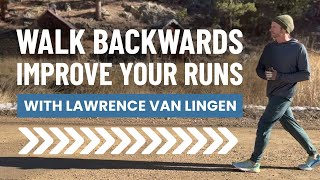
Coach Lawrence van Lingen explains how backwards walking strengthens the Achilles, hamstrings, and hip flexors while teaching your body to trust your heel. The key cues are soft toes with heel down and aligning your belly button forward, a move he calls grizzly bear walking. One elite runner cut two minutes off a 10 km time in six weeks using this technique.
Chapters
So backwards walking is basically increasing the range of motion of your Achilles, preparing yourself to run with your whole foot, which means at some stage your heel is going to be on the ground, and you kind of trust your heel. So walking backwards prepares you for all of that, but it also teaches you that because the exact shape of backwards walking is probably the movement patterns that you want to introduce into your running. So walking backwards will create forefoot to rearfoot mobility, it'll soften your toes, it'll lengthen out your plantar fascia, it'll lengthen out your Achilles and your hamstrings, it'll off in the front of your hips. But it's also giving your brain permission to put your heel on the ground and to trust all your weight in your leg. You'll see when you walk backwards, you put all the weight on your leg. And you have this sort of sense of, I don't have tension in my leg, and then I take the next step. We want to introduce that element into running forward. So it's just one of the most incredible ways of improving your running. How you execute it is, treadmill is the safest place to walk backwards because we run out of real estate very quickly when you walk backwards. And you might be concentrating on what the experience is that you're going into. And trust me, in the gym, you'll walk into gym equipment, you'll walk into a pole, you'll hurt yourself. So treadmill is probably the safest way, or big open field to walk backwards.
I have actually found going to a soccer field when there's no one out there and just walking along the line has actually helped me sometimes. If I like, oh, I can just see the line, like one foot next to me and there's nothing over there like that. That was one part because sometimes even here in Southern California, there's snakes out there, there's pine cones, or you want to watch out.
Yeah. Step on something. Yeah, please be very careful when you walk backwards. Okay. Big safe environment. Okay. So, so what you first— there's sort of two components mostly that you want to master with backwards walking. One is soft toes. So, so, and it's best to walk backwards barefoot as well. Okay. You want to have a sensation that your toes are bending, soft toes, and then heel down. And you just walk backwards, soft toes, heel down, soft toes, heel down. And it's remarkable. A lot of people get very stiff and locked feet and their toes can't soften. And backwards walking is fantastic rehabilitation for plantar plate injuries, plantar fascia injuries, Achilles injuries, hamstring injuries. Okay, so that's the first component is soft toes, heel down, soft toes, heel down. Once you've got a sense that, oh, I can, my toes are soft and my whole foot hits the ground. The second component is to get your belly button to point towards your lead leg. And 9 out of 10, or probably 99 out of 100 people here, if they backwards walk, will do that the other way around. And that's a really important tell, and it's very important to get that right, and to make sure that you're doing that right. So initially, you don't have to worry about it. But as soon as you've got the heel-toe part, the toe-heel part, right, make sure that your belly button points towards the leg that's in front of you. Okay, I call it grizzly bear walking. If your heel's tight, you'll turn this way. Okay, and what you need to be doing is you need to turn towards the lead leg. So if that leg's in front, your belly button must point towards the lead leg, and your belly button must point towards the lead leg, not the other way around. And that will teach you the proper hip shape. And you'll notice when you get that right, your shoulders sort of track and swap on top of your hips. As your hip makes the right shape, your shoulder makes the right shape. And that's one of the most healthy elements of running is to see people with shoulders that move with your hips. You're not trying to get your upper body to move. You're not moving your upper body against your lower body. The two work together, and you can learn that very, very powerful connection walking backwards.
I think once you are able to nail the flow rope, this backwards walking with the belly button pointing in the right direction becomes easier as well, because I feel like there's, there's quite a bit of a connection between the two. I noticed like once I had the flow rope down, even me walking around just changed. All of a sudden, my— yeah, just not not just the way I'm running, but even the way I'm walking out. Like when I wake up in the morning, first thing I do is stand up and I just notice I'm walking differently. And yeah, all of a sudden it just clicked and that becomes the new norm kind of thing. And so that's not a matter of sometimes you talked about, ah, some of these processes take a long time. Like once it clicked, it was just like, okay, now all of a sudden that's the new norm.
But yeah. Yeah, it's always quantum, you know? And I mean, like I take about, you know, we talk about like breakthroughs don't always happen. But in most people, if you're anterior chain dominant, and you figure out posterior chain, there will be a definitive moment and you go, oh, there was me before and there is me after. It's just the size of what before me and after me is. And very important, and that sounds crazy. I ask a lot of athletes that I work with to read Marianne Wilson's poem. It's We're more afraid of our light than our darkness. And who am I to be so talented? And also there's a narrative of you don't serve people, you don't serve the world by being small or constrained or not expressing yourself. And I asked them to read it and say, if any part of that doesn't resonate, let me know. You need to think about why is your brain sticking on part of that poem? Because when— I know it sounds crazy, but so I had this narrative with an athlete and they had fantastic success. Okay, they learned to use their hip properly, they took 2 minutes off their 10K in about 6 weeks. You know, it completely changed the trajectory of their life. This is an elite level, okay, in triathlon. I mean, it was life-changing. And they, they, I remember the moment very, very clearly. You know, they said like, we want to extend this and how does this look and we want you part of our program and our process and what does this involve. And we were going for a run, and I love talking and running because you think so much clearer and you express things so much better, right? And I said, I'm just telling you now, and you need to listen, okay? The hardest part was you got to where you are, leaving no stones left unturned, working the hardest, being the most diligent, being the most professional. And I said, and now talent has entered the scene, and you have to believe and accept graciously that you're now a talented athlete, and you don't have to work as hard, and you don't have to— you know, that's where we go into mastery, not medals, and trying to frame a safe environment. And people have a terrible time with this, and the number one roadblock or stumbling block I see when I'm working with people is they they can't accept that movement could be easy. Could be— I mean, running is still a tough sport and you still have to have grit and determination and a work ethic, but they can't accept the gift of moving easy and they'll derail. And so they'll be running beautifully and everything's amazing. And then they'll say, oh no, I need to add, I need to do this drill. So-and-so is doing this and you start aping and imitating. You just go back through a spiritual— basically a wheel turns, right? So it's totally okay. But it is very, very interesting is that mentally and emotionally being able to accept the gift of moving so well and running becoming a joy. And a lot of people, that's the hardest part to reconcile.