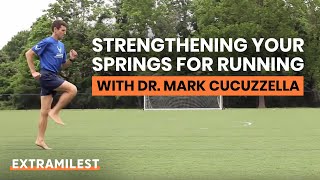
Dr. Mark Cucuzzella, a 2:24 marathoner, explains how to keep your running efficient and injury-free through childhood movements like A-skips, B-skips, and short sprints. Your foot has 200,000 nerve endings and acts as your body's shock absorber; arch supports can create problems throughout your legs. Barefoot running resets your foot's sensory system, and you need constant movement throughout the day to counteract sitting.
Chapters
Then the things that you all did as kids are the things that help the springs, jumping jacks, plyometrics, any type of burpees, anything that works. I do a lot of single leg running. At the end of almost every run, for a couple hundred meters, just one leg, hop, hop, hop, other leg, hop, hop, hop, hop, hop, hop, a lot of skips. They're on the website, the old track skips, so I still do all these track drills, A skips, B skips, skips. Sprinting really helps your springs. You know, not sprinting till you feel like you want to like puke. It's like little 40 meters. I'll finish like this morning, you know, beautiful grass and my bare feet, you know, did like 8 50 meters. And by like that 8th one, your stride's like opened up. And that's like dynamic stretching. So that's like, you know, hitting a lot of buttons, these doing these short sprints, you know, get your coordination, opens your hips, a little bit of strength training, works on your spring. We've got some videos in there called the Wake Up Your Springs, Lunge Matrixes, things like that. But your foot has to be in a good position. So if your big toe is bent in and your foot's not functioning like a spring because it's all messed up, so you gotta look at the foot too. So we'll always assess people's feet. If their feet are good, get their feet in a good position, then progressively, stair hops. There's all kinds of little, you could make on your kitchen floor, you could make a little square just kind of hop from— like you got 4 little boxes there, almost like hopscotch. You would just try it. It's really hard. I'm not talking about land, stick, land, stick. Pop, pop, pop, pop, pop, like really quick. Things like that. Start with 2 legs and then move to 1 leg because running is a series of single leg hops.
Yeah, we've been jump roping quite a bit with my kids outside. Just hearing you say it as well in the book, I was just continuing that as well.
If you're in a hotel, I mean, none of this stuff takes a gym, which is beautiful. I travel with a jump rope, throw it in my bag, and you never know what— a little resistance band, just bring these things with you. The foot has 26 bones, 33 joints, 100 muscle tendon insertions, and it's a neurologic organ basically. There's 200,000 nerve endings. That send messages locally and centrally to control all your movement. So if your foot can't feel the ground, you've got like, as an adult, not a kid, but you have 3 feet of shocks on your body which are kind of mitigated by what the foot's telling. Going up, you've got your plantar fascia, you've got your ankle, you've got your knee, you've got your hip. All this functions as a big shock absorber and it's all activated by the foot. That works beautifully. You know, I just came back now. I went out for about an hour and 20-minute barefoot run on the roads and get my feet— kind of went really slow because my feet haven't— they're kind of like tenderfoot because it's spring. You know, you're in shoes all winter because it's cold, right? And then you— but I love barefoot because you come back from a barefoot run and it's crazy. You— I've never not felt like a million bucks coming back from a barefoot run because everything kind of resets itself, you know, and your body will tell you how fast or slow you should go, you know, because if something's uncomfortable, your body just adjusts and slows down. But yeah, so if— when soon as you brace that foot or make some adaptation, say you brace something or put an arch support in or raise the heel, you make an adaptation in one part of the way the foot interfaces with the ground, the body's going to compensate and make an adaptation somewhere else. That's really against the human biology. But yes, I think you got to unwind it and kind of fix the biology. So that's what we try to do in our store, is try to really the human posture. You know, when you're in a heel, your posture, the way your back, hips, knees are aligned, you know, then you're looking at a screen and texting. I'm at a stand-up desk now, and you know, everyone's in here. Yeah, yeah, I can't tell, but everyone's in these kind of zoo-human, you know, positions, Homo domesticus. So then they want to go run for 30 minutes, you know, but there was just a study last week showing the amount of time humans are sitting is increasing and I think that's what I write about in the book. If you're sitting 12 hours a day and you think that you can do a couple foam rolling exercises and go run 30 minutes and you're going to do that wonderfully well without getting hurt, I think it's the rest of the day, how you just be more of an ancestral human, nothing weird or paleo about it, just stand up, move more, lift heavy things, do lunges, just do things to open your hip. Just walk, calisthenics, plyometrics, skips, jumps, all the things that we did as kids on the playground. Just recreate that into your day.