Injury prevention and recovery with Nate Helming from The Run Experience
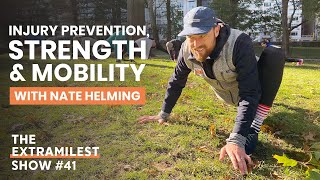
In this episode of The Extra Mile Show, host Floris Gierman interviews Nate Helming, founder of The Run Experience, to discuss his background as a marathoner and triathlete and his philosophy of exploring sport for enjoyment rather than competition. They cover the most common running injuries and overuse problems, emphasizing the importance of strength training, mobility work, and proper load management to prevent and recover from issues such as IT band syndrome, plantar fasciitis, and hip pain. Nate explains The Run Experience’s coaching approach, including personalized training plans, video analysis, and a library of instructional content on YouTube and the app. Practical tips are shared for improving running form, building durability, and integrating cross‑training. The conversation also touches on community engagement, encouraging listeners to share takeaways, and includes promotional mentions of PATH gear, upcoming Bay Area shoots, and the podcast’s production schedule and guest pipeline. The episode ends with a call to subscribe, rate, and share the podcast to help reach more runners.
Chapters
I really do believe that you can't wait for the injury to occur. If you wait for the injury to occur, you've got daily homework on that body part. But just healthy, I want to be foam rolling my quads, my hamstrings, my glutes, my calves like twice a week. And what that does is it gives me a really good foundation so that the next time I start building up my marathon training, I get to those 6 weeks, 8 weeks, I'm like, oh, you know what? I have this really good foundation understanding of like How much tension I normally have my calves. They're really tight today. They're really painful. If you talk to most physical therapists, they'll say, hey, remember this, happy, healthy human tissue should feel pressure, but it shouldn't feel pain. So if you are feeling pain in some of those areas, that's a sign that you're like, okay, I'm not in injury world yet, but I'm like just starting to get behind the 8 ball. So how can I start to do that with some regular application?
Hello, hello! Welcome to another episode of The Extra Mileage Show. My name is Floris Geurman, and boom, dropping another episode, stacking them a little bit more frequently. All about that patience and consistency. I don't know how patience comes into play. Consistency. Anyways, on this Extra Mileage Show, I interview different running coaches, different athletes, and different experts in the field of health and fitness, and we're often focused around the topic of how to become a stronger, healthier, and happier athlete. Today I interview Nate Helming. He is a founder of The Run Experience, one of the largest online running YouTube channels, and also one of the largest online running coaching programs. Nate has a tremendous amount of experience, and we took a deep dive into running injuries. A very common topic among runners. Strength training, mobility, flexibility. Then we also dove deep into stretching, into different ways to recover. A lot of different recovery tools we talk about. So many tools and topics that we discuss, and I truly think that this is an important topic to dive into more. If you enjoy this episode of The Extra Mile Show, it would mean a lot to me if you can share it with a friend. I truly bring on different experts in, in the field of health and fitness, and I try to just add value. And I truly hope that if you found this helpful, that you can also help share that message. So either share it with a friend, subscribe on Apple Podcasts or on YouTube, or make sure to leave a rating or review on iTunes or Apple Podcasts as well. Thank you so much for listening, and let's jump right into my conversation with Nate Helming. Welcome to the Extra Mile Show, Nate. Very happy to have you here.
Floris, a total pleasure to talk to you in this way to build upon all the conversations we've had together over the years.
Yeah, absolutely. I will say I started first of all checking out some of your guys' videos in early 2014, I think it was 2014 or 2015 when you guys had just kicked off your YouTube channel and you were at only a few thousand subscribers at the time. And seeing it grow, like right now we're here several years later and seeing it grow to almost like half a million subscribers at this point, like you have definitely touched a lot of runners between you and your team. That must be quite an exciting feeling, man.
Thank you. You know, it is, it is. It's a lot of grinding behind the scenes, you know, but then you do get these moments where not only you see a video do successfully, but when you get those in-person meetups where if I'm somewhere and someone happens to recognize me, which doesn't happen all that often, so when it, when it does happen, they're, they're kind of fun. And it could be at a race, but some of the fun ones this year, especially due to— I was hiking up on the trail up in Nevada, on the Nevada side of Lake Tahoe, and a runner stopped and turned around and And she was like, oh my God, a couple of years ago, I took a photo with you at the SF Marathon Expo and we had this long conversation. My wife and I were hiking one way along the trail. So just really cool moments where it's not just the views and viewership, it's like you're impacting real people and you're building community and relationships.
Yeah, absolutely. And even seeing that, like last year in November, we were both out at the New York Marathon. And we set up like a joint ShakeOut run where The Run Experience and PATH Projects, we got together in Central Park and we did— you were guiding us through like a dynamic stretch section and a warm-up. And then we did like a great group run through Central Park. And it was just so exciting to see all of these people coming up and joining and getting, getting everyone together that way. And many people I saw wanted to take pictures with you as well. Like, that was, that was really awesome to see that, that whole experience of everyone coming together.
Those are such a highlight. It's actually New York City Marathon would be this upcoming weekend or normally it is that first weekend in November or right after Halloween. So I always have a, this week feels a little bittersweet for me in that respect. It's nice to not be traveling. I'm enjoying my time up in Bend, Oregon as we were talking about earlier. I've got the beautiful Deschutes River in the background, but those moments of being able to connect with people and a race like New York where so many people come out is just, It's not just fun for myself, it's really magic for our whole team because our video editor gets to come out, our other coaches get to come out, and we just really get to experience the impact and connection we're having with runners that we can't always just get through an email or a comment on a video. As much as we love those, keep them coming. That in-person connection matters. And just the fact that there's so many things competing for people's times, especially on a busy marathon weekend, and that they would go out of their way and spend an hour with us, just, it's very special.
Yeah, yeah, for sure. I absolutely want to take a deep dive into the run experience and into the mobile app and the different training programs that you guys have, but I think it would be good for the audience to get a bit of a better understanding of your background as well. So maybe we can just start there, like, how did you get into running, and I know you have somewhat of a triathlon background as well, so maybe you can guide us through some of those early days.
Yeah. So, it was funny, we were just talking about this the other day in looking at our backgrounds. If you kind of had met me as a kid, I would probably be— starting a running company and a YouTube channel would be maybe one of the last things you'd expect. I ran a little bit. But I was in love with mountain biking and other sports. I grew up in New England, and eventually I tried playing a lot of other sports, and I just wasn't as good at them as I thought I was. Like, I tried to get on the varsity soccer team so many years, I just couldn't do it. And so eventually I kind of gave up and joined the cross-country team for, for running. And I had an okay experience with it. My coaches were okay. The team, it was kind of fun to run with the team. I dealt with some injuries, but it was like I was very much a seasonal mindset. So it was like, as soon as November rolls around, I am done with this. I'm skiing, I'm going to other sports. And actually the one sport that I was probably best at the time was sailing. So I sailed in college at, at BC, at Boston College where I went. But after a year or two of that, it was just like the Division I athletics was just so intensive in that respect that I realized that my college experience was going to be very one-dimensional. And I swear this is going somewhere. This is how I got back into running. I decided to leave the sailing team at the same time, like my first college love, like my girlfriend at the time, she broke up with me. So I was left with a lot of time open in my schedule because I wasn't sailing. I was questioning what my identity was as an athlete, and I was processing this, this breakup with a girlfriend. So I hit the door and started running a lot, and I found it as more of a, like, a cathartic thing.
Like, more like, more like an outlet of getting your energy out, or like, yeah, I just like, I—
this whole time, everything about sports to me was pleasing a coach. It was about getting on a team. It was about refining your skills. You could get to the next level. So you compete. Oh, you didn't do as well. How could you do better? Just all of those things. It just served a totally different purpose. So I was, I was hooked and I just started running a lot. And one day, and this is what kind of got me into running again in a more serious way. I'm, I'm heading through the hallways of Boston College somewhere and I see this flyer to sign up for the Boston Marathon. And they were looking for student volunteers to raise money for a local charity and to race at the back of the race. So we didn't have bibs, we didn't have medals. I didn't really care or know anything about that. I didn't even know at the time you needed to qualify for Boston. I was 19, 20 years old and I signed up for Boston. And that was like my first real hook into running.
Wow, so was Boston your first marathon you ran?
My first marathon I ran, I tell you what, after running Boston your first time, like you run subsequent ones and you're like, wait, how come people aren't like barbecuing and tailgating the whole time? You know, what's going on? Yeah, and it was a memorable one. It was 2004. It was, I believe, the last time they hosted that race at noon. Or 12:30 in the afternoon. And, you know, April in New England, you can get any weather from snow to sleet to really, really hot. And so, this was a year that it was 85 or 90 degrees. No way. Really? It was very, very warm. And so, of course, I'm training through a Boston winter where I can't feel my hands for the month of January. My feet are numb the month of February. I just start to have a little bit of visible sweat at the end of March. You're like, oh, it's cracking 50 degrees. And then, it basically goes from 25, 35, 50 to all of a sudden 90 and had to battle that.
Yeah, that's nice going into a hot race without any heat training or acclimation.
Yeah, but I was hooked. And again, the running the Boston Marathon was— it wasn't a competitive thing per se. It was just, uh, I can't believe I just did this type of thing. Like, I was just so happy. I remember, you know, finishing the race, and I wasn't a registered athlete, and it didn't fully occur to me, but they're handing out race medals to everyone, and I was like, oh man, like, I kind of showed up to the first person stumbling across the line all blurry-eyed, and they're like, oh, sorry, no chip, no medal. And I was like, "Oh, I'll just find someone else." So, I go to someone else. They're like, "Sorry, no chip, no medal." And then, there's like sense of dread starts to sit in the pit of my stomach. And I'm like, "Oh my god, I've just done this race, but it wasn't official in my mind until I got the medal." I probably talked to 5 or 6 people and I think they either saw the desperation in my face or just the hell I just went through. And finally, I got someone to cop up a Boston Marathon medal for me and I just wore that for probably the next 8 hours straight. I'm pretty sure I wore it to dinner.
Incredible. That actually reminds me of seeing you, like, obviously you have gone through that Boston Marathon experience, and it reminds me of a few years back when I saw you at the top of Heartbreak Hill, like, recording some videos as you guys were cheering up, cheering on all the runners, like, going through that last challenging hill over there. It's always so fascinating to see that point of the race.
It is fun, you know, just, I mean, to stay on this for a moment longer, like I grew up watching the Boston Marathon race ever since I was really young. I used to hold like water cups and orange slices for runners when I was like 10. We were not official aid station people. We were just on the side of the road. And so the game was like, if we could get a runner to like grab our cup, and if we did, we just thought it was so amazing. And just like all of these runners, it's like the regular runner Super Bowl. It's just everyone gets to feel like this incredibly special athlete. And I just saw that as a kid early on, cheering all these runners on. So it's very special for me to experience that and to be out on such a memorable day. I always remember that day.
I've never experienced a race with that many people coming out, even on a day where the weather conditions were terrible. Like 20, 30 miles an hour headwind with a lot of rain and whatnot. There were still 5 to 6 rows of people deep on the sidelines. It was— what an experience. I can imagine growing up with that, that you have a very special connection to that for sure.
It was. And I think what got me further into triathlon actually was battling with— I started to cross-train a lot because I had to, that eventually I realized I was doing, you know, two-thirds of a new sport. So I might as well take up swimming and get into triathlon that way. But what I sort of realized early on— well, I actually didn't realize this early on, and I didn't realize this till later— but I really thought that, you know, to be the best athlete, I need to listen to what my coach says. And at the time, I didn't have a running coach, but I had a running plan. And so I just need to listen. I need to follow the plan to the letter. And, you know, we printed out something online. It was just 5 days a week of running. I think it just said the mileage every day. There was nothing else that was in there. There was no strength recommendations. There was no cross-training. There's no mobility. There's no, oh, if this happens, do this instead. All I had was, okay, if I can check off another day on this program, that's just one step closer to this marathon and just a little affirmation that I'm gonna make it. But if I skip a day or have to adjust a day, then it just throws everything into this crazy world of uncertainty where I'm just like, I don't even know if I'm gonna make it. And so I was playing this like day-by-day high wire act with my running. And you know, like especially with early on in marathon training, like sometimes the first 4 to 6 weeks are gimme. Like you can beat the snot out of your body and you're gonna be okay. But it's usually like 6 to 8 weeks is when things start to catch up. If you have poor habits, if you're not as strong as you thought you should, if you have any mechanical errors, it's those little tiny aches and pains start to magnify. And if you're not careful, they only go in one direction. So I kept going through this with subsequent marathons where I kept getting an IT band injury or an Achilles injury, and I would have to go through this pain of trying to schedule an appointment with a physical therapist. Well, that's like 3 weeks from now because they're booked. And you're like, that's 3 weeks closer to my marathon. What am I supposed to do? I'm supposed to be running 18 miles in 3 weeks from now. Like, how does this help me? So I just acutely remember this pain of uncertainty, of only running and not realizing that all the other things that were missing from my program because I didn't know what I didn't know. And just kind of going from one ugly thing to the next. In fact, I ran that first Boston Marathon my sophomore year. By the time I got to my senior year, I had run another marathon, qualified for Boston properly, and was getting ready to train for the end of my senior year, and I was injured, so I couldn't even run.
That is so challenging, especially when you've worked so hard towards a race to be able to— and I think that happened with Kona with you as well, right? You had qualified fight for Kona as a triathlete. And then a similar thing had happened. Tell me a bit more about that.
Sure. So, you know, the irony of, of, of all this was, you know, after, you know, some injuries with the Boston Marathon and subsequent marathons, I started to ride my bike more. I always really enjoyed that. And, uh, I saw a local triathlon one day, uh, up, up on the coast of Maine and signed up for it. It was such an adventure. I swam in like a water skiing wetsuit and I had like 3 all shitty wetsuits on to try to composite like one. It took me forever in a day to swim like 3/4 of a mile. But I, again, that initial feeling that I got in the Boston Marathon, I was like, I can't believe I just did this. Like it just felt so great. So eventually when I moved out to California, I saw the Ironman and was like, ooh doggy. I remember being in the office and hitting that registration button and my heart going up like 25 beats a minute.
That's the best feeling right there. Yeah.
Yeah. And it turned out that all the running I did in my background was making me a good triathlete. I could run well off the bike. I was able to snag a, a win at Oceanside 70.3 as I was getting more competitive. I had a coach this time. I was starting to do some strength training. I was learning a little bit more about the balance of things. But again, I just probably pushed the extremes a little bit too much and came up with a weird hamstring injury that no one could figure out about 2 months before Kona. Floors is one of those things. If I had broken a bone, if I had fallen off my bike and broken my elbow or even like torn a ligament, like the timetable would have been faster for my recovery. Maybe he needs surgery, whatever. There's like clear exercises that he can do post and we'll get him back going. Like that would have been faster than what happened. I just had this weird achy hamstring that just never seemed to go away. And slowly my excitement for Kona— I'm going to go and I'm going to like do great and my whole family's out here, it's going to be awesome— turned into like, well, maybe I can just get enough training in to finish. And then it turned into, well, maybe I can just do the swim and the bike but not the run. And then it was like, well, should I even bring my bike at all if I'm not going to race? And it's like, I'm just not even going to go, right? So it's just you're negotiating down with yourself this whole way. It sucked. That was not fun at all. That was a very painful experience for me.
Yeah, and I think it sounds quite recognizable for quite a few different athletes though. The part of you really want something so bad, you're trying to do everything you can to get there, yet something is, is not clicking. So what were some of the steps from there for you to, to turn it around and still be able to improve your running and your performance after that?
So, this was kind of one of the ultimate ironies. Like, I think that I needed to leave the endurance world for solutions on how to be a better endurance athlete. And, the answers were not in the endurance world, they were in the strength and conditioning world. They were in the Olympic lifting, almost to a certain degree the powerlifting and CrossFit world, that was the things that I realized in ways that I was missing. And I did all this stuff very reluctantly. I think if I was very healthy, I would have never walked into San Francisco CrossFit, which was the gym that I started to train at at the time. Because if I was a healthy athlete, I'm like, I'm a triathlete, I know what I'm doing. Those guys are doing weird, scary things that has nothing to do with me. But meanwhile, I had been following the advice of all my coaches. I was doing, you know, safety triathlete-approved strength sessions which involved like sets on leg press machines and hamstring curls and little band exercises and Swiss ball curls from physical therapy. Nothing was having an effect. The thing that turns out was really missing was like full range proper squatting with a barbell, full range proper deadlifting with the barbell, learning to not think about endurance athletes as these fragile creatures that shouldn't move weight. It turned into like, you have followed this advice for so long that you were actually now very fragile. And that's a problem. And when I looked back in my own history, I was at my best when I was skiing like a maniac in the winter. I was mountain biking. I was doing all these different sports, lifting like a knucklehead in high school in the gym just for fun and doing some running. When I started to follow the advice of, oh, to be a better runner, I just need to run more, I let all this other stuff go, Floris, and that is— ended up being my undoing. And it happened in running, and then I moved to triathlon, and then it still happened in triathlon. So it wasn't until I brought all this heavy stuff back in that made a difference. But the problem at the time was that there was no, like, endurance coach that approved of this. There was no athlete that I saw that was— that was a good athlete that was lifting this way. And at the time, I wanted to race professionally as a triathlete, so I was in this weird pickle. I was like, huh, I know that I need to train a lot to be, or try to be, a professional triathlete, but I also know that I can't do that, I can't handle that training if I'm not healthy. And so now all of a sudden I need to do all this heavy stuff from all these weird people in the corner, but like, I don't know who to model this off of.
Yeah, so how did you end up figuring all of this out? Because you eventually indeed went more of that route of of working with a CrossFit gym and getting more of that experience. And eventually you somehow became an assistant coach, if I remember that correctly, right?
Yeah, as I was going through this time, I think what was very freeing for me is I think we go through different versions. Like right now you could say that marathon training and run coaching has been around for so long and it's so established that people aren't really experimenting that much. If anything, they're following like a proven recipe and they just don't want to do something that's quote-unquote wrong. But what's very freeing when you are— no one has done any of this before, so I can actually try to experiment with things. Like, there are stories of Bill Bowerman figuring out how to create water solutions with electrolyte and other stuff in it for his runners so that they could go on these 18 to 20-mile runs. This is before Gatorade existed in anything. They all joked, it was like the drinks tasted gross, but he was like mashing up potassium in there and mixing other stuff. You know, the first triathletes were only in the late '70s when they did Ironman. No one knew how to train for an Ironman. So I always joke, it's like, man, like, you know, there's probably one guy who rode 150 miles and another dude who rode 100 miles and hopped on his left foot 50 times. And if the guy who won who hopped on his left foot 50 times, the next generation becomes biblical and devout. You must hop on your left foot 50 times from now on out, no matter what. And you kind of realize, I think we forget, and I'm going somewhere with this. I think we forget that when we look at training that's been passed down to us, we don't want to discount it. Like, there's an affirmation when it goes from one generation to the next, but just some guy or gal made it up. Because they were trying to solve a problem. That's it. And I think if we can realize that, that gave me a lot of freedom to be like, actually, you know what, the endurance world knows a lot. These coaches and physical therapists are incredibly knowledgeable, but I'm doing things that they don't have experience in. So why not try to experiment a little bit? And I just tried to follow things that felt intuitively right And honestly, what got me into coaching was helping problem solve some friends of mine who are going through these same injuries that I were going through. They felt like they were like falling between the cracks of like, oh, if it was a break or a torn ACL, we know how to solve this. This weird achy hamstring that connects with you not being very connected and having kind of a wobbly spine and pelvis that's a little out of control. Like, we— it's It's too nebulous for us to fix this in 5 insurance-mandated visits, right? We can't fix it. So I started to have success with them, and just like myself, not only was I fixing my injury, but I was tapping into like a level of athletic power that I didn't know I had. And so all of a sudden, it wasn't a trade-off. It's not like, oh, you're trading health for, for for performance. In this case, it was like, oh, this is like two sides of the same coin. If I can get myself healthier, I can start building up a little more strength and power that not only keeps me healthy, but that allows me to perform to that next level. And I think in the Bay Area, you know, I just grew— I mean, this was before Instagram. There was no, you know, the marketing was just by word of mouth. So I just sort of slowly built a set of athletes by showing up and racing, by working with local athletes and building from there. So I was very— that was very gratifying, not only for me to improve myself in that way, but to help other people problem-solve their own, their own things.
So, so what were some of those key fundamentals of that problem-solving? Like, if you're if you talk about, yes, it wasn't a clear bone break, but it was some more of those aches or instabilities. What were some of that? Like, if you've, you've worked with many different athletes over the years, what were some of those high-level things that you, you kept seeing that was going wrong and what would you do to improve that?
I think that, you know, we're all built this way that if you have a hammer, everything looks like a nail, right? Like, it's like if you have a way of solving something, If you're an orthopedic surgeon, your nail in this respect is do I do surgery on this person or do I give them a cortisone injection? Right? Like those are kind of your needles or your, your hammers in that respect. If you're a physical therapist, it's like, well, I can, you know, what, what physical therapy modality can I provide? For most things, it, it, it turns into you with some band on a Swiss ball doing, doing some exercise. How many of those things can I do? But you're not good at prescribing things outside that experience. So for me, I had been down those avenues and I had seen other athletes come to me who had been down those avenues without success either. And I was like, well, hey, I have this other hammer, this other tool we can try. And I really found that with a lot of athletes that were dealing with persistent, chronically achy things, these really solid mechanical change, that neuromuscular change that's required in movement patterns. Because the irony with a lot of people who are afraid to lift or move in a certain way— and this has gone away, it used to be more— was like, well, I don't want to like do this squat or this exercise because I'm going to hurt myself. And the ultimate irony is that, you know, for the last 10 years, every time you've taken a step, your knee collapses in a little bit and your foot turns out., right? You don't feel this, but this is causing infinitely way more damage than you trying one squat. So let's be honest about the things that are really impacting us. And I need to put an athlete into a position where they have to face— where this, this weird mechanical deficiency doesn't become invisible anymore. It has to become very, very aware. And so We do that by challenging the range of motion through greater ranges and starting to see points of failure like, hey, oh, you can't squat very low because your ankles are stiff. You're not gonna notice that when you sit and stand and run, but you're gonna notice it when you can't hold the bottom of this position for a minute. Or how about hold that bottom position with the barbell overhead? Oh, you can't do it. Okay. Not throwing blame. I struggle with this too, but now we have a point to converse. We can say, hey, how do we improve your ankle range of motion? So having those things where it's either through load or range of motion or something, we can start to problem solve, hey, what's really going on that's potentially the problem? And then it's trial and error. Hey, let's try this. Let's see how this works. I remember working with a runner who was basically told she couldn't run again because she had knee pain. And I was like, okay, but we got her in the gym and she just wasn't very strong. And this happened to me, too. I remember that the one thing that was keeping some strength was all the training I was doing. But because the training dropped, I had not only lost my aerobic fitness, I'd lost whatever strength base I had. So all of a sudden my hamstring at the time was worse and I was more sensitive. It was to the point that I was sensitive to how far I had to walk from where I parked my car. If it was like over 2 blocks, I would start to get nervous and I'm like, how is this possible? That 2 months prior to this, I was able to run like a 3:19 marathon off the bike in an Ironman, and yet now I can barely walk 2 blocks without my hamstring starting to bother me. So we just started to get her stronger. We got her lifting and moving, and all of a sudden she's like, hey, my knee doesn't hurt as much when we run. I was like, okay, cool. Well, let's try this on a treadmill. Very, very short. Let's get you like max grades. We take all that impact away in your knee. Really force your hamstrings and glutes to fire. Let's try to have you run for 15 seconds. How does that feel? Oh, shit. That feels okay. How about we do 30? She's like, oh, that's not bad. So then all of a sudden we have her in a gym where she would alternate doing like deadlifts and squats with short uphill intervals in the treadmill, and we started to collect some wins. And eventually we were able to bring the treadmill down to a flatter level. So all of a sudden she's like, oh, actually I can run more than I— than I thought. And I'm not going to pretend to say at the time I knew what those answers were going to be, right? I was 28. I was figuring it out with her. But that was the process we took. It's like, hey, let's get you moving. Oh, okay, this feels good. Great. How do we double down on this? Oh, this doesn't feel good. Okay, why doesn't it feel good? How do we make an adjustment? Okay, let's just take this off the table. And you just sort of follow your intuition that way.
Yeah, so that was a lot of one-on-one truly observations and trial and error, or like trial and error, but at least you had seen certain things work over time with different athletes. So how did that transition from there then going into starting The Run Experience?
So that one-on-one programming eventually turned into me getting a job offer at San Francisco CrossFit, which was very exciting to not only just do one-on-one things but lead a group. And one of the things that was beneficial there was your ability to go from one-to-one. It was a great transition from one-to-one to one-to-many, which is what— which is what the RUN Experience is. I could give some cues in a class of 30 people, and I could quickly see like, oh, 5 people interpreted this way, this other person did this. You, you start to clean up your language of how to communicate. You also start to see better patterns. Oh, This is the new athlete. They're going to be worried about not doing something correctly. So they're going to go here. And this is the person who's going to be a little aggro and go a little aggressive. So I need to talk to them this way. So I started to gather all these stories about how to talk to runners in different places. I was also starting to coach endurance athletes one-on-one, and both things started to build up to the point that by the time I was 30 or 31 years old, You know, I was coaching 25 athletes monthly, writing one-on-one programs, and I was working anywhere from 6 to 8 hours a day of either group classes or one-on-one clients. So I was tapped.
Yeah, I can imagine.
I'm spending time emailing people and building programs and wasn't doing that. I was one-on-one with athletes or teaching group classes. So I was exhausted. And but I love the work and I was just excited about like, okay, what about the people? And this is what got me thinking about the next step was, hey, what about the people that can't afford this class or can't afford my monthly rate or the mom in West Virginia who maybe could, but she just doesn't have access to San Francisco and just can't get in here. How do we— how do we help them? And fortuitously, at the time, my co-founder Craig was a member at the gym. I had helped him through some running injuries. He was looking for a next project and he was like, "Hey, there's something here. Why don't we try doing some videos together?" which turned into our YouTube channel and to you probably finding us in those early days.
Yeah, no, and now like just seeing the amount of content that you guys are producing and it's not just you as a face person. You have a team of different coaches and a lot of content getting produced. And then there's, there's your paid training programs and now the mobile app as well, the online community, all of the different elements. For like, for the people who are not familiar with The Run Experience, can you just give a high-level overview of truly what it is about and how they can find out more about what you guys are doing?
Yeah. So like at The Run Experience, you know, we want to be the place that people can start running if they've never run before. So they have great access to friendly, empathetic coaches, follow-along workouts that guide you through, show you, like, the right drills to do in the beginning to build those habits in the right way. And then, and then continue with training that stays balanced and, and connects you with the community so you stay running, so you stay in it. So we really want you to start running and stay running with us. And we kind of build our broader community with our YouTube channel. And we try to be a resource where you could pretty much find almost any injury question related to a workout or race or distance that you can find something there. And if you're looking for something more, inevitably that's not gonna be solved by watching another YouTube video. You're gonna want to start to get into our environment and, and work with our programs and our coaches because our YouTube channel is really just the tip of the iceberg. And then once you download our app and you get into our programs, you start to see, oh, not only can I get this great, you know, 5K workout on the app, but I can actually go through an entire 6-week 5K program. And I've got the strength, the mobility work, the run form, the drills all built in. All the things that I learned early on as a runner and I learned through a lot of pain was missing from my programs. I basically built programs that I wish I had when I started out is, is kind of the, the, the short answer for it. That's what you can find in the app.
Nice. The website, TheRunExperience.com, is that correct?
TheRunExperience.com. From there, we have an incredible blog and team. If YouTube and videos aren't your cup of tea, we've got incredible articles coming out all the time that you can read. Then you can also easily find our app from there that you can download and start to navigate. We got a busy community in there. We're really proud of that. How much we interact with our runners. And yeah, come in, download the app, say hi in the community. I'll wave back at you.
Yeah, absolutely. The one part I always enjoy when I watch some of the YouTube videos of you running with the camera, you make it look so easy, man. Running up a hill, still talking into the camera. Sometimes you have your rescue dog Nora right next to you over there. It's always really exciting to see.
I just, I edit out the heavy breathing. No, it's a lot of fun. We like to take advantage of where we live. So it's like, oh man, like I want to create something that suits this background and climate and everything.
Yeah, for sure. So over the years, I want to talk briefly and talk about some of the running mistakes and talk a bit more about injuries, because I think that is something that you are very familiar with. So when we talk about some common running form mistakes, like, can you share a little bit more about what you see working with so many athletes over the years and different ways that people can improve their running form?
Yeah, I would be happy. How much time you got? I'd be happy to talk about some of those things. So to start with injuries, and then we can talk about running form as those things are connected. I would probably say there's two buckets of injuries that we can— that we could put in. One is the, the, oh, sudden, I just fell, twisted my ankle. I stepped out on a sidewalk and got hit by a bicycle or a car, like something— I said, I don't mean to be morbid, but just, you know, like, yeah, the sudden out-of-nowhere injury that occurs. More like, more like an accident-ish. Exactly. Like, like, and those exist, you know. Sometimes people are going down the trail and they eat it, you know, and they, and they all of a sudden they're like, I sprained my wrist or sprained my ankle, right? Like, that's a category of injuries where it's like Okay, this was a bad moment. You just need to literally rest, recover. There's maybe a few exercises you need to do, but there's nothing intrinsically wrong with your mechanics. So you can just kind of go back to normal and you'll be fine. The other more pervasive and insidious level of injury is the overuse injury. And I think the overuse part of the word is almost a misnomer. It's sort of like, well, I was fine. Until I just did too much and now all of a sudden I'm hurt. But what that sort of ignores is, is, is what the volume probably showed. And what the volume probably showed was, was the limits of your capacity both from a mechanics standpoint and maybe a stability or strength standpoint. Right? You just earlier on, maybe it was a small little wiggle, but you were fine, but then you started running more and more. Not only does that wiggle catch up with you, but maybe that wiggle gets even bigger. And all of a sudden, you start to see collapse. So if you're that person who deals with an IT band issue, a knee issue, or something else, if you just rest and ice and hope to return to normal, you actually haven't gotten anywhere because you're not taking ownership over the mechanical part. And The ownership part only really works when you're educated on that there's a problem in the first place. Because if you don't know there's a problem in the first place, well, you don't know what to fix. But it's questions we need to start asking. And every time a runner like, I was like, man, I was feeling great. And all of a sudden I got this weird calf strain. It came out of nowhere. And it's like, really, really came out of nowhere. Like, get out of here. Like, These injuries are like lingering below the surface of our awareness. I bet if we had a massage therapist dig into that calf of yours a week before, it was probably pretty darn tight. You would have hopped, yelped off the table. So this is where a lot of more preemptive work where I'm doing regular mobility work, I'm exploring my edges of my strength and my stability. It's not when— it's not if people fall apart, it's when. No one can hold a plank for infinity. So the goal is just to push my strength out commensurate with the distances I'm trying to run or the speed I'm trying to run. If there's a big mismatch is when we sort of have a problem. So that's kinda what I say with the injury prevention or the injury stuff is like we need to take ownership over the overuse stuff. And you're not always gonna figure out alone. Seek help, but you have to be your own advocate. And you have to realize that if I have this injury, that's this little niggling thing, like I can't just rest and ice and go back to normal thinking everything's going to be fine because maybe every once in a while it will be. And if that's you, kudos to you. But for a lot of us, myself included, it is, it is not the case at all.
Yeah, well, well said right there. And I think even at the beginning, sometimes athletes just go out there and they run and they spend most of the time on the running when they can get away with it. But sooner or later, especially as your intensity and your volume increases, indeed, you're just gonna, you're gonna start feeling it. And that imbalance starts to happen and become more and more. And yeah, until the point that you realize you have to start putting in the work.
It is. And, you know, so many of us, you know, run to get fit, but we're not always fit enough to run the amounts we want to do. And some of this, look, I will— I'm a coach and I will, you know, take the blame in certain respects here as well. But it's like, as coaches, we have to hold a higher standards for our athletes and especially the beginner athletes. So we walk this fine line between, okay, I want to put out a program, a Couch to 5K program that doesn't feel like it's too intimidating and it doesn't have too much stuff in there and it's this approachable thing. But if you simplify too much and it's only running, you're not addressing daily habits. You're not having them challenge themselves from a strength mobility standpoint. You're doing them a disservice. And these are people who don't know any better, right? They're looking to us as coaches to level it up. So if you're a coach out there, you know, don't be afraid to hold a higher bar for your runners. And if you don't have those resources yourself. You know, like, we're not supposed to be experts in everything. The reason why we have a lot of people on our YouTube channel from— the thing is it takes the stress off of any one of us having to produce all the videos. It broadens our audience, but also broadens our level of expertise. You know? Like, go find someone who's good at nutrition. Go find a good physical therapist out there. Go find someone who's good at strength— strengthening. Build those relationships. You'll learn more as a coach, and then you'll be able to share that with your athletes.
Yeah, yeah. I've heard you talk several times now about like the, the mobility, the flexibility, the strength all being important components of this. And, and if those are not in place, that does impact your running form as well, right? Like, I've, I've— can you talk a little bit more about what you're seeing in some of these athletes who don't have those areas developed.
So we cannot train pretending like it's 1950 or 1910. You know, we can't. Like, we live in a different world. If you've— I'll tell this story quickly, but it's a favorite one of mine. Have you ever read the book Boys in the Boat? No, I have not. It's, it's a great— it's a really fun read. It's about the 1936 gold medal crew team. From the United States at one, and they're from the University of Washington, uh, and this was like a, uh, David and Goliath on multiple levels. Um, first of all, like, the US wasn't supposed to beat Europe, especially Germany at the time was super dominant, but within US, University of Washington was nowhere near the dominant level of rowing that all the Ivy League schools on the East Coast were. And, in fact, a bunch of these dudes were literally lumberjacks in the sticks of the Seattle, Washington area. And, this wasn't a major part of the story, but my coaching, my geeky coaching years perked up when the coach at the time was like, "Hey, during rowing season, all I want you to do is row. I don't want you to do anything else. It should just look like rowing." We're like, "Oh." Specificity. We say that now, but the context of that message is everything, because at the time, these guys literally walked 10 miles a day. They fished and hunted all summer long. They were literally lumberjacks cutting down and carrying heavy things. Like, they were really strong overall dudes, so, who weren't slumped over their desk looking at their phone for hours., right? And all of a sudden, they probably had pretty good range of motion. So, in that context, when life provided so much strength and range of mobility, it's very reasonable to say, "Hey, just don't go walk 10 miles and fight grizzly bears in hand-to-hand combat while you're rowing," right? Perfectly reasonable thing. The problem now is that we have the same message It's just out of context and this ties directly to our running form. The kid who grew up really without shoes, hanging from trees, running around like a wild man or woman who just kind of continued in running but just life provided so much strength and mobility, yeah, you know what? They're probably going to run pretty well naturally. We don't need to say much. And they're going to continue to develop and it would be reasonable to have them do less. But right now for most of us who are on a device, who are sitting, who haven't been barefoot that much, so our feet— and for example, most people when they try to run, the biggest thing they go to is what their feet are doing on the ground. They're like, "Well, I heel strike or I do this." And I didn't make this up, but one of the best explanations I got about your feet was that it was at the end, the long end of this kinetic whip. That starts at your hip. So if I want to influence how my feet hit the ground, I got to start further up and go towards the middle of the body. I can't arbitrarily change where my feet hit. Someone told me I heel strike, so all of a sudden I'm gonna, you know, prance up on my toes. I'm just gonna— so I'm just gonna trade one problem for, for another. So I think having that understanding is really foundational for how we change things. And then understanding like, hey, you know what, The reason why a lot of people overstride or heel strike is because their hips are really tight. And their hips are really tight is because double-edged whammy. Like, well, they sit a lot. So they're in a folded position. But also when they do stand, they're not very good at squeezing their ass. Their glutes can't fire for shit. And the reason why their glutes can't fire for shit is because they don't do any exercises to get them firing and engaged. So they've got poor leg extension. They've got poor power. That leg can't swing out the back. It starts to go out the front. So like, this is where, like, I can't address running form in a vacuum without first addressing your athletic foundation. But if I start to build those things, improve your overall posture and position, start from the top down, working on breathing, working on your arm swing, your hip position, all of a sudden your feet are gonna fall in line in a much more natural place. These changes are going to be more gradual so that your body can adapt to it and it's going to be a lot healthier.
Such a holistic approach to training and racing right here, right? Like the running component, like mobility, flexibility, strength, and then obviously like the whole nutritional side that you mentioned earlier already, mindset, all of these things, it's all connected there. When we're talking about stretching, I would like to talk briefly about that because I see different viewpoints on stretching. Some people are actually very cautious about stretching and actually might say it's not for everyone, whereas other people are stretching a lot every day before and after their run. Like, I would love to hear from you, what are your thoughts on stretching? Like, best ways to somewhat implement this? Is it Is that more throughout the week consistently? Is this more like specific around workouts?
I would love to hear your thoughts. So I think that stretching becomes much more useful of like, I can start to understand when and how to apply it when I go back a bigger, bigger level and look at position. If I don't have a good understanding of how my body's supposed to move, how to create stability at the hip and the shoulder, how much extension I should have in the hip, how much flexion I should have in the hip, which is basically the difference between squatting all the way down to being in a full lunge where I can extend my leg out the back. If I'm— if I don't understand those basic things, you know, my stretching is gonna feel a little bit more arbitrary. Like, well, I guess I'm just sort of lengthening my hamstrings. And It's really not about lengthening any muscle. It's really about, hey, I know that to be a strong, healthy human, I need to be able to hit certain positions. I need to be able to bring my arms all the way up overhead. I need to bring that hip all the way back behind me. I need to be able to squat all the way down so that my butt can be right above my ankles and my feet are flat and straight ahead. And okay, if I can't do one of those positions, okay, why can't I do it? Am I lacking range of motion or is it a stability motor control thing? Oh, it's a— it's a range of motion thing. Okay. My ankles are stiff. Well, why are my ankles stiff? Well, maybe there's something connected to my shins and my calves. Okay. So maybe I'll start to increase the range of motion there in the calf. But keep in mind, when you're stretching your calf, it's not just lengthening the muscle for the sake of lengthening the muscle. You're affecting your ankle joint. So what we really care about is not stretching, but the mobility of the joint itself. We have to understand that every muscle is connected to a tendon, which is connected to a joint. So we wanna make sure that we're holding a high standard for what that joint movement should be. And this may sound more complicated like, well, man, how— where do I even start with that? It's simple as starting with a few basic positions we should all have, which would be a squat.
You keep coming back at the squat, huh? That is definitely one key one that I—
Yeah. Yeah. You know, just it's a simple soundbite for things like this, especially when I'm not able to like visually represent with people. That certainly is the tip of the iceberg. There are more things. You know, you could talk about being able to bring your arms all the way back up overhead. There's other little shoulder internal external rotation tests that you can do that can affect your arm swing, that affect your posture up overhead. There are certain tests you can do to look at how stiff your thoracic spine is, and they're, they're a little more subtle, but, you know, sort of important. But I find that is really helpful to then give someone understanding of like, okay, these are the areas you need to stretch because there are certain people that stretch too much. They're actually overly flexible, and it's actually not flexibility that's holding them back. It's lack of stability. They actually are not able to stabilize their joints, and that's why they break down and they get hurt. So it's not just stretching more, but it's, it's, you know, stretching the right places and stabilizing the right places.
Yeah, that makes a lot of sense. I want to be respectful of your time. I have a few last questions. Let's briefly talk about recovery tools, because especially in the last few years, I've seen so many different recovery tools coming on the market, and every week there's a new gadget. I would love to hear from you, like, what are some tools that you suggest every runner should have in their recovery toolbox?
Are there any specific ones? So any tool is no good if it's not part of a regular practice. So you want to find the things that are sort of available. And actually, I'm going to take this quote and spin it another way. I was watching— I know you're a Casey Neistat fan yourself. He is like one of the godfathers of awesome YouTube videos. And, you know, people ask him what, what video, what, what cameras he uses when he films. And he basically says, I shoot with the best stuff I have available to me in the moment. That could be a super high-powered camera or it could be my phone. So in terms of the tools for mobility, use the best tools you have available to you. That could be a high-level percussion gun or a pair of NormaTec boots Or it could be a lacrosse ball and a leftover wine bottle. Those work pretty darn good for rolling out your feet and your calves. And what's way more important is that you're doing it on the regular basis than not. So I find— I just wanna kinda get that out of the way. But I'm actually just towards the end. I'm shooting an upcoming video so I won't— I won't spoil it too much. But I'm in the middle of a 30-day run streak, which, Forrest, I've never done and coming full story for— for my background, you know, the idea of me trying to run 30 days in a row seems almost anathema to this whole philosophy I've laid out. But I wanted to see if I could do it now knowing what I know about training and mobility and recovery and adaptation. And it's been fun to play with some of the more advanced tools. I've been playing with a Sidekick Scraker tool. Lots of different places. I really like that. I have been playing with some different CBD oils and lotions just to sort of see how that affects like pain signals in our body because the source of the pain comes up here, comes up in your brain. It's actually not at the, the body part. So your body part could be healed, but if you've had chronic pain there, you're just having this pain signal that's just still going and you just need to disrupt that in some way. So I'm very fascinated with that. Then on top of my regular rollers, I have been playing with some of the percussion guns as a way of getting blood flow into certain body parts that I can't just get with a roller. So those have been some of my top toys.
Yeah, I will say when I look at you on the foam roller, you look like an absolute pro, man. Like some of the stuff, you make it look so easy. And then I go on there and I truly feel like I'm rather out of place in some of these positions that you make it look so, so easy that way. So do you happen to have any tips for athletes who have little to no experience with a foam roller and they would like to implement some of this?
Yes. So, well, thank you. It's fun to be a professional exercise demonstrator, as they like to say. With the, you know, foam roller, you're gonna have some gradients from like the old school like white ones that are super soft and spongy to the harder surface ones. There's kinda two directions you can roll. A lot of times we roll along the length of the muscle fiber, which I will call north-south. If you're foam rolling your quads, you might start at your hip or your knee and you're just gonna go north-south back and forth. What I find to be a particularly useful direction is not just to go north-south, but to go east-west. So this kinda falls into this idea of certain muscles get— certain parts of our muscle fibers get basically bunched up and they form little trigger points. So basically, you're gonna roll over parts of your muscle that feel smooth, and then you're gonna hit some parts that feel lumpy and painful. What you're gonna wanna do is pause when you hit the lumpy painful part. And then you're gonna start to breathe and first see if you can just relax. If you're holding yourself up against it, you're actually— it's like holding like this when someone gives you a massage. It's not productive. So as painful as it is, you gotta let yourself relax as much as you can. If you can't, try to take a little weight off, shift away just a little bit, and then move east-west. And you can try to break up and you can get that, that muscle knot to release. So it's really just a game of seek and destroy. I'm looking for those muscle knots. Finding tight areas and going. And if you do this regular, I really do believe that you can't wait for the injury to occur. If you wait for the injury to occur, you've got daily homework on that body part. But just healthy, I wanna be foam rolling my quads, my hamstrings, my glutes, my calves, like, twice a week. And what that does is it gives me a really good foundation so that the next time I start building up my marathon training, I get to those 6 weeks, 8 weeks, I'll be like, oh, you know what? I have this really good foundation understanding of, like, how much tension I normally have in my calves. They're really tight today. They're really painful. If you talk to most physical therapists, they'll say, hey, remember this. Happy, healthy human tissue should feel pressure, but it shouldn't feel pain. So if you are feeling pain in some of those areas, that's a sign that you're like, okay, I'm not in injury world yet, but I'm, like, just starting to get behind the 8-ball. So how can I start to to do that with some regular application.
Yeah, what a difference that breathing can make indeed when you relax and you let the breath go that way, it becomes a lot smoother. And so how long would you do that for if you're talking about twice a week?
So I would do a whole session of probably 15 to 20 minutes. And look, I say, look, we don't have more time in the day. I don't either, I know you don't. And so we just have to think about multitasking when we can. So, hey, if I'm on a call, can I be rolling out my feet or rolling out my feet or doing something while I'm typing emails or something like that? It's at the end of the day, having dinner, maybe I'm watching a program or watching a little show on Netflix. Hey, maybe that could be my, my mobility time. I'm going to take this 20-minute show and I'm going to instead of just be a lump on the couch, I'm just going to be a lump on the floor. Rolling around a little bit. So that to me is just— and then just make it a habit so you don't have to think about it, you know, and that way it just becomes automatic in that respect. I think that makes a big difference. And then, you know, finally, just a little plug for app. I've actually built in routines that I personally do, as well as like by body part, what problem do you have. And there are literally workouts you push play on, there's videos and timers that guide you through exactly which exercise to do, how to do it. It takes you from your left leg to your right leg and back and forth, so it solves a lot of those.
So good. So many great insights. Last 2 questions. Where can people find out more about you and about The Run Experience?
So The Run Experience, you can find us on YouTube there. You can find us @TheRunExperience on Instagram. You can type in our website. If anyone wants to send me an email or answer a question, nate@therunexperience.com, I would be happy to hear from you.
Excellent. Then in closing, we've talked about a lot of different topics here. Do you have any other thoughts for athletes looking to improve further and to truly become a stronger, happier, and healthier athlete?
I go back to more and more what got me excited about these different sports and things in, in the first place. And it wasn't necessarily about being the best athlete in X or the best amateur or running the best time. It was really about exploration and play. Explore. It could be in your sport. If you get burned out of your sport, try another sport. You know, the skills you took from running will apply to other things and vice versa. And maybe you'll come full circle around again and have a different appreciation of where you started.
Absolutely, I couldn't agree more with you right there, Nate. Thank you so much for your time, for sharing all of your insight. I'll make sure to link to all of these different resources that you mentioned over here, and I really look forward to another group run again sooner than later.
I know, Forrest, I love all the PATH gear. It's been keeping me warm as the temperatures drop down in Oregon. I'm excited to see what you guys out with next. Absolutely.
We'll be up in the Bay Area for a shoot in the coming weeks over here, so I'll make sure to give you guys a ring over there too. Hit me up. Of course. Thanks, Nate.
We'll talk soon.
Later. Cheers.
Bye.
Thank you for listening. Nate hit it so right on the head with many of his different insights. And I know personally I should be spending some more time on mobility as well. And I know some of you listening might be in the same boat. There too. I would love to hear from you. What was one key takeaway, one of your favorite lessons or your favorite quote from this episode? Please let me know in the comments. Some exciting updates about the Extra Mileless Podcast. You might have noticed that I'm dropping some more frequent episodes and I'm absolutely planning on continuing to do that. I have like a guest list, like a bucket guest list of about 124 guests right now I made like this long list and I'm just going through it and together with my producer, reviewer, and a few different guest options over there. But yeah, I'm really having a lot of fun with this and I hope you're enjoying these episodes as well. If you do, please share it with a friend. This truly goes a long way and it gets the podcast in front of more people. Also make sure to subscribe either on Apple Podcast or on YouTube. YouTube and leave a rating or review. This really makes a difference in reaching more runners out there. Thanks so much for listening and have fun out there on your run.
Later.
More from Floris


Ryan Hall 2.0 on Strength Training For Runners, Lifting Heavy & Trail Running




You’re Doing Zone 2 Wrong (Even If You Think You’re Not) | Scott Johnston Round 2


How to Build an Unstoppable Aerobic Engine (Even If Starting From Zero) | Scott Johnston


Stress Is Killing Your Running (The Relax Fix You’re Missing) with Dr Kasim Al-Mashat

When things get hard, say this, it (works in any race) #jeffpelletier #running #ultrarunning