Kate's Incredible Running Transformation
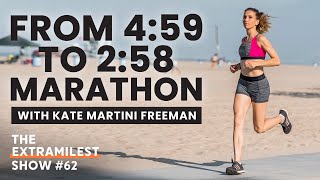
Kate Martini Freeman went from a 4:59 marathon debut to a 2:58 PR by building strength early, staying flexible with training, and listening to her body. She emphasizes periodized training, hill work, and mental resilience over excuses.
Chapters
Push it. Like, don't decide you can't do something. Like, keep trying, you know? Like, whether it's a workout or a new distance or whatever it is, it's fun to go after something a little scary, but then don't hold back. Like, go for it. Don't be afraid to push and then keep pushing, but don't get so wrapped up in your mind. Like, I've seen so many people, they're in the middle of it and they're obsessing over what already happened. Don't— no, be here. In this moment, what can you do right now? And then just decide you're going to keep trying for that thing, because like, that's where, that's where it all is, you know? That's where all that magic is, where you're like, you can look back and it doesn't really matter what happened then, because as long as you gave it what you had and you gave it your best, you're gonna be stoked on that, you know?
Hello, hello!
Today I'm going to be interviewing my friend Kate Martini Freeman. She's an incredible athlete and a really good running coach as well. Actually, she coached me together with her husband Jimmy Dean Freeman when I first really got into running, and I've learned so much from her. She has an incredible running portfolio herself. Her first marathon, she ran in 4:59, and over the years she was able to improve that gradually until a PR of 2:58. So a lot of improvements along the way. And she has also ran many different ultra distances as well. She has won 5 50K distances. She has run the 50-miler and 100-miler as well. So definitely a very broad background as a runner. One thing that I respect from her a lot is that she's a mom of two and she's still able to find really creative ways of being able to get her training in and still being able to run at a very high level. For example, a few years ago I was actually able to pace her while she set a very fast record time of running a marathon with a stroller. So we've gone on many different running adventures and have learned a lot from her along the way. In today's conversation, we take a deep dive into how she was able to improve her running over the years. A few other topics are the differences in training between men and women and older runners and younger runners. A lot of talk about setting goals as well that absolutely scare you. One thing I respect about Kate a lot is that she, for example, picked up stand-up comedy, something she was very scared and afraid of doing, purely to go into the unknown, scary territory where we all grow. And there's a lot of similarities there between stand-up comedy and doing some races that might scare you as well. With the Extra Mile Show, it is my desire to bring educational videos to the general public for free, and the aim is really for you to become a stronger, healthier, and happier athlete. With that being said, I would like to thank the sponsors of today's episode. Element is an electrolyte drink mix that has everything that you need and nothing that you don't. So there's plenty of sodium, potassium, and magnesium, and no sugar. I typically start my day drinking a large glass of water of about 500 milliliters, so half a liter, and I add one package of LMNT. It helps me rehydrate, it helps me with my focus and with my physical performance. Increasing my electrolyte intake has made a noticeable difference in my energy levels. No more brain fog and improved quality of sleep. Sometimes after harder or longer workouts, I would get a brain fog or like a headache in the morning, and this no longer happens either. Element has a no BS, no questions asked return policy, so you can try it for an unlimited amount of time, and if you don't like it, you can ask for your money back. You can even keep the box. That's how confident they are that you will love it. Go to drinklmnt.com/flow to get a free sample pack of 8 flavors with your first order. That is D-R-I-N-K-L-M-E-N-T.com/flow.
Www.hvmnt.com/flo.
See also the link in my description. Today's episode is also brought to you by HVMN Ketone IQ. Ketone IQ by HVMN is a supplement that increases your blood ketone levels. Many people, including myself, find that increasing your blood ketone levels can greatly improve your cognitive abilities and your physical output for mental performance and for exercise. I use Ketone IQ for improved focus with work projects such as preparing this podcast and also on some of my longer and harder workouts. Andrew Huberman from the Huberman Lab podcast also speaks frequently about the benefits that he notices with using Ketone IQ as a brain fuel. I'm a huge fan of his work, and I'm noticing more athletes take this, such as Sarah Hall and Ben Greenfield. If you'd like to try Ketone IQ, you can go to hvmn.com/flow to save 20% off your order. Once again, that is hvmn.com/flow /flo to save 20% off your order. Or if you're located in the US, you can visit any of the Sprouts locations nationwide. Hope you enjoy my conversation with Kate Martini Freeman.
Hello, Kate.
Hi, Flo.
Welcome. Thank you to, uh, to sit down and finally have a well-overdue conversation on record, right?
Definitely.
So you have made a big impact in my life, in my running, and also in my racing, and like general in my approach of life. So, man, I want to say, first of all, thank you. No, like, it's, it's been really fascinating, both you and Jimmy, throughout your coaching and throughout your guidance. You've really brought a lot of joy to my running. And so I want to really take a deep dive into you as a running coach, but I want to take a, take a look as to you as a runner as well. So maybe you can give some background information there of how long have you been running, like, how has that decision been from you? Because it wasn't always that you were a top-notch runner. You've definitely improved over the years.
So yeah, it's interesting. So growing up, I was not a runner. Um, I actually swam and played soccer. And then it wasn't until after college, uh, right during when I met Jimmy and he moved to LA, and his first— one of his first jobs in LA was coaching a marathon team. I don't know if he told you the story, but I was like, oh cool, I'm gonna, I'm gonna be on the team. And him being like the lifelong runner was like, oh, oh honey, you don't start with a marathon. I don't think he would say that to anybody now, but at that time I looked at him, I was like, but a 5K? Like he was like, oh, you start with a 5K. And I was like, well, 5K's not on my bucket list. He's like, a marathon is, I'm gonna do it. So I started training for that. And I remember that first 16-mile run in that training season was literally harder than my first marathon. It was so hard. And I felt like I got through that. It was really just 'cause I didn't eat enough calories during that first 16-mile run. You know, those first few years of running where you don't know anything. Oh, I actually have to eat? What? And so by the time I toed the line and did that first marathon, I mean, it was definitely challenging. But there was something about— I always say it's like it was giving purpose to my daily workout. You know, like, I love to work out. I always worked out my whole life. I, you know, did something. Luckily, I grew up in a home where my mom always encouraged us to move. She didn't care what it was. We had to do something.
That's good.
So yeah, it started from a place where it was just something I wanted to finish the marathon and I fell in love with having something to train for. So that first marathon, I mean, I finished barely breaking 5 hours, 4:59:51.
How did that go? What was that first race experience like?
Oh my gosh. I don't even remember all of it, to be honest. It— I chose to run the Kona marathon in June, so It was a little hot. And Kona is beautiful. The first— so I think it was an out-and-back. And that first 6 miles, you kind of ran through town. So it was lovely. There were people cheering and trees. But then it kind of turned slowly. Things started to disappear as you got outside of town. And then you were literally running through like lava fields on both sides.
That's what I see with Ironman always over there as well.
It was that. You ran on like the Ironman course.
Yeah.
And, uh, so then you do the 6 miles through kind of like these lava fields, and in June, and it was like dark lava fields, and you're like, uh, and then you hit the turnaround. And I remember I headed— heading back, at least I had something to look forward to. Um, and you know, that's always great to have something to look forward to in a race. And I always will tell my runners that now. I'm like, I don't care what it is, like save your favorite goo flavors for the end, whatever it is, have something to look forward to. And I was coming back and I remember Jimmy found me on the course because he was the coach. And luckily, we had had a bunch of friends do the race with us. So I kept seeing friends and some I would pass, some would pass me. And once we got into town, I knew I was getting closer. And I just remember, I don't know if I can curse on your show, but I remember bitching him out. I was like so mad because he came up and he was coaching me. He was so peppy, you know, and I was just like, grr. And I think at one point, he was like, let me hold your water. It was Kona in June, so, and I didn't know anything yet, right? So I had a little like Camelbak and I remember, I think I made him hold it for me, whatever it was. At one point I was so thirsty, I just looked at him and I just didn't say anything. I just snatched the little tube and I was drinking it just like, grr. And, um, I don't remember the end exactly. I imagine he had me pick up the pace for whatever the case, probably because he knew I was very close to 5 hours. Um, and I just gave it everything I had. I was completely spent. And I remember being so happy to finish. Finished in, you know, breaking 5 hours at 4:59:51. I'll always remember that. And immediately I knew I wanted to do another one. It was the weirdest thing. Like, setting out to do it, I didn't even think about the next one. And immediately I was like, I'm going to do another one. Which I did. Like, that year later, I did my second one in November.
I'm surprised you wanted to sign up that quickly. Sometimes—
Yeah, right away.
Some people had the first marathon experience and they're like, whoa, that was so rough, I'm never doing another one in my life. Yet you signed up for the next right away.
Yeah, and I mean, I see that, I see it all the way, all the ways. Like, I mean, you know, now that was in 2002, right? So I'm gonna throw like other distances in there. But after my first 100, I was like, oh, hell no, I am not doing that again. I have done another one since, but I've only done 2. Yeah, you know, and I, I know I'll do another one at some point, you know. I definitely want to see what I could do there, but it's not It's not right now.
And then over the years, like how many, how many races have you done or how many marathons or ultras? Like, wow.
You know what? I don't even know. I know it's well over 40 marathons. Um, I haven't done as many ultras. Uh, I've, you know, like the 200s, I've only done one 50, one 100K and then a few 50 milers and a lot of 50Ks. I'm not sure. I'd have to go look at results. It's funny. Cause so many runners and so many runners keep track of everything, you know, like they have to finish the, the mile on the dot and all of that. I am not that runner. I literally am like, whatever. Half the time I just have a rolling number in my head of my training plan, you know?
Yeah.
Um, and it depends on different things, what my goals are, you know, how specific I am. But, um, yeah, I definitely— last time I calculated, I think it was like 46 marathons, but I'm sure it's well over that now. But there was a lot of years where I was coaching and training and I would do 3 marathons a year and then a few other things. And then, um, there was a couple of years in 2006 and '07 where I did some triathlons because I had a swimming background. Um, and I wanted to do an Ironman, so I did one and it was awesome. Um, I would definitely do another one, but I'd want to train with friends. Um, yeah. And then I started doing ultras in 2009, so I definitely— it was spread out over a lot of years.
Yeah.
Yeah.
So what I find interesting is that you were able to bring your marathon time from about 5 hours to sub-3.
Yeah.
How have you been able to improve over the years, and, and do you see similarities of what what you learned over the years with some of the athletes that you're coaching as well, what ways to improve.
Yeah, I mean, for me, like, I wasn't naturally fast. I mean, maybe somebody would say otherwise. I mean, I loved it, and I think for me it was, um, it was having something to motivate you ongoingly and chipping away and just enjoying the journey such that it wasn't like letdown after letdown. Like, I had I had so many races, I guess not let down, it's more like not having every race as such pressure. So it was literally the joy of running. Like I did that 4:59, right? And then that November, I knew I could go faster and I did a 4:24. So that was a lot of time off just from my first to second marathon. But when I first found out about the Boston Marathon, I think it was even after my first marathon, I didn't even know it existed, learned about it. And literally my conversation was like, oh, that's cool. That's nice. I'm just, I'm not that runner. Just didn't think I was. Then I ran that 4:24 and then loved training. So I just kept training. I loved who I was training with. I loved what I was doing, keeping it fun, learning about injuries along the way, which is a whole nother conversation.
We'll dive into that later as well.
Exactly. So many things to running. I always say that I'm like running seems so simple, but there's so much to know. And that's what's beautiful about it, you know, the journey, but so I loved like It was something that I looked forward to on the daily. And I found as long as I honored those rest times and step back weeks, then I kept— the stoke was still there. It wasn't grueling. And yes, sometimes now it's hard to get up at 5:00 AM to run, but you have to have something to look forward to and make it be something that you're enjoying the journey. Otherwise, what's the point? Like the Coyotes, we always say, if you're not having fun, you're doing it wrong. And it is kind of that. But so I chipped away, right? And then over time, I eventually was like, oh my God, I could break 4 hours. Cool. And I did. And I broke 4 hours. And that's when I was like, holy shit, I could totally do the Boston Marathon. And once I broke 4, it was like, oh, I'm doing that. And then when I went to cheer Jimmy on at the Boston Marathon in 2005, right? So that's 3 years, only 3 years in. You know, that was his first time running Boston. And just being there and the energy, you know, and some of these ultras I'm at, like cheering Jimmy on at Wasatch when he was doing all the 600s, that 13-week period, whatever, that energy. I was like, I got to do this race someday. Boston was just like that. And I looked at him and Jimmy's dad, I remember I was like, I'm gonna be here next year and I'm gonna be racing this. My time was so far off still, I don't remember how much it was, probably 3:59 or something. So I was so, so far off.
And what would you have to run to qualify?
Uh, at that time it was a sub-3:40, so it was before they dropped the times.
Yeah.
And yeah, I probably had like 19 months to go, which in a year most people would be like, well, that's probably not worth it. But I didn't care. I was like, I am doing this. So I was just like woman on a mission, on fire, trained my ass off.
Um, and so that was increased training volume, that was increased consistency, or what were those changes?
So luckily, because I was started in 2002, and I was consistent for those years. So my base was already really there. Um, if you ramp up too quickly, that's where you get all those little injuries along the way. So I was lucky. I had, you know, like a little knee injury my first running marathon. It was just, you know, whatever it was at that time, it was just the body didn't have that base. So by the time 2005 rolled around, I had 3 years of consistency, so that base was there. So I was able to increase the mileage, um, you know, Everyone— coaches will tell you to increase by 10% at a time. All of us know that 10% is kind of a little bit, so we all push it. I try not to push it over 20%, keep it in the 10 to 15. So I definitely pushed it on the brink sometimes. Um, my own personal training philosophy now is variety, like such variety where I feel like most people don't work that in enough. And what I mean by that is variety in pace, um, variety in like your workouts. So I really started to get serious about cross-training and doing strength training, especially for female runners. Um, we naturally are built with less muscle, so we have to work that. You have to have muscle to support this kind of running and the impact. You just do, you know, um, if you want to have longevity in the sport. So for me, it looked like increased mileage, um, increase in speed training. Most people focus on speed, but in the first part of your periodization, you know, that's like how we like to train. So that first, you know, one-third of your training season more focused on strength and hills, and then I'll transition into more speed training. So I'm lucky because I like speed training, like whatever form, whatever workout. Um, and again, as long as it's fun, you know, as long as I'm looking forward to it, it sounds good. Uh, but at the same time, I'm also somebody that will have fun if it's really hard, you know, I'm not afraid to push it and like be the one like dry heaving at the end of just a workout, you know?
So, um, so what kind of strength training would that involve? Would that be going to a gym? Would it be more like hill training? Would it be a variety of different things there?
So, uh, both. For me at that time, um, it was the gym a few times a week. So like weights, um, and definitely hills as well. So I would— I mean, I always do strength training right now. I'm doing strength training only twice a week, but ideally like 3 times a week. And maybe it's only 20, 30 minutes, maybe it's 40 minutes. So it's not a tremendous amount, Now I've kind of gotten more into like, I go to Orangetheory and, you know, do the circuit training, which I'm sure Jimmy mentioned too. But back then I was going to a gym. So I think I was going to Equinox and doing weights or classes, whatever it is, you know, mixing it up just to have that variety and, you know, less impact. So on those days I'd probably, or some of the more cross-training days, hit the pool or the bike. Definitely hills. I didn't really get into like hills and trails till a little bit later. So, and that's where my times really started to drop too though. So beyond like, you know, Boston times. So for me to go from sub-4 to Boston, it was specifically just more strength training with weights and then more speed training towards the second half of my training seasons.
So.
It is fascinating how both you and Jimmy in your coaching approach, even for road runners, take quite a few of those runners to the trails for some of their workouts. Can you talk about the reasoning behind that?
It was honestly, cause we, once we both started doing it, we started seeing our times drop. So, and also motivation-wise, because running, running a road marathon, it takes, it takes a lot, like sometimes to recover from a 50-miler is easier almost sometimes with that impact, you know, just asphalt's a little rough, you know, it's awesome because that return and you're like, I'm from a hard, hard concrete versus the softer trails. Yeah, absolutely. Um, but also just purely for the enjoyment level. And I mean, if you look at, if you're training, you know, even at those times when I was training for, you know, chipping away at the 3:11 to 3:09, you know, 3:09 and then 3:04, whatever it was, you know, um, maybe I was doing trails a little bit less, but I was still doing it a lot at the beginning. And then a lot of the trails, um, on the recovery weeks, you know, cause I really started understanding like you have to take those recovery weeks very, very serious. Um, I feel like most people. So they kind of lock into their pace and they stay at a similar pace and they'll drop their mileage a little bit for step back week, but we get so in our heads as runners and we kind of get obsessive over the numbers. And I'd rather see a week that's real big and then a week that's really, really recovery focused. And most of us will take one week off when maybe our body needs two. We're afraid to adjust and I get it. I totally get it because we're all running for different reasons And most of them are great reasons. But so yeah, for me, I really saw my times drop when I would work in a 50K 5 to 6 weeks before a marathon, which I would not recommend to a first-time marathoner. But if you have a big, big base and you enjoy the trails, I have a whole different way to do a training program for a marathon now. And the trails, it's because when you can run a 50K or something longer, you're not as— I mean, You still respect the marathon distance and to run that fast for that far is really, really hard, but you just have a different level of endurance. So once I took to the trails, that's when I did see those times drop, but it's also because I had the mental capacity to push further. And I think my first few marathon teams, and I wouldn't take a first-time runner or even a second or third, I mean, maybe a third, but probably a second-time marathoner Beyond the distance, you know, I would take them up to 20, maybe 22 miles. You know, I'd rather do different workouts where it's focused on, you know, slowing it down and then speeding it up in an 18-miler or something like that, you know?
Yeah.
But, um, yeah, for the trail specifically, it's because it was strength, um, less impact. It kept the interest there. And then over time, more endurance.
Yeah. The other part that I've noticed is when we were going in the early stages or like in some of these training cycles, we would spend several hours on the trail sometimes, and it wasn't all running, running, running. There was hiking involved, there was occasional breaks involved, and it was more about spending time outside on your feet versus being running for 3 hours straight or for 2 hours straight. And like, once again, goes back to what you were saying earlier, like finding that joy in, in the running and the community element of it as well.
Yeah. And I mean, I always— it's like I mean, yes, even if we have big goals and we win races and all that, ultimately, this is a hobby. So if it's not adding to your life, and I mean, I'm not saying be lackadaisical about it always. I mean, if you do set big goals and go for it and like crush your body sometimes, you know, like in a speed workout, but like not when you're injured. Like, let's scale it back. And unfortunately, we don't learn that until, you know, you do it the wrong way a few times maybe, and that's okay too. But I always said like, you know, find the gold whatever it is, you know. It's like, I've had races where I'll kind of like give up a little at the end, and then I'll get 4th place, and I'm like, oh. And so I'm like, okay, learn, learn, take the gold, take the gold. So the next race, I'm like, nope, I don't care how I feel at the end, I'm gonna give it my all, because then I'm gonna— I know that I gave it my best, you know. Um, but, uh, yeah, it's, it's, it's, it's a unique sport because it takes you through, you know, so many mental places along the way too.
It sure does. How do you deal with the tough spots in a race once Once you get to that spot and you know, all right, things are going to get rough and I still have X amount of time to go, like, is there anything mentally that you tell yourself and/or some of the athletes that you work with as well to get through that?
Yeah, it's interesting. I mean, I think there's so many different, uh, mantras or tricks that I have, like knowing myself now. Um, I hadn't thought about this for a long time, but, um, for a long time when Jimmy first got into ultras, And if I had real extreme, extreme pain or like knee pain or something, I had trouble running through it. I couldn't, you know, I really couldn't run through that kind of pain. But also once I really established more of the cross-training and like the strength training, I found, um, I could withstand it in a different way, but also my body could handle it better. Um, once I had more variety in my training, like fast and slow and strength and, you know, big weeks and real step back weeks. And I think because I would push it more in the training, I learned ways to push it more in the race and kind of drop the hammer. But oh, what I was going to say about Jimmy, I remember for so long, he'd be like just devastated in the middle of an ultra and then he turned it on and just crush it on the second half. And I was always like, but how do you run through that pain? I don't understand. And it's funny because now I can like run through so many different things, just life experiences, and you take things along the way and you learn and you figure out, you know, how your own mind works. But I remember not understanding how we could run through pain, like a stabbing knee pain or something like that, like so intense. I was like, I just don't get it. And then over time, kind of chipping away at it and just going for really big kind of scary goals. And, you know, yeah, you could look and most people,, you know, are logical. They're like, I'm going to do a marathon and then I'm going to do a 50K and then I'm going to do, you know, a 50-miler. Also being exposed to ultras and just seeing people be at rock bottom and be able to recover, that's inspiring, you know. So it's like you draw strength from other people and then you— I was able to draw strength from my own races, um, along the way. Like I said, you know, if I gave up a little, well, next time I'm gonna push through and I'll remember that. So that's why I always say like, take the little piece of gold, like No matter how terrible something is, there's some little something in there that you can use for the next one. And really dialing in nutrition. So I learned once I could dial in nutrition, oh hey, guess what? That wall in the marathon, not so much a wall if you eat right. You know, oh, oh, my body likes electrolytes. Okay, cool. So it's like you set yourself up for success and you do what you can and be in the moment. I also found it's, um, a lot of us mentally will whatever you're feeling in that moment, in that hard spot, we're like, "Oh, it's only going to be here." And same thing when you're earlier in the race, when you're like, "Oh, I'm on target for this time," you think it's just going to remain the same. Whether it's really, really great or really, really terrible, your mind tends to think it's only going to stay there. But the second you can be like, "Oh, it's going to change," and that took a while for me to get there, respect, or just like knowing that it's it's gonna change again.
And that's the race experience probably as well, right? Just having gone through that several times and knowing that you can recover and get in a better spot after a low spot as well.
Oh my God, yeah, absolutely. And a lot of times it's like, okay, this is really, really a hard spot. What can I do right now that's actually going to help me next? Yeah, but then it also puts you in a space— like, I literally will think of like my third eye. This is where my Santa Cruz hippie, you know, my mom yoga, all of that. But I'll literally focus on my third eye and my power center kind of a thing. And it's like you said, all your little tips and tricks, and sometimes they're just so second nature to me, I forget about them. But I always have a mantra and I'll always have a kind of a plan, like when it gets hard, what am I going to do? And for me, I tend to focus on, especially in marathons, I focus on how much time I have left, because it's not very much time. Mileage can be a little hard when you're like, "Oh, 5 miles, oh, that's so long." But if you're like, like, okay, it's really, really hard right now and this is really, really terrible, but I have less than 1 hour of running, right? So the only hard part of the marathon— I mean, yes, they're hard, but it's that last like 6 to 8 miles that's so hard. And for most of us, it's like once we get to that point, you're like, okay, I have less than an hour or whatever it is. If it's an hour and a half, 2 hours, I don't care, whatever the time is, you think about, oh, this is probably my biggest mantra and help out there, right? I start thinking about all the amazing things. And so often in your training programs or your whole running career, you'll be like, oh, I missed my workout. Oh, I did this. Oh, I didn't hit my speed workout. Well, if you can switch that thinking to like, oh my God, remember that, that one Tuesday night track workout where I passed everybody? I, I was faster than my goal time, you know, or oh my God, I had that stair workout that I just crushed it, whatever it is. And that long run that I did, remember that long run that was so I ran 30 miles on trails and felt great. And we invest so much in the, in how we feel in our training. Um, but people don't remember that they're never fully recovered. So like, if you do a taper and you like toe that line tapered and you actually, you know, it's like you don't gain the muscle until you recover, you know? So you start that race and if you're serious about that race and you tapered properly and you're like mentally in a good place, Well, it's going to feel way different. You can't assume it's going to feel like whatever that longest peak run was. But we forget that in the training period. And then when we're out there in the race, it does feel better. But so the thing that helps me the most is remembering all the things I did that were awesome and remembering how much time I put into this. And what that does is it puts me in a place where I'm like, dude, I have 1 hour left. 'Come on, pull it together. Just give it your best every single step.' And I kind of feel like at that point I become like a little bulldog where I just won't let myself give up. Even if I'm like slowing down, I'm like, 'Nope, speed up.' And so I always say like, just keep, keep trying. Like literally from mile like 23 on to the finish, even 20 on, but really like 23 on. Because I would say 20 to 22, just, just hold, hold pace. And then 23 to the finish, the entire time, just try to speed up. I don't care if you are or not, just keep trying. And if you're just— if you're just in the mode of trying, you'll surprise yourself, you know.
Let's dive into running injuries and illnesses for a little bit, because I think we all to some extent experience it throughout our running careers.
I, I want to meet the person that's had no injury or sickness and learn from them.
Yeah, exactly right.
So I've had of the above.
Tell me a little bit about how you would go about dealing with injuries personally yourself throughout training cycles, and also when you work with different athletes. Any guidelines, recommendations for other athletes dealing with injuries?
Uh, you know, it's interesting because I've had smaller injuries and bigger injuries, and it wasn't until I had a bigger injury that I had to take legitimate time off from running. That I don't know, it was like myself and who I was was so— I identified with being a runner so much. And it's funny because I wasn't a runner and then I was, and then when I couldn't run, it was like I had to soul search. And it was such a— it was so hard on my ego, you know. And it was— I remember when I had to take the time off and being at parties and hear runners talk, and I was just like, "I got to get out of here. All they're doing is talking about their times and eating and blah." But it wasn't until I had to take that time off that I really got how much the body needs to actually have that break from impact to recover. And I always kind of smirk when everyone, and I think all of us have said this, and I said this for most of my running, I took a week off. Like what? I'm not healed in a week? Nah, your body's, you know, I said your body's not really going to heal something from a week most likely. And we're so afraid to take that time off. But how many times have we run through injury and raced through injury and months of dealing with the same injury? And certain injuries take longer. Like right now, like in my little girl group of like runners in the morning, last year, I think 3 out of 4 of us had the hamstring issues that we were dealing with. Hamstring takes a long time to heal. And some things, some things you can run through and some things you— that take longer to heal. And if you keep running through it, it's just going to take longer. So as hard as it is to take that time off, and depending on the injury, so it's like it really depends on what it is to know how much time you need and how you need to adjust. And most of the time, yeah, you got to talk to your coaches or talk to your PT or your doctor, whatever it is. I mean, some doctors, some, some, you know, are just anti-running, as we all know, but there's always a way. But, you know, there's things out there where you can still maintain your fitness. And yes, it's not ideal, but it is if you want to race, uh, not injured, you know? And it's like, who wants to race injured? You know, like, we've done that and it's not fun.
So how do you recognize some of those signals of like, like before you get injured? Yeah, obviously you're pushing your level, your, your stress levels to a certain extent to be able to grow. Yeah. However, you can push it too far either.
Like, how do you listen to those signals and what can you do Yeah, I think a lot of us have to learn by mistake, unfortunately, and I've done that a few times. And even now, you kind of know, like, if you just take a moment— and I know it's hard because we're always inundated with everything all the time and we're wanting to do all of the things— but if you really take a moment and listen to your body, most of the time you'll know, okay, if this is getting worse, or even if I have a little nagging thing and in the middle of that workout it's starting to get worse, you gotta stop. Yeah, like, you just— if it's getting worse, stop. And a lot of times we don't. And yes, I get it, like, you push through, but it's different. Um, if you're— muscular pain, like when you're running up, you know, a stair workout and, you know, hit double steps and all of that, yeah, that's gonna burn, that's gonna hurt. But, um, it's different. And I feel like if we can take a moment and just check in with our bodies, you know when you need to pull back. You don't want to So I always say run with your body, not with your head in those moments, OK? So listen to your body. Listen to those signals. And yes, while it's hard to take those 1 to 2 weeks off, a lot of times if you just step back for that 1 to 2 weeks— but I do find it's easier if you have a plan or something else that you like to do. So maybe that's aqua jogging. Maybe that doesn't hurt your injury. And I know it's terribly boring, but blast the music and I don't know, have some like— candies on the ends, like whatever you have to do to make it okay.
So tell me more about that part. So you would basically go into a pool, the aqua jogging?
I mean, that's just one, you know, basically I, I would adjust. Okay, so if, if there's an injury and if it's feeling worse in the middle of a workout or wherever it is, my rule with myself was just call it for that day, do something else. So aqua jogging was something that I enjoyed because I'm kind of a water kid, you know, grew up by the beach and all that. It It's maddeningly boring. You wear a floaty belt and you can— I mean, if it's a shallow pool, some people run on the bottom, but ideally you float and you literally— I mean, you're working against the water with your arms. So it's got a little mini arm workout too and your legs. And you basically look like a toy soldier and you're moving tremendously slow down the lane. And if you go to a regular pool where people are swimming laps, they'll be like, "What is this person doing?" But again, just get it done. And I mean, I will do anything. I mean, anything that's not going to make the injury worse. And most of the time, what you need to do is minimize the impact. And depending on what the injury is, whether it's knee, it's a different— walking, jogging is usually pretty good on the knees. But if it's hamstring, maybe something else is better. So it's figuring out what's not going to aggravate it. But I get keeping your endurance and your fitness up. I also do believe, though, taking a little bit of time off right away is better than than training for longer with an injury and then potentially, you know, expecting that injury to go away in your taper before your race. Um, and I've done it both ways and I've learned, uh, you know, when you need to kind of step back, find a way that's going to make it a little more bearable and then kind of get through it. Um, a lot of us, like, if we do go to PT or something for whatever it is, maybe we won't do exactly what they tell us to do, you know, maybe we'll, you know, kind of half-ass it Do what you're supposed to do. You know, just do it. But you have to make it habit. You have to work it into your life and like literally schedule it. Like, okay, I'm going to do my strength training on Mondays and Wednesdays and Fridays. And if I miss it one day, I'm not going to make it be the end of the world. I'm not going to run myself ragged trying to schedule it and remake it up. Maybe I'll push it more on like my next speed training day, or maybe on a day, on a random Thursday, I feel amazing. I'm going to turn it into a tempo run. You know, so it's like having a little malleability and then just kind of trusting your body and knowing like, oh, I can— I know my body, you know. Yeah, you can— you have coaches and you have all these people to lean on, you know, or maybe you don't, but it's like you kind of can figure out a way to push and pull back. And so it's like that little balance, but I would say finding something else that you can do so you're not going completely mad. And maybe it's like, I'm going to read a little more too. Whatever it is, you know, however much time you need, but you have to, um, fill that time beforehand and have an idea about what we're going to do, or at least have a plan. Cause otherwise you'll, you'll keep running or you'll be really miserable.
Yeah. Yeah.
So what about when people get a flu or a cold throughout that training cycle? Because that's the other thing, especially yourself, especially throughout the winter or when you have kids or you're surrounded and you're traveling or any of these kinds of things.
Germ gremlins, man. Seriously? Yeah. So if it's in your chest, if you feel it in your chest, it's best not to run. So like recently I had like a little chest thing and it was like, uh, great, I have to take another week off or 2 weeks or however long it's going to be. Um, if it's like in your throat and in your head, if it's like a head thing, you can usually run through it. It's not going to be as comfortable, maybe you're not going to nail your time, but that's kind of the general, very easy way to figure out it. Can I run or can I not? Is it in my chest? You shouldn't run. Is it not in my chest? Okay, it's not gonna be comfortable, but you could probably do So that's my fake Dr. Kate advice for you. Don't run if it's in your chest.
Big disclaimer, we're both not doctors. We don't pretend to be any.
Fake doctors.
Yeah, I think that's very true and listening to how the body reacts and indeed sometimes taking a step back day and really letting the body rest and sleep, sleeping a bit extra can be very beneficial there as well. One step backwards, two steps forward.
You know, I'm a big believer, like, this is going to sound— for people that train not every day, they're going to be like, what? But take one day of rest a week, just always. And then if you have to look at your month, like, one week of the month should be recovery. And I love to see it when people really drop the mileage. I'm not talking like, oh, I did 55 miles rather than 60. I'm talking like, yeah, maybe you do 60 to 70 miles a week-ish, or however many hours on feet that is, is maybe your step back week is like 20 to 30, like extreme step back. I love to see that. I'm not saying you can't still work out. You can do other things, you know, less impact, you know, cycling, whatever it is. And it should be something you normally do or work it in, you know, gradually let the body adjust to it. But I think a lot of people are afraid to step back, which is funny because then on the other side, maybe some of us struggle more with like, how do I push it more, you know? So, um, I guess it's just being, being in tune with, you know, what you want to do and where you want to take it. So adjusting along the way.
Yeah, yeah, yeah. So you have over the years worked with many different athletes, and you have, you've seen, you've seen some athletes succeed, succeed and do really, really well, and yet some other athletes are setting certain goals and they might not necessarily succeed in reaching some of those goals. Like, have you seen any similarities between, like, what, what makes people accomplish more, or what makes people reach higher and actually accomplish what they set out to do versus some people who might not get there?
Yeah, that's a fun question. It's interesting because I think if I had to say just one thing of how the similarity I see amongst everybody would be, I mean, it's an element of just believing that you can, or maybe you like, you know, even if you're like, oh, I don't know if I can do it, but if you're going for it, there's an element of you that believes that you can.
Can.
So it's just, it's like that old, like, throwing your hat over the fence. I'm gonna go for this. Um, but if you're, if it's something that you're enjoying it, I feel like that's going to be like, you're going to see more success. So I would say they're, they're liking what they're doing. So whether it's the training team, they're looking forward to it, or, um, you know, they're just, they're just all in after that goal. So it's just, it's going for it, deciding you're gonna go for for it, you know, because if you're kind of like one foot in, one foot out, it's going to make the whole thing harder. So I would say the successes would be going for it, maybe going for something big that's a little bit scary. Um, maybe if I'm seeing people that are not hitting their goals, I feel like people maybe aren't patient enough sometimes. Some people that I've coached, like, they want to have something and they want to have it like this training season. Um, sometimes you have to adjust and make a few-year process, you know. It's like somebody really made an impact— Gordy Ainsley, go figure, right? The godfather of ultras, you know. Um, I was just hanging out with him at an aid station once and he was like, Kate, you know, if I had to give somebody advice, it would be for ultras, a year per distance increase. And most people aren't patient enough to do that. I wasn't. I went from a marathon to a 50-miler. I did like I did a couple triathlons, I did an Ironman, you know, like, yeah, I'll just— but I like to say go where the inspiration is. Like, if you're lit up and inspired by it, go for it, do it, all in, you know. If it sounds logical to go from a marathon to a 50K and that's what you want to do, cool. But if the 50-miler sounds even better, do it. But maybe pick the one that's a little bit further away, maybe like extend it a little bit and, you know, work in like a nice periodization and like a great taper. And honor the build weeks and the step back weeks. But yeah, it would be impatience to answer your question. Impatience. They want it and they want it now. And their body, you got to let your bodies adjust. We're not all 18.
That's for sure. What kind of differences have you seen there with athletes in their 20s and 30s sometimes recover quite a bit faster than some athletes in their 50s, 60s, 70s, like, would you have different training and coaching recommendations there for athletes of different ages? And if so, what sort of way would that be?
Yeah, absolutely, good question. So yeah, absolutely, I feel like every decade recovery gets harder and I'm not 40 yet and so I like to take knowledge ahead of time and I'm already planning how I'm going to run in my 40s and 50s and 60s, luckily with the Coyotes, I get to run with people of all ages. So when I'm, you know, a guy that runs with us on Thursdays, he's in his 60s and he's always giving me tips. And that's the thing, he's like, "Kate, recovery gets harder every year or every decade." And he was like, "Most people will tell you, 'Oh, in your 40s.'" He's like, "No, no, no." Yeah, you got to adjust. You have to adjust, but he's like, "It doesn't get real hard until your 60s." And I'm like, "Okay, okay, I got it. I got it. I can still do some great things in my 40s and 50s. Cool." But so specifically, Warm up, cool down. It's funny, stretching is something— it's something different for everybody. But what I really am a huge fan of now is dynamic warm-ups. So I just have some simple ones that I do. A lot of times it's like basically lunges in all directions. And not only does it warm up the body, but it opens up and warms up the hips. And then for me, I like to do a lot of single leg in all directions. You can also see right away before you start your run. So So like for me, it would— for most runners, it would be warm up like maybe it's a mile, mile and a half, whatever it is. Then do a dynamic workout— or sorry, like a dynamic warm up. And you'll also be able to see if something's tight. Like, oh, my left calf is a little tight. Well, you already warmed up. You did some dynamic warm ups. So yeah, you can stretch that calf a little bit. You can massage it or whatever feels right. Like I'll usually have like a roller or just stretch a little bit, whatever it is. I like to check— do my check-in during my dynamic warm-up. I would recommend that for everybody, and I know we don't have time for that all the time. I mean, I've done plenty runs where I run right from my door, run back, no stretching, you know. So, um, but just kind of checking in with your body. Um, also what I've, uh, learned to do is if I do have an injury, whatever helped that injury, still try to do that. So like, I had plantar fasciitis once. Well, I still do my, you know, feet exercises. Maybe it's at my desk, maybe it's only once a week, maybe I forget and it's a couple times a month, but I'll still try to remember to strengthen my feet. So for everybody across the board, it would be warm-up, a little cool-down, some dynamic warm-up or workouts, whatever it is. And then, I mean, stretching, figuring out what works for you. I'm not the best stretcher, but whatever works. And I think as you— each decade, it's probably just more of a warm-up. Maybe it's a little bit longer. Maybe it's just adjusting on the day if your body's not wanting to do speed that day.
I really like that part too, the part even what you said earlier about warming up and actually listening to your body, what it's telling you and doing that checkup. I think that's a very valid point. What about like, so obviously with age things change, but then previously you mentioned, for example, women needing to focus a little bit extra on strength strength during certain stages as well. Yeah. Are there any other differences with the, the training and racing for women than with men, or is that mostly— I mean, strength-related?
I mean, we, you know, we deal with menstrual cycles once a month. If you want to get it out, like, sometimes it's harder to, uh, you know, do a race during that time. And some people, they don't, they don't worry about it, and some it does affect them, whatever the case. Um, so typically, yeah, maybe it'll be better to have a recovery week. It depends on like, you know, your own body. Um, but we'll have that to deal with. But then, you know, I don't know, like people said on the other side of childbirth, you can run better, you know, like whatever it is. So, um, but I mean, not really, I would say. I mean, I guess we have to honor a little bit differently, like our— just even our hip angles, like put a little more pressure on our knees. So it's like, that's why I'm a big believer in a little bit of strength training. But I think guys should do strength training too. Everybody should do strength training, in my opinion. Like, if you want to get faster, younger, do strength training, you know. Yeah, do speed training too, but you have to have the strength there to support it. Um, uh, I just remembered one other thing as far as aging too. Um, I specifically— anybody like once they get over 25, I was like, do not go from running really fast to running really slow quickly. Don't do it. I've seen so many people like get injured in like a warm-up because they're doing, you know, like butt kicks or something. I'm It's not about hitting your butt. It's just about warming up your body. Okay. We're not trying to like, don't try to just force the body. Yeah. Don't force the body. So I would say push it, but you don't need to go from 0 to 60 in a second. Like take your time on both sides of it. We're not like doing a sprint here, you know? So honor that. But yeah, I don't see a lot of other differences. If you want to get into like recovery, I would say, Um, everybody should work on recovery too. Um, as much as we've talked about like warming up and stretching, I think a lot of people don't. And I see this a lot of runners, like the things I see most are new runners, they are not eating enough and they're not eating consistently enough. Like I am like clockwork. I will have 100 calories every 30 minutes. I will have a salt stick every 45 minutes to 1 hour. And I drink a lot of water. I just drink a lot of—
so I don't have to worry about race strategy.
That's my race strategy. That's my like training run strategy. If I waver on that, I mean, maybe I need a little more, a little less, and I know I can't go over— under 150, I can't go over 250, like my body's not going to process it. But you learn that through experimenting. I feel like most people, um, at the beginning don't eat enough because they got through it. Well, that's great, you got through that run, but if you are in deficit during a workout or a race, whatever it is, you're not going to recover well. And then it's not about I mean, there's different things you can do, obviously, if you're like trying to have your body train on fats, and there's different things you could do. But it's not about just like getting through it, barely surviving. It's like if you fuel and then you set yourself up for recovery, then your body is going to already be recovering. So you're going to be awesome in your next workout, you know? So you're not always— Yeah, yeah, yeah, yeah. So, yeah, it's just like that consistency, but that recovery. So right after too, it's like, like, you know, the 4:1 carbs to protein. And like, you've got to eat after. And if you can't stomach something after, figure out something, whether it's, you know, a protein gel shot like for recovery, or even a banana, like a bite. Like, I don't care what it is, like you eat something after. It doesn't have— it's fine if it's an hour and a half or under, you know, but I'm talking about those longer ones. Set yourself up for success by recovering after, doing some foam rolling, doing some ice baths. Do the things you got to do, you know, so you set yourself set up for success on the next one.
Yeah, yeah, yeah. I think one part I want to talk a little bit more about is setting big goals and getting in, in, in almost scary unknown territory. And one of these reminds me of when you invited me to a stand-up comedy show a few years back, which I have so much respect for that you even dared to stand in front of a group like that. Tell me a little bit more about why you have done that several times, why you put yourself in some of these situations where you're quite this, like, uncomfortable. It's kind of the unknown. What is your reasoning behind doing some of these things?
I guess I like to see what I can do. Like, I don't know what I can do until I go for it. And I've kind of always had this philosophy, if somebody cross— if something crosses my path and it looks interesting, I should try it. I should go for it. You know, sometimes that's gotten me into trouble, but most of the time it's taken me on really cool adventures, you know? And I, I think I just— it's probably just, again, take it back to my mom, just always like, trust your instincts and, you know, do what you love and go for it kind of attitude. And I'm just like, if I'm gonna do something, I'm gonna do— I'm gonna go all in. In. Like, I'm gonna go for it. And I don't know, I could say that, like, for those big scary goals, it is— it's just a little bit of, I'm gonna go for this. And there's something— it makes you just feel alive, you know? Even when I remember when a friend recommended me for this stand-up comedy show, and it was so scary. And every day— but it was like, it was so cool every day to look through a new lens, you know, and to try it on. And it's You can go through a whole day and kind of not have something light you up. But if you're coming from a place of like, oh my God, I'm training for this big scary thing, or I'm going to do this thing. It's kind of like, you know, when you buy a ticket to go on a trip, right? It's like, you're so excited, you're already on the trip and you're not even on the trip. So it's kind of like that. It's like instilling that sort of excitement in the daily. And I guess, I don't know, it's funny because I do these things and I look back, I'm like, yeah, that was really scary. But it was fun too, you know?
And that often goes hand in hand, right? Where the growth happens, it's often in that scary territory, in that unknown, and putting yourself in that situation.
Yeah. I think I just like to live on that heightened on the daily. So even right now, you know, obviously like I have two kids now and all that. So it's like every day is full, but sometimes I'm like, oh wait, what is that next big thing? And I can feel something brewing and I'm like, playing with some things, but right now, like, on my calendar, there's not some big scary thing I have. But then it's like every day I'm kind of like, hmm, what is it gonna be next? I'm plotting. I think I just like having something that excites me every day, something, something bigger, that goal.
And I know it gives purpose, and I can highly encourage other people to do the same thing, whatever that may be. And I quite a few people can't even picture themselves running a certain distance, a certain time, a certain—
I couldn't many a times. Yeah. And then I just chip away and slowly get like closer to something.
Taking those small steps towards those bigger goals, but eventually not being afraid to dream big and to really put something out there further, further out.
It's like, I think we've all heard like it's the scare, the, the fee, the, the feeling of failing, or like the It's scarier to think about failing. I don't know, but it's almost like, I guess once you have and you've put yourself out there and you've missed on things, you kind of realize it's not as scary. I don't know. It's like, you have this one life, right? And somebody told me this a long time ago, like, people on their deathbeds, they only regret what they didn't do. So I think it's that same feeling. I would rather just go for it, and I think it's just an utter trust in myself. I will figure it out. I'm gonna go for this, and if all— everything crumbles and everything goes to hell, it's okay. We'll figure it out.
What is the worst thing that can happen?
Well, there's some really bad things that can happen, right? But let's, you know, yeah, let's know that we'll be all right.
Yeah, exactly.
Oh my gosh. Yeah, it's, um, I don't know, might as well go for it, right? Whatever it is, like, trust in yourself. Take the breath every day, like, dust yourself off and, like, go for it again. And try another way, you know. Oh, that didn't work? Okay, well, let's try a different way. Think about it differently, like be engaged in the conversation, you know. It's— I think I feel like a lot of people will like try and maybe if it wasn't instantly easy or something, they'll get disenchanted. But I think I like the work too. I don't mind working for something. Sometimes I feel like I need to work a little less and let it come to me a little more. But yeah, I guess just there's magic in in the working for it and pushing through and seeing what's next. Because that is, like you said, it's when you grow and you expand. And there's like, I don't know, there's beauty in all of that. Yeah, makes it fun.
I want to be respectful of your time over here because I know we've got some kids running around here as well that we've got to get back to. Oh yeah, yeah. Um, however, um, I do want to transition back to a little bit of the training cycle because I think obviously during a training cycle You have good days and you have bad, and some, some days are just more challenging to get out of the door. And whether that is because the training volume is ramping up, or you might experience that it's raining, it's cold, long or short days, how would you suggest your athletes actually deal with something like that?
Um, my very easy go-to is listen to your body, not your mind. A lot of the times it's just mental, like you don't want to go. If it's your body like needing a rest, that's different. My rule of thumb that I give all my like marathoners is the 10-minute rule. I do not care, go for 10 minutes. If after 10 minutes out the door, wherever you're running, if after 10 minutes you are 100% like, I am not running today, you can turn around and go back home. 'Cause guess what? 20 minutes is better than nothing. 95% of the time, you're gonna go beyond 10 minutes. You just will. So it's set yourself up. Like for me, I have to set out my workout outfit the night before. 'Cause a lot of times, like right now, like 3, 4, 5 mornings a week, I'm up at 5 to work out. 'Cause I like to work, get my workout in now before the kids are up so I can see them before I go to work. And it's hard. It's super hard. But I have to set out my clothes the night before. I'm not gonna be fumbling around in the dark and getting dressed and waking people up up. So that's what works for me.
Make it as easy as possible to get the shoes on and out of the door.
Minimize excuses. Yeah. And just like, mind, shut up. Like, we're going, we're going, you know, whatever it is. And, um, but don't be afraid to adjust it too. So I used to always have— made it easier because when we were coaching like speed or hill or stair workouts Tuesday nights, it was like, oh, okay, I gotta do mine Tuesday morning. And so it became, uh, it became my rolling speed workout. So it's, it's a little hard to do a speed workout sometimes in the morning, you know, you're like a little harder to warm up, and, you know, get a little older, a little colder, whatever it is, you know. But like, get the right gear, so minimize, minimize the excuses. Um, but so I would wake up, I'm like, I'm gonna do the speed workout Tuesday morning. And then if I would try, try, try, try, and if I just wasn't nailing the times right away, I'd be like, you know what, I'm gonna do it, I'm gonna do it, maybe I'll do it tonight or tomorrow morning. So then I would roll it to Wednesday morning. But if it was the same thing, if I didn't hit it Wednesday morning, Wednesday night was the last cutoff. That was my last And a lot of us, I feel like, will, you know, make magic, especially artists. It's like when it's due, right? But it's like, it's not that you're necessarily procrastinating. It's like you're, you're ruminating on it, you know? You're figuring it out. But, but Wednesday night, I would— if it got to Wednesday night, I would nail it Wednesday night, you know? So, um, yeah, just, uh, make it, make it less hard than it is, you know? Because it is, it's hard. Um, but also listen to the body on the days when it's not going to happen. And it's okay to move it, it's okay to roll it, it's okay flip-flop, you know, your big week and your small week, you know, it's okay. Have some room in there to adjust it.
So now, after many marathons and ultras and dealing with a lot of athletes as well, you have a lot of experience in running. What kind of recommendations would you give your younger version of yourself, like your, your 20-year-old Kate who is just getting started with running, if you could go back in time?
You know, it's like I was having fun with it back then, um, and I think it would just be like, honestly, being like, you, dude, this is gonna take you to places you never thought you were gonna go. Get ready for a fun adventure. Because it's not even like logistical advice. I mean, logistical would be like, don't start your strength training 3 years in, do it right away, you know? Like, because I wasn't as good at the weights like my first year, you know, whatever it was. Like, that would probably be the only thing. Um, I naturally was pretty patient with it because I I didn't have big crazy goals yet. You know, it wasn't until later I had the big crazy goals because I just— it wasn't on my radar. I mean, when I started running, there was literally like two types of goos, like blocks and Chomps, like, and, you know, waffle— like, none of— there was no options, right? There was like a couple running brands, like clothing, you know, whatever it was. Um, so it's like, it wasn't— there wasn't that all there. But it was just like, now I look back at it and sometimes I wish— sometimes I'm like, oh man, I really wanted to hit that Olympic trials time, or whatever it was, and I don't know if I'm going to now. And then I'm like, maybe I will, maybe I won't. I'm not worried about it. I'll go for it if I want to. But it would just be like, look at all the magic along the way. It's been such a cool unexpected journey. I never knew I was going to run 100 miles and do an Ironman, all these things. It's such a fun adventure. Just go with it.
Yeah. So there's quite a few people listening that are looking to improve their running times and become a stronger, healthier, happier athlete. Do you have any clothing—
closing— clothing? Wear less clothing. Less clothing.
Do you have any closing thoughts over here of suggestions for athletes to improve further?
I would say be present on the daily. Honor the body and adjust, as in like do what you can do to improve the little things like the stability, the strength training. Push it. Don't decide you can't do something. Keep trying. Whether it's a workout or a new distance or whatever it is, it's fun to go after something a little scary, but then don't hold back. Like, go for it. Don't be afraid to push, and then keep pushing, but don't get so wrapped up in your mind. Like, I've seen so many people, um, they're in the middle of it and they're obsessing over what already happened. Don't— no, be here in this moment. What can you do right now? And then just decide you're going to keep trying for that thing, because like, that's where, that's where it all is, you know? That's where all that magic is, where you're like you can look back and it doesn't really matter what happened then, because as long as you gave it what you had and you gave it your best, you're gonna be stoked on that, you know.
So yeah, yeah, very well said. Thank you very much. Of course, my pleasure for sharing all the insights, and I look forward to, uh, to another trail run very soon with you.
Yes, please, can't wait.
Thank you. Thank you for listening. What was your What's your favorite lesson, takeaway, or quote from this episode? Please let me know in the comments on YouTube, and I'll actually pick 2 winners that will receive a Zoom coaching call from me, like a 30-minute session that we can go over any of your training or racing questions. Also, every week I send out a newsletter to the Extramilers community with running tips, race strategies, stories, training, insights, different things that I'm learning and experimenting with in my own daily life. If you would like to sign up for this free newsletter, go to extramilest.com. This email typically goes out every Friday. It goes out at this point to about a list of 11,000 people, and the feedback has been really positive on a weekly basis over there. So yes, you can sign up at extramilest.com. See also the link link in the description over here. I've really been having a lot of fun with these podcasts. Many more are in the works, so stay tuned. Thank you for listening and have fun out there on your runs.
Bye now.
More from Floris


Ryan Hall 2.0 on Strength Training For Runners, Lifting Heavy & Trail Running




You’re Doing Zone 2 Wrong (Even If You Think You’re Not) | Scott Johnston Round 2


How to Build an Unstoppable Aerobic Engine (Even If Starting From Zero) | Scott Johnston


Stress Is Killing Your Running (The Relax Fix You’re Missing) with Dr Kasim Al-Mashat

When things get hard, say this, it (works in any race) #jeffpelletier #running #ultrarunning