Kilian's Adventure Advice - Storms, Sleep & Survival
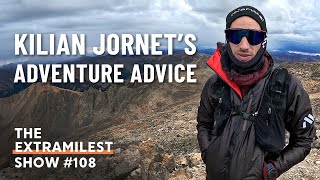
In this on‑the‑trail interview, ultrarunner Kilian Jornet shares practical advice from his ongoing "Trans‑14er" project, which links all U.S. 14,000‑ft peaks by bike (≈2,400 mi) and foot (≈600 mi). The conversation covers how to plan for unknown conditions, manage nutrition and calorie balance on multi‑day pushes, cope with limited sleep and fatigue, use caffeine sparingly, and stay safe in severe weather (lightning, hail, snow). Kilian explains his navigation workflow—pre‑loading routes onto his Coros device and adapting on the fly—while emphasizing perceived‑exertion pacing (zone 1‑2) and the importance of keeping legs fresh. He also discusses logistical support (RV base, meals like rice‑tofu, avocado sandwiches, cookies), mental mindset (privilege, purpose, handling highs and lows), and the challenges of altitude, distance, and unpredictable storms. The host interjects with observations, recounts sheltering from lightning, and reflects on the difficulty of keeping up with Kilian’s pace, highlighting the extreme endurance required for the project.
Chapters
Nice work, man. Do you have any advice for other runners who are trying to plan their own adventure? Maybe not like a ginormous adventure like yours, but going into the unknown.
Yeah, I would say first, like, try to plan everything, like, and thinking about what can go wrong, what can be the alternative routes, the weather forecast, and how the conditions are. If you can, things that you haven't planned will happen. So like have this flexibility, this mental flexibility, safety margin of capacities. So don't go to something that you say, okay, it's at my limit, but everything is planned and it's perfect, and go there. Like always leave a margin of saying, okay, if everything goes wrong, I still have the tools to to make it.
Last time when you and I sat down before Hardrock, you were like very deliberate about X amount of calories per hour. You know what your intensity was going to be. Are you aiming for a higher calorie intake or carb intake here as well? Or is your intensity quite a bit lower so you don't need that many calories and carbs?
No, well, I think the biggest difference is during a race, like it's, you have accessibility to food first. Like you don't need to think of, okay, how much weight they need to carry. And so you can take as much as you want. And secondly, you go for the maximum performance because after the race you rest. You don't care about if you have the legs inflamed, if you are tired. Here in a push like that, it's important to kind of match the calories at the total. So like not to lose weight. Day after day after day. So like keep the weight stable. You cannot like eat all the time because then you will have inflammation. So it's mostly to do that. And for that, yeah, to not eat too often, eat multiple times a day, but like normal, like 3, 4 times a day, like life. And then like to have big meals when I'm down by the bike or by the van.
How do you deal with limited amount of sleep? Sometimes you only sleep for a few hours.
I try to sleep at least 4 or 5 hours. I need some pushes that it will be less. So then it's just like, you know, that these pushes I need to manage without. And then when I get back to the van to try to have a good night of like 6 hours.
Is there anything in particular that works for you? Is it like coffee? Is it gels with caffeine? Is it anything in particular?
I don't know. I think it's more like if it's technical terrain, it's easy to stay awake.
Yeah.
If it's easy terrain like this, a bit boring, then it's hard to stay awake. And then it's, yeah, maybe I try caffeine, but it works for a while, but not for so long.
What's your favorite go-to way of caffeine?
I'm really not a caffeine person, so I just Yeah, coffee. I can take coffee. I don't enjoy it, but I can take coffee, or I can take caffeine pills or caffeine gel.
There you go.
So yeah, it's— yeah.
Today we are in Colorado and we're trying to meet up with Kilian. Kilian is about 1 week into his adventure right now, and he's on the bike, and then he's gonna transition to a run. We're gonna try to find a way to keep up with him. First we gotta find him. Kilian is now attempting to link 14,000-foot peaks. So that's about 4,300-meter peaks across the US. He's planning on foot roughly 600 miles, that's about 1,000 kilometers, and by bike 2,400 miles, about 4,000 kilometers. That's the equivalent of every day doing a Tour de France stage race plus a marathon at altitude with a ton of elevation. Colorado has 58 of these peaks, California has 12, and Washington has 3. Killian is now working to connect the public 14ers through iconic routes using only his feet and bike. He's gonna come bombing down this steep hill, probably. We just saw Kilian catching up with him now. The end of his bike. He's going fast.
Hey, Kilian! Hey!
Hello, hello!
How are you?
Good to see you! The bike that Kilian is cruising with. Looks fast to me.
And you saw that there's—
you're probably gonna get rain or snow tonight?
Yeah.
Okay.
I saw.
What are you eating here in between?
So now I was eating rice with tofu, with egg, with spices.
Plenty of avocado.
Avocado too, yeah.
Don't forget the cookies.
Yeah.
Lots of cookies.
Cookies.
I saw your sandwich post yesterday on Instagram.
Cheese. Cheese sandwich. Yeah, I took two cheese sandwich, Swedish style from Vienna, one Catalan style from— oh no, two Swedish style because I made it, and also two Swedish style sandwich.
So this is where you sleep as well? This is the RV where you rest?
Yep, here's our home.
Called the pond. All right, starting out here. Lewis and Killian getting off the path.
Start the navigation.
Oh, you can— no, you can long press the button. Let's go back. Resume. Resume. Long press and then go to navigation. Yeah, so you don't need to stop.
Okay.
On-site tech support.
What was that?
Kilian, you don't like wet feet for 30 hours?
No, and not only 30 hours, but the thing is that after these 30 hours is another, another, another. So for one day it doesn't matter, but for 30 days I don't want to get blisters.
It's interesting to hear that Kilian and Lewis are hiding from the lightning right now. Because I'm on the other side of the mountain. And there's literally sunshine. And some clouds. All right, I'm really high up now, 13,000 something, and I see a lightning strike in the distance, but it might be coming this way. I'm at the summit right now and lightning is starting to roll in. I'm not going to go out in the open. I found myself a shelter that I have to go in, that I have to stay. Yeah, boys! I see Kilian and I see Lewis in the back there as well. There was a bit of lightning there, huh? Yeah. Caught you? Yeah, I was at the summit when it started.
No way!
Nice work, man. I came from the opposite direction.
Ah, okay.
So I started where we're going to go towards right now. I parked where Nick is going to park as well. And then I just ran 5 miles up the hill already.
Nice.
Yeah, it started getting cold up there, man. Yeah, it really did. So you guys ended up twice in shelter?
Yeah, yeah. First when we were down, it was stormy. Then second, same as you here.
Yeah. So which ridgeline did you come over right now then? That one?
It's all this one, yeah. You start there and follow this down here. So it's pretty long.
Was it technical?
No, not so much.
I have all my stuff at the summit. My drone just— I wanted to fly my drone out to you and then it fell. No! So I just was able to retrieve it.
Lucky!
So yeah, I was lucky on that one.
Yeah, it's a bit of wind ruffles.
Yeah. When you were going in shelter, was it lightning around you guys already?
Yeah.
Yeah.
Or like, yeah, we started to hear very close.
Yeah.
Then started to grail.
Because it was kind of for me in the distance, and then all of a sudden it was like very close up. Yeah, it became very fast. Yeah, from there on it just became like shelter, kind of hide under the rock a little bit, like put on some warm clothes.
Yeah, exactly.
But within 15 minutes it was gone. Yeah, it went pretty quick. So how did it go today? What did you do so far today?
So, um, yesterday I was doing the Alps traverse, then I slept 3 hours, then I We was riding from Aspen to Twin Lakes and then with Lewis we did the Redwood Ridge, which is this nice ridge here.
Yep.
And so far the weather is a bit tricky because yeah, you see around, it's a lot of rainstorms and thunderstorms. So we have to hide a bit and wait for the thunder to pass.
So how do you go about it? Because obviously when you want to do this many forts containers in a row, you're going to encounter severe weather. So how do you go about it? You typically try to kind of navigate it, and then when the lightning comes nearby, you try to hide, is that—
Yeah, mostly. I think it's very different if you try to do like one thing, like one push, like let's say the Nolans, then you look for a good weather window. But for a project like that, it's impossible. So then you just start and you go and you adapt with the weather. So if it's snowing, you go in the snow and maybe you modify a bit the road. Thunderstorm, then you hide. So yeah, mostly that you visit. I don't know. For example, the other day we were going to the airport. It was a big storm in the afternoon. So I decided to sleep good and started in the morning. But it was not good to start with a thunderstorm. But yeah, it's a bit seeing in the moment. Yeah.
And it's tricky because you guys did the technical route. You guys came from that side.
Yeah.
You went up. I came from the other side. I ran 5 miles back in to meet meet you guys at the summit here. And even while I was waiting here at 14,000-something, like, a storm came in, the same storm, and it started lightning. So I had to kind of go down a little bit to find at least some shelter. And then it starts hailing, it starts getting like super loud around you. It's—
yeah, it's not fun.
Yeah, it's a bit nerve-wracking, but so far all good. Tell me a little bit more about what goes through your mind when you do some of these adventures, because I'm sure you have some high points, you have some low points. Like, how How do you navigate some of that?
Yeah, it's up and downs. I need just like to remember that I'm here because I chose it and because from a privileged position that I have, I decided that's what I want to do because it gives me a lot of different emotions. It gives me happiness. It gives me a sense of exploration of the landscapes that we see, but also like internal exploration. So it's that in the bad moments to remember that why we are here.
Any favorite part so far? You're about a week Yeah, by far the Alps Traverse.
It's very nice. All the mountains are beautiful. It's technical scrambling. And yeah, no, absolutely.
What are some of the challenges that you encounter?
Well, like I would say here, the technical part, it's very moderate. So it's not really challenging. Probably the challenge is more that the distance, that it's huge distance between summits. So both running and biking is not. And then also the weather, that the weather is very challenging.
Yeah, I think there's a beeping drone in the back. Yeah, we'll figure that one out. Kilian is the experienced one over here. He's like, let's go to the side of the summit so we're actually out of the wind.
Yeah.
And that made a big difference. So how do you go about the whole navigating nutrition throughout this? Like earlier I saw you at the RV. You're eating avocado sandwiches, you were doing different things, but like some toast, some soups. When you're on a push like this, are you trying to like keep track on calories, or does it go more go with the flow on this?
Yeah, no, I think it's impossible to keep track on calories, and I'm too much because it's— I would need to carry too much. So the, the— when I'm in the mountain, then it's like to, to try to eat Every now and then, not too often to let the stomach rest a bit, but every, yeah, like 3 times per day, 4 times per day, and try to eat different things depending on the section, the time of the day, a bit more fats, a bit more carbs. So yeah.
Hello Luis!
Hello!
Yeah! Hi! Looking good, my friend. Nice work.
It's a long ridge, yeah? It's long, huh? And the elevation goes higher, it's like, oh! Yeah, yeah, yeah, we feel it.
The altitude is no joke.
No, it's not for sure, yeah. Even if it's like, it looks like rocky, it's not like in the Alps or Himalaya that it's all snow. The altitude is the same. Yeah.
As far as for intensity, Are you mostly in zone 1, zone 2, or are you sometimes getting higher up as well? Are you keeping an eye on that, or are you more like going by perceived?
I go by perceived exertion, but it's zone 1, zone 2 all the time. Yeah, right? Yeah, yeah.
Because over here you would set yourself up.
And then also like the muscles, because one thing is like the tiredness. Yep. So then like, and you can see like at the end of our A long day?
I mean zone 100.
No, you can see at the end of a long day, like even if zone is 1, your respiratory rate, so your perceived exertion is very high. So go on that and then also to keep the legs fresh day after day, to never really push in the downhills, to always take it easy.
Yeah, that makes sense. How do you navigate around here? Like, what do you use, like, for planning, for, like, day to day, even right now, knowing where to go?
Well, like, I have the track in the Coros, so I have the track in here and navigate on that. And then it's just like when you are up, it's also looking and seeing where it makes more sense.
So you preload all of the routes in advance?
Yeah, I preload all of the routes. In case of bad weather and on a push like that that I don't know where to go, I know what are the big lines. And then like the micromanagement of the terrain, it's from there.
Let's try to find a way to get down this mountain. This is kind of the funny part. Kilian is just walking down the mountain and up the mountain. With his hands in his pocket. Meanwhile, I have one hand in my camera, the other navigating, and even with one hand I'm like, whoa, he has both hands in his pockets. He's such a mountain goat. He's the goat, but he's also a mountain goat. And Kilian is gone. That's wild. All right, gonna try one more time. Give it a little push, see if I can catch up with Kilian. They call him the goat for a reason. The mountain goat. This is the search to try to keep up. And it starts to thunder again. Maybe that will make me want to run faster. And he calls this non-technical. All right, that was meat down. Have a good rest of the adventure. Kalleen is getting cold, so he's going ahead. And just like that, he's gone again. There's simply no way, even if I try to keep up with him. Absolutely mental what he's able to do, running all the highest 14ers, all the 14ers in the lower 48 states. Yeah, he's a man on a mission. And just seeing how easy he makes it look, even though I know it's challenging, some of this terrain is absolutely brutal, and he's still able to go after it. Yeah, I'm starting to see some more hail starting to come down again, some snow, some hail. I'm going to catch up with Lewis, and then we will try to get off this mountain as soon as we can too, before it starts getting too dark cold and potentially have more storms roll through. But absolutely pleasure to spend some time with the goat. So inspiring, man. What a legend.
We are in the middle of the storm.
Yep. Did Killian drop you? Yeah, Killian is already way down there. He said I'm getting cold fast. Yeah, so trying to keep up with Killian, this is what happens.
I got something as well, so check it out.
Look, that's what I got. It's time for us to start putting on the gloves. Lewis and I are making our way down the mountain right now. Kilian is way ahead of us. He's gonna go through the night. Like, it's just so mind-boggling what he's doing out here for the next, whatever, 3-4 weeks through the storm as well. Yeah, through the storm, through sleep deprivation, through hill, rain, altitude, elevation, all of it. Seriously, I knew Kilian was an incredible athlete, but not as incredible. Oh shit, that's me. Just seeing him not just going up the ridgelines but going down. He said he was getting cold a little bit and he was going, and even me trying to keep up for like just 1 minute, like him tap dancing down the mountain. It's freaking incredible.
No, it's amazing, amazing experience to be with him for a day or half day.
Yeah, however, but I love it.
I think I learned a lot.
I also learned how to, uh, how to deal with thunderstorm.
Find a cave later.
That's a good call. And he said, better be slow than sorry. So yeah, that's actually, that's actually a good one. Better be slow and sorry. So cool. Yeah, that was incredible to see, incredible to watch, and I hope you guys enjoyed some of these learnings, takeaways, kind of behind the scenes of this Chilean state of elevation. So anyways, we're gonna make it down, put on the headlamp, and cruise back to the car. Yo, nice work, my friend! Even before the darkness, nice! That was one for the books. I'm not gonna lie, this was one of those days that I did not know what to expect, and we got everything and then some. Ah, and everyone is safe, and we had tons of fun, that's for sure. Mm-hmm.
More from Floris


Ryan Hall 2.0 on Strength Training For Runners, Lifting Heavy & Trail Running




You’re Doing Zone 2 Wrong (Even If You Think You’re Not) | Scott Johnston Round 2


How to Build an Unstoppable Aerobic Engine (Even If Starting From Zero) | Scott Johnston


Stress Is Killing Your Running (The Relax Fix You’re Missing) with Dr Kasim Al-Mashat

When things get hard, say this, it (works in any race) #jeffpelletier #running #ultrarunning