Kofuzi on MAF Training, Frustrations and Running Progress
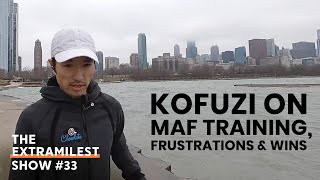
In this episode of the Extra Mile Show, host Floris Gierman interviews YouTuber and non‑elite runner Mike "Kofuzi" about his marathon journey, the shift to low‑heart‑rate (MAF) training, and the challenges he faced. Kofuzi recounts his early running background, a disastrous first marathon, a long hiatus, and a return sparked by a friend’s 10‑mile race. He describes adopting a Nike‑led program, discovering the limitations of speed work, and moving to Maffetone‑style low‑HR training, later evolving into a polarized approach (≈80‑90 % low‑HR, 10‑20 % high‑intensity). He shares frustrations during the early 100‑mile phase—slow paces, being passed by groups, unreliable wrist HR monitors, and the need for a chest strap. Over time he notices brief “blips” of faster pace within his HR zone, incremental mileage gains, and a shift from distance‑based to time‑based training. Kofuzi discusses lifestyle factors affecting performance: limited sleep (≈6 h), high coffee intake, family responsibilities, homeschooling during COVID‑19, and adjustments to training volume (70‑80 mi/week, 3‑4 h runs). He highlights equipment preferences (Polar Vantage V watch, Polar chest strap, Suunto strap) and the importance of sleep tracking. The conversation ends with practical advice—run more, slow down, build endurance, reduce intensity when injured, and use a polarized training model—plus promotion of Floris’s Marathon PR program.
Chapters
Like, people are always like, how do I improve my marathon time? You know, I was like, the answer is probably run more. That's the short answer. I'll give you a longer answer. But like, usually the answers that I was giving even before I was into low heart rate training was, you know, slow down your paces, get more volume in, build that endurance. All right. So unless you're training for 5Ks or less, you know, you— the right answer is probably build more endurance. If you're getting injured frequently, the answer is kind of run more. But the only way you can do that is by reducing your intensity. If you're getting overuse injuries, you gotta turn down some of those stresses until your body's strong enough to handle it. Then you can start putting on those extra pieces.
Welcome to the Extra Mile Show with today's guest, YouTuber Ko Fousey from Chicago. My name is Floris Geerman, and on the Extra Mile Show, we discuss ways to become a stronger, healthier, and happier athlete. My co— in his own words, would describe himself as a non-elite roadrunner who vlogs about marathons, half marathons, and being a non-elite. And last fall, so about 6 months ago, he started his journey with MAF low heart rate training to try to improve his running journey. And this running journey with MAF training had a lot of different ups and downs, and he definitely experienced a lot of frustrations and doubt along the ways. He actually made several different YouTube videos about his progress after 100 miles, 250 miles, 500 miles, 838 miles, and 1,000 and this gives a really good insight in what that journey for him was all about. And we discussed this in much detail on today's show. He initially had to slow down his pace significantly. He used to train at about a 7:30 minute mile, so that's about a 4:39 minute per kilometer. All of a sudden he had to slow down all the way to an 11 to 11:30 minute mile, so that's about a 7:08 minute per kilometer pace. So this definitely brought several different challenges with him that are going to discuss on today's podcast. We also talk about the world of vlogging, about some of his favorite training and racing tools, as well as family life. Kofuzi is a father of two young kids, and several of the different adjustments made because of the current coronavirus. There are no sponsors for this podcast. However, if you're looking for a running-specific training program that focuses mostly on a low-intensity, low-heart rate training approach, combination with some higher-intensity workouts and different structured training and racing schedules, check out my Marathon PR Training Program. Right now is a great time for base building, especially since you're running mostly solo. This is also a good time to lower your stress levels, to go after the right nutritional approach, get enough rest, recovery, and sleep, and boost your actual immune system. These topics and much more are discussed in 40 different videos of this Marathon PR Program, and more info can be found at extramilest.com/pr-training-program. Marathon. All the show notes from today's episode can be found at extramileless.com/33, and I will have to apologize for some of the poor audio and video quality in a few of the different sections of this interview. Unfortunately, Zoom and Skype had a few different challenges that seems to be pretty common these days, but we still found a way to make it work. I hope you enjoyed today's episode with Kofuzi.
Mike, glad that you're— that we're finally able to connect. Welcome to the Extra Mileage Show.
Thank you so much for having me. I'm very glad to be here.
Yeah, absolutely. I will have to say, I want to start out by saying that you're an absolute machine when it comes down to content creation, like your daily running videos for both YouTube, Instagram, and the other channels. Like, absolutely well done on being able to pull that off, man.
All right, thanks so much. I mean, with everything going on now and I can't really work all that much, I kind of Makes things a little bit easier, frees up a little bit of time. So it's been nice.
Yeah, it's, it's definitely a little bit of a wild, wild west adjusting to all the different schedules and whatnot. What I find fascinating when looking at all of your different videos and your journey on Strava and some of the other channels is you've really done an excellent job actually documenting your running journal. And you've done a really good job actually at giving an honest insight in the different, like, things that go well in your training, but also some of the challenges that you experience, and I really want to take a deep dive into that. But before we do, I think it will be good for everyone to get a better understanding about your own background as an athlete, as a father, as a YouTuber, like what, a little bit more about you.
Sure, I am a 40-year-old father of 2. I live with my wife and 2 kids in Chicago in what is becoming very apparently in these days a very, very small apartment, with also with a dog. Um, my running journey is, um, I mean, I guess it started in middle school when, uh, there were kind of sports teams, like for the first time organized at school. So about 6th grade for me. And, uh, I didn't really make it onto any of the other teams. And so I started going out for the track team because as long as you showed up, they gave you a jersey and you got to compete in all the events or some of the events. Um, and I wasn't very good at any of them. So I got put where like most kids get put when they're not really all that at stuff, which is like the half mile and the mile. So that's where I was. And so I did that from like in junior high school. And then in high school, I did track and field as well. I did some cross country, never really all that excellent at that either. I was kind of like, uh, the last— I mean, I was scoring for our team, but I was like the 6th person scoring for our team. So I was like, um, you know, bringing up the rear as a matter of speaking. And then I did do track as well in the springtime. And then later on in my career in high school, I started picking up high jump and pole vault and also doing some long jump as well. And so I did those, and those were things that kind of came a little bit more naturally to me. And I still kind of did an event here and there. Sometimes I'd run the 4, sometimes I'd run the 800. At that point, like, they stopped putting me in the mile. They, like, realized that I wasn't getting any better at it. So they kept me to the 800 and the 400. And then I think they couldn't figure out what I was good at, so they put me, like, all over the place. So I think I've done, like, one of every event before. But the things that I got kind of good at was pole vault and high jump.
I did eventually compete as a pole vaulter in college for one year.
At a Division III school, so a very, very small school at a conference that prides itself that none of the schools in the conference give any athletic scholarships. And so, it's called the University Athletic Association. So, like, no one gets any athletic scholarships in the entire conference. It's very strange. And after a while, it just seemed like too much work. And I wanted to have more of a college experience, whatever that meant. And so I quit the track team at that point and really took a very, very long break from all running for a long time. And then it wasn't until I turned 30 in 2010 and my dad was turning 60 and he told me he was going to run a marathon and it was his first one. And I was at like having some friends over and I was telling my friends about this, you know, we were having a little cookout. Dinner party. And then, uh, you know, I should do that with my dad. I mean, he's twice my age, no excuse. That's how I did my first marathon as a couch-to-marathon, starting in preparing in late May and then running the Baltimore, uh, Running Festival in October. Was a disaster.
I love disaster stories. Please tell me more.
It went about as good as like couch to marathon could conceivably go. Um, so it wasn't a great experience. I didn't really know what I was doing. Um, I did a Hal Higdon plan and it was 2010. So I, um, printed out the plan and put it on the fridge. Um, and I would look at it like that.
And the way I did it was I did like a beginner, like marathon plan, like maybe the beginner 2, uh, plan that he has.
And I basically skipped every cross-training day and took it as like a rest day. I think I maybe had like a 40-mile week in there at some point. Um, I was, I had no idea how fast I was running because it was 2010. I don't think people were really running with GPS watches that much then. And, um, or at least not couch-to-marathoners were. And, uh, so I had no idea how far I was going. I remember, I mean, I would remember, well, I would figure out like how long it would take me to do a run. By, um, looking at, there's a control panel in like the lobby of the building that controls like the elevators and like the fire systems and stuff and has a little blinking clock on it. So I would look at that before I left my building run. And then when I came back, I would look at it and subtract to figure out how long it took me to do that run. And for figuring out how far it was, I would map it like on, like, I forget, I don't know if it was MapMyRun or whatever the precursor to that was. I think it was MapMyRun, but before like Under Armour bought it. So I was using that to like figure out that's how, that's about where I ran. And then according to the elevator clock, this is how long it took me. And that's kind of how I figured out like what I was doing. And then it turned out I was underestimating, underestimating the distance on all my runs, uh, by probably about like 10%. So like just, you know, doing everything pretty much wrong, but having fun kind of doing it. And just running, uh, and running like too much, you know, increasing mileage too much too soon. And so by the time I got to the starting line of that marathon, I, uh, my left knee was just pretty much already giving out. And so it was a very long slog through that marathon, a lot of walking. I had no, I didn't even know to look at like an elevation profile for a race. And I had no idea that Baltimore is an extremely hilly marathon, at least according to like, compared to like Chicago standards. So, um, I was just so ill-prepared for everything that happened that day. There was a guy running in a like Dunkin' Donuts coffee cup costume. And my goal was to not get beat by that guy. And that guy totally beat me by a lot.
I'm sure you learned a thing or two that day, huh?
Uh, no, I mean, I guess not really. I mean, it's taken like years of like I kind of like shut it out of my mind. I took like a 5-year break from running after that. I was like, I did that, that was fine. I've like, I've got nothing left to achieve.
So classic. I almost did the same. For me, it was 2007, the first one. And then I felt I was almost going to die at my whatever, 18 or 20. And when I finished, it was the same thing. I'm never doing that again. And it took me a good 6, 7 years too before I got back into it again. And then what was it for you to get back into it again? And how was that experience different?
Uh, one of my friends, uh, that I met in Chicago when I went to law school here, um, one, uh, like spring, it was about this time of the year.
He was just like, hey, you used to run. Um, and I was like, yes, I did a long time ago.
He's like, let's do this race. And in Chicago, there's a big race Memorial Day. It's a Soldier Field 10-mile race. He's like, let's do it. And I was like, okay. So like, I just, it was like, you know, um, April. So I figured that'll give me enough time to train for like a late May race. And then, you know, then you'll be in good shape for the summer already. And so, okay, I'll try it. And, um, uh, he ended up beating me by a lot. Not that we were like racing each other, but I remember we did that race. He, we split up very early on. He finished the race. Walked to his car and then came back and still like met me at the finish. And so like, he just really beat me by several minutes, like a long time, maybe 10 or 15 minutes. Um, and my feet felt like they were going to fall off, but I was like, this is good. This is real good. And you know, there was lots of beers at the finish line. So I was like, okay, I like this. It's like 9 o'clock, 10 o'clock. Morning and we're drinking beers. All right. Okay. You know, he was looking for a way to stay fit. And I was like, okay, this isn't— this is going okay. I like this. And, you know, so then it just kind of kept like progressing from there.
Good.
And then when was it that you started doing like another marathon? Was that still like— this was one of the stepping stones to— was that again?
Yeah, that— I think, uh, you know, I had no plans of doing another marathon even at like, even after that first race. It wasn't for a while. I think I watched, I spectated the 2016, uh, Chicago Marathon with my dad. My, my mom and dad were in town. My mom is retired now, but she was a nurse practitioner and she was in town for like a nursing conference. And my dad came along with her just to hang out and it happened to be Chicago Marathon weekend. Why a nursing conference would pick Chicago Marathon weekend to like host like a conference where it's bringing in people from all over the world is beyond me, but that's what happened. And so, um, I just watched, I had no real desire. I had spectated like a friend running like the 2014 Chicago Marathon. It was the year it was really cold. Um, and, uh, I think it was 2014. And then, so like I had no desire to really do it again. Especially since I didn't know anyone running that year. And, um, but I watched it with my dad and like, we just, you know, we're really into it. And I was like, okay, I think I'm going to do that next year. Um, this looks awesome. So I want to do it. And so, uh, that's what got me thinking about it. So it was like another year and a half from that first race back before I was even thinking about a marathon again. Um, yeah, but I'd run a couple of other races by that point.
Yeah. What were some of your takeaways as you went back into marathon training, but now you had a little bit of marathon experience of what could happen when you don't train properly? What were some of your next training cycles or race experiences like after that?
I think I was still doing the Hal Higdon plan, but I found a plan. I think I graduated myself to the next level up because I felt like I had been running a little bit at that point. Um, but then like after a while it just got like too, too, not stressful, but it just got too annoying to try and be like, on this day you got to do this, on that day you got to do that. Uh, and I was just like, all right, how many miles does he have for this week? Like 40. Okay. I'm just going to figure out a way to do 40 that week. Um, and not really worry about the specific day. I just want to like have a good finish. I want to beat my 4-hour, like 40-something minute time for my first marathon. Like 7 years ago. So like, you know, just let's run some miles and let's just kind of try to enjoy it and try to get there healthy.
And did you have any finish time goals for that, or was that purely for the joy and being able to finish reasonable?
Yeah, I didn't at first, but then, you know, as you get closer, you start having your longer runs and you start kind of figuring out, okay, here's maybe what I could do. So I think for 2017, my goal was in the 3:30 area because I felt like, you know, running 8-something was about, um, uh, per 8 minutes per mile was what some of my long runs were. And I felt like, okay, if I can taper right, have a good day, um, I think I could do that. And so that was kind of my goal going in, but not when I started the training. When I started the training, I was like, I want to get like under 4 hours. Um, And cause I definitely need to beat that time. I need to beat my dad's time. So, um, which his time at the 2010 marathon, he beat me by like 15 or 20 minutes. So, uh, so that was kind of like my goals. They weren't that ambitious. Uh, but I wanted to have like, I wanted to have a good day and I just wanted to like, um, you know, be able to, to do it a little bit more successfully and kind of have a better feeling for it afterwards.
Yeah. What, what I found interesting is, is on your YouTube channel, at some point in 2000, like late 2019 really, you started talking all of a sudden about heart rate training and like experiments that you started to do with that. Uh, you mentioned meth, methadone, meth low heart rate training. Can you talk a little bit more about what got you into that and what your first experiences were throughout that journey?
Yeah, I mean, I first started getting into that because for 2019 I was training with a Nike team. Um, the local Nike coach, uh, had taken a whole bunch of kind of regular runners on and gave us a coaching program and workouts and we trained together on a weekly basis. Um, and it was very different than what I had been doing even before that. So early in 2019, I had kind of just been, uh, only worrying about continuing that idea about the weekly mileage and only really worrying about weekly miles and kind of running however I felt like running. If I felt running like at a moderate level every single day, and then maybe even like finishing with a fast mile every day too, I did that because it felt good. It felt like I was getting a lot done. Uh, and I feel like I had a really, a lot of good progress with that. And it worked pretty well for me. Um, and then I thought once I, and later in the year, once I was doing this, uh, other program, uh, the training was very different. It was a lot of the stuff that I kind of always thought I wanted to do more of the stuff that I didn't really know how to do myself. And it was, uh, like shorter intervals, like 400s, um, and 800s, lots of short rest, things like that. Some of the more complicated workouts, ladders, those kinds of things. And then, and that would be like Tuesday, Thursday, and, um, a long run on, on Saturday. And, uh, the coach, uh, took me down on mileage quite a bit, which I think was really smart because I hadn't done any speed work since about, uh, maybe the year 2000. So about almost 20 years prior to that. And so, um, I think from that I did respond quite a bit to some of that speed work, and I felt like I got very strong very quickly. But I think that, you know, the price of that was my endurance, you know. And so I felt like I was on the right direction, but I also was worried that, you know, I couldn't figure out a way to continue doing that kind of speed work while also maintaining endurance. I felt like I It's getting one or the other. And so I was looking at ways like, well, how do I build more of that endurance? And so I was, uh, watching a lot of your channel already and I saw a lot of the videos you had made around that time, um, about, uh, like Jeffrey Silver, who actually just talked to you today on an Instagram livestream and his story about his experience. And I was like, concept. So I looked into it a little further. And just the idea of kind of like building more horsepower first and then kind of worrying about like the higher end, uh, what your redline RPMs are kind of like to use like an engine analogy, um, made a lot of sense. Cause I felt like I was working on the higher end RPMs, like my redline, uh, but I didn't have enough horsepower to carry me the distance. And I didn't really think, couldn't figure out how to like have both without hurting myself. And so I thought, you know what, let's try something different. So that's kind of how I started along on the methadone journey because I was like, I need a couple of weeks to kind of recover from Chicago Marathon anyway. So while we're recovering, let's play around with this, see how it feels for a couple of weeks and then kind of go from there. So that's what I did.
And then you came out with a video after about 100 miles. Describing that you were getting passed by running groups by the lake that you used to be faster than them, and that there were sometimes some occasional frustrations in the mix and even some feelings of like, is this right? Like, can you talk a little bit more about that experience and how you dealt with that?
Yeah, I mean, the transition is maddening. I mean, I'm not a very patient person to begin with, and What I've realized through a lot, through a lot of the heart rate training is what I realized is I complain a lot about stuff I don't like. Uh, and I complained a lot about, uh, low heart rate training. It just didn't seem like it was working. It didn't seem like it could possibly be right. Like there's, I was just like, so every day I was like, there's no way that what I'm doing is the right way to something that works. It's just, it seems so odd and so counterintuitive because I had gone from running most of my runs at like 7 minutes 30 seconds per mile for like my just like go out like easy-ish pace. You know, I didn't really know what easy meant. I didn't really have a definition for easy. It didn't feel that easy, but that's kind of like if no one gave me a definition, that's about how fast I was running, anywhere between 7 and 8 minutes per mile. And to get into my maffetone heart range, heart rate range, That put me at, uh, like 11 minutes, uh, almost 11 minutes, 30 seconds per mile, uh, on good days in the tens, you know, in those first like 100 miles of it, uh, which is not, it wasn't that much. It was like, that's like 2 weeks worth. So not really enough time to say anything about it, but enough to say like, I did, I did this more than once, you know? Um, so that's where kind of like that 100 miles and the 100 miles more. Of like a mirroring of like my shoe reviews, which I'll review them after 100 miles. And so just to kind of like put that timestamp on things to document it as I went further. So I absolutely hated it at first and like getting passed by like all the running groups that you used to run with. Um, and they don't even like rec— people didn't even recognize me because I think I was just going so slow. They were like, that's not that guy we know. And so that was, yeah, it was miserable. I was, I was miserable. It felt miserable. I just hated it like that first. Especially those first couple weeks. But I also had some hardware problems too. So I was just using like the wrist heart rate monitor, and I've realized— I don't know if it's my skin tone, my bone structure, or what— but like a running heart rate, like a wrist heart rate monitor, just won't work for me. Maybe I can get it to work for like 30 minutes, but after then it just, it goes crazy.
You're not alone on that one. I've experienced the same thing. I've seen many different people experience the same thing, even differences up to 10, 20, 30 beats between like the actual optical and the chest heart rate strap. The chest is so much more accurate from that perspective, absolutely.
And so relatively early on, I figured out that that was like— well, and a lot of people were like commenting in comments, so like the YouTube comment section was like really helpful. And so people are like, you got to get a chest heart rate monitor. So I got one relatively early on. I was hoping that like magically I'd be running like 9-minute miles, that would solve all my frustrations. It didn't. It just gave me this a at least consistent frustrating readings rather than like inconsistent frustrating readings. But it was a step in the right direction.
How did you deal with that? Like, how did you decide to continue doing this although it was frustrating, it was challenging? What was for you the motivation to keep trying?
Well, I was kind of like, I'd like to say it was self-awareness, but I was making maybe an insecure bet on myself or some sort of bet on myself. The The idea being earlier running days, I was never a fast runner. And so, I felt like maybe focusing on that speed work is giving me gains, but it's maybe, it's perhaps very expensive gains. So, it's taking a lot of effort, a lot of energy, and potentially put me at a lot of risk of injury to keep, especially now that I'm 40 years old, getting older. And so, I was like, maybe there's other ways that I can input energy and get better returns from that input of energy. And I thought that this could be a way to do that. Not that like I couldn't get kind of where I wanted to go by continuing along with the training regime. I think that I very well could have, because if I basically just repeated the exact same training program that I had, but now that I've had some time with it, my body's adjusted to it a bit, maybe increased mileage, maybe I could have gotten to some of my goals, uh, as well. I don't think that's impossible, but I was just thinking even longer term, one of my goals is to break 3 hours. I don't want to just get 2:59:59, I want to destroy 2:59:59. And so I don't think that speed work is going to—
for me to get there, um, I don't know that I'll ever even get there with methotol or not, um, but I was thinking like The only way that I think that I could do that is if I'm doing something that really plays to my strengths.
And I think my strengths have been more of the, I guess, slower than faster twitch.
And then what was your training volume like at that stage and how did things progress for you after 500 miles, 1,000 miles? What did you start noticing over time there?
I started noticing that there would be like little blips, not like an entire run, not like any entire, even like a math test,, amount of time where like, oh, I got into a rhythm for like this 5-minute period of time where instead of like my heart rate range putting me at like a 9:30 mile, I was at like a 9-minute mile or like I was in the 8s again. I just like, this is magic. And it would be very fleeting, but that was kind of like the little nuggets, the little encouragements to keep going. I also thought that that was probably just equipment malfunction or some sort of error. Can't possibly be right. But I would feel like, okay, I felt it. I felt good. I felt I was in a rhythm. And when I looked down at my watch, I was running much faster than I had been. And so those are the things that started changing and started making me think, okay, I think there's something to this. I think it might be helping. As I got used to it, the amount of time it took me to run a certain number of miles like decreased because the pace was increasing slightly. It was much slower progress than I anticipated. Um, but, uh, then I was able to start thinking, okay, well now I can go back to increasing mileage again. So that was nice. So at one point I was training longer than ever, but fewer miles than ever, just because I didn't have enough hours in the day, uh, to run at that slow speed. So that was an adjustment. Um, but it also had me really start thinking about my running in terms of time. And not distance. So that was a nice, another change I think was really important for me.
Yeah, that, that's a big mind shift there as well. I see that, I've seen that in myself. I've seen it in quite a few other athletes where instead of saying I go out to run for 6 miles or 8 miles, it's more like I have 45 minutes time or I have an hour time and I'm going to go out there and run at X effort, whatever that effort level might be. And Yeah, that, that changes the schedule a bit that way as well. It almost simplifies it to some extent where you look at it that way. When you, when you look at those early stages and, and where you're at right now, how do you feel your runs are going lately? Because now you started this somewhere in October 2019, and now here we are 6 months, 7 months later. Like, how are you looking at, at this entire training approach at this point?
I mean, I think it's working for me now.
I mean, I did a math test a couple of weeks ago.
The times were in the low 8s. I even had a mile that was under 8 minutes. So I felt really good about that. Like if you had asked me at the, like the 500-mile mark, if I thought this would be possible, I would have said, uh, I mean, that's the goal, but I don't think so. Not on this trajectory. I'm not sure where it's going to end up. And so I thought that maybe I would have to at some point, like maybe hit a lab and try and get like a lab measured either VO2 max or max heart rate to figure out maybe like the ranges are wrong for me. Maybe I need to figure something else out and tweak it. Um, because it was progressing but not a lot. And so it was still frustrating. I was still willing to keep going with it, um, because even then I was only like a handful of months into it.
And so I had a lot of thinking to do about it.
I had the kind of unfortunate, um, instance where I had already signed up for another marathon. And so like in the middle of when I felt like things were starting to click, I then had to start like, at least in my mind, like kind of pause on the mathathon and at least get some sort of race-specific conditioning in. And, um, so that was positive. And the fact that I was able to kind of absorb a lot of training in some higher intensities, but like my body was in this weird state where it wasn't like low heart rate strengthened and it wasn't speed strength either.
So I was flopping around a little bit there. And so, uh, it wasn't a great race for me. Uh, but I learned a lot about some of my capabilities at some different heart rate ranges that I normally don't kind of experience. So it felt like it was a lot of useful data. But it was just kind of very unfortunate timing, which for most people would have been fine, but my running is a lot more public than most people's.
It was interesting.
A few more layers of complexity and pressure in the mix there. It's, yeah, that's interesting. So you briefly touched on Medical Lab, and I think that's an interesting one to talk a little bit more about because I think it's— the MAF 180 Formula is a standardized formula that gives a ballpark training formula that works for many athletes. However, there are also athletes that have an exceptionally low or high max heart rate, right? And so this number could be, could be pretty off for some, for some athletes out there. And for example, one of my friends, she's in her early 40s and she went to a medical lab. Her max heart rate is north of 200. And so when she calculates and compares, and even when she did the lactate threshold levels, even in the 170s, like low 170s, she was still running aerobically. And so when you compare that then to the MEF number for some of these athletes, indeed, they might be trained at a much too low of a heart rate to, to maximize that. However, that being said, some of the things I do really like about the MEF formula is that it does adjust. For example, if you have just been injured and you're coming back from an injury, or you have experienced recent colds, that you're going to be training at a somewhat lower intensity than when you have already been training consistently for 2 years and made, made progress. And so that is one part about the formula that I do think it's, it's unique that way.
So yeah, yeah. I mean, I think that like it's, it's useful. I mean, to the extent that people fault it for being like too generalized, I think that's also strength, you know, like it's, it's specific enough for most people to start using it, and then like if you're not getting any benefit from it, then you can always tweak it from there. But likely, the answer is probably that you just haven't been doing it. It's probably the most likely thing to kind of tweak first. At least that was my experience because right when I thought like, "Man, this isn't working. I got to do something different," that's when I was like, "Oh, wait. It's clicking now. It's starting. I see it." You know?
Yeah. And that's the other thing. Some athletes are progressing just faster than others. Some athletes are starting to see progress within a few weeks, whereas for some athletes it might take several months. And, and I think that's the other thing. It's not just a running component, but then there's some of these other elements like the nutrition, the stress levels, the sleep, and any of those. Like, when you look at your own personal circumstances, like, how do you feel like you approach some of these other things, like, like nutrition, like sleep, your stress levels? Like, How does that come into play for you?
Yeah, I think that that is something that I haven't really been paying attention to. Um, my lifestyle doesn't kind of allow it at the moment. Um, or I haven't prioritized those things and looking back on it now, I think that like kind of my perceived lack of progress from like the 100-mile, like like mark to the 500-mile mark, I think I could have really made much more difference, a bigger difference in there, if I had not been so adamant about like maintaining a certain number of hours per week or mileage per week, but instead thought, all right, instead of adding more mileage, let's add like an extra half hour of sleep and figure out a way to do that instead. I think that would have been more beneficial. It's hard to see in the moment, right? Especially when you're like, I'm not Why am I not progressing? You want more. Um, and so you add more, but I think the better answer would have been for me to just take some away. And I think my body would have responded sooner. That being said, I think that like, I have like pent-up progression that like, once my body was able to finally catch up, uh, it kind of all like, I had like a spike in terms of a change in my performance or like my response to the training style.
Yeah. What was the training volume that you have, that you have been doing, like, throughout some of these training cycles? Like, how many hours a week are you, are you running?
Well, it varied depending on, you know, what phase of the, like, the progression I'm in, because the earlier miles took a lot longer. But I was generally hitting about 70 or 80 miles per week. Running predominantly at low heart rate. Uh, the idea being, I always felt like Maffetone running is so easy. I could do it forever. So I was like, you know what? I got to put my money where my mouth is and I'm going to do that. And so I would just run like 3.5 hours on a Saturday. It'd only be like 17 miles or something like that, which was really frustrating. Um, but I was like, but you know what? It's not about the distance. It's not even about the time. It's about the workout and the workout is 3.5-hour workout. And if I ran a 3.5-hour workout at some of my previous paces, I'd feel pretty damn proud of that. And so I tried to look at them that way. Um, it's just different, but it's still a workout and it was a good one. Um, so that's what I was doing. I was still probably doing more mileage than I should have for kind of my level of progress, but that was like my way of like mentally kind of coping with some of the other kind of insecurities that I was feeling about my training.
Yeah, I think you made a really good point earlier there as well about the sleep component, where I see that sometimes as well. Yeah, if you're putting in X amount of hours per week, and especially when you have a lot of other things going on in your life, sometimes indeed you, you feel that part of like, ah, if I just go outside and run more, like, I will be progressing more. But Indeed, that whole sleep component being such an important one in there as well, and I see that being forgotten or kind of put into the back end by quite a few athletes that actually sometimes cutting back the training volume a little bit might actually help further in the improvements there too.
So, yeah. Yeah, I mean, the plus side of that, I think that there is a trend now where like sleep is becoming like fashionable as a recovery tool, And so that's a positive thing because I think it really, it is for sure. And so I've noticed because I've been like the various watches that I've been wearing or testing, you know, the sleep tracking is a really important function. And I've always thought of it as kind of like, oh, that's like the throwaway feature, like Fitbit does it. So to get people to pay a little bit more than a Fitbit, they put all like the Fitbit features and into like these GPS watches, but it turns out like that's the piece of data that I look at most from my watch these days is, um, uh, how well it like evaluated my sleep. And then the only other thing I really look at on most days is how long have I been out running? You know? So like, that's, uh, I don't even on my main like data screen, I don't have pace anymore. I just look at the heart rate and then amount of time time.
Yeah, that's such a difference there too. Once you take the pace off your actual screen and it's just by effort, by, yeah, by heart rate there. How many hours a night are you aiming at sleep-wise? Is there any number that works well for you? Probably depends on where you're at in the training cycle to some extent.
Yeah, it does. So it'll change. Like, the harder I'm training, the more I want to sleep, or I like to try to take a catnap during the day if I can, like, squeeze one in. Kind of like sleeping at my desk if I have to. But normally I shoot for about 6 hours of sleep. My entire life I've never needed like a ton of sleep. Like when people were like growing up, you're like a growing boy needs like 8 to 10 hours of sleep. I'm like, I don't think I've ever slept 10 hours. So like it just needed a ton. And I also think it might be a little bit of an East Coast thing. There's like a weird bravado on how little you sleep. It's like a badge of honor. Um, and so like, I kind of grew up in that kind of culture. So maybe that's it too. But, um, like something I used to tell myself in high school all the time is sleep is a habit, which is a terrible mantra to have. Uh, but that's how I kind of like got through high school and kind of tried to overachieve, I guess, back then. But now I try to get at least 6 hours, 7 hours if it's like a heavy training, uh, part of the cycle, uh, if I can.
6 hours is so little.
That's like, even, even when you're training like 10, 11, 12 hours a week, like with 6, 6 hours, are you not, are you not like zombie style during the day? Or is it just like you're able to get— yeah, it's, it's a fascinating one because I have, I've even seen it directly with different athletes who are running into like not being able to improve aerobically. And they're starting to sleep 7 hours or 8 hours from 5 or 6 hours, and all of a sudden they do see certain differences.
And yeah, it's 6 hours, it's not a lot, Mike.
I know it isn't, and I do drink a ton of coffee. I think I go through like at least 4 cups of coffee a day, and basically like if I sit down too long in any one spot, I'll fall asleep. So Um, I like to think that it's endearing because my, uh, I watch my mother-in-law and my father-in-law interact and like my father-in-law is that way too. Like he's just, he's been, he's retired now, but he's been a hard worker his entire life. And like the moment, like he would sit down for more than like 2 minutes, he's asleep. And then like my mother-in-law kind of nag him about it a little bit. Um, I like to think that she's like only pretend annoyed at him for having fallen asleep, like in the middle of the day. But sometimes I'm like that, like in a heavy training cycle where I feel like like, if you just leave me alone for too long, if I'm quiet, that means I fell asleep. But, um, for the most part, I'm, uh, not always as productive as I want to be. Like, especially like between like 2 and 4 o'clock in the afternoon during the day, that's my real struggle time. So I try to schedule meetings at that time of the day for myself so that way it's like not something where I can like sit at my desk and like zone out. It's something where I'm like, I'm with a person or I have to get up from my desk and go to a meeting, someone else's office, at a coffee shop, wherever it is. So I have some strategies to kind of like help me with that. But, um, yeah, there are definitely, uh, some— it take— I take some hits to my performance, but I try to plan around that.
Yeah, well, I will have to say, like, you are an absolute beast when it comes to creative output, and you're really pretty much creating like daily videos for YouTube, Instagram, and all that, like What are some of the strategies for you to be able to combine like your job plus content creation plus running plus like dad life? How do you, how do you make it all happen?
Well, one is I get up very early in the morning and that's something that's always worked for me. I try to take like a surgeon's approach to the day. So the surgeon always will schedule their most difficult surgery first. For like 5:30 in the morning or 6:00. Um, so that way, if you know, that's, they're the freshest, the team is the freshest, everyone's ready to go. And there's the fewest potential distractions. So I kind of say like, of the things that I can schedule and move around, the things that I absolutely want to do, I do first. And then everything else, uh, if I can fit it in, I can fit it in. There are certain things that I can't move, like when I take the girls to school or when I have to pick them up, I can't move that.
I can't do that.
Certain parts of my job, certain things I can't move when they are, but anything that I can control the time of, I shift it around so that way it's like decreasing order of importance as the day goes by. The problem with that strategy is though, you know, family time comes at the end of the day. And so that's, you know, combined— going back to like the discussion on sleep, you know, sometimes, you know, family relations takes a little bit of a hit, which I think I think a lot of endurance athletes can kind of relate to that. Sometimes the training becomes a little bit more imposing on the family relationship instead of just the hours that you're out exercising.
Yeah, it is a challenge, man, I think for anyone out there, but in particular once you're also trying to combine and a job and family life and content creation, like all of these different things, Yeah, there's a lot of spinning plates in the air and we're all trying to do the best we can.
Yeah, I frequently call it like my great big Ponzi scheme. You know, you're taking from one to pay another and then at some point, like everyone makes a run on the bank and you got to like admit to everyone that I didn't have as much time as I committed to. So every once in a while, I kind of have to like reset and reevaluate, not reevaluate, but like just make sure and reaffirm that I'm doing and spending the time on the things that I want to. So that's something that I try to make sure I'm doing somewhat regularly just to check in with myself and then with the family, make sure that everyone's happy. I don't always get it right. So having that reality check every once in a while is really important for me.
Yeah, absolutely. And I think in particular now, even everyone in the world is coming to this whole COVID-19 situation where things have changed drastically and all of a sudden there is from the homeschooling to not going to public places, not going to work. And that has rapidly changed for everyone there as well. And I know you're, you're part of the homeschooling crew as well, which I'm sure brings some additional layers there.
So, yeah. Yeah. I mean, it's been a challenge for me. I envisioned that it would very quickly become this routine where I had the girls lined up in chairs, sitting up straight, pencils ready, like every morning. That's definitely not what's going on. Today we basically just kind of played all day, but I felt like, you know, I mean, in the big scheme of things, we're here, we're healthy, we're happy, we're enjoying each other's company. It feels like emotionally we're still being very connected. I felt like that was a really important thing to do right now. And, you know, if we need to cram later on, I mean, my girls are 3 and 8. So it's like for the baby, play is the most important thing for her right now. It's like basically socialization and interacting with other people is what's important. So we did that. So 100% success. For my 8-year-old, you know, I did manage to slide in some like some times tables for her in between television shows. So I feel like, hey, that's a pretty good— and then, you know, her teachers are sending them links to like stuff they can watch like online. Um, like little mini lectures on stuff. So today she'll talk about like, uh, some geography, which I'm really bad at. So I could definitely never teach her geography. So she learned geography and some like, like easy, like history stuff. So we're figuring it out. It's not like a structured 8-hour day, but then again, you know, I've long been thinking that like, you know, my kids go to school, they get dropped off at their school before I go to my work. So they're at their school longer than like I'm at my work because I have to leave. I get there to my work after the kids are already at school. I leave my work early to get the kids at school. So they have a longer day than I do. And she's 8 and I'm like, that's not like great for an 8-year-old, you know? So I've been long thinking about like ways to like, how do I break that up? How do I make that different? How do I change that? And like, this is definitely a change. It's a very big difference from what I was kind of thinking about. I was like, well, maybe I don't put her in as many after-school activities. But, um, you know, I'm trying to just, uh, figure out what my expectations are of her right now because, like, I don't— I mean, I really frankly don't care what the public school's expectation of a second grader is in a time like this because whatever their expectation is, that's just kind of a guess from them.
Well, you guys are definitely spending, spending some more time that way as well at home. And there's, there's a lot of like good family bonding in one way or another coming out of that as well, which is nice. I do want to go back to your YouTube channel for a little bit because you are creating a lot of running videos about you and your training and you're documenting along the way, but you're also reviewing a lot of of running gear. And so I'm kind of curious to hear in particular about what running watch do you typically run with and what heart rate strap? Like, what are some of those tools that you're running with?
Yeah, sure. I test a lot of different ones of all of those. So like, at any one point, I might be wearing whatever just happens to be in the testing kind of phase. When I'm not actively testing anything right now, I really like the Polar Vantage V. Full disclosure, this is one that was sent to me. I didn't pay for it, but I do love it. It— the sleep number that— or not the sleep number, but like the evaluation of how good my sleep is, I feel like is pretty spot-on. It gives me kind of like, in relatively like kind of vague terms of like I don't forget, I always forget what the exact words are, but it's like not great to like great. Intuitively, it kind of makes sense. You know, it doesn't need to be like a specific number scale or whatever, but it kind of tells me what it thought my sleep was like. And, uh, I, whatever that is tends to reflect really well on how I feel when I have my run that day. Um, and especially it's more noticeable, like, you know, when I was run commuting, back before everything changed, you know, I'd run commute to work and then I'd run commute after work, like run home, but always tack on a couple more miles in the afternoon if I could just to make that afternoon run a little bit longer because there's not as much of like a time crunch. And so like if my sleep wasn't good, I felt like I definitely noticed it in that second run of the day. So that's why I really like this watch. And then I also like using the Polar Flow, which is like their tracking and like data storage system. I like the way that it just lets me slice up the data and look at like things on a weekly basis or a monthly basis, and I can kind of like take a look at data that way. I like— or I can look at a single run and look at like the middle 3 hours or 3, 3 miles, or like the, you know, the last 60 minutes or whatever it is. So I really like those things. From the heart rate monitor perspective, during the summertime, I prefer the chest strap. And that one, I mean, they're all kind of the same as far as like my ability or my needs are as far as data goes. And so the first one I ever bought was the Suunto. I don't— I think Suunto only makes one. One, or they made one. I don't even know if they still make it anymore, but there's one and it's small. It's really, really small and it works. So, I like that one. In the wintertime, I don't like chest straps because I need conductive gel to make it work. I have a slight rib cage deformity, nothing that's major, but it was enough that when I was 16 and getting a physical, a doctor is like, "Hey, you've got this thing going on." And I'm like, Okay. All right. He's like, do I have to do anything about it? He's like, no, but when you're 50, you might need to get a surgery. And I'm like, uh-oh. Now I'm like, uh-oh. The heart rate monitor doesn't quite fit well. So if I'm not like really sweaty, it doesn't conduct. And so I use like an arm-based one and Polar makes one that I really like. Very small and easy to turn on.
Right on. That's good to know even about the differences there with weather. Like, have you Just because you have done so much experimenting with the heart rate, like, have you noticed any other differences with heart rate training when it comes down to like the cold, to the hot weather, humidity, like with actual hydration, with cardiac drift happening? What are some of the things that you've noticed there?
Well, you know, I've still— it's— I started in October and it's now only just starting to become April here in Chicago. So like I haven't really done a lot of heat training with it, you know, I've run races and I've run in Austin, Texas. I did the Houston marathon. So I've gone to warmer places.
And at this point in my training, I don't see quite as big of a difference as a lot of other people see it with the caveat that it's not that hot yet in Chicago. So maybe I will see that, but like even on times when I'm indoors on a treadmill and I'm just like dripping with sweat, I don't feel like I'm seeing like a huge difference in my body's response to the heart rate. Uh, right now I see it. It, but it's not huge. The other thing that I've noticed is, for whatever reason, I find that I have to go to the bathroom a lot when I'm—
and maybe it's just that I'm older, I'm 40 now, so the other thing—
but I find I have to go to the bathroom a lot. But also related to that is when my body senses that it might need to go to the bathroom, my heart rate spikes about like 7 to 10 because you're just stressed, you're just stressing. Well, and it's wintertime. The bathrooms are closed in Chicago. It's like the normal place that I would go. So like, I, it's like, it's, it's, um, I don't know if it's panic-induced at this point or anxiety-induced, or if it's actually the act of holding it is raising my heart rate, but that's something else, uh, that I've noticed is the thing that affects my heart rate the most significantly and consistently is having to pee while running.
I don't know why.
That's classic. Why do I do think that? Yeah, whatever, whether it is additional hydration or you just like running volume that you're now able to get up to 80 miles a week or however, like 11 to 13 hours. Yeah, it could be a combination of things over there. But I do want to like transition and I want to be respectful of your time over here as well, but I want to real brief talk to you about, all right, the COVID-19 situation. Everyone is impacted in one way or another. Your Boston 2020 got cancelled. How are you currently looking towards your own training? Like, how have you adjusted your training, and what are some of the differences that you're applying right now? Are you still training at the same volume? Have you stepped back your training? Are you still able to run outside? Are you running inside? Are you doing How has that changed?
Yeah, it's, it's definitely reduced in terms of my overall amount of time and mileage that I'm running. We can still run outside here as long as you're running by yourself, like from your home, not like commuting somewhere to go run.
And I've been trying to keep it to an hour per, per day of running or less. Again, because I mentioned that, you know, my running is a little bit more public than others so I'm not trying to like go out there and say like, "Yeah, I've been running more than I've ever run before." I don't want to do that because I do live in a congested city and so I don't want to also take advantage of the things that we do still have as things that are available to us. So that's been reduced. So, uh, but I've been kind of a little bit lax with staying in my low heart rate range because I'm not out there as long as I normally would be. Um, and, you know, running for like the fun of it is more important than ever. Not that running by low heart rate isn't fun, but I don't always equate it with fun. Um, but like, like today, for example, I was feeling really good and I thought, you know, I'm going to, um, I'm going to run at a little bit of a higher heart rate for, uh, the majority of today's run. And yeah, it's probably not, uh, fast enough to be a tempo workout and it's not a low heart rate workout, but I'm just going to have fun with it. So I was shooting for like, you know, my normal heart rate, uh, my MAP number is 145. So I was like, I'm going to go with 155 to 160 for today. So I did 7 miles at that and it felt great. And I just kind of had fun with it. And I still made it back home in almost exactly an hour. So that was kind of like multiple goals achieved. The other thing that I've done with it, 'cause we don't have a treadmill in our house. We do have one in our building. I live in a condo building, but those have all been shut down now. I bought an exercise bike and I've got some sensors. So I'm on Zwift now doing that. Um, I don't think that the numbers I'm getting are accurate, but if I wanted to like play, my daughter puts it the best. And she, like, when she wakes up in the morning and sees that I moved the bike into like position, she goes, oh, did you play your video game this morning? And I'm like, yes, I played my video game. It was fun.
Yeah. So I do that to get it like a couple more hours of activity a week, just so that way it's not too drastic of a difference. Cause I'd been running anywhere between like averaging probably about 11 hours per week of running. Peaking at about 13 hours per week of running. And so, I'm trying to get to about 9 and change, you know, keep it for about 10 hours per week of activity. And I feel like that's probably a good number for me to maintain a certain level of fitness, just kind of keep everything sharp. You know, I want my body to be on its toes in case I do encounter an exposure situation. You know, I want to be like at— it's like tip-top. I don't need to be at like a razor's edge, but I just want to be at attention.
Yeah.
Yeah, such, such an important one right there. Are there any other ways that you're trying to boost your immune system at this point?
I am trying to sleep a little bit more.
That hasn't been successful because now the girls are like all sorts of off their schedule. So then I usually go to bed at the same time as the girls do. And so they're going to bed later, which means I'm going to bed later, but I'm still waking up at the same time. And so, you know, it condenses the amount of sleep. So that's like the main thing that I'm looking at. The other thing that's changed for the better, and I've been feeling much better for it lately, is that like I'm not eating out as much as I normally do. So at work, at the office, I usually buy lunch for everyone every day just to make sure that we're all eating as a team if we can. And so like we'd go out to eat for lunch every day. Not always like sitting down at like a restaurant, but like, you know, at least like having that time to commune together. Um, and just to talk, maybe we talk about work. Hopefully most of the times we don't, but that's kind of a big thing that I like to instill at my office. And so, um, but I'm not eating out every day. Um, so that has been really good for me. I'm like cooking. Uh, I haven't cooked this much since when we had only one kid. So, um, so it's been really nice. I've been feeling really good about— I was like remarking to my wife the other day. I'm like, You know, after dinner the other day, I felt really great. And I was like, I think it's because we've actually been cooking like more than we normally do. And so, um, that's been the other thing that I think has been helpful and just stay extra hydrated. This other thing.
Good. Several, several solid steps right there. That's, that's awesome. Um, last question over here. So there are quite a few people listening to this podcast who are Either like there's many different ways to improve as an athlete and there's different ways to go about this. You have experimented with MAF heart rate training and you have, you have followed this for several different months and it seemed to have worked well for you so far, or at least from, from what I can tell. If there's anyone else listening over here, do you have any recommendations, any suggestions, any tips for anyone else looking to improve whether this is with heart rate training or in any way, like to become a stronger, healthier, and happier athlete?
I mean, I think that the advice that I generally give to, uh, almost the answer to every question is to run more.
Right.
And so like, people are always like, how do I improve my marathon time? You know, I was like, the answer is probably run more. Um, that's the short answer. I'll give you a longer answer, but like usually the answers that I was giving, even before I was into low heart rate training was, you know, slow down your paces. Get more volume in, build that endurance. All right. So unless you're training for 5Ks or less, you know, you, the, the right answer is probably build more endurance. If you're getting injured frequently, the answer is kind of run more, but the only way you can do that is by reducing your intensity. If you're getting overuse injuries, you got to turn down some of those stresses until your body's strong enough to handle it. Then you can start putting on those extra pieces. And so lately, even my low heart rate training, I'm not sure if I can still call it MAPATONE anymore, but. Predominant, I'm using more of a polarized approach where the vast majority is at my low heart rate range, but a small portion, 10 to 20% of my running is at very, very high intensity. Um, and so that seems to have like really made everything take off. So some people might argue it's not the low heart rate training that's benefited me, but it's the intense work that has benefited me. Maybe I'm not really all that concerned about about the exact definition. I've stumbled upon something that really works for me. By doing Maffetone, I was able to run consistent 80-mile weeks, which was more than I'd ever run. And then on top of that, when I was ready for it, at that point I added some intensity. And so I was able to add hard work in an 80-mile week, and I'm still like, my body's handling it, able to take it. And so I feel like I finally built a chassis that's strong enough to put a giant engine in it, and now we can just like just rev it hard until the bolts fall off. And so, um, that's kind of what's been working for me so that for people looking to improve, I think the overall thing would be to run more, but the real— that's like, that's not really— that only is an answer that begs another question is how are you going to run more? And so there's a lot more nuance to it than that. But for me, it was to slow down a little bit, build a little bit more foundation first, and then I could get back to trying to run fast.
Very well said. I'm glad that you've been able to find something that's working for you. And, and obviously this is still, as much as, yeah, you're in it 6, 7 months, it will be interesting to see where things are at like in another 6 months from now or 12 months from now. And who knows whenever we're all back to racing again in a normal way.
Yeah. Yeah. I'm really curious to see where it went, where we'll kind of like take me. Um, and today when I was kind of just letting myself run a little bit, I was like, I'm feeling really good. Like I'm really, uh, like today I felt really bummed that Boston wasn't going to be in like a couple of weeks now. Cause I was like, I don't know that I would have hit my ultimate time goal, but I think I would have had a pretty good day, but there'll be other days. So, uh, this is just a great time right now to keep building on that base and, uh, maintaining more of that fitness. Um, so that way when we can ride race again, I'll be ready pretty soon.
Yeah, exactly. Where, where can people find out more about you, Mike?
I'm on YouTube under Kofuzi, so if you look for me there, that's where you can find me. Kofuzi on Instagram as well. Those are kind of like the two main areas that I focus on. I'm also on Twitter a little bit, but Instagram and YouTube are the main two that I focus on.
Perfect. I'll make sure to link to that at extramileless.com/33. Free together with all of the show notes to some of the different things that were discussed here as well. So awesome. Thank you very much, Mike. I look forward to continuing the conversation again further down the line.
All right.
Thanks so much for having me. Absolutely. Have a good one. Bye now.
Thank you for listening. If you're looking for a running training program to provide additional tools and get your running to the next level, check out the Marathon PR program.
Program.
This is not just for athletes looking to run a marathon, but also for athletes of different levels focused on other distances. Right now is a great time to focus on actually building that aerobic base, to truly develop that. And this program comes with 5 different base building schedules, anywhere from 2 hours a week to 10+ hours a week. And it also comes with 5 different race training goals, anywhere from finishing your first marathon all the way to running a sub-3-hour marathon. The program also focuses in detail about limiting your stress levels, the right nutrition, getting enough sleep, rest, recovery, boosting your immune system, and much more. All of the information can be found at extramilest.com/marathon. All of the show notes from today's episode can be found at extramilest.com 33. And I would love to hear from you, what was one key takeaway or lesson from today's episode? Please let me know in the comments on YouTube.
Thank you for listening, and I hope you and your family are well and safe these days. Bye now.
More from Floris


Ryan Hall 2.0 on Strength Training For Runners, Lifting Heavy & Trail Running




You’re Doing Zone 2 Wrong (Even If You Think You’re Not) | Scott Johnston Round 2


How to Build an Unstoppable Aerobic Engine (Even If Starting From Zero) | Scott Johnston


Stress Is Killing Your Running (The Relax Fix You’re Missing) with Dr Kasim Al-Mashat

When things get hard, say this, it (works in any race) #jeffpelletier #running #ultrarunning