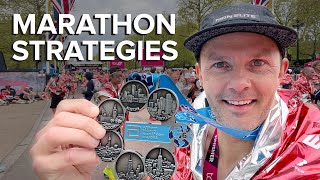
In this live commentary during the London Marathon, Floris Gierman reflects on his experience completing six World Marathon Majors and shares practical lessons for runners. He emphasizes arriving early to the start line to reduce stress and avoid long restroom lines, and stresses the importance of knowing each course’s unique features—hills in Boston, downhill start in Tokyo, flat routes in Berlin and Chicago, and bridge-heavy New York—to plan pacing and hydration. Gierman discusses pacing strategies, warning against starting too fast, and recommends using pace bands, foot pods, or bike cadence sensors for more accurate pacing when GPS signals are unreliable. Nutrition is highlighted as a critical factor; he advises consuming about 90 g of carbs per hour, using gels stored in shorts pockets, and fueling early to avoid underfueling. Mentally, he encourages runners to focus on one mile at a time, draw strength from the crowd, and think of supportive loved ones when the race gets tough. He also shares training insights, such as low‑heart‑rate base work, occasional speed sessions, and heat/cold exposure (sauna, heat training, cold days) to improve physiological resilience. Throughout, he cautions against trying new strategies on race day, promotes his Personal Best Running coaching program, and invites viewers to share their own lessons in the comments.
Chapters
It's going to be my 6th WorldStar Major. Going to share a few of my lessons learned from running 6 WorldMajors. Boston, New York, Chicago, Berlin, Tokyo, and today London. Welcome to the London Marathon. One of the main things to keep in mind with these races is to start early, get there early to the start line. World major number 6 as well, right?
Yes, sir.
Both getting, uh, getting it done today. Exactly. How you feeling? You good?
Feeling great.
All right, great so far. Cool, let's do this. Get to the start line early, it helps you relax, not be so stressed. Fast because the lines for the restrooms are always super long. No, of course, for any of the big world majors, there's quite a bit of a difference. Uh, Boston, a lot of hills. Tokyo starts with a downhill, whereas Berlin, pretty flat. Chicago, flat. Obviously New York, a bunch of bridges, so Know your course so you know what to expect. Can definitely help ease of mind. Know where the bathrooms are, know where the water breaks are, sharp turns, everything. The water stations, I often aim for the last ones. That way it's less congested, not so bottlenecky. Nice work, man.
Hey, well done. Thank you so much.
During any of these world majors, it's important to pace yourself well. The GPS can be really off, so sometimes I use a pace band so you can compare the mile markers to your times. Not even sure if you can hear me, it's so loud. For a bit more accuracy with pacing, you can also use a foot pod. Using one bike chorus definitely helps with some of the accuracy with the tall buildings, the bridges, tunnels, etc. Crowd is so loud here, it's incredible. Main thing with any of the world majors, don't start too fast. So easy to get carried away. 8 miles in, 54:20, still at sub-3 pace. Actually feeling surprisingly good. I think it was more of a downhill and bit of backwind, so knowing that it's going to get much more challenging, let's focus on 1 mile at a time.
Let's go!
Nutrition is absolutely key. I see a lot of runners, even in our running coaching program, the PB program, underfuel. So taking in enough calories early on is absolutely crucial. Halfway point, 1:29:25. Going to have to work for this, for sub 3. So far feeling good, but it's also starting to feel challenging already. So less talking, more running.
How are you? How are you going? How are we doing today?
Uh, not a great day. I'm just gonna jog it in. Right on. I'm struggling. Look at strong. You got this, man. All right, you wanna run together?
I can't.
All right, we'll see you in a bit. Almost 17 miles in. What a vibe, just getting all the energy from the crowd. 20-mile mark, 2:16. This is right away it really starts.
Well done, keep it going, give us a wave when you come.
When it gets hard, dig deep, do whatever it takes. Think about your loved ones, think about the people that give you energy, who supported you. 21 miles, and actually feeling surprisingly strong. Must be the crowds though, must be the crowds. What a day! Mile 22 with a minute and a half to spare for sub-3. Absolute chaos here, but doing well. It's going to be it. Marathons are hard and I can do hard things. Run in the moment. This one, run relaxed. Focus on your breathing. Drop your shoulders and take it all in. Oh man, mile 24. Time to get the head backwards and finish strong. Let's do this. This is so, so hard. Let's go! Everything you got, everything you got. Let's go, let's finish strong! This is it, you got this, Flo! You got this! Almost there. What a journey.
Hold it together, man.
Almost there. Why is it that after running probably about 50 marathons, I still get emotional? That was so Raw!
I had to dig so deep for that one.
Once again, what an incredible, incredible journey that was. Hello!
Congratulations! Well done! Fantastic!
Well done! Look at that! Thank you!
Hello! Oh, there he is!
Congratulations! Thank you very much! I appreciate it. It does mean so much. I can't even do one, let alone six.
He's an amazing guy, great teacher for many.
Okay, thank you so much. Congrats!
Oh, can't believe it.
There it is.
Stoke levels are so high. Wow, I got so emotional almost again from like probably a few minutes out from the finish line, and I had to hold myself back not to start crying. Dying because I noticed my breathing was getting really challenging at that point, and I want to do everything I could to finish strong. But wow, when you get to the end of a race and it starts to get tough, I really focus on running relaxed, running in that moment. Don't think about, I still got 5 kilometers to go or 10 kilometers to go. Think about, I'm gonna run this kilometer or this mile that I'm in. I'm gonna do everything I can. Because once you start thinking too far ahead, it becomes quite challenging. Also think about those people that were there to help support you along the way. Very often you You don't do these things on your own. It is other people that help hold it down on the home front. For me, that was Jennifer, my wife, my kids, Sadie and Zoe, and they supported me on this journey. And being able to think about them in the tough parts of the race, that just helps you dig deeper. Massive thank you to my mom, dad, and my sister for inspiring me to pick up running when I was young.
I'm just gonna keep smiling for the rest of the day.
The rest of the week. Obviously on race day, really try not to do things you haven't done in training. I really think training is where you practice all the things, nutrition, hydration, what gear you're gonna wear. You don't wanna be playing Russian roulette on race day. Too many things at stake that might not go according to plan. Know in advance it's gonna get challenging. Your pain levels can go from 2 to a 10 in a short period of time. So when you feel really good, don't get too confident prudent. Sometimes I see people cramping all of a sudden. They were running strong and then cramp, like in the hamstring, it jumps in. So when you're even close to the finish line, don't overdo the pace at some point. Sometimes you want to kind of play it safe a little bit just to not bonk or cramp at the very end. You see too many people cramp right at the end over there. And then celebrate your achievements too. Finishing a marathon, regardless of what time it is, is a huge accomplishment. Even if your race doesn't go according to plan, you're a champion in my book. Seriously. Whether you finish a marathon in 5 hours, 4 hours, 3 hours, or, or under the cutoff of 7 hours, it doesn't matter. I'm proud of you for giving it a try, for giving it your best, for getting out there. That's inspiring on its own. For this training block, it was very busy at work, it was very busy at the home front, and I did not have that much time to train. The stress levels were high, and so for me, low heart rate training works really well with some occasional speed work. I did some sauna training, some heat training, even cold days. I feel it helps me keep my heart rate relative under control, develop sweat glands. I saw several different members from the PB program out here as well in London at the Shakeout Run yesterday, and then even today a few other members are already coming through to the finish line. If you're looking for any coaching, for any additional guidance in your training or racing, check out our Personal Best Running coaching program at pbprogram.com. So yeah, on race day I think two things are most important. One is the pace Pacing— don't start out too fast, really hold back early on. I personally try to run even paces so that if I get to mile 20, 32K in, and I feel good, I can still pick up the pace. Second most important part: taking in enough calories early. I see so many people underfuel. Personally, I take in about 90 grams of carbs per hour. I like— often I calculate with other, other runners and they're only getting like 10, 20, 30 grams of carbs an hour. So yes, I almost down about 3 of these per hour. How do carry enough gels. So you can wear like a belt, one of those belts. Personally, I like wearing running shorts with side pockets. I'm running in the Graves PX shorts by Path Projects. I can get 5 of these gels without caffeine in my left side pocket and then 3 gels with caffeine on my right pocket. So I always know which pocket to go to and, um, yeah, makes it quite easy over there. I'd love to hear from you. Do you have any other lessons from major marathons? I think it might be helpful to let us know in the comments below. This way we can all learn from each other. Any lessons from training that worked for you? Any lessons from race day too that other people who are running some of the world majors or other larger races can benefit from? Also, I would love to hear from you. What was your favorite lesson, takeaway, or quote from this video? Let us know in the comments below.