Lessons From 60+ Years of Running with Walter Liniger | Running 100k at Age 68
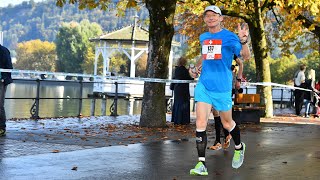
Swiss runner Walter Liniger has been running since age 6 and completed his first 100 km ultra at 68. After switching to low-heart-rate training in his 60s, his pace improved from 8:20 to 6:00 min/km, and he finished the 100 km self-supported loop in 13.5 hours by staying present and letting joy guide his training.
Chapters
Be patient and let joy lead your training. Let joy lead your training and not your mind who says you have to be fast, you have to be strong, you have to win, only then you are really happy. If you think like that, you are always unhappy. Stay in the moment, stay in the moment where You run, you run, pass after pass, you take one step after the other and look what will be coming out, what will be the outcome of that. And good, that was something I already did a lot in training and to see that you are living now, you are living in this moment, you are not living tomorrow, not in the next second, you are living now. And this comes to a feeling of easiness, of joy, of freedom.
Hello everyone, welcome to another episode of The Extra Mileage Show. My name is Floris Geerman, and on this podcast I interview different guests about ways to become a stronger, healthier, and happier athlete. Today I'm interviewing Walter Liniger, a 69-year-young runner from Switzerland. We had a great conversation about when he first started running at the age of 7, all the way until the age of 69 right now.
And he's just getting started, really. That's the beauty of it.
But let me tell you, he ran his first marathon in 1978, and he ran a 2:46, so a very impressive time, especially for a first marathon. Then a decade later, in 1988, he lowered that to a 2:38, and he continued running and training. And actually, he was always from a mindset of going pretty hard in training and in racing, and it was often that whole no pain, no gain, going out of the front door full throttle. Then when he got into his mid to late 60s, he started looking into a few other different training approaches, and he came across the low heart rate training approach like MAF training, and he was quite fascinated by it, and he definitely went through certain challenges at the early stages. Then about a year and a half ago, he actually joined the Marathon PR Training Program, and this was really for him— he wants some additional guidance. And so it has been really fascinating and fun to see the journey that Walter has been on. And in the last year and a half, just seeing some of the things that he's been able to do and accomplish— for example, recently, at age 68, he ran his first 100K. And just hearing the joy that he's been getting out of his training, out of his racing, and actually finishing races now too, not feeling completely beat, but actually feeling good, having joy throughout the process. It was a really fun conversation. Um, and I think you will enjoy several of these points that he has learned along the way as well. If you would like to find out more about the Marathon PR program, check out extramileus.com/training. I hope you enjoy my conversation with Walter Lineker.
Walter, welcome to the Extra Mileage Show. It is an honor to have you over here on the show.
Thanks a lot. It's an honor to be with you in the show. Thanks a lot.
Absolutely. I will start out by saying you are one of my heroes and examples, and I truly mean this because when I I have been looking at your running over the last year and a half since you joined our Marathon PR Program and just seeing how strong you are running, like well into your 60s, and how positive you are as a person, and you're continuously improving in your running and being able to, to go out there on some of your adventure runs. I want to— I'll be straight up— I want to be like you when I'm your age and running. So I just want to throw it out there.
Wow, too much of an honor. Thank you very much, Floris. You're so kind.
No, absolutely, I mean it. There's like a few people that I've had the honor of connecting with over the years. And when I look at strong and healthy athletes, I'm not talking about like running strong as far as for the fastest race times, but I'm often thinking about longevity in the sport, but still being able to perform at a great level as well. For example, Jonathan Walter in, Jonathan Walton in the UK that I had on the podcast, he is 50 years old and he is running extremely strong, yet also in a very healthy, maintainable way. And I see the same characteristics in you as well.
And that's why I wanted to have you over here on the Extra Mile Show today. So I think it might be good for the listener at home to get a better understanding of you that you can share a little bit about your running background and your athletic background.
Yeah, that is a big and little question. A big question because I am running since I can remember. So all my life I was always a little bit doing in this area. Sometime more, sometime less. It began already in the primary school when I was 6 years old. I had a teacher, really a sports interested teacher, who led us to run and to do orienteering.— this is running with the map and finding the way through forest and so on. And there I did my first race at all, it is at age of 8, it was a 3-kilometer cross-country run in Kerzes near us there, and I was so proud to have medal around my neck, first time in my life. And yeah, that gave a little bit of a start. This teacher was an important person in my life for sports, for what then came out in all my running, showed up in all my running. The village where I grew up, this village was on the street of a street run from Mora to Fribourg. That is a 17-kilometer street run, and it took part each year in autumn. And clear, that was a reason to take part as soon as I could. You had to be 20 years old in order to run this, this street run. And yeah, it was the first run really where I begin and I did it for 20 years. Each year I was participating.
Wow. And could you, could you see yourself improve over time as you were doing that?
Uh, not really. I was always full gas. Full throttle. And I remember training those times, it was not what I know now. In the view of today, it was always too, too fast, way too fast. We were out running and this was always full throttle. And in this run, then In the time I did this, in the years I did this, I had perhaps a little more knowledge then of what training should be, and I progressed perhaps for 5, 10 minutes maximum for the whole long of this 16 kilometers. But it was fun to to be able to run through Kullabon. Kullabon was the name of this little village where I grew up, and all the spectators by side of the street were cheering us. And yeah, it was a happy time.
It's so fun indeed with having the spectators on the side. It almost gives you more energy that way again while racing. Yeah. So when did you start making the distances longer? Because you started getting into marathon running at some point as well. How did your first marathons go?
That was an interesting point because it was not a normal street run or marathon run, the first of my marathon races. I was doing the Annual Swiss weapon run championship. That is a specialty of Swiss Army, those weapon runs.
Yeah. Tell us a bit more about that because that is a whole different type of running yet. There are a lot of similarities.
Yeah. Yeah. We were really, um, in, in a Swiss Army uniform. We had to run and we had a backpack. We had a bag. A pack on the back because we had to carry with a gun in it, and the whole thing weighed 7.5 kilos. Wow, so heavy. Yeah, it was heavy. And the first time I did all those runs, it was also in heavy shoes, army shoes, or nearly Yeah, it was demanding, I say today.
And you ran a whole marathon that way?
Um, the Swiss championship was about 10 to 12 runs in different places around Switzerland. And one of them was in Frauenfeld and this Frauenfeld Waffenlauf, weapon run. Counted exactly a marathon and 500-meter height at more. So it was quite a demanding thing. And I remember that when I did the first Waffenlauf in Frauenfeld, the first of my marathons, I bonked in a way that I never did again after that. I was really after, but 32 kilometers, from one minute to the other, I had no more energy, I had to lie down and I thought, "Now it's over." And happily, there was a spectator who spent me a Coca-Cola, I remember fine that Coca-Cola and a banana. And then the, And she came back and I could finish.
Wow. Coca-Cola can do some miracles right there.
You can say it. Yeah. That is really, yeah, it was a hard race. And on the other side, it was so much of emotions that I encountered during those I had 3 and a half hours for doing that. It was really crazy. I arrived at the finish. I had really tears in my eyes. I was crying. It was such a hard thing. I was so happy that this was finished with this.
It was crazy. I can only imagine. Like the emotions you often feel at the end of a race, they are real. Like when you put so much effort into it. And it's such a relief when you then get to there.
Yeah, exactly. That's exactly that. I remember exactly, I saw this finish line 100 meters away and I began to cry then.
If you go out there and you, you carry a gun on your back, are you only carrying that or do you also shoot with the gun?
Ah, okay. No, no, it's really only carrying. In the beginning— the question is really well, because in the beginning of this championship, that was in, in the year, I think around 1920 or so, they really shot during the run. They had to shoot during the run, and that counted also in the final time then. So it was included in the competition in some, some way, but then later on, no more. When I came to run this race, there was no more shooting. It was John McCarthy. But one point is important also. At the beginning, when you begin to run with such a weight on your shoulders, you feel it. It is heavy. But after 5 kilometers, you don't feel it anymore. It is as if you run normally. For the feeling of running, it's really interesting.
But finishing in that time of about 3.5 hours with all the weight on your back and your heavy shoes, that is a very impressive time still.
Yeah, that's right.
And then when you go from there to running with just running shoes without anything on your back, it must be a lot easier, I assume. How did some of your next races go after that?
Um, with marathon, my first marathon was then some years later, a civil marathon. I did, uh, sometimes the Frauenfeld Marathon, the weapon-run marathon. And then the first civil marathon I did, I reached the finish at 2:43 or like that.
Wow, that is fast.
Marathon, yeah. That was in the year 78, around 78, like that.
That's a very impressive time. Yeah. How did you train for a race like that? Like, how did you get ready to be able to run such a fast time?
It was not really that we did speed work or something like that. We were always too high in velocity to run. We trained too hard, always. And even if we did trainings then of 20 kilometers or 25 kilometers, at the end I was really down, I was really tired, and it was too much. It was, yeah, it was a heavy time. I think that with training of math now and the possibility of math, I would have quite easier life those times.
Yeah, I think that will be, that will be an interesting topic to transition to. So how has your approach to training and racing changed over the years? How has that evolved?
I, the longer in my life I had began to read books about training and to discuss with other guys who were also running. And so I learned a lot about training. But one point was as if it was engraved in my head: you are going to train, and each time you have to be faster. You know, the training is only worth training if really you advance. If you— and it is crazy because like that, if you do a training on 20 kilometers and you have 3 seconds less than the time before, then you are happy. Wow, wonderful, I've reached my goal. And if it's 5 seconds less, then you are fully down and frustrated about your training. And I don't know how I could overview that today. I really, I cannot really see how I was overdoing that way. I could do that way. I would not be anymore, to be really not anymore possible to to do such things. So in the running of these years, I had learned a lot about then speed work, slow work, and so on. I began to do that, to try, but this image of the training has to to me, to lead to an advance, it has to be better and better. I have to become better and better. That was not possible to eliminate out of my head.
And that is so common indeed, because yeah, there's very much that notion of no pain, no gain, or like you have to run hard most of your runs indeed. So, so how, how did that go when you first started out with low heart rate training and when you started experimenting with that?
Yeah, that was really the first time that I, I did the training as it was asked to really come down with the heart rate and to really only run at the heart rate that, that is given. And not push. But that was a hard time. That was really a hard time to get accustomed to that. I had some, some when I went out for training and all, everyone was, was faster than me and I was there and I asked myself, to what things would that lead? That doesn't give anything. That will not help to get some advances in my running or to— I was really, at the beginning, I was really frustrated fully. Every time I come back. But what Also was then— has become clear to me is that after each training, I was happy. I was not tired. I was not— it was a fully unknown experience to see that, to feel that I could go day after day after day, and I had no problem with that. That was not possible before, was absolutely not possible before. And so, in current of the time, then I was accustomed to go slowly, and the more and the more I feel joy of it. I become to feel the body in fully another way. I've begun to feel when I reached this upper limit where I— down this limit I have some, I would say, sweet spot or sweet feeling that I can run forever. I had the impression I can run forever. And there was a limit where I began to feel, oops, if I go further on with that, then I will get tired and tired and tired more and more and more and finally that stops me. And it's under that condition that I saw that I could begin to think about the ultras, to begin to think about, hey, perhaps I could even run longer than the marathon distance. At all marathons I did until that moment, at the finish line, I was so on zero that I had no possibility to see how I could do one meter more or one kilometer more than that. For me, all that, those ultra runners, and there was, there was Superman and Superwoman. I never even I could think about doing such things, even dream about it, came not in my idea. But when I came down with this training, it became a possibility to, wow, that become a topic of interest for me. And there was another point that leads, in this time leads me to think about ultra. I had a client or friend of mine who came regularly to my massage, to be massaged by me, and he was an ultra runner. He didn't speak a lot of ultra running. He did marathons with me. We did his military runs together, and we saw each other from time to time in all those races and so on. And when he came then regularly to massage, we were speaking a little bit more about ultra, and one day he said, why do you not also try? And I remember that he asked me this question time after time after time, but it doesn't enter in my mind, I had the impression finally. I didn't hear it really until the moment where I began with Maf. Then suddenly I began to ask him questions and he said, it is quite another dimension of running. Ultra running. It is not the same as running a marathon. A marathon is much harder than running 100K. 100K. And I couldn't believe it. I was not able to think about that in that moment. And then came this moment when I I went to my first ultra, my first 100K. I had run until that moment. The longest distance was one time around Lake Zug and then some kilometers more, made 52 kilometers or 53 kilometers total. And I went to do this 100K.
I want to, I want to dive deep into this, this 100. I want to, because this is so fascinating. Before we do, I want a real brief ask because I think this is good to hear. How old, like, what was your age when you started with math training?
How old were you at that point? That was last year, I was 68.
That was at 68 years old? Yeah. Yeah.
Okay.
And then as you started to progress and you started thinking about the 100K, Tell us more about the 100K. What was your plan going into it and how did it go for you on race day?
I think my plan for the track was very simple. I wanted to start from the door of my house and I wanted to finish at the door of my house.
That's easy logistics right there.
Yeah. If you have not to go outside for official run, then at least this advantage I would have. I had an app to plan this running distance. It is an app that allows you to find out the route for hiking. You can Give in, I want to go from this point, point A to point B, and it tracks the route on streets for walkers, for hikers. And with this outdoor active app, I planned the 100K, and what I was interested in was to not have too much aid. I live in Switzerland and there's much of up and down and much of hills and mountains. And where I live here, I had the possibility to go in more, to choose more flat and height. Yeah, finally I think I arrived in, let's say, 600 or 700 meters for the 100K.
That was quite good. Yeah. And, and so when you started, did you have a specific plan with, I want to keep my heart rate below a certain point, or I want to keep my pace, or I want to— did you have anything going into it as far as for a race strategy?
Yeah, yeah, exactly. At that moment when I did this, this race in April this year, my math pace was 7, 7.1 minutes per kilometer, and I set the goal to run the 100 kilometers in 8 minutes. Per kilometer. That was the goal, to run it in 800 minutes when— if you want to run the kilometer. And this was one part. And the other part, not with a higher heart rate than 135, I thought.
Okay.
In, in taking account that to the end, normally the heart rate is rising, it's going up, not coming higher than 135. And finally, when I was back, I finished in, I think, 13 and a half an hour. That was just 810 minutes or so, and pace was 1 1:32 for the whole race.
Wow. Wow, wow, wow, wow. Did you— how did it go along the way? Did you feel good along the way? Was it— were there moments that you think you could not do it, that you could not finish? Or how did the actual journey go throughout it?
Yeah, I was, I was planning to do self-supported, as normally we say, self-supported. But I had a big advantage. I had my, my girlfriend or life partner who is a big fan of myself, who wanted to, to join me in of the 50 kilometers like that. I was starting at midnight here, middle of the night, and so I was planning to do the first 50 kilometers with backpack, with a water bladder for drinking, and then some mountain gel. You, you know the mountain? Yeah, yeah, yeah, yeah, yeah, with some mountain gels and That was all, no clothing or anything like that, as simple as possible. And at 50 kilometers, I met her the first time, and I was really happy to change my, my running shoes because I was running up to that moment in the Ultra Escalante. And on that trekking path, in current of the time, the stones were feeling more and more while running. And it began to hurt on the downside of the feet. And I had really, I was really happy to change to the Hawkeye and speak goat, even nixle. Yeah, very good.
Yeah, a lot more support that way. I, uh, exactly, for, for the long— plus it was on road too, right? It was partly like the surface was pretty hard, right?
Yeah, yeah. The first 50 kilometers, or perhaps 30 kilometers, on natural ways, on natural paths. On hiking paths and the rest 20 kilometers on asphalt.
Yeah. And so then you had your new shoes, you, you had 50 more kilometers to go. How did the second half go for you?
Yeah. Yeah. For me, I had some advices from Urs, from this guy who led me to the ultra running. He told me, never think about what you have to do. Think only about what you already did. That helps. Don't make you crazy with thinking about how to finish the rest. That will only lead to problems, only lead to big problems. Stay in the moment, stay in the moment where you run, you run, pass after pass, you take one step after the other, and look what will be coming out, what is the outcome of that. And good, that was something I already did a lot in training, and to see that you are living now, you are living in this moment, you are not living tomorrow, not in the next second, you are living now. And this comes to a feeling of easiness, of joy, of freedom, of— it becomes to run itself. There's nobody running anymore. There's only running happening. And it's a feeling of such easiness, such joy, pleasure. It's fulfillment pure. And clear after 50 kilometers, I began to become a little bit tired and tired, more tired and more tired. But it's also only thoughts if you think about, oh, I am in that condition now, and with that you will finish one more marathon and even more, you will never finish if you begin to believe those thoughts. You can't stop, you can't really stop your race. It doesn't help. The moment you understand that all those thoughts, they don't help, they only bring you in big problems, you stop to believe those thoughts. They are for nothing. Perhaps they continue coming, but you don't mind. They may be here, but you don't believe them. You are interested in feeling what is happening now, what is living happening now, and that's all that counts. And so, yeah, the 52nd kilometers were harder. I had one point where really I was sure that I have to stop. That was after around 70, I think 69 kilometers. I did a little step out in order to not touch a stone with clay in the way, and this movement, I got an explosion of a pain in the back in this moment. I had the impression I was blocked, I was really blocked, I couldn't move it, I couldn't cry, it was really a hard— it was really, it hurt extremely, extremely. So I stood there and felt, and then finally I thought, okay, I will try to do stretching of the front fascia. I do a lot of those stretching, and it is, it is the stretching that is known in yoga also. You lie down, you push both of your hands down, and you push the upper of the body up. And first, when I was down and pushed up, it was like hard, like, I don't know.—
how to— It was tight, tight, the muscle?
Yeah, it's really fully tight, fully tight. Body was really not able to fell through. It took some 2, 3 minutes up to the moment where really I was down. It already hurt, but I was down. I was able to move in that way. And then I stood up, it was hurting always, but it was feeling better then. And began to march, to walk, I did some steps, oh, it was really hard, it was really hurting a lot, very heavy pain in the back. And after perhaps a minute, Tried to talk slowly, and that worked also. You have to try, then you know, not before. And it hurt it, but it began to slow, less and less, it hurt less and less in time going on. And you don't believe, but after 10 minutes, it was away. There was no more pain, nothing at all. And that's what the full rest of the race then, of this track then.
I couldn't believe the, the body and mind is so incredible, that entire connection. And, and good thing that you have the experience as a massage therapist yourself, that you were able to apply some of those exercises yourself like 70K into your, your adventure run right there. But yeah, like you and I spoke a little bit before we started recording about the importance of the mindset and the right mind and the power of the mind as well, because very often in situations like this, you might think, I will throw in the towel or I will quit. Versus what you did right there. You look at the problem at hand, you take a step back, you start to work on it, and you slow down a bit. And sure enough, you're able to overcome some of those challenges and continue to run without pain at that point again. So yeah, that, that is incredible.
Crazy. Even if, if I look at all I know about my body, when such such things happened and you have such high hurts in your back, then normally you have to go to the doctors, you have to go to I don't know what treatment. But the body is really a wonder. You will never, we will never understand really what the body is really. The mind is not the right tool to know what the body is really. We can just try and look what happens, and that is the answer in every situation. We can just try and look what happens. If you know, we think we know, we are going to limit ourselves always, always. It cannot be otherwise. You go to step in, you go to calculate your steps about knowing that you think it's true, it's never true, it's never true. It doesn't really match the energy of life. We are always only in a kind of world that is imagined, but it is not real.— the world itself, it's not life itself. We imagine life, we imagine all that around us, but it's not what it is in reality. And that is an interesting point. You never know what comes around the corner in the next second. You never know. You go to a race, you can plan whatever you want, but What will happen will happen as it happens and not in another way. And you can in each moment now, here and now, in each moment of the race, you can take your decisions about what you will do further on in the best way you can. That's all. It's not right or false. It's the best way you can, you know, in each moment, but only then when it happens. Not before. You cannot really plan a future. That is imagining, and imagination is only here. It does not happen, or it does not match what life really is. So that is, um, I have learned that in the last 20 years, perhaps I did a lot of thinking about what thoughts are, about learning about what life really is, but not in a way that thinking can really embrace, that thinking can really understand. We are, we are, we are human beings, but we think we are humans, we are persons, we are without thinking, who are we really? Who are you really if you let go all thoughts?
Yeah, so well thought, so well said right there. And I think many of these points that you make apply to runners of all levels, runners running any distance too. Whether you run 100K, whether you run a marathon or a local 5K, there are going to be easy points, they're going to be challenging points, and it's, yeah, up to us to see things for what it is at the situation and adjust accordingly. But indeed, that, that mindset plays a big role in that performance there as well, besides the actual training component.
Absolutely, absolutely. That is what I have learned for me. If I go to a race and I say I am happy if I reach a sub-3 marathon, I am happy if I reach that. I will reach that, and then I'm happy. You are under pressure the whole long of your life, race. You are under pressure, even if this pressure is not sensible or not seeable in that moment, but there is something that, that eats your energy. That diminishes your energy that you have to— otherwise you have to run. It is not those thoughts, they are energy. And if they block, if they block the body because, oh, will I reach it, will I not reach it, will I have a happy end or will I not have a happy end, that are seemingly now big, big unrealities, but they exist. They live in us. They lead us. They eat our energy too. So it's good to perhaps sometimes look what do I reach really if I believe that thought? What will really happen if I believe that thought? How do I feel if I say, oh, I should reach sapsri in order to be happy? That feels like a pressure here. Who would I be without that thought?
Wow, I run free. I run— no, no, no pressure, a lot less, and the body flows well and the energy levels are optimal.
Exactly, that's what, you know, what I, I see for me now. I didn't see, sure, 20 years ago, but there are Have a lot of things happened those last 20 years for me.
I can imagine. Um, and then you ended up getting to 90K, 95K, and then you finished your 100K.
What did that feel like? Yeah, you cannot describe it. You have to feel it. You have to do it. You know, then Now, it's what was really, really crazy. There is a 100K race in Switzerland, in Biel, and I was enrolling, or how do you say? You were entered? Yeah, I would like to enter this race. It was in June this year, normally the beginning of June in this year. And how everything else got down this year, also this 100K was cancelled. Yeah. Because of Corona. Yeah. But then when they said that it would not happen in March, end of March was that, I said, okay, now I have done a lot lot of training and I was preparing, they can without problem for me stop this race, but I do it myself. That is no problem. They cannot stop me to do it. That was an advantage here in Switzerland because we were allowed to jog, to run, to go outside for sports, but alone.
No, no problem. Plus, yeah, it seems like you're putting in a lot of running or you often run an hour, hour and a half, 2 hours per day. And so you, yeah, you're so used to running like that already.
So yeah. Yeah. Yeah. I would really know what that means to run an ultra and you can say, okay, this crazy, you did 54 kilometers as longest distance before, and then you'll make a jump to 100K. But that is not really— that does not really matter. You have to do one step after the other, one step after the other. It's all— it's crazy, but how will you explain that to mind? Mind will never understand that.
You have to do it, and then you see what, what what it really is. Yeah. One of the biggest parts for me too was in line with what you and your friend talked about. Instead of thinking I have 50 more km to go or in a marathon I have 10 more miles to go, I just think about indeed either the next few steps or until the next aid station or until the end of the street or whatever it might be. But you break it up into these small little parts and it becomes easier because you can make it to the end of the street.
You couldn't make it if you think you still have this many miles to go. Yeah. Next step is mostly possible, always possible. Next step. Yeah. But the next 10 kilometers, that's another question.
It's another thing. I do want to talk a little bit more about meth training. About how you integrate that in your own running. And also, like, you, you've already shared a few different things there, but can you maybe explain how, how do you calculate your, your running heart rate? Or like, what heart rate are you running at? And I know that you have modified that number a bit as well. I think that would be helpful to talk about here.
Yeah, yeah, yeah, at the beginning I really was taking math numbers as Phil Mathstone tells it. So, in '68, with 68 age, 180 minus 68 is 112, and there I added 5 bits.
Yeah. And then he has mentioned the part as well of like, if a runner is over the age of 65, that they are able to potentially do up 5 beats, but that all depends on if the athlete has made progress for a while and these different things. So at the beginning, you were at a relative low heart rate there.
Yeah, yeah. I began with this 117, and what I saw then is that at the beginning I had quite a higher pace than after one month. One month later, pace was one minute slower.
One minute slower or faster?
Slower. Slower. Yeah, I begin exactly with 7 minutes, 7, 10 minutes per kilometer. In May, in May 19. Then in June, one month later, I was at 8.20 minutes per kilometer. So it's more than 1 minute slower, but I have read a lot of things, a lot of information, and there were people that told about that in first 1, 2, 3 months it could even become slower and then only get fast.
Yeah, where your body is de-stressing first because it's used to always working out at a higher heart rate.
Yeah. Exactly. It's that the body was able to run this 7:10 minute per kilometer with 117 heart rate because it was used to run faster than— before it was used to run faster in training than it normally would be allowed. That was stress for the body, it was a big stress finally. I was, in each run I did, I was using too much substance of the body, which you had to gain again in between up to the next run. And so substance stays finally on the same level, it does not change anymore, you are just allowed to get to the same point and then you are going to run again. But it seems that those fast-twitch fibers of muscle are becoming used to go at that pace, but it's too much finally. So I thought that it was kind of story like that, that was slowing me down. Because then one month later in July, in mid-July, the pace was then at 7:30 again. It came down from 8:20 to 7:30. And then I had the feeling that this 7:30 was not appropriate for my body. Body. I know we can fool us with our thoughts, but I really had the impression that it was not really— it was like going to hiking or nothing. Way, way not enough, I can say, done in that sense. So I asked Alessandra, my life partner, she's a kinesiologist, she works with kinesiology, to test where my math rate is that is best for my body now, this moment. And I tested 128. And not 17. So more than 10, more than that. And I begin with this 128 to, to train in 128, and, uh, pace was at first 7:05. Directly in the first races, I I did the first runs I did, that was in mid-July. And now it is around 6 to 6:15 minutes per kilometer at that rate.
That has definitely come down further.
Yeah. Even, yeah. Even, even if the body is 69 years old now, this adaptation takes part. It's crazy.
It's, it's really a wonder how it reacts to. Yeah, and, and I, I, I truly think that the 180 MEF formula is indeed a nice basic formula that, that works for quite a few people. However, I think there's absolutely outliers, and I think the formula also is probably easier for people to maintain if they are like in their 20s or 30s or 40s. Whereas for athletes like yourself, where you have to deduct a lot of beats, I see sometimes indeed athletes in their 60s or late 50s benefiting if, if they're not seeing the progress indeed, to adjust that a little bit and seeing how the body responds to that if they are seeing some further improvements. That being said, sometimes people right away go, I need to do meth plus 15 because, uh, this, this, this. I see a lot of people still putting too much stress on their body versus realizing that at the beginning your body has to de-stress for a bit. But I'm, I'm glad that you were able to further customize indeed the heart rate and find something that worked well for you and that you felt worked and was the right heart rate there too.
Yeah. Yeah. Okay. You never know what happened if you did not that way. Yeah. That is something you can't discuss in that way. I know now if I run with this 128, I came down one more minute,, with my pace. But if I wouldn't have done this, if I would have, or if I stood at 117, I don't know where I would be now. I cannot say.
Yeah.
Yeah.
That's life. Absolutely. What, um, do you have any, like, you obviously have experience now with this training approach. You have in the past trained very hard, then you have taken more of a lower heart rate training approach. Can you talk a bit more about any suggestions or recommendations to other people who are starting out with this training approach?
Yeah. If I take my case, I would say do it and, and Be patient with your body. We are in— we live in a time where we think all has to happen quick and go on fast and change us better yesterday than tomorrow. So I think that the body is not a machine that you can push to change or to adapt faster than it can. And it shows you that it needs its time. These minutes that change when you run slowly, that are due to changes in the body, that are due to adaptations that the body has to make. And those adaptations are not done from today to tomorrow. It is hard to run in that slow pace at the beginning, because if you are used to run faster, then there is one point your full— your muscle is able or is adapted to run faster, and he is optimized by your body to run faster. And up to the moment that it is optimized to run slower, it felt— it may hurt, it may even hurt, but because the muscle is too much under stress, he cannot— there are too less muscle parts that allow you to run slow. At the beginning. You see what I mean? Yeah, yeah, yeah.
Difficult for me to—
No, no, no, absolutely. Yeah, yeah. So, um, that's, that's used— that, that needs time to adapt. And it is normal that at the beginning, at first, you have to slow down. All other runners are doubling you, are going faster than you. That's one point. For ego, that is It is hard to let go of the others and stay behind. And the other part is that really it is not enjoyable to feel that your body has problems to run slow. Your muscles are not adapted to run slow. And some time ago it becomes easier and easier. But there is really a time that you have, for me it's really a time of at least 2, 3 months that you have to wait until you decide if you will go on or not, or yeah, if it's really nothing for you. But I don't think that there is one person out that is nothing for her. Everybody is unique, sure. But these principles are, are, count for everybody, count for, yeah, yeah. Everyone will feel in another way if he will do Maftet, if he will do the Maftet way. For everyone it's another experience, sure. It is, it seems to be the same, it's not the same. Everybody has to find out himself what is for his body, what is best for his body. And he never will know if he had gone another way, if it would be another point, or it would be another— that is not possible. Enjoy your way, enjoy your moment, enjoy your thing that you do, your Be patient and let joy lead your training. Let joy lead your training and not your mind who says you have to be fast, you have to be strong, you have to— and only then you are really happy. If you think like that, you are always unhappy because you can only be happy in the moment where you reach that point. So now you are unhappy, you think that, then that automatically puts you in the position that you feel yourself unhappy.
Yeah. Well, Walter, you run a lot. 10 hours, 12 hours, 14 hours per week. Can you tell me, why do you run? What is it for running that is so special for you that you're out there for that many hours?
Yeah, that's a great question because the truest answer is because it is fun. It's fun to run. I have read the book Born to Run. I find it wonderful. Great book. Yeah, yeah. Life is moving. Life is running, is moving. Life is always being in movement. All change. Each moment is new. Each moment changes. All is in constant movement. And running is, is an expression of that. And if you allow the body to run, he's just happy. It is, it's such a pleasure and a joy to be out in nature and in some way to forget all what is in mind and to just live, to just It's such a feeling of being one with nature, of being happy in this moment, happiness that is real, that is true, that is here. You have nothing to do in order to create it. You find it if you stop all the things that you do in order to find happiness. That is unbelievable, really. And clear, do now 100K, that is official, really finish 100K. That is my wish, big wish. But if it will happen, okay, if it will not happen, okay. It does not give me more or less. It is just a new experience that will be experienced. And it happens. And if it happens, okay. And if it does not happen, then other things happen. And it's okay. Always it's okay as it is. Out of this energy, of this energy of life, things happen. If you, if you are in the flow of all that, you're—
you don't need any more.
Yes, very well said. Yeah. And perhaps one more point for you. You asked me before what, what could be an advantage for some body beginning I had a lot of injuries all my life with running. I had a lot of injuries. I remember that in 2015, I was ready for the marathon in Lucerne, in Lucerne, and half a week before, I went out for just doing a speed work, for short speed work, for getting in movement. And what happened, I had a muscle tears, and I couldn't start this. And so I was 3, 4 weeks without being able to move. And that was a constant in my life. It was a constant. And since I do enough, no, absolute nothing happened in that way. And nothing was— is here that would show that it is possible that there will be injured, that an injury occurs.
It's not possible, I have the impression. Do you do any speed work at all, or do you run only at low heart rate at this point?
Absolutely, most of the time is low heart rate, but sometimes there is a, oh, this time I will force a little bit. Or if I do my turns around the lake, perhaps the last 2, 3, 4 kilometers, I give a little push, I push a little bit. But it is out of the moment, it is not planned, or it is not, I will do that and that and that. It's not my way.
It's no more my way. Yeah. I want to be respectful of your time. I have a few last questions over here, kind of in in closing. Like, you have done this training approach for about 18 months with training and racing. Do you have any other key takeaways or any other recommendations from your training for other athletes looking to improve their performance?
Yeah, as I said, I got big other perspective now. I didn't think about running an ultra up to the moment where I began to really slow down my running. That was not possible. That was something that didn't exist in my view. And suddenly, uh, a thought that is absolutely real, and I can try And also the joy of running. You know, the time where I was training full throttle, I had some kind of a hate-love relationship with my running. You know what I mean? I love to run in the whole way, the whole thing, but going out and knowing I will come back and it will hurt and it will— that was hard. That was really— a lot of times it leads that I didn't go too long with that, with that no pain, no gain thinking. That is not really not a nice thing. And What I found out also with the MAF is in the low carbohydrate thing of feeding, I did the 2-week test, and I had for years, I had problems with indigestion, a lot of troubles with when running on to be, to go to the bathroom during running and so on. And when I did the 2-week test after 3 days, all that was away. So I feel much more healthy since I look to not eat any low carb, sugar, any artificial nutrition. It's taking in natural, normal nutrition, yeah, that the body is used to that and not to this artificial things that are invented since.
Wow, that, that, that's a big difference that you could already notice it indeed within 3 days that your body starts making positive adaptations.
Yeah, absolutely. And I feel also much more constantly energized than it was before in, in eating sugars. It was sugar and with those artificial nutrition, I had always a high and down and up and down feeling for the energy. I was just nearly sleeping during the day and then up for 2 minutes and then we're down. And now it is constantly in an energy level that is really, wow.
Really great. That's a nice way to feel. Absolutely. Let me see over here. Where can people find out more about you? I know that you're quite active on Strava.
Is that usually the place that— Yeah, Strava for running. Strava is the, for the moment, only way to contact me. I have this This Strava account. And I have a own website under Walter, Walter-Lininger.ch. But it is in German. And it's about, more about my work, my business and less about running.
Right on. I will make sure to link to that in the, in the show notes here as well. Do you, do you have any other closing thoughts that you would like to share with the listeners?
Is there anything else? Yeah. I, I love to be in this group and this PR Marathon group because it's so much sharing of all our running and So much support, so much new ideas that come along, new inputs that come along. Yeah, it is a real, really nice group that comes together with that. I have, with that, I have possibility to contact people who run every day or near every day or at least 2, 3 times a week. And who share the same problems and troubles with that, and it is wonderful. Also, I have to thank you that you invented this group, that you started this group, and for all the work you did for it, and all the work you do every day for it, all that you pushing it. Thank you very much for this. It's so, so great. And I, in that way, I would say to everybody who is thinking about training regularly, to enter such a group is a big, big support in order to really constantly run and to to be helped when it is necessary and to share our joy, to share our pleasure of running.
Wow. That means so much to me. Thank you very much for sharing that. And it has been fun to see you post your runs and seeing you responding with a lot of other runners and your name honestly comes up quite frequently. Like one of my running friends, Duke, who was also on the podcast. Like we run sometimes and we're like, oh yeah, did you see what Walter just did? He did like another 2 loops around the lake, or your name came up when you finished your like 100K.
And so it's been really fun to follow you on Strava and along the way over here. So absolutely. Yeah, exactly. That's what I mean. It's just well-doing. That is that way.
Yeah, thank you very much. Absolutely. Walter, thank you so much for sharing all of your experiences over here.
I really enjoyed our conversation and I look forward to connect again soon down the line. Thank you very much that I had the honor to be in your podcast and I hope that we will see again. Absolutely. Be it on Strava, sure, and Perhaps also on Skype or in one of your talks that you have.
Well, hopefully I just got to, I got to come visit Europe soon and hopefully can make it to your, your part of Europe. And, uh, we'll, we'll get a run in around the lake. I've seen every photo of Strava from every angle around the lake already. So now I want to see the, see the lake in real life.
You will already know the whole story before you do that.
Perfect. All right. Thanks, Walter.
We'll talk soon.
Bye now. Thanks, Floris. Hey guys, Floris here with a few last comments. What an inspiration Walter really is. I truly hope that in my 60s, 70s, and well beyond, I'm going to be running just like Walter as well. If you would like to find out more about the Marathon PR training program or the 5K to Half Marathon program, check out extramile.com. And I just want to say have fun out there on your runs.
Have a good one, enjoy it, and I will see you at the next podcast.
Bye now.
More from Floris


Ryan Hall 2.0 on Strength Training For Runners, Lifting Heavy & Trail Running




You’re Doing Zone 2 Wrong (Even If You Think You’re Not) | Scott Johnston Round 2


How to Build an Unstoppable Aerobic Engine (Even If Starting From Zero) | Scott Johnston


Stress Is Killing Your Running (The Relax Fix You’re Missing) with Dr Kasim Al-Mashat

When things get hard, say this, it (works in any race) #jeffpelletier #running #ultrarunning