MAF Low Heart Rate Success with Maria Lurenda Westergaard
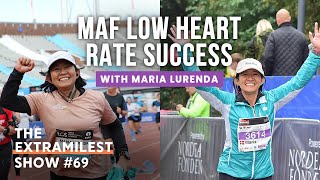
Maria Lurenda Westergaard went from non-athlete to endurance runner using MAF low-heart-rate training over a decade. She tracks weekly heart-rate pacing, sleep, nutrition, and glucose levels in a long-term journal, racing marathons to manage anxiety and qualify for Boston at 80.
Chapters
If you're going to compare yourself to somebody, I would compare myself to 10 years ago and what I've done since then and see, okay, this is how I've developed. And then there were some setbacks, but then I developed more. It might be slow, but I know I'm developing as well as I can develop at my own pace. And you say to yourself that I'm going to do my best today. I'm going out for a run and let's see where it takes me. And as long as I can do my best for this day, day, then I'm happy, you know, and, and not stress myself more than that.
Hello there, my name is Floris Geurman. Welcome to yet another episode of The Extra Mileage Show. I think we're on episode number 69 already over here. 69, 68, 70, lost track. Anyways, on this podcast I interviewed different guests about ways to become a stronger, healthier, and happier athlete. Today's guest is Maria Lorenda Westengaard, and she improved at a heart rate of 140. She used to start out walking with just a little bit of running, and she was doing a pace of about 19 minutes per mile. So that is around 12 minutes per kilometer. And over a few years' time, as she improved further, she was able to get faster at the same heart rate, and actually at a lower heart rate too. So a few years later, at a heart rate of 130, she was now able to run a 12:50 minute per mile. So that's about an 8 minute per kilometer. Over the past 6 years, I've coached a variety of different athletes in a personal best running coaching program, and it is super exciting to see all of the different results there on a weekly basis, not just in running improvements but also in other improvements in people's lives. Maria is a great example of an inspiring success story. She's a She's a doctor of medicine and she is a member of our Personal Best program. In our conversation, Maria shares all of the different things from her research and from her approach to running. She also talks quite a bit about journaling and about keeping track on a variety of different things such as sleep, strength training, stress levels, and nutrition. Maria is an inspiring runner to me and to many other runners out there. She talks about health and about what really matters when it comes to running and overall performance. If you would like to learn more about my running coaching program, check out pbprogram.com. Those are the letters pbprogram.com. This episode is brought to you by LMNT, which is a delicious electrolyte drink that has everything you need and nothing that you don't. That means plenty of salt, potassium, and magnesium, and no sugar. Increasing my electrolyte intake has made a significant difference in my energy levels, in my quality of sleep, and no more brain fog or headaches. It really can make that much of a difference. I typically start my day with drinking a large glass of water of about 500 milliliters, that's half a liter, and I mix in one package of LMNT. It helps rehydrate and allows me to maintain my focus and physical performance. And I actually really like their packaging. You can decide how much water you want to put in, and that's how salty it actually becomes. And you will notice, you can make it quite salty or you can dilute it, but it tastes delicious. Go to drinklmnt.com/flo to get a free sample pack of 8 flavors with any order. This offer can be used multiple times. That is drinkelemente.com/flow. F-L-O. See also the link in the description. I hope you enjoy my conversation with Maria. Welcome, Maria, to the Extra Mile Show. I'm very, very excited to have this conversation with you here.
Hi, Floris. I'm so glad you We're talking again and thanks for the invitation.
Yes, absolutely. Let's, let's start with your background and how everything started for you because you've been a part of the Personal Best Running Coaching Program for a while now. So I've actually seen your progress over time, which has been really awesome to follow. But I know you were not always seeing yourself as an athlete and maybe we can start over there. Like, how did this all start for you? When, when did you first start getting into running? And what was that journey like for you?
I had no running background before. I wasn't very athletic in school, not in university, not in high school. At any point in my life was I ever athletic. So I guess at university, we would go outside and run around the campus oval, but but not in any structured way. And maybe it's like, you know, some, some days that are particularly stressful and then you run around and walk around a lot, but there was no program to it at all. And I could go months without running again. So there was no, there was no structured running, no athletic program that I was involved in. And that has been the case through my whole adult life almost until maybe around 10 years ago, around 2013.
You grew— I believe you grew up in Asia and then later on moved over to Europe. Is that correct?
Right. I come from the Philippines and I studied there at the University of the Philippines. I finished my medical degree in 1995. At the College of Medicine there. And I thought, well, I would live my life in the Philippines. But then I met my husband and he's Danish. And at some point when our kid was 3 and a half, almost 4 years old, we decided to move to Denmark. And here in Denmark, we started our life together. We had another child and I had to restart my career again. I was pretty stable with my work as a doctor in the Philippines, but coming to another country that's in the EU, and I'm not from the EU, so everything had to restart. I had to get certified and, and try to see how I fit into the healthcare system. So again, it was very academic work. Again, no running, nothing whatsoever. No, no background in running here either. But what happened was that in 2013, our research group had to go to Boston to present some papers. So it was still academic work. And then that was just a few weeks after the Boston Marathon bombing. And when we arrived in Boston, it was very strange. Everything, everything was quiet. And you can feel this tension. We weren't even sure if the conference would happen. And then there were like these banners on the windows of shops with Boston Strong, and people were walking around in the park, but you could feel that the place was unusually quiet. Not just that there weren't as many people, but I guess everybody was just thinking about what happened. And the worst part of it was that I was nervous. I mean, normally I like to travel, I like to go everywhere and explore cities and And this time it didn't feel like I wanted to go out. There was just this tension, this nervousness that I felt, and I didn't want to be outside for too long. And after the sessions in the conference, so I would go back and not really be very interested in being outside, which is very opposite of what I would normally do. And then after I got back from that trip, I was thinking that You know, if this would happen as something regular every time I go out of the country, then I would be missing out on a lot of things and I wouldn't enjoy my traveling as much as I normally would. And the weird thing, my conclusion about it was, all right, if, if you experience anxiety, the best way to get it out of your system is to do exactly what you are afraid of. It's just like when they say when you fall off a horse, you have to go back on the horse. Or if you have an accident driving a car, you have to go back and drive that car. So I was thinking that way in my mind while this happened. And I thought, all right, maybe I should run a marathon. That was the thinking that I had at the time. Because if it was a marathon bombing that got me scared, that maybe the way to get it out of my system is to start running myself. So that was the first idea. That was in around March, April, I would say. And then two things happened. One was that we had this team that we were supposed to build and join this 5K relay, which is a big thing in Denmark because like there are hundreds of thousands of people who join that all over the country. And I thought when I joined it that we were going to run 1 kilometer each, 5 of us, so we would complete the 5K. So I didn't understand the instructions. And then I found out later that it's 5 kilometers each. So actually, we will run 25K.
That's a little bit further.
Yeah. So I thought, okay, I'm not going to survive without any training. So I started training there. And then, of course, we completed it. It was just for fun. It was not like we had to go fast. And then a few weeks later, the World Half Marathon Championships was supposed to be held in Denmark. And there were a lot of campaigns of getting new runners in and having as many people as possible join that half marathon. So I thought, okay, I've already trained for the 5K, why not just continue and join a running club and see what happens? And so I did that and joined the half marathon group. And then I thought while I was training for the half marathon that If I compare our program with the full marathon program, I just have to train a few weeks more and put in a few more long runs, maybe get up to 32K, and then maybe I could get up to the marathon level. So I thought, okay, I'll just keep going and continue training and see if I can actually join the Copenhagen Marathon the year after. So that's what happened. I ran the Copenhagen Marathon in 2014. It was 5 hours and a half. I was walking and running, so it was about the best I could do.
That is awesome. I do want to take a step back for a little bit and talk about those early stages of your running journey, because I remember at some point you were not even running outside, but you were mostly running inside on a treadmill. Can you explain a little bit more what was the reasoning for you and how did you see yourself initially at the early stages of your running journey and how did this change over time?
All right. When I decided to join this group, this team, and I realized that I have to run a 5K, I thought, okay, I have to start somewhere. But I felt so embarrassed embarrassed about running outside because I had no running background. I didn't know how to actually run. You think it would be natural, but I was embarrassed. So I found this treadmill in the basement of our apartment building, and I was there alone, and I just started walking on the treadmill and see if I could run. And then it took me 30 minutes to run 3K. So that was 10 minutes per kilometer, which is almost walking and maybe running a little bit. And I was just, I couldn't breathe almost. And I thought, okay, maybe it's good I'm inside this small room because I don't think I want people to see me like this. So there was this thinking that I have to hide myself there. Because people might see that I'm not good at this. Of course, now thinking back to that, I don't think anyone would care if I was just walking and running a few meters on the street. But I think as a beginner runner with no background, there was some part of me that was thinking, this is so new, I'm not going to be good at it. So I can't just be out there. And I think that was maybe what stopped me for a long time from just going out and trying something. I hope that makes sense, Floris. I know it doesn't make sense to me now.
No, it totally, it totally makes sense. And it is interesting to me though, that how sometimes the stories we tell ourselves and like what we think other people might be thinking about us, but very often other people are just focused on their own thing and it's completely like not correct, like some of these thought processes. But initially, there's just— whether it's like insecurity, whether it is like we're so new to it, we don't know if we're doing it right. Um, and yeah, that, that can be like not only in running, but it can be in anything new that you start. Like recently I started getting into swimming, and even at the beginning of the swimming journey, I felt completely new, like I don't know what I'm doing. And it's starting all over again from the beginning. And you— there's almost that embarrassment feeling, or like, I can understand where that's coming from. Yet a lot of people who participate in the sport would never judge you on you trying. I think whenever we see another athlete attempting just to go out there, and whether it is walking or, or slow jogging or whatever, the pace is irrelevant. It's just going out there and learning and growing as we go.
Exactly. That's the strangest thing because these thoughts about what other people think about us are just in our thoughts. They don't actually exist. We never know what people are thinking about us, but some thing in our head tells us that we're too slow, or maybe you don't have the right clothes on, or maybe your shoes aren't the right fit and maybe you're going too slow and maybe you should be running somewhere else or the pace should be faster. You know, all of these thoughts are really just things in our heads and we assume that those are the things that matter. But in reality, what matters is just getting out there and trying something. And in the beginning, of course, you don't know too much about the sport, about any sport, but the biggest step that you've taken is that now you're out there. Now you're taking some steps and you're running. And I think I undervalued that idea of just starting. And then over time, you learn a few things. As I said, I'm very academic-oriented, and so I use that strength to my benefit because I know I don't have any varsity background, running background, but I'm pretty good at reading and researching. So I got all the books I could get my hands on, looked at studies, looked at videos. That's how I found you. You sort of start with your strengths, I think. And if you're the type of person like me who likes to read and check on the studies and then start with that, And then later on, you get a few more things. You know, you learn a few more things and then you change how you approach the running and look at form, look at pace, look at heart rate, look at cadence. But those are things I learned later as I tried. And of course, I've made lots of mistakes. I've made mistakes all over the place. And that's how you learn too. And because you can't be afraid of the mistakes, of course, they're going to happen. And then that's how you actually develop faster. And so I've never been— well, at some point, I just stopped worrying. I just stopped worrying about what my Strava looks like, what shoes I'm supposed to wear and where I should be running. You know, at some point that just falls away. And you say to yourself that I'm going to do my best today. I'm going out for a run and let's see where it takes me. And as long as I can do my best for this day, then I'm happy and not stress myself more than that.
I love that part. And at that point, you're also just comparing yourself to yourself and you're not comparing yourself to other people. You're comparing— like, you're really— running is so individual that Like sometimes when we start to over-obsess about pace or time or distance or any of those kind of things, those are at the end of the day, like what our objectives with the running journey. I think it's often to optimize health, to see what we can accomplish and to do the best that we can given, given our own life circumstances. So yeah, so well said. I wanted to go back for one second about the comparison part because one thing that came to mind was yesterday. My friend shared this thing on Instagram and I just want to read it out because it was a repost by Laurie Harder and it says, get out of your head. No one is thinking about what you said or did. They're all stuck in their own head. No one cares. Now let's go on and live. And I thought, like, it was so spot on.
So yeah, I think If we're ever going to do any comparisons, I think it has— it should be something that's inspiring. You know, you look at Eliud Kipchoge and what he's doing. I watched some Olympic videos and I see David Rudisha running this 800-meter world record in London. You know, things like that are very inspiring. But I can't compare myself to Eliud. And David Rudisha. You don't do that. You can only be inspired by them. But if you're going to compare yourself to somebody, I would compare myself to 10 years ago and what I've done since then and see, okay, this is how I've developed. And then there were some setbacks, but then I developed more. And I think that's where the strength of it lies. That's where we get the power from. If I can call it that. And then you can see how it might be slow, but I know I'm developing as well as I can develop at this pace, at my own pace. I can't compare myself to someone who can run much faster or can train much harder or can improve faster over a shorter period of time. I can't do that. It's just my pace as it is, and that's fine.
Comparing yourself to your previous version, that is a, that is a really good one. And sometimes on the day to day, it is hard to see the progress because sometimes it just like, yeah, on the daily, although we're putting in the time and effort, we might not see the progress at that time. But then indeed, if we look back at our version from last year or 3 years ago, 5 years ago, 10 years ago, then all of a sudden that difference starts to show up in a much bigger way. So what are some of those things that you have noticed?
Yeah, if I compare how fast I run at a certain heart rate and just look at 1 week, 4 weeks at a time, then it seems like nothing is happening. But if I compare it to, for example, 2021, right after the lockdowns where I didn't run for many months and my fitness level was just at the bottom. I did a baseline test at that time and I was walking on the track and I was going like 12 minutes per kilometer. At 140 heart rate. And that's walking and my heart rate is so fast. But that was 2021. And I did that same test around the track for about, well, 6 kilometers or so. And now, 2 years later, I can run around that track. Well, still slow, about 8 minutes per kilometer, but my heart rate would be 130. And if I just look one just one month at a time, then it feels like nothing is happening. But if I compare my Strava graphs now to two years ago, then you can see that there's this big change. And I think we sort of lose track of that, that we sort of are worried about, okay, what did I do this run compared to last week? You can't work with such small time intervals. You have to look longer, years at a time. Because that's where you see it. That's where you see how far you've come.
Such, such progress indeed. If you compare it that way, like in a 2-year timeframe that you're shaving off several minutes per kilometer and still able to actually work out at a lower heart rate, that is, that is very eye-opening. And this is why I think those, those MEF tests are just going to the, to the track for like some submax heart rate tests. It is very eye-opening and you start recognizing trend lines and it It doesn't improve every month. Some months you might plateau, some months you go backwards, or some months it's really hot and you get an impact from the weather. But as long as we're trending in the right direction, like it, yeah, it can be very eye-opening that way.
Right. And I think pace is one thing, heart rate is one thing, but there are other goals that you can look at over time. For the first time, I did a negative split on a 10K. I've never done that before. I always go out too fast. Either that or I just lose energy towards the end. And it's the first time I've done that, that my second half is actually faster than the first. I've been working on cadence forever because I just always have this feeling that my legs don't move fast enough. But now I can go 180 and still feel comfortable. It's 180 steps per minute. And before, I thought I could never get over 160. And then the idea of still showing up at work after a run in the morning, I thought that was not possible. You know, you push the run to the end of the day because you don't want to miss work. But now running a 4K, 5K before starting work is just a normal day. And I can still appear at work and still be present and not feel like I'm totally drained for the rest of the workday, that's a big achievement, I think. So, of course, we all want to go faster. Of course, we all, we all do and finish strong, you know, and I still want to do that. But I think there are all these other successes along the way that we sometimes miss, and they maybe mean a lot more than just the pace.
Absolutely.
We've talked a lot about blood sugar and continuous glucose monitoring, right? And, you know, it's been years since my son was born. And when I was pregnant with my son 19, 20 years ago, I was injecting insulin 3 times a day. And I had to make this shift with how I eat and how I exercise. And now 20 years later, I don't take any medications. And my insulin level is okay. My glucose level is also okay. But things like that, you might think would not matter as much as the pace and how fast I finish. But for me, it means a big— it's a big deal that I never developed diabetes, even if I'm at high risk for that. And maybe in the end, that's what matters most, right? How healthy you're feeling.
Absolutely. Absolutely. Health first, running performance will follow. And too many times I see people jeopardize their health and prioritize running speed or race times or frequency of racing or anything like that. I thought to me, a very valid point was this, was my conversation with Dr. Steven Seiler, where he talked about when an athlete would have a toothache, they wouldn't even send them up to training camp at altitude because they first like at that point, if you start adding training load and additional stress on top of the high altitude, it's just too much and your body wouldn't absorb the training the right way, or you have a higher risk of, of something happening. And so once again, I think that part alone, make sure that your health is in the right place. And of course that can go hand in hand with running too. This morning before we recorded our, our podcast here, I went for a nice 4-mile run. And it was at a low intensity and it felt really good and you have energy after that again. And I think once a run can actually give you energy, you come back and you feel really good. There's also a time and place for speed work, but like very often I just feel like if there's a lot of stress going on around the day, I just keep my runs at a low intensity and you come back and you feel re-energized again.
And so, yeah, there are two things I try to look at. Uh, one would be the energy level, like you mentioned, um, how How much energy do you have left? And sometimes after a run, the energy is even higher than before the run. So that's a good sign. That means that it's actually activating you rather than making you even more tired or stressed. That's one thing. The other thing I've been looking at now is what my heart rate is in the morning when I wake up. As soon as I wake up, I look at my watch and see what's my heart rate for the day. Before I started running, because I noted this in one of my journals, my resting heart rate is about 70. And then slowly over time, it became in the 60s and the 50s. And now when I wake up, it has to be between 45 and 48, 49 or so. And I would never have dreamed that before. And I know that if my heart rate is a bit over 50 or going up to 60, then something's wrong. Either I didn't sleep too well, my stress is high, maybe my blood sugar is up, I don't know, or, you know, some infection that's starting up, and I know I should take it easy. But just listening to your body more in general, I think, is the key, that you understand what running gives to you instead of what you have to, you know, what energy you have to use up in order to run fast. I think I've changed in terms of how I see that. So I look out always at what I get back in return for the running effort that I make.
In our Personal Best program on Sunday, we often have a weekly recap and we talk about what were some of the things that you learned for the week, what were some of the takeaways and what, like, any things along the way that stood out to you. And You often write a very good detailed recap in that, and so do other members in the program, but you often highlight a few different key areas and it's tied back into journaling as well. Can you talk about what those areas are that you look at and why you track those?
Right. I track 4 things now, and the first one is stress management and how, how I handle stress during the week and see how much— of course, there's always stress at work, and that's the nature of the work. But how have I handled that despite all the things that happened? So I give myself a score from 0 to 10, and that's always very high up, fortunately. And then there's sleep. That's a bit hard because I do work at the hospital and sometimes I'm on call and some Fridays I have to be at work late or I work maybe 2 or 3 weekends in a month. So the long runs aren't there or maybe my sleep is disturbed or so I know that I have to somehow try to make that better. So sleep is the second thing. The third thing is nutrition, how well I eat. Blood sugar is one thing, carbs and all that, but also, um, what's the protein, what kind of protein am I taking, how much fat am I taking, um, how, uh, how am I eating compared to what my running load would be for that day. If it's a rest day, then I tend to fast and not take in too much because there's nothing to fuel. I'm not running today. Um, So I try to balance that out. And then the fourth—
Hold on, I want to clarify that when you're talking about I fast, you don't eat anything that day or you don't eat breakfast that day, or tell me a bit more about that.
Normally, I run in the morning before work. So I drive to work maybe an hour earlier than most people. And then I go straight to the hospital gym and train there for 30 minutes to an hour. Um, so if I know that I'm running, um, then I try to get something. I eat a little bit before or a little bit after, um, depending on how much energy I'm going to use for that run. But if it's a rest day, for example, a Monday or another day during the week like a Thursday or a Friday, then I know I don't need energy for that first run. So, I can go the rest of the morning without anything solid really. Bullet coffee maybe is an exception.
But then— I'm literally drinking one as we speak.
Yeah. But I could go and fast over lunch. And then, the first real meal would be at dinner. And then that would somehow cover my needs for today. I won't really feel hungry because there was no energy use for that morning run. But if I am running like a normal day where there is this 4 or 5K before work, then I have to get something. And if it's a weekend and we know we're going to have a long run between 1 hour to 4 hours, then that's a big meal. So I think I've changed my thinking about food as fuel, where you know that you have to match that output with something that will fuel that run. And I think that somehow worked. It's very different for people. The CGM, the continuous glucose monitor, helped me to figure that one out. So Yeah, exactly. So I know that, all right, if I'm going to run, my blood sugar should be somewhere between 5 and 9 millimoles per liter, right? And so if I'm ready to go and I know I'm somewhere at 5, then why would I eat? My body is ready for it. Of course, when I see that it's relatively low and I'm going out for a 2, 3, 4-hour run, I know I have to get something. And then over the run, then of course, with the data that we get from those monitors, then we know exactly where. And before I joined the group, I would get this, you know, the blood sugar monitors where you stick a needle into your finger. And I used to do that and park my car and get and have all these needles in this little machine, the test strips, and I would run around for 5 kilometers, come back and test myself again, and then see, okay, what happens if I take this gel? What happens to my blood sugar then? Yeah, because I was worried about two things. One is that what if my blood sugar just goes so low because I'm being very careful about my carbs? I'm trying to control my diet so that I don't eat too much sweet stuff. But what if it's not enough for the running that I'm doing? So I was worried about going too low, but I was also worried about going too high because you know how sweet those gels are, no matter which brand we use, you know, it's very sweet. I was thinking, what if I'm in a marathon and then my sugar is just going up and up? And that's unhealthy too. I mean, that, that can really be very dangerous. And I'd never knew what it was. You can't go and test yourself in the middle of a marathon. So I was trying to test in the parking lot until we got the CGMs and then I knew, all right, it means that I should take a gel every 5 kilometers, maybe 6 kilometers if it's slow. I use kilometers because when you're running the marathon, you see the kilometer markers. That helps you know and take and keep track. It's harder with a watch because then I don't remember. So during an event, then I can see it from the kilometer marks. So yeah, so I think I look at nutrition as an important part, not just because I'm pre-diabetic and have a risk of diabetes, but because it just means so much for runners. That we understand how the body works and metabolizes. I know that because of insulin resistance, my muscles don't take in this energy as much or as fast as it should. And I think maybe that's a factor in why it takes me a lot longer to develop as a runner and get faster and build more muscle. I don't know, but that's how my body is. And I just have to find the right pace and help my body develop its capacity to use this energy and then go for, you know, runs that help me improve my health in general. I mean, it's a very individual thing. Yeah.
What was the fourth one that you keep track of?
My fourth component there is strength training. And I didn't know this was so important. We have a physiotherapist at the hospital who takes my weight in this very complicated-looking weighing scale where you get the fat percent and muscle mass and all of these different things that you can look at. And of course, I was losing weight, but I was losing fat and muscle. And I couldn't understand it because of course you want to lose weight too. So your body feels lighter. And I was very overweight after the lockdowns when I wasn't running. So I wanted to lose some weight. But then I noticed that my muscle mass was going down too. And I'm not a very big person. I don't have excess muscle as it is. And then because I wasn't looking at strength as part of the week's training, then I was losing muscle mass. And maybe it's also because my protein intake wasn't too good. I wasn't getting as much protein because I was looking at my diet. And so I had to make sure that I was getting that too. But If I don't do any strength training, I can clearly see that the muscle mass goes down. So I really have to work on it. Maybe some people, maybe some men more than women wouldn't see as much change, but for me it was a significant thing. So it's not just strength training to, you know, build the muscles and and go faster. Of course, you want that, you want the more explosive push-off, and, you know, you want to be able to maintain that pace over the whole distance. But I think for me, it's more just to make sure that I can carry my body as well as I can. Yeah.
Especially for athletes like once you start getting into your mid to late 30s, 40s, 50s, the importance of us like consistently doing strength training indeed, because we are losing muscle mass, muscle strength, and it's not just for us to like improve our running. It's like it even, if we have developed proper strength, it even helps stabilize our blood sugar levels. It even if we would end up falling, not being able to break a bone, but actually being able to like absorb some of that impact. And so there's so many different things for that. And I think still I see a lot of runners only focused on running and forgetting about the strength part. And I know for some people it might not be that exciting to do, or they might not enjoy it, but even just setting aside a few times a week that you consistently do it, it will make a big difference in the long term. And yeah, you might not see results right away. You might not notice much within the first few weeks. But as we build that up, indeed, as you were talking about looking back to your own self 5 years ago or 10 years ago, it will absolutely make a big impact there.
Yeah. And a good thing we can actually measure it. You know, these weighing scales, they can give an estimate of your muscle mass. You can see if if you're going in the right direction. And that's also a good tool if you want some confirmation of if what you're doing is right. I also think that we shouldn't look at strength training as something very complicated. It's easy to learn some bodyweight exercises. It doesn't have to be very heavy weights. And it's not like we're building a lot of muscle. It's more to be able to hold that form and keep your knees up, keep your arms up. It doesn't have to be too complicated, I think. But you're right. If we only focus on the long runs or even the speed runs where you want to move those feet faster, then you tend to think that the strength part isn't as important. But now I can see that it meant a lot. It still means a lot. And it's now part of that, the 4 things I monitor. So that's my way of remembering that I have to, I have to make sure that every week I look at these 4 things.
Yeah. And then you sometimes start noticing too, like if you were to write on there, my stress score was like instead of a 10 out of 10, like being a good thing or your nutrition at like 9 out of 10 being a good thing. Sometimes if you would write, all right, my sleep was a 4 out of 10, It's an easy one for us to start looking at, like, okay, what might have possibly caused that? What is it that we can do to improve that? Or what small steps can we take today to, like, further improve that? And I think that's how we can start recognizing patterns, because especially if we start recognizing this week after week that we score low on some of these areas, then we can really start realizing to take some action there.
Right. Because then if you're honest with yourself and you can see that sleep has not been good for 3 weeks in a row, then you're not going to wait for 8 more weeks before you do something about it. And then it sort of makes you feel accountable that, okay, I'm not just putting in these numbers for nothing. I mean, it's there because I want to do something about it. And then, and then you make the necessary changes over the next week. How can I do this better? How can I make sure that I sleep better? Is it, is it the hours that I put in at work? Is it what I'm doing at home? Is it too much videos, binging on whatever? So you try to check what happened last week and how can I do it better this week? It's not to put in more stress and scolding yourself for what you didn't do. It's not that at all. It's more to think about what am I going to do next week so that I can be better at this? Yeah. Yeah.
Totally. Here's, here's one example from my end that I wanna share is recently in the last few weekly recaps, I noticed that I had been drinking more coffee than usual. And normally I would try to stick to one, one a day, sometimes two a day. And I noticed consistently I was at about three a day, which is more than I want. And so I actually made it a point that, all right, in 3 months from now is the Berlin Marathon, and I kind of want to go through a proper, like, next 12 weeks of training here. By the way, we're going to be doing a shakeout run at— so to anyone listening, we are going to be doing a shakeout run in Berlin. So anyone there, that's going to be a Strava link in the coming weeks here if anyone wants to join. Um, but I've made the decision I'm gonna actually cut back coffee cut, cut out coffee altogether. So right now I already went to 2 a day, and then now I'm actually, for the next few days, I'm gonna go on 1 a day, and then I will go to probably some tea, and then I'll just be like off caffeine for the next 3 months. One of the main things is, is that I just noticed I was almost like addicted to coffee, and it had to get me back to baseline to feel good energy-wise. And I'm like, all right, that's not a good thing. I just want to get it out of the system. That's when I would actually take some coffee have a really positive impact versus just being dependent on it. And I think the less we can depend on a lot of these kind of things. So yeah, for me, coffee was one of those things that I recognized. So we'll, we'll see how that's gonna go. I'm not gonna go cold turkey because then I might get a headache or I might, might feel like garbage for several days, whereas I'd rather like build it off a little bit.
So, right. And when you're running and you're alternating those gels with caffeine and no caffeine and And then you get much more effect of it.
Rocket fuel.
When you need it instead of when you're already high in caffeine normally, then those gels won't give you too much more.
Yeah, exactly. Exactly. Let's talk about your Valencia marathon because we all have certain races that go according to plan, but sometimes there's also races that don't go according to plan, yet we learn a lot from those experiences too. So tell me, what was your Valencia marathon like and how did that day unfold for you?
Right. Oh, I was so excited to run in Valencia and we looked at what the cutoff time was. I wasn't sure, but yeah, we checked and it was 5 hours 30. And I thought, oh, I can do that. I can do that. So I signed up for it. But the problem was I had an unlucky break with my ankle 2 months before. That was October and Valencia is in December. And it was, well, I overtrained and then I stepped on something and then at the bad time and there was no time to heal for those 2 months.
It was not broken though, right?
No, no, no, no.
I just want to say I thought I heard you say unlucky break. I was like, hold on.
No, it was not a broken ankle. I sprained my ankle. So I was okay walking, but I can't like stand on one leg. I can't even skip on one leg. So something was wrong. I mean, of course, I could still walk around and it's not like I was in terrible pain, but I can't do as much on that left ankle as as we would wish. So I knew that I will be walking and running that marathon, and maybe I won't just fit the 5— get into that 5:30 mark. But I thought, okay, I have the tickets, I should go and just show up. And if I'm over the 5-hour-30 limit, then I'll just do my best and try to make it to the end of the, of the race. And just finish. So I had no big expectations. And I think that decision was somehow influenced by the idea that I've been in a lot of marathons where the organizers wait until the last people come in. Everybody who wants to finish is sort of helped up to the end. And in Copenhagen, the last finisher is sort of, you know, they get a big cheer at the end. And then in Athens, the last finisher gets this big bouquet of flowers from the mayor of Athens. And so I just had this idea that, okay, you know, people try their best and sometimes they finish in 6, 7 hours, but, you know, they put in this effort. And so I was thinking, okay, I'll just show up and try my best. But the thing is, in Athens, they do have this cutoff time. We have to respect the organizers of the marathon because it's hard to put the city in this situation where they have to block traffic and make sure that the volunteers go home on time, the contractors are there to clean and take out all the metal barriers. You know, they must be running on a tight schedule and we have to respect that. And when they said it was 5:30, then it was 5:30. So, and here I am walking and running very slowly through the whole thing. And it must have been like 8 minutes instead of 7 minutes, or maybe almost 9 minutes per kilometer. Because there was a lot of walking. And then I saw this bus that was getting people off the road. And they were saying, oh, just let me, I'll just go onto the sidewalk and just walk to the end. But the problem was, of course, when the marathons are strictly run, the aid stations disappear. And at some point around halfway, at the half marathon mark, there were no more aid stations. And then so you only have to rely on what you have. And of course, I had some gels and I picked up some bottles that had not been packed away yet. But you never know what you will see on the next one if there's an aid station there. And of course, I knew that there won't be any more markers like, you know, when you cross over on the 10th kilometer or 15th or 20th, there's this electric marker that sort of tracks where you are. Those were all— those were gone. I was really just following this blue line on the road and to see where I am. So I knew I was in trouble, but I was just too stubborn to get out and get myself away from the course. And this has nothing to do with the organizers, of course, because then I have to take responsibility for my own run. And because, you know, the rules are clear, that's the cutoff. But I thought, okay, let me just try and see where I end up. And then along the run, there were these two guys from a charity. They were running for motor neuron disease and they were going very slow. They were even slower than I was going because I could catch up with them. So the last 6 kilometers, like from 36 to 42, we walked the course together and we talked about life and about their charity. Their families, and they really want to finish because that's really part of their charity work. And you learn about people that way. You learn about other types of runners with different abilities. And I know that we always tend to focus on the fast runners, and I have the biggest respect for the fast runners. I follow several on social media and see what they're doing. And again, these heroes of mine are very fast runners. But then when you start at the end of the marathon waves, like I do, you see different kinds of people there. First, you see older people, older runners. But if you look closely at their t-shirts, they will say like, 100 marathons, you know. So of course they're seniors, but they run hundreds of marathons and there's something to learn from them. And then you see people with some illness that slows them down. Maybe it's an artificial leg, maybe they've had some kind of transplant or some kind of chemotherapy. Or an operation in their heart and they just want to try. And of course, they'll start at the end. And then you've heard about Team Hoyt, right? Father and son team that go around in triathlons and marathons and they go together, you know. Here in Denmark, there's Team Twillinge, which means teen twins. So there's several of them that always start at the end. So I get to see them pass through. Yeah. And then people who are very fast runners, but somehow get into trouble, you know, they bonk in the middle, or they hurt the hamstring, but they're really so committed to it that they really want to finish. And so you go with them, you know, you try to encourage each other, you know, and tell each other that it's just a few more kilometers. So there's a whole different kind of people who come in last. And sometimes you say, oh, maybe they didn't train too well, or they were too lazy and they were just running one, one a week instead of the 5 or 6 a week. And, but that's not my impression. I think the people who are at the end, who actually take so much time coming in, there's they have their own stories too. And I think that, of course, if you're planning a marathon that is more focused towards the faster runners and, well, 5:30 isn't fast, but, you know, with the cutoff at that point, then of course it's fine. But I think what I learned from that marathon is that, well, for one thing, I have to take responsibility for my own run. You know, sometimes you don't get the aid stations and you finish and no one's there because everything is backed up and you're not going to get your acknowledgement from that. You have to find it within yourself that you're running this because you want to finish, because you want to prove something to yourself, not to the cameras and not to someone else out there. But I also realized from that run that there's so much more to learn about that marathon distance and the people who run it than is very obvious if you just look at speed. There's so much more to marathon running. You know, some people say it's in my bucket list. I will run a marathon and I'll never run a marathon again. That's also fine. Of course, that's really good. There's so much to learn. There's so much to learn than just finishing that distance. And there's so many stories out there, and I think we, we have to listen to that. And I think what I got out of it was that, all right, this is officially a DNF, you know, I did not finish, my name doesn't appear anywhere there. But what is, is it really that which matters? You know, there's something else that I gained from that. It's still very memorable to me. I still remember it now. And when I think about it and I think, okay, 15 kilometers, no aid station, that's nothing. And then when you're really tired, you just look at the next runner beside you. And then I remember this conversation I had with those two guys. And then you know that, okay, 6 kilometers, that's nothing. And then you get stronger afterwards. And I think it helped me in the next marathon, which which had its own challenges. And I think whatever run I do afterwards would somehow be affected by the challenges of that marathon. So you still get something out of it. It wasn't a disaster at all. And when I wrote about it in our group, I said, please don't feel sorry for me. I actually had fun in this run. And I would not see it as a defeat.
No, and that's not how it came across at all. I really enjoyed, enjoyed that recap post. And even now hearing you talk about this, like, you're a winner in my book because of your attitude towards it all. And I think you're so spot on that every athlete has their own story. And whether that is someone running their first 5K, someone like running a half marathon, a marathon, or further. And yes, some people have done it many times. Some people are just there exploring new territory. They are going going further than they ever have, or they're going longer than they ever have, or, or people who are coming back from an injury or illness, or, and everything in between. And this is why it's, it's really hard to see that sometimes from the outside, to, to like, it's hard to judge people. Like, regardless, we shouldn't judge people, but it's, we don't know someone's story sometimes. And this is why I have respect for each and every one who starts a race and puts in their best effort. And I think just the differences that you, like, experience sometimes, and hearing you say that, like, and how you went through that and even finishing the race with two others and, like, having stories to share and memories, like, different things to talk about, yeah, it still sounds like you got a lot out of that race and you learned again and you were able to bring that to a future race. Race again.
So I think, um, I'll tell you two stories. Um, um, Flores, um, the first one was, um, in Berlin in 2015. And I feel so bad that I can't run with you this year.
I would have loved to run in person.
I know, but, um, this was in 2015 and I had a scare about cancer and I really was scared. I mean, I had to go through the biopsies and the tests and things like that. And I had already thought in my mind that, but I want to run a marathon again. And I was thinking, but what if I get cancer? Then I can't run a marathon. But maybe if all the tests are negative, then I will sign up for Berlin and run there. And then at some point I changed my thinking and said to myself, but even if the tests are positive and I have something that's really bad, I will still run in Berlin, you know. And then after I got that, that thought in my mind that I can run that distance no matter what, then it didn't matter what I had, you know. Then the stress of thinking about am I sick or not just faded away because I would still be able to run that no matter what happens. So when I shifted the thought into I will be able to run that no matter what happens to, you know, how my body is challenged with, then, you know, the challenge becomes doable. It's not overwhelming anymore. Of course, luckily, all the tests were negative and I didn't have anything bad. And I finished Berlin. So even better, you see. But I think the running sort of puts you in that frame of mind where you feel like you can do anything. And according to your limits, of course. But it didn't matter if I ran fast or not because I can run Berlin and I have the medal to prove it, you see. So that's one thing that I can be proud of no matter what happens. So that's one story. The other story was here more recently and you heard about this because I lost my dad here at the beginning of May. And you would think that, you know, these very difficult life situations that really bring people down would be hard to handle. And I know when you're sad, you think that, okay, you stop everything and you sort of retreat into yourself and not do much and, you know, take yourself out of your normal days. But I think, well, that was just a week before the Copenhagen Marathon. And, you know, you've been preparing for it for almost a year. And then suddenly, you think that, okay, I just want to run this. And you realize that the running, these habits that you've developed over time, actually help you deal with the difficulties of losing someone in your family. And then that actually helped me get through that week. And I was thinking towards the end of the run that in some way I was talking to my dad in my head, like you want to finish it together. So somehow that lifted a lot of the weight weight that was heavy for me to bear. And then a week or let's see, yeah, a week later, I was with my brother and he's a very fast runner. He wins his age group. And luckily, maybe luckily or not luckily, he was training for a half marathon.
Is this the half marathon in Guam?
Yes. Which is just 1 week after the Copenhagen Marathon. So I went to Guam very tired and jet-lagged, but my brother wanted to run, so I said, hey, let's go and run. And humidity was, I don't know, 80%, 90%. It was so hot. And I've been training all winter, and being in a Pacific island just did not suit me at all. And we were going at my heart rate limits. And in the end, it was just too hard. So we had to walk and he walked with me because he wanted to be with me the whole time. And then you realize, you know, we were having fun and we joked with the people that were at the aid stations and they were teasing my brother because why is he so slow? And he was pointing to me because it was my fault. But we finished together. It was a very nice half marathon. And then we went back home. I showered, I napped a little bit because I was still so jet-lagged. And then in the afternoon, we went to the service and said goodbye to my dad. And I think, you know, how can you run a half marathon and then do that in the afternoon? And it might sound strange, but the running actually helped us get through it. And somehow this practice, this discipline of showing up and regulating your emotions so that you can do what you need to do to finish the run actually helped me in another part of my life, which is how do I manage the stress of, you know, being afraid of cancer or saying goodbye to your father, you know, these things somehow just became easier. And I know it might be hard to explain. And maybe someone would think that I'm resilient because of other things, but I am very sure that running plays a big part in it, that I'm able to regulate myself my energies, my emotions, my physical strength because of the running. Also because of other things, but running is a big part.
Everything is connected. And I think you have found a way to get energy out of running that helps you in other parts of your life and that it helps balance you and that it helps bring joy. And, and sometimes I think too that when you have a busy job and busy family life, we're always in a go-go-go moment and there's not much time to digest our thoughts. And then when we get to a place where we can actually run, but we can run at an intensity where we can actually still think, we can still be in alpha wave brain waves, and we can still it's almost like, yes, you process some of your thoughts throughout the day. You might, might, yeah, find that calm place within your running. And this is honestly one of the main reasons why I personally enjoy a low heart rate running approach in most of my runs. And, and it is very nice to see how many other people are also experiencing such positive benefits from a low heart rate holistic training approach, really.
Right. I think you mentioned being calm. That's, that's a big thing for me. Remember that I started this with anxiety over the Boston Marathon, right? And that is definitely something that I got from running. The other thing I think that has made a big impact is this creativity that somehow becomes stronger, especially when you're out there on the long run and your mind is just free to float along in all kinds of thoughts. And then when you get back home, you realize that there's a problem that you actually solved in your head because you've been thinking about it for 3 hours while you're running, right? So that creativity level, I think, is somehow affected by these runs and you come back having actually worked through a difficult problem and then you're somewhere else. You've advanced in your thinking somehow.
Totally. I've literally gone out of the door when I was stuck with a problem or even when I would have, let's say, a disagreement or an argument, whether it was with someone or with a family member or whatever. And you go out of the door, you come back, and I was like, why was I so upset about this? This is nothing. And all of a sudden you had rephrased it. Like, it just looked— looks differently, the situation. So yeah, you seem to be able to get a different viewpoint there. Earlier you mentioned you've made some mistake in your training journey and you have learned quite some lessons as well with your low heart rate training over the years. Can you mention a few examples of some of the mistakes that you have made, or maybe even some recommendations for other athletes wanting to start out on their running journey?
The first one we've already talked about, and that's, you know, being, feeling embarrassed, feeling insecure, or thinking that you're not as good as all the others and therefore you shouldn't even start. You know, that kind of thinking you should just throw out. I had that kind of thinking in the beginning, and I wasted— I just wasted time and energy on that. You know, it really shouldn't be a factor. You just do your best and you learn along the way. You just have to start. That's one thing. Number 2, I think, is that this all requires a lot of patience. You're not going to have this 16-week, 18-week program and then suddenly you're on top of your game. You know, it's It's just a way of giving some structure and that you have something to look forward to in 4 months or so. The goal of this is really to have a life that is as healthy as possible. So now my real goal is to run a marathon when I'm 80. So it's a long timeline. And when I first wrote down this goal, I said, I will run the Boston Marathon when I'm 80, and it will take me 35 years to do that, you know. And now it's just 25 years left.
I love that. So there you go.
Yeah. And I hope to see you there in, in what, 2050, you know. And then, and then, yes, when you have this long-term goal, you don't think too much about Am I faster today compared to 3 days ago? You don't think that way. You think, um, can I run a 5-hour 20-minute marathon when I'm 80? Um, so you think about how you can preserve your body and how you can avoid injury, how you can make sure that your body stays as fit as possible over the long term.. And if you take care of your body that way and think 25 years, 35 years in advance, then you make different choices. So patience, when I say patience, it's like a 25, 35 year timeline. So it's not like patience next year or in 2 years. So I think way ahead. And that's, that's my number 2 lesson that I've learned here the past 10 years. And I think the number 3 lesson, the 3rd lesson is that it's important to journal. You know, we sort of think about it like an afterthought. You make us write what happened to our week on a Sunday. Yeah. And somehow it's, you know, it's a bit of a chore to write it down, but it's not really. It's our way of remembering what we did last week and then how we can improve for next week. And I think this idea of reflecting on how you're doing is so important because otherwise just things just move too fast. And when I say reflection, it's both the good things and the bad things and how we can find some perspective and learning in all of that. We can always just brag about how many medals and, and what time and how many personal bests we've done, and— but it's just as important to write about all the mistakes we've made and all the challenges we've had to go through, because you learn just as much from those too. Um, and, and I think that, um, the fourth thing, the final thing, is that, um, we just have to be very persistent. And I think that's what long-distance running tells you, that, um this is going to take a long time and it's going to be demanding a lot out of you, and there will be a lot of challenges along the way. But if you're passionate about this and what you're running is to you as a person, then you find a way to get through it. I think that, um, persistence is not just stubbornness, and I know a lot runners are really stubborn. But if you understand what you're doing it for, then it has a different kind of meaning to it. And I think understanding what you're doing this for is just a part of the journey of what we're trying to achieve here. And, you know, we have to be more creative than saying, yeah, I want to run 3 hours or 2.5 or under 2. I think there's so much more to what we're doing than just one number. And I hope that the people around us, you know, the people in the team and your listeners or viewers would try to think rather deeply about what persistence means to them and see how is running important and how it can be meaningful in their lives more than just how many minutes it takes to finish a run.
Totally. And that approach, that mindset that comes in handy not just in our running journey, but in our health journey and in our daily life. I know that you have some very long-term goals. Can you tell us a little bit more? Where can people find out more about you? Because I know behind the scenes you've been working on a blog. Tell us a little bit more about where people can find out more about you.
I just talked about journaling and why I think it's very important to reflect on, on our runs and what we do every day and every month or every year. And I've actually had a journal that I've kept private for so long, since maybe, um, 2015. And then I find I have a lot of notes and things that I've written over time since from my first day of running. That first day when I was in the basement of our apartment building walking, huffing and puffing on a treadmill in the basement. I have notes from that first day. And I'm trying to put them all together in, um, in a blog that I'm going to now be able to show other people. Um, the website is marathonat80.com. I'm trying to put everything there, so it's not completely finished, but most of the stuff that I've written and used over time are there. And I hope, um, it might be interesting to people who are starting out and would like to see how I'm doing and all the mistakes that I've made. Hopefully I post more positive stuff. If, if it will be helpful to others, then well, then I'm happy.
Such a great long-term goal over there. So marathonat80.com, I'll make sure to link to that in the show notes as well. Maria, in closing here, do you have any thoughts, any advice that you would like to share with the listeners here?
When I started this, I started from a negative point, right? When I talked about the Boston Marathon, and I could have stayed at that negative point and became very anxious about traveling, very anxious about visiting new cities, coming out of the house and walking around in strange places. That was what, 2013? And think of what I have— I would have lost in the 10 years between 2013 and 2023 if I stayed within that frame of mind. And And I think we all have our ways of coming out of those deep holes, whether it was that year in Boston, whether it's the pandemic and shutdowns or whatever things that go on in our lives. But I think for me personally, running helped me get through all of that. And I'm not saying that running solves everything, but it just somehow makes things easier. And if we find that running is helpful in that sense, then it has this big purpose in our lives that is a lot more than just meeting a deadline or, um, coming in to the finish line at a certain time limit. It's much more than how many runs you've made each week or how many medals you have in your closet, you know. It's much more than that. And I think when I chose that goal of running in Boston when I'm 80, part of it is because, you know, that's when I can qualify for Boston. With the pace that I do, I can't qualify until I'm around 79 or 80. That's one reason. But I think in my mind, it's going after that positive point, um, starting from that negative in 2013. I want to turn this around and be at a different place in my life when I'm older.. And when I go back to Boston, my frame of mind will be different, much different from what I started with in 2013. I hope that makes sense to the people listening to us. But what I'm trying to say is that the reasons why we run has to be much more than just saying that I will run at this pace or finish at this time. For me, it's much, much more than that. It's a, it's a deeper reason for, for what I, for why I'm doing this. And I hope that the people listening to us will, will find a way to get to that deeper reasons for why they're doing this. And when they actually get to that reason, motivation, it's not even something you have to think about. You just go out there and run, you know. It's just easy and I don't have to push myself or, you know, it's a chore. Why am I going out? It's winter and there's snow or it's too hot. I don't think about that at all. I just know where I'm going in the next 25 years or so. And that just makes things easier. And when I say long-term view, I'm talking 35 years long-term view. And I hope the people listening to us I think most of us will understand that. You know, it's when you think that long term, you make different kinds of choices.
Maria, thank you so much for all of the different things that you've shared in this conversation, like your learnings, your experiences, mistakes along the way. I found this very helpful to hear, and I know many people listening would have found this eye-opening as well. Look forward to following your running journey inside the Personal Best program. And we'll connect very soon again on some of the Zoom calls there. Have a good one.
Thank you. Yeah, we'll be in touch.
Yeah. A few closing thoughts over here. Maria is such an inspiration, and I hope you enjoyed this conversation as much as I did. What was your favorite lesson, takeaway, or quote from this episode? Please let me know in the comments on YouTube. And we actually have a giveaway tied into there as well, so you can win some nice prizes. I just announced several of the winners from past YouTube contests that we have ran, and those are mentioned in the pinned comments at the top over there. So check it out. If you would like to learn more about my running coaching program, check out pbprogram.com and you can see more results from other members. This really is for runners of all levels, from beginner to advanced. So yeah, check it out at pbprogram.com. My stoke levels to run are super high right now, and I really hope that you're enjoying your runs as well. Have fun out there. Bye now.
More from Floris


Ryan Hall 2.0 on Strength Training For Runners, Lifting Heavy & Trail Running




You’re Doing Zone 2 Wrong (Even If You Think You’re Not) | Scott Johnston Round 2


How to Build an Unstoppable Aerobic Engine (Even If Starting From Zero) | Scott Johnston


Stress Is Killing Your Running (The Relax Fix You’re Missing) with Dr Kasim Al-Mashat

When things get hard, say this, it (works in any race) #jeffpelletier #running #ultrarunning