Massive Running Improvements with Calvin Sambrook and Josh Sambrook
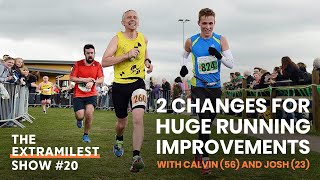
In this episode of The Extra Mileage Show, host Floris Gierman talks with Kelvin Sambrook (referred to as Calvin) and his son Josh Sambrook about Kelvin’s dramatic marathon improvement—from a 5‑hour debut to a 3:14 personal best—achieved primarily through run‑commuting, massive increases in weekly mileage, and low‑heart‑rate training. The conversation covers Kelvin’s early marathon failures, the discovery of run‑commuting, the importance of training volume and consistency, pacing strategies, heart‑rate management, and the role of slowing down to avoid injury. Josh explains his informal coaching approach, the use of a race‑predictor tool, and how they plan training cycles together. The duo also discuss parkrun’s social value, a heat‑training study that altered Kelvin’s sweat physiology, nutrition habits (fasted runs, minimal gels, limited water), cross‑training via aerial circus work, recovery practices, mental preparation before races, and practical advice for other runners—emphasising more miles at slower paces, finding enjoyable training methods, and maintaining consistency despite life interruptions. The episode ends with resources, links to their Strava profiles, and a giveaway promotion.
Chapters
Well, I was running 4.5 hours regularly for a marathon, and that was just my time. That was just, I'm never going to get better than 4.5 hours-ish. I've run a dozen marathons at 4 hours 35, 4 hours 32, 4 hours 34. It was all, you know, within minutes of each other. And then I started run commuting. I knocked an enormous amount of time off my marathon. And it was just the fact that I've been secretly training by run commuting.
Volume and volume inconsistency, those are the big things that I would suggest. But more important than that probably is finding what works for you.
Hello everyone, welcome to another episode of The Extra Mileage Show. My name is Floris Geerman and we're already on episode number 20. On this podcast, I interview different athletes, different runners, different coaches from around the world. And a lot of the topics are focused on how to become a stronger, healthier, and happier athlete. In today's episode, I have a fun conversation with Josh and Kelvin Sambrook. Josh was on the podcast last month already. He's a 2:28 marathoner who improved significantly over the years, and that episode already had more than 30,000 downloads and views on YouTube as well. And so a lot of positive feedback. I definitely wanted to get him back on the show, especially when he brought up his father Kelvin Sambroek. His father is 56 years old, and his first marathon that he ran, he didn't finish it. He actually had to get rescued, which was quite a fascinating story there. And then the second one that he ran was in 5 hours 15, but over the years he was able to improve that significantly, all the way down to a 3:14 so far. So he improved by making several changes to his training program. And also with the guidance of Josh himself as well. And they share many different insights of this journey, which was a very honest and open conversation about several of the mistakes that they have made and several other opportunities that are still there to improve as well. All show notes from today's episode can be found at extramileus.com/20. I hope you enjoyed today's episode with Josh and Kelvin Sandbrook. Welcome to the show, Kelvin and Josh. I'm happy you guys are here.
Hi there, thank you very much for having us.
Yeah, absolutely. It was great having Josh on the podcast recently, and he shared a lot of his different insights already about low heart rate training and the journey that he had made. Then after the podcast, I asked him, do you have anyone in mind that would be a good guest for the future podcast? And he actually said you should have a chat with my father. He might be a really good case study of what is possible to do with some of the low heart rate increased training volume. And he has come from a 5:30 all the way down to a 3:15 so far. So just want to start off right there. Congrats on your journey so far, Calvin.
Thank you. It's not over yet.
No. And that's the beauty of this. It's this journey that continuously goes on. And I think we can all learn from each other. So I appreciate you sharing your story today. Let's, let's maybe start out over here with hearing a little bit more about your background in running. So have you always been a runner? Has this been something as of late?
Okay, so I'm 56 now. I, as a kid, I used to run a bit but not very much and not in any structured way at all. I picked up running again maybe 10 years ago. But very short distances, not, not marathon running. Um, and got introduced to parkrun, and which is a 5K timed run, just once a week. So I was doing maybe 5 kilometers a week, which is nothing, but enjoying it. And I really like running. That's my whole reason for running, is that I enjoy it. And I always said I would I would never do a marathon because it takes too much training. Oh, I got that wrong. I got that so wrong. And then in 2013, I think, I finally got persuaded to do a marathon. And my first official proper marathon was in Berlin, and I got a shocking, horrible, terrible 5 hours 15 or something. But before that, I have a Strava log which is entitled something like "Nearly a Marathon," because I did a— it's called the Boundary Run around Cambridge where I live. It's a full marathon around Cambridge, and the first half is on road, the second half is kind of cross-country.
All right.
It's organized by students, so it's really not very organized at all. And I ended up doing about 37 kilometers out of the 42. And it's in February in Britain. It was cold. It was windy. I was hypothermic. There was no one else around. I was walking along the sides of fields. I could easily have just curled up under a hedge and died. They came and rescued me. They came and found me.
Wow.
I didn't even finish my first attempt at a marathon. My first real marathon was Berlin, much better organized, and 5 hours 15, and just as painful.
Wow. How did you train for that first marathon? What went into that?
I think that was the problem, actually. I didn't train for the first marathon. I did parkruns, I mean, literally, so 5 kilometers a week and felt invincible and felt, I don't care, what's this marathon? So I can do that, you know, don't have to do it quickly. And it hurts so much. No training doesn't work.
And I think there can be many witnesses of that one. Everyone has their own first marathon stories. I, I think it's 1 out of 100 people who run their first marathon who are truly like, yeah, that was a great experience, I'm gonna do that again, that felt good. I think 99% of the other runners are like, I'm never doing that again, I thought I was gonna die. So it sounds quite recognizable right there.
Yeah, I recognize that. And then I got persuaded to do some training, and I was doing maybe 40, 50 miles, 60 kilometers, 70 kilometers a week. Yeah. And sort of 3 years later had what— from— well, I was running 4.5 hours regularly. For a marathon. And that was just my time. That was just, I'm never going to get better than 4.5 hours-ish. I've run a dozen marathons at 4 hours 35, 4 hours 32, 4 hours 34. It was all, you know, within minutes of each other on that sort of mid-range training. And then I started run commuting. I realized that my journey to work by car I live in the countryside and it's entirely unpredictable. The first half of my journey, first 10 kilometers, 6 miles or so, is very predictable. It's a car journey from one village to the next. And then second half is through city traffic, very, very unpredictable city traffic. And so I took to parking at the first village on the outskirts of town and running the rest. So I was running 10 kilometers from my car into work and then back again in the evening every day because it was easier than driving. Yeah, it's more predictable. I was getting to work feeling fresher, and magically I was doing training without realizing. And, um, I went— I was— I just booked on my next marathon expecting to do 4 and a half hours. And I've quite forgotten where Josh was, but he'd been away or he'd been ill or something.
I'd been away. I'd been away for 4 months. 4 months previous, not doing any running at all.
Yeah, he was way out of shape. So, um, this particular marathon is in the middle of nowhere in the countryside, um, in the Fens in Britain, and it has a marathon and a half marathon. And the half marathon sets off sort of 2 hours after the first marathon from the same place. The marathon is 2 laps, the half marathon is 1 lap. It's fantastic. You run through. If you're my sort of— if you're a 4.5-hour runner, you run through the start line of the half marathon while the runners are getting ready to go. You get a fantastic amount of support. Yeah. So I had organized with Josh that he would be running the half marathon because he wasn't fit for a marathon, and he could run the second half with me. It's just a bit of fun. I was out for a bit of fun. And so I'd organized to go through at 2 hours. And I went through a bit early, but I wasn't looking at my watch because I wasn't really paying attention.
So early, I still had my tracksuit on. I was still in my hoodie, not expecting to see him. And I just see like a blur with his yellow vest as he sprints past, like 15 minutes before he said he's going to be, uh, he's going to be there. God, he's really messed this one up. He's really gone off too quick.
And then Josh was this idiot that people see that did the first half of his half marathon at sprint pace to catch me up and then jogged around the second half with everyone else.
So I set off, I set off absolutely, uh, full speed for the first 10K of my half and caught up with him and practically stopped dead because I had gone from, uh, sprint pace and kind of, yeah, pretty much 10K pace to 4-hour marathon pace.
Wow.
Just like, just, yeah.
But, but then he caught up with me I finished, and I've got one of my treasured photographs of me crossing the finishing line looking alive, which was rare in those days. And I did what you do after a marathon. I lined up for a photo, I went and got my bag, I went to the bar, I bought a drink, I sat down, and I looked up at the clock, and I realized I should still be out there. And I'd done it in 3 and 3/4 hours, or 3 hours 40 or something. I'd knocked an enormous amount of time off my marathon. And it was just the fact that I'd been secretly training by run commuting without realizing it.
Yeah, so what was your training at previous cycles like and how high did you increase it? Did you run commute every day, like 10K to work and 10K back?
Yeah, pretty much, yeah. You kind of have to do the back if you left your car in the car park.
That's the beauty of it. What about the training volume before that at your previous training cycle?
Yeah, nearly nil. Really? Like 5 kilometers a week. Yeah, literally parkrun and maybe a little jog around the village, but nothing you can't really call that training.
Yeah, yeah. So a massive, massive increase in training volume. What about the pace? What pace were you running those at, or what heart rate?
Well, he slowed down. He slowed down crucially, because in order to get— if you're running 10K in and out of work, if you want to function during the day after your 10K, you can't do it too quick. So you had to, you had to slow down. And in order to get that done every day, 10K in, 10K out, you can't do that quickly if you want to be able to walk. So you did slow down.
I did slow down, but I was still at that phase in my running where I didn't understand that I had to slow down in order to train, if you see what I mean. Yeah. So I was still occasionally trying to push the pace, but I would always do it on my run home in the evening if I felt up to it. And I've got some shocking logs of me running at stupid speeds. How I didn't age it, I do not know. Right on.
And so both you and Josh kind of started marathon running around the same time then, right? Is that correct?
Yeah, yeah, that's right.
It was actually, it was me entering, entering Berlin kind of the day after my, well, the Berlin Marathon was the day after my 18th birthday. So I answered that and then he—
yeah, I got told— what happened was that Berlin is very hard to get a place in. You have to be quite lucky to get on the website in time. It sells out in like 20 minutes. And I got instructed to book Josh a place because he didn't have access to a computer at that time of day and I did at work. So while I was booking his, I just booked two. I thought, I'll give it a go.
Perfect. Well then, it's nice that both of you guys have been in this journey together now since about 2013, I believe it is, and both of you have grown so much. Do you guys run much together at all?
When we're in the same place, yeah. Obviously kind of living in different cities makes that a challenge, but definitely, we always run together when I'm staying back home visiting, and if we're on a Saturday morning in the same place, it's always going to be a parkrun.
I mean, it's almost a religion, the Saturday morning parkrun. If there's a chance for a Saturday morning parkrun, then it will happen.
Yeah, particularly at Christmas. Christmas is great because we have all of the family. All the family goes out for the Christmas Day parkrun. All kind of— what, there must be 8 or 10 of us who all turn up and run, grandma runs, 55 minutes or something, and then other people are doing 16 minutes near the front. It's great.
It's so funny, I've had 5 guests from the UK now, 4 out of Leeds. I think I've spoken to every runner in Leeds by now. But it's been funny how all 5 have talked about the parkrun being a part of their routine, which is It's a very social thing.
People do parkrun, they do it for the running, but they do it for the social structure of it.
Yeah, and now it's awesome to see them happening all over the world as well. It's a really good happening.
Yeah, they can't stop growing.
They have a real problem.
That's a good problem to have, right?
Yeah.
Kelvin, when you look at the main facets, like obviously the increase in training volume was a big one. What are some of the other things that you feel you can contribute contribute to your improvements in running?
Well, the training volume is by far the biggest one. Um, the sheer number of miles is, is the big one. So slowing down— that I've now learned. I've had it beaten into me to slow down when I'm training. So I, I was initially in that run-up to, um, sort of 2016 in that Bungay race where I did sort of 3 3 hours 40. I was doing 20 kilometers a day, but I was still not deliberately slowing down. So I was slowing down because I had to work during the day, but I was still trying to go fast. Yeah. And since then, I've— I now do even more distance, but I do it consciously slowly. Yeah. Um, so I've changed location of where I work And I now have to commit, if I'm going to run to work, I have to commit to a half marathon on the way in and a half marathon on the way home, which is fine. I don't mind doing that, but you have to slow down. Yeah, you have to allow yourself sort of 2 hours each way.
Yeah.
Um, and so I do that sometimes. Sometimes I'll go out at lunch, or most times I'll go out at lunchtime instead and do 10 or 15K at lunchtime, and then again in the evening I'll do another 10 or 15K. But consciously slowly now. Yeah, that's a, that's a big difference for me. And it's partly that's about increasing the distance, and partly I'm very conscious that I've been very lucky to avoid injury. Yeah, I hear stories of everyone else getting injured, and I also hear that if you don't want to get injured, don't be stupid about how fast you go.
Yeah. So how do you avoid it besides slowing down your pace? Because you're, you're in your 50s and obviously recovering can start taking a bit longer as you, as you get older. Like Josh, he's 23 and he is like, he would run 500 miles in a week. Some of his training volume, I've seen him posting 130 miles in a week sometimes and he's totally fine. How about, how do you do it?
I, if In my opinion, if you're having to recover, then what are you recovering from? You shouldn't be training that fast. So I've also put in, yeah, a 5-day week of running a marathon a day, effectively 2 half marathons a day, which is 200 kilometers in a week.
And only in the 5 days, not over the—
yeah, sorry, work days. Um, and then done a parkrun. Um, the only fast running I ever do is a parkrun. All of my training is at low pace, and I, I don't— recovery isn't a thing. I, I don't do it because I never train hard enough to need to recover. Yeah, the only time I have to recover is if I've done a, um, a marathon in which I care about the time. So I run for fun, that's all I run for. And almost all of the marathons I do, I don't chase a time. I'm just doing 26 miles, 42 kilometers, about having fun.
Yeah.
And I don't need to recover from that. I'll maybe go a bit easy the next day, but nothing much. If I'm chasing time, which I've done twice this year, then I maybe can't walk very well for the next 3 days. Stairs are a bit of a problem, but other than that, no, recovery is not an issue. Yeah, right on.
Is there a specific heart rate that you aim for in your runs, or do you just run more by feel?
Hmm, if I'm training, I tend to have heart rate on my watch, so I'm keeping an eye on it, but I'm not sticking to a heart rate. I use it more as a sort of limit. So if I see my heart rate's doing something stupid, I'll think, what's wrong here? You know, something's not going right. And I occasionally— I've shortened runs, occasionally I've stopped runs. Um, I've had particular marathons which I've been really enjoying, but my heart rate's been doing something really stupid. Um, not just on the watch, but you can feel it. You just think, this is not a good idea anymore, I'll stop. Yeah. Um, and I've called that 2 races for that now. But it's a learned—
that's a learned thing because as a result, that, that is a— where that comes from is that he has, uh, almost unique ability. I've never seen anyone work themselves as hard in a race as Calvin does. Honestly, I can't get myself to anywhere near the kind of level of exhaustion that he manages to pull. I remember Frankfurt Marathon in 2015, I think it was, um We were going for a PB and I was pacing him. He had trained really hard and we had predicted him his time and got his heart rate all sorted and we had a plan that we were going to execute. Went out to execute it and crossed the finish line. He stopped his Garmin, but then he just collapsed on the spot and had to be taken away.
Yeah, I woke up in the ambulance. Well, they had a lift to their medical bay on a different floor.
Wow.
I woke up in the lift. There's a video of me crossing the finish line and the video only covers the next 3 steps and I collapsed on step 4.
Wow, you surely pushed yourself hard on that one. What do you think happened?
I went too fast. It's the only thing that I ever get wrong. I just pushed too hard and I've had this before. Since then I've learned that feeling. The feeling of, um, ah, it's when you hit the wall. It's, it's 20 miles, 30 kilometers, and I get— I suspect it's low blood pressure— so tingly fingers, a bit floaty feeling, a bit not quite with it, a bit disconnected. And that's fine, but if I keep pushing it, then start to weave from side to side— everyone's seen these videos of this happening to marathon runners.
Yeah.
And that's the point that it all goes horribly wrong. And, and I just timed that particular race in Frankfurt to that point where that happened 4 steps over the line.
Well, I would suggest that that says you timed it perfectly.
Yeah, that's not what the medical guy said, and the result wasn't what I wanted either, so I clearly didn't time it perfectly.
It was still a PB though.
True. And that there was a period around that time where I was getting a new PB at parkrun every single week. Which might sound like a great thing, but I stopped doing that. I consciously deliberately stopped doing that and started jogging around for a few weeks because I realized I was being dangerous to the people around me. So as I got a new PB each week, I'd start to realize that I wasn't able to run properly. And at one point I was running up the sprint line— the sprint line, that says it all— the finish line And I could— my vision was closing in from the sides. Yeah, I was getting tunnel vision, and I thought, this is just not safe.
This is—
someone's gonna be picking me up soon.
It's that fine line, right, of how far can you push yourself that you can put everything out there yet still be able to finish strong and get over that finish line in the fastest way possible. And so how How fast do you start? How high do you start with your heart rate and your pace? Because Josh and I had a talk about this in our previous conversation, how he generally starts out rather with a lower heart rate and he has his heart rate increase throughout the race. How do you go about strategy if you're training at a low heart rate? How do you pace yourself throughout something like this? Do you look at heart rate? Do you look at pace?
So that's always a worry to me, um, particularly first race of the year. So you've trained all winter, um, but you've done it really slowly, and then you're going to go out there, and often the first race of the year is the one you really care about because that just happens to be when it is. It certainly was for me this year, and it's— I can't even remember if I can run quickly anymore. Yeah. So I don't— I tend not to look at my heart rate. As I said, I don't look at my heart rate in order to keep to it when I'm training, just, just as a sort of interest thing. Yeah. Um, but I have the logs, so I go back through my, my Strava logs and I look at what my heart rate's been in training, and I consult with Josh and sort of, you know, we discuss what we're gonna— what that means effectively about how fit I am. And cook up a race plan for heart rate, which I then proceed not to stick to because I'm terrible at sticking to heart rate in a marathon. But at least I know what I should be doing.
Yeah.
So my, my race plan has been for a few years, um, 150 beats a minute, um, at the start, 170 at the end, and a sort of 1 beat per minute increase in the first half marathon.
Yeah.
And that, that kind of works if I could stick to it, but generally the adrenaline rush at the start of a marathon means that I'm shockingly bad at that. One day I will manage it and I will get great times as a result.
It's, it's, it's this. Yeah. I actually looked at your PB on Strava and I looked at heart rate as well throughout the race. And it's, it's indeed a tricky one to like have it go according to plan because sometimes there's that race excitement at the beginning as well and your heart rate might shoot up rather quickly already right there.
Or even on that PB was London 2018, it was a really hot day.
Yeah, yeah.
So all of a sudden your heart rate's just thrown off from that and you've got to make adjustments on the day because you weren't expecting it to be 23 degrees.
Yeah, that was a very lucky race for me and a number of people from Cambridge actually because that particular London Marathon was extremely hot, unexpectedly so. Yeah. And I had been the, the lab rat for a study into, um, temperature control whilst running and the effects of training at temperature for the previous 8 weeks. So I'd done an absolutely horrible 8 weeks of layering up with more layers than you want to imagine for each of my runs. And by the end of 8 weeks, I hated this, this business. However, I then did the London Marathon, and it was a hot day. And, and so what? It was a hot day. It didn't matter. And other people were really suffering. Yeah.
So you had improved your, your sweat glands, your sweat rate, all of these things.
You could really tell.
Yeah, tell me more about that study. What came out of it?
Well, they were looking at— this all comes down to how you take on liquid in the marathon. They were looking at where your body gets the water from that it needs in order to cool you down. So you cool yourself down with perspiration. Where does your body get that from? And I'm not the scientist, but, but as far as I understand it, you can get it from within your cells or within your blood or a mixture of the two. And one of the things you heard me mention earlier, that one of the things I suffer from is low blood pressure at the end of a marathon. Yeah. And that's caused by your body extracting water from your blood in order to fuel perspiration, to fund perspiration. Okay. So if you train hot, then you train your body to instead draw that moisture from the cellular space, the intercellular space, which means that your blood pressure stays up. Okay. And it's— there's some evidence that that's what's one of the things that's happening when people talk about hitting the wall, is that they're hitting this. And certainly that worked for me in London. 2018.
Good, good, good. Yeah.
I'm a believer in that. It's just that making it happen hurts. That 8 weeks beforehand was not nice.
I can imagine. Jason Cheriman actually shared in one of his previous, uh, in our previous podcast about how he is heat training. And he also loads up with 5, 6 layers and a beanie and gloves. And he goes out there and he said it also, it's very uncomfortable at the beginning. Your body starts to adjust after a while, but that it's a very important part of his training regimen as well.
Absolutely. You do have to— the one thing you have to be careful of is we're all athletes in the UK who are doing this. Yeah, over winter, or when you do it over summer, you don't layer up. It's a whole different story if you're training in somewhere where the climate is hotter. If it's, you know, somewhere between 0 and 10 degrees outside, you can layer up with everything you like. You're going to struggle to get your body temperature that dangerously high. Whereas if you're in Texas or something and you try and do this, don't, because that's how you'll end up in some real, real trouble.
Yeah, very well said. And I get often emails from, or messages and comments from people out of India as well, who say we have a lot of humidity over here, it's hard to keep the heart rate low. And yeah, that's kind of in line with that as well.
Yeah, you're already, because if you're in one of those hot, humid climates, you're already doing exactly what what we in the UK are trying to do by layering up with beanies and jackets. We're just exposed to it all the time. Yeah, yeah, yeah. So they don't even stay safe as well.
Yeah, absolutely. One thing that I want to kind of go back to for one, one minute here, because this is more a question towards you, Josh. When Kelvin is training a lot at low heart rate and he's doing the park run, but all his other runs are at low heart rate, Wouldn't, wouldn't he get some benefit out of running a few miles at marathon pace just to become accustomed to that? Or, or is this something that you prefer to wait with for until marathon itself?
And before you answer that, this is something I worry about as well, so carry on.
Yeah, I mean, I'm a bit personally— my opinion is a bit— I'm a bit split about this because I don't think it's doing anything, probably not doing anything massively negative to you if you, if Calvin did decide he wanted to go and do some runs at marathon pace, it could have a very positive benefit of getting you used to running marathon pace and upregulate a whole bunch of systems that he's not accessing by training at low heart rates and slow paces. But on the other hand, it could have the negative benefit, the negative effect of meaning that he has to reduce his training volume because he all of a sudden needs to recover. You're— he's trading one positive adaptation for another positive adaptation. And what seems to work exceptionally well for Calvin is a hugely high volume with no speed at all, because he spent the last 5 years tinkering and trying out different things. It works, and it's what he enjoys as well, crucially. Yeah, 99% of people aren't in marathon running to be world-class. They're in it because it's an enjoyable enjoyable pastime, really. If that's what's enjoyable for him, it's more fun to commute by running than by sitting in a car. The result of that is that he ends up with a cracking marathon time. It's about him then deciding what's— you're playing with what's enjoyable, what works for you. Yes, maybe it would help, but maybe it wouldn't. And maybe what helps you physically isn't necessarily what helps you mentally with the enjoyment of the sport. So it's about every individual person deciding what works for them. And Calvin seems to have struck something that really works for him.
Yeah, I mean, I'd go along with that, but the one thing that I question in that is that my— not just my cadence, but the way my legs work when I'm running slowly or running quickly is very different. So when I'm running quickly, I— if I'm racing, I lengthen my stride, I— my foot lands differently. I can't help but have that nagging doubt in the back of my brain that when I'm training at a low speed, I'm not training the same muscles exactly that I'm going to use in a race.
Well, then you need to start up to parkrun more regularly.
There you have it. Do you, like, talk a bit more about cadence when you do run your miles at lower intensity? Do you have any idea of what your cadence is there?
No, it is actually recorded, but I've never looked at it. I know it's the shortest stride. Yeah, so my cadence must be higher.
You don't really pay attention to cadence, you're just more focused on pace or heart rate?
Actually, for my training, I don't really focus on anything. I just run. And I've cautioned myself to run more slowly. So I run at about 5 minutes a kilometer. If I go any faster than that, then I'm conscious that I'm going faster and I should perhaps slow down. So in the weeks just before a race that I care about, I'll go a bit quicker. But generally, if I'm running to work, it will be— well, if I'm feeling good, it will be 5. If I'm feeling less good, it'll be 5 minutes 30 a kilometer, unless there's a reason not to. If it's super hot and I'm running home after a long day or something, then maybe 6.
But yeah, that really means you're regulating very nicely by effort rather than by perceived exertion, rather than by looking at a number. You're doing all these Instead of just looking at heart rate, you're looking at effort, and looking at it involves mental checks rather than checks on a watch.
Yeah, so my watch laps every kilometer, and that's probably the only time I look at it normally.
Yeah.
You know, it buzzes on my wrist every kilometer, I glance down, and that's about it. I'm not paying attention to it while I'm running. I then get home and look at Strava log, but that's afterwards.
Yeah, and I will make sure to include a link to your Strava as well in the show notes, and to yours as well, Josh, just if if anyone wants to check it out there. Do you do any strength training at all? Do you go to the gym? Do you do any workouts there?
Yeah, that's very conflicting for me because I'm part of a community circus, so I do a lot of aerial circus work, trapeze and rope and stuff like that, which is all upper body and involves stretching and pointing toes and all of the things that you don't do when you're running and that actually work against you while you're running. But I do it because it's fun and I enjoy it. And it tends to mean that when I'm doing a lot of circus stuff, I have to back off the running a bit. Yeah, just because it conflicts. And the other way around, if I've got a race coming up that I care about, then I will opt out of teaching the previous courses at circus because I know that I that I need that time for running. I can't go and teach circus in the evening if I've run to and from work and done a marathon during the day. It's just not going to happen. Yeah. So you can kind of think of that as going to the gym, but unfortunately it's upper body mostly, which is really not what you want.
Well, please do tell me more because I find this interesting. So the circus, is this your profession? Is this your full-time job?
No, no, not at all. No, no, I have a boring desk job. So literally, I have a desk job. I don't move that much during the day at work. No, the circus is just fun.
Okay.
I do sort of 3 hours, 4 hours a week, once a week. That's something. Or maybe twice a week if I'm not running much.
That's some great strength training right there.
So it is, it's great fun as well. It's really, really good fun. Yeah, but it's just completely different muscles and different requirements from your muscles. So I don't care about pointing your toes. You try pointing your toes if you've just run a marathon a day or two before. It's really not fun.
Yeah, absolutely. Absolutely. Do you do any stretching, foam rolling, ice baths, any other recovering tools?
I know I should, and I know I benefit when I do, but I can never make myself do it.
Is that, is that a time thing or is that a Yeah, so it's just, you know, I've just done 2 hours of running.
So typically, for instance, this spring, um, so in the UK it's very dark in the winter. Yeah. So I'm not running to and from work because it's on road. They're quiet country roads, but it's on road. So I was running 10 to 15 kilometers at lunchtime and then another 10 to 15 kilometers of the evening. Around my village. And when you've run 15 kilometers, you've run for an hour and a half, do I want to spend another 20 minutes stretching? Probably not. I'll have a drink, thanks.
Well, plus it does help that you probably have a solid warm-up, you run at a pretty low intensity in the cool-down, and then at the end of the day, the amount of recovery required then is a lot less than when you're going to be out there sprinting.
So, and yeah, I do notice it though. I am really quite conscious that it's, it's tightening joints. You can feel it, and I feel it when I go to circus, that if I've done a lot of running in the previous weeks and months, then my stretching is shocking.
Yeah.
And if I haven't, then I can stretch a lot more. So it— you really should, just not very, very good at these things.
Yeah, it's— I'm not going to lie, I'm in the same boat and I know I should be doing more of it. It's just I have X amount of time in my day. I have like also a full-time job, family, and other things that I want to spend time on. And then it's more if I'm going to spend much more time on that, it's going to take away from my running. Whereas ideally I would have 4 more hours available in the week to spend on a variety of strength training and mobility and all of these kind of things and more running. Yeah. Yeah, that's the other thing as well. But then again, I think it's also listening to your body and if things don't feel right, to kind of back off in training for a bit. I think a mistake a lot of people make is here's a set training schedule and you gotta stick to that, whereas it's not adjusting to how their body feels at that moment.
Definitely.
In what sort of way, Josh, do you guys work together? So you're his son, but you also coach your dad? In what sort of way does this go on a weekly— let's say your last training cycle, can you walk me through some of that process?
Yeah, so I guess it's more informal than the other athletes I work with, but essentially it's more a case of because the style of running he does is that he runs for enjoyment and he's going to do these run commutes in and out of work. He does these, these run commutes, and it's more a case of as we get closer to the marathon, I kind of say, well, here's the time you're, you're looking for, here's how much you're going to have to do. I look at his average pace over the last couple of months and say, okay, we're now 3 or 4 months out from race day, this is the kind of distance you're going to need to hit at this, and this amount the distance is going to need to increase by this amount each week or month because his pace doesn't vary very much at all, so I can do that. And then 8 weeks out from, or 9 weeks out from race day, 8 weeks out from taper, you kind of say, right, a more prescriptive number of kilometers. And this is often done just over Facebook or—
Yes, you know, the reason I'm laughing is it's carrot and stick from Josh. So the carrot will be the day that I have an option in my head of driving to work or running to work, I'll get this little note from Josh on Facebook Messenger which will just encourage me to run.
You know he's gonna need it when it's dark outside. That's what having someone looking over your shoulder does, it is that you're aware that they're going to be looking and not judging in a negative way, but keeping up to date with exactly what you're doing. If you don't meet the requirement, you're going to have to—
Answer for that one.
Yes. I mean, that makes it seem pretty negative, doesn't it?
But it's not.
It's more that just having someone looking over your shoulder is a very useful thing to do. Then before a race, we'll sit down, we'll spend a good amount of time, sit down, look at exactly what heart rate profile we're looking for. I mean, it's all going to be ignored on race day anyway.
So true.
But we'll try and we'll sit down and we'll say, this training load, we're going to predict you this off it. We're going to look at the course profile. We're going to look at what pen he's starting in. We're going to look at every factor we can, what the weather's going to be. The hills, whether— where the pacers are, every, every factor we can think of. What clothes he's wearing, whether he needs a haircut or not.
Hey, don't joke! Yeah, yeah, it's a factor. Always have a haircut before your race.
Makes you so much faster, huh?
Well, you can shed heat easier. Yeah, it really does make a difference.
And if you miss your PB by— if you miss your PB by 5 or 10 seconds and you haven't had a haircut, you kick yourself.
Yeah. So this conversation that Josh is talking about, this is usually done in the living room, or if we're apart, then it's done over Messenger. But it will generally resolve to coming up with a plan, and it will be based on Josh saying, you really can't go faster than this. And I'll be going, yeah, but I can knock another 5 minutes off that. Or in the case of this spring, I really needed sort of 3 hours, 3:05, and I'm being told by Josh that I'm really in 3:10, 3:15 shape. Oh, come on, Josh, I know I can do this. Look, look, you know, if, if we view these figures this way, then we can get this different spin on it. Doesn't work. He's always right. I go out, I do my thing. I wish I'd stuck to the plan. Um, yeah, it's just how it is. But yeah, he does, he does, um, sit down and go through the plan with me, so at least I've got that plan in my head. And, and the other thing is, during the race itself, knowing you're going to have to answer for how you messed it up, it can just encourage you enough. Uh, the, the first time I got a good-for-age time for London, which is 3 hours 20, was at the time 3 hours 20 for me. This was 2016, I think. I remember about 22 miles, something like that, feeling terrible and thinking, I've just got to do this. I've just got to keep the power on and keep going for it because otherwise, A, I've got to answer for this. I've got to, I've got to explain what I did wrong, and B, I've got to do it all again.
Yeah, well, that's the other thing, but Josh has got really good experience at this point with even forecasting what kind of shape you are, right? And maybe, Josh, you could talk a little bit more about the Tandem Race Predictor and how you've incorporated this in your training, but also in your father's training.
Yeah, so it's a really solid predictor once you know someone's individual offset. So I know that the last time I talked talked about this, people have played with the numbers themselves and found that it doesn't quite— maybe hasn't quite predicted perfectly accurately for them. But it's just important to remember that the predictor at tanderracepredictor.com, the one that predicts what an average person might be able to do off a given volume of training if they get the race right, if they have hit the wall in the race and slowed right down,, then that's because they set off too fast and, yeah, of course it's going to predict badly there because it can't predict how badly you're going to hit the wall. But essentially this predictor just looks at your training volume, the number of kilometers you've run in the last 8 weeks, and the pace, how quickly you've run those kilometers, and spits out a prediction. And once we can see what performance you were able to achieve off a given prediction,, we can tell whether you are quicker, how trainable you are, whether you respond to training in a better way than the average person or a— I'm not going to say worse, but not as effectively as some people. And really interestingly, actually, what predicts that offset from that, how trainable you are, I'm yet to find what it is. It's not elevation, it's not where in the world you are. It's not even obvious genetics because I'm very fortunate. I'm actually— I'm pretty trainable. I have very positive response to training. Calvin has— I've never come across someone who is as untrainable as Calvin. He— the race predictor, he has a 15-minute offset. So the race predictor predicts him 3 hours, and the most he's going to be able to do is 3:15, even when I run alongside him and make sure he does everything on the race correctly. I'm making sure he's running the shortest course, not cutting corners of course, but running, not weaving in and out of people, making sure he runs at a sensible pace, on a flat course, in a sensible temperature. When he gets all of the conceivable race day variables correct, he still has a negative 15-minute offset. And that's the way it is. That's why some of us are going to be Olympic athletes and others aren't. That doesn't detract from the away from the joy of marathon running at all. It just means it's a fact of life. But understanding what your offset is lets you get the best result from your training. So for Calvin, I know that when he has— he's done one marathon where he's beaten this race predictor by 12 or 13 minutes. The others are all about 15 or even a bit more like 20, where he's lost by about 20 minutes. You play it safe and you, you go 15 minutes slower than the predictor says, and at the end of the race you turn to him and he'll say that that's the hardest he could have done. And you can see it as well.
You can really see that. That's— yeah, I can guarantee you when I finish a marathon, there's nothing left.
Yeah. Yeah, it's a really useful— it's a really useful tool once you know someone's offset. There's nothing you can do. You can mess up by getting things wrong on the day, but you can't produce a result out of nowhere. The predictor will let you see what you're going to get.
I can guarantee to you it doesn't matter how much you want that result. You can try and spin the numbers however you like.
You can't cheat. What's next for you, Calvin? Race, races, are you, are you looking at anything in particular now, or are you taking it, taking it back for a bit?
Well, I always ease off at this time of year, just because life gets in the way. But I've had a shocking spring by, by sort of 5 or 10 minutes each, each race from where I wanted to be. So 2 important races for me that I've just done, Manchester and London, both had times that I wanted to achieve for different reasons. And in going for those times, which, which Josh was telling me I wasn't going to achieve— and sure enough, the problem is if you don't achieve— if you set out for a time you're not fit for and you don't achieve it, you just don't miss it by a bit, you miss it by a long way then, because it's gone horrible. So I've had two horrible proper races this year. I've got another one scheduled for, I think, the Chester Marathon in the autumn, which I need to get somewhere around 3 hours for. So I would like to— well, I'd like a PB. I'd like to, to get down to 3:10, but really I'd like to get under 3 hours. But that's going to involve quite a heavy training load.
So your— what was your current PB and your volume leading into these last two races that didn't go according to plan?
Well, I had less running over the winter than, than I would have liked. Um, so I really did not very much in the autumn and then started out on the 1st of January. And no, it wasn't a New Year's resolution. It just happened to be the beginning of January. Um, and I started doing really ramping it up quite a lot, which I was comfortable with. But it wasn't early enough for races in April, end of March, April. So I just needed more time beforehand. Okay. And I was doing 30 kilometers each weekday. I tend not to run much at the weekend, I tend to run during the week. Um, so 30 kilometers times 5 days, 150 kilometers, 100-mile weeks., and it would have got me— I'm, I'm fairly sure if I'd stuck to the plan, it would have got me 3:15, 3:20, which would have been great, but I didn't need those times. I needed faster times. So I run one or two races a year which are races which, for which I have a time that I want to get for whatever reason, a good-for-age time for next year in London or whatever. And then the rest of them are for fun and I can afford to run those for fun.
What are your thoughts on all this, Josh, if you look at his training and racing and things that have gone well and things that can still be improved from here?
So as far as the training, when he trains, it's fantastic. He can get himself into really genuinely really good shape. Very, in terms of the number of in terms of hours he's willing to commit, top-notch. It's just that sometimes, as with all amateur, for-fun athletes, life gets in the way. So actually, the best shape he's ever been in was effectively thrown away because he went skiing kind of 3 or 4 weeks before London. He got himself into a genuine 3-hour shape. He would have been done a 3:02 or something, and then he went skiing and Yeah, you get a bit of cross-training from skiing, but it's really not the same. So that turned into a 3:20 because, um, because life got in the way. So it would be nice, it would, it would be very nice to see Calvin put in a good 6 months, maybe 4 months, where, where he's able to really commit, um, to a steady increase in training load, and then 8 solid weeks before race day, um, and then you have to get lucky on race day with weather and all the things that require a bit of luck on race day. But it would be— that's what would be really nice to see, because he's in the past had training blocks that have been exceptionally good, but they've just had one or two weeks in there where he's gone skiing, or he's had a building project at home, or, or I've helped you move house, or Yeah, for whatever reason you haven't— something's happened and then running goes— whereas the problem is then running goes really out the window when, when that happens. You'll go from 100 miles a week to zero for 10 days and then straight back in 100, which seems to work. Seems to be able to get back in straight back into 100 after 10 days off. But those 10 days is 10 missed days, and that's Yes, over 130 miles or something that you haven't done that would really help up your race day performance.
Yeah. I see it sometimes too though, even around me where I see some people go pretty all in on training and sometimes, yeah, whether it is life gets in the way or they get skiing or sometimes they might even get kind of overrunning for a little bit that they almost want to like not do it for a while. Where sometimes I even feel like lowering that volume a little bit so that the motivation levels and the amp levels get really high. But it's that fine line, right? Because at this point you're already— you've established a really high PR and you're trying to still lower that, which requires just significant amount of training effort.
At this point, really. So yeah, you have to, you have to love the, you have to love the journey. You can't— marathon running isn't something you can do for the solely for the result. You have to enjoy putting one foot in front of the other, um, for, for a lot of, a lot of hours each week. And if you enjoy that, then the added benefit is a cracking race time at the end of it.
Yeah, that's kind of a bonus, really. Um, the running is the fun and the race time is the bonus. Yeah, absolutely.
Tell me a bit more about your approach to nutrition. Anything in particular that works for you?
Are you drinking chocolate milk as well, or milk, or anything and everything? So I'm not a great breakfast person. I never do breakfast. So I will go out and do my morning commute run on nothing, and then I'll snack through the day, but only snack, not, not a full meal.
But he says snack, it's, uh, quite a lot of Nutella, chocolate as well, just like you, Josh.
Yeah, yeah. And then, and actually, if you're doing that amount of running, in all seriousness, there is a problem getting enough food in you, just, just finding the time, because you don't want to eat for that hour after you've come in from a run. And then suddenly it's 8 o'clock in the evening or it's 9 o'clock in the evening and, and there's only a certain amount of time to eat. So I tend to eat a lot when I eat and then sit down with a jar of Nutella and a spoon.
There you go. What about like, do you eat high carbs? Do you eat a lot of additional sugars? Do you— is there certain things that work better than others?
Or— so yeah, I mean, I, I'm not a vegetarian, but I don't eat very, very much meat at all. I live with a vegetarian. We tend to eat vegetarian almost all the time. And yeah, carbohydrates. I like my carbohydrates. I like my pasta and my rice and my bread. So yeah, it's not a conscious, oh, I've got to shovel carbohydrates in, but I recognize that that's a high part of my diet. I've got a very sweet tooth. If it's not Nutella, it will be the biscuits or something else. I will think nothing of sitting down and demolishing a whole packet of biscuits without thinking to offer them to anyone else.
Well, here's the interesting part, though. Both you and Josh are running fasted in the morning. So it sounds like, like that does to some extent help increase your, or improve your fat burning, that you're able to just go out there and run for 10K and be totally fine without needing any food.
I've heard the theory, and, and I subscribe to the theory, and that's not why I do it. I do it because I don't enjoy breakfast. But I would go along with that theory. Yeah. And, and certainly my approach to nutrition and water on race day has completely changed. You know, I was that guy who used to run marathons with a belt on with gels in the belt, you know, sort of all the way around like some sort of ammunition belt, and a bottle of water and another bottle in my hand. And then I realized you don't need that stuff and spent years, a couple of years running with just one gel. I never had the same gel, the actual same gel. Because it had, you know, good luck Calvin written on it from, from a good runner friend of mine. And then finally realized that that was costing me maybe 15 seconds on a marathon, and that doesn't go with me anymore either. So I don't eat or drink for a whole marathon. You don't drink either? I don't drink at all. The only water I take goes straight over my head for cooling. Really? Yeah. I wouldn't recommend that if you've not trained for it. So when I do, when I When I run, I don't take liquid with me at all, ever.
Um, but that is gradual. Important. Yeah, that is gradual. Because if you, if you go from consuming liquid as, as you on your training runs and when you race, and fueling when you train and race, and then all of a sudden you hear someone say, I don't, I don't fuel or drink when I race, you go, I'm going to do that, and make the change on day one, you're going to get yourself again into some hot water.
So yeah.
It was a— for Calvin, it was a gradual change. He went from having, yeah, lots of water when he was running and racing to like a little bottle that he had with him, and then just the, the volume of that bottle that was drunk gradually reduced over— we're talking months and years here. This isn't a week or two of process. It really is a long process, and it's about feeling out how much feels good for you, um, and then you can go, and then 2 years down the line, you can run fasted for a marathon and not drink anything.
So I still have my small water bottle that was the last water bottle I used to carry, and I do dig that out in the height of the British summer, not for going to work but for running home if it's hot and sunny. Then I'll carry 170 milliliters of water.
So this is one part where, like, when you sweat a lot, right, your blood gets thicker and your heart rate increases. Are you not concerned that this is holding back your performance? That if you would be drinking water, like, your heart rate wouldn't shoot up to like 170 towards the end of a marathon?
Well, crucially, your blood doesn't get thicker if you're able to extract the water from your cells. If you, your blood, you sweat from your blood, it's a blood filtrate sweat, but if you can then take water from your cellular space into your blood, then you can defend your blood volume and your blood won't get thicker or won't get thicker enough for it to be a problem. And your heart rate will still rise, but that's all of the other things of fatigue setting in. And then you don't need to try and digest something when you're running, which can be a challenge. Even water, even water. You've got to— you drink water when you're running and it's uncomfortable. It's really uncomfortable. So if you can train yourself to sweat, um, very unsalty sweat, and then extract water from— not from your blood—
your blood won't get thicker, right? And the pleasure after race day of looking back at the Strava flybys where you overtake people at the water station, it's just fantastic.
Do you, do you normally drink, do you normally hydrate quite well during the day then, or you're just not that much of a water drinker in general?
Yeah, I do. No, I do. I'm guilty of drinking a lot of coffee in the morning at work. That's permanent coffee at work. Yes, I'll drink during the day and I certainly drink during the evening.
Just not while running.
Yeah.
Yeah, right on. Ultimately, what, unless you're gonna shrivel up and become nothing, you've got to replace the water you're drinking. It's just whether you replace that water when you're actually running or a bit down the line after you've got changed.
And yeah, yeah. What about, do you have any other routines? Like, I think the, what, like doing the circus obviously is an interesting way of creative cross-training, I would say it like that. Are there any other routines that are part of this whole journey?
No, none that I can think of. I mean, the only other thing I consciously do is not— I attempt not to allow myself to get wound up before a race, particularly immediately before a race. Those, those couple of hours that awful time between when you've arrived at a race and when, when you start. I have to consciously calm myself down, so I will go and hide away somewhere. I won't talk to other runners because other runners are all talking about running and strategy and pacing, and that's the last thing I want to be doing in the hour, 2 hours before a race. So I will tend to go and find a quiet corner and huddle up under a under a silver blanket and just sort of wait for the start of the race. And it's a very conscious thing of trying to think about something else, trying not to, to be too wound up, because I know the effect that will have on me. It will push my heart rate up, and if I'm not careful, it'll make me go off too fast for the first 5K at least. Yeah. And, but that's the only thing I subconsciously ever do Yeah.
What about when you look, Josh, when you look at Calvin's entire training and lifestyle, is there, are there any other opportunities that you see for him for future training cycles here?
Well, the opportunities are a bit more consistency. It's about not letting life get in the way. But if you're running for fun, which Calvin really is, he's,— which is absolutely a brilliant thing to do. Actually, yes, nutrition could probably be optimized a bit, and a bit less coffee might help you sleep a bit better. There's little things you could tinker with, but actually, if you enjoy coffee and you really, really like Nutella, then that's absolutely fine. Those are really tinkering at the edges of of performance. And the vast majority of what is going to make you good and make, make Calvin a better runner is being able to be more consistent with your training and do more of it.
Volume and consistency. I think the consistency— I know personally that that's where I let myself down. If I were trying to focus on getting a race time, consistency is where I let it down.
Yeah, because you've already— he's already got the volume. That's clearly there.
It's just the consistency when other things happen. And I get these Facebook messages— you were asking earlier how we, how we communicate when, as coach and athlete, I will get these messages from Josh asking me why I'm detraining.
You must have a race coming up that he's not told me about.
Where is the secret training you're doing then?
He's excellent at tapering. That's classic. We have one, one guy at our office too who said he has been tapering for the last 5 years and he's really good at it too. Perfect. Well, I want to be respectful of your guys' time. I want to close this conversation with just wondering, Calvin, you obviously have improved significantly in your running journey so far. There's quite a few listeners on the podcast who are looking to improve as well, either just becoming stronger, healthier runners or trying to bring their marathon or their race times down. Do you have any other recommendations from your end, things that you feel can benefit them as well in their training?
I'm definitely, definitely a believer in more running and slower running. They, for me, they really worked. And I hear a lot of people of my age sort of using age not quite as an excuse, but maybe it's in the back of their mind as a, as something that might hold them back. And honestly, it doesn't. It's, it really isn't a factor. You can still get the result. Maybe you have to put a few more kilometers in than somebody who's in their 20s, but you still get the result. Yeah, I would just say more miles and definitely slower miles.
Yeah, well said. What about you, Josh?
Do you have anything to add to that?
Yeah, well, I mean, we've touched on— well, I've talked about volume and volume inconsistency. Those are the big things that I would suggest. But more importantly than that probably is finding what works for you. We've talked a lot about— clearly Calvin and I you're big believers in these, in math and low heart rate and high volume and all of that. But if that's not your style, that's fine. There's more than one way to train for a marathon. Work out what works for you. Yeah, try things, find what works for you. There are many ways, many ways to train for a marathon, and each of them will have benefits and drawbacks. But find something that is, A, enjoyable for you, and B, results in a good time. And just keep doing more of that.
You're not going to do it. You're never going to train for a marathon if you hate running. It's not going to happen.
You've got to find the running that you enjoy. If I had an athlete that I could mold into whatever I wanted, I would say I would do volume and consistency, and they'd be a full-time athlete trotting along at 6 minutes a kilometer all day, every day. But realistically, that's not going to happen. Whenever you meet an athlete that's halfway through their they're running journey already, halfway into their running journey already. They've got their routines, so just tinker with your routines, find what works for you, keep doing that.
Awesome, very well said. Where can people find out more about both of you guys?
After you. Well, my coaching is on jset.run, www.jset.run. I'm on Strava as well, which I don't know my Strava URL, but I'm sure you'll link it in the show notes.
And Yep. Yeah, I'm on Strava. I have a suspicion that my runs might be set to private at the moment. Okay. Right on. I'm not sure.
I haven't looked recently, actually. We're friends on Strava, so I see all your runs in there, but I'll take a look as well and I'll make sure to link to both of you guys' profiles there. Thank you.
Awesome.
Thank you guys so much. And I look forward to following the rest of your journey along the way.
Thank you very much. Thank you.
Nice talking with you.
Definitely.
Same here.
Have a good one.
Bye.
Cheers.
Bye. Thank you for listening. I would love to hear from you. What was one key takeaway or one of your favorite quotes from today's episode? Also, all show notes can be found on my website at extramileus.com/20. One more thing. I'm actually launching a really big contest over at www.extramilers.com/giveaway. This is the biggest contest that I've ever done with some really awesome prizes, so check it out. Alright, you guys have fun out there on your run. See you next time.
Later.
More from Floris


Ryan Hall 2.0 on Strength Training For Runners, Lifting Heavy & Trail Running




You’re Doing Zone 2 Wrong (Even If You Think You’re Not) | Scott Johnston Round 2


How to Build an Unstoppable Aerobic Engine (Even If Starting From Zero) | Scott Johnston


Stress Is Killing Your Running (The Relax Fix You’re Missing) with Dr Kasim Al-Mashat

When things get hard, say this, it (works in any race) #jeffpelletier #running #ultrarunning