My 2 Hour MAF Test on a Track
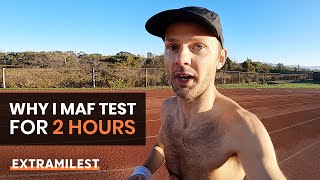
Floris Gierman runs 2 hours on a 400-meter track at 143 bpm using the MAF formula, covering roughly 20 miles in 80.5 laps. His pace drops from 6:26 to 6:54 per mile as temperature rises and cardiac drift sets in. He tests the COROS track mode, new On Cloud shoes, and various nutrition and clothing strategies.
Chapters
15 miles in. I don't drink coffee anymore, so when I do take caffeine, it's like rocket fuel. So good. Let's go.
Hello everyone.
Today I want to share some of my recent experiments with the 2-hour math tests. And what this test really is, is you use Dr. Phil Maffetone's 180 formula and you calculate your max aerobic heart rate. And I'll make sure to link to that formula in the description so you can calculate this yourself as well. And for me, for example, it is 180 minus my age, 37, is 143. And then you adjust that number with a few fitness and lifestyle health factors as well. For me, I don't need to adjust it anymore, so I stick with the 143 number. And so what I do is I go to a running track and I will warm up for about 15 minutes. And then from there on, I would run at that 143, so your max aerobic heart rate. And you would actually check after a mile or after a kilometer what your time is in total. And what you will notice is over time, after you do this for several miles, your pace starts to become slower. Because of cardiac drift, because of fatigue levels kicking in. And so what I'm curious about with these tests is to see overall how my fitness level is, what my aerobic pace is, but also what my drop-off is. Most people do a test like this for 3 miles, so 5K, or 5 miles, so 8K. However, I want to do this much longer to actually see further down in a race once the temperatures become a bit warmer. Um, or once I'm a bit further fatigued, how much that drop-off is going to be. And so that's what I'm going to cover in today's video. One thing that I've noticed when running on the track for longer distances and times is that the GPS watches are not always very accurate. And last week, COROS came out with a specific track mode when running on a track. So I want to check what the accuracy is, especially when I would be running like 60, 70, 80 laps on a track to actually see if it would pick up the right distance or if it would be way off. So I want to test that today as well. I think these math tests are really good to perform, not only just to see how your performance is aerobically at this point in time, but if you do them, let's say, every 3 or 4 weeks, you can start noticing progression over time as well. Or when you're not progressing, you can notice that something might be off, or you might have to switch up your training a bit. So let's dive right in.
So before I start a run, I usually have my gear already laid out because the family is still sleeping. So I have a few energy gels over here from Spring Energy. Here's the canna berry flavor, and then I got one with caffeine as well. And this is actually the Hill 8, about 100 calories each. Then I'm going to be running with my Coros Apex. This does have an optical heart rate monitor as well, but I'm actually syncing it to my Garmin HR heart rate monitor as well for, uh, the most accuracy. And then I'm going to be running with this little COROS Pod. It gives a lot of additional data that I'm going to be testing as well.
So there's that.
Then I will be filming today with my GoPro, the Hero 8. So I'll have that in my pockets and in my hands with an extra little battery over there. The Stance running socks, absolutely my favorite ones. Then I have some baseliners and running shorts from Path Projects. These shorts have a lot of different pockets so that I can actually put all of my gear, my gels, my phone, my camera and stuff in there. Running shirt that I will be taking off after the warm-up, and then I do like to run with a hat as well to protect myself from the sun because it's still going to be quite sunny later on, on the run. I will be starting with a headlamp, so I got a Petzl headlamp that helps out when it's dark out, and then Ultimate Direction actual bottle. It's nice that your hand can fit in, so it's easy to run with.
Made it to the track. Had to climb a fence again to get here because it was closed, but, uh, yeah, excited to get a few loops in this morning.
For the past 5 months, I've been running several times a week with the zero-drop Altra shoes. I really liked them. However, I did notice that my Achilles, calves, and ankle muscles were pretty tight and sore, and I think the zero-drop does have to do with this transition. So recently I actually bought some On Cloud shoes with some more drop, and I'm going to be testing them out on the long run today to see how they feel.
Typically start out with a 1-lap walk just to kind of gradually loosen the legs. Temperatures are good this morning. It's in the low 50s, which is going to be pretty similar to race day.
Probably.
So let's, uh, let's see how it goes. All right, so I can even indicate what lane I'm gonna be running in. Lane 1, 400 meters. Lane 2, 407. Lane 3, 415. So I indicated lane 1.
Start!
Let's do this. Let's see how it goes. Coming up on my first lap here. Let's see how accurate.
0.25 exactly.
Here we go.
And there it is.
I don't think you can see it anymore, but there was a coyote that just ran across the track. Not the first time over here. This track is close to an actual trail. Pretty close to the forest side over here. Yeah, always nice to be surrounded by wildlife. And soon we're going to see the sunrise. I just got rid of a few layers. It's, uh, want to do everything I can to keep the body temperature low. Plus running with a hoodie, it's not what I would do during race day either. So race day will probably be a little bit cooler than it is now.
So tank top on race day versus no shirt today, who knows if it's the same.
But yeah, 2-mile warm-up right here, and then after I finish this lap, I'm ready to start my actual math test. So I'll be running at a heart rate of 143 and seeing what my pace is going to be. We'll probably see a decrease over time, hopefully not too much. So let's see how it goes. Just finished the first lap, going well. I'm going to put the camera away because it's hard for me to run and talk. It's doable, but it's going to impact my pace and I want it to be a good solid test. So I'll talk to you guys in a bit. So far so good, 5 miles in, around 6:25, 6:30 minute miles. So it's going well. I did forget to set my heart rate alarm. Normally I have it at 143, so now I have to guess and I'll look quite frequently on my watch to see if my heart rate is going over. A few times I saw that 146, so just got to chill out and keep it going.
Time to eat. Nom nom.
It's really thin, so you don't really need water with it.
It's nice.
About 10 miles in, the sun is coming out and I can definitely feel the temperatures getting a little bit warmer. Since I'm also— I've been running for more than an hour, the pace is also slightly dropping. Dropping as in slowing down, not speeding up. Cardiac drift in combination with the temperatures increasing. But so far, still all good. Let's keep it going. 15 miles in, so about 60 loops I think that is. And initially it was going quite well, no real drop-off. Then I noticed my mind started kind of just losing focus a bit. Honestly, I've been doing a lot of laps, but also I think it's time for some caffeine. So keep the mind focused, especially since I don't have a heart rate alarm. It's good that I can speed up once I hit the lower heart rate ranges or slow down when I keep going too fast.
So first some gel. 20 miles.
Boom.
Wow, that went surprisingly well. This was my first long run on these new On Cloud shoes. I'm actually really, really enjoying them. They, uh, they surely felt good. They had good support, but not too stiff either. And so yeah, I felt good with the ankle. What else can I say? Yeah, the first, first miles obviously were faster. The temperatures were a lot cooler than later on towards the end. Also, I could absolutely tell that I was starting to get more tired towards the end, so there's a natural drop-off in pace there. It was good that I had some water on the side, so from time to time I could stop— or not even stop, like actually on the run grab a bottle of water, drink something, and put it back on the bench again the next lap.
Also had a few gels along the way, which was nice. So yeah, I was pleasantly surprised by the running watch actually.
So the good thing is, is that it does really sync up with the laps on the track. And so I ran 80 and a half laps in total. The laps are 400 meters and an actual mile is 1609. So if you calculate 20 miles times 9 meters, that's 180 meters. And so you have to go more than 80 laps to hit the 20 miles. So sure enough, when I got to 20 miles, so 80 laps and a half lap, at about the 200 mark, so 180 meters in, that's where my watch indeed said you have run the 20-mile mark. So it really picked up the signal of the track well.
This was my first test run with the Coros new setting.
They only released it last week, I believe. So yeah, it's a great setting. I haven't seen any other company come out with that setting, so I was stoked to see once they launched it, and it was actually the watch that I'm running with. Now I'm gonna go for a little cool down. Definitely important to let the, let the muscles know that it's the end of the workout instead of just going to walk the entire way. I'm going to go for a slow, slow jog, gradually have the heart rate come down, and then call it a day. I was just looking back at some of the data, and overall that was a great run. I ran a 6:39 minute mile average, so that was good. If I take— that was with the 2 warm-up miles taken out, and then the first mile was a 6:26 minute mile, and mile 18 was a 6 54 a minute mile. So definitely more of a drop-off than last month, but that was definitely part of that was the, the actual cooler temperatures last month versus this month. The main reason why I do these longer math tests, because most people end up going to a track and do 3 miles or 5 miles or whatever that is, 8K, um, the reason why I do these longer is just that I'm curious to see what my drop-off in pace is over longer period of time, especially as temperatures increase and as the actual fatigue levels, cardiac drift comes into play as well. But yeah, I saw what happened today. Don't know what the temperatures are going to be on race day. Today, obviously at the end it was quite a bit warmer. It ended up being 69°F at the end, so that's more than 20°C, whereas at the start it was only 11°C. Whatever that was, low 50s in Fahrenheit. On race day, everything can happen. It can be quite cold, it can be quite warm. So I'm both doing sauna training to get used to developing the sweat glands in case it is going to be warm, especially in the later stages of the race. But I'm also experimenting with running shirtless and running when it's quite cold out just to not feel too cool either, because I'm going to be really running with minimal clothing on. Purely to keep the body temperature as low as I can without pushing it too hard. So yeah, overall a great learning experience. And yeah, for anyone else wanting to try these tests, you can just go on a track and go longer. See how long you can actually end up going. Obviously build it up the right way. You don't want to go increase your training volume too rapidly right there. But Yeah, these are definitely good tests, not only physically but even mentally. To be able to run 80 laps in a row on a track, you definitely got to get kind of in a flow state and just focus on the next lap ahead of you. But I think the stronger you can be mentally, the easier it becomes on race day as well when the mental game comes into play in the later stages of a race. But to anyone else out there training and racing, Have fun out there on your runs.
Later.
More from Floris


Ryan Hall 2.0 on Strength Training For Runners, Lifting Heavy & Trail Running




You’re Doing Zone 2 Wrong (Even If You Think You’re Not) | Scott Johnston Round 2


How to Build an Unstoppable Aerobic Engine (Even If Starting From Zero) | Scott Johnston


Stress Is Killing Your Running (The Relax Fix You’re Missing) with Dr Kasim Al-Mashat

When things get hard, say this, it (works in any race) #jeffpelletier #running #ultrarunning