My Berlin Marathon 2023, Lessons From Start To Finish
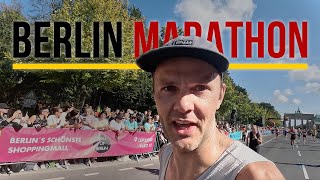
Floris Gierman ran the 2023 Berlin Marathon in 2:57:50 despite a calf injury that forced him to abandon his sub-three-hour goal three weeks before the race. He uses a five-stage psychological model to move through injury denial to acceptance, then adjusts his race strategy in real time to stay under three hours. His main lesson: strength and mobility work matter as much as the miles.
Chapters
Almost go time. Let's do it. 3, 2, 1, go! All those training sessions. Berlin Marathon 2023. 4th world major over here after New York, Chicago, and Boston. So super excited for today. Not going to be filming that much. Starting out a bit mellow, testing the legs. Left calf is feeling good. So yeah, let's do this. I can't believe I'm here. It's really freaking exciting. I'm glad to make it to the start line alive and well. Almost 6 miles in. So far so good. It's a bit of a puzzling game to figure out the pace that's right, but around 6:30 it seems to settle in all right. Just saw two people slamming flat out on the ground at the water station. Slightly feeling the left calf. It's about 12K in, so I'm dialing it back a little bit. Heart rate is good, but really don't want to push too soon. Almost 9 miles in. Heart rate was a bit higher than I expected. I really do think I lost some fitness the last few weeks here. Heart rate is 159, 160, so got to dial it back a little. And it's not going to feel much. Having fun? Oh yeah, how about you? A lot. Half marathon in about 1:26. On 26:10. So 13 miles in, 21K, and my left calf is giving me major havoc. 6:30s I cannot hold anymore, so I'm really going to dial it back. Looks like 6:45, 6:50 feels a bit better. Going to run in the moment. My parents, that was fun seeing the family. Oh, that gives you energy. Anyways, gonna do everything I can to run relaxed, run in the moment. Look at this crowd support. It's not the engine, it's not the breathing, it's not the heart rate. It's the left calf that is super tight. That is pull. So going to dial it back a bit. Really want to do everything I can to run under sub-3 at least, so let's take this step by step. Well done, man! Mile 15. Look at this energy! If that doesn't give you energy, I don't know what will. Two voices in my head. One is like pity party for my left calf, and then that one I override quite quickly with run the moment you are in, enjoy this experience. It's only 15 miles in and I'm already emotional. Discomfort level 6, almost 7 out of 10. Seen so many good signs on the side of the road. They really help take your mind off things. Running just in a moment. 16 miles in. Time for some more caffeine. Bleed out a little. I can definitely use a little pick-me-upper here. Thank you. Really tough day in the office. It's literally focusing on the moment. It's rough. Legs are hurting, calf is sensitive. Well, 26:53. 3, but the vibe is incredible, so we're going to dig deep. Still on pace for sub-3, but got to keep digging here. Going to be a rough last few miles, but going to do everything we can. 21 miles in. Hey, running to David! Hey guys, go hard! Crushing it over here. This is awesome. Well, keep charging, man. All right, you too. Have a good one. All right. 22.5 miles. I'm definitely fading, but all I'm thinking about— stay on that blue line, put one foot in front of the other, and enjoy the process. Mile 24, 7:09-ish. 25 miles down. Almost there. This is so hard. I'm running 6, 7, 20-minute mile and it feels like 6-minute miles. Come on, you got this! That's it, I can smell the finish line! That's it, I've been dreaming for years to run under here, and here we are heading towards the finish line of the Berlin Marathon. Sadie and Zoe, this one is for you guys. Daddy can do hard things, and marathons are hard, and I know you can do hard things in your life as well. I'm so happy. Look at that beauty. Well worth it. World major number 4. Third one and there's 3. Thank you. Get myself a blanket. Oh, I don't have to rush and drink it. I can just drink it. Anyone have a question? Please, we have so many. Can I have another one? The post-marathon high. Holy smack, that was no joke. Cheers. Just got through the finish line, ran into Dimitri. Dimitri is part of the PB program and he just ran a 2:52. Yay! So 5-minute PB. Thanks to the program. No, but that's so, that's so awesome to hear. You were holding back at the beginning, right? Yeah, just holding back, and after that I was just, just picking up the pace a little bit, then just a little bit more and a little bit more. Love that. Nice work, man. Thanks. Wow, made it past the finish line under 3 hours. That was so brutal. That was It's really no joke. I'll just share a few things here. Going into the race, my training was going very well. I felt very confident going into it all. I had some killer workouts. Things were really lining up good. Like, 2 workouts that really stand out to me. One was a test half marathon at one of my peak weeks, about 4 weeks out. I was doing 60-mile weeks, 65, 68-mile weeks. Weeks, and then I did a half marathon in 1 hour 19 minutes and whatever, 20 seconds. That was my fastest half marathon. And so yeah, that gave me a lot of confidence. I was able to hold whatever, 6:03, 6:04, 6:02 minute mile pace confidently for a half marathon, and it felt controlled. Heart rate was relatively low, in the low 150s, mid-150s. 150s, felt good. Did a 17-miler with 4 times 3 miles in there. Once again, same heart rate, like mid-150s. Was able to hold 6:05, 6:04, 6:03 minute mile pace. Felt really good. Then about 3 weeks out from race day, I had my last workout. The following day I was gonna have a rest day and a friend asked, "Hey, do you wanna go for a run?" I was kind of thinking like, "Ah, it should be a rest day, but let's go for a mellow run." At that moment, my car broke down when I was gonna go meet up with him. And so I ended up having to run for 2 miles to meet up with him. And then I ran faster than I should have to meet up with him. Then we ran 6 miles together. So I ended up running 8 miles while I actually should have taken a rest day. And the following day my calf started hurting and I was like, uh-oh. This was about 3 weeks out from race day. Took a few days off from running and tried to run on it and it still hurt. Took 2 days off from running, tried it again, and it was still a 3 out of 10 discomfort level. And at that point I got a bit concerned. All right, I really should take completely off. I literally only ran 0.5 miles or something in that test run. And then I called it and I just walked back home. So I ended up not running for about 2 and a half weeks before the marathon. Did a little test run just a few days ago over here and it felt okay. Absolutely know that I lost some fitness, but it was my main goal at that point just to get healthy to the start line and to be able to run this world major. It is a big goal of mine to run all 6 world majors under 3 course. How much under 3, I honestly don't care about. You might have heard of the 5 different stages that people can go through in a situation like this, and dealing with challenges, or dealing with grief, or dealing with injuries. First stage is denial, disbelief, then anger, then bargain, depression, and acceptance. Very often when a runner gets injured, There is really that phase. You're like, you simply cannot believe it happened. You're in that denial phase. Then there's that anger phase. You really get, get angry, like, what happened? Then there's the bargaining. You try to still get creative with how can we get out of this, or how can we deal with this the quickest way possible? And then you actually realize that it is an injury or it is serious. There's the depression phase, and then there's the acceptance. 3 weeks ago, when I realized that my PB was probably out of the window and I should not run for 3 weeks. I realized there's 5 stages of this whole process. Is the more time that we spent in that anger and disbelief and depression phase, all that negative energy, it's not really doing much for you. So this time around, as a running coach, I know that these are the stages that people go through. Like I see it all the time in our Personal Best Running coaching program as well. Well, I decided instead of losing a lot of negative energy over this, let's just skip the anger and depression and disbelief phase and just accept I should not run on this calf for at least the next 2.5 weeks here. And so that's what I did. Ended up going straight to the acceptance phase and doing whatever I could do within my control. And that's something that I would recommend you as well. Don't get stuck in that denial phase for too long and that anger that depression and that, that whole stage. It's all negative energy. So the sooner that you can go to that acceptance phase, the better that you can work on a solution over here. So you can still do a lot with rest, with self-massage, with seeing a professional, like working with a physical therapist, working with a doctor, looking what really is going on over here in your body and specifically making an action plan over there. There. Very many times you will see that people think they're going to lose all of this fitness, so they start overdoing it even though they're half injured. They start to overdo it in the taper phase, and that's when the trouble starts. You can do a lot more damage at that point. So 2 and a half weeks not running might not be ideal for your fitness level. I understand that as well, and it can be mentally hard when all you want to do is finish your training cycle good and you think all your fitness goes out of the window. Well, well, if you can't make it to the start line healthy, then you're not gonna have a race at all. On race day, I ended up starting the first mile 6:40, second mile around 6:30, and that felt really good, felt confident. Then I ended up running about the first 10K around 6:30 pace. I was like, yes, it's feeling good. Then I started feeling a 2 out of 10 discomfort in my left calf. I was like, uh-oh. By mile 8, it was a 3 out of 10, and by the half marathon point, it was a 6 to 7 out of 10 pain discomfort in my left calf. And I got very concerned that I wouldn't be able to finish the marathon at all, that I would have to DNF because my calf was so sensitive and so painful. So I ended up dialing back the running intensity quite a bit. Instead of trying to run 6:30s, I ended up running 6:40s, 6:50s. Yes, I was gonna lose some time, but at least the discomfort level kind of went down quite a bit. But I did notice I wasn't running very relaxed. I was running pretty tense. And when I run tight, when I run tense, I just noticed my heart rate goes up quite a bit when I can't get into a real relaxed them when all I'm thinking about is, all right, let's hope that my calf holds. Let's— so I had to continuously tell myself to let's just run in the moment. Let's get our mind off the body and let's just be present. Let's run every mile, run the mile I'm in, take it one mile at a time. Let's dial back the intensity a little bit. When I'm running at some point 7-minute miles and my heart rate was 1:60. Something was off. Something was not how it was going in training. And so at some point you have to make some adjustments. So after a while, my goal shifted from let's run the best time that I can to let's do everything I can to still find a way to get under 3 hours to that finish line. And this is one of those things— running marathons are exceptionally hard. Hard. And you can really go from a 2 out of 10 discomfort level to a 7, 8, 9 out of 10 discomfort level. But as the finish line was getting closer, I was seeing other people were having challenges too. People were cramping up left and right. People are having a hard time. And all I was thinking about was, let's put one foot in front of the other. And I'm not gonna lie, I was so happy when the finish line was so there. I got emotional, like even at the start line when the gun was about to go off, I was already emotional. And then when I was running it, I was just very happy that I made it to the start line healthy. And then when the race didn't go according to plan, I ended up adjusting that part too and getting to the finish line still healthy, alive, and well. 2:57:50. That was what was on my watch. I haven't seen the official time yet. And next year, going to be running Tokyo and London. So super excited for all of this. It was once again a good reminder to never underestimate how hard marathons are. But yeah, then again, we can do hard things. I look back at this training cycle and learn learned once again a lot of things. Several sessions went very well. Some sessions I had to be flexible with. The family is always a priority for me, so there was— yeah, I can only handle so much training volume. But really enjoyed this training cycle. It went very well. And then when it didn't go according to plan, it was once again one of those domino things. I knew I had to take a rest day, ended up saying said yes to a run that I should not have said yes to. Then the car broke down, ended up— should not have, like, tried to run over to the start to meet him. So it's like this domino thing, it's never one thing that goes wrong. So yeah, learning some things from there, going to be integrating some more strength training, some more mobility, probably a bit more frequent self-massage and working with a PT as So yeah, all different takeaways over there. Running finish times are just times, honestly. And I think you can see a personal best in different ways other than your finish time too. For me, a personal best is also showing up the best way that you can, even when you experience challenges. And that can be within your running, that can be within your professional life at work, that can be within your family life. I really have to sometimes take a deep breath when you get injured, not to get too caught up in it. As in, yes, you're a runner, but we're doing this for fun, and there's a lot of things outside of running too that can bring us joy. And I'm a non-elite runner. I'm just here to see what I can do, and that is not always pushing for another personal best. That can also be how do you deal with challenges when the training might not go 100% according to plan? And how do you show up on race day still given the challenges that you experience in training? The Berlin Marathon has been an absolutely incredible experience over here. It was so nice to see and meet many other members from the Personal Bests program at our group shakeout run There were members from the Extramile community, from the Path Projects community. We had a ShakeOut run at Tiergarten and there were more than 50, 55, 60 people that showed up. I was absolutely blown away. Members from all over the world. It was so cool. Such a diverse international group of people just sharing the love for running and meeting in a place like this. Meeting old friends, making new friends. And so that was really good. Coach Ben Edesai came out from New Zealand to help guide a warm-up routine, a cool-down routine. We talked through marathon strategy, to pacing, through nutrition. That's what it's all about, like meeting up with other people. Yeah, different stories from around the world about training, racing, and daily life. So anyways, I hope you enjoyed this video. Not, not every run goes according to plan. Not every race goes according to plan. Not every training cycle goes according to plan. And I think the way we respond to that, that's what really matters. Like, yes, in an ideal world we have this perfect plan and we follow everything and everything goes perfect on race day. There's very few people that that happens to. So realize that and embrace that. I would love to hear what has been one lesson or takeaway from you in one of your recent recent training or racing cycles? Anything that went according to plan or anything that did not go according to plan? Please let me know in the comments below over here. So Floris has just finished his race and he's now trying to attempt to walk it up some stairs. Let's see how this goes. I've been standing here for a while trying to decide how. Mm-hmm.
More from Floris


Ryan Hall 2.0 on Strength Training For Runners, Lifting Heavy & Trail Running




You’re Doing Zone 2 Wrong (Even If You Think You’re Not) | Scott Johnston Round 2


How to Build an Unstoppable Aerobic Engine (Even If Starting From Zero) | Scott Johnston


Stress Is Killing Your Running (The Relax Fix You’re Missing) with Dr Kasim Al-Mashat

When things get hard, say this, it (works in any race) #jeffpelletier #running #ultrarunning