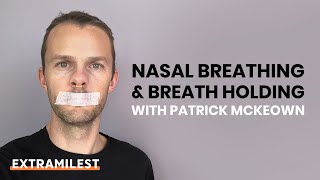
Floris Gierman explores how long nasal breathing benefits last. A BOLT score above 25 seconds signals functional breathing; lower scores mean dysfunctional breathing that raises injury risk. The two pillars are nasal breathing to improve oxygen uptake and vagal tone, plus breath-holds to build breathlessness tolerance.
Chapters
How long do the benefits of the nasal breathing exercises last? Like, is this something that you do and you're gonna stick with that and, and you're gonna see that benefit for quite a while if you've been doing that for several months? Or is it something that you have to continuously keep doing to make sure that those, those benefits maintain?
It will depend on your BOLT score. If your BOLT score remains at a pretty decent level you're holding on to the benefits. And we don't just use BOLT score, we also use the maximum breathlessness test. So the BOLT score gives you feedback of the onset and endurance of breathlessness. And it's a very simple test, you take a normal breath in through your nose, normal breath out, hold your nose, and you time it in seconds until you feel the first involuntary contraction of your breathing muscles. And then you let go and you breathe. So we want, we want athletes to be at least above 25 seconds of a Bolt score. If they're less than 25 seconds, they have dysfunctional breathing. Dysfunctional breathing equals dysfunctional movement. Dysfunctional movement equals increased risk of injury. But we also want them to have a decent maximum breathlessness time. And that's, take a normal breath in, normal breath out, pinch nose, hold, start walking, and count how many paces, what's the maximum number of paces that you can walk while holding your breath. Now it's a push. That's measuring the upper limit of tolerance of breathlessness. So to, to answer your question, it's nasal breathing during every day, and during physical exercise, but breath holding as well, and breath holding on the, on the exhalation. So nose breathing, slow breathing is improving functional breathing, increasing oxygen uptake, increasing oxygen delivery, protecting the airways, you know, influencing the autonomic nervous system, etc. Cadence breathing, for example, increasing HRV, respiratory sinus arrhythmia, stimulating the vagus nerve, all that good stuff. But then we do breath holding to push the boundaries. So we have functional breathing on one hand, that's one pillar. And breath holding on the exhalation is the other pillar. And I want people to bring it into their way of life. You know, I'm not an athlete, but I'll have my mouth closed every night. I walk down the street with my mouth closed. If I'm on a treadmill, I have my mouth closed. I do breath holding. And, you know, if I'm doing presentations to large groups of people, I want to be fully in the present moment. I don't want to have my mind agitated by distracted thoughts. I want to enter the zone. And you can do that and you can replicate that by the breaths. This isn't just about, you know, physical performance. This is also about mental performance and sleep.