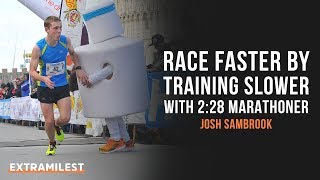
Josh Sambrook ran a 2:28 marathon while doing almost no speed work, instead running high mileage at easy paces. Only 2% of his training was near marathon pace. He also does fasted long runs to train his body to burn fat during the race, skipping fuel entirely.
Chapters
You just don't need speed work, and I can think of numerous examples of very quick runners who do effectively almost no speed work. If you look at my PB, 2:28, if you look at the training I did before then, I did roughly 2% of my training at somewhere near marathon pace. It was slightly slower than marathon pace, but 2% I did. I averaged in the 8 weeks before that 172 kilometers a week at an average pace of 4:30 4:47 minutes per kilometer. I only did 5 kilometers a week that was quicker than 4:40 per kilometer. So really, what we're talking about, like, slow, slow running here. I was running and I could chat the whole way, just steady chatting running. I am a big fan of recording. The first thing you've got to do if you want to improve is, is keep a record of something. It almost doesn't matter what you're keeping a record of at the start, whether it's your average pace in the week or your distance or the number of runs you went on, or your average distance per run, or something. Keep record of what you're doing, critically analyze what worked for you and what didn't, and build on the things that worked and ditch or change the things that didn't work. And then that is the— that's got to be the secret to continual improvement. Again, it's about finding what works for you. So what works for me and a lot of other athletes that I've worked with is doing some fasted runs. So I mentioned this, not having, substituting your breakfast for a run, which works because one of the big things that, the big problems that runners face at kilometer 35, mile 20 of a marathon, is this drop in energy, is kind of hitting the wall, is lots of different systems crashing all at the same point. One of these systems is the inability to fuel yourself. If you do some fasted runs, so maybe you do your Sunday long run without having breakfast, or for me, I often eat quite late in the day. I eat a lot, obviously, with a lot of running, but I eat quite late in the day, so I often do 2 runs before I've eaten anything in the day. You're kind of, what you're actually doing is upregulating the fat burning system. You're having to tap into your subcutaneous fat all the time, every single day, because you do a run, You just have coffee on the way to work, then you do a run at lunchtime, and halfway through that second run, you've burnt all your— you've done all your blood sugar. That's gone. You have to use your fat stores, which, when it comes to a marathon, I've now found that I don't take on any fuel during a marathon whatsoever.