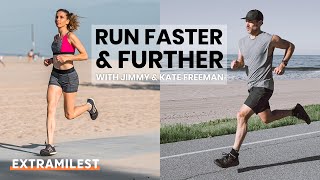
In this interview hosted by Floris Gierman, elite ultramarathoner Jimmy Dean Freeman and marathon runner‑coach Kate Martini Freeman discuss their extensive coaching experience (over 2,000 athletes) and personal racing achievements. Jimmy explains his shift from outcome‑focused pacing to a process‑orientation, emphasizing mile‑by‑mile presence, mental “war room” race planning, and the necessity of embracing unprecedented suffering, which he calls the “Hurt Locker.” Kate outlines a training philosophy built on variety—mixing pace, strength work, cross‑training, hill and trail sessions, and periodized phases that move from strength/hill focus to speed work. Both coaches highlight the performance gains and recovery benefits of trail running and low‑impact cross‑training. The conversation concludes with information about their SoCal Coyotes coaching services, community trail runs in the Santa Monica Mountains, and how listeners can access in‑person coaching or online programs via socalcoyotes.com.
Chapters
If you want to run faster than you've ever run before in your life, or further, you have to be willing to suffer more than you've ever suffered before.
Today I would like to introduce you to two of my very dear friends, Jimmy Dean Freeman and Kate Martini Freeman. They're both incredible runners and they're also really accomplished running coaches as well, and combined they have coached more than 2,000 athletes over the last 12 or 14 years, I believe it is, including myself. When I first really got into running about 8 years ago, I was looking for additional guidance and I came across the SoCal Coyotes, which is their actual running group. And so I trained with them for several seasons and I learned a tremendous amount. Jimmy and Kate have run hundreds of different races over the years. For example, Jimmy has run anywhere from a 5K marathon, 50-miler, all the way to the Badwater 135-miler. And then Kate, she has run many shorter distances and much longer distances as well. She was able to get her marathon time from a 4:59 all the way down to a 2:58. She has won 5 different 5K distances and ran the 50-miler and 100-miler as well. So yeah, recently we sat down, I invited them over at my home, and we had a deep dive into actual running into their own running journeys, into their actual coaching, and also life as a parent. They both have 2 kids, just like my wife and I. So that's always a challenge on how to combine that with personal life and running and coaching and work and all of these different things. So here are a few different clips from the recent conversation, and I hope you enjoy it.
In my later stages of coaching, you know, after about 10 years of coaching, I whittled it down to what I call, um, process orientation versus outcome orientation. And when we're really confident, what we get really focused on is mile-by-mile splits, the time that we want to run. And independent of how confident we are, you have to focus on the process. What am I going to do this mile? What am I going to do in this 10-minute block? What am I going to do in this hour that sets up the next hour? And process orientation in many ways ignores the goal. It ignores the mile-by-mile splits. It's— the idea is if you focus on what you have to do right now, if you can stay present, you're more likely to have your peak performance. And that— it's funny, especially in the 100-mile distance and, and in the marathon distance, um, when I have sometimes not even had a goal, like, I'm gonna kind of just focus on the race experience and the race process, um, my performance has sometimes come out of the blue, really surprised me. And some of my most fit times when I was confident But that confidence led me to look at, you know, I know how fit I am, I can run these splits. And, you know, each mile you're checking in, every half mile you're looking at your pace, and there's just too much mental energy put in the wrong bucket. I have a little thing that I do with many of my runners before their big A race, which is called what I call the war room. And it's a race planning session, which is as much mental prep as it is logistical, um, you know, when to take your calories, um, if it's a long, long race, what to put in your drop bags and where. Um, the idea is if you want to run faster than you've ever run before in your life or further, you have to be willing to suffer more than you've ever suffered before. Now, running by feel, um, has become a bit cliché in the running world. And sometimes running by feel in training gets collapsed by running by feel during a race. And you should always be running by feel, like you're gonna have feelings, you're gonna have, you know, biosensory feedback that you should be paying attention to. But our pain receptors, our brain, you know, are there as kind of a warning system. And when things start to feel really awful, the message being sent by your brain is shut it down, slow down, stop, you're going to hurt yourself. And in distance running, many of us know that to set your personal best, PR, PB, to do a distance further than you've ever done before, there's going to be a suffering that you haven't experienced yet. Or more of it than you've experienced before. And, you know, in the Coyotes, we like to use the phrase "Hurt Locker." You're going to have to go into the Hurt Locker and be there. And not only be there, but it's not that you have to welcome suffering, but you have to at least allow it to be the passenger in the vehicle.
My own personal training philosophy now is variety. Like, such variety where I feel like most people don't work that in enough. And what I mean by that is variety in pace. Variety in like your workouts. So I really started to get serious about cross-training and doing strength training, especially for female runners. We naturally are built with less muscle, so we have to work that. You have to have muscle to support this kind of running and the impact. You just do, you know, if you want to have, you know, longevity in the sport. So for me, it looked like increased mileage, um, increase in speed training. Most people focus on speed, but in the first, you know, part of your period— like periodization, you know, that's like how we like to train. So that first, you know, one-third of your training season, more focused on strength and hills, and then I'll transition into more speed training. So I'm lucky because I like speed training, like whatever form, whatever workout. Um, and again, as long as it's fun, you know, as long as I'm looking forward to it, it sounds good. Uh, but at the same time, I'm also somebody that will have fun if it's really hard, you know, I'm not afraid to push it and like be the one like dry heaving at the end of just a workout. You know, so, um, so what kind of strength training would that involve?
Would that be going to a gym? Would it be more like hill training? Would it be a variety of different things there?
So, uh, both. For me at that time, um, it was the gym a few times a week, so like weights, um, and definitely hills as well. So I would— I mean, I always do strength training right now. I'm doing strength training only twice a week, but ideally like 3 times a week. And maybe it's only 20-30 minutes, maybe it's 40 minutes, so it's not a tremendous amount. Um, now I've gotten more into Like I go to Orangetheory and, you know, do the circuit training, which I'm sure Jimmy mentioned too. Um, but, uh, back then I was going to a gym. So I think I was going to Equinox, um, and doing weights or classes, whatever it is, you know, mixing it up just to have that variety and, uh, you know, less impact. So, um, on those, those days I'd probably, or some of the more cross-training days, hit the pool or the bike. Um, definitely hills. Uh, I didn't really get into like hills and trails till a little bit later. So, and that's where my times really started to drop too, though. So, um, beyond like, you know, Boston times. So for me to go from sub-4 to Boston, it was specifically just more strength training with weights and then more speed training towards the second half of my training seasons.
So it is fascinating how both you and Jimmy, in your coaching approach, even for road runners, take quite a few of those runners to the trails for some of their workouts. Can you talk about the reasoning behind that?
It was honestly because we— once we both started doing it, we started seeing our times drop. So, and also motivation-wise, because running, running a road marathon, it takes, it takes a lot. Like, sometimes to recover from a 50-miler is easier almost sometimes with that impact, you know, just asphalt's a little rough. Yeah, you know, it's awesome because that's return and you're like, I'm from a hard, hard concrete versus the softer trails. Yeah, absolutely. Um, but also just purely for the enjoyment level. And I mean, if you look at, if you're training, you know, even at those times when I was training for, you know, chipping away at the 3:11 to 3:09, and then 3:04, whatever it was, you know, um, maybe I was doing trails a little bit less, but I was still doing it a lot at the beginning. And then a lot of the trails, um, on the recovery weeks, you know, cause I really started understanding like you have to take those recovery weeks very, very serious. Um, I feel like most people, they kind of lock into their pace and they stay at a similar pace, and they'll drop their mileage a little bit for step-back week. But we get so in our heads as runners and we kind of get obsessive over the numbers.
Yeah.
And I'd rather see a week that's real big and then a week that's really, really recovery-focused.
These are just a few of the clips from our recent conversation. We sat down for almost 2 hours, and I truly mean it that I've learned a lot over the years from both Jimmy and Kate. I'm quite often asked if I offer any in-person running coaching, and at this point I only have an online running coaching program available. I don't offer any one-on-one in-person meetups. However, my friends Jimmy and Kate are offering this. So for anyone who's located in the Los Angeles area or in the Orange County area and you want to drive up towards LA. They are offering a lot of different trail running classes and road running classes as well, and you can find out more at socalcoyotes.com. SoCal— socalcoyotes.com. I always butcher that. socalcoyotes.com. So take a look over there on the website. You can find out more about the bios of both Jimmy and Kate over there as well. I cannot highly recommend these guys enough. They're absolutely incredible to work with.. And so yeah, anyone who's looking for one-on-one coaching over there, go take a look. And, um, yeah, maybe you guys can find a way to work together. For any runners visiting Los Angeles or living in LA, Jimmy and Kate organize free community trail runs every Thursday, 6:10 AM, in the Santa Monica Mountains. The meetup location can be found on their website and on their Facebook page as well. I've joined them on many of their group runs, and it's a great way to discover new trails and meet other runners as well. Hope you enjoyed this video. Many more clips coming soon, and, um, I hope you guys have fun out there on your run. Later!