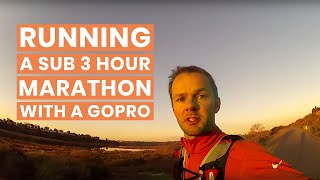
Floris Gierman runs a 2:56:59 marathon in Newport Beach while filming with a GoPro, sharing his pacing strategy, nutrition timing (gels every 25 minutes), and mental tactics like breaking the race into three phases. He uses a 6:45 min/mile virtual pacer and documents everything from his pre-race breakfast to post-race ice bath.
Chapters
Hello, my name is Floris Gierman here in Newport Beach, California. I'm about to run a solo sub-3-hour marathon and I'm bringing this little GoPro to share a few marathon running tips along the way. Hope you learn a few things. Today I'm gonna try to run a 2:57 marathon, that's a 6:45 minute mile pace. Or a 4 minutes 12 seconds per kilometer pace. I'm trying to have like a 3-minute extra there just in case, um, the course is a little bit longer when you try to run a marathon, or when you have to zigzag in between people, or it's also nice if there's a little bit of room for error in case you get it really tough at the end. Get started here. Here we go. I started my run this morning at 7:00, woke up at 6:30. That gives me 90 minutes to, uh, some breakfast, uh, get ready, put all my gear on, and, uh, warm up properly. Last night I ate a regular dinner of what I normally eat. I really wouldn't try anything different on race day or the day before. So last night I just ate a regular dinner with veggies and a steak. Works well for me. I've trained with that and it works good. This morning I just ate 3 eggs, uh, baked with a banana and some water. It's my magic formula. Try to see what works for you and just eat that before your race. First mile in 6 minutes 43 seconds. That's about right on target. A lot of people start very fast, especially at the beginning of the race. They see other people start fast, they have all their race excitement kick in, probably have done some sort of taper, so you're really hungry to run. But start slow. If you shave 1 minute off at the beginning, it might cost you 5 minutes later when you start cramping. So start slow. I'm running with a water pack for In any marathon race, I would always recommend drinking at the aid stations. Water pack is very heavy and I wouldn't recommend it, but I'm running solo, so it's the only option. Airplane! You might want to practice with some water stations just because for a lot of runners it's new to try to grab water, gulp it without choking. So, uh, yeah, maybe just set up a little table in your front yard, run by it, get some weird looks from your neighbors. Wondering what the hell you're doing. Yeah, give it a go. See a lot of runners wearing very warm clothes. I like not wearing too many warm clothes. I'm rather cool at the beginning, kind of cold even, just so later on in the race, once I'm properly warmed up, I, uh, do not overheat. This morning it was 44 Fahrenheit when I started. That's 4 degrees Celsius, so it's pretty cold actually. So I'm wearing a long sleeve. Later on I can just roll up the sleeve, wearing shorts with it as well. The 4 settings that I have up on my display are overall time, overall distance, heart rate, and average pace per mile. The third mile in 6 minutes 46 seconds. Pace per mile is a great function. It really gives you a good idea how you break down each of your miles. You can really tell that way how you're on schedule if you're trying to run somewhat of an even split. Like right now, I know I'm pretty well in range of my target goal of 2:57. Because I've run 3 miles around 6:45. Just got to keep that going for 23 more miles. Another great setting I like to use is the time alert. That was the time alert right there. That way I can tell myself every 25 minutes I should be taking a gel. Whenever the alarm goes off, kind of reminds you. When there's hills on the course, I would try to go not too fast up the hills just so you kind of keep your heart rate under control, not burn too much energy on the uphills. When you go down, you can really let go and make up some of that time. Right now I did about 7-minute mile uphill, and now I can do 6:30-minute mile downhill. So use those hills to your advantage. I have my virtual pacer set to 6:45-minute miles, and if I click now here, I can see I'm 6 seconds ahead of my virtual pacer. So especially further on in the race, you look at your virtual pacer and see if you're still on goal or not. So very handy feature. Every 50 minutes or every hour I take a salt electrolyte pill. In my mind, this helps me against cramping later on in the race. I think a marathon can be split up in 3 parts. First part is mile 1 to 13. This is really the part where you kind of have to hold back. You're very excited to race, but just hold back for a little bit. Mile 13 to mile 20, it's kind of like that really getting to work part. Focus on your nutrition, focus on your pace, on your form. And then mile 20 to mile 26, that's where the race really starts in my mind. Up to mile 20, it's just foreplay, and then mile 20 and on, that's where it is like get to work. That's where people either fall apart or where people can really run through and run a good race. I just passed the halfway point in 1:28:26, 4 seconds ahead of schedule. The halfway point is always good to kind of give you an idea where you are, how you're doing, what you need to be doing the second half. So on schedule, going to keep it going. In a race, don't try anything you haven't tried in training, so don't try any new gear No new shirts, new shoes, new belt pack, whatever. Run what you trained with so you don't get any surprises. I just finished mile 18 in 6:44. This is kind of the part where your mind starts playing tricks. Um, to run a marathon, you have to be strong physically and mentally, and mentally, I think it's pretty underestimated. Um, If things get tough, I usually start just talking to myself and just focus on the little things. Just run the next mile really good, run to the next aid station, and you'll be fine. Or just like even a little pep talk, like, are you doing good? Come on, you got this. Anyways, going well. 6:44 last split. See how it goes. Mile 20 in 6:47. One thing to accept in advance when you run a marathon is that you are going get tough spots. At some point your mind is gonna start playing tricks. You might start to feel some aching. Just take it step by step. Don't think about the long distance you still have to run. Just think about the next 500 meters or half a mile, and you're totally gonna work through it. Mile 22 in 6:46. Still on schedule for 2:57. So all good. So this is mile 22, the part where it's make it or break it. If you feel shit, just smile, laugh, slap a high five to a volunteer or someone in the audience, and you'll instantly feel a lot better. So give it a go, smile, and keep going. Mile 24 in 6:45. This is the part of the race where you have to dig deep. This is where you got to go into those reserves and really go for it. 2 miles to go and a little bit. Mile 26 in 6:46. Almost there. Just going to go for it now. Yeah! Timer stopped. So that was a marathon in 2:56:59, about 1 second off my goal, but I'll take it. After my races, uh, within 30 minutes I try to eat and drink, um, and I actually also enjoy taking an ice ice bath. I know there's no scientific evidence to show really that ice baths help speed up the recovery process, but I enjoy ice baths, so that's why I'm just gonna jump into the cold water in a second here. It's gonna be a cold one. Oh well, there we have it. Marathons can be pretty tough. But at the end of the day, it's all about having fun out there. It's totally normal to hit some tough spots. Everyone does it. It's just the mind game to get over that. As we said earlier, just break the race up in small chunks and take it piece by piece. Most important part, have fun out there. You trained really hard. Just believe in your training. Just go out there and do it. And it's totally normal that things start messing with your mind, but just stay calm and go out there. And have a good time, enjoy the journey. Alright, hope you guys enjoyed this video. Check out my blog, flottography.com, for more videos, and I'll be posting the Strava details of this run as well in a bit. Alright, happy 2015, have a good one, later.