Running the World Marathon Challenge with Greg Nance | The Extramilest Show
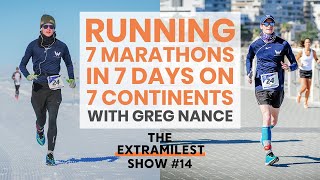
Greg Nance ran seven marathons on seven continents in seven days. He trained with heat acclimation in Shanghai saunas and parking-garage hill repeats, then battled stomach bugs and quad cramps across the Gobi and Antarctic deserts. His next goal is the 206-mile Bigfoot 200 around Mount St. Helens.
Chapters
The next day we then get a briefing on Antarctica and what we can expect, and part of that briefing is basically signing a waiver like, "Hey, I might die going to Antarctica." You have to accept that, acknowledge that, sign off on it, and then there's this big list of dos and don'ts while there to kind of keep you safe and keep Antarctica a pristine environment.
Hello ladies and gentlemen, my name is Floris Gierman and welcome to another episode of The Extramileist Show. On this podcast, I interview different guests who are truly able to go above and beyond and go that extra mile in many different areas of their life. Today's guest is none other than Greg Nance. He just finished the World Marathon Challenge. He basically ran 7 marathons in 7 days on 7 continents. And so it's an incredible challenge that he just completed, and we're gonna go through his different training approaches We're gonna go through the actual challenge and all of the different learnings along the way. All of the show notes of today's episode can be found on my website, extrememilest.com. I hope you enjoy today's conversation with Greg Nance. So where are you located right now?
I am in Shanghai. I am, yeah, I'm based here for work and yeah, it's Friday morning and I'm super pumped to be on with you, man.
Yeah, perfectly same here. Well, first of all, I wanna say congrats, man. You did it. I can't believe you finished 7 marathons in 7 days in 7 continents.
I can't either. I only know it happened because my quadriceps are so sore. That's the one proof point I have that this actually occurred.
That's good, good for you. I'm sure that Yeah, we're gonna dive deep into all of it, from logistics to training to everything over there. And by the way, I already started recording, just so you know.
Oh, did you? Great. Let me whip off the jacket here and then get slightly more comfortable. Dude, I'm really pumped. I read your— spent some time on the site this morning, read your story. Dude, I'm inspired, man. You've got a Your transformation and now you paying it forward is awesome. I admire that and I'd love to be a small part of it here. So, really jazzed.
Yeah, absolutely. I'm very happy to have you on the show. And it's funny because I was doing some of my homework as well and I was going through your website and through some of the adventures that you have ran. And you have quite some running experience on different countries, man. Hey.
I've used it as my excuse to travel. Yeah, basically look up cool places and then go for it.
Yeah, because I read 49 countries, 11 different ultras, so that's, that's quite some miles right there.
Yeah, hey, exactly. And just like you, just getting started. I mean, that's the nice part about it is you build great habits. And I've loved learning more about your ice therapy stuff because like I want to teach my grandchildren how to run and to love running. And so that that's my time scale here. So I'm trying to take care of the body when I'm young so that I've got that chance.
Yeah, absolutely, so important for sure. Well, let's take a little step back and talk some more about how you actually got into running because you have obviously been running for quite a while, it sounds like. And you have done quite a bit of hiking. Is that where it kind of started? Did you start with hiking and transition from there into running or? How has this all started?
Yeah, it begins— my dad was a 10K champ back in the '70s and '80s, so before I was born, Dad was a great roadrunner during the jogging craze.
Nice.
He's my first role model inspiration idol. I remember chasing Dad on Evergreen Forest trails outside of our home on Bainbridge Island. Off Seattle and just loving it. I always had a big smile on my face. I wasn't a competitive runner. My sports were basketball, baseball, football, soccer, tennis, and in each of those sports, running is almost like punishment. It's what the coach makes you do when they're mad at you or you haven't been working hard enough. I was always the one guy while running that had a big smile, and so I had a coach tell me, my baseball coach Mike Benz told me, "You're going to be a track star someday," kind of teasing me. It was only in high school, my senior high school, that I actually began competitively running around the track, the 400-meter and mile relay races. I kind of got hooked. I loved the element of going and competing. I liked being able to see how am I doing. Here's the clock and here's me competing with other runners, but I was always happiest actually when I was out on the trails. You noted the hiking background. I just love being out there. It's a natural cathedral for me just to be out in nature and the solitude of it all. That's really been my favorite way to run is getting off way away from civilization going to experience natural wonders.
Yeah, yeah, yeah. And then from there, did you start with shorter distances just like your dad was, and then from there on you slowly increased the distance, or—
I basically had a— yeah, I had a buddy in college that basically was like, oh, you think you're in pretty good shape, why don't you run a marathon with me? And I foolishly agreed. Here 2, 3 months thereafter, I got on a little training plan and was plodding along. I did actually better than I thought I would. I came in around 3:35 at the Chicago Marathon back in 2009. It was awesome. It was a huge challenge, by far the longest I'd ever run, but I also knew that it was a little crazy. There were so many people. I was dodging and weaving the first few miles. For me, it was like, hey, That was sort of intense. Let me actually look at other marathons that maybe are a little less crazy. I did, I think, 7 or 8 of these over the next couple of years in college. My favorite runs were those that were through beautiful areas like the Pavo-Nerme Marathon up in northern Wisconsin near the Canadian border. That was just beautiful. It was rolling hills, a little bit of more prairie and farm area. That, I just love it. A lot of open space, you can cruise, and though it's a really pretty tough course, actually a lot of hills, I love that. That gave me the idea, look, I've been hearing about these trail marathons, trail ultras. Let's look into that. I accidentally got plugged into my first. It was a 50K in the UK at the Coastal Trail Series on the White Cliffs of Dover on the Jurassic Coast. I had heard all about this as an American, studied in my schoolbooks growing up. Wanted to experience that. I get there and actually it's a completely foggy day. You can't see anything. It's okay, there's no view, but there's at least rolling hills all over these cliffs. It was so rainy and cold. It was early December 2011. Brutal, brutal experience. I figured I was in last place. I was going so slowly, but I end up finally mercifully crossing the finish line. The team says, "Wow, congrats, 10th place." I couldn't believe it. I was like, "What?" I thought I was dead last. So it, you know, I'm kind of an accidental ultra runner, but I got hooked. I just loved it so much. Love the community, love the challenge, love the training and actually the racing. And so I've been hooked since, been slowly leveling up, taking on bigger challenges as I go.
Yeah, and it's funny because once you transition from like the road running towards more of a trail running, there's also a transition that's happening in mindset. Initially I'd notice quite a bit that you still keep trying to hammer out miles, but you don't necessarily look at the pace as much as you do with road running. And especially with the hills, they just slow you down. And yeah, that's a bit of a transition right there.
Big time. And as a 400-meter guy, I was glued to the clock growing up, 'cause that's telling you everything you need to know. You're right, on an ultra with the terrain and the topography, the weather, the climate, all of this, it's far less indicative of your actual performance. It's much more how you react those obstacles, and I love that aspect as well.
Yeah, and then from there, what was some of the next races that you had an eye on? Because you did a 50K, and what was it from there that from 2011 got you going into more?
Yeah, so I did the first one actually at the finish line. I had a couple good chats and someone mentioned, hey, there's this Hadrian's Wall run. And I loved learning about the Roman Empire and the Roman Republic growing up, and so I was like, oh, Hadrian's Wall, I know a little bit about that. And there's a race and actually it's like a 70-miler coast to coast on the UK and it coincided with the week following my business school conclusion of classes. I was like, "Wow, what perfect way to celebrate finishing my business school experience here in the UK. Let's go do it." That required a little bit more training. All the while, I'm actually on the university boxing team. I'm getting a lot of fitness from that and of course we're doing some running but it's I did a lot of 200-meter, 400-meter stuff, nowhere near obviously the typical distance required to run 70 miles. In the course of that, I had a good fitness foundation to then build off of. That was the next one I did. Then I had a wonderful experience crossing the UK. It was tough actually. I ended up rolling an ankle about 20 miles in. It was my first experience really suffering with pushing through an injury and a physical setback as you go. Basically kept setting the sights. After that, I learned about a race in the Sahara Desert through Racing the Planet. I had registered, had signed up, gotten a spot. It was a 250-kilometer run.
Was that the Gobi Desert one?
This one actually is the Sahara, the Sahara run. Here was the challenge. I was in Vietnam on a little holiday. I'm actually writing a a motorcycle and I get clipped by a drunk driver actually. I go flying over the bike. I roll and I basically skin— the skin, my hide on my knees and elbows is ripped straight off. I'm lucky to have survived that at all, but the doctor says, "Look, you'll be walking again, but it's going to be tough for you to run and the idea of doing these crazy long-distance things, that's just a bad idea." I remember hearing that and just being like, "No, no, no. That can't be right." I needed to set the next goal. The Sahara run had already passed, but 10 months into the future would be this Gobi run that I could do. I signed up for 250 kilometers through the Gobi Desert. That was the turning point where I realized, look, running's given me so much meaning and it's helping me get myself back on track at a and really reinspire myself, reinvigorate myself. And so that was the first big target I kind of set, and after that I haven't really looked back. I've been trying to keep building it and grow as I go.
This race, you wrote an article about it as well, right? Quite an in-depth article. Yeah, I did. I read it earlier, and I'm blown away by a few of the things that you've experienced over there. Can you just describe, because I think this is a good leadway into like the 7 marathons 7 Continents adventure. So this race, 250K, how in the world do you train for that? Especially in those conditions as well.
It's tough, and I've been based in Shanghai for work, and so you can't replicate the sand dunes of the Gobi Desert in Shanghai. You can't really effectively simulate river crossings or rock skipping in pancake-flat, no-river Shanghai. You have to acknowledge, look, I can simulate aspects of this, but the real deal is the real deal. It's going to be way up here. I'm a big stair guy. I climb a ton of stairs. I work on the 15th floor. I'm walking the stairs up and down. I do a ton of calisthenics each morning to try to get myself as strong and fit and flexible as I can because in the Gobi, you're carrying a 10-kilo rucksack. That's really tough and then carrying 250 kilometers. You got to strengthen yourself and then mileage, putting in miles. There's a couple little hills mainly on bridges in Shanghai and then there's parking garages. I'm kind of a crazy guy as you can already tell and part of it is you basically have to embrace the craziness. It's literally doing parking garage hill repeats or being the sweaty guy in the staircase going up and down. As you go. That's been how I approached both the Gobi training and actually that formula, it paid off. It helped me power through and so I've used a lot of those elements as I train up here. 'Cause it would be easier to just be able to hit the trails hard, but Shanghai, very flat, not many trails. So you gotta make do with the environment you're in.
Yeah, yeah, yeah. So did you end up training in the sauna and getting accustomed to all of the heat? Into dry temperatures?
Yeah, I did. That was my first foray into some of my strange heat training. It's jumping in the sauna. I'm a member of a local gym. Getting in the sauna, knocking out some push-ups while in there just to kind of get warm and realize, wow, that's really, really tough. I was looking at the temperature table in the Gobi. Like a lot of deserts, it's extremely cold in the early morning and then it heats up. The sun coming up is a heat lamp and within an hour or two, you're frying right there. Then you've got a long a long day of running, and then you're going to be really cold again at night. That kind of cycle, I realized, look, I got to train for that because I'm from Seattle, a very temperate place, and I'm a little wimpy. The cold really chills me. The heat really fries me. I got to be careful to really train that up because I don't want to risk heat stroke or something really bad happening out there. That was my mentality. Break it down, what are all the big challenges I'm probably gonna face, reading competitor blogs, learning, you know, trying to talk to someone who's actually done it before, and then learning from those folks what was the hardest part for them, and then figure out, hey, how can I reduce that, how can I actually train that up so that when I face that challenge, it feels more manageable.
Yeah, absolutely. And so, when you trained for the race that you just did, what is the official name of it actually? Is it the World Marathon Challenge?
That's right, World Marathon Challenge Powered by Wentworth.
Okay, so there we go. Just want to make sure I got that right. So when did you first come up with the idea to wanna partake in this?
Yeah, so I had a friend from my days of university student government. This fellow sent me a link to a website saying, hey, you seem crazy enough to try this. I take a look and wow, this is crazy. It's 7 marathons, 7 days, 7 continents. Wow. Just seeing that, it fired me up, man, just thinking about it. I made a mental note of it. At that moment, I didn't feel like I'm not in physical shape to try something like this. I really got to get to that next level. Then looking at all the logistics and operations required, the price tag, it's like, oh, that's the next level. I got to build up to it. 2.5 years transpired from learning about it to actually being able to toe the start line there. In that 2.5 years, it was always on my mind, always pushing the rock forward to get closer to it. Both training and getting connected with a sponsor that really saw the potential in this and that was as fired up as I was and that could support me step by step by step as I made it happen. It was really like a multi-front campaign with a lot of false starts in there too, but the beauty is once Once you're locked and loaded, man, it's like the brain and the body, you're ready to roll.
Yep, absolutely. And I'm sure that this race, more than even some of these other races, it was very heavily focused on the mind. It's one thing the body, but also the mind with overcoming tough spots. So how far in advance did you know, like, alright, I'm gonna be running it next February?
I set the intention back a full year previous, and I was messaging with the race director, Richard Donovan, who's a legendary character in the ultra space. He was the first ever guy to do this way back in the day. He's a legend. I'm a fanboy over here emailing this guy asking for, "Hey, how can I make this happen? Any advice? Any tips?" He's a very, very compassionate fellow who wants to help and just very gracious with his time. That was really cool. It was specifically July where actually I had all the pieces in place, got myself registered, qualified for the spot, and then thereafter it then became full frontal. Look, I feel pretty well trained, but I got to get to that next level in order to make this happen.
Yeah, what would your training days and weeks look like? What was your volume like up until July, and what would you try to ramp it up to?
Yeah, so in July, I was training for the Atacama Crossing, which is a 250K desert run in Chile that I actually did in late September, October. And so I was already in a training cycle, getting kind of ramped, as it were. Specifically, in both a race of that kind along with the World Marathon Challenge, Recovery is super critical, like your ability to recover quickly. I made a note that my rest days are going to be easy run days basically. I was doing a number of 15, 20, 30, 35-mile long runs, nice and slow, just getting the volume going, and then paired that with— on my rest day, I'm just going to jog the 3 miles to the office, the 3 miles back, and then lots of extra stretching to build the flexibility. I wanted to basically teach my legs that there are no off days, like you got to I've got to be ready every single day because that's the model of the World Marathon Challenge. You're exhausted, you've already run 2 or 3 of these, but the next one is happening right now. I wanted to simulate that in a small way as I went. In the back half of 2018 as I was ramping up for this, I can count on just 2 hands the number of days I didn't run actually. I made a special note to slowly build it up so that I wasn't— risking injury or overuse. I felt like I was in control as I was building that up, but at the same time, I knew, "Look, I got to get the brain ready and the body ready here." Those miles, as you said earlier, were mostly pretty mellow pace, or did you add speed work and hill repeats and any of those kind of things in there as well? On the longer days, it was pretty mellow for me. I did have a number of 10, 12, 15-mile tempo runs. I live about 8 miles from downtown Shanghai, and so one of my favorite runs is throw in some fast-paced music, go put down a strong 15, 16-mile run, going down and back, snapping a couple of photos of the skyline when I get there. That was my favorite extended tempo run that would help me get into marathon pace. Then I do a lot of stairs, and I'll do those at a relatively quick pace to build a little bit of fast twitch muscle. And also just get a good sweat going too during the winter especially. Then I'm also a big fan of parking garage hill repeats. I've got— it's 3 floors of this. It's basically a big corkscrew and I'll give it hell at 8 PM, 9 PM after I'm finishing work. Go down there and it's actually downstairs at the office. I'll go knock that out and then jog it home. You got to get creative when you're living in a big city without trails.
Oh, absolutely. Absolutely. So did you mostly focus on training volume in hours, or did you look at mileage?
I look at both. So yeah, as a general parameter, I would sort of think about kind of both, because right now it's a busy stretch at work. I work as a startup CEO, and so there are a few, there are a lot of times where stuff at work is like bubbling up, and oh, I wanted to get a full, 30-miler in this morning, but actually, given how the schedule is shaping up, I might only have a 3-hour block right now. It's like that's going to equate closer to an 18 or 20-miler. I would basically use the hours as my basic constraint and then figure out the desired pace and then plug a mile value in there. It's been a particularly crazy time in startup land here, and so because of that, I haven't been as able to put in the full volume as I would usually like to going into a race, but you also make do. It meant more tempo work, it meant more stair work, and a little bit higher intensity as I went.
Yeah, right on. And then the week came that you were gonna fly out to South Africa. Yep. Because South Africa was the starting point that everyone flew into, right?
Exactly, yep.
So into Cape Town, and Then what? Walk us through some of the highlights of what was happening over the next 7 days.
It was amazing, man. They fly us in 2 days early. It's basically a big meet and greet. I was in the hotel courtyard connecting with a couple of amazing folks. My first conversation was with Michael Wardian, who is the world record holder in this event. He had run it before in a 2-hour 45-minute average marathon. Which, uh, it boggles the mind. Yeah, it really does. It really does. And it was, it was really cool. I was just picking his brain. Hey, like, tell me more about this. What are, uh, what are you expecting? And that was the first moment where I realized really the generous spirit of the community of runners. And as you get to know, there are 40 people on this trip, you get to know folks. Everyone's got their story. And there are folks that have, uh, you know, uh, Jenny, the, the grandma who's had both her knees replaced now run over 200 marathons, and she won't stop because she loves raising money for charity and showing other grannies that they can do it too. It's like, wow, that is so cool. It's amazing. It's just incredible. It's literally incredible. You connect with folks and everyone's got their story, and that little meet and greet showed me why this is just such a powerful, interesting, authentic community of folks. I'm excited to be part of it, and I want to get out there and just have the adventure of a lifetime. And that was the— that was a little bit of my mentality. I am a competitor, but I also noted the special occasion this really was and wanted to embrace it for what it was. We, uh, the next day we then get a briefing on it, on Antarctica and what we can expect. And part of that briefing is basically signing a waiver like, hey, I might die going to Antarctica. You have to accept that, acknowledge that, sign off on it. And then there's this big list of do's and don'ts while there to kind of keep you safe and keep Antarctica a pristine environment. So that was really fun. And I've been geeking out on Ernest Shackleton, Robert Falcon Scott, Amundsen since, since I can remember, literally since early boyhood, reading about the great Antarctic and polar explorers. So that part was really, really just fun to think about the the journey I'm on and the journey that I have so blessed to partake in. That was all before we get on the airplane. It's a Boeing 757, which is a nice aircraft. They fly us from Cape Town. It's a 5-ish, 5.5-hour flight down to Antarctica. It was so interesting. You see the— they have a little flight map with the airplane and where it's going. Antarctica is getting closer and closer and closer. It's surreal. I've been on a lot of flights in my life, but I've never been going to Antarctica before. I've got my running stuff on because I have to go run a marathon in Antarctica. It's that moment where it's really— I try to keep myself cool, calm, collected, but tons of butterflies, more than usual even for me. I was trying to keep myself calm, cool, collected, but I was also just chomping at the bit, ready to get out there, ready to run. That, uh, yeah, just so much expectancy. And so it was really amazing. We touched down at a place called Novo, and it's a former Soviet research station. They flattened out a little bit of the ice for a runway. We touched down, we get off the plane, and then we've got basically 90 minutes to get ourselves prepared while they, they do a final certification measurement on the course. And actually, the, uh, the fun, uh, the fun trivia here is they actually mismeasured the course. So instead of being the standard, uh, 42K, it was closer to 45 45K is what it was.
It was 3K off.
3K off. That made me feel— I ended up running up. I went out fast because I was so cold. Everyone is. I went out fast. I was able to hold the pace and I felt really, really good for most of this race. I crossed the finish line, 7th place, feeling good, and then I see 4:08. Huh? It felt like I was going faster than 4:08. Then an hour later, they confess, "Sorry, that was actually like a 45K." You just ran an ultra.
What were the temperatures running out there on the ice?
It, uh, it was actually very fortunate. So it's summer, so you have like 23.5 hours of daylight. And actually, we caught a pretty unseasonably warm, um, bit there on the coast where Novo is. And so it was just under freezing during, uh, when we actually fired the starting gun. And there was a couple moments where like the winds were howling, so it was the wind much more than the actual cold. That, uh, they got us. So I remember one moment I'm turning a corner on this big loop we're doing, and the wind hits my neck, and within moments my fingers actually go numb, and then my toes go numb. And it's like, I've just never— even spending a, a near lifetime in the mountains, a gust of wind that powerful and that chilled is a rare one. And I was wearing multiple layers, and it still chilled me to the bone just like that. So I was very, very, very lucky, as were all of us, that we didn't have colder temperatures. I think that would have made it even, even trickier.
Yeah. And then, then starts the hardest part. You finish your marathon. Yeah. You have to wait until the last people finish it.
Yeah.
And then, like, how does it look like? Because you guys are flying in a private airplane, right? That plane is with you guys the entire way for 7 days?
It's with us. So it basically, it touches the, the plane touches down in Antarctica. It's on the runway. Our big loop is actually around the runway. And so, um, in this case, it's actually quite, uh, it's really convenient. You can actually see the plane at all times. You know, it's not going to leave without you. Yeah. And the, uh, but it basically, it lands at each airport that we fly to, and then we go through customs, we clear customs, and we literally are jumping on like a little charter bus there that takes us to our start line., and then we're running the next marathon. It's like clockwork. It is tough because you finish, you get a couple hours of rest, the final folks come through, we're all tired, we're all feeling it, jump on that flight again. Actually, in Antarctica, we get back on that jet, we fly off to Cape Town, and this is really where my own race really began because I started out relatively well. My goal was Top 10 for sure, and then top 5, I can really push this. I thought at that moment, hey, I can do this. But really the wheels start coming off. And getting into Cape Town, I wake up while we're still flying, and actually I'm in a cold sweat. And you don't want a cold sweat when you're training, let alone racing. Super dehydrated. I go to rehydrate here, chugging a Gatorade, and actually it hits my stomach and it just Something feels way off, way, way off. I feel nauseous over this. Gatorade's not sitting well, which I just never experienced that before. Let me get some tea or something, drink some tea. Same deal. I don't want any of this. Water, coffee, Powerade, it's all hitting my stomach and I just feel terrible. With that, I'm still having to jump on this bus heading to the start line in Cape Town. Now instead of it being a below freezing. Now it's 100°F and we're toeing the start line and I'm already feeling dehydrated. I wasn't able to put enough fuel down the hatch here. I'm really just like, "Look, mind over matter. Mind over matter. We got this. I've run big chunks of ultras very hungry, very thirsty. No problem. Let's go do this." Unfortunately, in this case, it's just lots of nausea, big upset stomach, and what amounted to the stomach bug. Cape Town was torture. I remember looking up and I said, You're on the harbor there. It's beautiful. It's so beautiful. And that's the, the roughest part is like you're in this idyllic, amazing, uh, city and yet you're not feeling very well at all. And you watch these waves come in, you look back at the pavement you're running on, and now the pavement is, is like undulating like this. And it's just like you're dizzy. And it, you know, for me, that was the start of the World Marathon Challenge. I then had to really, really dial it in. And after making an emergency pit stop in the bathroom, tried to to dial it back and just trying to get yourself back in your zone.
That is a rough beginning of this whole journey, eh?
It was, and it's something you can't quite prepare for that. You never think it's gonna happen.
When you look back, do you have any idea what it came from? Is it from like the race excitement in combination with running in really cold temperatures? Or like what would it be, you think?
I think, so at first I thought it was food poisoning, 'cause it's like, look, I must have eaten something or drank something The doc that was on the trip who helped me actually end up finishing all this, that was his initial speculation as well, though it stayed with me and it actually was just as virulent and just as challenging the day after, the day after, the day after, the day after. Usually food poisoning, it'll hit you real bad, then you'll purge it, you'll get rid of whatever it was, and then you'll be good to go. Because of that, We settled on like a stomach bug, like a stomach flu is what it amounted to. When you're running 26.2 miles and you're flying, not getting consistent sleep, your immune system can't really fight off whatever it is. I wasn't actually able to actually really recover until 2 days after all this ended. The stomach bug, yeah, it stalked me, man. It was always with me and it made, I think, a really tough challenge. A real sufferfest for me. But it was also a chance to really go inside your mind and you gotta figure out how you're gonna power through. And that part was, I love that aspect of it. And I came to embrace the suck for what it was.
How do you do that? And even to some of the people listening, there's not gonna be many people listening to this podcast who are gonna be running a 7-marathon challenge. However, I think in any of these races, we all overcome or have to overcome certain type of challenges. So how did you mentally deal with this? How do you push through those tough spots?
Yeah, I went in thinking about all this as like, hey, it's a 7-stage ultra, was sort of my mental model. After I get hit with this in Cape Town, and actually it's like 10 miles in Cape Town too, so there's still a lot of marathon in front of me, I realized, look, Even thinking about the full 7-day deal, that's just going to crush me because there's no way I can get my mind around that anymore. Just no way. I'm suffering. I got to break this down as much as possible. What I started thinking about is, look, in 1 or 2 miles, there's the next checkpoint. At that checkpoint, I'm going to get some pain-relieving cream that I know the doc has. I'm going to put that on my quads because now my quads are cramping up because my electrolytes are down to zero because I can't hold anything down, and I'm cramped But now the cramping is the hardest part, not even my stomach anymore. I basically, I'm trying to triage between different major issues I'm having as I go. But I think about, hey, that next checkpoint, I think about how great that's going to be. I'm going to get this cream. I'm going to pour some cold water over me because I'm overheating. I'm going to sit in the shade for 90 seconds while I rub this cream on. Oh, that's going to feel so good. That was my big thought that I had. My idea for what I want to do here. That, breaking it down, helped me keep moving forward. It helped me basically to move and move and move. It was exhausting covering that mile and a half, so by the time I get there, I realize, look, I need to break this down further. There's no way I can think about the next 6 miles to the next checkpoint. That's just way too much right now. I break it down further. I said, look, how do I get to that next cove that I see a quarter mile in the distance? I'm trudging, trudging, trudging. Eventually, the COVID to the building landmark strategy is not going to work. Then there's these light poles that are maybe 75 or 100 feet apart. That became the next one. Pretty quickly, by mile 18, mile 20 on this deal, I'm in just severe pain. I'm watching as my quads are pulsing, almost like a heartbeat in my quadricep. I'm in big pain. I'm really suffering. It then literally becomes a game of taking the next step and not triggering a massive charley horse on my quad. My advice to folks that are struggling, which we all do every race, right? That's the nature of this. Find a way to break it down. Find a way to concentrate on your breathing, in and out, in and out, in and out. That was the one thing that was my pain relief, was just focusing on my breathing. It would distract my nerves from the pain I was feeling, and it helped me actually get into a bit of a rhythm. And of course, I was really, really shuffling and just trudging along, but the breathing aspect and breaking it down helped me make it through.
I think that is so well said right there, because as soon as you make the goals more attainable, it becomes less of a struggle. And truly focusing on how to fix the problems at hand, that is really what, that is the only thing you can control, right? You can't control some of the other elements, But what can you control and how can you fix it? I think the breathing part is an interesting one because I meditate quite a bit and obviously with meditation as well, you focus back on breathing and instantly once you even take a few deep breaths in and you focus on it, you notice that sense of calm almost going over you. And once you're learning how to run a bit more relaxed, even though you feel tense, it already helps relieve some of that pain.
Sure, absolutely, absolutely.
Good, and then you had several more marathons to go. Did you ever think about quitting? Did that ever cross your mind?
Quitting never crossed my mind, though I got very, very negative. So like in Cape Town and then in Madrid, so on the second and the fifth, marathons, I was in a dark place where basically I was really, really down on myself. I was so much negative self-talk. I think that's somewhere actually on the road to quitting because ultimately quitting, you're flipping a switch there. There are several steps that it takes to probably get to that moment. I think the negative self-talk, I tried to catch myself as quickly as I could and really flip it around. In Cape Town, I go from complaining about being a big baby and how are you letting this happen to yourself to trying to get more affirmational, which is, look, you've been through hard times before. You've trained for this. You got it. Just trying to get positive in whatever way you can even when you are suffering. I took that onto Perth, which was the third marathon. Actually, I had a hometown buddy who lives in Perth come out. He brought some salty snacks. I told him I'm desperate. I think Pringles and pretzels are the things I'm craving. He brought those out and actually every— it was a short loop course. I think we had 14 or 15 loops there. It's a lot of loops through there. He had snacks for me and then little various sweet drinks. I was able to get some of that down as we went. Perth actually was one of my better experiences. I had a buddy there. I was getting a little bit of fuel down the hatch. Still had a couple of emergency pit stops but felt stronger and actually felt really uplifted as I went. Actually, it was a cool night. It was a night run, which was so good after sweating bullets there in Cape Town. It's relentless, and that's the tough part about it because as soon as you're done with Cape Town, then it's on to Perth. Then you're going straight to Dubai, then to Madrid, then to Santiago, then to Miami. There is no rest for the weary. Every one of us is dealing with this. I was the guy that I think I got sick first out of everybody. Every one of us is dealing with setbacks. All of us are dealing with pain, and I, you know, I love learning from others how they were going through it. Like, I had buddies saying, hey, you're getting quad cramps? Me too. Here's what's working for me. Or, hey, have you tried this? Have you tried that? And again, going back to the generous spirit, just so many amazing folks who— they're competitive, they're world-class athletes, but they're also there to help you reach your dream too.
Yeah. It sounds like such a sufferfest. Because it's one thing that, like, everyone during an ultra has ups and downs and starts to feel low, but this is a 7-day event and after the first day you feel sick. Like, that is a rough one right there. Well, talk to me about marathon number 7. You came to Miami. What was that like, finishing this enormous adventure?
Man, it was amazing. Coming into Miami, I never thought about quitting, but I also couldn't even picture what Miami would be like during this thing because it just felt so far away. Actually touching down in Miami, getting a text from my mom and dad saying, "Hey, we're at the start line. We can't wait to see you." I'm not the most emotional guy, but I'm feeling it at that moment. Moment, just really, really, really pumped on it. I get there and I've got a few dear friends who've come into Miami. Mom and Dad are right there. I'm toeing that start line. The funnest aspect about this is my sponsor, Wentworth, has flown in 15 folks and they're all at the start line there. They're basically chanting for me. Getting me fired up. And it's just like I'm flowing with excitement about this. And I've been dreading previous start lines. I know the pain is about to come. And this one, it's like, look, I feel light as a feather right now. Let's get after it. And I even had one of the— a lady named Michelle from Wentworth. She's a runner. She ran the first loop with me. So she ends up doing a good 6 miles with me to kick us off. And it was awesome. It really felt It's like anything's possible right now. I can do this. We're going to make it happen. Then having Dad do 2 loops with me and then being able to cross that finish line with Mom and Dad to make this dream come full circle, come fully true, it was amazing. I crossed that finish line and the first sensation is champagne being sprayed on me. There's confetti, there's champagne. And the folks from Wentworth are giving me a champagne shower right there. And then there's a video camera and a big bright light right in my face. And it's 3 in the morning, by the way, so it's late night Miami as we finish this. And it's so much wonderful, great vibes. It's all these people that have been rooting for me, helping me train, supporting me every step during all this. They're right there. I've been to a lot of finish lines. Every finish line is sweet in its own way. This was a really, really special achievement for me, and I'll never forget it. It was really an amazing moment.
Yeah, I think just the energy right there that even your mom and dad came out, that must be really special.
It was amazing. They helped inspire my love of running, and so having them there was just, yeah, it was really, really amazing.
Well, yeah, wow, how good. That's definitely nice. You would have to give any type of recommendation or any words of advice for other people looking for big challenges in their life? Like, how do you— because this is not a small goal to set. This is truly like a next-level goal. Is there any words of advice that you have for people who want to push themselves higher to that next level?
Yeah, the advice that I've heard that's really been impactful for me is take the leap. In life, a lot of our biggest goals, the ones that are really, really out there, they're going to push us to become the best version of ourselves. Those are also the ones that scare us because we could fail. We could hit setbacks and disappointments. Sometimes that scares us from actually starting. I feel like a lot of the folks listening, they've taken the leap many, many times before. It's all about identifying what's that next level for you. We're all on our own journey and you got to find out what excites excites you, what makes you feel alive, and then figure out, is this something I really want to do? Once you've decided on it, start before you're ready. You've got to take the leap. None of us are ever really ready. You've got to figure out how to train, how to prepare yourself step by step by step as you go. I would say that all of us are closer to those big, wild, crazy dreams than we realize. The more that we can put ourself out there, go for it. That's how we change our life, step by step, brick by brick. Take the leap. That would be my advice. Yeah.
Wow. Well said. What's going to be the next leap for you? Have you thought of anything else after this?
Yeah, I've got— I'm always on to the next. I've been basking in— it's been a slow recovery for me, actually. I'm just now— quads are just now fully back online after a couple of weeks of, whoa, let's take it real easy because they're so tender. I've gotten back into ambition mode here, like what's ahead, what's ahead. And I've got a couple things on the horizon. So the, the next one planned for May 25th is a fastest known time attempt on Hongqiao Airport to Pudong Airport, the two airports in Shanghai. There are 53 kilometers, 33 miles apart, and I'm aiming to put down the fastest known time between the two. And so Want to do something local here. I've done the Shanghai Marathon years ago but haven't done anything really of material significance since then locally. I want to do that before I set out on the— in August, going to knock out the Bigfoot 200. It's a 206-mile race around Mount St. Helens in the Cascade Mountains in Washington.
I'm definitely familiar with that one. That's no joke, man. That would be a good one.
I'm pumped. My dad has done the 40-miler 2 summers ago, and so I'm trying to talk him into doing the 200 with me. We're going to see how it plays out.
It'll be very special to run an ultra with your dad like that.
It'll be very nice. Yeah, we've done one. We did the Atacama, the 250-kilometer I mentioned, and that was absolutely amazing. It was a stage race, so we had to share a tent. Eat dinner together each night and Bigfoot is continuous run so it'll be a little bit different but it would be amazing to be there at the finish line for each other.
Yeah. Going back to your recovery part real quick because I do find this interesting and we didn't touch on that part yet. When you get on the airplane, how do people recover in between those races? Is that, do they have massage therapists massages going on, rolling, like in what sort of way?
Yeah, so I think everyone had their own routine, but the common thread was as soon as you got on the plane, they, um, we would basically start recovery practices and then get fed and then sleep. And so like there's like a little— there's clockwork to this. And so, you know, for me, I brought my, uh, my roller, which I use every day. I brought a, uh, like a lacrosse ball that I would use to work out some of the tightest hamstring, glute, lower back, my arch of my foot and all. That's always useful. Then a few folks actually had some pretty fancy equipment here. I'd never seen these. They're these big sleeves for your legs that fill up with air and actually give you a massage. I was like, "Whoa, it's science fiction, man." I'd never even seen that. By the end of it, I got hooked. Like, one of my buddies was like, hey, you can borrow it. And so I was using that by the end there. So all of us, I think, had our own routine. But basically, as soon as you're on the jet, you're doing that so that then you can get fed once we're in the air and then hit the sack and get some good sleep. So—
Well, I'm glad you got to sleep a lot after you finished the whole thing and you're back alive again.
Yeah, exactly. I looked, I'm looking at photos, they just sent us photos from the race and dude, I look like a zombie for most of this. Just like so poorly slept, been up like vomiting all night and like just look like a zombie. So I feel way better now that I'm eating again, drinking again, sleeping again.
I can't wait to see some of those photos. You gotta send me a few so I can add some into this video and into the blog post as well. Absolutely, absolutely. Good. So you have obviously grown a lot over the years as a runner, and obviously by running many miles, by running many different races, you have grown and improved. For the different runners listening on this podcast, what are some of the key things that you would recommend? Or even if you look back at your previous self, like, what would you recommend to yourself as an early runner or to some of the other beginner runners looking to improve?
Yeah, great question. I think the biggest thread that I think on is start small and ramp up consistently. I was in a huge hurry when I was getting into this to go make it big, go do the toughest races, and I was in such a hurry. Actually, I built, I think, some bad habits in the process of that because I wasn't really focused on my day-to-day-to-day improvement. Improvements. I wasn't focused as much on building great routines and just really steady fundamentals. Instead, it was like, "Let me rush off to this next race, now this race, now this." You don't perform as well and you're also much more likely to face setbacks during the race, during training, or in recovery. It's a longer process, more drawn out. The biggest piece of advice would be be less in a hurry but ensure that you're always moving in the right direction. The way that I've been doing that now, I'm getting better. I'm still not perfect by any stretch, but I'm getting better. I debrief each race. Actually, I have a little file on my OneNote, a little software I use, and I draft out, "Here are lessons I learned during this run. Here are things that I'm actively learning as I go." That way, every run I'm able to consult, what have I learned previously? I'm like, "Oh, I would have totally forgotten that actually I need to put on this sock arrangement works best for my feet to prevent blisters," or, "Hey, that pair of This pair of shorts was excellent because of the, you know, all like the sweaty humidity. This just worked. This was a better setup, for instance. And I've got a long list of these now over all these runs. And being in less of a hurry, learning consistently, building really good fundamentals, I think that is how you get to, you know, setting that new marathon PR. That's how you hit that Boston qualifying time. That's how you jump into the ultra game if that's your interest. And Without that, I think it's a shortcut that could work out in the short term but usually doesn't get you very far in the long term. So I'm trying to— that's advice for myself as well, trying to get better at this as I go.
Yeah, that's really well said.
Awesome.
Where can people find out more about you, about your run? Is there any place online that you write about this?
Yeah, so I love sharing a little bit on my journey and things I'm learning through training on Instagram. @gregrunsfar is my handle, and I would love to connect with you, love to hear from you and hear what you're working on too.
Absolutely. I'll make sure to put a link in the show notes and everything. And then last but not least, I do remember that you had tied this race into a charity as well, right? That's right. Yep. Can you talk a little bit more about that charity?
Yes. So we're called MoneyThink, and our mission is to help students overcome the financial barriers to university. And so the way we do it what we do is we help students from inner-city communities apply for financial aid and scholarships. It's a group called MoneyThink. We've been around for 11 years. Started actually in my dorm room during college years and years ago. It's a really incredible group doing some really incredible work. I'm honored to be a charity athlete going out there trying to raise awareness, raise funds for this amazing mission. It was really, really fun connecting with competitors during all this. To share kind of my why and, you know, why I'm out here running these 7 marathons. So it's a really, really, really awesome organization. Moneythink.org is where you can learn more. Awesome.
And I will make sure to link to that as well. And I'm sure that that during the race kind of helped from a motivating factor as well, right?
100%. And that's— you asked why, you know, did you think about quitting? So I got it. I got to make this happen because this is bigger than just me reaching the finish line. There's a— there's real purpose behind all this. So that was a big big motivator, and it really kept me focused on the steps in front of me.
Yeah, great. Awesome. Thank you so much for, for your time. Really appreciate it.
Floris, my absolute pleasure, man. It was wonderful to connect and hopefully share something of interest.
Yeah, absolutely. All right, you have a good night.
Talk to you soon. Thank you.
All right, bye now. Thank you for watching. If you enjoyed this video, please make sure to give it a thumbs up and subscribe. All of the show notes of today's episode can be found on my website extramilest.com. Many more episodes coming soon. Have fun out there on your runs.
Later.
More from Floris


Ryan Hall 2.0 on Strength Training For Runners, Lifting Heavy & Trail Running




You’re Doing Zone 2 Wrong (Even If You Think You’re Not) | Scott Johnston Round 2


How to Build an Unstoppable Aerobic Engine (Even If Starting From Zero) | Scott Johnston


Stress Is Killing Your Running (The Relax Fix You’re Missing) with Dr Kasim Al-Mashat

When things get hard, say this, it (works in any race) #jeffpelletier #running #ultrarunning