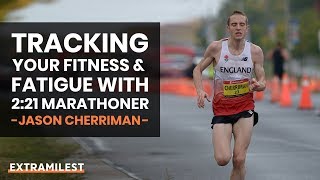
In this interview, marathoner Jason Cherriman explains how he monitors and optimizes his training using the concept of aerobic efficiency—measured as heartbeats per mile—to gauge fitness improvements. He emphasizes the importance of balancing training load, distinguishing between fitness (which decays slowly) and fatigue (which dissipates quickly), and uses a Training Stress Score (TSS) derived from heart rate data to maintain an optimal training stress balance. Cherriman relies on the Elevate Chrome extension, which syncs with Strava, to set heart‑rate zones (max, lactate threshold) and project future stress scores, helping him avoid over‑training and injury. He discusses tapering strategy, noting that a 2‑3‑week taper typically costs about 10 % of fitness but can yield a positive stress balance of +20‑25, positioning him to start a race fresh. He also references the book Running with Power and his use of a Garmin power meter, highlighting the emerging role of power data in running. Throughout, he shares his personal goal of breaking the 2:20 marathon barrier, describing the disciplined yet flexible approach required to achieve that performance.
Chapters
You know, one of the things that I really like to track is something that we call aerobic efficiency. So this is really around how many beats per minute— how many beats per mile your heart beats to cover that distance. So what it means that, you know, over time as you get fitter, you'll be able to see that you're covering the same pace, if you like, with less heartbeats. So it's like the fuel efficiency in a car, essentially. You know, if you're a Ferrari, you know, you're burning a hell of a lot of fuel. You know, but if you're a, I don't know, some sort of diesel Prius or something like that, you can go forever, you know, without burning much at all. The idea, especially where long-distance running is concerned, is obviously to be as efficient from an aerobic standpoint as possible. The secret to that is that there's actually no secret. It's just doing the miles and putting the time in and running as much as you can without stressing your body too much that's going to cause you to break down or get ill that will make you miss those sessions. It's a fine line, right, between the two? Yeah, it really is, it really is. And I see a lot of runners doing way too much. I've been guilty of it in the past. I may even have been a little bit guilty of it in this current build-up to London. It's a hard balance, and I suppose there's two aspects to it. One, there's the health and fitness aspect. Yes, I think folks could run brilliant marathons off purely aerobic distance, and they could probably return and do many marathons a year and run well at them. But then there's the sort of the peak performance side of things, and I think if you really are trying to squeeze that last little bit out, I do think you perhaps do have to push the to push the envelope a little bit and see, you know, just see how much more you can get. You know, I have a PR of 2:21 as we talked about earlier, and I'd love to get under 2:20. I think I'm capable of it, but it's gonna take an incredibly strong effort to get it, and it's gonna have to have had a a brilliant buildup that's been really consistent. There's, uh, there's a, uh, an extension on Chrome for, uh, called Elevate, um, which, you know, ties into Strava. Um, and what you will do through that is you will set up your, uh, your, your heart rate, um, uh, max, uh, lactate threshold heart rate, um, and then what it will do is it will calculate a training stress score. So basically, they look at your short-term training load and your longer-term training load to get an understanding of your, your fitness versus your, versus your fatigue. Fatigue obviously diminishes quickly, fitness less so. So, you know, what this allows you to do is to, to get— try and get a balance between the two. If you're overly fatigued and you're stressing too high, you're likely to go into a situation where you're overloaded, which is increasing the chances of, of you getting injured or ill. You know, I've certainly suffered in the past from, you know, from pushing too, too hard. So the idea to continue to improve, as much as I understand it, is that you, you know, you have to keep in that sort of optimal zone. Now, as you're approaching a race, The idea is obviously to freshen up. Now, you know, I think those numbers that you mentioned just before are particular to me and with the data that I have put into, into the extension. But the idea is obviously to get a situation where you've got a positive training stress balance, i.e., your legs are fresh, your body's fresh, you're ready to go, but recognize that you are going to lose some fitness if you, if you taper, you know, there's just no doubt about it. You know, if you're not running, you are by definition losing fitness, but thankfully your fitness hangs around longer than your fatigue does. So to get a taper right, it's about trying to manage that to hit the start in perfect shape. I was reading a book It's called Running with Power, which is, you know, there's all these power meters that are out. I see more and more of that lately. Yeah, yeah. There's a few, and I'm only using the one with my Garmin at the moment, and the Garmin chest strap. But it's quite interesting. I still think there's a long way to go with it, but there's an interesting piece in this book anyway.— he talks a little bit about the training stress balance related to power, but it's still related to heart rate as well. For a marathon, it's suggested that, you know, you— to hit a marathon in peak shape, you'll probably lose about 10% of your fitness over the 2-3 week taper period, but you'll end up in a training stress balance of plus 20 to 25. So, you know, that's sort of what I'm aiming for. And looking back at previous marathons I've done, it's been in that sort of ballpark where I've, where I've run well. So, um, you know, it makes sense to try and hit that. Uh, but the, the, the extension that you can get is called Elevate, um, and, uh, it is, it is really good because it, you know, it projects forward as well. So again, you can you know, just tweak things as you go through that, especially that last week before race day to make sure that you're not doing too much. I think from a scientific point of view, cycling is incredibly well covered, but I do think running, I think it's a bit more, I do think it's a bit more of an art than a science, and that's kind of fun too because it leaves us guessing a little bit of, you know, what is the doing the right thing and just trying to feel our way through, you know, the, the, all these questions that come up and as we go through our training day to day. So, but it's, it's fun trying to work it all out.