Triathlon Taren on Heart Rate Training for Running, Cycling and Swimming
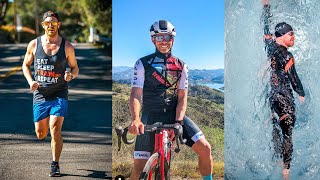
In this episode of the Extramileage Show, host Floris Gierman interviews triathlete, coach, and YouTuber Triathlon Taren. The conversation begins with Taren’s personal back‑story – a former professional curler who discovered triathlon after an injury and struggled for two years training without a plan. He describes three distinct “lives” in his sport: an early period of aimless hard training, a middle phase of inconsistent results and overtraining, and a current phase built on polarized (80/20) training with a strong low‑heart‑rate base. Taren explains how he determines heart‑rate zones, favoring the Maffetone method with a safety buffer rather than costly lab testing, and notes that swim heart‑rate targets differ because water pressure naturally lowers heart rate. He discusses the practical limits of heart‑rate monitoring in the pool and the role of power meters (Stryd) for running analysis. The interview delves into stress monitoring: using a 7‑day rolling average of heart‑rate variability (HRV) from an Oura Ring to decide when to back off, and how sleep, alcohol, and low‑carb nutrition affect HRV. Taren outlines his low‑carb, high‑fat approach (100‑150 g carbs per day, timed around intense sessions, with fiber‑rich sources to protect gut health) and its impact on performance and “diesel‑engine” endurance. He describes the Team Trainiac web‑app, which auto‑generates periodized training plans based on race distance, desired weekly workout count, and season timing, offering a low‑cost alternative to personal coaching. Finally, Taren shares productivity habits (daily journaling of three high‑impact tasks, focusing on work only he can do) and announces upcoming books on Running Foundations and Nutrition Foundations. The episode closes with a reminder to train at lower heart rates, manage stress, and prioritize recovery for better race outcomes.
Chapters
If you've got 3, 4, 5 months of solid base training where your heart rate has gradually come down on the bike and the run, and all of a sudden the endurance is really high, completing the distance is no problem, then you can start layering in some of the intensity, and that's when your body starts absorbing it. In the most general sense, people train too hard on their easy days and not hard enough on their hard days.
Hello, athlete friends around the world. My name is Floris Gierman, and thank you for listening to another Welcome to another episode of The Extra Mile Show. On this show, I speak with different guests about ways to become a stronger, healthier, and happier athlete. And over the last several weeks, everyone's world has been turned upside down by the COVID-19 virus. And I've spoken to many different friends, family members, and runners from around the world, and everyone is impacted by it in one way or another, and everyone is dealing with it differently as well. Some of the things that I'm hearing is an increase, like an elevated resting heart rate, that feeling of restlessness, some elevated stress levels. But also when people are going out running at their MAF heart rate, all of a sudden they're experiencing that they are running much slower at that same heart rate. Some athletes have said 30 seconds per mile slower, some other athletes have mentioned several minutes per mile slower. I've also heard on some of our Zoom group coaching calls that people have experienced a harder time with eating healthy and with snacking more, either because of increased stress levels or by boredom or by just being stuck at home and nothing else to do, so they just end up snacking more. If you recognize some of these things that I just mentioned, just realize that you're not alone. This is absolutely something that many different athletes experience, and it is something that we can find ways to work through as Now more than ever is a great time to focus on limiting the amount of stress on both the body and the mind. To focus on some more aerobic base building workouts and to limit the amount of high intensity and longer harder workouts. To truly focus on trying to get 8 hours or more of sleep per night. To have enough time to rest and recover. To realize and to recognize some of these signals of stress in your body. Sometimes to do some breathing exercises, some meditation, meditation or some journaling, just to write some of your thoughts on paper, and truly to focus on surrounding yourself with some healthy snacks and making sure that you limit the amount of sugar, caffeine, and processed food intake. This is a time to be flexible, patient, and kind to both yourself and to others. We're all in this together, and I strongly encourage you, especially during this time, to not let your fitness completely go out of the window, but to find some sort of way to continue training consistently. Constantly, even if that's at a lower volume, just to adjust that and get some routine back in there. Moving on to today's podcast guest, Triathlon Taren. Many of you might already be familiar with him. He is a triathlete, he's a coach, and he's a YouTuber as well with a variety of different training and racing videos. We recorded this podcast several weeks ago before the coronavirus impacted everyone's upcoming race and training cycle. And this was a very eye-opening conversation to me to truly learn about the world of triathlon training and racing. We talk about heart rate variability, about MAF training for cycling, for running, and for swimming. We talk about power meters, both for running and for swimming. And we talk about the Oura Ring, the low-carb approach to nutrition, and much, much more. If you would like to support this podcast, it would mean the world to me if you can take 15 seconds and head over to Apple Podcasts to leave a brief review or rating, and this can really help get this show in front of many more endurance athletes looking to improve. All show notes from today's episode can be found at extramileage.com/32. That is the number 32, and I hope you enjoy my conversation with Triathlon Taren.
Welcome to the Extramileage Show, Taren.
Thanks for having me. It's exciting. I love geeking out about heart rate training.
Absolutely. And I'm very excited to take a deep dive into a variety of different topics. I must say you have quite a few fans around the world. Yesterday I posted a message in the Extramile Facebook group, our Facebook group, that we're going to have a conversation. And I got a lot of great questions that were submitted. So we'll take a deep dive into a variety of topics, anywhere from heart rate training to like nutrition, your own training, your coaching business. But for those who are listening who don't necessarily know you yet, can you give a little bit of a background between how you went from no triathlon Taren to triathlon Taren?
Well, the story, I'll apologize to anyone who's heard it before. About 10 years ago or so, I was fairly unfit, fairly unhealthy. I was a former professional curler, and curlers aren't really known for being very fit. We are known for being overweight and somehow still having a sport in the Olympics and drinking a lot, and I was that guy. So I ended up getting healthy-ish through weight training and eating like a bodybuilder and a lot of boiled chicken and rice, but it didn't really stick. I lost some weight and I just kind of felt bulky, and it wasn't entertaining, it wasn't fun. Eventually, fortunately, I was trying to show off one day and do a really heavy bench press, which for me at the time was I think 225 pounds, nothing too crazy by bodybuilder standards, but it was the most I'd ever done, and I tore my shoulder. Oh, I couldn't do anything, couldn't, could not lift a weight, couldn't do a bicep curl, and like you live and breathe bicep curls when you're a weightlifter. So I started walking on a treadmill and I had to do something. So I was walking on a treadmill, maybe jogging a little bit, and then that got boring after a few weeks. So I started mixing in walking on a treadmill one day and then biking the next day, and I would go back and forth. And then one day I looked over and I went, there's a pool over there. So then I started going from the pool to the bike to the treadmill, just intermixing it, not knowing what I was doing. And eventually I thought, Hey, I'm pretty close to doing a triathlon, maybe I'll try one. And that's how it started and it instantly got me hooked because all those, like those butterflies that you feel as a kid in competitive sports, if you've ever been in that, I never felt that as an adult, but I felt that coming up to the start line and in the few days leading up to that race and I was addicted and I wasn't any good at it, but just having that excitement and that thing to build towards that was like real challenge, it really got me hooked.
And how was that first race experience for you? Because I know in marathon running everyone is like, yeah, you have certain expectations and then you go into it and you're like, well, that was nothing like it. And how was that for you?
It was awful. It was so awful. I did not show any sign of talent in my first race. I ended up finishing second, But it was 2nd out of 8 people, and 7 of the 8 were children. So, I wasn't that good at it. It was a 300-meter swim, a 13-kilometer bike, and then a 3K run. And I remember getting off the bike, and I had not done a bike-to-run workout at all in my training. Didn't think about it. And I got off the bike and boom, my legs locked up, And I almost fell over so much that after the race was over, one of the officials from the transition area came over and he said, "How'd you do when you hopped off the bike?" And I'm like, "Why didn't anyone tell me about this?" So I ran, air quotes, ran for 3 kilometers, still the hardest race I've ever done. I was like Frankenstein walk for the entire 3 kilometers. It was like every mistake that I could have made, I made.
And that's how we learn, right?
Yeah, exactly. Yeah. So I— that's how I end up coming up with ideas for YouTube videos. Like, what have I screwed up? And it's a long list.
Oh yeah, we've, we've all been there. I think it is hard to even know some of these things, even like bonking in a race. You can describe it all you want, but unless you have been there, you feel like you're gonna die. And yet you're still able to maintain after that and sometimes even pick up pace again after that. Yeah, it's, it's, it's fascinating for sure. So what was next after that? Did you start to like realize, all right, I got to put in some more consistent training to improve further? Or from there, how was the journey then?
I struggled for about 2 years. I didn't really understand how to train. I didn't understand how long a long run should be or how long a long ride should be, how hard hard should be. I didn't understand anything about heart rates and I just kind of trained aimlessly. I still just swam a bunch and ran a bunch and biked a bunch and I went from sprints to Olympics and then down to sprints and then I did some duathlons and some half marathons. I had no idea what I was doing. So for 2 years, I really, really struggled and then In between years 2 and 3, something just kind of clicked that I said, you know what, I want to see what my body's capable of. So without knowing it, I kind of just started to get a better handle on training by making my hard runs really hard, which is good, and making my longer runs and rides fairly long and just consistently push longer and longer. And something in there just sort of unlocked because I was training not necessarily properly, but I was training with more intent. I heard somebody say, don't start a workout without knowing what the purpose of that workout was. So I started working out with some purpose, and my hour and 30-minute sprint distance came down to around an hour and 12. My hour and 53-minute half marathon came down to an hour and 32 half marathon. So it was things like that, but I still wasn't elite by any means, but at least I had kind of— I at least felt athletic because I kind of had a better idea of what my body could handle.
Yeah, there you go. Yeah, I thought it was quite fascinating when looking through many of your different videos, you talk about the polarized training approach quite a bit where you have the vast majority at quite a light effort and then some of the workouts are at a quite hard and difficult effort. Can you talk a little bit more about how that was for you when you started training with that and also how that has been for you seeing that in some of the athletes that you coach as well?
Yeah, that's actually kind of interesting and I've just started looking back on it over the last month or so and what I realized is there's basically been 3, 3 lives. I've had like 3 lives in triathlon. The first was that first 2 years where I had no idea what I was doing. The second life was the next 5 years or so where I just trained kinda hard and fairly hard sometimes, really hard other times, but I didn't really understand this idea about polarized training or 80/20 training or pyramidal training, whatever you wanna call it. Didn't really understand that. And during those 5 years, yes, I got slightly faster, but it wasn't consistently faster. I would have a good year and then maybe a bad year. I was injured a lot. I was always kind of battling overtraining, and there, right at the end of it, I got so overtrained that my hormones were completely shot. I was underperforming in every race. It was 5 years of harder training but not purposeful structured training that was correct. And the third life I had, fortunately I managed to get through that, come around and get a little bit healthier and start training again. And the third life happened after that where I realized that you have to do a vast, vast amount of training at a low, low heart rate and then you sprinkle in little bits of the hard stuff. It shouldn't always be hard. It doesn't have to always be hard. Particularly if it is always hard, you are going to be doing yourself a disservice because you're not going to be making as much progress as you can. You might make progress for a year, but you're not gonna make progress year after year after year. And in this third life, I've had 3 consistent years of just almost every single race is better than the last, over and over and over. And it's to the point that some of the races that I've done, I never thought that I would be capable of going sub-10 in an Ironman, or even sub-4:40 in a half Ironman. And now I'm doing, last year I did a 9:41 in my first Ironman, and a 4:28 in my most recent half Ironman. And the only reason for that is because I've got more of a polarized training method, and my training, it feels easier than, 4 years ago, and here I am going faster.
Mhmm. Yeah. It's so fascinating.
Can you—
how would you suggest, like, triathletes to find then their right heart rate training zones for, like, swim, for their rides, and for their runs? Like, there's a few different ways to go about it. What do you feel is, is a good way that works for you and for some of the athletes you work with?
One of the gold standards to get the right heart rate is, and all your zones, is in a lab. But frankly, that's not accessible for a lot of people, so I don't really ever like recommending that unless people are very, very serious about triathlon. I like for the low heart rate ceiling that I call it, basically the number that you are gonna keep your heart rate under for 80% of your training throughout the course of a year, I like using the Maffetone method and then also erring on the side of caution. Because the reason for that is, let's say there was a time, actually this is a perfect example, there was a time that my Maffetone heart rate number was 142. But I went into a lab and my lab, VT1, my first ventilatory threshold, basically the aerobic threshold, what my actual heart rate ceiling is, was 137. Had I just trained that extra 2 or 3 beats per minute harder past my first threshold because I had gone with only the Maffetone method number, I would have been digging myself a hole and, and risking overtraining, training too hard, getting injured, getting sick. So I like to use the Maffetone method and then say, you know what, be 5 or 10 beats away from it because there's almost no penalty to training too easy, but there is a penalty to training too hard. So I like the Maffetone method to get you in the range, but then saying, you know what, be somewhere around 5 to 10 beats away from it, just comfortably away.
And that would be for all 3 sports, or would you adjust one more than the other?
I like to use that for bike and run. If anything, it might even be a little bit lower— or sorry, it might even be a little bit higher on the bike, but I like to keep it simple. For bike and run. For swim, there's not really a big issue with training too terribly hard in the swim, as long as you have decently designed swim workouts where you're not doing like, say, a series of hard 100s with 5 seconds rest in between year-round. Because the hydrostatic pressure of the water around your body compresses your body, it brings your heart rate down naturally, so it's not as hard on your nervous system. So I almost tend to say that almost all swimming is in that 80% easy stuff. The time that it does get worrisome is if you go and you're constantly training with a group of people that are 20 to 30 seconds faster per 100 than you are, and they're getting 30 seconds rest and you're getting 5. That's when it gets a little iffy because then all of a sudden your rest swims aren't really rest swims. They're all just hard all the time.
Yeah, the one question that came up like I think 3 or 4 times actually was how, how to integrate low heart rate training or MAF training for swimming. Because very often the data that you— like, even I got the Garmin Tri heart rate monitor, um, and even there I believe you don't see the actual data until after your workout, whereas on your ride and on your run, you do see it during your workout.
Yeah, it's not terribly accurate in the swim. I once watched somebody, he was a newer athlete, and he was in the pool and he was just killing himself. And he was swimming 100s over and over, and I guess he wanted to hit some sort of specific heart rate. And I saw him over and over, he would finish this 100 after going absolutely all out, and then he'd stand up, take his heart rate really quickly, put his hand on his, on his neck. And then I watched him go, "Oh, geez," slapping the water, just furious at himself. And then I heard him mumble, "I cannot get my heart rate up." And I was like, I didn't have the heart to say to him because he was a total stranger. I was like, "You're going to be here all day, buddy. You're trying to get your heart rate up into the same zone as when you're biking or running." Yeah.
Well, plus doesn't the water temperature have something to do with it as well sometimes?— like I've swam in some of these pools and it seemed definitely harder for me to get the heart rate up in there as well.
Yeah, I think water temperature, hydrostatic pressure, it all has such a huge effect that there was one time that I was water running and I was doing water running sprints, 30-second water running sprints, and I put my hand on my my jugular and manually took my heart rate, and it was 115 beats per minute going all out doing VO2 max efforts. So it's just not accurate.
Yeah. So in, in your own coaching program, you also work with many different athletes in this periodized training approach. For some people first starting out with this, It's quite a 180-degree switch to what a lot of people have been doing previously. What are, what are some of the things that you have noticed with your athletes there?
We actually tend to lose athletes in the offseason, in the base building season, from somewhere around October to January. We will lose athletes that give us the feedback that they say, I just feel like I'm not being challenged. All of this is so easy. And what we do with our plan is we tend to follow the cycle of most races in the northern hemisphere and even a lot in Australia and New Zealand where we end the season roughly around October, early November. And after that point, all of the training just becomes base building training at low heart rates and we gradually increase the amount of time that people are spending each month and each week and we're building endurance and then we start filling that time in race season with a greater and greater proportion of hard stuff. But because people are doing months and months with very little effort, they feel like they're basically going backwards. So we do get some feedback where people say, I want to qualify for Half Ironman World Championships next year, I need to be going hard now in October. And we've lost some athletes from that, and I'm sorry, but if you wanna be constantly beating yourself into the ground, I'm not the coach for you. Because I have experienced what it's like to beat yourself into the ground year round, And while it does have a beneficial effect for a small amount of time, in the long run, people can't hold that kind of intensity and that kind of fitness for very long. And what ends up happening is that your hard never ends up being hard enough to make progress because you're just constantly beat down. But if you've got 3, 4, 5 months of solid base training where your heart rate has gradually come down on the bike and the run and all of a sudden the endurance is really high, completing the distance is no problem, then we can start layering in some of the intensity and that's when your body starts absorbing it because it's not trying to A, complete the distance and B, complete a difficult workout. It can do the distance all you want. It can pump blood throughout your muscles for hours and days on end, but then we just have to start layering in the speed and that's where we get a lot of athletes that are PBing by 10, 20 minutes in a 10K run. Some athletes that are qualifying for their first world championships after 8, 9 years of doing triathlon, and they're in their first crack at it with us, and it's because you can start layering on week after week after week of good quality training without having it deteriorate your body.
Yeah, very well said. And obviously you have experienced that yourself as well when you got injured in 2017 and then changing the training method around, and all of a sudden you are able to, to train for several years without, uh, without experience that adrenal fatigue and hormone imbalances and whatnot.
Exactly. Yeah, I, I was the perfect example of why not to do that training hard all the time. It ended in such a disaster that I was lying in bed one day at about 5 PM on a Friday afternoon crying because I didn't know if I would be able to ever do triathlon again. I would train for 2 weeks and then I'd get sick and I would underperform and I got 5 colds over the course of 4 months and I had underperformed in every race that I did the previous season and I was injured and not getting any better like it was just I was a complete disaster and it was just from like really one year of training hard all the time.
Yeah, yeah, and I see that across the board. Sometimes people have to get injured first or they first have to hit that wall that they are fully gonna start looking at alternatives. And that's why I also think this training approach might not be for everyone. Some people simply don't have it in them to take 3 months or so to, to really slow down significantly, to maybe sometimes even have to take walk breaks or, or really go easy. And it is a big blow to the ego for some, for some people, even when they have always posted in a certain pace on Strava, or they have always been the one who were passing other people, and now all of a sudden they're the one getting passed by other people. However, the people that I've seen who stick with it have seen tremendous results as well. So it's awesome to hear you experiencing that with many of your athletes as well.
Yeah, did you have to walk when you first started doing the low heart rate training?
On the trails, I absolutely did. But on the flats, I will never forget the moment when I was always running around, I was training around a 7:30 pace 1-minute mile, which is around, I believe, 4:40 minutes per kilometer. And then all of a sudden I had to slow down to about a 9-minute, 9-minute, and then on the trail became an 11-minute mile or 13-minute mile. And just remembering being passed by, I believe it was a lady in her 60s or 70s that I would always see on the boardwalk, and I would be so much faster, and all of a sudden she was faster than me. I just had I just had to think to myself, like, this is all for a purpose and soon I'm gonna be able to run faster at the same heart rate and sure enough, that's what happened.
So you must get a lot of feedback from people in months 3, 4 where they're saying, like, I've been doing this for 3 months here, Floris, why am I not faster?
Yeah, no, absolutely, it does happen and I even see it with some people who almost have to de-stress first where they have a certain pace at MAF, and then they might even, because they have overtrained for so long, they even go backwards before they can start going forward. And I've seen that several times as well. But I think it doesn't only come down to the running component. It's also the, the stress component in their life, the nutrition, like how well they sleep or recover. When I see people putting in back-to-back 2-hour runs at low intensity, but they're still running 12 hours a week without the proper buildup, it's still like, you can still overtrain that way. It's, it's still all about the gradual buildup there as well.
So yeah. Yeah. Well, that, that's another entire topic that it's all the same thing that managing your overall level of physical stress from training, from sleep, from what you do throughout the day, it's all the same thing. And just taking out one piece of it being the running stress or the training stress and still having poor sleep and day-to-day stress, like, yeah, it's better than nothing, but it doesn't fix everything.
Absolutely. Talk about stress a little bit more. I think you are wearing an Oura Ring.
Is that correct?
Yep. I got one.
I almost lost it in the pool today. Really? Yeah, like literally just 2 hours ago I was walking around the pool parking lot like, oh man, I lost my ring. And everyone lost their mind around me because they're like, did you lose something? I'm like, yeah, I lost a ring. And the ladies were like, oh God, oh, let me help. And I was like, no, it's not an important ring. But I was, yeah, I was searching for it for a while.
Right on. Yeah, I've actually— mine on the left hand is a little bit loose as well. Sometimes I switch it when I'm swimming. I switch it to the right hand. Indeed, it's a bit tighter. How do you integrate some of that heart rate variability and some of this other data into your training?
I've been really fortunate to be able to work with Dr. Dan Plews over the last couple of years. For anyone who doesn't know, he's a researcher, a physiologist, He's also, he walks the talk and he's an awesome triathlete. He's the current age group Kona world record holder. He just recently won Half Ironman Taupo, the overall amateur championship there. And what's really interesting about him is that he does this while he's tremendously busy. He's, like I said, a researcher. He has PhD students that he supervises. He owns 2 businesses. He coaches, he publishes, all these things. He doesn't have time for huge, huge hours of training, but he is really, really efficient. And one of the things that he is one of the most sought-after people in the world about is heart rate variability and how you incorporate it into training. And one thing that I learned from him is heart rate variability, for anyone who doesn't know, it's just the differentiation between the beats, your heartbeats. So you want them to be irregular, not really regular. When they're regular, that just means that your heart is kind of going through the motions. So you want it to be like beep, beep, beep, beep, beep, like only beating when it needs to, not beep, beep, beep. That monotonous beep beat is not what you want. Anyway, you want a high heart rate variability. But when you start using heart rate variability, you'll notice that it's very off every single day. It varies all the time. It could be up, could be down, and you're like, well, what am I doing? It's really low today. Does that mean I change my training today and then I wait for tomorrow? That's too hard to actually create a life around that if you're constantly changing your training schedule based on— what your heart rate variability says in the morning. So instead, using a 7-day rolling average is a lot better. It ends up giving you a better trend of if your heart rate variability is going up or if it's going down. If it starts trending down, that means that you're not absorbing the training anymore. So in our case, what we do is I don't necessarily have a 2 weeks on, 1 week off, or 3 weeks on, 1 week off. What we have is keep training hard until I stop absorbing it. And when, then when I stop absorbing it, then we back off and we look at that 7-day rolling average of the heart rate variability to see if I'm not absorbing it anymore.
Yeah, right on. Are there any other tools that you use with determining stress level scores? Like for example, TrainingPeaks or Strava Summit or Elevate for Strava? Do you look at any other factors for distress or do you only look at the, the heart rate variability?
Tends to be mostly heart rate variability. I very much prefer to look at fewer things that apply to a lot of things. And that tends to make our decisions a lot more clear if there are, and I'll look at, say, The Oura Ring, for example, or Whoop, they're all very guilty of taking a huge amount of inputs and then having one output. But what I've found is that if you instead have one input that can be a really good proxy for the output that you want, it's easier to understand why you're doing one thing over the other. I think that some of these technologies, Oura is guilty of it, Whoop is guilty of it, they're taking too many variables that it's hard to start knowing what you've actually done to determine like what the outcome is. Yeah, yeah. So yeah, I do look a little bit at training peaks and the fatigue score, but I'll more look at that after the fact. Like if heart rate variability is starting to trend down, then I'll maybe look at fatigue and say, ah, yeah, fatigue is kind of low.. So, I do look at it a little bit but not a lot.
Yeah. The one part that I've noticed with the heart rate variability though is the impact of sleep directly on heart rate variability. And, I've had it where I will be editing a podcast and all of a sudden it needs to go out the next day and I go to bed at 2:00 in the morning and the kids wake up early. And, all of a sudden, I've slept 4 hours, which I've really tried lately to avoid. However, sometimes it just happens and you just see directly how hard you get dinked into heart rate variability.
It's fascinating. Oh, sleep and the big eye-opener for me is I always used to love a glass of wine at dinner and maybe over the course of a week, we'd go through one bottle or maybe a bottle would last two weeks. But even at that pace, one glass of wine will destroy your heart rate variability. It's incredible. And when you start training really hard for things, it amplifies it. So over the holidays, there were 3 days that, uh, Christmas Eve, Christmas Day, and Boxing Day, I think I had 2 wines each and combine that with still trying to train hard. I felt bad for 10 days after. So when you start riding that, that, edge of trying to have elite performance, like these small little things, a little bit of bad sleep, a couple too many drinks, a little bit extra stress, it can wreak havoc on your body. I'm astounded once you start quantifying all this, like, oh man, I got to change some habits.
Yeah. Well, plus you're a lightweight now. You're not like, like the curling Karen anymore. So that probably changes quite a bit too.
Oh yeah. Like 22-year-old Taren would drink 37-year-old Taren under the table any day.
Classic.
Yep.
Surely changes. One thing I do want to touch on, and this question has come up several times as well, is power meters for running. I hear more and more about it lately. You have some experience with this, to my understanding. How beneficial do you feel it is to have additional data from a power meter for running, like if you're already tracking heart rate?
Yeah, I— if you had asked me actually 2 weeks ago, I would have said it's nice but not necessary. We just did a podcast with Jim Vance, who literally wrote the book Run with Power, and he opened my mind a little bit. Taught me that a power meter for running can be used in a similar way as heart rate is used for running. So it, I think it can be beneficial. One of the things that I really like to use it for is on the Stryd Power Center. They used to have this, I haven't looked for a while, but they would have this, this basically a chart that showed are you doing enough speed work or enough long tempo work or enough long endurance work and like clockwork I would always fall short on longer tempo runs and my performance would indicate that actually. So it's fairly accurate I would find. Is it necessary is another question. I will always take a heart rate monitor over a power meter any day, but if you are a data person and you really enjoy understanding what is actually happening to your legs while you're running, and do you break down at 18 kilometers or 13 kilometers, or did you overpace hills, perhaps, it's a nice check-in, it's a second check-in. Rate of perceived exertion can be inaccurate. If we're talking about a bike, power meters can be inaccurate. But I think running power meters are fairly similar in purpose to heart rate, is sort of my understanding. And I think they can have a purpose. If you ask me in about 6 months, I'll probably have a better answer about how I do or don't use it.
Yeah, I, I will be honest. I personally haven't experimented with it much at all yet. And I, I'm curious to try it as well. I've, I've really been looking at heart rate quite a bit and indeed perceived effort and some of these other things. But this is one thing that it's fascinating to see more and more people experimenting with it.
So yeah, that's— Yeah, one of the, so to get right into what I really like about it is, in my case, I could see from half Ironmans that my leg spring stiffness, basically like how sturdy are your legs, are they still snappy or are they starting to getting that heavy feeling? It would break down around kilometer 13 or 14 in a half marathon and that's just an indication of you haven't ran hard enough long enough. So not enough tempo runs, not enough long runs. And if I went into the Stryd Power Center, that's what it said. So you can start looking at what your performance is and then seeing what some workouts are that will help it.
And I think it's a decent guide.
Yeah. Good.
I want to be respectful of your time. Like, time is flying over here. I got a few last questions Can you talk a little bit more about your nutritional approach? I know that you have, you've gone the low-carb nutritional approach. How has that been going for you? Like, are you feeling it's working well for you?
How are you going about this? The approach that I have to nutrition is, yes, lower carb, certainly not keto. I'm not a big believer that keto works for everyone, especially people who are training hard. What we target is in between 100 and 150 grams of carbs a day, but timed at certain intervals. So I will have carbs before a really intense session, but I won't have carbs before most of my sessions. So those 80% low heart rate trainings, I won't have carbs before them. I'll have a fat-based coffee, with some MCT oil, some protein powder, and a little bit of ghee, some clarified butter, and then I might have some peanut butter just to fill me up if I'm feeling hungry. So I'm always, if the intensity is low, trying to increase that ability to use fat as fuel, and then after a workout, I'll have carbs. What we are finding is that when I went low carb and when a lot of people went low carb, they end up kind of screwing with their stomach. So those carbs, let's say it's 100 to 150 grams of carbs, a lot of people will take it from a picky bar, an energy bar, pasta, things that are just starchy carbs. But what we have learned, particularly for me, that we have to do is those carbs have to be from fiber because if I'm not taking it from fiber, my gut microbiome ends up getting really wacky and I'm constantly hungry, like constantly, constantly hungry. So I've got to supplement with prebiotic fiber and always having salads. From my carbs, having cucumbers, having things that are very nutritious, very fibrous, a lot of volume but not a lot of calories and not a lot of carbs. And that seems to do a little bit better for me because otherwise I will put on weight really quickly because I'll just get ravenous. I'll be hungry all the time. So performance-wise, well, like day-to-day, It's been a learning process. It's not as simple as just lower your carbs and everything will be fine, but performance-wise, things have been great. I am able to go for longer runs, longer rides, not have those achy legs that feels like you're just training too long or you're failing or you're bonking. I haven't had any feelings like that in a year since going low carb, and just become a diesel engine, like you can go for forever. And I remember going for 4-hour rides last summer and nutrition was an afterthought. I fill up a couple of bottles and then I got out after the first hour and I was like, oh yeah, I guess I didn't grab any bars. Yeah, well, I'll grab some water like when I run out.
And I was totally fine. And it is so fascinating how quickly you can train the body though. And it does take some experimenting to find what is that right amount of carbs to be taken in that you feel good with. But I've even noticed it on some fasted runs where at the beginning it was quite challenging, whereas later on you'd be running for 2, 2.5 hours without having eaten anything and totally feel like it's doable. So yeah, it's fascinating how that changes.
Yeah, the very first no-carb ride that I had was only 2 hours. And I remember leaving and it was like I was jumping into the middle of the ocean without a life preserver. I'm like, I am leaving without a gel in my pocket. Like, I warned my wife, like, if I call you in an hour and a half because I'm bonking, you're going to have to pick me up. I was worried from a 2-hour ride. And this is what happens to people because The endurance nutrition industry has got us believing that we have to have carbs all the time. Now, I'm not saying take away carbs all the time, but I'm saying there's a time for carbs and there's a time to not have carbs. You should be able to go out for a few hours and not worry that you're going to be on the side of the road in a ditch.
Yeah, yeah, absolutely, absolutely. When you look at a lot of the different athletes that you have come across over the year, what, what are some similarities in, or like some commonalities in mistakes that you see in their training and racing approach? Is there anything that you feel it's like, ah, every time again I come across someone who, who does this or that, that if they make some tweaks they can avoid that?
We've talked about it a lot here. It's training too hard when they shouldn't be training hard. The easy needs to be easy and long. The hard needs to be really hard and short. And it's as simple as that. It's hard to end up coming up with a big training plan that works throughout a year when you start looking at all the nuances, but In the most general sense, people train too hard on their easy days and not hard enough on their hard days.
Yeah, spot on. Talk to me about Team Trainiac. You have developed an awesome tribe yourself and a really great coaching program.
Can you tell us a little bit more about that? Yeah, that, that was designed a couple years ago. We were getting a lot of people asking me if I would coach them. And I thought about it a lot and I thought, okay, maybe I'll become a one-on-one triathlon coach and I thought, alright, to do this really well, how much work would it take? And I kind of wrote it all out, how much work I'd want to do with somebody over the course of a month to feel like I was doing a good job and I went, I'm gonna have to charge somebody $750 to $1,000 a month to do a good job and then I thought about that the $100, $200 coaches and did some surveys, and I found that those— most of the coaches out there at that price point, at the entry-level price point, it was hard for them to give good service. It was tough because they weren't basically being paid enough to spend a lot of time. So what we ended up doing was we created— it's a web app right now So it's just on desktop, and we're soon going to have a smartphone app that all the athlete has to do is takes about 30 seconds, they sign up, they say what distance they are focusing on for the year, then from that it'll say, alright, well, if you wanna just finish, let's say you're doing a sprint, if you wanna just finish and finish okay, 4 to 7 workouts and so many hours is about what you want. But if you wanna be fairly competitive, you need about 8 to 10 workouts a week. And if you wanna be really competitive, 11 to 14 is what you need per week, and here's how many hours it does. And then the athlete can just say, all right, well, I just wanna finish feeling okay, and I've got 7 hours a week to train, so I'll choose to do 7 sessions per week. Basically, it just guides them into, How much, or what distance are you focusing on? What amount of workouts do you want to do in a week? And when are your races? And then it generates your plan for you. So all throughout the year, every single day that athletes have said that they want to do their workouts, it pops up with an audio or a video explanation of the entire workout, why it's being done at that point in the season, what the purpose of it is, if there are drills in swim, how to execute those drills. And instead of the $750 a month that I thought we were gonna have to charge, it's $57 a month. So it allows those athletes who don't feel like they're ready for a coach, can't afford a coach, or just aren't really in a position to want to work with a coach, they can still get really good quality training for a lot less. Now, is it going to appeal to those athletes who are trying to make it to Kona or make it to a world championship? We have had some world championship qualifiers, but it's really more designed for that average everyday triathlete, which is 80% of the field, and there hasn't really been a whole lot that was designed for them.
Yeah, wow, what a great solution right there, and I'll make sure to link in the show notes to that as well. So see, these days, like, your YouTube channel has grown to like 100,000 subscribers, which is absolutely— you hit it last night, which is just absolutely incredible. Congrats there. Um, how do you these days like spend your time between content creating for YouTube, then like working obviously on the coaching program, and then putting in a lot of hours into your own training as well? How do you How do you divide your time these days?
It's a lot less impressive than most people think. A lot of people think that I'm just constantly busy, constantly working. It's not the case. I am a much bigger believer that instead of doing lots and lots of things, you need to do fewer things but the right things. So most days I will only be working about— working, working, like 3 to 4 hours. And I'll do a chunk of about 1 to 2 hours first thing in the morning while sipping coffee, then I'll go and do most of my training. So I'll do an hour to a 2-hour session, I'll come back, have maybe another hour in the early afternoon, go do my second workout late afternoon, and then maybe an hour to an hour and a half after that session. Most days are kinda like that, somewhere around 3 to 4 hours a day. That is pretty much all week though. I don't really take Saturday or Sunday off. So yeah, in between like 20 and 25 hours of good thoughtful work, that's the right work that you've really thought about. And that's part of the trick is figuring out what the right work is to do and not spending time on things that aren't going to really move the needle for you. But 20 to 25 hours a week of really good, thoughtful, intentional work can go a long way.
Yeah. Yep. Yep. And it's always all about— there's so many distractions. So then indeed it is identifying what, what is that right work or what is that right thing to focus on? Is there any— do you use any personal like productivity tools or are there any things that— anything that works well to keep you on track over there? I'm just curious. Because this is your whole entrepreneurial side as well.
I don't use a whole lot of tools because again, I like to keep it fairly simple. The one tool that I would use that has been significant effect on things is I've got a journal and every day I will write down what are 3 things that get me closer to where I want to be, which is kind of like, it's just sort of a fictional thing. It's not a 10-year goal, but it's something that I say like, What are 3 things that I can do that are going to be a significant mover? And I do those 3 things every single day, day in, day out, and they can be small things. It can be a 5-minute email that I've got to craft to the right person, or a 30-minute amount of time that I've got to spend on a certain thing in our business. Something like that done day after day is really key. And the second thing that I'll say is really just thinking, what are the key things that only I can do? So podcast editing, lots of people can do that. Video editing, I do a little bit right now, my wife does a little bit right now, but for the first bunch of years we had a video editor doing that. Marketing, code designing for teamtrainiac.com, all the development work. Like, what are the things that I am uniquely good at? And fortunately, that list is really short, so I, I only have to work 3 or 4 days a week. And it's thinking like, what are the things that only I can do? And then I focus on that and try to outsource the rest to people who are better at it.
Yeah. Well done, very well done. Last thing I wanna hear from you, or actually two more things I wanna hear from you. So your books, you have already come out with Triathlon Swimming Foundations, with Bike Foundations. Are you going to be focusing as well on a running edition?
I just had to ask for that one. Running Foundations is actually being uploaded to Amazon right now. It might not be made public right now, but it's sitting there waiting. We're just building all of the landing pages and everything like that for it. And interestingly, I finished Nutrition Foundations before I even started Running Foundations, but my wife said, you know what, you really should just come out with swim, bike, then run. So we've been sitting on Nutrition Foundations for a while as well. So those will be out, um, uh, Running Foundations will definitely be out within the next couple weeks. And nutrition foundations probably within the next 2 to 3 months.
Awesome, awesome, good. And where can people find out more about you, Taren?
Fortunately, there aren't a lot of Tarens around in the world, so if you look up Triathlon Taren anywhere, T-A-R-E-N, I didn't have to fight for any of those domains anywhere, so our website, our YouTube channel, our podcast, Instagram, Facebook, The books, everything is Triathlon Taren, T-A-R-E-N.
Perfect, and I will still link to it in the show notes as well. And I believe I found you on Strava as well a few days ago.
So there's a—
Oh yeah, I'm there too, yeah. There's that. Do you have any final suggestions for triathletes looking to improve their performance?
Anything in closing you would like to share? Well, considering what we talked about before getting on, that not a lot of triathletes are tuning into your podcast just yet, and this might be their introduction to you, I'll say the same thing that you and I have talked about, and it sounds like you talk about with a lot of your guests, it's to train at a lower, lower heart rate. Just relax. I know we're triathletes, and we like to challenge ourselves, and we wanna feel like badasses, but it's counterproductive to your health and your performance. Chill out and you'll have a much better time in the races and in training.
Very well said. Taren, thank you very much for sharing, and I hope we continue the conversation again down the line.
Yeah, thanks for having me. This is fun.
I love geeking out about low heart rate stuff.
Yeah, good stuff. Thank you for listening. If you would like to support this podcast, it would absolutely mean the world to me if you can take 15 seconds and head over to Apple Podcasts to either leave a rating or a review. You might be thinking, oh, someone else would be doing this for me, but you can truly make a difference here to help get this podcast in front of many more endurance athletes looking to improve. I would love to hear from you. What was one lesson or key takeaway from today's episode? Please let me know in the comments on YouTube. All of the show notes from today's episode can be found at extramilester.com/32, and there are many more episodes in the works. For example, next week I'm sitting down with YouTuber Kofuzi from Chicago, and we're going to be talking about his overall running journey and his experiments with methanol. Training as well. Much love to each and every one of you out there, and please be safe.
Take care now.
More from Floris


Ryan Hall 2.0 on Strength Training For Runners, Lifting Heavy & Trail Running




You’re Doing Zone 2 Wrong (Even If You Think You’re Not) | Scott Johnston Round 2


How to Build an Unstoppable Aerobic Engine (Even If Starting From Zero) | Scott Johnston


Stress Is Killing Your Running (The Relax Fix You’re Missing) with Dr Kasim Al-Mashat

When things get hard, say this, it (works in any race) #jeffpelletier #running #ultrarunning