Garrett Lord on Building Handshake and Shaping the Future of Careers with AI
In this interview, moderator SPEAKER A talks with Garrett Lorde, CEO and co‑founder of Handshake, about his personal background, the origins of Handshake, the tactics that grew it from a handful of university pilots to a platform used by 92% of U.S. higher‑education institutions, 22 million students, and every Fortune 500 company. Lorde explains how a combination of relentless on‑the‑road sales, timing luck, and a clear value proposition for universities enabled rapid scaling and a $10.5 M Series A raise. He then details the creation of Handshake AI, a new business line that leverages Handshake’s massive network of PhDs and master’s students to supply expert data for frontier AI model training. The conversation covers the separate organizational structure for Handshake AI, hiring philosophy, and Lorde’s view on how AI will reshape careers, emphasizing the importance of AI‑native skills, the rise of gig‑style knowledge work, and the eventual disruption of traditional job boards. The interview ends with quick‑fire personal reflections on leadership, what keeps him up at night, and advice for aspiring founders.
Chapters
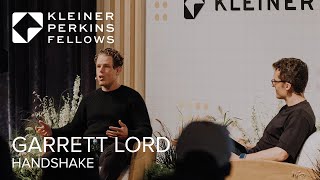
Hi everyone. I hope you're all doing well. I love this event every year. This is one of my favorites. It's a time to get the fellows and the fellows community together and talk about some of the war stories and recent accomplishments and I'm sure some flavor of AI this year. But the intellectual horsepower in this room is next level and I'm just so thankful we have such a community like you guys to do that. So another part of my, the reason why I really like this event is that we get to hear from amazing founders and one founder that I have long admired is Garrett Lorde. Garrett is the CEO and co-founder of Handshake, which is— I'm sure a lot of you know it at this point, but it's the leading, uh, career platform for Gen Z. It is a thriving business, 700 employees, hundreds of millions in revenue, ridiculously happy customers, um, and it also has a new business line as of this year called Handshake AI, which is probably one of the fastest growing businesses I've ever seen. So there's a lot for us to dig into. I think you're really going to enjoy this conversation. So, uh, with that, let's dive right in. So Garrett, maybe to start, to set some context, you're from the Midwest. Actually, show of hands, who's from the Midwest here? Do we have any? Okay, so we have some kinship. Nice. Some kinship in the audience. Tell us, and by the way, I'm from Ohio, Garrett's from the less cool state of Michigan. Tell us about growing up in Michigan and how that led to the Michigan Tech for university.
Yeah. Yeah, so I grew up in Metro Detroit. I grew up in like a working class family. Dad's in construction, like nothing really to complain about, but I went to community college for 2 years. Paid my way through school fixing and repairing computers, mowing lawns, valeting cars, and then I've always been a nerd, like I was really into programming like most of you are, and the most affordable school to go to was Michigan Tech. It's also very outdoor focused, I love to ski and hike and bike, so I went to Michigan Tech, and that was my story in Michigan, and I think my story of breaking out of Michigan was a lot of the reason I started Handshake. By the way, show of hands, who's heard of Handshake in the room? Awesome, cool, that's great to hear. Yeah.
Awesome. So, though, someone told me that the idea from Handshake actually came from an internship that you did at Palantir when you were at Michigan Tech. Is that true, and how did that come to be?
Yeah, I, so one of my good friends in school, actually the co-founder of XAI, Ross Nordin, pretty crazy, go Michigan Tech, he got an internship at Los Alamos National Labs. Which is, for those of you who don't know, it's like there's 3 national labs that basically make sure that, their core focus is basically make sure the nuclear stockpile can work. So back in the day, they had the largest compute clusters on the planet. They were, I think, number 1, number 2, and number 3 in the world at supercomputing at the time. And they had this high performance computing internship. And Ross had gotten an internship, this buddy of mine, at Los Alamos, and referred me in as a freshman. So I drove my old Jeep across the country from the Upper Peninsula of Michigan to Los Alamos, New Mexico, where it's a highly, like, securitized facility. So if you, like, take the wrong road, which I did in my internship, like, there's, you know, armored personnel carriers there, because they're worried about spies and other people breaking in. So it was, like, an epic internship. I didn't really travel much growing up. Like, it was great, but I didn't really leave the state of Michigan. So going to Los Alamos for this internship was just incredible. And then I met a bunch of kids from these amazing schools, like most of you guys are probably a part of, like Stanford and MIT. And they had talked about working in the Bay Area. And so I really set my sights on— one of the PhDs there said Palantir was the hardest internship to get. And so I started reading all about Palantir and researching it. And I applied. And I'm a kid from Michigan Tech, so nobody looked at my resume. And so I started cold emailing recruiters, and like most of you guys, hustling down trying to get an interview. And I remember then I broke out to Palantir, but the interview process was like, it was very validating for my family in Michigan. They pick you up in a chauffeured car at the airport. My dad's like, "This nerd shit's really working out for you. Chauffeured car at the airport? You're grounded for being on the computer all the time, and now you get picked up in a Cadillac." So I got this internship at Palantir, and then I started referring a lot of my friends from Michigan Tech to Palantir. And they would pay you like $5,000 to $10,000 to refer your friends. And I met out here, like people are starting companies, you know, there's like the Kleiner Perkins Fellows, and you know, there's all these incubators, and people would start about talking companies, so I was like, well maybe I could start a company that makes it easier and more fair, depending on what kind of, regardless of what school you go to, to be seen. You know, there was a couple big problems that I had thought about, like one, we didn't have access, so like the best companies, They couldn't afford to get to Michigan Tech. Why would you fly out there? There's only like 200 computer science graduates per year. So they couldn't afford to get there. And even then, there's really smart students, but if they waited at the career fair, Palantir, people didn't know what it was. Literally, it would be called— people used to pronounce— I was there when it was like 200 people would say, it's like, what's Palantir? They wouldn't even walk up to the booth. Students wouldn't know that Palantir is a cool company. So there was a huge access problem depending on what school you went to, and there's also an information problem. And that's really what the kind of foundation of Handshake was about. It's like leveling the playing field for students in America to launch their way into dream jobs.
So bring us back to that moment. You have this idea. You're a student at Michigan Tech. How do you go from that to convincing universities to effectively hand over what is their most important institutional outcomes, which is getting their students jobs, from an unknown startup? How does that even begin?
Well, it's not sexy. I mean, how did it begin? We started working on Handshake. I used to read— back then, there wasn't a ton written about entrepreneurship. So there was Paul Graham, iconic blog. And then Peter Thiel taught his first class at the Stanford Startup School. And so I watched all of Peter Thiel's Startup School videos at Stanford. And they were like, you've got to talk to customers. That's the way you build a company. So we started driving to all these schools. Well, first we were like, we want to build a job network. We want students on one side. And employers on the other. And we're like, we'll try to go direct to consumer. We'll try to get our friends to sign up. We'll try to get employers to sign up. But nobody really took us seriously. So we're like, well, this is not working. How do we get to scale at building this marketplace? And we really realized that universities were a critical part of that. Because the universities are focused on getting their students jobs. And they could be this immense distribution partner at acquiring and helping us acquire all of their students, and then also helping fill up the employer side of the network. So we got really fixated on— We have to build software for universities. Today we power 92% of higher education. And the universities, getting them to sign up, really was like driving around in our car. We bought this Ford Focus because it had good gas mileage. We didn't have enough money for plane tickets. And I would just drive from Michigan to North Carolina to visit Wake Forest. And then I would drive to University of Florida. And then I remember driving up to Princeton. We drove all the way to— Colorado College, and we would just, you know, we'd sleep in the back of our car, in the back of McDonald's parking lots, 'cause they were well lit, and we kind of, we really realized, it was hell or high water. We either needed to sign up customers or the company wasn't gonna work. And getting in person was super, super helpful to building this trust and building this relationship and figuring out what features we needed to build Luckily for us, 5 schools took a bet on us. Yeah.
And did you feel like once you had the credibility from those 5 schools that things started to fall into place, or was it kind of a grind for many years?
It was a grind for many years, but a lot of times too you get a little bit lucky. We happened to be at the right place at the right time. And I say that because a lot of people aspire to build companies. We'd been building Handshake for 3 and a half years. and when we graduated, I mean building, we were in school, right? But, and we had 5 schools signed up, and the year that the 5 schools signed up, right around that spring season, one of our leading competitors bought another one of the companies, and they forced a migration from one of the systems to the number 1 system. And so that really opened up an opportunity for us to sign up, we ended up signing like 55 more schools. So we went from 5 schools to 60 schools. Without that moment of these two companies being merged and bought, we would've never had the demonstrable growth to then go out and raise a round. That's when we raised $10.5 million from Kleiner. But had we not had that growth, this would've been seen as a small ed-tech player that wasn't venture-backable. So much of you get lucky, or maybe you're like, what are those lines? You're prepared to get lucky, right? But we had been working very hard. A lot of times, like, some macro event really helps shape your trajectory.
Amazing. So I want to make sure there's time to talk about Handshake AI, but maybe before we do that, just to help the audience understand, like, the scale of Handshake today, you started with 5 universities. How many universities are you in today? Slash, how much of the Fortune 500 do you guys work with today?
Oh, we work with 100% of the Fortune 500. Um, there's a million employers on the network. Uh, we are growing extremely fast in Germany, France, and the UK, and becoming the dominant platform for young people over there. There's 22 million people that use Handshake, and we partner with every university other than, you know, most universities. We partner with 92% of the universities in the country, community colleges and 4-year schools. Wow.
So the reason I wanted to set the stage for that is because usually when your core business is working so well, and it's compounding, and you have a great team, and you have these really happy customers, usually you don't start another business inside of that, and that's exactly what you guys did early this year, and it's seen wild success. Can you just talk about like what was the catalyst for Handshake AI?
So we are inherently like a marketplace, right? There's employers on one side and students on the other, and the real asset we have is like scale with both those sides. And we started to see players, human data players, that were main, you know, the, the, uh, you know, Surges, the Scales, the Mercores of the world, like we're trying to recruit in our network. And we really started to realize that as Frontier A models moved from— most of the gains came on the pre-training side of the house. And then about 2 years ago, most of the gains started to come from the post-training side of the house. Reinforcement learning with human feedback. And we started to see that more and more of the shape of data that these labs would want to buy was moving from generalists to experts. So it was moving from international labor arbitrage of, lower-cost talent in the Philippines preference ranking post-A or post-B to PhDs and master's students and experts in accounting, law, medicine, finance, biology, chemistry, you know, material science being needed to like shape the frontier of these AI models. And we, you know, in structurally, just like from the outside, I mean, I'll talk about structurally and then how it happened. Like structurally, it's like there's no real moat in those businesses. It's basically like a massive operational challenge. You're like, spend a bunch of money. Like, how does Merck work? You like You spend a bunch of money on performance marketing, and then you take the people, you vet them, and you sell them to the labs in your— and you have to apply a ton of operational expertise, but there's no real moat. It's just like brute force to build that pipeline. And we really realized that we had a massive advantage, a customer acquisition advantage, a network effect around having so many experts. We have 500,000 PhDs. We have 3 million master's students. We have basically in every esoteric academic domain in the world, we have more access to these people than anyone else does. And so it actually started at the Kleiner Perkins holiday party this last, I think it was October or November, where I walked in with my wife and the first person I met was a researcher at an unnamed lab, I'll leave it unnamed, and about 20 minutes in the conversation I told my wife that she needed to go meet friends and that I was gonna be unavailable the rest of the night, and I like pinned this dude down for like 2.5 hours at the Kleiner Perkins holiday party because he was telling me exactly the shapes of data that the labs were gonna be buying in the future, how reinforcement learning environments were gonna evolve, how post-training teams were structured and worked. And so by Christmas and New Year's, and you know, now we, we will, we'll go from zero to, you know, far over $100 million where, you know, went from zero to $50 million in a quarter in this business. It's been just like completely on fire.
Wow. So when you're seeing such hyperscale and use this, this poll, the market poll from Handshake AI, how do you think about team building and like how do you design the org, especially given this is a business line within the broader Handshake?
Yeah, I was pretty excited to run back starting a company again. Your job has evolved. Shoaib talked about being involved in product. It's epic as a founder. But it's just, now we have 600 people in our core business, your weeks evolve to weekly business reviews. And everyone, you walk down the hallway and people part ways, because they're nervous. It's not as cool as being like, in a room with 10 people just grinding and doing all the work yourself. So I was super excited to run back starting another company. And I wanted to do it with a lot of the lessons I learned in building Handshake, the things I wish I would've done differently. And so it's a completely separate team. Everyone that's on the team just works on Handshake.ai. So that was one. And we have a separate set of values, a different spot in the office. We're actually renting our own separate office space. And over time, the connectivity between both businesses will come more together, but right at the very beginning, you just didn't want to stifle innovation. And I guess an example of that is we hired somebody, just to make it tactical, maybe for what's like operator tips. It's like we have to instruct all these PhDs on how to perform these tasks. And we have to put them through this pipeline and training and mock tasks. So I hired a head of learning and development, this PhD woman who's incredible, Magdalena. She leads our training team. And she starts day one, and the core business is like, she gets like 8 Slack DMs. I run training for our university business. I run training for our employer business. We have these training tools you can use. And it's like, actually, Magdalena, I don't want you to talk to anyone in our core business. You don't need to integrate with the single sign-on system. You don't need to use existing tools they use. Clean slate. You're 10 people in a room. This is, go nuts, right? We don't need to worry about security. We have our, Rupar, head of security, like, can I understand the overall security environment? And it's like, no, no, no, no, fuck the security environment, all right? Get this out. Just keeping it real. And so you try to encapsulate that. And so that's one, is keep it separate. And two is I've really learned a lot that teams are built on— you watch basketball. It's like there are two players that put up most of the points in the game, right? And so it's like, how can you— build a team of the most talented people and give them incredible economic upside to found a company inside of your company. So I recruited several leaders from these very prominent human data businesses who were extremely excited to run back a differentiated frontier human data factory inside the company. And now we've grown and we went— We started with 3 people in early February, and I think probably number of signed offers are probably over 100 people right now. So it's been a lot of growth, but it's been fun.
Wow, amazing. And then maybe for the folks in the audience, given I imagine most are still young and have their whole careers ahead of them, has your proximity to the bleeding edge of AI, how does that inform how you think about AI's impact on careers and where— maybe people should be spending time?
Yeah, I mean, um, what we're hearing from a lot of our companies, like, as relates to like their hiring trends, is that like, you know, it used to be not too long ago, maybe 10 years ago, where like people got jobs because they knew how to like use Google Search. And maybe we're, we're not quite old enough where that was a thing, but you like literally put that in resume, like, I know how to use Google Search. And I think people, young people, everyone in this room, and especially like high schools and college students right now, it's like this is a daily part of their life, right? Like, they're just so AI native from day one. They know how to write great prompts, they know how to integrate tools, like, they know how to spin up, you know, they know how to use like lightweight coding tools like Lovable and v0. And so it's like, you know, what we're hearing from a lot of companies is that it's kind of the school of have and have-nots. Like, it's— they want to hire the marketer who can like use tools to build the creative, use tools like programmatically run advertising campaigns and pull all the reports all by themselves. It's one person that used to be like 4 people. So I think a lot of young people will be successful who are like extremely, uh, competent and like know how to leverage this like Iron Man suit you can build around yourself. And then I think there's a lot of jobs that will become like, you know, irrelevant and like, you know, radically displaced as companies try to drive towards, you know, better, better margin profiles and have less headcount. I also think there'll be a whole world of like knowledge worker gig work. If you really take like a 10-year perspective, it's like agentic supervision, like safety use cases, like fine-tuning specialized smaller models. Like we are in early, early innings and And that excites me for all like the advantages we have in our core business, right? It's like, how can we build like the best job matching marketplace on the internet? Like, it's probably like one of the— it's the allocation of human labor in like the knowledge worker economy. It's like a massive problem. And if you think about it today, it's like most Americans like log on to like Indeed. It's like, go visit Indeed. It's just a search box. It's like, you know, software engineer, and then it's just a list of jobs. Like, that is going to be totally revolutionized. And then hiring managers, like, it sucks to be a hiring manager. You're going through like 130 resumes, like, trying to point out things you want the recruiter to focus on, and like, only recruit from these companies. Like, I think that will— there will be so much AI that affects the end-to-end productivity and matching, and ultimately helps people find like more fulfilling work that's more aligned to what they're good at, and helps companies like find great talent.
Yeah.
And that's what we're— that's what we're very much— we're building— we want to build like the marketplace that takes down LinkedIn and Indeed. Like, the longer-term narrative is like, you know, hopefully a 100+ billion dollar, like, the de facto place that knowledge workers on the internet come to find jobs, to learn skills, to monetize their skills either through contract work or through human data, but that's the ambition.
Amazing. Before we end on this AI piece, I've heard you've done some extreme things to get in front of candidates. Would you mind sharing an anecdote or two and, you know, why you stay so deeply involved in hiring despite Handshake's scale?
Yeah, like, I mean, hey, anyone in this room, like, I'll happily meet, happily talk to you. We're trying to hire a ton of people, so just email me, Garrett, at JoinHandshake, or I give you my cell phone if you want to talk. Like, definitely trying to hire really talented people, so I will go, I'll go hard at anyone here too. Uh, but I mean, what's the story? Like, there's this guy that lives, you know, well, I mean, one story is like every single day between 2 days before Christmas, all the way through New Year's, I was on plane rides trying to chase down people to work in this human data business. It's like, now it's working, 'cause my mother-in-law was like, "Why are you doing this? This is crazy with your pregnant wife." And I'm like, "I promise it'll work, and this quarter we'll blow through $100 million." So it's like, definitely worked. So you gotta like, you have to work hard, and you have to be willing to make sacrifices. It wasn't easy. Flying every single day between Christmas and New Year's, like flying out of Arizona, like flying to New York. Like, it sucked. It just like, it's not fun. But sometimes you really have to put in that hard work to make it happen. And I don't know, like funny stories, like one fun, the one that Moon loves, is like chasing a guy because he gave me an hour on his 30th birthday in New York. So I like red-eyed to New York to meet him for an hour. We ended up hiring him, which is huge. But I like that principle of like leaving nothing to chance. And I think that comes from how I grew up. I witnessed my dad drive his 300,000-mile, 15-year-old Ford F-150 pickup truck to recycle the refrigerator or install it in a low-income home. I grew up around— So I'm living a dream, and I might as well go as hard as I possibly can.
Amazing. I love that anecdote around— bashing into someone's 30th birthday party and then recruiting them thereafter. That's amazing. Okay, so let's end with a quickfire round here. Maybe to start, what's your favorite thing about what you do as the CEO of Handshake?
I love hearing the awesome stories of people finding great jobs. I love the look on a PhD's face when he's teaching a class for $22 an hour and we just paid him $235 an hour. Have you seen the look of a PhD's face when you pay him $235 an hour and the best job he could do before was DoorDash or teaching Physics 101 for the 15th time, it's pretty epic. I love like the real value add to people.
Amazing. Uh, question 2: What keeps you up at night besides your new baby?
Um, I think taking advantage of like just this like totally new playing field that's being built on the internet. It's like if you're willing to work for it right now— I've been running this, you know, it's my only job I've ever had, right? I was only ever an intern at Palantir. And there are gonna be some just ginormous, defensible, massive companies. And I think a company, the cool thing I think about is like, it's, you know, I didn't come up with this, but it's like, you can do good in the world either through like a nonprofit or a company. And like, I believe the best way to like make an impact in the world is through delivering like something that helps the world through a company. And that's what's cool. I think it's cool that Handshake one day, I hope, has like 5,000 engineers. And those engineers wake up every day helping real people find a better spot in the economy that's more aligned with what they want. Seeing firsthand the impact on my uncle who just found a new job. And he went from miserable, got divorced, to in a cool job, relocated, and he's full of life. It's his confidence. So I love the impact.
Awesome. And then last, say you're— there's a younger Garrett sitting in the audience today. What advice would you have for him?
I love show apes. Like, go big. Like, what do you have to lose? What advice? You know, you're the sum of the 5 people you hang around with. Go big. Do something meaningful in the world that actually moves the needle.
Yeah.
Like, work out every morning and try to sleep.
I don't know. Easy enough. Well, guys, I'm really excited you got a chance to hear from Garrett. Garrett, if there's one word that comes to mind besides brilliant and humble and hardworking, it's just he's a force of nature. And I think he's proven that sometimes running a company is hard, but if you keep pushing through, you can build amazing, amazing companies and outcomes and deal with people you love and contribute immensely. So I'm really grateful for you to be here and to have a chance to talk to you. And I know others are too. So thank you very much. If you can join me in a round of applause. [SPEAKING CHINESE]
More from Garrett
This Entrepreneur Made A Job Site That College Students Are Using Instead Of LinkedIn | Forbes