Inside the expert network training every frontier AI model | Garrett Lord
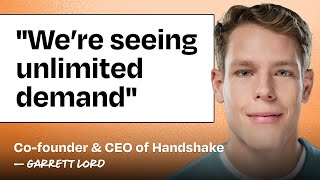
Garrett Lord, CEO of Handshake, explains how the company trains frontier AI models using data from 18 million users and 500,000 PhDs. He describes how AI will replace resume review with skill-extraction tools and work simulations, and shares his path from sleeping in his car to building a labor-matching platform.
Chapters
There will never be a time like this. I've never seen anything like it. I doubt I'll ever feel anything like this in business again, where there's unlimited demand. How do you make sure that 3 months from now, 6 months from now, you have like no regrets? Get on the plane to go talk to a customer. Make the late night push. Check the data 6 times over again.
Your company creates new data to continue advancing the intelligence of models. This is a business that you built on top of a business you've already had.
We're the largest expert network in the world. We have this massive strategic advantage, which is like no customer acquisition costs. The only moat in human data is access to an audience.
You guys come in after the model's trained to tweak the weights based on additional data that you've created.
The models have gotten so good that the generalists are no longer needed. What they really need is experts.
There's this tension between all these students training models to become smarter, and then there's the— they will have a harder time potentially finding jobs.
That's not what we're hearing from our employers. This is just enabling human beings to be even more productive. You used to put like Google search on as a skill on your resume because you like grew up with Google being like AI native. Young some people are at a huge advantage.
Today my guest is Garrett Lorde. Garrett is the co-founder and CEO of Handshake, which is one of the most interesting and incredible AI success stories that you probably haven't heard of. Handshake has been around for over 10 years. They're essentially LinkedIn for college students. It's a place for students to connect with companies to find a job. They are the platform of choice for every single Fortune 500 company. Over 1,500 colleges, over 20 million students and alumni, and over 1 million companies use them to hire graduates. At the start of this year, Garrett and his team realized that their huge proprietary network of students, including tens of thousands of PhDs and master's students, is extremely valuable to AI labs to help them create and label high-quality training data. So they launched a new business, From Zero to One, in January. 4 months later, they hit $50 million ARR, they're now on pace to blow past $100 million ARR within just 12 months. They'll exceed the revenue that they're making with their decade-old business in under 2 years. This is a truly incredible and rare story, and one that I think a lot of teams can learn from because AI is creating a lot of opportunity, but also a lot of potential disruption. And this is an amazing story where the company basically disrupted themselves. This episode is packed with insights, including a primer on what the heck are people actually doing when they're labeling and creating data to train models? A huge thank you to Garrett for making time for this. His wife just had a baby this week. He's also in the middle of scaling this insane new business. So thank you, Garrett. If you enjoy this podcast, don't forget to subscribe and follow it in your favorite podcasting app or YouTube. Also, if you become an annual subscriber of my newsletter, you get a year free of a bunch of incredible products, including Lovable, Replit, Bolt, N8n, Linear, Superhuman, Descript, Whisperflow, Gamma, Perplexity, Warp, Granola, Magic Patterns, Raycast, ChatPRD, and Mobbin. Check it out at Lenny's newsletter.com and click bundle. With that, I bring you Garrett Lorde. This episode is brought to you by CodeRabbit, the AI code review platform transforming how engineering teams ship faster with AI without sacrificing code quality. Code reviews are critical. But time-consuming. CodeRabbit acts as your AI copilot, providing instant code review comments and potential impacts of every pull request. Beyond just flagging issues, CodeRabbit provides one-click fix suggestions and lets you define custom code quality rules using AST grep patterns, catching subtle issues that traditional static analysis tools might miss. CodeRabbit also provides free AI code reviews directly in the IDE. It's available in VS Code, Cursor, and WinSurf. CodeRabbit has so far reviewed more than 10 million PRs, installed on 1 million repositories, and is used by over 70,000 open source projects. Get CodeRabbit for free for an entire year at coderabbit.ai using code Lenny. That's coderabbit.ai. This episode is brought to you by Orchus, the company behind Open Source Conductor, the orchestration platform powering modern enterprise apps and agentic workflows. Legacy automation tools can't keep pace. Siloed low-code platforms, outdated process management, and disconnected API tooling fall short in today's event-driven, AI-powered, agentic landscape. Orkus changes this. With Orkus Conductor, you gain an agentic orchestration layer that seamlessly connects humans, AI agents, APIs, microservices, and data pipelines in real time at enterprise scale. Visual and code-first development, built-in compliance, observability, and ROC solid reliability ensure workflows evolve dynamically with your needs. It's not just about automating tasks. It's orchestrating autonomous agents and complex workflows to deliver smarter outcomes faster. Whether modernizing legacy systems or scaling next-gen AI-driven apps, Orkus accelerates your journey from idea to production. Learn more and start building at orkus.io/Lenny. That's orkus.io/Lenny. Garrett, thank you so much for being here. Welcome to the podcast.
Yeah, thanks for having me. Long time subscriber.
I appreciate that. Okay, so before we get into the insane trajectory that your data labeling business is on, which is just an amazing story that I think a lot of founders and product teams that are trying to navigate this AI disruption that's happening will have a lot to learn from. I want to first help people understand what the hell data labeling actually is. Just like, what are people actually doing? Why is this so valuable? Some of the most, I don't know, fastest growing companies in the world today, including you guys, are just— are, are— this is what you do. Clearly there's something really important here. I sort of understand it, probably not really. I think a lot of listeners feel the same way. So let me just ask you this: what is data labeling actually like? What are people actually doing? And then just, why is this so valuable to Frontier AI Labs? Yeah.
So I think it's helpful to take, I guess, step back of like, what, what does training a model look like? So there's really two primary functions. There's a pre-training and a post-training process in training a model. And for a long time, these AI providers or LLMs or Frontier Labs were focused on basically sucking up more and more information on the pre-training side of the house. And that's basically the entire corpus of like written human knowledge. So that's not just written, but every YouTube video, every book. Basically, the pursuit of sucking up everything that was on the internet. And that was the pre-training side. And there was a lot of gains from pre-training. Models continued to get better. And about 18 months ago, 24 months ago, we started to really see an asymptoting of gains coming from— because they had essentially sucked up all the knowledge on the internet. And so labs really shifted towards most of the gains now coming from the post-training side of the house. And what post-training is, is it's augmenting the— and improving the data they have across every discipline or capability area that they care about. So take coding or mathematics or law or finance, you know, they are focused on collecting high-quality data that really improves the state-of-the-art capabilities of their models. And you can see a lot of these popular benchmarks on, on what are called model cards. You know, when Llama 4 is released, you'll see like the benchmarks across various domains. And each one of the research teams inside of the labs are, have different use cases. Basically, they're running experiments. Almost think like the scientific process. They have like a hypothesis around how to improve the model. They're trying to collect small pieces of data to see if that hypothesis works out. If that hypothesis is proving true, then they expand the overall collection of the data in that effort. Um, and it can, it can look like reinforcement learning environments. It could look like trajectories. It could be audio and multimodal. It can be text-based, like prompt-response pairs. Um, it can also be like reinforcement learning with human feedback, which is like, you know, preference ranking data. Um, and so that's the, that's the state of the art of models. And most of the gains that are happening for models right now are, are coming from the push-training side of the house. And there's just an, an incredible amount of demand to stay at the absolute frontier of where models are going.
So training, pre-training is feeding it, say, the entire internet. Here's like all the data that the humans have ever created, uh, figure out knowledge and facts and how to reason and all these things. Post-training, is it correct to say there's essentially two buckets of things to do? There's reinforcement learning, human feedback, RLHF, and then there's kind of this bucket of fine-tuning.
I mean, yeah, yes and no, because like, like take for example, like trajectories or like you want to be able to do, people use flight search or like an accounting end-to-end process, or you want to be able to like conduct biological like experiments. Like you need actual trajectory data. Like you need to, there's still very much a lot of the labs are still, they have points of view on what data to collect. It's evolving very quickly. But I think, you know, reinforcement learning is really like preference ranking, right? Like which, which question do you like more? Question A or question B? SFT data is like a prompt and a response. And obviously the labs are very focused on these like thinking or reasoning models. So in order to improve a reasoning model, you need to actually have like the step-by-step instructions of which when you interact with a lot of these frontier models, they're, you know, they struggle in very advanced domains. And so, you know, I think there's a variety of data that, that they're working, you know, working with to improve capabilities in their models.
What I'm hearing is there's other ways to post-train. Which of these are you guys focused on? Where do you help models most of these 3-ish buckets?
Our real unique proposition as a business is the fact that we have an engaged audience. We have 18 million professionals across, you know, we have 500,000 PhDs, we have 3 million master's students, we're a global platform. And so depending on kind of what you're looking for across any area of academic knowledge, you know, what is the definition of a PhD? It's essentially to like be at the, how do you get your, how do you get your PhD? You defend your thesis. Defending your thesis means generally speaking, like you have proven that you have extended the world's knowledge in a particular domain. And so the ability to like hyper target this audience into chemistry, math, physics, biology, coding, and really touch parts of human knowledge that have never before made it to the internet is really where we, we excel. And I would say that when you talk about the labeling market, something to, to make it more abstract is like, it used to be generalist work. Like a lot of the market before the model started to get better was leveraging talented international lower cost labor. To do basic generalist tasks. But really what's happened is the models have gotten so good that the generalists are no longer needed. Like, what they really need is experts, experts across every area that the models are focused on. And really, you could think about these model, model builders as they're focused on like the most economically valuable capability areas in the economy, right? And so that, generally speaking right now, is focused on advanced STEM domains, advanced science and math domains, and then the kind of derivative functions of like accounting, law, medicine, finance, uh, where they want to make the models more capable. Um, and then the work that we're doing, I think to come full circle to your question, like we're doing work across, uh, across so many domains. I mean, we have, we have millions of bachelor students that are being used for work in like audio. Work in customizing a model depending on the voice and tone where you are geographically in the country. Uh, what do women versus men prefer? All the way to the most advanced PhD STEM domains out there.
Okay. So is it fair to say essentially all the data that is available has been trained on and your company creates new data, new knowledge to continue advancing the intelligence of models?
Yeah. And I also say we help point out where the models are weak. So in order to break a model, you know, it's pretty tough for the average person to break a model and get an incorrect response. But if you're a PhD in physics, like you can go in, in multiple kind of subdomains of physics and prove where the model is actually breaking, either breaking in its reasoning steps, or it's where it's broken in its ground truth right answer. We start throwing tools in there or needing to follow some step-by-step process. I wouldn't say it's easy for them, but the average person cannot break the models. That's where we really come in.
Essentially, it's just catching mistakes that the model has made. What are these people actually doing? I know there's all kinds of different types. You described all the ways that data is generated, what kind of data is useful. So maybe just like the most common examples, like let's say a PhD person is sitting there doing stuff. What are they actually doing?
A great example is a public paper called like GPQA. So for the engineers out there that want to read about it, like essentially the, the crux of the paper is you break the model, you provide a ground truth, the right answer to the question, you provide the step-by-step reasoning steps. So, you know, you can, you might imagine like, because models are non-deterministic, like the model can get the answer right once, but it might not get the answer right, you know, 3 out of 5 times. So you actually prove where the model's failing. You actually break down into like, where is it failing? You know, maybe it can get the, it knows the question, but it can get the right answer, but the actual steps to get there are wrong. And they're really focused on like the steps to get there. Say there's like 10 steps in a math problem, right? Like step 6 through 10 is wrong. And so like, how do you fix the actual steps? and, uh, what are they doing? So they're going in, we put them, you know, we really focused on calling this like a, uh, branding the experience and treating people like experts. Like PhD students expect to be treated different than lower cost international labor with a different work expectation. And so these PhDs come into a community, we have an instructional design team and an assessments team that's going through and basically iteratively helping them understand how to use the tools that we built and how to interact with the latest models. Then they go in and start actually creating data. And that, you know, that process is on our side, the model builders, they want to know that the data we're producing is high quality. So we have our own research team, our own post-training team. I hired a gentleman from Meta that led a lot of the post-training over there named Garrett Lorde.
Hope you paid him well.
Yeah. So war for AI talent is very expensive, but super, super privileged and proud to be working with him. And so, you know, each unit of data, you know, we have to build an environment for them to actually create the data. Then we have to understand at a, at a, in a unit level, we're trying to approximate the actual gain from that piece of data and whether it can improve in a particular capability area. Uh, and then we're also focused on, you know, evolving the use cases to also follow what the model builders want, which is they want more, they want more real-world tool use and trajectory-based data as well.
Okay. There's so much here and like we could go infinitely down here, but I think that this is really interesting because just like people hear so much about all of this and they barely understand what the hell it actually is. So this is for me really interesting. I think it's going to help a lot of people. So essentially a PhD, say a biologist, biology PhD is just their job is find flaws in what say ChatGPT is producing and then come up with here's the correct answer. And that is used to fine tune the model. Here's like, here's something you are doing incorrectly. Here's the correct answer. And that improves the model. Is that a simple way to think about it? And please correct anything I'm saying that is incorrect, because I don't want people to misunderstand it.
I mean, like, um, a great example, let's take like a non-verifiable domain like education. So there's like a PhD student, uh, Rachel on the network. She got her PhD from the University of Miami, spent 2 decades as a teacher teaching students in the 8th grade, and she was an adjunct professor at a local community college, uh, in the field of education. And so she is interacting with the state-of-the-art models in educational design. So actually trying to understand what is the best way to teach people and like, how do you frame the, how do you, how do you spot incorrect issues in a model and the way that they're like training people and help the models understand the forefront of educational design with the hands-on experience of being an 8th grade teacher for 10+ years and having a PhD in education. So that's an example of like, you know, you can have that all the way down to like a verifiable engineering problem that you're seeing the latest, you know, you know, seeing the latest models fail on. So you have, yeah, I think that gives you a, you know, the gamut. You also have, you know, we talk about professional domains, like these reinforcement learning environments, like, you know, there's a bunch of papers out there that basically speak to like, people narrating over their step-by-step tool use. So as they go to solve a problem from start to finish, interact with multiple different service areas, interact with multiple different tools, you know, they're like, you know, there's papers that talk about this, but you know, talking over what they're doing, actually following and screen recording where their mouse is going, how they're problem solving, when they run into a roadblock, what do they do? They really want to understand how humans think.
You mentioned this term trajectory. Can you just explain what that actually means? Because it feels like you've mentioned that a few times and that feels important to all this.
A trajectory is basically just like the entire environment that is collecting what you're doing. Um, so it's your screen, it's your mouse. Oh wow.
Yep. Including this voiceover. Okay. And then this might be too technical, but what is the output of all this work? This, say, teacher, is it just like a JSON file, an XML file, like a text file?
Yeah, think about it, it's JSON data.
JSON data, okay.
And then you also have like multimodal work, like audio, like classifying music and understanding. We're engaging like thousands, or not thousands, like probably hundreds of top music students at, you know, the weed music schools in the country who are improving models' understanding of music. And you also have the thing called which we haven't talked about here, like rubrics. And a rubric, like models are, you can, you can put a model in as a judge. Like you, you can, if you, what is a good, what is a good educational design or what's a good MRI result? And instead of having some of these, in some of these domains, you actually don't have a guaranteed correct right answer. And so models can sit in the middle as a judge and actually understand You know, what is, you know, kind of like think back on your school days, like what it, how do you get an A on your 5,000 word paper? Well, there's like a great introductory statement and there's scientific proof, you know, like, so you can build a rubric that allows a model to sit in the middle and actually like auto-evaluate responses. We're seeing a lot of rubrics work as well.
And you would think like, why would you trust this one teacher's opinion that this is the right way to do it? But that's cool as the market speaks for itself. If these models are being used more and more and people love them and value them. I imagine there's steps in between to verify this is good and other people think this is a good idea. There's— it feels like the market dynamics will tell you if the data you're providing is correct and what people want. Is there something more there?
You know, I didn't get a PhD in, in AI or math or physics, and I haven't trained myself via frontier models, but you know, there is a lot to each unit of data, whether it's improving if, you know, there's a ton of science and research out right now around like, how do you make sure that the data that you're producing is improving the model? And it's very hard for model builders to understand, you know, they can really care about— to zoom out, they care about 3 things. They care about like quality first and foremost. You have to have high-quality data. And if you imagine you're training a model, like teaching a student, and you're giving it the wrong data, it's extremely, you know, challenging to overcome that. So quality is first and foremost. And then the other huge problems you have is like volume. Like how do you generate thousands of pieces of data in the most advanced domains of chemistry and mathematics and physics? And how do you ensure that it's high quality? Well, for us, we say in physics, we just reach out to students at Stanford and Berkeley and MIT and like they're at the top GPA, the, at the best physics schools in the country. Our ability to get to scale or volumes of data to produce very high-quality data is something they care deeply about. Then the other thing I'd say model builders care about is speed because they have all these hypotheses and they're constantly testing different pipelines. You might have 3 or 4 bets going at once. Then as soon as one is actually showing a gain, imagine you're a researcher or you're assigned to the process, once you're running again, then you're trying to grow that pipeline and grow that piece of data that's actually improving it, and you're maybe ditching 2 or 3 other projects you had that weren't showing improvement. So your ability to quickly turn around for them in, in a period of days and then get to high volumes of data that are high quality is the number one thing they care about. And so there's quite a bit of technology we built on our side to assess each unit of data. We have our own post-training teams, we're renting our own GPUs, and we're trying to make sure that we can sit directly with these researchers and help share what we're seeing with the data that we're creating and how it could improve the model, how they could best train with it. So hopefully that helps.
Going back to the types of post-training, just because I think this might be helpful, at least for me, the mental model of there's pre-training, there's post-training. Within post-training, there's reinforcement learning, human feedback. There's kind of this concept of fine-tuning. There's also eval and stuff like that.
There's SFT, yeah.
SFT, which is supervised fine-tuning. Is that Okay, so the stuff you've been describing, is that— would you mostly describe that as supervised fine-tuning?
Uh, yes, I'm working on preference ranking. We're kind of doing all of the above. We don't do the auto eval, we produce rubrics which are used in auto evals. Um, yeah.
Okay, awesome. So essentially there's a model, it's trained on all this amazing data, uh, you guys come in after the model's trained to tweak the weights based on additional data that you create. What's interesting is that this is a scalable system. I, I wanna talk about just like the supply of amazing people that you have producing this, but it's amazing that humans can do this. Like you would think it needs to be this infinitely scalable thing, but like humans sitting there adding, creating data is working in improving the intelligence of models significantly.
Oh yeah. I mean, I think like maybe a funny joke, it's like all the MBAs think this is all just like going to go away. It's like, and I think for as long as models are improving, humans will be needed in this process. And when you talk to the lead scientists and researchers at these labs, it's like the data types will evolve and what they're trying to capture and collect. But you know, there will be, there'll be humans needed in this space for the next decade until we reach like full ASI. So yeah, it's, I mean, you think about like, you know, a lot of the models struggle to do basic trajectories right now. So, you know, right now people are very focused on academic domains and I think they'll continue to be focused on academic domains, but there'll also be, you know, far, far more demand for professional domains as well across basically every trajectory or step-by-step kind of problem that a knowledge worker solves in the workplace. You know, it's the pursuit of these labs to make sure that they're trying to collect the data to help add as much value in that process for humans as possible.
So let me ask you about this. There's this tension I imagine people might feel between, uh, all these students training models to become smarter and smarter and smarter. And then there's that they will have harder time potentially finding jobs if models are so smart that people at entry level aren't being hired as much. How do you think about just that tension? Do you think this is a real problem or not? Where do you think this goes?
I'm probably in the camp of like GDP growth over like universal basic income. Like, I, I like very much like believe that this is going to improve and accelerate every human's ability to like create an impact in the economy, in the world. And that, you know, we're hearing from— there's like a million companies that use Handshake. Like, we have 100 100% of the Fortune 500 uses Handshake. So we, we basically power the vast majority of how young people find jobs. And a lot of people are kind of hyperbolic and saying that all young people won't have jobs. And like, that's not what we're hearing from our employers. What we're hearing is like, take like social media marketing. Like before you needed like somebody that could do Photoshop and take pictures and have created videos. They needed somebody that understood like marketing analytics platforms to track, you know, you're posting on different social media forums. It's like now one person, one like young, talented, AI-native, Iron Man suit-enabled young person can get on and like, they can build their own videos, produce their own creative assets, post across multiple social media platforms, run all of their own analytics. They don't need a data science degree to be able to do that. And that's an example. Or like take an intern in our company. Like he had his first PR up, like I think like the afternoon he started, right? Like you were a PM, like Figure out where to add value. He just took a bug and squashed it. And so I'm really a believer this is just like enabling human beings to be even more productive and create more impact. And yeah, like, of course, like, like hundreds of millions of jobs will become, you know, the jobs will evolve. Like people will become displaced, they'll have to upskill and reskill. And I think Handshake has a huge role to play in, in helping, uh, knowledge workers evolve.
This has come up a couple times, this point that I think is really good, that younger people coming out of school are actually going to be much more likely to be successful because they're kind of growing up with these tools and are much more native to all these advanced tools. And so they just come in as beasts, just doing so much more.
Do you remember? Do you remember when, like, I mean, I, I, I still, it predates me, but like, you used to put like Google search on as like a skill on your resume, right? Like you were a person who were like good at Googling, right? Because you like grew up with Google. It's like, I think being like AI native and having your Iron Man suit on and understanding how to leverage these tools is like, uh, young people are at a huge advantage.
Yeah, especially if they're involved in training these models. I imagine there's some other cool advantage there.
Yeah, well, I mean, just to hit on that, like, what we're hearing from like our thousands of fellows is like they're in the classroom, they're actually producing research. Like, we're talking about, you know, PhDs at the top institutions in the country, and like they, they can make like $100, $150, $200 an hour in their area, in their field of expertise. It's pretty sweet. Like you can make like $25 an hour being a teacher's assistant, or you can actually make $150 an hour breaking the latest models. And like you're learning what we're hearing from our, our fellows is like they're bringing a lot of those insights into the classroom to help them be more effective at teaching. More importantly, they're starting to learn how to leverage these tools to actually advance their area of research. So they believe that these tools can help them advance their area of research by helping them be more effective with their time. And so, uh, it is quite cool to get kind of paid to learn a skill.
Before I get to the story of how this all emerged, because that is an incredible story, is there anything else about this whole field of labeling, of reinforcement learning, uh, that you think people just kind of don't fully understand, or you think that is really important? There's just like so much happening. Like I said, some of the fast-growing companies in the world are in the space. Scale was just like acquired for, you know, 30— like, sort of acquired for $30 billion. Uh, just like, what else is there, if there's anything that you think people need to understand?
Generally speaking, like, anytime that you're interacting with a model and you're asking it to do really advanced things and it's not performing to your expectations, like, somewhere there's probably an expert that is, you know, the top mind in that domain. Working directly for the best researchers in the world at the frontier labs, trying to understand and go through the scientific iteration process of how to make that better. And that— the assumption there is that like they already have the entirety of human knowledge that's written and recorded. And so, you know, for as long as there are problems in solving any problem with AI, you know, any human problem, there will need to be humans in the loop Helping advance that. And like models don't generalize. I mean, they're obviously the field will advance a lot and the type of data they'll collect a lot will evolve a lot, but it's, it's pretty exciting at the frontier.
Kevin Weil was on the podcast, the CPO at, uh, OpenAI. Yeah. And he, he made this point that really stuck with me that the model of today is the worst model you will ever use.
I love that line.
Will only get better. Just, just boggles the mind. And now we know why these are getting better because all the work you guys are doing. Uh, just one quick question on this whole Scale thing. I guess they were like, I don't know, the main company doing this. Now they're swallowed up and Alex is running Superintelligence and Meta. Are they still like a big player in this labeling space or are they kind of out of it? And, and that's—
yeah, I mean, I think the whole Scale team, uh, a lot of respect and for what they built. Um, there's many great companies operating in the space. I think to the core of your question, it's like, uh, I think if you were building the most, if you viewed your research team and your model building team and the experiments they're running to be, you know, really the cornerstone of how you're improving, you probably wouldn't want the latest research of what you're trying to work on being, you know, being invested in by a peer. I mean, that's just generally what we hear in this space. And so we have seen an incredible surge in demand. Um, and are, I think, extraordinarily well positioned. We like to say like the only, the only moat in human data is access to an audience. Basically, there are, you know, many, many small players in the space, uh, some mid-sized players in the space, and they're basically, you know, running TikTok ads, running Instagram ads, paying money for Google search display ads, YouTube ads. And, uh, they will be like, can you get me 200 physics PhDs? They, what do they do? They only can do one thing. They like, you know, they have 100 recruiters on staff. They all get on LinkedIn. They all send messages. They spend a couple million bucks on performance advertising campaigns. Somebody's scrolling their Instagram feed that's a physics PhD, of which you can't target them that well. And they like see, you know, come train a model. It's like, I've never heard of this brand before. The huge advantage that we've had and why we've resonated so fast to the marketplace is like, we've built a decade of trust with you know, 18 million people and they trust us and, and we built a ton of brand affinity and they use Handshake and they have an active profile and we have a ton of information around their academic performance and what they've done in school. And so we're able to really target people really effectively and get to scale and volume of high quality data faster than anyone else. And I think that competitive advantage of access to an audience is really resonating in the marketplace.
Today's episode is brought to you by Anthropic, the team behind Claude. I use Claude at least 10 times a day. I use it for researching my podcast guests, for brainstorming title ideas for both my podcast and my newsletter, for getting feedback on my writing, and all kinds of stuff. Just last week, I was preparing for an interview with a very fancy guest, and I had Claude tell me, what are all the questions that other podcast hosts have asked this guest so that I don't ask them these questions? How much time do you spend every week trying to synthesize all of your user research insights, support tickets, sales calls, experiment results, and competitive intel. Claude can handle incredibly complex multi-step work. You can throw a 100-page strategy document at it and ask it for insights, or you can dump all your user research and ask it to find patterns. With Claude 4 and the new integrations, including Claude 4 Opus, the world's best coding model, you get voice conversations, advanced research capabilities, direct Google Workspace integration, and now MCP connections to your custom tools and data sources. Claude just becomes part of your workflow. If you want to try it out, get started at claude.ai/Lenny, and using this link, you get an incredible 50% off your first 3 months of the Pro plan. That's claude.ai/Lenny. Okay, this is an awesome segue to where I wanted to go, which is just how, how this business emerged. This is a business that you built on top of a business you've already had. From what I understand, you were at like $150 million in revenue. You've been at this for a long time. You found this opportunity. And now that I, you know, looking back, it's like, obviously this is an amazing idea. Labs need data. You guys have the supply of incredible experts. What an opportunity. Talk about just how you first realized this was something that you could be doing and should be doing, and then how you started to kind of execute down this path.
Yeah, I think it's been a pretty natural extension from like helping people jumpstart, restart, or start their career. Like, you know, monetizing your skills in this new employment ecosystem is going to look very different in the future. And we wanted, you know, to zoom into like how we discovered it. It's like we, because we have such a large access to this audience and as the world shifted from generalists to experts. We're the largest expert network in the world. We have, you know, more PhDs, 500,000 of them use Handshake than any other platform. We have 3 million master's students who are, you know, in school or alumni. And so we started to see all the, what I would call like middleman companies reaching out to us saying, can we recruit your PhDs and master's students? And like any great marketplace, you know, we started sending them to these different platforms and started to really realize that hearing from our users that the experience was really frustrating. Training was very transactional. The payments were, you know, it was very amorphous how you could get paid. There was an immense amount of drop-off in the process to actual project completion on these other platforms. So we started to think, the company was making tens of millions of dollars from helping these other platforms. And we started to realize like, You know, what really kicked it off was like hearing also from the Frontier Labs, like they started to reach out to us and started to go direct and trying to like almost kind of cut out the middleman. And we started to realize, well, you know, we could really serve our fellows, our PhDs, our experts. We could treat them. We just believe there's like, there will need to be a platform, an experts-first platform in the pursuit of ASI and advancing AI. And There will need to be a place that everyone in the world could go to, to monetize their skills and their knowledge as these labs are focused on improving in these, you know, in all these multidisciplinary outcomes. And yeah, we, we entered the business in really like I started doing it over like Christmas and New Year's. Like that's when I started like flying around. My family kind of thought it was a little wild that I was like on planes trying to chase different leaders, but we built an incredible team of people that came from the human data world and really started building out our platform in January and then started really monetizing the relationships about 5 months ago. Fast forward to today, we're working with 7 of the frontier labs, basically every lab that's doing, that's doing work and building the best large language models. And the team has exploded and revenue's exploded. And it's been, it's been really an incredible ride, kind of like running back a new company inside of a company for the second time over again.
And just to share some numbers, tell me if this is correct or if you're sharing these, but I heard that you hit $50 million in revenue just 4 months into this. Today we're at 8 months in and you're on track to hit $100 million in revenue in the first year.
I think we'll blow through that number, but yeah.
Okay. Incredible. Garrett Lorde, uh, and I didn't even know there were 7 Frontier Labs. That's, uh, 0 to 50 is pretty good in 4 months, I think. Uh, 0 to $50 million in 4 months. That's something. It's like the bar has been shifting constantly. Like, you know, a year ago that'd be legendary. Now it's like, all right, well, another one of these. It's $50 million in 4 months. No big deal. Uh, it's truly insane. Just to zoom out one second for people to, that don't know a ton about Handshake, the original business. What was that like? What was actually this network that you had that you sat on top of?
Yeah, that network does about $200 million. This will do about $200 million.
Yeah.
So that's, we have like 600-ish, like super passionate teammates that work on, on the core business, which is, you know, I would separate these out. I was like, these aren't two businesses. I think it's like, it's one business, but, uh, that, what is that business? Um, it's the num— if you're a young person in America that's graduated in the last 5, 6, 7, 8 years, you probably have Handshake on your phone. You like definitely know what Handshake is. It's like a, it's a verb with young people in America. It's a verb with people that like are in college and their PhD or master's, you know, program. And it is, I call it like an unconnected graph, uh, meaning like you don't need to, you know, LinkedIn's very focused on like who you know and like what your experience is. The first question on LinkedIn is like, what's your job? And a lot of young people start off like, they've never had a job before, right? They don't, they don't have like 500 connections to add to their, to their, to their graph. Whereas on Handshake, you start off like trying to discover and explore and figure out how to navigate through a school and figure out, oh, I'm an engineer. Maybe I want to be a PM. Maybe I want to work at a startup. Maybe I want to work at a larger company. Like, what are the pros and cons? You want to learn from near peers and young alumni. And so Handshake's this, I call like a very like social platform with like groups and messaging and profiles and short-form video and feed all focus on your interests and helping really like build your confidence in your early career to find your first job, your second job, and to manage, you know, kind of 18 to 30, I would say.
And how long have you— that has that business been around?
It's been around 10 years.
10 years. Yeah. Okay. So it's just like, again, it just feels like such a holy shit. You guys are in the right place in the right time with the right network that is extremely valuable now. Uh, what an interesting story. I feel like, I feel like it's just another interesting example of you've been doing something for a long time and then all of a sudden AI is just like, opens up a whole new way of leveraging something that you have been doing for a long time. It makes me think a little bit about, uh, Bolt and StackBlitz, which was building for 7 years, this like browser-based, uh, OS where you could run an OS in the browser. And they're like, I don't know, no one needs this. Why are we, what are we doing? And then all of a sudden AI and they're like, oh, what if we build AI apps in the browser? And just generate products for you with AI. And now it's, I don't know, one of the fastest growing companies in the world. Yeah. So interesting. And so I think this is just an interesting time for our people to think about what have we done that may give us a new opportunity to build something huge based on this unfair advantage that we have.
I think also like as your company grows in size and headcount and maturity, it's also like hard to like incubate something new inside of a business. Like it's hard to, you know, it's hard in so many ways, right? Like the way that you build zero to one and find product market fit and scale a team very quickly and is very different than the way that you run a more mature business that has been around for 10 years with hundreds and hundreds and hundreds of people. Um, so I've really had a ton of fun and been, it's been fun, a ton of passion in like running it back again for the second time inside the business. And then, yeah, we have this massive strategic advantage, which is like no customer acquisition costs. And we have like much higher conversion rates and retention than like any of the other platforms by a large margin because we have such consumer affinity.
There's actually two threads here I want to follow. I'm going to follow the second one first. Uh, this idea of where this data labeling work can come from. This is a really clear, simple, understandable one, which is just experts sitting there creating data. Another one that I know a lot of other companies in the space use, Scale, I know especially, is just like low-cost labor internationally. Um, are there other methods for doing this that isn't one of those two? How are other companies doing this?
I think if you like care about building a really high-quality business and having like good gross margin and like high-quality growth, like the ecosystem here is like one of the leading players has like, they have like 200 recruiters. It's like unsustainable. There are like 200 people on LinkedIn sending individual messages to acquire these people because there's no brand, there's no trust. They spend, they're spending tens of millions of dollars a month on performance advertising, Google Ads.
To find experts and to find folks. Find experts. And it's experts mostly at this point.
Yeah, and then they put them onto an experience that like, is treating them like they're drawing like boundary boxes around stop signs in the Philippines. Like, you know, the, the frontier tax accountants don't want to be treated like low-cost international labor, right? And I, I mean, I don't think anyone enjoys that process. And so, you know, the ability to build an experience that's rooted in community, that's rooted in like high-quality training, like if you're getting your PhD at MIT, chances are you're just not being taught well enough on how to use the tools. Now you can break the models. It's just like, you know, the other platforms, you know, they're spending thousands of dollars to acquire an individual user and they're put right into a project with no training. So we just started from day one at building like this expert— we believe there'd be a deep network effect here that's very connected to our core business of starting, jump-starting, or restarting your career. And like, you know, you come in, you build a profile, you see the community, there's groups and a feed of here's how people are learning. Like you come into actual individual cohort with like peers that look like you and have your similar backgrounds. You're being taught on how to interact and there's like a trial and error and we have an instructional design piece. You can't do it. Then you're put on a project where building like, you know, there's certain swim lanes where we're actually pre-building data and selling that data to all the labs. So we can do this thing where, you know, we produce one unit of data ourselves. We pay for it almost like a movie production. We pay for a unit of data and then we, you know, we make sure it's very high quality. We run our own post-training on it. And then we produce a bunch of specifications of the data and we actually sell that individual package of data to like many different labs. And so you get put on a project like that. Once you're doing a really, really good job on our projects, oftentimes that will put you on customer projects where, you know, They only want the best of the best people in machine learning, right? And then they go from our projects to their projects. And so there's a huge customer acquisition. I mean, it's a basic, you know, you love going deep on your podcast. So just to talk about it, it's like, you know, you really have a couple of things that matter. You have a cost to customer acquisition, right? Your CAC. And then you have your LTV, like the lifetime value of a user. And an LTV is calculated pretty simply in this business. Like it is based on the retention of a person and how many projects they can participate in. So if you treat people really well, you train them really well, right? Like, well, A, we have no customer acquisition cost because we partner with 1,600 universities, power 92% of the top 500 schools in the country. We power almost every institution and community college in the country. We have no customer acquisition cost to acquire the people. We have a ton of brand and trust with them built up, so they convert at And it's, you know, really, really high rates. And then if you treat them really well, and because that's what they expect from us, like they know Handshake, their school buys Handshake. Like we, we need to treat, we care about treating these people well, but like the universities would not tolerate our partnership with these, with these fellows unless we treated them well. So you put them into this process where our LTVs and repeat engagement rate and retention rate on different projects is, is really high. And so these structural advantages are quite significant when you contrast like a leading provider that has like 200 individual contributing recruiters and are spending tens of millions of dollars a month on performance marketing, you know, so that's, I think, why we've seen so much success.
So extremely interesting. And it feels like, as you said, there used to be a big focus on generalists, which is people anywhere in the world for low cost can do the work, like draw bounding boxes around things. And it, and essentially the market has shifted from low-cost generalists to experts. And a lot of these companies like Scale were optimizing for general work, model training data. And you guys are set up to be extremely good at expert-based data. And so you're in the right place at the right time with the right supply. Uh, what a business.
Yeah. Nice work. I would say it's not been easy building business 2 inside of business 1, but—
So let me actually, yeah. So let me follow that thread. That's where I wanted to go. Garrett Lorde. What was just that like? So you started noticing that model companies were coming to your people, that people were having hard times with some of these other companies in this space, and you're like, oh, maybe we should be doing this sort of thing. How did that just like initial inception start and how did you start to explore that idea and to see if it was a real thing?
Tactically, um, you know, we were working with many of the middleman companies doing work. We started to see the demand as I talked about earlier. We, we started to see direct outreach from the Frontier Labs reaching out to us, trying to cut out the middleman in their pursuit of getting higher quality data. And we started to put together the dots on, we, we could build a way better experience for our fellows. We could serve them directly to the labs and build a direct customer relationship with the labs and basically cut out the middleman and provide a better experience to the labs, provide a better experience to our fellows, and provided a better experience long-term to our million companies in the network. And you might think about just like upskilling and reskilling and what's going to happen there. So we want that into the space. We started in really December exploring and learning more about it on expert calls and hammering down. I hired like 3 expert firms, Alpha Insights and GLG, and started doing a bunch of calls with the latest researchers because we had resources. One of the cool things about being larger companies, like we have financial, you know, our core business is $200 million ARR. So it's like, you know, we, we, we had resources to be able to like accelerate the learning curve here. Uh, and then we started working with the arguably like the number one lab about 5 months ago.
I wonder who that is.
Yeah. Um, yeah. Wonder who it is. Depending which Ben from our key, get different answers. Uh, working with the number one lab and, uh, and, and have just you know, now we're working with Zebra on the Frontier Labs and, uh, the number one thing we're trying to do is just focus on like scaling up. I mean, we've gone from 4 or 5 people working on this to 75+ people working on it. Uh, we're trying to, I think we had like 12 people start last Monday. It's like we're, you know, we are so bottlenecked on just meeting this opportunity because in this market there's there's essentially like unlimited demand. Like if you can produce high quality volumes of data, uh, you most likely will be able to sell whatever you produce. Um, and so on our side, it's like we're really focused on making sure that we pick the right longer term strategy, uh, making sure that we don't grow too fast as to erode the trust that we built up with these frontier labs. Yeah, but It, uh, you know, it's, it's been, it's been fun.
You said it's also been really hard to start this business within an existing business. What it's been, what's been hard, what's been hardest? You touched on a couple of these elements already, but what else?
I think I just kind of followed a lot more of my intuition around this, doing this. I mean, the story of Handshake was we had to sign up 1,600 universities. So I had to learn how to be like the best. We are the fastest growing higher education company in like history. So we signed up to 600 schools. Then we had to build an employer business where we had to figure out how to sell the 100%, you know, 70, you know, all these Fortune 500 companies use it and like 70% of it pay for it. So I had to learn about like upmarket sales to like Goldman Sachs and General Motors and Google and the biggest companies in the world, which is totally different than selling universities. And then we had to learn how to build like an incredible student, like kind of social network. Like what is the, what is the best feed look like? What does group messaging look like? You know, so we had, I felt a little bit of familiarity in this like kind of zero to ones. Oftentimes like marketplaces are like many zero to ones. Sometimes I dream that we just like, I actually don't dream, but I make a joke that like, I just wish we were like a cybersecurity company and we had like Warren Byer and just like one product. And it was just like, you know, we had to, in a marketplace, you have to serve three different sides, you know, from your time at Airbnb. And so one of my learnings in spinning up these 3 different businesses in starting Handshake was like, you know, you, I was pretty hands-on. So like, you know, everyone reported directly to me. I really did not try to be like, I really said in a lot of meetings, like, I'm not trying to be the boss. I'm just trying to be like another smart guy in the room. Like I hired, I was just, we've hired an incredible team of people that have spent a lot of time in this space and have been big leaders at a lot of the human data companies in the space. And so everyone saw very clearly the structural advantage that we had. And a lot of the focus was on making sure that we could deliver high-quality data to one customer before we expand to anyone else. Like we just, you had to say no to a lot of things. And then you also had a lot of people in the core part of the business that rightfully so, but like there's just checks and balances that there's a lot of people that like try to get involved, right? Like everyone wants to say, not everyone, this is a stretch, but you know, it's easy to say no, right? It's easy to be like, I can't prioritize that this week or this month. I have an existing set of priorities. So, you know, I essentially, with the exception of a few things, like everyone just came straight into this new org that I built. Everyone did not have any responsibilities in the existing part of the business. It was extremely clear who was like the directly responsible individual across each area of the new co. And now we've got deeper coupling and integration points across the rest of the business, but like we sat in a separate part of the office. You know, we are, we, you know, everyone's in the office 5 days a week, a lot of weekends. There's a totally different expectation in hiring talent too, where it's like, Hey, this is a, this is a 24/7 job, right? Like this is an early stage company. We, the compensation was also different too. And based on like hurdles in this new business. So people felt like owners creating the new co. And yeah, it's like, it's still extremely nimble, very, very flat. You know, just because you want run one function doesn't mean you're the directly responsible individual on a project. We pick the best person. Who's most capable of driving an initiative forward regardless of the function to be the DRI. We're a lot more metrics-oriented. You know, when I, when I built Handshake, we, we, we resisted this like operating cadence for a long time, like this weekly, monthly, quarterly operating cadence. With Handshake AI, we've, we've been way more focused on like operating with data and metrics and rigor from an early stage. There's a gentleman named Sahil on our team who's been doing an incredible job with that. Shout out Sahil, shout out Yong, shout out Paco. Um, yeah.
Okay. This is incredible. So a few kind of elements of what allowed this to succeed within a decade-old company. And by the way, so you're at $200 million a year in revenue with the traditional business. You're going to, as you said, blow past $100 million in the first year of this new business. So it's wild that in the first couple of years, if things continue to go this way, You'll exceed, uh, the size, the run rate of a business that took you 10 years to build. Incredible. To make this successful, a few of the things I noted as you were talking, one is clearly you were just like in founder mode. You were the CEO of this company. You're like the lead of this new business. You were taking, you weren't delegating it to someone, hey, go start this thing. You dedicated people here. We're going to pick people. You have nothing else going on. This is your new job. You're going to work on this, this stuff. You worked in different part of the office. There's a different, there's a metrics-based cadence. It was just like, let's stay really diligent about here's how it's going. Here's where we're going. Here's our track. Here's our KPIs, things like that. Anything else there that you felt really important to making this work? Because a lot of companies are going to try to do this, I imagine. And so I'm curious what else you found important to make this work.
Yeah. I mean, I just really believe in separating everything, like separate engineering team, separate design team. Separate accounts and operations team, separate finance team. Like early on, everything was separate. People only had one job and one job only, and that was making Handshake guys successful. We had a couple integration points more, and I have it. I had an incredible executive team on the core part of the business, and now there's becoming more and more involvement. But like, you know, I, the, our executives that have built Handshake for a long time, like ran the core business. And I focused 80-plus percent of my time and attention on just this. And, you know, we hired an incredible engineering leader like Avery, who, you know, we focus on hiring a lot of entrepreneurs. We have a lot of entrepreneurs, people that have started companies inside the company, or pardon me, people that have started companies before. Like, that was huge. A lot of familiarity with hiring talent that have like only worked at early-stage companies before that feel super comfortable with ambiguity. We were also like way more upfront around this is going to be chaotic. Like just like owning that narrative, like in front of all hands at the core company, owning it directly with the team. We have a separate all hands. We have separate onboarding. We have a separate recruiting team. Like, you know, everyone was essentially, you know, I had some connection points, but mostly separate. And I think that was like absolutely critical. We took some of the top people. I mean, we have great people in the core business. We took some great people from the core business in and basically said, sorry, like, I know you love your old team. I know you love what you're doing. Like, will you join us in Hinchik AI? And they like completely forgoed their historical responsibilities and came over. That became really critical with engineering when things started to scale and topple and like, you know, we're growing so quickly. We took some of our top senior engineers who are very entrepreneurial and principal engineers, staff-level engineers, like parachuted them in and that's been awesome to be able to like, it's been awesome to like ask some of the most talented people in the core business, like, hey, do you want to come over here and do this? And sometimes they say no, like they're like, I don't want to work most of the weekends. I don't want to be on the number of 2 AM, 3 AM nights we've done in this business. It's quite regular. Like people sometimes don't want to commit to that, but we've been up front, like here are the expectations for this team. It's a, you know, it's an insane pace. If you want to be a part of one of the fastest growing, you know, businesses in Silicon Valley, you can join it. Um, owner— the ownership too has also been huge. Like owning this outcome and like, we have, we have this model, like leave nothing to chance. Like I always, for a while there, we like drew the number of days in the year on the whiteboard and it was like, there will never be a time like this. I've never seen anything like it. I doubt I'll ever feel anything like this in business again. Where there's unlimited demand and it's just our ability to execute against it. And so we had this motto, like, leave nothing to chance. Like, how do you, how do you make sure that 3 months from now, 6 months from now, you have like no regrets? Like, get on the plane to go talk to a customer. Like, make the late night push. Check the data 6 times over again. Like, ship the extra feature that helps. And really a huge celebratory culture too, like calling people out across it's very flat, right? So there really isn't this principle of, you know, there's so many people putting up points, like directly calling out the people that are putting up points and creating a really fun environment around impact. I think it's been, it's been awesome.
Believe Nothing to Chance piece, I imagine, speaks partly to the value of trust in what you're doing. People are gonna, like, you win if they can trust that your data is awesome and great and consistent. And I could see why that ends up being such an important part of what you're building. And like, just listening to you describe this, I understand, like, it's— there's so— it's obviously a massive opportunity, obviously a massive advantage you guys have. And just like the stress that comes with that burden also, imagine, is very high of just like, this is— we can't screw this up.
No, it cannot. Cannot. Yeah, it's— Handshake should be a business, does billions of dollars of revenue, is a public company, like, there should, you know, we should be able to continue to, I mean, and it also helps our core business. Like the longer term opportunity that we see is it's connecting, it's building the best job matching marketplace on the internet. It's like, you know, it's probably one of the largest problems in the world, like labor supply matching. Like it's where people spend most of their time and energy. Just hours of their life they spend it at work. The process of like searching for a job, applying to a job is going to be completely reinvented with AI. We've been leading the charge there. Like, you know, an AI interviewer that's collecting the skills and actually asking about your experiences, doing work simulation experiences that like help employers find the best candidates. I mean, I don't know the last time you've done this, but like a hiring manager process, like reviewing 200 resumes. Are you kidding me? Like, I'm going to sit there and review 200 resumes? Like, not a chance. 5 years from now, right? Like, students manually making cover letter? Like, not a chance, right? So there will need to be a marketplace that wins in connecting, you know, supply and demand and, you know, talent with opportunity. And we think and get psyched about like the opportunity for impact here. Like, that's my story. Like I went to community college, I paid my way through school. I went to a no-name school in the Upper Peninsula of Michigan. I worked at Palantir as an intern. It totally changed my life. And like I started Handshake because I wanted to make it easier for like anyone, regardless of who you knew, what your parents did, what school you went to, to find a great opportunity. And I think AI, like totally step function improvement in matching. And I think that our human data business is really serving as like the foundation for improving matching. Like a lot of things that we're doing in the human data business are being integrated to our core business. I think that's going to improve outcomes for employers, save them, you know, in the aggregate, like billions of dollars over time. Uh, and I think it makes the experience way better for students. So it's, uh, it's just like, we have to meet the moment. Like, you know, I, we still have the stamina and the excitement and the passion internally in our core and in the new business. To like go charge after this. Uh, and that's a lot of the message we've been sharing internally is like, it's, it's time to amp it up. It's time to like, this is a once in a lifetime opportunity to be positioned this well. And like, we're, we are going to meet the moment as a team.
It really is. This is very much feels like a once in a lifetime opportunity. Let me ask a few other questions along these lines that are something I've been thinking about, something that a lot of people think about, just while I have you. There's always this question of, will we run out of data? Will models stop advancing? Are we gonna hit some plateau and there's not actually going to be some AGI moment, SGI moment. So first of all, do you think we'll run out of data? There's a point at which we just can't produce more knowledge and data to feed these models. And kind of along those lines, what do you think is the biggest bottleneck to advancing models faster and further?
Yeah, I mean, like, it's just the type of data we're going to need is going to evolve. It's going to be CAD files, it's going to be, you know, scientific tool use data as they are trying to automate scientific discoveries and drug discovery. It's gonna, you know, It's going to be esoteric operating systems that exist on scientific tools. It's going to be, you know, so I love this trajectory and stitching together step-by-step instruction following. The type of data we're going to need is going to evolve a lot. And we haven't even talked about multimodal and video and text and audio. Audio is, is, is just a huge demand for audio data right now. So the type of data is going to evolve.
Yeah. I use voice mode all the time. That's on my default ChatGPT experience. Just talking to it.
It's amazing. It's amazing. I just had a baby on, or my wife had a baby on Sunday and voice mode has been incredible. I mean, I'm every night at, you know, every 2 hours, it's like, I have more questions. Voice mode's been huge. So shout out voice mode. And yeah, so the type of data is going to collect a lot or change a lot. Um, I think synthetic data has a role to play in like in verifiable domains, but like what we consistently hear from companies is like, you know, their synthetic data is not going to dominate. Like it's not going to be like— there's billions and billions and billions of dollars of value to extract as a company over the next decade and following the frontier of AI development.
Let me first say just huge kudos to you for, uh, just having a kid, your wife just having a kid a few days ago, and building this business that is growing bananas and doing this podcast conversation. I really appreciate you making time.
Of course.
Is there anything else that we haven't covered that you think might be helpful for folks to hear, or part of your story that you think might be helpful for folks to learn from, or something you may want to just double down on that we've talked about before we get to a very exciting lightning round?
I mean, the thing I always love, like, talking— I'm really passionate about, like, people starting companies and helping them do so. And like, I just think in this moment right now with AI, like, for young entrepreneurs that listen to, that read this podcast, because I've been a reader since 2020, we lucked.
Yeah, we did check. That's incredible.
The long-term reader. I'm just like so curious and love sucking up your interviews. But it's like, you just focus on doing something like of meaning, like that really helps people. And I think with AI, there's like going to be so many opportunities to improve the way people learn. Like, just, you know, I'm just really passionate about trying to make Handshake a platform that is not only an incredible business, but it's also something that like really helps solve a societal problem that matters. And yeah, that's my one, one shout out here. If anyone wants advice on how to do that or wants to reach out, I'm like happy to chat. Hmm.
Okay. So this is an offer to share advice on starting companies within AI. Is that, is that the offer here?
Just folks, it'd be great.
Okay. I don't know how much time you'll have for the hundreds of thousands of people coming your way, but I appreciate the offer. That's very cool. Um, anything else before we get to a very exciting lightning round? No. Well, with that, Garrett, we reached our very exciting lightning round. I've got 5 questions for you. Are you ready?
Ready.
What are 2 or 3 books that you find yourself recommending most to other people?
I'm a sucker for Peter Thiel's Zero to One. I read it And I started the company and watched Peter Thiel's like startup school class at Stanford. He taught back in the days where there wasn't everything written on the internet about how to start companies. And like, just think he's was the coolest. Um, love, love Shoe Dog. Like, I think that, you know, it's epitome of like starting a company. Hard Things About Hard Things, obviously. But these are, these are all quite common books.
But, uh, also classics. Uh, Ben Horowitz is coming on the podcast, talk about Hard Things About Hard Things.
Super cool.
The hard thing about hard things. Yeah. Okay. Uh, what have you seen a recent movie or TV show you really enjoy it? I imagine you don't have much time for this, but I'm going to get blasted for this, but I did start Game of Thrones with my wife and I, uh, cannot for the first time.
Yeah.
Okay.
So I got a lot of catching up to do.
Why would you get— no, this is great. That's like people that have watched it. You've loved it so far. Okay. It's quite, quite gruesome. That's the only downside of that show. Don't watch it before you go to bed. I don't know how many gruesome scenes you've seen already. Do you have a favorite product you recently discovered that you really love?
The Snoo, the baby automated Snoo, it's like, has, uh, really helped us a lot. So love that. Shout out Snoo team.
Amazing. I had a Snoo as well. We never actually turned it on. We just ended up using it as a bassinet.
Yeah, most of the time it's not turned on, but a couple of cries, it's been turned on. It's been very helpful.
Do you have a favorite life motto that you find yourself coming back to, sharing with other people?
I love that, like, leave nothing to chance, like, leave it all out on the field, you know. Grew up in, you know, like, a really hardworking family, and Dad worked really hard to provide, make it, make it happen for us. And it's like, just give it your all, leave nothing to chance.
Okay, so last question. I've been— I was researching you in prep for this podcast, and there's a story that I love about your hustle early on is when you were, you were going from campus to campus pitching schools to join Handshake. And there's a story where you had to shower in the the Princeton pool to save money because you just didn't have a place to stay. Is there something there? Is there a story there you could share?
Yeah, so it was a tough one. I mean, I almost got arrested at Princeton because, I mean, I guess for entrepreneurs that are traveling around all the time, you, you, we were sleeping out of our car. We had this like Ford Focus. We would put 20,000, 30,000 miles on it, sleeping in the back of like McDonald's parking lots because they're well lit and had good Wi-Fi back in the day. And instead of staying in a hotel, way to freshen up ahead of your meeting is like every university has a pool and the pool's almost always, it is always open. We never had a situation where it's always open for people to swim in the morning, like fitness, faculty, students, and every pool, what do they have? They have a shower. So you could go to any pool at any university in the country and you can get a free shower and freshen up. So the Princeton campus security did not appreciate me showering as a non-student, but I think it meaningfully helped us because the Princeton campus security like called the Career Service Center director we were selling to being like, who's Garrett Lorde? Like, is he really here to like pitch you software for your career center? And, uh, it made the start of the meeting with the career center like really stimulating and exciting because, uh, they were like, you showered in our pool? You drove here? Yeah, we drove here from Michigan, you know? Uh, we like, And so I think that showed a level of commitment that was exciting for them.
Fast forward to all these founders now starting to use this growth lever of getting in trouble with the campus police to get better meetings with the school leaders. Incredible. Garrett, this is such an insane, amazing, inspiring story. Just like what you're building and the opportunity here and just how fast it's going and all the advantages you have. Like if I was an investor in Handshake, I'd be like, all right, 10 years, it's going great. And now it's like, whoa, holy shit, where did this come from? Incredible. And it's just also really meaningful. So I'm really happy that you made time for this in spite of the madness you are in right now. Two final questions. Where can folks find you if they want to maybe reach out, or maybe if you're hiring, let us know? And then how can listeners be useful to you?
I mean, sign up for Handshake. If you want to message me on there, it's the easiest way to reach me. So you just find me Garrett Lorde at Handshake, and you find me on Twitter. Love, uh, Lorde Lorde, huge, uh, huge Axe guy. Uh, you can email me at garrett@joinhinge.com. Um, and double R double T. And, uh, how can you be helpful? Like, we are trying to hire so many people. Uh, we have offices in New York and in San Francisco, in London and Berlin. If you have friends that are maybe passionate about this, you want to know, or you're interested in learning more, like, please reach out. We'd love to talk to you. Uh, hiring, hiring is like the number one, uh, problem we have right now to meet the demand. So if you're talented and interested in learning more about Handshake, if you want to work on our consumer product, if you want to work on our employer product, cool PLG issues, or the state-of-the-art consumer social experience, like reach out. Or you want to work on the AI business, we'd love to talk to you.
To make it even more clear for folks, what roles are you most hiring for? Is it every role? Is it engineering?
Engineering.
All right, if you're an engineer, want to join one of the fast-growing AI companies in the world right now, here we go. Uh, we'll link to your careers page in the show notes.
Thank you.
Yeah, of course. Garrett, thank you so much for being here. This was incredible. Of course. Bye everyone. Thank you so much for listening. If you found this valuable, you can subscribe to the show on Apple Podcasts, Spotify, or your favorite podcast app. Also, please consider giving us a rating or leaving a review as that really helps other listeners find the podcast. You can find all past episodes or learn more about the show at LennysPodcast.com. See you in the next episode.
More from Garrett
This Entrepreneur Made A Job Site That College Students Are Using Instead Of LinkedIn | Forbes