Admiral Brian Christine, MD: Why Men's Sperm Count Dropped 50% | TUH #293
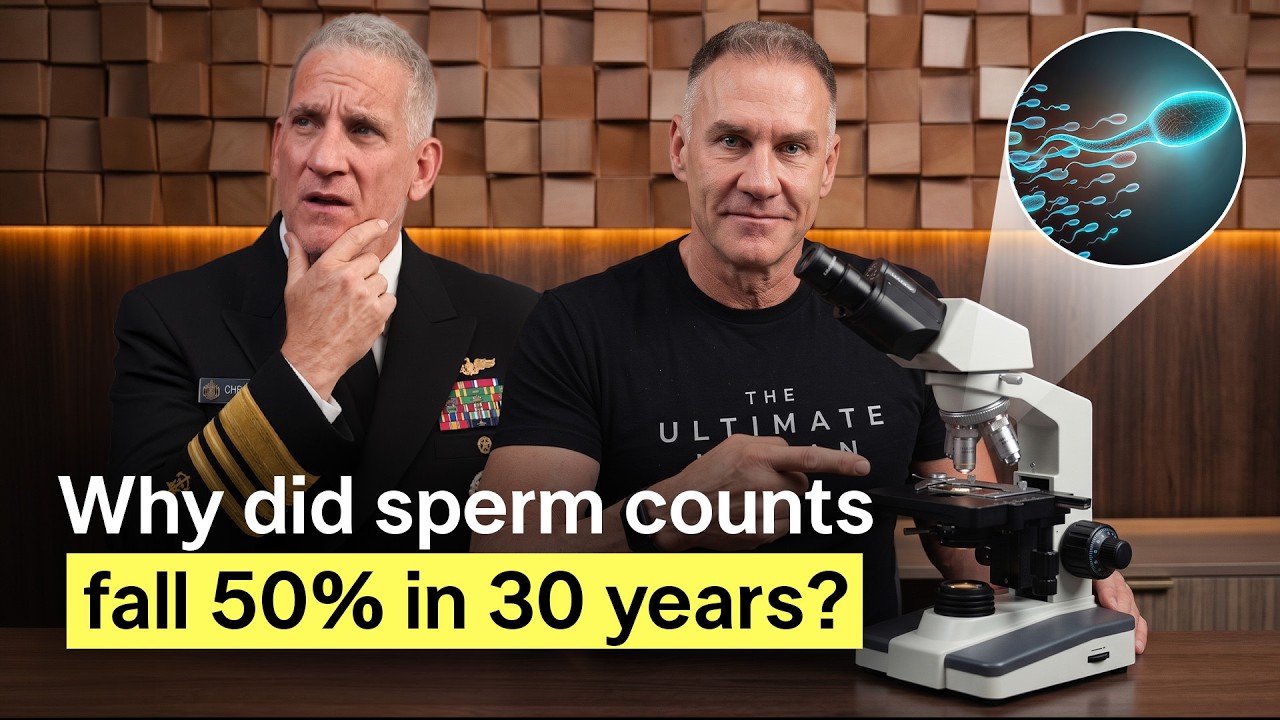
In this extensive interview on the Ultimate Human Podcast, Admiral Brian Christine, MD, the 18th Assistant Secretary for Health at the U.S. Department of Health and Human Services (HHS), discusses the administration’s sweeping public‑health agenda under Secretary Robert F. Kennedy Jr. and President Trump. He explains how HHS has flipped the traditional food pyramid, emphasizing protein, healthy fats, and nutrient‑dense foods while moving away from ultra‑processed products. He links these dietary reforms to a "prevention‑first" strategy aimed at curbing chronic disease, improving military fitness (77% of 18‑25‑year‑olds are currently unfit for service), and addressing a national fertility crisis—both declining birth rates and a 50% drop in male sperm counts over the past few decades. Christine outlines concrete policy actions: new dietary guidelines, the reinstated Presidential Fitness Test, the Get Kids Active summer program, a forthcoming round‑table on infertility, and efforts to regulate peptide compounds through FDA rulemaking. He highlights inter‑agency collaboration (e.g., Ebola quarantine facility in Kenya, partnerships with the State Department, Department of Defense, and DHS) and the role of the U.S. Public Health Service Commissioned Corps (≈5,400 officers). Transparency, restoring public trust, and the broader "Maha" movement—taking care of women, children, and men—are presented as the moral and strategic foundation of the agenda. The conversation ends with Christine’s personal definition of being an "ultimate human," rooted in knowledge, service, and love for the Republic.
Chapters
Do you know that about 77% of young men and young women are not fit for military service? A lot of it because of obesity or other chronic disease issues. You talk about a real national defense crisis going on, which is why our guidelines talking about eating nutrient-dense healthy food, talking about getting our youth active, getting away from screens.
I think there's two ways to attack this chronic disease pandemic. One is to go in and fix the entirety of the bloated, broken healthcare system. The other is to educate people so they can stay out of it en masse.
We've taken that old food pyramid and we have literally flipped it on its head. And so now we're emphasizing protein that we obtain from nutrient-dense food. We're emphasizing healthy fats. What we are moving away from are the ultra-processed, highly processed foods.
By updating the nutritional guidelines, these will now determine how our military servicemen and women are fed, how public school lunches are formed. This is major, major deal.
This is maha— taking care of our women, taking care of our kids, taking care of our men so that we have strong, healthy men, healthy women, healthy kids for a strong, healthy family.
In a perfect world, how would the next 3 years of your career role at HHS play out?
I will tell you, one of the things that I think that we are seeing in this administration that like we've never seen before is Ultimate Human.
Hey guys, welcome back to the Ultimate Human Podcast. I'm your host, human biologist Gary Brecka, where we go down the road of everything anti-aging, biohacking, longevity, and everything in between. And as you know, I am an enormous supporter and participant of the Maha Movement, Secretary Kennedy's agenda, what we're seeing at Health and Human Services, what we're seeing at the Food and Drug Administration, the wins we're having for Americans all over the spectrum of health. How we feed our military, how we feed our public schools, how we feed, uh, our, our patients in our hospitals, how Medicaid, Medicare reimbursing nutritional foods, removing black box warnings from female hormone therapy, getting petroleum-based dyes out of the, out of the food system. This is not a political message, it's a human message. And today we're sitting down with somebody very, very special. He is a physician by training, He is an admiral by career and I think is uniquely qualified for the role he's in. He is the 18th Assistant Secretary for Health and Human Services at the U.S. Department of Health and Human Services. I didn't even— no offense to you— know that that role existed until— first of all, welcome to the podcast.
Thank you very much.
Thank you so much for sitting down with me. My father was a Navy captain.
God bless him.
Thank you for your service. Captain John Brecka. And and was also in naval intelligence for a while, which he'll tell you is an oxymoron. But don't, don't take offense to that either. But major impact on my life and still my mentor today. And he's, by the grace of God, he's still with us. But Dr. Admiral Brian Christine, I am so excited to sit down and talk to you today. And I'll tell you why. Because I believe that some of the most principled and passionate, purpose-driven people I have seen in roles now in charge of changing and modifying, expanding, fixing our, our healthcare system to the benefit of the American people. One thing that really touched me was, uh, you and I joined each other at a roundtable and then a dinner in Washington, D.C. not too long ago. That's right. Um, and you told the story about how you got into the role that you're in now. And I wonder if for my audience, you would just talk a little bit about how you, how the importance to you of seeking that role and how you really and literally prayed for this role.
Yeah.
And how it came to be.
Yeah. First of all, thank you so much for having me on today. I'm really pleased to be here. And as you were going through just there in the introduction, kind of listing all of the wins that we have for the American people at the Department of Health and Human Services. There are so many wins that we are delivering for the American people on a daily basis, whether it be, again, the things you pointed out, whether it be our dietary guidelines, whether it be the things we've done to protect our most vulnerable children, the things that Dr. Oz is doing at CMS with lowering prices and most favored nation drug pricing, the good things that are happening at FDA. We have done so much for the American people. We could take victory laps all day long, We don't do that. We continue to produce the wins for the American people. So I appreciate you mentioning those things. And yeah, it's great to be on and to see myself here, or rather to see myself as the assistant secretary for health serving President Trump and serving the men, women, and children of our republic, getting to work with just an incredible individual, Secretary Robert F. Kennedy Jr. It's the pinnacle of my medical career. I am by training a urologist.
Mm-hmm.
Uh, I went to medical school at Emory University in Atlanta, did my residency in urology at the University of Alabama at Birmingham, which is the medical arm of the University of Alabama system. 'Cause you have the flagship campus in Tuscaloosa where you have the football team and the undergrad school. And then you've got the University of Alabama in Huntsville, which is more hard science, works with NASA engineering and such. Then you have the University of Alabama at Birmingham, which is the health sciences, the medical school, the dental school, the nursing school, the School of Allied Health, a lot of research. That's where I did my residency. And the interesting thing is, Actually, the way I wound up in Birmingham is I actually matched. So when you go through medical school, you then decide what you wanna do for your residency, and then you go through a match system to match you up with your residency location. I actually matched and did 2 years of neurosurgery. Really? That's how I got to Birmingham. I was really turned on by some dynamic neurosurgeons at Emory University, a fascinating field, very competitive residency to get. I was blessed and I matched in and went to Alabama. Did 2 years of neurosurgery, and about 18 months in, I said, you know, this isn't right for me. I'm not as happy as I could be. I had a great meeting with the chairman at the time and said, listen, I don't think I wanna do this for the rest of my life, but you know, I'd like you to help me find another position. And he said, you've been a great resident. He said, let's complete this year. Let's have you find something. And ultimately, I was able to find a spot in urology because I wanted to operate. I've always, the only thing I've ever wanted to do in my whole life literally from the time I can remember is be a doctor and be a surgeon.
So you could fix people.
Exactly, so I could in my own way minister to my brothers and sisters out there and then use the things that really interested me like science and biology and human science. Anywho, I was able to get the spot in urology and urologists are great. They tend to be incredibly happy people. You have an office practice where you can form relationships with your patients and then you spend a lot of time operating. So I love the operating room. So I actually did a residency in urology and then I joined a large urology group in Birmingham, Alabama. Okay. A large group that now has 30, 32 doctors, I believe, in it now.
You're in the military the whole time?
No, no, no, no, no, no. So no, we'll come to that. I was actually in the Georgia Army National Guard during medical school in Atlanta. Okay. Served in that for a few years and then rotated out. I'm actually an Army brat. My father was in the Army. I was born in what used to be West Germany. And I'm old enough to, and probably you're old enough to remember, there used to be an East and a West Germany.
Oh yeah, yeah.
But I was born in West Germany. My dad was in the Army. He was severely injured in his second tour in Vietnam and left the military. But no, I'd never served in uniform except for those few years in the National Guard. But I did my residency, joined a group in Birmingham, and then no one in the group really wanted to own men's health. And so I dedicated, that's what I spent the last, 27 years of my practice. I practiced about 35 years, spent the last about 26, 27 years exclusively in men's health. And so that was kind of my medical career. But when I had the opportunity to come serve the president, to come serve this country, it's the pinnacle of my medical career. It's like a dream come true.
Yeah.
So, uh, yeah, I'm very blessed and very lucky to be where I am. Yeah.
You told the story about how it was down to two candidates And you left the room, walked down the street in D.C., and I forget the church that you went into.
Yeah. So that was— do you mind if I recount that? Is that okay?
No, go right ahead. I love that story.
No. So when I got the nomination from the president, well, before that, when I expressed interest with the transition team and said, listen, I would like to serve at HHS, I submitted my application and I knew an individual in the transition team who said, yeah, put your application in. And so we did that and then went through a series of interviews. Ultimately interviewed with RFK and his team, had that interview. And then the final interview was at the West Wing of the White House, not with the president, but with some of the staff. And after that interview, they escorted me out of the West Wing and they said, "Yeah, it's down to two individuals and we'll let you know. The president makes the decision. We'll let you know." And again, I walked out and I'm a Catholic and I wanted to go pray. And so I walked to the Cathedral of St. Matthew.
That's what it was, yeah.
Which is the seat of the Archdiocese of Washington. And I'd never been there before, but I wanted to go pray. So I walked in. I just wanted to go kneel in front of the high altar and reflect. And as I walked down the central aisle, down the central aisle of the cathedral, right in front of the high altar is a disc in the floor. And it says, this is where the body of President John F. Kennedy Jr. laid in state after his assassination. And so I knew I was on hallowed ground 'cause I was in a church, but this was particularly hallowed ground for our republic. And I literally, Gary, I literally hit my knees. And I said, Lord, I said, I said, please let me serve this president and let me work with this amazing man, RFK. And here I am. I'm blessed.
Wow. Right on. So now, you know, I'm following this road into public service. And why Assistant Secretary of Health? And for those people that are not familiar with, like, the inner workings of the government, we know what Health and Human Services is as a department. Most people are familiar with Secretary Kennedy, and you were directly beneath Secretary Kennedy at Health and Human Services, am I right?
That's right, that's right. One of the assistant secretaries there. In my case, the assistant secretary for health. And it's one of those positions, as you pointed out, that a lot of people aren't familiar with.
It's a huge department.
But it's a big department. And the assistant secretary for health kind of has three roles. You help produce policy, form healthcare policy across the different divisions of HHS. And then you actually help to implement that policy. Which is important. And then there's a communication role where you communicate policy to the country writ large, right? So you have this policy formation role, this policy rollout role, and then the communication role that I truly enjoy.
Mm.
The other role that the assistant secretary can have, you can serve as a civilian, or you can ask for commission from the president, in which case you become commissioned as the senior flag officer, the senior admiral in the United States Public Health Service Commission Corps, the uniform branch of the Public Health Service. And that was incredibly meaningful for me to serve in uniform. And so I have these roles in, but you're right, a lot of people don't know about the Assistant Secretary for Health. They know about the Surgeon General. The Surgeon General.
Or how many uniformed public health professionals there are.
No, that's right.
6,000.
Well, right now there's about 5,400.
5,400, okay.
Yeah, again, of members of the Public Health Service Commissioned Corps. So it's a big role to fill. And like anything of that size, it takes an incredibly devoted team. And I have an amazing team that works with me.
So working underneath Secretary Kennedy, I've been in a tangential part of, uh, Maha. I'm a co-chair of Maha Action.
Yes.
Um, very often I think these things make headlines and we, we don't really realize the impact that it has. Like, we flipped the food pyramid upside down, basically.
Sure.
Pulled it out of the ground, flipped it over, stuck it back in. Um, but by updating the nutritional guidelines, you know, part of my messaging was to, to let people know we didn't just change a food pyramid that's going to go on a wall in a kindergarten classroom. These nutritional guidelines will now determine how our military servicemen and women are fed. They're going to determine how public school lunches are— the, the, the, uh, how public school lunches are formed. They're going to determine how, uh, Medicaid, Medicare recipients in hospitals are, are going to receive nutrition. This is a major, major deal. It may have been one policy, but the impact for the American people and, and people in my, you know, platform, um, you know, are furious when they go into the hospital and they see a loved one in, in their— in the ICU or in the emergency room or doing overnight stays in the hospitals and looking at the, the garbage that they're eating, right? Um, I've done many, many a post on this. I had a friend of mine dying in the, uh, um, ICU at Mayo Clinic of a pretty advanced colon cancer. And when I walked into his room, there were you know, Seagram's sodas, pureed applesauce, high fructose corn syrup-laden fruit cups. It was like, sure, this is a part of what put him here. Um, so these have demonstrative impacts. I think the sad thing for what is happening in the administration and, and for folks like you is that we won't see the real impact of this for maybe for several years, how these policy shifts really going to impact the American people.
No, I think that's a great point. Our dietary guidelines— and I'm glad you brought them up because I think that's one of the most important things that we have done under Secretary Kennedy at HHS— is institute these new dietary guidelines because we have done literally what you said. We've taken that old food pyramid that we all remember, right? And we have literally flipped it on its head. And so now we're emphasizing, as you know, we're emphasizing protein in our meals, emphasizing protein that we obtain from nutrient-dense food, beef and poultry and chicken and healthy fish. We're emphasizing healthy fats. We're not afraid of fat at the Department of Health and Human Services. We know that healthy fats are necessary for brain development in our kids, right? They're necessary for hormone balance in us as adults. We're not afraid of fresh fruits and vegetables and healthy carbohydrates. What we are moving away from and what we advocate against are the ultra-processed, highly processed foods. Additional amounts of sugar in our diet, particularly for our kids. So you're right, producing these is gonna have an immediate effect because as you know, you eat better, you do feel better. You do have the energy to do the things that you need to do. But it's gonna have the benefit of years to come as we see a decrease in those chronic diseases that Secretary Kennedy rightly says are ravishing our country. Obesity, diabetes, hypertension, cardiovascular disease, all of those things. So we're going to have an immediate effect, but more importantly, probably be a more lasting effect. And you know, the cost savings from the work that we've done with our new guidelines, ultimately, as we improve healthcare, as we reduce the burden of chronic disease, is going to be— it's going to be astronomical.
Yeah. And I think that, uh, I mean, that's another side effect of this. And I think every person listening to this podcast right now knows somebody suffering from one of those chronic conditions that you just named. So the, the agency has a tagline, the current Health and Human Services, Prevention First. Um, and Secretary Kennedy, I'm just to read a quote, chronic disease is a lifestyle-driven issue. Um, so can you give us some specific guideline updates and policy moves, um, maybe that are currently in flight, um, that where you're taking a prevention-first posture towards chronic disease, because I think there's two ways to attack this chronic disease pandemic. One is to go in and fix the entirety of the bloated, broken healthcare system, which will take some time. The other is to educate people so they can stay out of it en masse. And I think a lot of, as I zoom out and say, what is the implication of a lot of these policies? Removing black box warnings for female hormone therapy, removing petroleum-based dyes from the food system, flipping the food pyramid, is that people are going to be healthy enough that they don't go into this chronic disease hamster wheel. That's one way to fix the problem. So what is the agency doing with this orientation of prevention first?
No, we know, as you know, we have a very reactive healthcare system. And listen, I'm a product of the healthcare system. I'm trained in the United States. I went to a great medical school, did a great residency. But we have a very reactive healthcare system. One of the things again, that Secretary Kennedy does talk about, and we all talk about at HHS, is being more preventing chronic disease. And that's, that's more important than reacting to. You have to be able to treat, of course, but don't be as reactive, be more preventative. And for example, we're talking about dietary guidelines, a perfect example of how we do that. We've produced these new dietary guidelines. We're now, of course, in the process of rolling them out, educating— educating the public is so incredibly important with our guidelines or anything we do at the Department of Health and Human Services, because That's where the real changes are going to occur.
That's right.
And that's why I think it's incredibly important doing things like this and why I'm so appreciative, because this is part of that educational process. This is part of the catechesis, the catechizing, right? Americans about the benefits of our guidelines and eating healthy, about the benefits of getting active and exercising and getting our bodies moving again. And I think it's great when we see Secretary Kennedy on the road, as he is so often, talking to the people, educating, talking about what we're doing, advocating for getting active and eating healthily. You know, he's probably the greatest evangelist for what we're doing. He's out there speaking. But you have Dr. Oz doing the same thing out there advocating for what we're doing. That educational component is incredibly important as we move forward.
So what do you feel are some of the— to be blatantly transparent, some of the, let's call it, forces working against you? You know, one of the things I see is that, people try to politicize these messages. I don't see any political angle to improving the health and nutrition of our public schools, about getting highly processed foods out of our children's diets, about attacking the chronic disease, you know, pandemic, whether you believe in it from a fiscal responsibility standpoint, because it's going to save us hundreds of billions, if not trillions of dollars, or whether you believe in it from the humanitarian standpoint, this is the best thing to do for, for humanity. But when you took on this role, what surprised you about how either how difficult it was, challenges that you would face, or what surprised you about the support that you received?
Yeah, I think both of those things in that this is a very different role than I've ever had in my entire life. I've spent my professional career in the operating room over an operating room table or counseling patients in the clinic. Right. And so now I find myself in a role where you are working with incredibly smart people to develop policy and to execute and put that policy into action. It's very different. This is something that I did— if I didn't have a great team, if I didn't have the support from people like Secretary Kennedy and all the individuals in my team, then it wouldn't be— we couldn't do it. I couldn't do it. I will tell you, one of the things that I think that we are seeing in this administration under President Trump that, like, we've never seen before is the collaboration, the interagency collaboration, working together through all the agencies at HHS, but across the federal government, really totally to produce the wins for the American people. This is an administration that is very collaborative on all levels. And that's something that helps produce these wins, helps drive these wins forward, helps us initiate and execute the policies that we're developing. It's incredibly important. So that's been a real surprise to me to see how, again, In this administration, we do work across the different— we do across the different agencies and we work together. You know, just as an example of that, you know, there's a very large Ebola outbreak going on in the Democratic Republic of Congo. And so there are a lot of Americans who are— there are. It's probably— it's on scale or it's on track to be probably the worst Ebola outbreak that's ever occurred.
Wow.
Cases are really racking up in the Democratic Republic of Congo. There are a lot of Americans who work with NGOs who are trying to help out the people in Congo. And so we were tasked at HHS, and specifically the Public Health Service, to help set up a quarantine facility in Kenya for American citizens who are over there, and before they return to the United States, quarantine there and then bring them back safely to the United States. But we had to work with the Department of State, had to work with the Department of War, obviously different areas within the Department of Health and Human Services. This collaboration to produce this facility has been amazing. And what we have, starting from an empty field over there to now, we have a world-class quarantine and treatment facility. But it couldn't have happened without the collaboration that we see across agencies that the leadership of President Trump and people like Secretary Kennedy and Secretary Hegseth have allowed to happen. And of course, Secretary Rubio have allowed to happen, bringing together, allowing the collaboration. So that's incredibly important as we initiate the Maha agenda, right? Having that collaboration. So that's been eye-opening, uh, pleasantly so. It's been eye-opening to see how we all were working together in this administration to make America healthy again and to make America greater than she's ever been. Truly, that collaboration is impressive.
I like to hear that. So, and where do the waters get a little muddy? Like, um, well, you know, I think that politicians don't like to talk about that, but like, what is, what is slowing you down?
Well, I think it's You know, there are forces who don't want to see the Maha agenda initiated. You know, we've talked about, you know, you know, Big Food, and Secretary Kennedy has talked about that. Although what's really interesting to see is how people are coming on board. Even Big Food, restaurant chains and such, are recognizing that the American people say, yeah, we've heard what Bobby Kennedy is saying, and we believe in it, and we want to have healthier options. And so Secretary Kennedy is getting these big industries on board to make their food healthier, to have healthier options. You mentioned about the food in hospitals. You know, it was just a week or so ago when Secretary Kennedy was at a hospital, I think with Dr. Oz, at a hospital, hospitals voluntarily saying, yes, we're going to adapt your dietary guidelines. We're going to make our food healthy. Before we're forcing it. But not— that's right. Not only for our patients, but for the loved ones who are visiting them. So I think this is a movement. The Maha movement is something that has really, I think, taken America by storm. I think, I like to say this, that Secretary Kennedy has been almost a modern-day John the Baptist. He's been crying out in the wilderness, look what we're doing to ourselves with ultra-processed foods. Look what we're doing to ourselves by not exercising, by not eating healthily. And people heard that cry. They heard that voice. They heard this prophet and said, yeah, we believe in this. It's been amazing to see. And it's been amazing to be a part of that.
Yeah, you know, it's, when you look at, you know, we were talking about this before the podcast, I come from a, a data science background. So, you know, when you look at the big data, you know, what is— what are the meta-analyses and the big data and the Blue Zone studies? Like, what do all of these, uh, what does this vast opinion agree on? Well, it doesn't agree that dogmatic dieting extends life. It's not all carnivore, all keto, all paleo, all pescatarian, all vegan, all vegetarian. It's the absence of processed food. You mean you don't go to any areas of the world where you have um, hypercentenarianism, extended life expectancy, and find concentrations of highly processed.
Exactly.
So just targeting that. And I think too, the narrative sometimes, in my opinion, gets twisted that we are attacking food, pharma, chemical companies. That's absolutely not true. I would love to see, personally, and I think my audience too, the most powerful, profitable, um, influential companies in America, and if not the world, be the most in service to humanity. Nobody cares that you're making a profit. Um, I would love to see Kellogg, General Mills, um, you know, the, the, these, these big food companies that have the capacity to make choices, um, that impact so, so many lives. I would love to see them be, yeah, profitable and nothing wrong with successful. No, it's just not at the backs of making our kids sick.
That's right. And I think we are making us sick. No, that's exactly right.
Especially in a knowing way.
And we are seeing that. Like I said, we are seeing companies and chains come on board and say, yeah, we want to be part of this. We do want to help make America healthier because we see that's what people want. People have responded to the Secretary and the President when we talk about making America healthier. They're coming on board. And I predict we're going to see more and more of that as we go on.
So what are some of the agenda items in your crosshair right now? And how, how aligned are you with the messaging coming from Secretary Kennedy? And I think what I'd love to land for my audience is how does something go from a passionate, great idea to actually being implemented? You know, because at some point policy's got to shift and somebody's got to do some work to put these things in motion. So first, I'd love to hear like what's, what's in the crosshairs of HHS right now. Right.
So specifically talking about Specifically talking about the Office of the Assistant Secretary, because that's what I have the most knowledge of, of course. You know, again, we're continuing to roll out and evangelize about our dietary guidelines. We're not going to stop that because that's so incredibly important, right? And like you said, it reaches our children, reaches our men and women in uniform service. You know, it reaches all across the society. So we're going to continue to roll those out and evangelize and educate about those. You know, we have reinstituted the— we started back this year with the Presidential Fitness Test. Yeah, I love that. I think is an amazing thing, right?
I think we had that when I was— I remember it. I remember doing it 4th, 5th, 6th grade, 7th grade, and then it sort of kind of went away. It did go high school.
It was— yeah, it was. So I remember doing it as a kid, and we took great pride in doing that, right?
Yeah.
And if you couldn't, you know, if you couldn't, you know, it was always a healthy competition, right? There's nothing wrong with competition.
Run a mile in 9 minutes or less.
So we did— when I was doing it as a kid, it was the push-ups, the sit-ups, and that was the run. The one—
yeah, push-ups, sit-ups, runs. Yeah.
Exactly. And so that was— the Presidential Fitness Test was unfortunately sunset under the Obama administration. Well, this year, President Trump said, listen, we're going to bring this back, of course, engaging Secretary Kennedy, and we're relaunching the Presidential Fitness Test. And what's really great, Gary, is that in preparation for this happening in the upcoming school year, we have a program that we're conducting, that we're carrying out this summer called Get Kids Active. And what we're doing, Secretary Kennedy is going to different sites, different cities around. We're getting kids together at YMCAs, at boys clubs. We've got the WWE involved. Oh, yeah. We're getting big groups of kids together.
Making fitness cool.
Yeah. Making fitness cool. And I'm proud to say it, my public health service officers are at each of these events teaching the kids how to do the movements, working, for instance, with WWE out there having the kids do the pushups and the sit-ups and the shuttle run that they're doing and the planks and all those kind of things that are part of the test. And this is going on throughout this summer. Again, Secretary Kennedy, myself are at different locations doing this. It's so much fun to do. That's hugely important for our country. This is an initiative that we're really proud of.
And you got to get to that generation so that it permeates up through.
Absolutely. So that's something really important for us. Uh, you know, we, for, we know that there are falling fertility rates in the country, right? We know that we are at the lowest— exactly, we're at the lowest fertility rate our country has ever seen. We're far below replacement. That's a problem.
We're below replacement.
Below replacement. That is a problem. It's a problem, for instance, for our workforce in the future.
Right.
You got to have the people to work. It's a problem for defense readiness when you think about it, because we have to have the pool of individuals who will serve in uniform to protect our country. So the fertility challenges we have are incredibly important. We, through the Office of the Assistant Secretary, we're going to be having a roundtable on male and female infertility, looking at that, looking at root causes, offering, offering pathways forward that are going to help solve these problems. So that's going to be coming up later in the summer. A date's not set yet, but that's incredibly important for us.
Wow.
This administration has been incredibly supportive of women's health. The Office of Women's Health exists under the Assistant Secretary for Health. Our Office of Women's Health, we take women's health and, and, and well-being very, very seriously. There have been things done in this administration that we have enacted to lower maternal mortality by 40% or more. Wow. Really important things that we're doing to support women, to support children. So important.
Black box warnings, female hormone therapy. That was huge.
Out of the FDA. Exactly right about that. Uh, you know, so you mentioned falling fertility in men, falling fertility in women. Again, what are the root causes? We're going to be talking about it, but not just talking. We're going to be offering concrete ways forward. That's to come.
So that's very important because I think you, you start coupling some of these statistics together, they get really scary, right? If you have fertility rates dropping at 2%, and you have sperm counts dropping at 1%, you know, 1% a year doesn't sound like a huge big deal. That's 10% every decade.
Well, no, our sperm counts in men have dropped, you know, over the past 3 or 4 decades, 50% or so. And so it's really, really important. So we have to figure out what's going on. What are the reasons for this? I personally—
just gonna ask you that. Well, I was like, as a urologist, I was definitely asking you that question.
Well, you know, we know that things like chronic disease, obesity, lack of exercise, those things can affect fertility, but also Environmental toxins, microplastics. There are things in the environment that we believe, and this is not just me, science, scientific community believes are affecting fertility. Again, we're going to be really working on those things. So that's a project going forward. Again, there's so many things that we're doing, always supporting Secretary Kennedy and his efforts, always collaborating across the agencies to support. Yeah, really exciting things happening.
So women's health, Um, fertility, which I think is— you, you said, uh, and I don't want to gloss over that, that we are below repopulation. I, I read a statistic, I don't know if this is true for every country, but it said when the birthing rates, uh, when the fertility rates drop below 1.2%, the birthing rate drops below 1.2%, there reaches a point where that population may be permanently unrecoverable. More people obviously passing away than being born, and then being born. Um, I think you have fertility rates, you also have sperm counts dropping, you also have— and we don't need to go down this bandwagon— I think the disruption of the nuclear family, which, which, which is a challenge.
I would agree.
Um, you would agree with that too? Um, and, and so all of these things combined— so you have socioeconomic forces and then you have these actual health issues. And have you been able to put a spotlight on what we think is causing this male fertility drop, or these fertility rate drops in females? Or that's what this next objective is for? This is what's in your crosshair?
Well, I think looking— always one of the things that Secretary Kennedy has said from day one is that we will be driven by gold standard science. And that's going to be part of this roundtable and expert panel. Going to be bringing in individuals who are experts in these fields, not only to opine what they think is going on, but to make research initiatives going forward to look at concrete ways to treat the root causes of infertility, because that's important to do. Talking about it is great, but action is more important. And there will be action that comes out of this. There's no question about that. Incredibly important. Again, like I said, there's national defense ramifications to this, because if you don't have a ready pool of soldiers because your population is going down, Something that's similar to that, and we'll come back to kids for just a moment. Do you know that about 77% of young men and young women ages 18 to 25, which is the prime recruiting years, are not fit for military service? A lot of it because of obesity or other chronic disease issues. 77% are not fit for military service. You talk about a real national defense crisis going on, a real problem for protecting our borders and our shores and getting men and women who are ready to serve in uniform again, which is why our guidelines talking about eating nutrient-dense, healthy food, talking about getting our youth active, getting away from screens, getting out there.
I saw the Surgeon General's report on the detriments of screen time.
And that report out of the Surgeon General's office, I think, is going to be one of the most important things we see out of the Department of Health and Human Services during our time there. There because that's critical. But again, this all bleeds over. And this is Maha, right? This is Maha taking care of our women, taking care of our kids, taking care of our men so that we have strong, healthy men, healthy women, healthy kids for a strong, healthy family. Because again, personally, I believe that's the bedrock of our society. So that's Maha, right? That's Maha. And that's the beauty of the Maha movement is that It's the right thing to do. It's being led by the right man, Secretary Kennedy, under the right president, Donald Trump.
You know, I, I, um, uh, watched this PCAC committee, uh, hearing on Thursday and Friday last week, which was to recommend, make recommendations to the, to the FDA relative to these, uh, certain peptide compounds. Um, 6 passed, 1, 1 did not. Um, these are just so that people understand, because I think for, for people that are not familiar with how the government operates, Health and Human Services, Food and Drug Administration. So there was a committee, um, that made a recommendation—
that's right—
to move 6-peptides from what they call Category 2 onto the Category 1, put them back in the hands of compound pharmacies. Um, this does not mean that it is FDA approved. And where do we go from here? Does it go into rulemaking? What is the next stage for us?
Right. So the next stage— again, you said this panel has made recommendations to the FDA, and then what will happen is the FDA will make a decision. There'll be a rulemaking to move that, to move those peptides. You're right, from, from the schedule into Schedule 1, which will then allow United States compounders to be able to produce these as these peptides are undergoing scientific study and review. So the people need to understand We're not saying— and listen, I agree with what this panel suggested.
So did I.
Secretary Kennedy has advocated for this. I totally advocate for this. I believe that there's great utility in peptides. Also, I believe that we have to always do studies, right?
Yes.
And so we want the American people to understand we're not saying that if this happens that we're simply going to throw something that's not going to be studied. No, it simply says you can have access as they are being studied. And the important thing is right now it's kind of the Wild West out there with peptides. You don't know when people buy peptides, you don't know where you're getting them. They could be coming from offshore, they could be coming from China, they could be sources that aren't sterile or tainted. Now, what we want are men and women to be able to have access to these peptides as they're being studied, but have safe product to use. I fully support that 100%.
So do I.
Obviously you do. Secretary Kennedy is very passionate about this because I saw what happened.
And maybe it was an unintended consequence because in, in the administration prior to this, this past one, the, you know, peptides were, um, under, under the purvey of compound pharmacies. Um, my clinical team was prescribing them on a regular basis, and then one day we woke up and the light was just shut off. And, and what happened is the demand didn't go away.
That's exactly right.
It just shifted to whatever you want to call it— the black market, the gray market. And the consumer didn't know. They would go to websites, order peptides. I saw, I saw sterile vials that would show up to clients' minds with screw-off tops. Yeah, that definitely was not made in a compound pharmacy. Exactly. Um, and, uh, and, and you would take the top off and just put a syringe down into an open bottle of liquid. And, and then, you know, you've seen a lot of the, the studies. There's a lot of influencers out there doing it too, you know, ordering peptides from different websites and finding endotoxins and heavy metals and just simple things like rice flour and no trace of of the peptide. So I, I applaud restoring this chain of custody because it doesn't mean that all peptides are safe and effective. It also doesn't mean that everybody needs to be on peptides. What it means is you're restoring that doctor-patient or clinician-patient relationship. The patient is going to have a clinician guiding them to compound pharmacy who's going to at least give some measure of guarantee for stability, sterility, potency, so that at least you know what's going into your body. Is what's on that label.
No, that's exactly right. This is an example of what you want your Department of Health and Human Services to be doing. You want it to allow science to proceed, studies to proceed, while at the same time protecting you so that what you're getting in that bottle is not going to be tainted or dangerous or not sterile or not even have the product in it. Yeah, incredibly important. I think that's a big win for the American people.
I think so too. I want to also talk about what is under the umbrella of your office. Um, Surgeon General.
That's right. Okay, so, so under this, you have the Assistant Secretary for Health, then there are a variety of sub-offices, offices underneath the Assistant Secretary for Health. The Office of Women's Health, Office of Minority Health, uh, the Office of, uh, Disease Prevention and Health Promotion, right? So different offices, and there's a variety of them underneath the Office of the different verticals under there.
Exactly. How big is the department? How many —people does it employ?
You know, when you look at the number of employees, probably around, I want to say, 300 or so. So a significant number of individuals, maybe a little bit less than that. But then you also have the Commissioned Corps of the Public Health Service, that 5,300 or 5,400 individuals in uniform. The Office of the Surgeon General falls underneath the Office of the Assistant Secretary for Health. So the Surgeon General reports up to the Assistant Secretary for Health. And I'm going to be very happy when we get a Surgeon General.
Yeah, we'd love to see a Surgeon General too.
America needs— America needs a Surgeon General, and they need a Surgeon General in place. I'm excited about when we get— of course, right now we have someone who's been nominated. I don't know when Dr. Safire, Nicole Safire, I don't know when her hearing will be. I haven't heard that. But I'm excited about having the opportunity, once she is confirmed, to work with her and form a relationship as we begin to speak to the American people. We begin to advance policies for the betterment of the country. The United States needs its Surgeon General, so I hope that will come soon. But that falls under the Assistant Secretary for Health. So we really touch a wide range of things that happen in the government at HHS, Office of Population Affairs. So a lot of things fall under the Assistant Secretary for Health.
And just in a broad sense, you know, so many departments there and such a behemoth, you know, it's like trying to steer an aircraft carrier, you know, and turn it in the ocean. It doesn't slow down very quickly. It doesn't turn the other direction very quickly. And you've got a certain number of years to make the biggest impact that you can. How do you restore trust in, in, in the American people that there isn't a sub-agenda? You know, there's— I think, I think— and I'll be very careful not to turn this into a political podcast. I mean, I think we've gotten so, you know, the temperature is so high. It is in the political environment right now. But I think it's important that we sort of cut through that. And when we talk about health and we talk about food, we talk about chemicals in our food supply, we talk about feeding our children— okay, this is the one place that we should all be able to sit at the same table and say we, we can at least agree, uh, upon, you know, these, these agenda items. So how does your office restore trust in the American people that —doing the right thing.
Gary, I really appreciate you asking that question because that is one of the things that motivated me to want to work at the Department of Health and Human Services. Because as we saw during the COVID pandemic, we just have to admit that there was a loss of trust in our higher institutions in healthcare. In general, when you talk to someone and say, do you trust your doctor or your nurse practitioner? Yeah, I trust them. How do you feel about CDC? How do you feel about NIH? You know, a lot of people just aren't trusting. And there's good reason for that. We know what happened in the past in this country. And it was really important to me to say, okay, I'm a product of our, I'm a physician, I'm a surgeon. It's been an amazing career for me. It's been such a blessing. Like I said, it's all I ever wanted to do was be a doctor. And so when I saw this loss of trust, it was really hurtful. And I said, I wanna be able to try to help restore trust in our higher institutions of healthcare and healthcare policy in this country. I believe personally that one of the reasons that I was selected, that I was nominated by the president, because I did practice as a Main Street physician, if you will, for 3.5 decades administering healthcare, you know, taking care of patients. And I believe it's beneficial for me to bring that experience to my job as— no doubt— Assistant Secretary. And part of that is as a surgeon, as a physician, and more specifically as a surgeon, I had to earn the trust of my patients, right? Because if you're gonna administer care to someone, they gotta trust you. If you're going to take them to the operating room and have them undergo an anesthetic and manipulate their body, they have to trust you. And so I believe I have a certain skillset, like many physicians and surgeons do and nurses do, to be able to endear trust from their patients, And I wanted to bring that to this. And so I think, how do we do that? I think exactly what you see, what we're doing, transparency. Secretary Kennedy talks about radical transparency. The transparency is important. We'll answer questions. We'll do long-form podcasts like this. Yeah, I love it. We'll do interviews. I love being out there doing interviews. Secretary Kennedy, part of his superpower is how he can connect with people and they believe him because he is an eminently honest man. And I think that's part of the way that we restore that trust. Again, I referenced Dr. Oz, Mehmet Oz, amazingly honest, a truly good man, a smart man. Does he have to have this job? Does Secretary Kennedy have to have this job? No, they could be doing other things, but they want to restore trust as well. So we're part of that team to do that. Again, transparency, answering questions, being willing to sit down, talk to people. I think that's incredibly important.
Yeah, I think so too.
And admitting— I'm sorry. No, go ahead. Admitting that we have made mistakes in the past. Yeah, that's a big— you know what? Because again, how much have we seen that? The hubris and not saying we got it wrong. You can always make mistakes. I think people are understanding and forgiving if you say maybe we got this wrong and we're going to do better. And I think we are not above saying if that time comes that we've made a mistake, we can admit that and move on and do better.
So in a perfect world, how would the next 3 years of your career role at HHS play?
Yeah, I think it's going to be continuing to work with Secretary Kennedy and the amazing people at HHS to serve the president, to advance his agenda, and of course to advance the agenda of making America healthy again, making America great again. Whatever role I play in that, like I'm doing now, helping formulate policy, get that policy out there, and working with the Commission Corps. Because I have to say, one of the high— it's been, it's been the highlight of my medical career to be the Assistant Secretary for Health. The IC— Yeah, you're only the 18th one. The only 18th one.
Ever. So it's a big deal.
I mean, congratulations. No, thank you. But to serve in uniform and to lead my officers, and I call them my officers not because I own them, but because I have a love for them. To see my officers, the men and the women who wear this uniform, who are out there, their expertise, their dedication, their moral character to be out there. And they could be doing other things, I'm sure, that would make them more money, but they want to serve our republic. They want to be on the front lines. Like I said, we have— now we have over 60 Commissioned Corps officers who are at the Ebola facility in Kenya. Wow. They were there.
Out of the 5,400.
That's right. And they're happy to be there. We have Public Health Service officers who work with DHS, right? Many of them work with DHS, helping keep our borders secure, doing the right things for our country. I have 15 or 16 Commissioned Corps officers at Guantanamo Bay in Cuba providing medical care and services there. I went to visit them a few months ago, which was an amazing trip. We've got Commissioned Corps officers that are in the Indian Health Service, and that's a passion of Secretary Kennedy to take care of and render service to our Native Americans and Alaskan natives. So we have a large number of Commissioned Corps officers that are in the Indian Health Service. Taking care of their Native American brothers and sisters, right? We have Commissioned Corps officers that are at FDA, at CDC, working with the other uniformed branches of the military, Commissioned Corps officers that serve in the White House, that serve in the Pentagon. Yeah. I'm incredibly proud of the job that they do. It is a privilege to wear this uniform. It is a privilege to lead them. It's been— that's been a tremendous blessing. It's been one of the best parts of my job. And so I look forward to, like we said, 3 more years of wearing the uniform and taking care of my officers.
Amen to that. Admiral Christine, I wind down all my podcasts by asking my guests the same question, and there's no right or wrong answer to this question. That's good. Good. But what does it mean to you to be an ultimate human?
To be an ultimate human? To be an ultimate human. I would say this. What I think it means to me, as I think about that, and I like being put on the spot, as I think about that, what it means is taking the blessings that I have had with my fund of knowledge, right? Taught to me by so many people so much smarter than me and mentors who have taken me under their wing, taking my fund of knowledge, taking my skill set, which I think hopefully involves communication, dedication to our republic, and then using that honestly to better the lives of my brothers and sisters that are out there, right? I think you feel the same way. I haven't known you long, but I think you feel the same way. Part of that comes down to love, right? A lot of it. Love of our republic, love of the men and women and children who are in this republic, love of the fact that we have the privilege of having a knowledge base and an understanding that we can use to try to help. So for me, I think that certainly plays into that as part of the ultimate human. I'm sure there are other things if I thought about it, but that's what comes to my mind.
Well, it gives me a great deal of confidence to know that there's men and women like yourself at the highest levels of our government fighting to make this country healthier again, championing the, the, the wins. I will continue to be a big supporter of, of, of this agenda to make America healthy again. I think the, the, the policies, uh, that have, uh, been taken and enacted so far, like I said, we will see those effects years from now in such a demonstrative way. The impact on chronic disease, um, on, on the number of our children that are facing chronic disease, on morbid obesity, on type 2 diabetes, and eventually on healthcare costs. So I really just applaud what you're doing, and I appreciate you coming on the Ultimate Human Podcast. I appreciate that.
Thank you for the opportunity to do it. One of the— some of the many nice things about this are that we are getting to have radical transparency talking about what we're doing to let the American people know that in this administration, we really aren't taking our foot off the accelerator. I mean, people might say 2 years in, you're going to lay back. Not under this president and not under Secretary Kennedy. We aren't laying back on nothing. I mean, we are keeping our foot on the gas and we're moving ahead, which is exactly what we should be doing because it's a privilege to do what we do. So being able to talk about that, being able to have people get to know us as humans, and then also helping to form a friendship between you and me, because I really want to nurture this friendship. I love what you're doing. I want to be supportive of you because I know you want to be supportive of us at HHS. I want to be supportive of you. Thank you. Because I think what you're bringing to people is really important. It's really cutting edge, really important.
Thank you so much, General Christine. I hope you come back on the Ultimate Human Podcast. I will. I appreciate your, for your time today. And until next time, guys, that's just science.
More from Gary







Perimenopause Symptoms Can Start in Your Late 30s - Dr. Remina Panjwani | TUH 312

