Artificial, but Intelligent? Colgate University panel on AI and human/machine collaboration
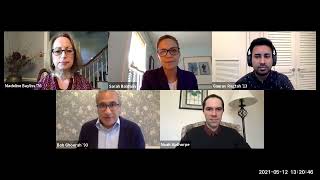
The Colgate Professional Networks hosted a live panel titled "Artificial, but Intelligent?" featuring moderator Sarah Baldwin and four Colgate-affiliated experts: Noah Abtorp (Assistant Professor of Computer Science), Madeline Bayless (Advocate/Advisor, Future Works Alliance), Bob Gura (Founder of Qorri Ventures), and Gaurav Rukta (Co‑Founder and CEO of CatalyzeX). The discussion explored a wide range of AI topics. The panel began with a clear, accessible distinction between artificial intelligence, machine learning, and deep learning. Noah presented his research on privacy risks in smart‑home IoT devices, showing how seemingly innocuous sensor data can reveal detailed personal habits and how insecure devices can be hacked. Madeline addressed the future of work, emphasizing reskilling, upskilling, and the need for human‑centric design in AI‑driven tools. Gaurav explained deep learning’s capabilities, its current limitations, and how AI can be harnessed for societal good, such as “democratizing luck” by better matching people and resources. Bob framed AI as the next evolution of software, discussing verticalized applications, investment criteria (large problems, founder conviction, startup‑friendly domains), and gave examples like Airbnb, Zoom, and autonomous navigation projects. The conversation repeatedly returned to governance, ethics, bias, and risk‑management, with Madeline urging a purpose‑first approach to technologies like facial recognition. The panel also examined educational impacts, describing student projects that blend technical ML work with ethical considerations. Finally, the group tackled long‑term concerns such as the singularity, job displacement for investors and professors, and the importance of keeping AI complementary to human intelligence. The session concluded with optimism that AI will augment rather than replace humanity, provided governance and human values remain central.
Chapters
Hello everyone, I'm Mark Walden, Communications Director in the Office of Communications at Colgate. Welcome to Artificial but Intelligent. It sounds like upspeak, but this is actually an event on the future of artificial intelligence brought to you by the Colgate Professional Networks. And Colgate Magazine. The professional networks create connections and conversations between Colgate, our alumni, students, and family members. University staff work with volunteers in 11 different industry-focused networks to host educational events, provide on-ramps for jobs and internships, and encourage engagement with Colgate. My CPN colleagues thought it would be a smart idea to create a series of events around a recent Colgate Magazine feature that asked, what does the future hold for humanity? On the web, in artificial intelligence, in international policy, and more. Here in communications, we saw it as an opportunity to introduce you to some of Colgate Magazine's talented freelance writers, who are widely published journalists in their own right. Typically, you only read the end results of the conversations they have with their sources. So today, you can listen in and even participate. So on behalf of managing editor Alita Main, assistant editor Rebecca Docter, and the Colgate Professional Networks, I want to thank you again for joining us today and, and introduce introduce you to Sarah Baldwin. She's the co-writer on this feature and our moderator. Sarah is a communications consultant and freelance writer who is also the former director of communications for the Watson Institute of International and Public Affairs at Brown University. Today she is host of the institute's podcast, Trending Globally, and you can read her work in Colgate Magazine and Colgate Research. Sarah is joined today by a panel of Colgate experts: Noah Abtorp, Assistant Professor of Computer Science at Colgate. Madeline Bayless, Class of '76, Advocate and Advisor, Director, Future Works Alliance PHL. Bob Gura, Class of '93, Founder of Qorri Ventures. And Gaurav Rukta, Class of 2013, Co-Founder and CEO of CatalyzeX. They will be discussing what does the future hold for AI. It's a broad field, and that's why our panelists cover the range from educating new computer scientists and designing systems to investing in that work. This is an interactive event, so please submit your own questions via the Q&A button, direct them to the panelist of your choice, and Sarah will read you into the conversation after she's had her turn. I think that's all I have, and Sarah, you have the con, as they say.
Thank you, Mark. I'm very excited to be having this conversation, and I'm doing my best not to come to it from an overly black mirror. Place. I only wish we had more time, but I will do my best to make sure we hear from everyone as much as possible. And I'm going to direct questions to each of you, but if anyone would like to add a few words or offer a different take at the end of someone's comment, please do. We just have to be mindful of keeping our answers relatively brief. So I'm going to start with some specific questions, but I also have some really broad questions that I'll save for the end. And then, as Mark said, I'll incorporate questions from our, our viewers at the end as well. But Noah, let's start with you. As the professor among us, I wonder if you might help us differentiate in as accessible a way as possible between artificial intelligence and machine learning. And I'd even say deep learning, if that's relevant to this conversation.
Sure, thanks, Sarah. Um, so the definitions of artificial intelligence and machine learning can be quite broad, and as with any evolving field, they're also changing rather rapidly. So the definition that I will use will be, um, the one that I use for my students in my classes. The main distinction here is that artificial intelligence, broadly writ large, is a field which involves writing computer programs that can learn from—
Noah?
Oh, I was on the edge of my seat because I want to know the difference. Well, let me— let's say, Noah, maybe we can get Noah back. And Noah, maybe turning off your video for a second might help. Madeleine, let us— I want to turn to you and just go right into some sort of everyday-based thoughts that I've been having. There's a lot of hand-wringing about the potential of AI to make many, not only blue-collar jobs, but white-collar jobs obsolete. And it's happening already. So I wonder, do you have a sense that our society is prepared for the implications of that? Is anyone trying to envision a workforce or an economy that integrates advances in AI, which are admittedly amazing and important, and yet doesn't completely decenter the human?
It is an absolute concern and issue that a lot of organizations are dealing with, Sarah. So the future of work is an operative phrase today, and it very much takes into consideration the current status, and it starts to bring in the notion of reskilling, upskilling, changing roles and jobs. And it's also the concern of public sectors. So you find actual jobs and commissions and work being done in this area. So I think the attention to it is there. Are we there? Is it— as with technology, you are always running from behind. I think what is promising, because the future of work is very much a concern, on one hand you have estimates of a million-dollar— a million shortfall of jobs And so there is a true gap, and in the same way we all got behind STEM to promote, perhaps because of deficiencies on equity, we do need to think about how are we going to staff and, and put labor while labor is receptive to the automation and augmentation done. So I think this very much is about people taking their careers into their own hands, being embracing of technology, and yet a holistic approach. And a quick example for all of us who have had an experience with a chatbot or a virtual assistant, most of which have some element of, yes, both machine learning and AI. So we'll, we'll wait for Noah's answer, keep you on your edge. One of the most important things in making that work well is making it know the language of the people. And so if you think about it, people who are screenwriters, people who are linguistics, people who are anthropologists, understand language, understand how people talk, um, generational, new people coming into the workforce, understand how today's people talk and think. Absolutely essential to making AI work for us and create work change work and make it be a constant aspect of the future work.
That's a great example. Thank you. I had not even thought of that. Thanks for that. Well, we've got Noah back, so let's go back to learning the difference between machine learning and AI.
Yes, sorry about that.
Internet problems strike anywhere at any time. Yeah, so the distinction that I usually make when teaching my AI seminar is between general artificial intelligence and machine learning, like you asked. And general artificial intelligence would be a still aspirational technology that we don't have yet for a computer program that can think in a way which is like humans and that can be applied to new problems, any problem that it may see, and may be able to generate solutions as we would, or better than we would. Where in, in comparison, a machine learning approach would be a program that can take data that exists out in the world, or that's been created for this purpose, to improve performance on a specific problem. So machine learning solution is what you've run into if you've dealt with AI in any of your interactions with artificial intelligence systems, a chess-playing—
He's just keeping us in suspense. Noah, I think you're doing that on purpose. I was— okay, well, we will come back to Noah again.
I can probably jump in to add there a little bit.
Sure.
Even to the, the aspects of machine learning and deep learning. Machine learning works really well when you have well-defined data in some format that if a human or enough humans had enough time to go through, they could start doing pattern matching. Except the computer is much better at running calculations at orders of magnitude faster than a human. So if you have data that lends itself well to pattern matching, Machine learning is a set of techniques that lets computers learn that from very labeled, organized data of what to do when you see pattern X and scale that up. Deep learning takes that to the next level where the people creating this intelligence don't even have to put in the effort to, you know, say this example means this or this pattern means this. Let, let a bunch of mathematical calculations a bunch of brute forcing and a bunch of, you know, different approaches to this, figure out what underlying patterns exist in the data, do that at massive scale, which is why you need, you know, these huge computing powers, and then do something that humans may not have even thought of before. You see an example of that in the game Go. The AlphaGo that beat the world's, you know, grandmaster in that game They saw new plays being made that even the, the world's foremost experts had never seen before. It made no sense to a human because the space of possibility in that game was so much that we hadn't explored it, but computers at scale were able to do that. So I think that's where you start getting to the next level where it starts getting so black box that we cannot even fully comprehend it except for the underlying math that describes how the system works at a very high level.
So is there— so deep learning exists, that is happening. Is deep learning going to just become a superintelligence that makes us obsolete?
That is a topic of huge debate as to like, is that a bit of hyperbole? Is it basically limited by what we can put together still? And, you know, people working at the forefront of the field just see how much it's still very much like a toddler. Like, you talk to a chatbot, you talk to Google Home or Alexa, or you talk to any of these, you know, sophisticated technologies, they fall apart at the, the, you know, the simplest of edge cases sometimes. We have to keep in mind these are very powerful demos put together for the public audience, but it's still very like tinkery and, you know, still have a lot to figure out. So in some hypothetical future, sure, just like any tool that has to be used with caution, but I think we're still far ways ahead from it. But at this point, the possibilities are super exciting of what we can do with it that individual humans or groups of humans couldn't do themselves. Mm-hmm.
There, I might add an example there, where in the field of cybersecurity, that is becoming very common knowledge to everyone in current events. The debate there is not that there aren't systems to be able to take all this massive data about users and all the rest of it. And in fact, it— it's becoming the preferred approach to let the automation systems make sense of the data, of outliers, of patterns. But the question then becomes, at what point do you allow it to take the action? Yeah, so an action in cybersecurity would be to shut down, right? And we've seen that this week, right? That was a manual decision in this case, but that's the question. And as skills shortage issues become more relevant as advanced threats, you know, human mind devious can always work faster than where we are. But this is a real-world example of where the rules and the boundaries that humans make on these still are the governors in the stage we're in, and one that has a lot of relevance to us today.
Thank you for that point. That's great. It's very topical indeed. Um, thank you, Gaurav, for the, the machine learning, deep learning, um, lesson. And I, I'm gonna go back to, to Noah in hopes that the third time is the charm. And now that we know the difference, um, I wanted to talk to you a little, or have you talk to us a little bit about your research. Um, Just to make this relevant to our everyday lives, some of your research explores the privacy risks of the quote-unquote smart home. And I'm sure many people are familiar with the convenience of smart homes and virtual assistants like Alexa or Echo. But I wonder if you can talk to us about the privacy risks of having these always-on sensors in our houses. Are those risks worth the convenience, and is there anything that can be done to sort of mitigate those risks?
Yeah, that's a great question, Sarah. Um, so like you said, my research focuses on IoT devices, or Internet of Things devices, for consumers, or what are kind of more widely known as smart home products. And I see the privacy risks of these things kind of coming in two different categories. The first is from the data that gets collected by the manufacturers or the companies that build and support these products. A lot of people aren't aware when they buy and install a new smart device what information it may be collecting about them. And most of these products have sensors that are designed to record information about things that are going on inside your house, and that can give a pretty detailed view of many things about your lifestyle. And one of the things I've been able to show in my research is of just how much detailed information you can infer using a machine learning algorithm about what people are doing inside their homes or wherever they put these products from the information that gets collected. Oh, you're muted.
Sorry, I just wonder if you could give an example of that. Like, is it sort of low activity someone can infer that you're not home and rob you, or is it much more sort of fine-grained than that?
It really depends on the product. So we've looked at a wide variety of these home devices. Some of them is fairly broad strokes, things like light bulbs. If you, if you look at internet traffic or information that's collected by a light bulb, you can tell when someone is inside a house or not, or inside a room or not. Other devices collect a lot more granular information. Like we did an experiment with some security cameras where we set them up and put them in a, in a room in a lab, had people walk around in front of them, did various movements inside the room and showed that you could infer when someone was moving around inside a space based off of not just sort of the information that they were directly collecting, but the internet, the patterns of internet communications that they were, that they were using. And this kind of brings me to the second privacy concern, which is not about the manufacturing manufacturer, but is about the potential for other third parties to get that information. I think many of us have seen press articles about smart devices that have been hacked. There was a particularly scary one a while ago about a baby monitor that had been vulnerable and that had been hacked, and sort of a third party could, could get in and could use that baby monitor as a camera and watch what was going on. And one thing that I found from looking at lots of these devices is there's such a huge range of attention paid to cybersecurity issues. And while, like, some of the most well-known companies really know that this is a big issue and are trying to do their due diligence to keep these secure, there are a lot of other companies which, presumably for cost reasons, aren't placing as much emphasis on security. And that raises a whole other set of privacy issues when those devices could potentially be hacked.
Yeah, that's good food for thought. Um, thank you and welcome back. Um, thanks, Bob. I want to turn to you now, um, and, and sort of pick your brain about, um, well, back in, in 2011, Marc Andreessen, with whom you've collaborated, wrote that software is eating the world, or that was the title of his essay. And I wonder Is AI the next evolutionary step of software? Is AI going to eat the world?
Yeah, for sure. I think that's the right way to think about it. So thank you so much for having me on today's call. It's awesome to be part of this discussion. Yeah, I think that artificial intelligence is essentially software. And as described by Noah and others on the panel, It's applying software to large datasets and problems and looking to drive efficiencies, et cetera. I think that it's increasingly becoming verticalized. So—
What do you mean by that, Bob?
Industry by industry, right? So not all software is applicable to a particular industry in a generalized way. And so what I think is important to note is that we're very much in the early innings of artificial intelligence. And I think a lot of the breakthrough applications are going to occur over the next 10 or 20 years. And you may not even know, but there's— There's AI running right now. It was brokering Noah's connection here on this Zoom call. And if you have your filter turned on, that's computer vision. So there's AI running. Or if you used Face ID to log into your iPhone, that's AI. But it's different from the AI that is being applied to, for example, the supply chain in the context of getting the vaccine rolled out across the world. And so having worked with a number of founders who are innovating in the space, I think You know, the thing that we're definitely cognizant of is that we're in the very early stages of all of this. And it's a great time to be an investor. We're super excited. Another thing that I would say is that a lot of the innovation is happening from the big companies. So the FANG, for example, Facebook is innovating pretty significantly, as is Google. Gaurav mentioned the application of DeepMind to Go and to Pai Gow and to chess. All of that will eventually trickle down into the ecosystem and create the environment for additional innovation from a startup perspective.
It could potentially sort of— that everyone could benefit from.
Yeah, absolutely. And I do think that there's, um, you know, Jim Breyer, who was the first investor in Facebook and a pioneer, um, and probably the greatest venture capital investor of our time, um, has you know, talked about the application of AI in a global context. And along with folks like Eric Schmidt of Google, they've really sort of zeroed in on this race between the US and China in the context of developing AI. And so we look to that. As well as part of this just sort of broad question generally, like, where is software going? What verticals will it be applied to? And how will it ultimately benefit humanity in a global context?
Speaking of benefiting humanity, I wonder if, Gaurav, you could speak a little bit about— your— this notion of adding meaning to all this data and positive meaning. You've said, and I'm quoting, that AI might help democratize luck by connecting the right people with the right sources to make great things happen, which sounds so much better than being spied on by Alexa. So can you talk to us about a specific way or ways that you see AI being harnessed for good?
Sure.
So, you know, at the very core of all of it, I think we have to remember that, like I said earlier, computers are just super, super good calculators. And now with the, you know, with Moore's Law, we reached a point and we're going to continue to just increase the computing capacity, doubling every 2 years. And what we have going on is We are able to do a lot more with computers than any group of humans can do. And what that means is increasingly, as we're generating a lot more data about ourselves, about the world around us, how to make sense of them. Humans tend to default to whatever evolutionary biases and limitations we have, whatever limited understanding of the world we have, and whatever immediate network or networks we're surrounded by. But that is not necessarily, globally speaking, the best way you can match things, whether they are people, whether that's information, whether that's, you know, any progress towards all kinds of outcomes. So the general idea was if we are able to do a lot more powerful things with data, we can start changing things like how dating works. We can start changing things like, you know, how you match capital to ventures and projects. How you can just connect people that should be collaborating on an important project that didn't happen before. Just as an example, right? Like my wife and I met through online dating a few years ago. I'm from India. There's no way that would have happened. I probably have an arranged marriage. So you're already seeing these things, you know, coming through in a very real way that changed not only how the world works, but that our tools are shaping humanity You know, it's just like a back and forth of, you know, who meets, what kind of things happen and come through in the world. And so there's a lot, a lot of positive things that can happen. And I know sometimes the conversation just does get taken away by what are the dangers. Like I said, like any tool that adds responsibility to use it well, and, you know, the people building it should keep that in mind of, you know, with great power comes great responsibility. Make sure you're data is actually good. Make sure you have checks in place to intervene and keep in mind when certain things are happening. At least retroactively, try to analyze and see, are we doing well? As opposed to saying, oh, it's just math and computers, that's what it is. So there's a lot more amazing things that can happen. And just to touch upon even what Bob said, yes, software is eating the world. AI is going to devour it. And it's then going to go into the background, just like electricity. You know, people back in the day, there were electricity companies, electricity this and that. It's just going to go into the background and we're going to have exponential increases in what it means to be human and what, what is our capacity. Like our mobile phones are an extension of us. We are literally tapped into the whole world in real time. There's no way that would have been possible a century ago or even 20 years ago before the internet. So I think there's a lot more great things to happen and we're just at the tip of the iceberg of what's even possible that we've seen so far.
Well, that's certainly a positive take on things, and I take that to heart. Thank you. You're making me bad for just wanting to move to the woods and disconnect. I feel like I'm going to be missing out on things. I'll think about that twice. Madeline, speaking of all this sort of positive or negative, I've heard you say that we might consider explorations into the potential of AI, even when they take us to like ethically questionable places, um, like facial recognition, as a sort of like risk management way of thinking of things. So what is the potential? Why, why in your view is the potential worth the risk, the potential of AI? And what does taking these risks enable us to do?
Thanks for that total framing, because I think it is really the— first of all, the exploration, right? I think of all of us that have gone through a Colgate experience enjoy and value information and the pursuit of understanding. So when I say that, I mean don't stop at assumptions. Don't stop at the fears. And look at the real-world applications. And view it as any other resource that's going to be used in terms evaluation of risk-reward. So for example, this notion of facial recognition has some very legitimate concerns. It did before for accuracy. It does for day— today for, for bias, but in what's available in the world to manage AI, there are several alternatives. Facial is not the only biometric that can be used for identification. In the evolution of COVID software was changed to be able to identify people with a mask on, to identify people with respectful religious apparel that is necessary, or to respect that someone for religious or ethical concerns did not want to participate. So You look at the choices and again not stopping at the technology but looking at the purpose. The purpose of facial recognition is simply one means of identification. Oh, another topic that is getting a lot of political conversation for identity and means of identity and identification records. There's always alternatives for what the purpose is. And I think when we say AI is going to take over the world, we also have to, like, look at it that how will we make it serve the world? And using a, a data-driven, intelligence-driven, collaborative-driven point of view on evaluating the possibilities and setting risk management barriers around it, and then identify the alternatives. Don't let up on the purpose. Because the promises of AI for what it can deliver for security, for privacy, for job opportunity is too great to be fearful about the outcomes. We should, as I said, embrace that challenge and make sure we've taken it to the edge of possibility, but with governance.
Governance.
Yeah, and I hear you saying— I think I hear you saying as well sort of pay attention not just to the what but to the why.
Absolutely. It's simply a tool. Any piece of data is just a piece of data, right? It's, it's what you're doing. And that's why I love Bob's comment about the future and the evolution and the speed, and Gaurav's point about we're at the beginning. But like most technology pieces, there's already so much here that the question is, how do you apply? And I love Kurzweil's word of democratization, because it's, for example, fueling developments now on how to make, for example, process efficiency in the hands of the user. Agile development, having a perspective of the user.
So what's an application of that?
So for example, taking government services, And the whole— there's a process called digital, making them digital, right? We experience that, but that digital transformation is a big buzzword. In many of those, as Bob pointed out, we interact with today that have AI behind them to power the speed of it, the recommendations around it, just the process efficiencies so that it knows it's waiting for an approval. It knows it needs X data. Well, the design of those used to be big, bad, long-term software development projects. Now there are means to engage that user who knows the process the best, and the inside user, allow them to interact with these AI-driven tools and datasets to help design the processes and improve the processes so that the democratization not only occurs on the consumer side, but on the inside of the organization serving them, the people who want to do a better job can do that also. So again, it's a tool, it's a means to an end, and what's more important is the purpose. And it's by saying, I can't get to that purpose, that more research, more innovation happens.
That's a great point. Um, well, with this in mind, Noah, I want to go back into the classroom for a moment and You know, you're teaching people whose future it is, and I wonder what kind of thinking students are bringing to your classes. Are they asking technological questions? Are they asking ethical questions? Is it both?
Yeah, so they really are asking both. A little background, this spring I taught a seminar on applied machine learning, and the course was taken by all seniors, so second semester seniors who were computer science majors. So these were all students who were very effective programmers. They'd gone through the major's, uh, program, and they were coming to the class with really, like you said, a combination of technical and sociological and ethical questions. Um, for the most part, many of them were very familiar with a lot of these big discussions about artificial intelligence. So they'd read the articles about self-driving cars and about computers playing games and about issues with predictive policing. And what they want to know is sort of how to bridge the gap between the computer science that they know and that they've learned in other classes and these issues, sort of the, the real technical details of how we bridge these two things. So when they ask questions about social ethical issues, they understand what the underlying technology is that's enabling those programs so they can reason about them more. And during the course of the semester, we learned about a whole variety of different technical approaches of actually implementing machine learning programs, implementing AI programs, trying those out on a wide variety of of interesting and useful datasets that the students can engage with. And as a big part of the class, they were all asked to form teams and to conduct a research-like term project using machine learning. And there was some really fascinating projects that they came up with, everything from trying to generate better covers for Spotify playlists that contain songs from lots of different artists to doing predictions of what sorts of side effects someone might have from a COVID vaccine based on their demographics, uh, predicting, uh, soccer scores, or, uh, looking at ways to, uh, decide whether they thought an article that was published on a newspaper site may or may not be popular with the newspaper's readers. So they did the whole space of these projects. They went out in the world and they found data that they thought would be useful. They collected that, they spent a long time evaluating the data, trying to clean it up, and then implementing a machine learning pipeline which would try to answer the question. And at the end of the day, evaluate whether or not it worked and what they could learn from it either way. So during the process of that, I think they got some really good hands-on experience. So seeing how real machine learning engineers, uh, out in the world go about these tasks. And also along the way, we had lots of conversations about things like data bias and how the choices of algorithms that you pick can affect your outcomes. And I think that by doing that process, now when they go off and they run through those questions in whatever careers they pick, they're much better equipped to supplement their opinions with the actual technical details that they learned in the class.
That's awesome. Bob, from your perch in Silicon Valley, sort of ground zero for innovation, as an investor, what are you looking for, or maybe not even looking for, what makes you sit up and take notice and say, I'm placing my bet on that startup or that technology? What gets you excited?
Yeah, the bigger the problem, the better. But generally, we stick to fundamentals. We're looking for teams that have massive conviction around a particular implementation or an approach to a problem. And, you know, we— again, we kind of look to what's going on in the ecosystem more broadly and the companies that have achieved scale and where they're allocating their resources, their capital. There is this sort of, um, uh, um, inverse relationship, and it kind of all goes back to Clayton Christensen's, um, uh, point of view, The Innovator's Dilemma. There, there are some problems that a big company just can't solve, and, um, but that are perfect for startups. And so that really ends up being kind of the filter that we look at this through. And it always goes back to the founders. Founders that have conviction and are willing to sort of break through walls are really, really what we look for, in particular at the early stage. So, you know, we're not looking at financial metrics per se. We're really looking at whether or not the application of the technology is the right implementation for the given problem. And, you know, just to kind of go back to the question that you were discussing with Madeline, I, you know, my personal view is that AI is going to create more jobs. And it's going to create the right jobs for the future. And, um, it is, it is something that, um, uh, you know, we, we all, you know, this, this is going to come from, um, the, the work and the research that Noah's doing with the students at, at, um, Colgate, as well as the postdocs and the fellows at some of the technical universities. But one of the things that we're increasingly seeing is the application of creativity to a lot of these technical frameworks, right? And so, one great example is Brian Chesky, the founder of Airbnb. He was a BFA major at Rhode Island School of Design, and he had this problem, right? Like, he was like, you know, hey, um, I have to go to this, you know, this conference, and like, I don't have any place to stay, so like, I'm just gonna rent out, you know, a bedroom. In my apartment in San Francisco. And increasingly, founders, creative founders, are solving a lot of these problems because the tools are there. The development community, open-source technologies, et cetera, now have proliferated so that you can use lots of different things. And you can build applications that, again, are bespoke or custom to a particular vertical or industry or problem that you're solving. And so, yeah, that's how we think about it. And it's an awesome time to be an investor. I consider myself to be one of the luckiest people on earth, you know, that I get to do this for a living. So that's great. Yeah.
I want to make sure I just— I want to make sure I understood something you said, and that is that some problems are just so much better suited to be solved by startups than by entire industries or big companies, sorry. And so Airbnb is an example of that, right? Like that's a small-ish problem that required some nimble thinking, but that ended up revolutionizing hospitality in a way, right?
Absolutely. Yeah. And they didn't have the drag associated with like all of the infrastructure that Hyatt Hotels had built out or Marriott had built out, right? And they also, in the context of scaling their business, they unlocked this massive underutilized supply in the context of your residential or your second home space, right? Like that had been, why not stay at a place in Napa or the Hamptons if you can, right? Versus a hotel or an inn or something like that. And so, yeah, I mean, that's a great example, I think. We've also seen it in the context of the delivery apparatus as applied by DoorDash. And Zoom video is a great example. FaceTime was out there and there were a number of enterprise-class applications for video and collaboration, but Eric Yuan and the team at Zoom just built this perfect software application for consumer usage, and then it found its way back into the enterprise, and in the process, they outflanked Cisco and WebEx, which he had previously worked at. We see that time and time again. I think that's a phenomenon that is quite prolific in the context of innovation and why I think that there is just n number of opportunities for startups. And as software and artificial intelligence and machine learning gets better and the development community continues to innovate, we're just going to see lots and lots of amazing companies over the next 10 to 20 years.
10 to 20 years. Okay. Gosh, I'm still going to be alive. Okay. Well, we haven't even gotten into space travel or national security, the weaponization of AI or robotic surgery or fintech. But in the remaining time, while we see if we have any more questions coming in, We do have one question that dovetails with a question I was scared to ask. I'm just going to throw out some questions. Some of them are more philosophical than others, and whoever wants to chime in, please do. These are some of the things that I wonder about, and I can't imagine that other people aren't wondering about. And one is something we've touched on, and I kind of have a sense of where you all stand on this, but you know, talk about the possibility of optimizing AI while preserving our humanity. Um, and assuming that should we be pursuing AI is the wrong question, what questions should we as a society be asking ourselves? We've also touched on that a little bit, but I think these are really important things, and it's very reassuring to me and hopefully to others to see such big thinkers like yourselves really contending with, with the important questions and not just sort of forging ahead. And I'd love to know what you all think that most of us don't get about AI. What's the one thing that we don't understand that we should understand? And then I'll, I'll add some questions. Um, that was a lot to throw at you, but Does anyone want to jump in?
I'll, I'll speak to the humanity because I, and I think it relates to your second question. As Noah explained, the aspect of AI that different is about learning and to a certain degree reasoning. These are human cognitive features, and I think when you look at AI being augmenting the human experience and then looking to see how you balance what we as humans want. So these conflicts, if you will, between security, personalization, which is a humanization of technology. How do you quote unquote speak to the person that you're seeing? How do you serve up to that individual that you're speaking to? How are you representative? Is the data biased in a way that we should correct and pay attention to? Are the algorithms properly— is there drift in that? So the— I believe there is a filter today. Where I think some of the conflict comes into play is at what cost? So are we willing to outweigh that personalized approach and capture all that data, but oh, I didn't really mean to give them all of that. Um, what's the difference between security and privacy? How much efficiency do you want? How much speed do you want? Convenience do you want? And again, back to my other point, we'll reach our boundaries, and those boundaries will evolve because we as learning individuals sometimes have to learn iteratively, have to learn through experience, So it's not just about what we can do, it's what we choose to do. And I think that goes to, as Bob talked about, the external investor to make the industry happen. These are the dynamics that go into play to the adoption side. You know, what are those big companies and small companies and individuals investing in? Because they want something, and they are governed by level of investment, level of human And I, I think again back to the work question, there will be work displacement because of efficiency or whatever, but there is a counterbalance to what other new services are being created, what other new experiences are being created, what new development has to serve that new product experience or new supply chain experience. So I do think humanity is at the center of how it's being looked at. It's a function of the execution and that balancing of those factors, but we choose. We are choosing these things.
Well, an extension of that thought, or that actually the original question is coming from one of our viewers directed to Bob. Could your job as an investor be replaced? Can AI be as smart as you are to imagine the future for profit? Does a yes answer to this worry you?
No, it doesn't worry me. I think, yes, I mean, it already kind of exists in the context of the liquid capital markets. And we are seeing algorithms getting applied to the private markets. In the context of trading. So I'm kind of like firmly in the camp of like better technology is— or technology that can be applied to make things better is a good thing. So not worried about it. To your question, Sarah, about the application of AI in kind of a humanity context, AI is going to solve the COVID variant problem. AI is going to get us to Mars, right, or to the moon, or whatever. This is the future, right? Like, computer and how we interact with computers is, you know, we already do it, right? Like, we have an iPhone in our pocket, right? And like, it's opened up the world to us and it's connected us. So, you know, as an investor, like, I'm interested in, you know, learning more about like all of this in the context of new startups and as well as, you know, the application of just creative uses. I think healthcare is probably, you know, we're gonna find a cure for cancer someday. We're gonna find a cure for lots of things. But then there's gonna be a new a new type of cancer or disorder or something that we're going to have to work on, and the only way we're going to be able to solve that is through computers.
A similar question— this is a provocative listener and very engaged, which is great— what about the replace— this is a question for Noah— what about the replacement of the job of college professor? Is that in the offing?
So like Bob, this isn't really something that I worry about. I think that, I mean, this year has shown us so much potential for different types of learning than had been prioritized before with all the remote learning that students were doing this year. But to some extent, I think that what really makes the job is the personal interactions with students. I mean, anyone can go and purchase a textbook and read, you know, about a topic, or they can go and find, at this point, online videos that have been created by professors and by non-professors to learn things about material. And for some students and some people, that's great. It's a really effective way to learn things, especially if they're outside of the traditional academic structures. But I think one of the things that still brings students to colleges is the one-on-one human interactions and the small group interactions that they can have by learning from a person. And I think that that's been true for thousands of years. And I don't expect that, that interactions with another human being as a motivator and as an impetus to learn and to, and to continue learning is really going to change, even if artificial intelligence gives us better ways of presenting material and managing classes and like finding students who maybe we weren't finding otherwise that could expand access. But I think that fundamentally the personal, you know, relationships and discussions that happen in a college setting aren't something that we're going to be able to replace with AI.
So you're saying AI— I think what you're saying is AI is complementary to human life. It complements human life or enhances it or should.
Hopefully, I think should is the key word there. And I think that as long as many of the panelists have said, we're conscious about both how it's being applied and also sort of with what data it's being used to be created, that there's many possibilities for that to, to complement things that we already do.
Yeah, and you've all given us great examples. Well, um, I have the big daddy of a question, um, and I think that's probably all we're going to have time for, but it was inevitable maybe that the singularity came up. Um, so there's a question from a viewer: What do the panelists think about the singularity, and if they are concerned What should we be doing about it? And I'm just going to open that up to anyone who'd like to answer.
The definition of singularity in my understanding is when, um, the computers and the algorithms and the AI is basically, um, self-propagating and no longer requires human control, nor can humans control it. I think it's going to happen just by definition and the exponential rate at which computer systems are are advancing. I think it's going to get applied to things like space travel and others. We're going to have to harness it. I think Madeline, you know, earlier in the discussion correctly pointed out, it's like how you use it. There were— there have been some early experiments at places like Google and Facebook, where they've actually shut it— shut down the AI because they were losing control. Yeah, but like, you know, as, as we figure out how to transport data across, you know, long distances, like, or we develop new propulsion systems, and I think it's also in line with being able to to solve quantum physics. And so there's just, I think there's probably a personal view. There's probably an application for it. And I think it's gonna happen and it's probably gonna be amazing, right? Like, I don't know, well, maybe we'll be able to, you know, finally determine whether or not there's other intelligent life out there. And kind of a nod to Professor Avini and the work that he did at Colgate for, for many, many years looking up, you know, into the sky. So I think it'll be interesting. I think it'll probably happen in our lifetime too, probably sometime in the next 20 to 30 years. And You know, Elon Musk, who we haven't mentioned yet today, is certainly working on problems at this scale. And he's also— so are the good folks at OpenAI. And they're doing it in a transparent way. And it's the developer community. I think we can rely on the ethics of the developer community in particular to make sure that we do it in the right way.
Sarah, there's an example that's going on as we speak, and it's a project called the Mayflower. It ties a couple of concepts that Bob has brought in, and it's really navigation on the open seas. We think of autonomous vehicles as being cars or trucks in many ways, and this is a challenge in honor of the anniversary of the departure from Plymouth in UK to Plymouth in the US, and it's a maiden voyage of an autonomous solar panel-driven, AI-driven, and it's using that AI to navigate, to understand the seas, to understand that using sensor data, using data that it started with, and it does need to make decisions. It does need to choose. And so I think as we talk about the way AI exists today, for these concerns, we'll have to start putting more attention on, on the governance, on how we define and code rules. To what extent are we letting that organism work independently, as we all do as workers? But that's what it is. It's— it becomes a worker, it becomes a system. That is cognitive, i.e., human-like. And so the shift of what we need to pay our attention to to get our outcomes and be safe and be fair, be transparent, be trustworthy, these are all really important principles. And a lot of that work has already started. And so it'll come to the forefront, right, Bob and Gaurav, as needed for the particular projects. And the weight. I think we all have that confidence, even though we're perfectly aware that bad things have happened, they will happen, and we will have to pull back and redirect in order to avoid more.
It sounds like the human story, actually. And I have to say, as a non-expert and maybe not skeptic, but as a naive, maybe anxious person, person, when I look at what's happening, you have all just heartened me so much and given me hope and, and reassured me that the human part of, of intelligence is still at least as important as the artificial part. So thank you so much, everybody, for your thoughtful answers. And I'm going to hand it back to Mark, who has reappeared magically.
Yes, the, uh, the future has become the present. According to the clock. So being able, as I'm listening, I realize being able to have conversations like this any day of the week is definitely a perk of working in higher education. So I wanna thank you all for being a part of it today. Thank you for making it possible, our participants, our viewers for making it possible through your support of Colgate. Many thanks as well to Sarah, Noah, Madeleine, Bob, Gaurav. We will post a recording of this event to the virtual events page at colgate.edu/alumni. So you can rewatch or share with friends and classmates I hope to see you online or maybe some glorious day in person at another CPN event. And if you have any questions or comments, email Kelly Best or Jen Stone. You can find them at colgate.edu/directory. And thank you all very much again.
Be well.
Thank you.
Thank you. Good day.
Thank you.
More from Gaurav

#Time #travel to 1600s Taj Mahal #sora #ai #India #history #trending #funny #adventure #desi #scifi

Native American ICE officers arresting Christopher Columbus #sora #ai #history #america

Apparently Werner Heisenberg was in Breaking Bad #sora #ai #physics #police #footage
Oh buoy. Archimedes spills all in a stand-up comedy set about his eureka moment. #sora #ai

Krishna doing a stand-up comedy set about a funny incident from his childhood #sora #ai #india

The Implications of AI on Entrepreneurship and Innovation — Grand Challenge @ Colgate University