Exploring Smart Entry Solutions: SpiderDoor | Self Storage Explained #3
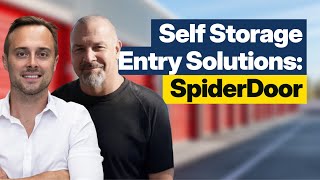
Aaron, founder of SpiderDoor, walks through smart entry systems for self-storage: cellular keypads, a tenant app that opens gates from 150 feet away, wireless motion and door alarms with 3-5 year batteries, and automated padlocks for unattended move-ins. The company serves over 5,000 US locations.
Questions this video answers
February 12, 2024
5,000+ locations (USA)
Approximately 150 ft (tenants must be within ~150 ft to open gate via app)
About 200 alarms per gateway (additional gateways for larger counts)
Approximately 3–5 years
Chapters
Hi, I'm Gavin Shields and this is Self Storage Explained expert advice on how to set up and scale your self storage business. Okay. Hi and welcome. Welcome, Aaron. Thank you very much for joining us.
Absolutely. Good morning. How are you today?
Very well, thanks. Very well. How are you?
Fantastic. I am good. I'm good. Fighting the cold around here. We had a little ice and snow this week, but it's all good. All good.
Where are you based on?
So we're in Birmingham, Alabama in the US it's southern part of Alabama, so we don't normally get snow and ice, but we got it.
So yeah, very nice. Well, so Aaron, we've met quite a few times at conferences over the past year, year and a half or so and we've got to know quite a bit about yourself and Spider Door. And so if it's okay, it'd be great to start with a brief introduction. But what, but yourself and Spider Door.
Absolutely, absolutely. So I started spider door about seven years ago. I've owned storage facilities in the US for roughly 27, 28 years. And about seven years ago I wanted to build an app that allowed customers to actually just be able to make a payment and then I wanted them to be able to do rentals and then we wanted to be able to report problems. And then I want to be able to open a gate. And, and what happened is we've got a lot of locations in America as well as I've got one that is a remote location. So I've got a satellite office down the street about a mile and there's no Internet there, no connection whatsoever as far as networking goes. So my access control had to have a computer running there and that access control software had to be on that computer. And then of course that made the gate work appropriately if the computer was running. But again, it didn't have network connection. So we fooled around and built a device that I mount on the gate that knew where the tenant's app, if the tenant was current, it knew that the tenant didn't owe any money and allowed the tenant to open the gate if they're within X amount of feet of the, of the, of the gate. Now that is our cellular access control. We've got Internet access control as well that uses a Cat 5 to plug in. But bottom line, I just wanted our app that worked for our facility to, to be able to actually allow the tenant to open the gate as well as me open the gate. So yeah, so everything flew from there. We've got 5,000 plus locations in America that use Some sort of product of ours and yeah, grateful to be where we're at. So yeah, that's kind of the, the 50,000 foot view of Spider door.
The thing that I've always liked just when talking about Spider Door is just the, some, I think you seem to find quite simple solutions to a lot of the, you know, the problems that operators have.
Yeah.
So I think, you know, one of the things that I think is different from Spatterdor versus some of the other smart entry systems here in Europe I believe is that you would tend to operator would order the solution from you and they would self install. Is that, is that correct?
So yeah. So you know, at my size, just for example in the past before we created Spider Door, if a, if a gate controller goes down as a storage owner, that is so frustrating. You guys know that, you know you're going to get the call at 7, 8, 9pm, you're going to have to go over there, let somebody in because let's, let's, let's be real. They're paying you money to be able to have access to their site and if they're paid current, your gate's not working, it causes havoc. So the main thing, the problem I was having is I was replacing a digital display. You know, a lot of keypads have a digital display on the front. Ours do not. We just want the gate open. Your tenant does not need this keypad to tell them they're delinquent. They know if they're delinquent or if they're current. So, so bottom line is I wanted something that was cost efficient up front but was easy for a customer, an owner of a facility to be able to install it as well as if something goes wrong they can actually work on it. It's low voltage. And this is just one of our keypads. It's the smaller one. I didn't want to bring the bigger one. The other one's a little, well, it's this one right here. It's a little bit wider in size but bottom line is the customer literally can install it, the owner can install it. And what we've got, you've got a power supply that powers it up. So just a positive and negative, it's low voltage. We send you a power adapter and from that you just run a wire with a positive and negative into the keypad. So that's the connection as far as electricity goes. The only other connection that you have is from the keypad to the gate motor. And forgive me if I'm telling you Something you know, but a normally open and common, those two wires go into your gate motor and then there's a normal opening common that goes into this keypad and that's it. So you've got a total of four single wires that power that up. For our cellular pad, our Internet pad simply requires a Cat 5 cable. So your network, it just literally plugs in. If we look at this keypad and I'm going to try to do this, but We've got a Cat 5 input right here that, that can power it up with POE and as well as your network. And now this thing is functioning based on just a Cat 5 cable going in there. And again, Poe is power over Ethernet. So what happens when that. And forgive me again if I'm telling you something, you know. But yeah, through that Cat 5 cable it introduces electricity, low voltage that would allow this to work as well as it gives you your network connection. So they are crazy easy. The days of pan installer. Two grand to install because there's no software like we integrate straight with stora. So. So if you order a keypad from us before it leaves our manufacturing building, we're already connected with storas access control or, or your platform and it sends the gate codes back and forth and we test that before it leaves here. There's no additional software that you have to add to your computer or load to it. The user can load that URL from any computer. They'll have a username and a password and they can open the gate remotely from anywhere in the world that is the owner or the manager. We've got an app that allows the tenants to open that gate if they're within x number of feet of the keypad. Basically 150ft. You don't want them opening your gate from their sofa at home. So yeah, I'm rattling a little fast on that, but any questions on that? So far.
You'Ve covered a lot of stuff. So the first thing that I'm thinking is. So it's the. You talk about the different cables and connecting them and there might be some people watching, listening, you think, oh yeah, that's all simple for me. All that stuff sort of stuff goes over my head sadly. Yeah. So just to think about that. So I have two sites of my own here in Northern Ireland as well. So if I was opening a third site I and wanted to install Spider door, I would probably have somebody building a, putting something into the gates and like maybe, maybe I have gates and maybe I'm getting somebody in to put a motor on it to open and close the gates. So to be completely honest, so I wouldn't even try that. So you could get something like that, or if you know a little bit about it, it sounds like there might be a lot of people who could do that themselves.
Yeah. And most storage facilities have a pedestal, whether it's new or whether it's existing. You've got your pedestal outside if you're entering a gate. So you've got your pedestal. From that pedestal, there's conduit that runs into the office or over to your gate motor. Bottom line is any gate controller, any, any access control system is going to require conduit from the keypad and ultimately end up at your gate motor. Because when those two wires make continuity, that tells the gate to open. So your gate motor's got to have that. So. So, you know, I sent my daughter on a job site to actually install just so I could say my daughter, who is 22 and she's fairly smart, but she was able to install it because there was an existing conduit with wire already there. That, that was for the original access control. So again, the conduit is going to run into the office because in the past, we had to have software in the office. There was a brain in the office that the keypad ran into the brain, and then from that brain it went out to the gate motor. We can loop through that way to get to the gate motor, but you don't have to do that anymore. You just gotta have a run from the keypad to the gate motor. And again, if that pipe has got wiring in it, fantastic. You just gotta have four of those wires to use. If it doesn't pay an electrician to go do it, because they'll, they'll fish that, that pipe with a fish tape. And it's just going to save you a lot of money based on what you would be paying an installer to do that.
Yeah. Yeah. Okay. Okay, that's. That's helpful. Thank you. So from a customer point of view, then. So if you're, you know, you're renting storage and you, you know, you book online and you turn up at the gates, what's the customer experience there? Do they. Have you mentioned about a customer app? Do they have to download the app? What are the different ways that a customer might interact with the system?
So the system's going to work just as any gate system would. The customer's always going to be able to drive up and type in the code. So understand that they do not have to Use the app. Matter of fact, there are a lot of locations that do not provide the app for the customer to open the gate. That's strictly, that's perfectly fine. It still opens based on what their code is in your system. One thing I didn't point out. Let's say that your network goes out last night at 9:00pm at 8:59, you know, whatever had synced from Stora to Spider Door, it's on this keypad. So if the network goes down, that customer's code lives on the hard drive in this keypad. So as long as it's got electricity, if a storm comes through or whatever, it's not going to stop the keypad from working unless you lose power to your gate motor into the keypad. Codes are stored here. Now you will not be able to rent a new unit and update it because you know there's no way to connect to it. We also allow the user to, or the, the manager to add master codes. So you can add 500 master codes if you want to or one those codes live internally on this keypad. So if that network goes out, it's gone. I mean it's there but you know, you can go in your admin, add or delete master codes as you see fit as well, if that makes sense.
Okay. And then I mean it's probably like it sounds pretty obvious question here, but if somebody hasn't paid and you know, using store and pre work with other systems too in the US it just overlooks them based on the settings that you've set up in the software.
Yep, that's exactly right. If your software tells me they should be denied access, we deny it once they pay. Your system knows that and it tells us and our system allows them access. But yes, it's going to follow your rules. You don't have to set those rules in Spider Door. We follow that rule based off of what you send us from store.
Yeah, yeah, yeah. Okay. Okay. So. So Aaron, as well as the smart entry solutions you have, you have some other products as well. And can you talk us through a little bit about those?
We do, we do. So we have that tenant app that I mentioned earlier that allows people to rent units, pay bill, open the gate, report an issue, notify the manager that they're moving out. Those are some of the the things that it, that it does. But we also have alarms. We have alarms that actually go in the individual unit. So let's say that you've got alarm inside the unit or every unit, let's say you had 100 units, and every unit had this alarm. It's a wireless alarm that literally sticks to the wall with a magnet. It's assigned. So let's say unit 105. We've assigned my unit. You've rented me unit 105. I come into the facility. I type in my gate code. It this. Not only does it open the gate, but it disarms the alarm. In my unit, that alarm does a couple of things. It picks up motion. So it picks up motion of something hot in there is infrared. So it picks up me moving in there. So when I go in there, raise the door. I can work in there for eight hours if I want to. For after one hour of no movement, the alarm rearms itself. So what that alarm will do. Let's say that I'm a thief. I come into the site, I still rent from you, but I'm a thief. Type in my code. I go to unit 105. Me and you both know that I can go in my facility today with a drill and take metal down and go right into the next unit. We call that tunneling. Someone. I could do that and go over to 104. 104 has that motion alarm in it too. But I didn't type in my code for 104. So 104 is still armed. So when it catches movement in there, it does. It can do a couple of things. It can scream immediately or not. It's the owner's call. Whatever the owner chooses to do there, it will text message the manager or not. Just whatever the owner chooses to do there. It will also text message the tenant just based on if. If you got. If the owner wants us to send that to the tenant or not. So. So, yeah, they upsell that like insurance. We've got a guy in California that's got 51 locations, and he upsells it like insurance. He charges $9 for each alarm. So they pay us a dollar a month for the alarm, and then he upsells at $9. And they've got an additional alarm in there. So that's one item we've got. We have debt collector. You got a question on that? Gavin, did you have a question?
So you mentioned that. So that the. You said the sensors are magnetic and go onto the wall. So how are they powered and how are they connected to. How do they communicate?
Yeah, so they're on a mesh network as far as connectivity. So you've got one gateway that sits centralized. And 200 alarms will grab onto this one gateway. If you had, say, 390 units, you'd have to buy two gateways. So these two gateways would sit and you'd have a alarms and they'd go around the units closest to this gateway and then you would have B alarms and this is a B gateway. So they connect to that. So they connect independently to each gateway. If you had a thousand, then you would have, you know, for each, each 200 units, you'd have one gateway. The battery life is three to five years depending on if somebody uses it quite frequently, it might go out. But you, I don't have a battery sitting here with me, but you can buy our batteries on Amazon. And my, yeah, my. They're about $13 and my admin will let you know when that battery gets to 20% life. It lets you know if the, if for some reason, let's say an alarm went bad or somebody stole an alarm or whatever is going to turn red and your manager can see that list in real time at any time or within a couple of minutes, it's going to reflect in our admin and let you know that that alarm is actually missing.
Yeah. Okay, interesting. So, so the alarm costs a dollar a month and then you, and then you have to replace the batteries every three to five years, which you can buy on Amazon.
You do. And the alarms, we've got them down now we've got a new product so they're down around $90. So you got to buy the alarm and then you pay us a dollar a month for that service per alarm. And you know, I got a group, another group in Arizona that has 6,300 units and they provide that as a service. So they don't upcharge it. Now they're probably getting it on the rent, but you know, they don't, they don't upcharge it as far as they just, it's an amenity.
Okay. Okay. So 90 bucks, $90 to buy the alarms. You self install them because they're just, they're magnetic. You can put them up yourself.
Yep. And when you, when you. Not to go into too much detail, but on the alarms they have NFC sticker on them. So you, or it's built in the board so you have the manager's app that you can tap and you associated unit 101. And now it lives on 101. So if somebody rents automatically arms it after an hour of the, from the rental and, or no movement, whichever comes first. And that's how that, that works. It's all automatic. So you don't have to, you don't have to rearm it when they leave or forget about rearm it and all that jazz. It does it automatically.
Yeah. Okay. And I think one of the things you mentioned there that I find particularly interesting is the idea of kind of upselling. So you might put, if you've got 100 units, you might put, you might decide, I'll put these in half of them. And then the customer you mentioned, you said it was $9. Are they charging $9 per month extra for these units with the alarm or is that.
They are. It's an upsell. Just like we sell insurance for $7 or, you know, $14 for $2,000, whatever the case may be of insurance. Same thing with alarms. We have this alarm in your unit. It will notify us if there's movement in there. If that customer comes in and piggybacks in and doesn't enter their gate code, it's going to go off. So if somebody gets in a unit that's delinquent, that they're not supposed to get in, they jump over the gate. The owner's going to know, the manager is going to know. That's what I like doing. I like catching somebody when they try to sneak in. Yeah, so that's. But, but yeah, that's, that's the, that's the flow of that thing. So absolutely.
Okay. So smart entry systems for gates unit alarms. Is there. Are there other things that you do at Spider Door as well?
So we have debt collector, which Debt collector is just an automated service that allows us to provide the owner of the storage facility with a telephone number that you can plug in your tree, your IVR or whatever people call that number. It researches the database of the tenants in our back end. It says, ah, that's Aaron Brown. He rents unit 105. He owes us $112. It tells them what the balance is and they can, it walks and prompts them through and they can put their credit card number in and pay over the. Over the phone call. So that's one item of the debt collector. Second part is tax collections. We send out a text on say the 5th, 11th and the 19th. It basically says friendly reminder. And all these are on our website. Gavin. They can go to our website and see all this. But it basically says, you know, friendly reminder, you're currently due $74. Please click here to pay. When they click it, they don't have to log into anything. It already. The URL that they click allows them to open up. It shows their name, their unit number, their balance. They Put their name in their credit card and submit it, and it processes it, for example, through store, it would just process that payment right through. So same thing with an email. You say, maybe I want the email to go out on the 9th, the 17th, and the 28th. We send that email out. And then lastly, I hate robocalls. I hate them. But one of our big REITs called and said, aaron, we want to do robocalls. I'm like, why? I hang up on robocalls. And he's like, it's beneficial because it at least lets that customer know that owe us money. Even if they don't want to take the call, they know they owe us money by getting that robo call. So it will leave a voicemail. It notes that if it's a voicemail picks up and it tells them a different message, basically to call the office. So that is called our debt collector suite. And that has. That's only been out about four months. And we probably. We probably got 2,000 locations using it now. It is wonderful. It automates your collections. You know, if there's 50 people that don't come in and pay this month manually, they didn't want to go on auto pay, but they're cool with clicking on that link and do it. That's 50 people that didn't talk to my manager, and it gives my manager time to do other things.
Fantastic. Yeah, that sounds. That sounds great.
Yep.
Okay. Oh, wow. Okay.
I think. I think the only thing I haven't shared with you is something brand new. We've got. We've got door alarms now that are wireless. So just like you're at your home, you know, you've got something mounted on the wall, and then something's mounted on the door when those pull apart that magnet. So we've got those that are wireless now that they really just. I just. They just got. We just finished them, so. So, yeah, they work just like the alarms do. They're wireless. They've got that same battery that I shared with you inside that. It doesn't scream. It simply text messages. Management says you have a door that's been opened and it shouldn't have been opened. So we've got those that are coming out too, that are still under that $90 price point. And we charge monthly a dollar for each alarm that's on the door there.
Do you see that solution as an alternative to the indoor magnetic alarm alarms or. As well as.
Or.
How do you say that?
Yeah. So the motion one, to me is a better product because if somebody comes in the side door, it's going to get it. If they don't raise the door on your slide, you know, your rollup door, that door alarm's not going off. The problem is, is let's say that you're 90% full. You got to call each customer and bring their key to unlock the door to put that unit, that wireless motion sensor in their unit. That's irritating. If everybody were there on the same day and let you in, then fantastic. But it never works that way. So the door alarms can be put on without ever opening the door.
Okay. All right. So if you're retrofitting alarms and using spider door, that might. Might be a much better solution. It's similar sort of price. 90 bucks.
Yep.
Is it battery powered as well?
It is battery powered. They're all wireless. So two screws to mount it to the door casing and then two sheet metal screws amounted to the. To the door itself. Super simple. And you do not have to get inside the unit to do that.
Wow. Okay. Okay, thanks. Okay, so you mentioned, was it 6,000 facilities, 5,000 facilities in the US using Spirador?
Last time I checked about a month and a half ago. Yes. And this is. We use their subdivisions, apartment complexes, homeowners association. That has gates. So not only do we do storages, but we've got people's personal houses, their homes. They've got a gate at the entrance. They use our cellular access control because all they got to have is a little bit of power there.
Yeah. Yeah.
Okay.
Okay. And so for. For the operators, the self storage operators, what's the most common. What's the most common use of your. You have a lot of products. What's the most common desold product that operators would have installed at their facility?
Keypads.
The keypads.
Yep. Cause the keypads are pretty much a necessity. There are people. I actually had a facility that did not have access control anywhere. It didn't have a gate around it. My clim. It was. A lot of. It was climate, you know, interior hallways. I didn't have a. It was in a very good area. A class facility, brick. I mean, the whole nine yards. And I didn't have. I didn't have gates there. We just overlocked, which. That's something I failed to tell you about too. We. Now you can go to. We have Home Depot and Lowe's here. I don't know if y' all got those hardware stores.
Yeah, I've heard of them.
Okay. Okay. So you can go buy a padlock that's got a four digit tumbler code on it. It's just a manual lock, you know, and you can put that on your unit. And when somebody pays, our system would send a text message to that customer and say, hey, you just paid for your unit, Gavin, here's your unlock code and you can take that. And that's overlocking. You know, at my site we used to do that with a key, you know, or we had buy this overlock that had the four digit combo on it, but we didn't have an auto, a way to automate it. Now our system will allow us to automate. You can go buy padlocks from Home Depot or whatever your hardware store is. And we, we allow you to plug that code along with an identifier, we give you a sticker or you can do your own sticker, you can write it on the back with a Sharpie, whatever floats your boat. But that identifier lets us know, hey, this padlock goes with unit 218 and the combo code on is 2121. And it'll allow that customer when they pay is automated. So they don't call that owner or manager at 7 o' clock mad because they can't get in. If they'd have paid their bill, they wouldn't have been mad to begin with. So, you know, pay your bill and you won't have this happen. But if you do now it's automating it. And even though they were delinquent, it still makes your owner look good because he's automated this to where this flow can happen at night if he chooses to.
So could that solution potentially also be used or is it also used by any operators for, you know, if somebody wants to move in the first time on a Sunday night, there's a padlock on the unit and they could, you know, open the, open the door with spider door and then go and go and you know what I mean, open the pad, open the padlock as well with the code. Is it used in that way as well?
Yeah, when they do the rental with different management software. When they do that rental, it actually they plug it in the lease agreement. So there's a keyword. We store it in the software, not only our software, but it would store in your software and that code would actually run with that unit. So when they rent the unit, yeah, that code's there. They can do it. We can also locked in ready is what it's called in our system. So if I put them on my empty units, a lot of people we got some crazy people in the United States, California for example, the law is very difficult to get people from sleeping in your facility or staying at the site. So we overlock those units to keep that from happening. You don't need anybody sleeping in my units or living in my units. They go to the non rented units and they sleep there. Well, if you've got those non rented units, even though they're empty, if you've got them locked up with that padlock, then they can't get in obviously until they rent the unit. So. Good point.
That's a, that's a really nice solution and I think would be interesting for lots of people here in, you know, in the UK and in Europe because lots of people want to run these sites without staff there. So you could combine the smart entry system in the gate with your padlock solution as well on unit doors, containers. And you know, in theory, well, not in theory, you can actually then have customers drive up on Sunday night, book online and you know, just move straight in and unlock the unit.
Absolutely, yeah. Yeah, absolutely.
You could really covered quite a broad range of, of products. I hadn't. We, we. Whenever we chat at the shows, it's often five minutes while there's. Nobody understands.
Yeah, yeah.
It's really interesting to hear about more stuff that I didn't even know you did. So it's, it's great, It's a great suite of products.
I can see quite honestly all these ideas just keep coming because people will tell me something that I had not thought about and I'm like, wow. And because we've, our integrations are so thorough, just like you, you and I met and you're like, hey, let's integrate, make the access control. Because access control is the most important in my opinion. You know, 90, I would say 99% of all locations do have gates or they've got a mag lock that's on the door. And I did, we didn't discuss that. But our keypads will work with a mag lock too. You can, you can control that mag lock, mount a keypad straight on the side of a building and control that lock going into that door. I didn't mention that a minute ago, but it works perfectly there. But yeah, yeah, I learned from, from owners and it's pretty cool. I love what we do. I love what we do. It's fun. You know, some, some people will bring you a stupid idea sometime and I just smile and go along with it. But a lot of times they're bringing, you know, I, I listen and learn. And if it makes sense, I learn from. From these owners. So, yeah, it's been cool ride.
Yeah. Okay. Yeah. One thing I just realized we didn't cover was the cost or the price of the smart entry system. So we covered the cost of the alarms and all that. So can you give us a. And I know you've got different solutions. What are the prices? If somebody's looking to get into this in the UK Europe, what are the prices of some of these systems?
Absolutely. So we charge a base fee per location. So first and foremost, you know, if you have four locations or whatever, our team's going to ask you. If you're above 400 units, then it's 75 base fee. Doesn't matter what you use at spider door. So 75 base fee. Right. To begin with.
Per month.
If you're under that. Per location. Per location. Yeah, per location. If you're under that, they're going to write that price down to probably $60, give or take. So bottom line, let's say you had 200 units at a location, $60 base fees, what you're going to pay, you had. Let's say you had 44 locations that were all 200 units a piece. 60, 60, 60, 60. You're going to get an invoice for each location each month. The keypads are $10 a la carte. So you're adding $10 for each keypad. So let's say you had an Internet keypad, let's say you had an entrance pad. That's all you had. So $60 plus 10. So that's $70 if you use our Sailor, which I'd have to double check to make sure our Sailor coverage works in in Europe and UK and what have you. But they're $30 additional here. Just like you were to go get a phone for a family member or whatever, they're going to charge you that extra amount. Unlimited data on the keypad. The chip comes in it. You do not have to go get the SIM card. We provide the Sailor connection when it's shipped out. So that's $30. So if you had one cellular keypad, plus the base fee, it would be 60 plus 30. If you had an entrance and an exit, it'd be 60, 30 for the entrance, 30 for the exit. Debt collector. All those are different prices. If you already use our product, the debt collector right now is set at $55 a location. The alarms are a dollar a unit. Probably forgetting something else. But, but, yeah, but the base fees, the main thing you need to know if you use the tenant app that's part of your base fee. So let's. We've got hundreds of locations that just use our app to. To pay their most important thing is to give them all the opportunities to pay a bill easily. Give them a website, give them an app, give them text, collect whatever it takes for me and my customers to pay easy. I'm trying to get their money. That's my goal. I want them to pay me. So. So yeah the app is just part of that base fee if they do.
The app and then other is there a one off cost into purchasing the hardware as well.
So yeah, the hardware is priced differently. That's on our website to anywhere from 1500 to about 1800. Actually our bigger keypads are 2100. So from 2100 down to say 1500 is the ballpark. The smaller ones are more cost efficient. They're made of a polycarbonate glass blown nylon. We do have some that are stainless steel. The big ones are stainless steel. They're a little fatter. I didn't show you that a minute ago but let me see. This one is not built all the way but nor do I have a key. But the antenna for the sailors mounts on the top and they're just a little bulkier. A lot of people use these for the entrance. This is the S23C. We have an S23I that allows you to plug the Internet in. Override key on the side. If I go to my site powers down or let's say my keypad's dead, got hit by lightning. But the gate motor is still powered up. There's a key right here. We call it the manager's override switch. They put the key in to turn it. It makes continuity manually inside of the box. So the gate would still open if this keypad were to do something crazy or if something wasn't sinking or it just wasn't working. The manager can always click here and if they turn that key it's like telling your gate motor we're touching the two wires together. If it doesn't then it's very easy for us to know that it's your gate motor. It's not the keypad support. Monday through Friday 8 to 5 Central Time and troubleshooting. It's crazy easy. When they call we. This is all low voltage inside of this keypad. So our team may ask you to pull two of the relay wires out. Let's say the keypad you call and you're like man. The gate's not opening, we're going to be the first ones to be blamed because we're the, we're the access control part. So when they call, we look at a couple of things. Takes about four or five minutes. We have them pull the wires out the manager. Now, the spider keypad is independent. It is no longer connected to your gate motor. When I touch these two wires together, your gate's supposed to open because this wire runs over to your gate. When you make continuity, the gate opens and you pull it apart and close it. If they touch these wires together and the gate opens, this is bad. And we will send you a new PCB board. They're 300 bucks to replace the PCB board and your manager can install it. Four screws and three wires. If your gate does not open when they touch those wires together, unfortunately you got a gate problem. And that's not anything that, that we can help with, but you'll at least know. Golly, I need to call my gate motor guy and have him come out and check it.
Yeah, yeah. Okay, so to review some of the pricing then, because there's quite a lot of different things to think about there. So let's say you're opening up a site with 200 outdoor units. So in the UK and your containers, shipping container storage is very popular here. So let's say you're opening up a shipping container site in the UK you're going to buy 200 of them. You want to put a gate on the front, you're going to get maybe most of the hardware. So something from, I think you said 1600-2100 in that region to purchase the hardware which you then install and then 60. $60 if you have 200 units, it sounds like it'll be around $60 plus another 10. You've got the, the Cat 5 cable for that thing per month. So you're talking about $70 or have I missed something?
No, you cut out on me just a little bit there. But the, the $60 plus 30 if it were be this, if it were to be using the cellular, $10 if it's Internet. You got that right. So 60 plus 10 is 70 or 60 plus 30 is 90 for the cellular.
Okay, so you cut out on me as well there. So I'm gonna assume that it must be my Internet. I'm gonna assume that. So 60 plus 10 or 60 plus 30, is that right?
Yes, sir, that's correct.
Okay. And then if you wanted to get the alarms, which I think are very attractive product to us, $90 to buy they're a dollar a month as well. So you know, you might be buying 200 of those or you might buy 100 and, and you know, you make that back in a year or two of renting it easily with fee. You know, it's more secure.
Right.
That's fascinating.
That's right. And keep in mind the base fee is charged with whatever you use. So if, let's say you called and you had 200 alarms and that's all you did, obviously you got to buy a keypad to get to disarm the gate, disarm the alarms, open the gate and disarm the alarms. So you got to pay $60 base fee plus the keypad and then the dollar per alarm. Nobody normally calls and goes, aaron, we don't want a keypad, we just want the alarms. But if they did, they would still pay us that $60 base fee and then a dollar per alarm. But they've got to have a way to disarm it.
Okay. Okay. Is there anything else that I haven't asked that you think customers should know about?
I'm sure I've forgotten something because I'm getting old. But, but, but yeah, I think you've pretty much covered the, the necessities anyway. Yeah.
Okay.
Our biggest sellers.
Great. Okay. Well, Aaron, thank you so much and great again. And I'm sure I'll see you in a few months at the next conference.
Absolutely, my friend. Thanks for taking time and letting me chat and hit me up next time you get in the States.
One final question. I forgot to ask if somebody listening or watching wants to actually get in touch to find out more or order a system, where should they go to?
So SpiderDoor.com and it's just like the insect Spider Door.com obviously they can go to our website. We're in the states, so 200-582-1000 is our number. They're welcome to call us there. But yeah, you can talk to a person live or you can go to our website. Our website is full of videos and info, so I would, I would Suggest going to Spiderdoor.com first. But you're welcome to call and we'll chat with you, long as you want to chat about our products.
And it's correct that at the moment all of your customers in the U.S. so if somebody listening wanted to bring Spider Door into the uk, they would be your first customer here as it stands today in January 2024. But there's no reason all the stuff we talked through would work fine there. Integrates with Stora, I'm sure other software systems too that some people here might use. So there's no, there's nothing stopping it working here just as well. So you know, if you're listening then you know, check it out and give Aaron or one of his team a shout.
Absolutely. We would love for you to be our first customer there. So yes, that would be great. Like I said, the only question I would be curious to find out and I just need to call them to find out to our from our providers is the sailor part but everything else should work appropriately. We've got, we've got customer in Australia now of course we're in Hawaii and Canada already so. So yeah, would love to be in the uk.
Great, great. Thank you so much Aaron.
All right my friend, thank you. And you have a great week.
You too. Thanks very much. Bye.
All right, take care. Bye bye.
Thank you for listening to Self Storage Explained where we aim to provide expert advice on how to set up and scale your self storage business. For more resources including financial models and in depth guides for setting up or growing your business, visit our Self Storage Academy at Stora Co. That's forward slash academy. And if you would like to find out more about how Stora can help your business grow sales and save time, set up a demo or contact us at Stora Co. At Stora Co. Thank you.
More from Gavin





Wie Space4You Einzüge von einer Stunde auf wenige Minuten verkürzt | Kundenbericht





