How to Grow Your Self Storage Business
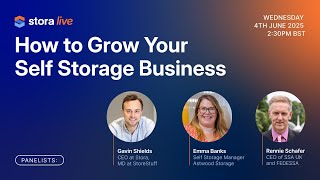
Gavin Shields talks with Emma Banks and Rennie Schaefer about scaling a self storage business. They cover building a growth plan, fixing operations before you expand, raising revenue through pricing and add-on sales, and deciding whether to add units or open new sites.
Chapters
Hello everybody. Hi and thank you very much for joining our live webinar. We're joined by two absolute legends of the self storage industry today, joined first by Emma Banks. Emma is a self storage manager at Asford Self Storage. Thanks for joining Emma.
Thank you for having me.
Do you want to introduce yourself briefly to the listeners?
So yeah, I'm Emma Banks from Asford Storage, self store manager. I've worked in the industry for about just over eight years. I also do a consultancy, part of my business as well with on my box consultancy.
Thank you Emma, thanks very much for joining us. And we're also joined by, I'm sure most people know him as well, Rennie Schaefer, the CEO of the SSA UK and Fidesa. Renny, thanks for joining us. Thank you very much Gavin.
So yeah, so I've been in this role for about 12 years now and prior to that I ran the Self Storage association of Australasia for nine years. So I've been doing self storage for a bit over 29 years now. Yeah, so that's me.
Great. Well, yeah, thanks. Thank you both of us. It's great to have you both on here. I'm sure we're going to cover a lot of interesting stuff and I think this, this topic especially about how to grow your salesforce business, really it's very interesting topic. I'm sure a lot of people listening are asking the same thing every day. So got some great content I think to get through here. So let's get started. Emma. Oh actually before I start the first question, anybody who's listening or watching, feel free to drop some questions into the comments box. We will have time at the end to go through them so if something pops in your head just note it down and then I'll give us a chance to come to it later. Emma, can you tell us a little bit about how you got started in self storage?
So I actually fell into it by accident. I was in retail for a long time like everybody got fed up of working stupid hours at Cross Christmas, no time after and some are all that sort of stuff. So I actually went for a role, didn't really know what it was, just came up as a duty manager. Didn't actually even say self storage in the original role. Went obviously applied, went for the interview and it was with a space station which obviously was run by Kevin Prince. So that was my first role into the industry. So I went as a duty manager at the Kings Heath store in Birmingham and you know, absolutely loved it, Thought it's such a different different industry. I've never seen anything like it before.
And as a duty manager, what were you doing? What's, what's the duty manager role?
So duty manager was almost like an assistant store manager. So I ran the site when the store manager wasn't on site. That site was quite, it was quite a big site. You know, we had sale internally and externally. So while I was there over two years, we increased the external side. I kind of of slightly managed more so the external one because some of it wasn't going very well. And then, you know, and then obviously looked at new ideas into the, you know, obviously looked at new ideas to help promote that site, which, you know, they were open arms with, which obviously then led me into being able to go into my next role with squab and you know, doing more and more local things and growing the business there.
Excellent. Okay, thanks. Emma Rennie, I'd ask you the same question, but it's so long ago you probably can't even remember how you.
Moving.
On to kind of, I suppose, growing business. What should operators focus on first if they're looking to grow their business and how can they go about doing that?
Yeah, so I actually think they need a plan, which sounds really basic and common sense, but I think I see a lot of operators that kind of just grow for growth's sake and don't necessarily have a plan. So I think you really need to have a growth plan. And that growth plan is kind of typically why, how, where and when. And I say this to people and they kind of say, you know, the why bit sounds a bit silly. Why do I want to grow? Well, actually that's kind of a fundamental question because people grow sometimes just grow because they think they need to. But where do you. Why do you want to grow? Do you want to grow because you're trying to grow your asset base? Do you want to grow because you're trying to get more cash flow? Do you want to grow because you're trying to resell at some point? So you want a platform to resell. If you have an understanding of why you're growing, that's going to change the way you grow. So I think right before, right from the word go, you need to kind of understand that why, as in what are you trying to achieve? Why are you growing? And then you can go into the okay, how are we going to do that? Where are we going to do that? Because obviously self storage. So location is super important. And think about that location and how you're going to, you're going to spread out and also give yourself a timeline. It's not about, it's not a race necessarily. So some people kind of expect to be able to grow at mega speed. While sometimes it's not always the best thing to grow at mega speed. So I think you really need to have that kind of structured plan to say okay, understand why you're trying to grow and how you do it. And then you've got something to work towards and have a plan.
What about people's expectations? Because there's an awful lot of. The self storage industry is growing and attracting a lot of new entrants who are ambitious and keen to kind of grow their business, establish a business and grow it. But I think the reality sometimes can be a little bit like you've just gone through there. It's not as simple as just I'm going to grow. You know, we would, we would talk to a lot of people getting into the industry. We might say I want 100 sites. And I actually originally thought that myself, I'm going to get 100 sites the next five years. And then reality hits and you kind of, you realize actually it's not as simple as I thought. You know, there are different things can block your growth along the way. Like what are some of the most common blockers you see or mistakes operators can make kind of at that kind of stage when they're thinking about how am I going to grow.
Yeah. So I've quite literally spoken to hundreds of operators that have said talk to me about their growth plans. And honestly I'm not sure I know any single one of them has actually met those growth plans. Everybody thinks they're going to have 20 stores. Even if they even think they're going to have three stores, more often than not they don't manage to do it. Very few people even opening a store. Everybody says they're going to open the store on say March and usually it's April or May or June. Even hitting an opening date these days is really hard. So there are so many things that can delay and, and put off a site just in terms of construction and planning and all the rest of it. But I think in terms of the most common mistakes that we see or the growth blockers, I do think a lot of it comes back to foundation as well. So before getting your first site is a massive achievement and it's a big learning curve and there's a lot to do and all the rest of it. But when you move on to your second or third and fourth site, that's a Totally different journey. And I think it's really important you get that base foundation right. So if you haven't got your first site locked down and you haven't got your first site operating as best as it can and get all your, your procedures in place, those problems, those issues are going to then roll onto other sites. So you've got to make sure you've got a good management system, funnily enough, you've got to make sure that you've got your marketing plan set up, you've got your pricing policy, you've got everything really set really well for your first site, and then that will force the foundation to roll it out. The thing with self storage is essentially speaking you make money two ways. You make money by adding space or you make money by charging more for your space. And that's the other thing. I think people, people often go on these growth spurts and they forget a little bit about their existing store. And I think this is particularly prevalent in container sites, container sites or external storage sites. It's really easy to go out there and put more containers down or put more units down or grow more space. But at the same time, you should still be managing the revenue on your existing space as well. And it's all supply and demand. In some cases, you're actually better off to put prices up in your existing stores and manage that than you are necessarily adding new space or new stores or things like that. So I think you need to really think about your existing platform, your existing stores, manage those as well. And I guess the other biggest mistake I see is I do see people spread themselves too thin. So they either grow too quickly or they grow too far away. So self storage is really localized. Yeah, it'd be great to have 100 stores across the UK, but very few people will be able to pull that off. If you're going to grow, it's better off predominantly to grow in your local community first, where you're going to get those efficiencies. It's going to be easier to manage. If you start kind of growing with stores that are scattered all over the place, you're losing those efficiencies. So I think people do sometimes spread themselves a bit thin because they see this great site, they want to buy it and they kind of forget, yeah, maybe that, maybe efficiency wise, that's not the best thing, given that I'm located here and that's, you know, 100 miles away.
Okay, interesting, interesting. And so, Emma, you're very involved in running your businesses. How do you think about and how do you make time to think about how you bring the business forward? Some of the things Rennie's talked about are the why, the how, like how do you make time for that and how do you approach that sort of thought process.
So I'm, I've always had this mentality. When I came into industry, when I came in to begin with, it was a case of I need to go and look at what everybody else is doing. So I've. I've always said that to any team member I've brought on or whether I've been talking to people looking to come into the industry is go and look at your competitors, where you're potentially looking at, because that will give you a lot of what you need, what you want to do best, you know, what you like. Some. What you might like doing actually doesn't. We've seen it in action, it doesn't work. That helps that also about making time to look at, look into the future as best you can. And that's really sad, it sounds really funny. But, you know, it's going, having that opportunity to go and look at sites further afield, go and have a look at. So I obviously being part of the ysn, I have a lot of communication with the American, their American version and some of the Asian, some of the people from the Asian version of us as well. And obviously Asian markets, mass, you know, they're doing some really cool things with tech that, you know, we're not doing yet, even the Americans aren't doing. So that helps me vision what I'm going to do to help my business grow. But I also look at other industries. So I also spend a lot of time looking at the, looking at the moving market, looking at the removal market, because that has a high impact on my growth of my business. So, you know, if the removal market's not moving, you know, removals are really quiet. I'm potentially going to be really quiet. How do you go on.
Sorry, I was going to say, how do you. Do you have some way of being able to see that, keep an eye on that sort of market, or do you have some friends in the industry or how do you track that?
Friends in the industry. So having friends in the industry, picking up the phone, having a conversation, you know, I know Ian stood very well. So, you know, I could, I know I could message him and say, like, what's going on? But I follow the bar, I follow, you know, the moves and met removals moves and all that sort of stuff and lots of little other groups on LinkedIn. And you know, you know, Britannia are a massive company and obviously they're franchises, but if you can get in with a couple of those, they'll tell you about what's going on. And it, you know, it, it's about in your area. So there might be one big removal company. If you can get in with them, they'll tell you how they're doing. So that then helps you, you know, if you find every, you know, obviously we talked about seasonality. I think, you know, when Covid hits and seasonality changed. I have, we have seen a little bit more of it come back. Obviously when Stamp Duty finished last in April of April, everybody at conference was saying, oh, it's gone really quiet and it's kind of okay, so what have you planned for that in between? You know, really like, you know, what are you doing? I said, well, I'm marketing for the next three months in advance or six months in advance when people are gonna start buying properties or I'm checking.
Right.
Move and all that sort of stuff. Right. What properties are coming on the market now? Okay. What type of properties are coming on the market? So the type of properties are like four or five bed house. Okay. I'm going to target those people that are probably move downsizing because kids have left. So that. So then that changes. Right. Okay. What am I advertising for? And obviously, you know, looking at other industries, you know, you can look at different industries and look at what they're bringing in. Like the logistics side, the transport side, it all has an impact for sure for us.
So you're thinking ahead, you know, like you're kind of thinking three to six months ahead. And I suppose because you've been in this industry for a while, you probably knew, you know, the stamp duty change at the start of April was going to lead to a very busy march. I remember one of our customers telling me at the conference it was a quiet April, but they've done as much business in the first quarter of this year as they did of all of last year.
Yeah.
So it was obviously, you know, it was a good time, but planning ahead, like I said, that sounds like it's. It's a sensible approach.
Yeah.
And to be honest, the thing that it's gone a little bit busier now again, which is good. But the people that are walking through my door, the people that I was advertising to, which is the people I knew were going to come through, and that's just down to knowledge. And obviously, you know, been in the industry for a while and seen it when we had the last ambitious changes, we learned off that.
Yeah.
And, you know, and obviously, if you're new into the industry, you know, I was talking to a guy at conference and he's like, oh, yeah, I'm gonna do this and I'm gonna do this and do this. I'm like, because it's been massive growth. And I went, yeah, it was during COVID Now it's gone back. Don't just get into it because it was really profitable. It's not like it's not possible now. But, you know, I think there has been a bit of blindside where people have been going through that first stage during the end of last bitcoin. And now I've come into it, it's not actually happened how they want to. Wanted it to, because they've had conversations with friends or whatever that were in it during that time.
Yeah, interesting. So. And Rani, one of the things you mentioned there just about when you think about moving your business forward and growing the business. So let's assume you're. That's the plan. You want to grow the business. You've got. You've done your why and you know why you're doing it. And you mentioned that, you know, you can kind of grow in two ways. One is you can. You can open more space, whether that's a new site or open more space in your existing site, or you can kind of optimize your existing space, and that's around occupancy and revenue. What should operators be thinking about if they want to expand their current site? What are the things they should consider? Yeah.
So obviously expanding your current site is something you really need to think about because you've only got so much space. You haven't got an unlimited amount of space with your existing site. So it's not uncommon for people to fit out parts of a building or have so much land available and put extra land on. But you've got the ability to learn from what you've got. So obviously Unit Mix is a big part of that. So when you first open your store, Unit mix is a bit of a guess, be perfectly honest, because it changes depending on the demand in the store and the location, all the rest of it. But now you've got some operating experience, so you can kind of see what the demand for different units are depending how long you've been open. You can see the seasonal demand for different size units and all this kind of stuff. So you get to have a bit of a better take on. On unit mix in terms of. In Terms of that, I think you're also.
So you saying, sorry, Rani, but are you saying, look at your unit mix and maybe change it if. Well, yeah, I think people do that.
Yeah, I think not necessarily change it, but I think if you're looking at expanding, putting new space on, you can. You can say, okay, am I going to build big units? Am I going to build small units? Am I going to build. Yeah, that's the kind of decision you can make. When you. When you start your new store, you typically take a bit of a scattergun approach, kind of going, okay, I've got a bit of an idea. I can look at the competition and all this kind of thing, but generally speaking, you kind of go, all right, I'll put this many large units on the ground floor and then kind of tear them up and take a bit of a guess. But once you've been open for a year or whatever, you get a better idea to say, okay, well, I know that I've got a massive demand for small units because of this, or, you know, I've already filled up all my commercial units, so therefore, do I want to go commercially more commercial units? So. So you can take a bit more of an educ. Philosophy to the unit mix. And I guess also think about, in terms of commercial customers versus residential customers, all these kind of things. So you've got much more data on your business to be able to have a more educated approach to how you develop that store. And unit mix is probably the most. The clearest kind of evidence of that, I think. You do also obviously need to think about the competition, what extra space is coming on? Are you about to have three new stores open nearby, this kind of stuff? Because that influences your timing of it and. Yeah. And the ability to sell a product and all that kind of thing. And I think, also coming back to what I said before, I'm probably going to keep coming back to this. And again, it comes back to pricing. So what impact is if you're going to put an extra 400 units or 100 units or 20 units, whatever it may be, onto your store? What impact is that going to have on your pricing? What impact is that going to have your pricing on existing customers as well as new customers? And think about that kind of kind of pricing strategy in terms of what's your goal in terms of revenue generation rather than necessarily your goal in terms of occupancy? Because I think it is easy when you open a new expansion to kind of say, gee, I've got to fill it up. I'VE got a, I've got empty space, I need to fill it up. And, and that's all good and well, but at the same time you're there to make money, not necessarily to fill space. And, and so managing that pricing is really important. Right from the, from the word go.
I was just gonna say. So obviously done expansions in the past. What we found after the first one we did was, is document it from the day one. So start putting it on. So this is my social media. You start pushing it on, on. We did it by pushing it on socials. Like this is, like this is. Oh, look, within a day, look how much the guys have done or you know, and that's literally some starting building the Met if you're having a full measure, structure, whatever. And what happened is it gained people's interest and we actually with, with a lot of the ones we did with when I was at squad, we had waiting lists. We were opening it on like this day and we were having like 3,000 square foot go in within a month because we'd like to planned it so people like, right, okay. And it also meant that if somebody came to us while we were developing this extra space and said, actually I actually want this slightly different size because you were still developing it, you could change it. So, you know, instead of, you know, I've done it lots of times where I've built a brand new, brand new section of cell store and end up taking walls down because somebody's walked through the door and wanted 500 square foot. Where if you've got, if you're building that and that customer's like, yeah, oh, I'll wait, I'll wait, I'll put a deposit down. Then at least then you're kind of building it ready for them. It makes you more attractive than them going, or I can have it down the road like next week, but it's gonna have walls in it or it's not as nice, it's not as clean. So that's just a bit of experience that I've had with it.
And what platforms would you recommend people use for that kind of. To customer advertising?
Facebook all the way. Yeah, yeah.
But also, but also offline advertising as well. Like, you know, just simple things like signage around your store. If you've got, if you've got bus stop advertising or roundabout advertising, you can put near your store, stuff like that. Yeah, I agree. You've got definitely start marketing it, you know, as you start constructing it, if not before. But yeah, think about offline marketing opportunities as well, just to tell people in the local area what's happening.
Yeah, excellent, great advice. And yeah, advice I, I should have you taken from my second site, which I kind of opened without telling anybody. But anyway, that's. I didn't make that mistake with the first site, but the time the second one came around, it was maybe I was a bit. Bit cocky about it. So, Rennie, you've talked there about kind of managing, you know, expanding existing sites and the unit mix and thinking about that. Actually, one quick one with that. Do you see many people, you know, the sort of meter cube kind of lockers? I don't see them that often. Is that something that's quite common here to kind of fill smaller bits of space that you can't get a unit into? Do you see that much? Maybe, Emma, maybe you can answer that too.
I mean, I certainly see them. They've definitely got their place and it does depend a little bit on the market. I mean, they're great for students and things like that as well. But yeah, I mean, I think they definitely have a role. But it does depend on the store and it does depend on the market and they are very good for just filling empty. They're great. If you've got a little bit of an area which has got an angle like under a stairwell or something like that, where it's just somewhere where you're not going to put a full unit in, then why wouldn't you put something like that in? I mean, the yield on them is fantastic in the respect that you get a lot much per square foot or square meter for them than you do with anything else. But at the same time, you know, you're not probably going to put 100 of them into your store because. Yeah, you just don't have the demand for that kind of. That kind of product. Sorry, Emma. You want to. That.
Yes. Yeah. Students are great. If you're near a truck stop, lorry drivers, they find them quite handy. People that live on canal boats sometimes will use them or like, if you. Yeah, like anywhere by this, you know, somebody that lives on a yacht or something, that'd be nice. But also engineers. So engineers that have parts delivered, they. They work quite well for them because they generally need somewhere just to collect, you know, part delivered by delivery driver and they come and collect it. So they can be quite good. But they tend to want to be right near your roller doors, which obviously if you've got like races, a bit of, you know, weird space and you're loading bay or something, you could, you could Utilize that for sure.
Okay.
The reason I ask is I just, I can see how it can be interesting when you're kind of getting fuller and wanting to sort of grow the revenue a little bit. And I think about it at my site sometimes I haven't done it yet, but it does interest me anyway. Renny, what about, so what about you want to make an open additional site? So you're thinking about, you know, I've got my first site up and running, on my second third, you're looking at additional site. What are the key factors for that sort of stage of growth?
Yeah, so the obvious one's location. I've talked about this already. So location is everything in terms of self storage. So the location is going to really set up where that still goes and in terms of whether it's high profile location versus secondary location. But also like I said, how far away is it from your existing store? How easy is it going to be to manage? Are you getting efficiencies from the fact that this is kind of close enough to your existing store that customers that might find it's a bit too much travel to your store will pick up that store. So I do think when you can, you want to try and grow outwards from your existing stores rather than spread yourself out too thin like I talked about. I think also management is a key thing as well. Managing two sites is different to managing one, and managing five is different to two. Managing 20 is very different to managing five. And that doesn't really matter how big or small they are, it's just the logistics of it. And even if you're looking at having remotely managed sites, you've got to think about, okay, how am I going to get people out there to manage the security, to clean them, to look after them and things like that. So managing those extra sites is something you kind of need to think about. I think in terms of building them. Security is everything these days. So invest in security. Invest in as much security as you can afford and make them as secure as you can. Again, particularly if they're going to be remotely managed, you want to make sure that they're really solid and secure. You've got monitored CCTV and all these kind of things that mean because there's not somebody on site, there's really good security. And I think that also lends me to something I'll talk a bit about these days and that's kind of future proofing your site. So 20 or 30 years ago, if you look at these big stores that big yellow built 20 years ago, they're still running now and they've had very little capital maintenance done on them other than maybe a new floor put down or replace a few roller doors. But these days, with all the technology coming on board, you really need to think about what will your store need in the future. So you might not be putting electronic locks in now, but in five or ten years time maybe you're going to need to put electronic locks in because that's what everybody's done. You might not have individual alarm units, you might not have all these other different things, but maybe in the future the market's going to go to the point where every customer is going to be expecting that. Have you got the bandwidth for it? Have you thought about the cabling you're putting in? What can you do when you build your site that is going to make it more future proof? Even if you're not going to put that tech in right now, I think you definitely need to think about setting it up so that you can potentially put the tech in if you do choose in the future. Because retrofitting a lot of this stuff, if you haven't planned for it, can get very, very expensive. And if your customers start coming in and saying, why am I staying with you when I need a key, nobody else gives me a key, then you want to be prepared for that kind of stuff.
And Emma, you've been involved in quite a few new sites and growing these sort of businesses. Do you have anything. How have you thought about looking for new sites? Do you have any different sort of approach, anything that you've experienced?
So I, I, it's really, it's a really weird one because I've had sites where we built that have been frontage that I've had sites that have built that you can't see at all. And then obviously I've built, we built us. I've built a site with Squab where obviously it was with Birmingham Council and they wanted X, Y and Z to the hills because if they want to be net zero by this, by 2020, 2030, I think it's 2025 once we're ahead of everybody else. So, you know, you have to put in extra things just to make it future proof, I think. Interesting. Obviously really says about, obviously, you know, the locks, etc. I've never. So I've only ever done one locking mechanism for doors, which was with, with another company and personally had nothing but issues with it. But because we were unfortunately beginning things. But that's fine. But there also was an element the customers you know, come customers like, oh, I don't, you know, there's still that element of customers with tech. You know, what happens if it fails? What happens if all the doors, you know, you can park it and all the doors open, you know, so I get like, there is still that element of customers with security, but it's definitely the way forward. You know, I think when we build our next one, we'll probably look at a version of, you know, electronical lock on the ground floor, probably more than likely not the upper floors, because one you can then charge a premium. But also, like I say, future proof is at least we've already started it. So if we then need to do it for the other floors, we'll have it ready for those. But yeah, I think, I think it's, it's a really difficult one to know what the future is going to be. I think as well, you know, we've talked about, you know, I, Interestingly, I saw somebody put on about having a QR code for their wallet for their customers and interesting. I've been looking at that as well for access code because obviously now you pay everything on your phone, don't you? You have your Costa card on your phone, you have this on your phone. You know, you don't actually physically have something. So I think, you know, that the tech is going to be what's going to. What is going to change a lot. And I think that's why looking at what the Asian market are doing is very interesting. You know, obviously having robots that take people around to their storage units instead of people, you know, that's quite, that's quite funny, but it's also quite freaky, you know. So, yeah, I think there's lots of things and I don't think it's ever, we're ever going to be like, ahead of the game, I don't think, ever.
Yeah, there's so much happening, isn't there, in the industry and, you know, even, you know, outside the industry too. There's just so much going on, so much changing that it is, you know, it's a big challenge to kind of think, you know, where is it going to be in five years? So good to get a bit of vice, I think, from both of you about, think about how people are going to access the site, how are they going to access their unit, how is it kept secure? I think that's, that's about, you know, the most you can, as long as you do that. For now, I think you're, you kind of, you know, you're You're a good bit of the way there. And I can hear your puppy in the background there. Emma.
Yeah, she's crying.
Yeah, well I know, what a shame. But okay, so Emma, what about. So one of the things that I think is really interesting for me it's like the most interesting part of kind of managing a self storage business is once you kind of are at a sort of capacity where you're sort of foolish full, not foolish full. How do you think about kind of managing your revenue, managing your occupancy, managing your rates? Because this is one of the things that we often bump against people who've got like oh I'm 100% full. You know we're doing really well, we're 100% full. But you know then there's so many stories of people wants to change their approach and actually think about well actually I'm optimizing for you know, the business, I'm optimizing for revenue, not for being full. How do you, what advice would you give to operators thinking about that kind of problem? Because there's a couple of moving parts there.
Yeah, you shouldn't be 100% full. Me and many have always had that discussion, don't we? Personally I think if you I like to 85% the reason I like to 85 is because it gives me something to sell to somebody else. So it still gives me that ability to, to offer supply. I always look at our levels of pound square foot every sort of every two weeks, every three weeks because we have a move ins and move outs. The reason doing that is then if I can see that, okay like you know we've got X amount of units sold at this rate. Okay, I need to up that rate on that bill on that that. So for me I, I, I'm happy to change our prices every month or every week. You know I've just done it where the company, company I now work for, we had a new building come on which was you know, 20, 000 square foot brand new space. We opened it on 29th of January. We're nearly at 35 full already by doing that. So what we did is the first month we did discounts and then after month, after the first month I looked at how much we had occupancy and I'm like okay, I'm going to reduce the discount length and then once again so once we get to 50 discounts will change again because one I don't need them all and I also don't offer the discount the customer has to ask me for it. I think there's a lot of that, you know. Oh, you know, I, you know and I do put discounts out there but if a customer doesn't ask me, I'm not going to tell them. And then obviously it comes to revenue. It's a case of managing, you know, managing, managing what your customers are paying. If your customer is paying you, let's say 14, 15 pound a square foot for something that's too cheap. If your competitors are charging 20, 24 pound a square foot, you should be as close to them as possible and rent increasing regularly. So first I only do it once a year but that is something that I personally do and it, it kind of because I've kept on top of our prices. But what I've recently done with the company, I'm now some of these customers never price increased since they moved in, which was like four years ago. So they had a bit of a shock when I gave them a 15 price increase and I said that's fine, you know, off you go then, go somewhere else. I'll put your notice in now. They're still with us because we're still, they're still paying less than they were competitor. So again I'll do another one. In a year's time they'll go up another 15%. Don't be frightened to lose customers because if you lose that customer, you'll gain another customer that's going to pay the higher rate which obviously then helps with your revenue.
What I find interesting about this whole discussion is pretty much the way you prefaced it. Gavin and I get this a lot. We're almost full now or we are full. What can I do to make more money? Why were you not asking that question the day you opened? Why is it you wait till you're full till you go, gee, we need to sell more insurance. Why is it wait you wait till you're full to say, gee, maybe we should put a box, shop up and sell boxes. Why is it to your full that you start going gee, should I put custom rates up on that customer that.
I've been had for two years?
So I think that the trick if you want to make more money in self storage, the trick is to be doing that stuff from the day you open. So from the day you open you should be trying to sell as much insurance as you can. From the day you open you should be selling boxes and packaging. From the day you open you should have a structured program that you're putting price rises up on people. Don't be afraid to say, oh gee, I'm only at 40%. I don't want to put price rises up, they might move out. That's not how it works. Manage your pricing, sell more boxes, sell more insurance. Look at what you can do to make money from your business from the day you open. Like Emma said, 100% is not good. 85%, 90% maybe. But if you're getting up to that 90% mark, then you definitely need to be looking at your, your existing customers and managing those yields.
It's an interesting set, Rennie. I sometimes, I've sometimes thought that, but never been able to put it as eloquently as you just did. The approach that we're talking about here can be started, can be in place from the start is what you're saying. You know, don't wait until you're, it's like 100% full because you've probably missed out on something on the way to over the past few years as you've been filling up before. You missed out on revenue.
Yeah, exactly right. And goes back to what I said before. Why open an existing, why open a new store if you can go through all that heartache, if you can make money out of your existing store first and get your existing store working as well as it can? I'm not saying don't open a new store, but at the same time, don't forget about your existing stores and your existing space and maximize that revenue from day one.
Emma, looking back now, what would you do differently, if anything? What would, what might you do differently if you were starting kind of again today?
I would go and rent for my competitors. That is the big thing that I would do because it then shows me what I'm competing against. So it will show me. So I would, I would go and rent from my main competitor for at least three months. Months, yes, technically I'm giving the money. But it will show me how they run their business within that first three months because it will show me, okay, how do they operate with me inquiring the sign up process, the moving in process, what is the aftermath in that first three months, how easy is it to leave, what is this, you know, and obviously visiting the site regularly at different times because then it shows you, okay, well this is what I like, this is what I don't like, like. And this is how I can be better. So that is my big, that is my big thing that I wish I'd done. And I, and I say this, people coming in the industry, I'm like, go and rent well, yeah, but I said seriously, go and rent. I said, because it will you, you open your eyes. One that if you've never done it before, you actually, if you never use storage yourself and you want to open your first storage, you need to know what, you need to have a look at one for one. But actually by renting one, you'll see it from your customer side and obviously, you know, and if you can also make the friends, and that's very funny, but make friends with your competitors. I'm quite lucky. I can, I've done that. You know, I, I've had a conversation with somebody from another competitor the other day and we were talking about, you know, oh, we've got this customer. Can't, we can't really help them. Can you help them? You know, and they're giving me square footage because they can't facilitate it, but then it can go back the other way when I can't. So, you know, and that's another thing. I would always try and make friends in the industry very quickly.
Quickly.
That is. What an interest. I did not expect you to find that. That's a great idea. So it might cost you a few hundred pounds, but the learnings are well worth it. If they have a 1 meter by 1 meter square cube, maybe that would be the one to take as well. Okay, Remy, so you're, you're the CEO of the SSA UK and Fidesa. What support can associations like the SSA UK and FidesA offer to, you know, operators who are ambitious and, you know, looking to kind of get into this industry and grow?
So obviously we've got a whole lot of tangible support. So we've got like, we've got a marketing guide that gives you tips on different things you can do in terms of marketing. You know, we do a lot of training and a lot of webinars on pricing policies and dynamic pricing and understanding unit mix and the kind of things I talked about before about balancing revenue versus occupancy rates and all the rest of it. Obviously we can give you a whole lot of context for suppliers, people that actually understand the industry know what they're doing. Sometimes it's tempting to go out there and get the local guy to build yourself storage units, but the local guy doesn't necessarily have any understanding about exactly what self storage is and the unit mix and all the little intricacies that make a self storage unit work. It looks simple, it looks like it's just a whole lot of kind of steel and framing, but it's actually a lot More complicated than that. The same thing with security and things like that. So we can give you all those contexts. We've obviously got a ton of data as well in terms of supply and a lot of information about upcoming stores and stuff like that. But I still think that the number one thing we can give you is we can give you the opportunity to actually sit down and talk to somebody who's been there and done that. So, you know, we've got a whole lot of members that have all been through the same journey that you've been through. And so you get to come to a regional meeting or come to a conference or whatever it may be and you get to sit down and have a good chat with somebody who went through the whole process and they'll be more than willing to kind of share with you the things that worked and the things that didn't work. Some of the tips that Emma's just given you are just an indication that kind of thing. But that is one of the amazing things about the self storage industry, partly because it is such a localized business, but just also because it's full of a whole lot of entrepreneurs and business people and our events are fantastic place to network and sit down and people will be quite open with you about what works. And I've been at events where we've had the CEO of Big Yellow, like Jimmy Gibson sitting there talking to a guy putting 20 containers on the back of a farm and still sharing information. So it's a great opportunity to come and really learn from others that have done it.
One of the things you said there about kind of thinking about the right, like learning with the suppliers and doing it right. We hear this a lot. Somebody has maybe opened up a self storage site and. And it's the access control sometimes that we would see that some local person has installed a git with some kind of access control system that he knows. There are hundreds of access controller thousands probably around the world, but what happens then is a year or two goes by and they want to use a software product to help their self storage business run more smoothly, but they've installed some kind of random access control system that won't integrate with self storage software products. And that then can sometimes mean, well, we can't use software or we have to put in a new access system. So I know it's a different example, but we do see that a lot. Even just the access control being kind of some random local system.
Yeah, it happens with all sorts of stuff. It happens with CCTV cameras as well. You go in and the local security guy says, I'm going to set these CCTV cameras up and that's great. But then you're going to go to a monitoring service. The monitoring services will hold on. They're actually not the right cameras for us to do monitoring on or we can't run the AI algorithm through that because they're not in the right positions or whatever else. Locking systems, the whole thing. And the self storage is quite a niche market at. And it's. It really benefits from using quality suppliers that understand the industry. It might cost you a little bit more. Sometimes it doesn't, but maybe it will cost you a bit more. But long term that's an investment that's so much worth paying off.
Yeah. So, Emma, just to kind of wrap things up and then we'll move to a few questions. You might have already given your top piece of advice, but what is your top piece of advice for operators listening and if it's something you've already given as fast?
I think, yeah, top advice is research. So whether that's going and renting or physically going out and visiting the area properly. So I know there's lots of softwares out there now that can show you like this is an area that'd be really good to put a self store down, that's fine. But actually doing your actual physical work is always good. So physically go drive around, go and visit, you know, local estate agents in the area, go and visit solicitors, go and visit, you know, building merch, that sort of, you know, all that sort of thing as well as go and visit the competitor sites. Even if they're 10, 15 miles down the road, still go and visit them because people that I, I'm finding people are traveling further now to a self store than ever before because, you know, they're a bit more price conscious or the local ones are a bit more fuller than. Haven't got the availability. And also local look at future planning. Interesting. I'm with the company, I'm now looking at doing a new venture and we had planned to do one in a local city and I just happened to put something in and it came up. The planning had been approved in April 2025 for something and I was like, if I hadn't done that, we would have just carried on. So, you know, it's also looking at other planning that's coming about. So look at planning for the future. So housing in the future. Is there going to be a new skill bill? Is there going to be a new hospital bill? It might not be there now, but it might be there in three years time. So by the time you've got your site set up and running and establish yourself, you're almost kind of ready for that next phase for those customers that are going to be coming into that area.
Brilliant. Thanks, Emma. Rennie.
Yeah, it's similar. Have a plan which I said before, so which is the same thing. Do the research and all the rest of it. And yeah, as I've said all the way through, don't forget about your existing space. Don't get so focused on adding new space that you forget about managing your existing space and manage your revenue, manage your pricing. And self storage is more than occupancy. Self storage is about price as well. I can fill any self storage up really, really quickly. I just discount the rubbish out of it and sell it really, really cheap. That's fine if you want me to get your place 100% full done. That doesn't mean you're going to make money and that doesn't mean you're going to make it as efficiently and as easy as possible. That's what we want on this. Let's be fair. We're in this to make money. It's not a charitable effort. We're not trying to save the world. We're actually trying to make money out of this. So you want to be maximizing the revenue on all your space, studio space.
I would also, I would also say decide what you want your customer to be. Yeah, that's also a very good thing because you know, like Ren, it's a welling good, you know, going cheapest cheerful but unfortunately you sometimes attract the wrong type of customer if you want to be a certain client basis either age or you know, female, more female orientation, design style. So it's more, more catered towards females or you want to have social sites more catered to somebody that's a bit younger or something that's like older or you know, then obviously work that into and that comes down to like your plan with obviously how you're going to, how you're going to, you know, put yourself out there for your business.
Thank you, Emma. Thank you, Rennie. So I'm going to move on to a few questions. We've got a question which I think is unanswerable but we can certainly you might have a view on it. That's your first one. Thanks for that Gav.
You know, let's start with the unanswerable question.
That's real good. Well, I think I couldn't answer for it that Way, have you had any experience sponsoring a local football team and if so, did you get a noticeable ROI from it? And the reason I think it's impossible is it's so hard to track that. But Emma, have you any experience of that?
Yes, so I have done it, done it for rugby and football. The way we did it is we did it by having their members. If they had a member, if they were a member of the, the club, they would get a discount as a member. So that way we could then follow it. So although yes, we wouldn't get general public but if they were a member, they get a member discount. And we, and we did have some, did have some good fe, you know, good move ins from it I think as well is about if you're going to sponsor a football club or football team, whatever, it's about making sure you're, you're shar, you're actively sharing for them as well as they offer you. So you know, say because you're going to give them X amount of pounds. Okay, what am I going to get from it? So come to a deal with them. Okay, well, every time you put out that there's an event going on or the team that was sponsoring us, you know, playing or you know, we'll, we'll share that on our socials or you know, we'll come down and help out, we know we'll be Marshalls for the day because then at least then you'll be seen and then at least then also when you do it that the other way. Oh, we're doing an event here in store. We'd really like the team to come down and take some photos. You know, how many, how many of the football team can you get in this size unit? It's a bit of fun. But that way then at least that, you know, and that comes down to, you know, they can then put it in there, you know, because a lot of football teams would give out like little. What's the word? Booklets.
Yeah, yeah, the programs.
Yeah.
So you know, and you can get into that and obviously you could get the local press involved, you know, we sponsoring this, that sort of stuff.
So yeah, I think there's definitely value in that. I think a couple of things. Like first of all, this is the problem with being in a digital world is that nobody would have asked this question 20 years ago because nobody got ROI on any marketing. You just kind of did it and then you hoped it worked. And if your business grew, you thought you were doing the right thing and you changed something different. The problem now with Google AdWords and all the rest of it, everybody expects to see a dashboard that says, hey, I spent this and I got this return and all the rest of it. And not every marketing program gets to do that. But I would 100% reinforce what Emma said. If you're going to sponsor a local football team, then if you expect to get an ROI from just having your banner on the side of the ground, then don't bother. You're wasting your money. What you've got to do is fully engage with them. All the things Emma said, you've got to embrace it. And if that's a football team, great. But if it's your local school, pick something that you can embrace, that you're willing to embrace, that means something to you and you'll find you get a right return out of it. And just one more thing just to illustrate that point. I get asked this question a lot, but I always kind of come back to when I was in Australia, one of the big self storage companies over there. They did the equivalent of sponsoring a Premier league team in Australia. They sponsored a national football team and a fairly big national football team. And it must have cost them a small fortune, but they still do it, and they do it because of the branding. It gives the fact that people think about them when they need self storage, the fact that it exposes them to people that are not necessarily thinking about self storage. And these are very clever people that are making a lot of money and are now the biggest self storage business in Australia. And they weren't when they started it. I figured these guys would not be doing, doing it if it wasn't giving them, you know, some sort of value. Now I'm not saying you should sponsor a Premier League football team, but the concept goes the same way. But again, they, they are fully involved in that. You know, they, they, they, they, they are, they are full on with it. They have the players in the, in the, in the, in the, in the stores, they embrace it. They give away tickets to customers. You know, they're full on embracing that, that sponsorship.
Yeah, brilliant advice. Okay, so it wasn't unanswerable at all. I was wrong. Thank you very much. There's a couple of questions I'd like to get through. There's a couple here really would like to get quick answers on because I do want an answer. I want to at least talk about it. I have a question from Tobias Butler. What are your tips for bringing on team members? How do you choose a great business manager? Any 30 seconds on that from either of you. Emma.
So I personally retail is the best because they have to deal with a lot day to day. They're used to doing slightly weird and wonderful hours, but also how that person feels about you. Ask the question, do you want to come and work for me rather than just do you want the job? I think you're going to spend 40 hours a week with that person. You spend more time with them than you do your family members. Sometimes.
Yeah. I think definitely don't necessarily get focused on somebody stealing somebody from else in the industry because sometimes they've got preconceived ideas that don't necessarily match your kind of business plan. But also I just think they've got to be personable. That's what it's about. How well is this person going to relate to all your customers? Is this person going to be able to talk to somebody who's just gone through a divorce or lost a family member? Is this person a personable person who's not necessarily completely driven by their ego and all the rest of it that can understand other people?
Yeah. Okay. And we have a couple more, but there's one I want to ask this from Grant Daniel. How do you set the Google Ads spend per site? So I'm controversial business.
I'm very controversial at the moment I'm not doing Google Ad spend at all. I'm trying, I'm just trying something different. See if it actually. Do you need to, do you need to spend it? Not saying you don't, but for where I am from my site, where I am at the moment I'm proven that I don't need to spend on Google Ads. Yeah. I'm not saying it's the right answer but it's very difficult to know. It's, it's, I think it's very difficult to know how much you need to spend that you have to trial and error it.
Yeah, I think, I think what you spend on your Google is very much determined on where you are in your business cycle and all the rest of it as well. If you're on fill up stage then you've got a different ROI to what you are. But I think the important thing as well is do you need to measure your ROI on Google a lot with a lot more detail. It's not just how many conversions you get, it's what's the length of stay, what's the average, what's the return for that customer? If I'm paying 20 quid to get a customer and that customer stays, gets a Month free for the first month and leaves after the second month. How much value do I get out of that customer versus a customer that stays for 12 months. So I think that if you really want to maximize your Google AdWords, you need to start linking your data together to say, okay, what are what words create which customers and what's their actual, what's their lifetime spend? With me, and that gives me a better idea of ROI and how much I'm willing to spend on a word. Absolutely.
Because there's different, different ads are going to attract different people. Different people will want different service and will stay for different time and be worth different amounts. So it's really connecting your ad spend to lifetime value on a customer by customer basis is not easy to get that. But that's really what you need to be able to make that decision, isn't it?
Yeah, 100% agree.
We have one final question. I know we're running out of time, so Isaac has asked, do you have any tips for standing out in a competitive local market? Well, maybe just any 10 seconds on either of these things, then we'll, we'll wrap it up.
Make, have a, have a brainstorm with your team, find out what you want to do, how you want to, and also think out of the box is what I was going to say.
Yeah. Be different.
As simple as that.
Be different, don't be the same. Don't look at your competitors, ignore your competitors, look at competitors to be what you don't, what you don't want to be and be something different and be bold. The only way to stand out in a competitive market is to be bold and I think engage in your local community as well. Self storage is really, really localized. So if you want to stand out in your local, local community and you want to stand against your competitors, then engage with that community. And that does go back to what I said, whether that be with a football club, whether that be putting different advertising up. But you know, it's, and it's about, think about why people use self storage. It's the why, not the what. So it's not about your doors and your security and your 24 hour access. It's about giving people solutions to their needs. And, and if you address that, you will stand out.
Yeah, great. Well, listen, Emma and Rennie, thank you so much to both of you. It's been really, just really, really interesting and great to hear from two quite different perspectives, I suppose. But great, great advice for our listeners. So thank you so much.
Cool, thanks for having us.
Thank you.
Thank you. Thanks.
More from Gavin





Wie Space4You Einzüge von einer Stunde auf wenige Minuten verkürzt | Kundenbericht





