Running a Profitable and Scalable Container Storage Business
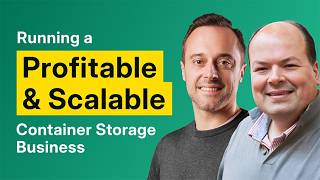
Martin from Universal Storage Containers explains why cheap containers don't guarantee profits. He focuses on maximizing profit per square meter first, using occupancy rates and pricing power as levers, before expanding to new sites. Unmanned facilities are the future, but they still need remote support channels like WhatsApp.
Chapters
If we have 50 or 60 sites, we're all going to be millionaires. But that should not be the case. You should be able to earn it with just a couple of sites.
Welcome to the latest edition of our podcast. Today I am joined by Martin, who is the owner of Universal Storage Containers. Martin, thanks very much for joining us. Where are you joining us from?
Thanks. I'm joining you from Deventer in the Netherlands. We are roughly 1 hour east of Amsterdam.
Well, yeah, thanks very much for joining us, Martin. I want to run through a few— I want to use this to try and learn as much as I can about Universal Storage Containers, your own journey, your own experience in self-storage, which, you know, I know you've been in the industry for a long time, so I'd love to learn as much as I can from you, and hopefully our listeners can learn a lot too. So I just want to start by asking, obviously, you know container storage very well, What are some of the common misconceptions about container storage?
Yeah, there are of course a lot of ways to make money in container storage, but I think the biggest misconception is that the smartest move is to do the lowest investment, for example, by buying the cheapest units. That sounds logical at first, but in our opinion, it's actually the wrong way to look at the business. What really matters is that not the It's not what the unit costs, but what it earns over time. Storage is a long-term, cash flow-driven business. You don't win by minimizing the investment, you win by maximizing reliable income. If you buy a unit that costs half the price, but it also generates significantly less rent, it may feel like a safe decision. But when you invest in a higher quality unit that costs more, yet consistently produces higher revenue, the math starts to work very differently. Even if you pay twice as much for a unit that only generates, let's say, 25% more income, you often earn, earn back that difference within 4 years. So after that, every additional year, the higher yielding unit keeps pulling further ahead, and over a 10 or maybe 20-year horizon, the difference is substantial.
Yeah, it's an interesting point, and I think You probably see that a lot when you hear about acquisitions in the space as well. You know, it tends to be the really high-quality self-storage businesses. So the ones who've spent a lot on the buildings, the fit-outs, you know, even outdoor sites, whenever they're, you know, they're really well maintained, it's a premium experience. Those sort of businesses tend to go for higher multiples. They attract a lot more investors. If you're optimising for minimising your upfront cost, then you aren't necessarily optimising for the best possible business. You must have seen hundreds or thousands of different outdoor container sites. What would you say, or what do you see, or what do you know tends to be the difference between a successful container storage business and an unsuccessful one?
There has to be, um, you have to buy, you have to find a sweet spot in scalability. Um, if you start, of course nobody can earn a living with, for example, 15 or 20 containers. Um, but on the other hand, if you rent out 20 containers, you should have a clear vision of what you want to earn about those containers. So it may be not, it may be not enough for, for now, but, um, you don't need, um, need to look for an escape in simply renting out more units. A small site can be very interesting, um, just for, um, what it's worth on its own. So even if only 20 containers can fit there, you still first need to optimize the revenue on that small site before you go to another site. Yeah, we have— I have customers who, they, they, they think they only think in numbers. So they say, okay, we have some sites, and if we have 50 or 60 sites, we're all going to be millionaires. But that should not be the case. You should be able to earn it with just a couple of sites so that there can be an escape, a wrong escape, if you want to scale up without optimizing your sites. Your sites should have a projected profit per square meter, and first you need to focus on achieving that before starting with something new. And in practice, that's not always the case because when your neighbor or somebody offers you a new site, yeah, that's always inconvenient. So I understand that it doesn't work that way all the time, But in theory, please focus on optimising what you have before starting something new.
Well, what are the sort of things that you'd recommend people do? So if you're running a self-storage business and you're thinking, I'm not sure if this is optimised, what should people think about? What should listeners do in their business?
Yeah, occupancy is of course a magic word. So people focus on 90% occupancy. But that's not all. When you divide an outdoor unit into 4 units, it generates 30, maybe 35% more profit instead of renting it just as one. Keep focused within the fences of your property and try to optimize there instead of only looking at other new sites.
What are the specific metrics that you would suggest an operator focuses on to tell if they're on the right track or getting towards profitability or success?
A lot of operators look for one magic number, but I think there isn't one. Profitability in the container storage is really about understanding a small set of signals that tell you whether the site is healthy or not. It usually starts with what I said first, the occupancy level, but A site can be almost full and still struggle if your prices are simply too low. And in some countries, low prices are so important that people really think, if I'm the cheapest, I'll be the richest in the end. But that's simply not necessary.
Okay, so moving on then to the point at which you're ready to scale the business. So it's time to scale. You've got, you know, you've built an efficient business. What is the signal that it's ready to scale? You should be thinking about scaling the business. And what does it mean to scale? Does it mean, you know, lots more sites, more containers? Like, how should people think about moving beyond one site?
Yeah, if you have the feeling that there's simply nothing more left, you optimized your containers, you have a very nice optimized mix of different sizes, you raised your prices to a level that you are, yeah, almost can be called upmarket. I think then it's the time to copy that formula to another location. But I think that an experienced self-storage operator knows when the time is right for a new site.
So, because it's interesting when you talk about scaling, I suppose what people really— what I think of when I think of scaling, I think you're talking about growing the revenue of your business. And that can mean you get more containers, it could be more sites. But, you know, I remember listening to Dean, um, talk— Dean Booty talking about one of his Outdoor Sites a few years ago and how he had almost trebled the revenue because he started to focus on price, not more containers. So he did exactly what you're talking about here, which is, you know, optimizing your existing business and trying to make sure the pricing is correct because you can grow your business, you can scale your business through smart optimization of pricing. And that's something we have started to see with our customers more and more, especially some of the tools that we've released recently about— I think it's so important to be reviewing prices and making sure that you are not just that you're competitive, because you do want to be competitive in your local market, but you don't want to be wiping value out of the market or leaving a lot on the table too. So really optimizing your pricing can have a huge, huge impact.
Absolutely. People are willing to pay for decent storage. You don't have to be the cheapest, not at all. If your product is right, if your location is right, if the facilities are 100% functional, if it's clean, if it's safe, you know, why should you be the cheapest? Of course you need to be competitive. You cannot be 50% more expensive than somebody who offers practically the same. But usually that isn't the case. So people are willing to pay more when they get something from it.
If you're starting on self-storage today and you want to scale, you want to, you know, have multiple sites or scale the business, whatever that means, what should an operator be doing differently from the very start today?
Yeah, you should simply do the math. What am I planning to earn? For my square meter or square foot. That's something you can easily calculate, of course. And maybe there is some financing involved. So don't expect to earn a lot in the first couple of years, but you have to have, you need to have a long-term plan. Usually people who work in self-storage already earned a little bit in other markets, in other, in in other, uh, they had other professions before, maybe they earned something, they inherited something, but it's a capital-intensive market. So usually people have the money and try to invest it in a proper way. But I think you can calculate, um, upfront what would be the amount that you need to earn. But on the other hand, you can calculate what you can earn. You can always cut your operational costs, of course. Unmanned is, of course, a new magic word in storage, but unmanned doesn't mean unstaffed. Yes, people can work remote, people can rent remote, they can, of course, the software is there, people can simply sign a contract, they can reserve a unit, they can onboard easily without seeing anybody. But your park still needs maintenance, people need support, they need to be somebody for emergency questions. So at some point you need staff.
Okay, so like looking ahead, it was obviously— there's lots of changes going on in the industry today and in the economy in general. Looking ahead for the next 3 to 5 years, what are some things you think people in this industry will be doing differently in 3 to 5 years' time compared to today?
The whole fairy tale of the unmanned sites hopefully get a little bit more into balance. So unmanned sites are unstoppable. Sites can be run unmanned as well, but there has to be— we need to create a new balance in it. So sites are unmanned, but still people need to have support in an old-fashioned way. So in my own experience, WhatsApp can be, for example, very useful for that. So people don't see a friendly face on the site, but they can ask their questions with just a touch of a button. So they still feel protected, helped, and feel welcome.
Okay, so before we wrap up, it's worth saying that STORA and Universal Storage Containers have partnered up to support your smart lock, the MyLock.
Yes.
For the container doors. So that allows operators who are using Stora to let their customers open their units remotely. If you're using, if you're ordering your containers, the Universal Storage containers, and you want to have the locks built in, we have the Mylock integration. So if you're using Stora and ordering containers from Universal Storage containers, then we have that integration, which is great news. And I think one final thing is if you're Universal Storage Containers also get 50% off their first 3 months of storage. So if you're a Universal Storage Containers customer and you're looking for software, give us a shout. We have a special relationship with a discount.
So yeah, you can order right away.
Exactly, exactly. Martin, thank you very much for your time. It's been great to talk to you. Thanks for joining us.
Yeah, it was great joining you.
Will you be at the Will you be at the UK conference in Telford in April?
Yes, absolutely. Yeah.
Okay, so let's first—
the first show where we're present is Spain, I believe, in a couple of weeks. Yeah.
Oh yeah.
Yeah. But yeah, we will definitely be in Telford as well.
Brilliant. Okay. Thanks very much for joining us and chat soon. Thank you.
Yeah. Thanks for being here. Thanks. Bye.
At Stora, our mission is to help our customers build the best self-storage businesses. Self Storage Explained is here to try and bring you the best from inside and outside the industry to help you grow your business. If you want to find out a bit more resources, go to store.co to sign up for a demo or find out more, or you can go to store.co/academy for lots more resources including our financial model and other in-depth guides to setting up and growing your business.
More from Gavin





Wie Space4You Einzüge von einer Stunde auf wenige Minuten verkürzt | Kundenbericht





