Stora Live: Customer-First Strategies for Modern Self-Storage
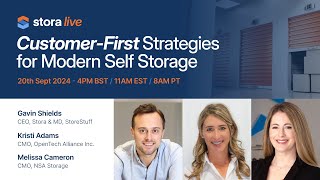
Transcript of a Stora-hosted livestream (Sep 21, 2024) led by Gavin Shields with guests Christy Adams (OpenTech) and Melissa Cameron (National Storage Affiliates). The discussion covers what “customer-first” means for self-storage (personas, self‑service, transparent pricing), practical technology to enable it (online rentals, smart gate/mobile access, kiosks, sensors, chatbots/AI), tradeoffs between automation and human touch, KPIs and feedback mechanisms (surveys, NPS, call/chat analytics, A/B or before/after testing), and future trends (AI, personalization, cross‑industry expectations). The session closes with operator-focused advice (map the customer journey, gather reviews/surveys, prioritize high-impact/low-effort tech).
Chapters
Just gone live. So welcome. Oh, welcome everybody. I think we've just gone live so we're going to give it maybe 30 seconds while some people join and then we'll get, we'll get stuck in.
Gavin, you can say good afternoon. We have to say good morning.
Yes, yes, good point. Yeah, good afternoon for me.
And we're all ready for the weekend, right?
Well, once I finish this, my weekend begins. So unfortunately you've got a, I don't know, half a day of work ahead of you.
It's true at least that I was.
Like full day here. We're just starting in the day. How was Friday, Gavin? What do we have to look forward to?
Well, what is the time there? Is it 8am 9, 9, 9 mountain time.
Christy and I are in Colorado 1. We have some bad weather right now so you can't see the mountains but usually right out here you see all these beautiful mountains.
Yeah, lovely.
I do.
Okay. I don't know if anyone. So I think we're getting people joining. If anyone wants to mention where they're joining from, that'd be great to see. If you want to. You could add it in the comments. So we have obviously myself in Northern Ireland and we've got Melissa and Christie in Colorado. So we're going to hear. We're going to get some pretty. For anyone in the UK which you know, probably, I'm sure lots in the UK we're gonna hear some pretty interesting stuff. I think today some different perspective to what we're used to. I'm used to. So it's going to be great. So if Isaac joining from Nottingham. So yeah, we know Isaac's part of story but we've also got Fiona and Halifax in the UK so there's two people in the UK so far. So we'll, we'll give it another half a minute or so before we get started. Then we'll get another. We've people from Hungary welcome. Budapest. And somebody from Stratford upon Avon. So Lawson. All Europeans so far. I wonder if anybody from us. Oh, our first person with somebody else in Ashby, Josuch. I don't know if I'm pronouncing that correctly. Somebody in California. So we international attendees. That's great. Okay. Okay. Well I think maybe we should get started as we've lots of people joined. So welcome everybody and welcome. Massive welcome to Christy who met many times. So thank you so much, Christy and thank you so much, Melissa. Well, maybe just kick off with a few introductions. I'll start. My name is Gavin. I'm the CEO of Stora. Stora is a self storage software platform based in the UK. We have about 20% of the UK's self storage sites using Stora. We have a few customers in the US and in Europe as well. And I also run my own self storage business here in Northern Ireland as well. So maybe Christy, we could maybe just go to you you'd like to research, please, Christy?
Sure.
Thank you Gavin and Store team for the invitation. So my name is Christy Adams. I'm the Chief Marketing Officer at Open alliance. But I've worn many hats in this industry. I'm about, I think I'm 21 years, so starting really on the supplier side and then to to operator side, I manage the marketing for portfolio of about 600 locations. A REIT like Melissa that we'll learn about and then really moved to the uk. Actually I've lived in Cheltenham and ran a brand that was based out of St. John's Wood and Oxford. So I've had a lot of international experience. Spent six years in Europe and then moved back to the US and have been really contacts and have purchased from Open Tech before. And so it was really an honor to come and work under Robert Chidi and really the tech side. So it's, it's really fun and a great perspective for me to be able to understand all those different purchasing decisions and needs of both operators and the customers.
Thank you Christy and Melissa, It'd be great to hear more about you.
Yeah, thanks for inviting me. I'm excited to be here. My name is Melissa Cameron and I'm the Chief Marketing Officer at National Storage Affiliates, otherwise known as NSA Storage. And we are a large REIT in the United States based out of Colorado. I've been here for six years, have seen a lot of change, a lot of growth. We're over a thousand properties throughout the United States and before this I was with another large REIT in Utah. And so I've been able to do a little travel and set up shop in different spots and experience different parts of the United States. I'm actually originally from Canada. It's Montreal, Canada, so it's even just coming over to the United States has been really incredible in learning about storage and growing in storage over the past at least 15 years. I haven't even done the math, Christy, when I was trying to do that while you were saying it. But similarly, I've seen a lot of evolution in storage through the time that I've been in it from very early digital marketing practices and web digital experiences, all, you know, seen it all. And it's been really exciting and fun to see how the customer experiences have evolved.
Thank you very much. Melissa. One of the things that I've been amazed by by going over to the US is just meeting people. And in the UK, if you talk to somebody that's got 10 sites, you think that's a big business. And then you're in the US and you have people telling you, oh no, it's just a small, it's just a small thing. We only have 200 sites and you just think, wow, so to have over a thousand sites, it's great to have you on. Thank you so much. The perspective I think our listeners can get is going to be so different probably to what we are used to, maybe a lot of our listeners with the smaller businesses. So thank you very much. And just this is for me mostly. So REIT stands for, I believe Real Estate Investment Trust. Is that correct?
You got it. Yep.
So in the uk, I believe Big Yellow is a reit, if I'm not mistaken. And then sureguard in Europe as well. So we have a few. But it's much more common structure in the US and then it's public list, publicly listed as well, which. And so that's relevant because there may just may be a little bit you needed. Melissa, you've mentioned it. As a public company, there's some things you can't say, some things you can't. So if anyone's asking questions towards the end, Melissa can't answer that is why. So, Melissa, thank you for. So let's dive into some of the questions. This is. We're going to talk about customer first strategies for modern self storage. So really want to hear your perspectives. Melissa, we'll start with you. So what does putting the customer first mean to you in the context of self storage? And how do you kind of see this customer first philosophy impacting our industry as a whole?
I think it's a really important question for us to be thinking about. You know, putting your customer first means you need to begin by understanding who they are. Right, right. And what matters to them. What needs, wants do they have during their life transitions that they're going through, the time of need that they're going through, who are they? I actually learned early in my career in digital marketing is that when you're creating experiences, it's best to ask these three simple questions. One, who are the customers? And develop Personas to represent them so that you keep them in the mind's eye as you're going through implementation. Second question is what actions do you want them to take in your business? So for instance, and there's multiple goals we have, right? Whether it's renting a storage unit or paying a bill online digitally and having those actions in mind. And then the third is, well, what will persuade them to take that action? What journeys do you need to create in order to accomplish those actions being taken? And really it's about, so it's interesting how we talk about what actions do you want them to take? However, where we turn to and kind of how it comes full circle is it's really about having an outside in mentality where you're matching your processes and the experiences you build to the way the customers want to interact. Right. That is ultimately what is going to persuade them to take the actions you want them to take. So right now in storage, if we think about that, I think being customer centric has a lot to do with, with empowering customers to self serve through seamless experiences. And in many ways that's digital or technologies in multiple fashions, sometimes hardware. So just some quick examples and I'm looking at Christy and I know that we partner on a couple of these already. So completing an online rental and making sure they can self serve either before digitally or with technology such as kiosks, et cetera, at an actual store. Automated gate access, that's a huge thing. People want to come and move in when it suits them. They don't. You know, if you get them an automated gate code through an online rental and they can show up and just access the unit and move in during access hours and not store hours, that's an ideal customer experience. Another big one that our company thinks a lot about is being able to allow customers to reach out with questions or needs when they want to, how they want to, any time of day they could potentially chat or call. And are you leveraging things like AI so that they can self serve or get the answers to their questions through any device, through any channel, you know, and so those are really just some of the examples in practice within the storage industry of being customer centric.
Wow. Yeah, that's really, really interesting. And it makes me think about some of the, some of the stuff we're doing in the UK and operators act here and behave here. So anyway, we're here to hear, nobody's here to listen to me, we're here to talk, to get some new perspective. So Christy, what are the biggest challenges self storage operators face when trying to adopt a customer first approach? Do you think? So maybe you see this in some of the solutions you have actually at open tech. But where do you see customers struggling to find, adopt this approach, this customer first approach?
Yeah, I think putting on my open tech hat probably, and Gavin, you can speak to this too. It's the technology adoption when we're looking to put our customers first. And I loved everything Melissa said. I think that customer first approach requires us to do just that, put the customer first. So are we looking at our customer feedback regularly? Looking at those reviews? Are we. And then the next kind of component is, are we adapting those services accordingly? And that's where the tech plugs in. You know, some things many operators have. That's kind of their, their point because they're using an outdated system and that's really hard to offer that customer friendly online reservation system or digital payment or that live help option if the tech doesn't match the consumer needs. So, so I think it's really, you know, that if you, if I put it in a nutshell, the biggest challenge that we're facing, especially in the US because we do have, we have older properties. You know, many of these properties are on their 30th year. I'm sure Melissa can speak to their portfolio. You know, it's a horse of a different color. With a thousand properties, she, she doesn't have one facility that looks the same. And I see that being less of a challenge in the, in the international markets. When we speak with operators, because we are international, their facilities are much new. And it feels like that kind of next step to update tech is a little bit easier in the international market. So in a nutshell, it's really that technology adoption.
Are there some things that when you talk to or work with these older sites, are there solutions that make it easier for them to adopt new technologies? Are there things specifically designed for them or to kind of help them sort of take the steps towards this new technology? I can just imagine it's quite a, There's a lot of blockers there sometimes.
Yeah.
And I think for us, that's really having that relationship with the customer and saying, okay, what's our first step? Right. And it's actually different again, based off geographical situations, based off of the consumers. You know, we have a five mile. Again, Melissa might be able to speak to that, but we have a pretty tight radius around our facilities. And so what's the demographic of that customer and what tech is the best to plug in? And we're seeing Gavin. I mean, the number one is, to Melissa's point, what we've partnered on together is the automated gaze, you know that having that piece because that's where the customer, I mean often the keypad's the front door, if you think about it like that is where the customers are entering and exiting your facility. So where's an immediate point of change is really at the gate. So it depends, but I think we commonly feel that that's the first step to then once they have an updated gate system and that customer experience has been elevated, I mean if you think about mobile phone access being one of them. I have a friend in Sweden and she is using a sure guard and she constantly is like, I love your app. You know, she pulls it to the gate and it automatically opens. And for her that's a really great customer experience. So again, finding little wins like that, but understanding the customer's needs for our perspective, it's like our customer's customer. So we work, we work first with the operator to understand their challenges and then can really serve them up. What's the first piece of tech that makes the most sense to adopt?
And you could have, you know, class B properties that are older and even, you know, need some capex, need some love and you can still implement a more modern self serve, seamless digital experience or leveraging hardware like Christy mentioned. And I would say even at some of those properties, I mean obviously we have, we have those gate systems throughout our entire portfolio and we're able to not only leverage a better customer experience, but from an operator perspective we're also able to leverage, leverage the data from those access points and frequency and who is doing what, right. And that changes by geography and that can really inform a lot of the intelligence you're building as well about that particular property or that market. So it's kind of a twofold thing. It creates a better customer experience, but it also helps the company continue to improve and drive performance.
That's a very interesting point, leads into the next question, which is how do you see technology like these kind of smart entry systems management software playing a role in enhancing the customer experience in self storage? Maybe Christy, you could start with that. So we're talking about the operator experience being better, but the customer experience being better too. And all driven by these technologies that are. It sounds like you've got in all your sites, Melissa.
Correct?
Yes, I know I mentioned kind of that. So the question was how do you, how do you see technology like the smart entry systems? And what was the other part?
How do you, how do you see technology as a whole? I suppose when I think of it as a whole I think smart entry systems and the software that maybe the facilities using and that might, like you mentioned earlier Christy, that might impact how the operator lets people book or pay or the sort of maybe how much can they self serve these important parts? How can those things impact the customer experience, the customer first approach?
Yeah, what we see across the board is really that technology can reduce that friction in accessing the units. So if I think of the smart entry and I know I've kind of already spoke to the mobile piece of it, but what we're seeing now, and I'll plug in the operators because that's probably who we have on the call today, what we're seeing is customers first adopting that smart entry system. But now we're integrating sensors and cameras and that's really elevating both worlds. If you think about it, some of the sensors that we offer is like a smart gate sensor and that it goes on the gate and so anytime that gate doesn't close, the operator gets an alert, hey, your gate didn't close. I think in Melissa's that's probably we're hearing a lot of operators saying is it's very important that gate closes. That's a big friction point from, from an operation standpoint because anybody can come and go at that point. So alerting operators to that they can get a text, they can get an email, they can kind of be alerted in a predictive, in a predictive maintenance way. We have another sensor called Smart Door. So a lot of our operators are trying to understand foot traffic. So how many times does the door open and close? I think our managers give us one number and the reality is slightly different. And so we kind of are trying to understand and Melissa may be able to speak to this or may not because she manages some remotely managed facilities. What does that look like? How much traffic is actually coming in and all that data is being fed to that same system where we can see who's coming and going. I mean we really start to get intelligent to see all of these data points across sensors, across access, the keypad. And so I think that smart entry is only going to take us to the next level. If I think down the future, where are we going that that intelligence from a data standpoint. But I wanted to talk to the management software too because at Open Tech we again Open Tech is, we are open to all of the property management software and it has upped our game. You know, we, we integrate to the majors. We integrate with Stora and having really that, that customers can easily make that payment if somebody's overdue making that payment to get immediate access to the keypad, that's really created that seamless, hassle free interaction. And so I think the management software and where you guys are going and your map roadmaps only makes our technology smarter. So we really have to play together. And, and that's why I love our relationship, Gavin, where, you know, when a customer comes to us, we, we actually have to work together to make sure that our, the, the software plays with the tech. And I think Melissa and I have, we've encountered that in many scenarios too, where it's really a, a relationship between all three of them, the tech, the tech company, in our case, open tech, with the property management Gavin, and then the customer, Melissa. So I love that we actually have that on the call today because it does take a great relationship between all three of them and they all do need to work together to give that customer first. So I hope I answered that in a roundabout way.
Yes. Yeah. Thank you very much, Christy. Yes. I really am so interested in customer first because we at Store have been talking about it for a few years and when we talk to our customers often we will talk a little bit about put your customer first, think about what they want. And as Melissa said earlier, you sort of start at the start of the journey and think of the who and develop Personas. And one of the ways we see that in the UK industry, which I think is just fascinating, is the hiding of prices behind a contact form or gated pricing, which we've developed initially. We developed Store where we just kind of said, look, we don't support that. You have to just show your prices. We think that's the best way you've got to do it. But so many people do it that we then decide, well, you know what, it shouldn't matter to us. We'll support people whatever way they want to run their business and if they want to get prices, that's fine. Do you, do you see much of this in the US how does, how do you see, how do operators in the US think about that? I know there's a specific little issue, but how do you see that in the US Market?
Yeah, and I'm not saying we don't have our own challenges. However, definitely, you know, again, the customer wanting to shop, when, how, through what device, all of the things. Right. It really is about them and what they want to do. If they have to fill out a contact form in order to get pricing, that just, that's an additional roadblock. It's an Additional stumbling point within the customer journey. And it seems almost like we're being a little dishonest or a little slimy. It feels a little archaic, honestly. So not trying to insult anybody literally. Just I think if we're going to really put ourselves in the customer's shoes, that is what they want. They want to be able to shop at their leisure when how you know, they want to do it. And so giving them pricing, really upfront transparency around that, all the attributes, allowing them to interact how they want to interact, whether that's chat or call or maybe fill out a form but not to get pricing and then even complete a rental there and show up when they want to show up with great text messages and emails after every step in the journey. And really again just to be able to self serve. So I think you definitely want to expose pricing and and I would even say I would challenge this and I'm a big believer in a B testing. So if you have the ability with whatever, you know, software vendor or you're building it yourself is if you don't believe me, then a B test it and see are you getting net net more reservations and rentals because you're not hiding pricing.
That's a really interesting point. And actually we've got to the stage where we're hosting, so our software hosts everyone's checkout. So we're at the point now where we are managing thousands of checkouts a month. And the issue I think for lots of our customers is they might have two or three sites and maybe maybe 20 or 30 bookings a month. It's not enough data to really do an A B test. Now you don't have that problem with a thousand, more than a thousand sites. You can do a B test and get great results. We would love now, I would love in the future for us to be able to run some of these tests in the UK market and go and show people the results and the results we do sometimes here and I don't contest this at all, some customers who have showed prices and bookings have dropped off and then they've gated them again and bookings took off again. And I don't know, there could be different reasons for this and I'd love to do a proper A B test. Scientific results, good, high level of confidence in the answers. But anyway, that's a different topic.
Yeah, I think that in the US it's less about not showing pricing but in some cases I've seen it, the action is to call in order to see availability instead of Being able to reserve and rent. So I think that's a good comparable. And a B testing that in my history has demonstrated that you really want to allow them to be able to take action. But it depends, like Christy said before, the demographics of different areas and what their expectations are with regards to being tech savvy. And it's different. So be thoughtful of your area. Maybe it is different.
Yeah. Okay. So Melissa, how do you. So you obviously think about this stuff all the time and putting the customer first. How do you measure the success of customer first initiatives in your organization? Are there any specific KPIs or feedback mechanisms you rely on?
There's quite a few and we like to come at it from a few different angles. And I would say in general, just making data driven decisions is really important. So yes, we need to measure success and that's data driven, of course. But just like I mentioned before, we also need to measure the opportunities up front. So that will help us prioritize the focus areas. Because you don't want to just be implementing technology for the sake of implementing technology. Right. So this is how you kind of approach doing the assessment of the opportunity and gaps is once you've identified them, you can score each opportunity on what you think the estimated impact to the business goals are and then the effort that it takes to implement it. Right. And that's your balance is impact and effort and then have a continuous improvement mindset. Of course. Right. Ongoing data analysis to expose new opportunities and solutions. But then when you're actually measuring the success of what you do prior to the implementation, you really need to identify what goals you're even trying to optimize towards. Right. And then either you measure A before and after. So Gavin, you mentioned maybe not everybody has the data to be able to do an A B test. I think that's totally fine. I still think there's enough data in some regards to do A before and after. It's not the ideal way, but it is a way. Can you see an uplift that way? If you can a B test or multivariate, then do that. And you've already identified those goals you're trying to optimize towards. So again, I'm going to bring up an example of like online rental systems. Okay. And yes, of course, when we implemented ours and we got ours out right before COVID hit, which was lucky, we a B tested it and it wasn't just about did we increase conversion rate or did we increase, you know, overall rentals because of it, but did it drive more efficiency and what's the cost or benefit of that efficiency, which is, you know, less human interaction versus what's the cost of the technology, whether you're building or buying and then maintaining that. Right. And then that's your roi, that's your balance that you're measuring towards. There's also the softer side of measurement. And so, you know, you can learn a lot from conducting surveys, identifying through those what the customer satisfaction or net promoter scores are that you're trying to measure. And then obviously you can also leverage AI or social listening to get some of the qualitative, which is also very informative. So again, some examples, doing a like for instance, at our call center, we do a post call survey by a text message to say, well, how is your experience one to five? And that's a customer satisfaction score not only for the whole call center in general and that call experience, but specific to an agent and being able to continue to work with them. We do move in and move out surveys at the point of move in, at the point of move out. Not only to understand who our customers are, what situations they're going through that are causing need for storage or leaving storage, but how was their experience and were there gaps in that experience so that we can look at those as a company also analyzing call transcripts, chat transcripts for getting quality scores around those things and again getting some of that sentiment out of it, that sentiment analysis. And we do a lot of social listening also within our reviews, our social media, the feedback we're getting there. All of these things are important obviously to point out and work internally, to continue to work on. I would say you got it. If you're doing all of these things, just make sure that you're closing the loop with the customer. If they do leave a bad review or there is a poor survey response is close the loop. That is a huge deal too. Being customer centric isn't just about creating these experiences up front, but having customer service in mind and then also expose the data internally. If it's multiple departments or if it's just even a single leader is really come up with solutions to those big gaps that have been exposed through that analysis and then rinse and repeat. So those are just some ideas of how to measure success.
That is Melissa, so interesting. It's so interesting to hear from a business with so many facilities that you can really invest in building these systems and maintaining them and looking for the data, looking for the sentiment analysis and really doing stuff off the back of it. So it's really interesting to Hear that? If there's a listener here, maybe with two or three sites or even somebody just getting started, do you have any advice for like what's the first thing of those things you've gone through? What's the first thing you think you would focus on or you'd advise those operators to focus on?
I mean, I think so. The good news is we have folks like yourself, right, to work with technology experts and businesses. Not everybody has to build it, they can buy it. And there's a lot of opportunities out there. So even conducting, you know, a move in survey, how was the experience? Who are those people? Better understand them. That will also help you create those Personas and think about customer first things. But it'll also help you understand where are some of those gaps. Reviews are critical for everyone. Doesn't matter where you're located in the world, you need reviews. So. And the reviews can also be very informative. And the good news is through some of these review systems that are out there, you can run. It's part of their system is running sentiment analysis and exposing some of those larger gaps. So you don't need to be this sophisticated large company with 30 people in the marketing team and all of these things. Right. We have partnerships that we can leverage and technology out there to do these things. So again, if we go back to what I said earlier is really put yourself in the customer's shoes once you know who they are a little bit, walk through that journey, identify what those biggest gaps are, what do you really think the customer is going to need the most? And focus. You're not going to do it all in one day. You're not going to do it all in one year. But focus on the highest priority, the highest impact to the business that you are projecting, of course, with the lowest potential effort and then just start chipping away at it. One thing at a time.
Brilliant advice. You're not going to do it all in one day and not even do it all in one year. Just keep chipping away. I think that's really, really interesting advice. So the two things I heard there were if you're smaller and even for myself, two sites here, surveys to learn more from the customers and get reviews. I hear that all the time. Just get more reviews. And I probably have two or three because I've never really worried about it. But yes, great advice. Thank you very much. Melissa Christie. I wanted to ask you a little bit about because one of the things we do here a bit is automation and technology and the risk of sort of veering into this idea of making everything very impersonal. How do you see the balance between automation and the need for some human touch in a customer interaction?
Yeah. And from my perspective, we're hearing from operators all over the United States and again international, they're trying to test that fully automated model. So we're in the thick of that Again. Melissa can speak more to her side because she's managing that as well. I think each of them have pros and cons. But what, what we have learned in working with from the REITs down to, you know, a single operator is you have to balance it. Right. One of the, the tech technology pieces that we offer at OpenTech is a kiosk and I think that that's probably where I'll leverage in. There is a button on there that actually toggles and moves as you walk up to it and it says Live help. Right. Like so if I think of self service because we know our consumers want that. Right. We're they want, they don't necessarily want a human. And as the generational, as generations change, I see that becoming less of a thing. Self service is the way I don't want to talk to my Starbucks gal anymore. I just want to place the mobile order and pick it up and be on my way. We're all in a hurry, so how can we get it done quickly and efficiently? So we're finding it at Open Tech. That and I'll give you some numbers. We do a white paper every year because we look at this data to determine we had over 240,000 live help calls initiated on a little over a thousand kiosks deployed. So that number is, it's still pretty significant. So as somebody was walking up to a kiosk looking at the pricing, the location of that unit, the size, the attributes, they had a question and got life help. So I think that's a great example of balancing that because you know, we are multi generational. We have from 60, 70 year olds renting down to, you know, six 18 year olds. So we have to really have our technology and our business reflect that. And so I think that makes this whole thing very difficult for our industry because we have to, we have to show up in all of these different consumer preferences and what, what we have seen in the kiosk is make it available to them and they will use it. And then that live help agent actually will walk, will answer questions. Especially in the international market, you're less familiar with self storage. So the questions that come up are great. And that live agent is able to answer them, address any concerns. They can actually take over the screen and help them complete the rental. So it, that's probably the perfect balance that we've seen because in some cases, you know, any unmanned remote location, any operator would tell you there's still humans involved. Right. They're doing and Melissa knows that there's, there's still humans involved in the background, whether they are answering calls, addressing move ins, move outs on the facility, checking the properties. Like there will always be a human element to our industry. It's just finding that efficiencies. And again, we've seen operators with kiosks massively reduce payroll. Right. They've been able to use those foot traffic sensors to determine their busy days. And so on the busy days they'll have a manager there on property and then on the, you know, maybe Tuesdays have historically shown less foot traffic, they'll have the kiosk run those hours. So it's constantly looking at the data, which I know that we spoke to, and understanding your property and your demographics and when technology can be plugged in and when a human needs to be there.
I don't think these things are mutually exclusive to Christy's point. Right. You can accomplish both and you should have both goals in mind. And if you're going to look to build a certain personalization experience or customer centric experience, yes, it could end up costing the company efficiency, which is why you need to keep it in mind and assess that other side of the balance. Right. Just like if you're looking to gain efficiency, you want to make sure you're not creating a jarring and broken customer experience with unhappy customers. So, you know, if I could bring up an example as well, is if a customer shopping online and you give them the option to call or use like a web chat where they can ask their questions and again, at any time that suits them through any device. Right. And if that's not your normal hours, then how are you building those experiences? And really a balance when you think about both goals in mind in this situation, could be that you're building the automation or an AI driven experience to answer the customer's questions, leveraging these bots or artificial agents and that type of thing. And if done successfully, it's a win for the customer and obviously it's efficient for the business and drives performance. However, if the intelligence doesn't successfully answer, that's what Christy's mentioning is you can't have a break there. You need to make sure that you're continuing the conversation. So do you then have a protocol or an experience, a process in which that gets escalated to a human and maybe it's a reduced amount of humans because there is the self serve portion and so you're able to reduce your cost there. But it is able to go to a human in a prioritized type of fashion so that it can serve the customer where they're basically picking up where the technology left off. So these things normally need to be thought of hand in hand and it needs to be a balance between both.
Great, thank you. Really interesting to hear your views on that and I couldn't agree more. It's always a balancing act between the two. This is the so this is the question I'm looking forward to hearing more. The most of all the questions I planned. So how so I'll maybe start with you Christy, but this is a question for both of you. How do you see customer experience and the customer first approach in self storage evolving over the next five or dare I say 10 years? Maybe 10 years is too much. The rate of change is so fast. But how do you see things forward that far? Like how do you think what will we be seeing in 5 years time? In 10 years time do you think?
Well Gavin, this is perfect for me. I'm working on a presentation right now for Fidessa. So anyone listening that's at Fidessa, please attend it. We're we're actually looking at the future of self storage. So I've been digging into really consumer vision reports of what does the consumer look like in 2035 so I can share with you maybe like unpack a few of those. Please still come to my presentation but where I'm looking at because we can't talk about the future of self storage without understanding the consumer. So back to your whole customer first. What are consumers what are consumers going to want in 5 to 10 years and how can we meet them in that need? And so I'll share with you. I actually took some notes and put them here and if anybody on has some really great ideas please reach out to me because this presentation is due pretty soon. So looking at the consumer, the current consumer some of the just bullet points that and I'll go in depth in Vanessa but they're they want fast and easy. So that whole Amazon effect delivery apps like right we're in that season now of fast and easy. How can I get into my self storage unit, put my boxes in and get on out the digital savviness. So we're the consumers are really focused on self service again not all of them. If you think about the supermarkets in the kiosks, I know that they're all over. I was just in London not too long ago, I didn't see a person. I checked in, checked out with a kiosk where we're seeing that become the popular route. And that tech has really improved. I think we all on the call who've used that have had our disgruntled moments with that supermarket kiosk and now it's getting better. And then social media and these eco warriors. I know sustainability is a big thing in international, probably less so, but we're still trying to learn is that consumer willing to pay more for their unit because that facility has a green sustainability. You know, I think that's probably a big question we're all trying to answer. So when I looked that's kind of current consumer. When I looked 5 to 10, the word AI just kept popping up and popping up and popping up. And I feel like a lot of us kind of just, we la. Sigh when we hear that because we're like, we get AI but really will AI take, take foothold. And some of the themes that I have picked up so far is this tech savvy and totally connected. Like just imagine smart devices are everywhere. Like everywhere. You will rely on your watch to tell you more than stand up. Like if you're an Apple watch user, it will be telling you that your heart's escalated. It will be telling you you didn't get enough sleep. Like just, it will be telling you all the things. And then the other trend is personalization. Your AI, you will have an AI assistant. So imagine that AI assistant telling you, hey, there's a new restaurant in town that you really like. Thai food. You gotta go, you know, like think, think through that. Two concerning ones that I was hearing about was experience over things, which we're all we want, we want things because that helps our industry. And then sharing, if you think of kind of the, the sharing, the rent, the rent subscriptions, the Uber, the, you know, why, why buy when you can rent is. Is some of the, the trends. So with that consumer in in mind of a tech savvy, totally connected AI personalized consumer, I think from our perspective as storage owners, we just have to be thinking through how, how can I ensure that I'm meeting that customer in that vein. And I think back to the customer. If we're not thinking of the customers first, we will lose. And Gavin, you asked a question in the beginning of like what is the impact of us having putting Customers first me to our industry. And this is where as an industry at a whole, if we have increased customer loyalty, if we've given these, these, these customers a great experience, I can't help but think that that gives us higher retention, higher word of mouth, really drive our industry's growth and stability. Like we all owe it to ourselves to give our customers the best experience for the help of all of us, whether they're moving from Ireland to Germany or wherever we want them to use storage again, we all do. We're all in that together. And so thinking through that customer experience and making it really good. And I love that Melissa said, you know, when there's closing the loop, like we, we owe it to our, ourselves and our colleagues to close the loop if that customer had a really terrible move out. Let's, let's, let's build that, let's understand why fix it on our operation side, but also build the trust with that tenant, that store to want to rent again. So I digress from there.
That's great. Kristi, I couldn't agree more with what you said. And I like to, instead of talking about specifically five to ten years from now, I would more challenge all of us to say, is storage a little bit behind other industries and are we looking kind of cross industries to understand where the customer experiences are going? And therefore maybe they didn't even know that they wanted those experiences, but these businesses come up with them and they are enhancing these seamless and wonderful experiences they couldn't have even expected to have received. Well, guess what? We're being held accountable to that same experience that they're getting day in, day out. You know, like some of the things that just came to mind were like being able to rent a car digitally and literally show up and you don't have to speak to anybody and you just take that car. First time you do it, you feel like you're stealing it. And it's a very odd thing, but now people are used to it right there. These are the experiences that they are expecting. Same with being able to choose a hotel room on a map. Well, guess what? Hotels are pretty complex. So are storage facilities in some regards. Right? And they're able to check in digitally, use their mobile device in order to open the hotel room. You know, all of these things we can see translate into our. Just like Christy mentioned with Amazon. So I think, you know, yes, it's hard to say truly with the five to 10 year. And I commend you, Christy, for even go. I like some of those ideas. I Think it's truly realistic and I would say we can. Even in storage, the five year plan might look more similar to what some other industries are today.
Yeah, true.
Very interesting. Yeah. Okay, thanks very much. I think, I think we have some audience questions so I think we could maybe switch over to those. I see quite a few here and I think there's some really interesting ones. I don't know if. Let me see if I can. I'll just have a quick look and see if I'll pick one. Okay, so we have a question here from Kathy. With the growing competition in the self storage industry, what innovative strategies can operators use to differentiate their services while keeping the customer at the center? I think we've touched on some of this, but just be interesting to hear your answer on that. Either of you want to go first?
I can go first and then Christy. So essentially, I mean ultimately where we're competing first is at the point of search, at the point that they have a need, they're going through the transition and they're looking for storage. So yes, there's a lot of technologies in you can put in place after the fact. Right. But ultimately if you're even going to get the click to go to your website or the click to call to go to your call center in the first place, people are shopping based on, you know, location, price. Now that's the beginning. But if they enter the process and it's broken right out of the gate. So I would almost start at the beginning of the funnel. You know, when you think about that is you're trying to get the click, you're trying to get the call. So you need to compete in what you're doing from a marketing standpoint or a pricing standpoint point up front. But once they get to your website or they call the call center, they show up at the store, have you made sure that it's a friendly experience to begin with? So I would start there again. I'm all about chip away at it. You're not. It's going to take us years to get there, but start there. To me that is being able to stand out and compete more effectively.
That's really interesting. And I think one of the things that I sometimes would talk to customers about is that fluid, it really starts at the point where somebody is maybe on Google searching for you or asking a friend for a recommendation. That's the start of the journey. And got to think from the customer's point of view from that point onwards. And when they land on your website, what's that Experience like it's so important. I would often think of my website as my number one salesperson. That's kind of, that's where most of your customers are going to have a, have an experience with your business and making sure that flow is as good as possible and very focused on conversion and conversion and like also like price and basket value and everything else and really optimizing that experience to, to get your customer to I suppose the point of success for them, which is I actually want some self storage here. It's not necessarily. We're not trying to trick them into going down some flow. We're trying to facilitate them on this journey and the better the, the better you can do that. I think it helps as well. Christy, do you anything to add to Melissa there?
Yeah, I'll just add one more layer since we want to give operators just that next best step. So we talked about the website. Does your website have really great photos? Are you really selling your attributes? If there's a question, do you have a place for them to ask, like think through just those simple experiences right there, you know, have you, have you assured them, you know, in this case maybe they're looking for price. I know Gavin mentioned that that's kind of a hidden thing. You know, making your property shine in that moment with your access hours, your features, your amenities, your great customer reviews, like really hone in on that as a first step. And once you're there then I think you can look to add, hey, here's our mobile app to access. You know, like there's, there's a lot of different ways, Kathy, to kind of continue to innovate and grab some market share over your competitor. But making sure that you're really dialed in on your website is probably the best first step.
Okay, thank you very much. Thanks, Christy. So the question from Jorine and if I understand it correctly, the question is so it's, it's good that a client's coming to your facility. So I think that's physically turning up at your facility. How can you attract clients from a sales perspective? So not by marketing. So I guess so if we're taking out marketing here. So how can you attract clients from a sales perspective? Is that maybe outbound or like doing some of that sort of stuff during the fear there?
But yeah, I think maybe the question here, Jerreen is around, are there more boots on the ground type of things that we can be doing to, you know, and although our company doesn't take action in these things, it was more maybe a decade ago at my previous large operator when digital wasn't quite as large. However, you know, things like if the storage facility has apartment buildings nearby and making sure that you've connected with those folks to let them know there is a storage facility down the road, referral programs, that type of thing. So it doesn't have to be that you're all just digital and have these sophisticated paid marketing practices and really elevated. Although I would encourage you to do so because that's where most people are coming from. However, hand in hand, there are boots on the ground, things that we can be doing to try and attract customers.
Yeah, I'll just add to that. I was recently on a site visit here in Colorado Springs and we were at the facility and there was like I tripped over a drill that was on the floor. So think about when that customer from, from the signage. I know we all have some signage restrictions, but think through the. Is my signage proper? And then when I walk in that front door, you know, making sure that customer, whether there's a staff in there or not, that you've really been intentional in keeping that space clean and customer focused too. So.
Okay, thank you very much. We have another question from Kathy about how can automation and virtual assistants work together to enhance customer service. So a virtual assistant, if I'm correct, a virtual assistant is a human who's available remotely. Is that correct?
That's correct.
Okay. Any Melissa or Kirsty, any comments on that question? How you would get them to work together?
But we definitely use automation and again, it goes back to. If I'll give an example, Christy, you might have ideas. You know, we, I mentioned we look through data a lot and we look for opportunities. One of the biggest things that we found out, for instance, in our experiences at the call center is we were getting a lot of volume around people losing their gate code. Well, automated gate systems helpful help with that. Although, you know, there are situations where people don't want to download and they want to be able to use their gate code. So you can create automation and it's not full AI or anything, but you can create systems that look up the gate code based on a series of questions in an automated fashion with no human interaction yet, and provide that back. So for instance, when you call a specific number, press on a certain prompt in our IVR and you say, I'm looking for my gate code that is all automated. And then the system is going out retrieving it based on a series of questions that, that they have to answer and delivering and text messaging them the gate Code. Right. So there's a lot of those small automation opportunities but it goes back to are you analyzing, are you looking at where those biggest gaps are? Chrissy, what about you?
Yeah, I mean there's, I would love to hear your guys thoughts kind of on the chatbot world because that's more in your space and you're seeing that. But I think you know how I mentioned Kathy in the example of you know the, you walk up to a kiosk it, you can completely self service an entire rental payment, you name it. But again we're still seeing that piece of virtual assistance and I, I should be clear that that is a two way video. So you see them, they see you. So we have found that that even takes it to the next notch. You're actually looking at a person and they're looking at you. And so I think we know that that's still being utilized. So that's kind of that human touch that we, we still have in our industry and I think we will continue. So I don't, I don't, I can't think of anything off the top of my head that, that I can go any further. But I know you guys, Melissa, you guys have some chatbot systems and so how do those work together to, to get further down the customer journey? I'm, I would leave to you.
Yeah. And that is the kind of hand in hand. We do have a chatbot built on AI and it does, you know, we've constantly gets smarter because it's constantly being fed with what people are looking for and then what we're able to provide at building those experiences. However, it is very clear. Did we answer your question? Yes or no. And if it is a no, it gets escalated or if somebody clearly is on pause, it gets escalated in a prioritized queue. So these things can work hand in hand and they quite frankly always think about the ripple effects of one thing to the other. You don't want to implement something cool and shiny and you know this great technology and you think you're doing a great job and you find out that you're actually making people mad because you're breaking it.
Yeah. Great. Thank you very much. There's a question from Fiona Woodhead. She's asked if it's possible to see an example of the move in and move out surveys. So I don't know if that's something that either of you might be able to share afterwards.
I would love to. Unfortunately I cannot. However, I will say there are plenty great vendors out there that you can look at and they have, they usually start with a good template that you can build off of. So I would take it from there and just tweak it based on your particular circumstance.
Or Fiona, you're going to have to come rent at an NSA facility and experience it yourself. Yeah, I would just double down. There's great examples. I think if you can go online and search them or reach out to some of the suppliers in your area, they should have that. But that's such a great step. I mean if we're talking about customer first, surveying them.
Okay, okay. And we're going to finish up in a few minutes so if anyone's got any last questions, please type them in the comments box. Fiona is going to come and move in if we sort out the flights. Okay. So if any final questions, please type them in. Otherwise I was, I just like to finish off with one little thing which is we've covered a lot today. So if you're kind of new ish to the industry or you've been in it for a year or two, and this is for both of you, like what would, what would you say? What would your advice be to those operators when they think about what are the things I can do for customers first? So we're probably going to recap on things we've said. So it's kind of just a 30 second answer. What are the 1, 2, 3 things you would say? Focus on this and that will help with your putting customer first experience and hopefully then help with all the knock on benefits to your business as a result.
Christy, you take this one.
Oh man. If, if we are talking about customer first, it demands you do just that, put your customers first. Maybe it's you going through the experience yourself. Start with a phone call to your location. Like go through the process, put your undercover PI hat on or hire your. Hire someone and get that feedback that, and then get that regularly and, and then adapt your services accordingly. You will find your gap, you will understand where you maybe are excelling in. And then on that website you need to say, hey, we are the best, whatever that is. But put your customers first and that might be you. As simple as going through the experience yourself and finding like oh, that didn't feel great. Oh, I found out that we really didn't. You know, this, this area needs help.
So yeah, to play off of that with Chris, what Christy just said is again, if we go back to those questions, right. Who are they? Develop Personas. You don't need to be incredibly sophisticated with a lot of background in how to do this, honestly, you could probably Google it and find some great examples of how to go through that flow. But you want those Personas to live on, because when you. For instance, if I have a Persona called Jane and she represents XYZ person, right. And that I will talk about Jane, I will keep Jane in mind as I'm going through this. And maybe Jane is going through a very difficult circumstance in our personal life, you know, divorce or a death in the family. And when you're walking through the customer journey, like Christy said, and you're mapping that out, and I literally think you should. I mean, if you have a whiteboard, you have anything, map out the journey, walk through it physically, like Kristi said, step by step by step, and then map it out as Jane and keep Jane in mind all along. And that should be a continuous improvement process. So. So those are some tactical things I think you can do right up front to identify what those biggest opportunities are. And then again, it's a journey, not a particular destination.
Brilliant. Thank you very much. Thank you so much, Melissa. Thank you, Christy. Sorry, I don't see any final questions. So, yeah, thanks again. It's been a real pleasure to have you both, especially Melissa.
Thank you.
Not like Chrissy, too, but Melissa, just to hear about the rate and hey.
I will say it's tough to get her. It's tough to get an hour of Melissa time. So this.
This was this. Yes, for me as well. Yes. I enjoyed it very much. Thank you for inviting me.
Thanks very much. Thanks, everybody.
Bye.
Bye. Bye.
More from Gavin





Wie Space4You Einzüge von einer Stunde auf wenige Minuten verkürzt | Kundenbericht





