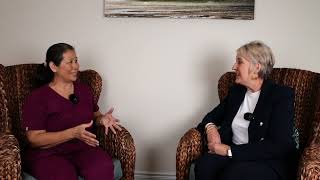
A short video interview between consultant Gene St. Louis and Sharon, a dental hygienist with 25 years of experience (23 years at the practice). Sharon recounts initial apprehension about coaching but reports a major positive transformation after implementing trackers, audit forms, a periodontal protocol, and ideal-day scheduling; these changes improved charting, patient conversations, clinical prioritization, and reduced schedule stress.
Questions this video answers
25 years.
23 years.
Chapters
Hi, I'm Jean St. Louis and I'm sitting here with Sharon who is a hygienist and I've known you for a little over a year and I know I came into the practice that you're working in and just wanted to ask you how long have you been a hygienist? Sharon?
25 years.
25 years. And how long have you been with this practice?
23.
Okay.
Okay.
So when doctor said he was going to bring a coach in, what was your feelings? Were you panicking a little bit? Yeah, I bet, I bet a little bit.
But wow, what a transformation it was.
And did you feel, were you nervous? Were you thinking like, I'm sure you have colleagues that you spoke to about, oh my God, my doctor's bringing a coach. What does this mean? Am I going to get fired? Is she going to make my world miserable? What's going happen?
It was, it was quite a journey.
Yes, it was.
It was at first it was a big learning curve, that's for sure. But. But it has helped so much. It's really the trackers. From the trackers to the audit. The audit form was something that I already, you know, was doing in my head.
Yeah.
So it's so much easier having paper to write things down on.
Right.
And work with. Yeah. And then how to talk with patients after 23 years. I thought I knew.
How.
Did you feel that you know that? Because I know we do introduce some languaging skills but did you feel like we were kind of saying like you must say it like this or was it just like, hey, you might want to try this. If it works for you, great. And if it doesn't, that's okay?
Yeah, it helped because I know you.
Were one of the individuals that when we said like, hey, here's some scripting, here's some language, you kind of went home that night and you read it as part of your homework and you came back and you were like, hey, I was wondering if you say it like this, how does that sound or something. And I remember thinking, good, I'm glad you, you know, you took it seriously to read it.
Yeah, it was the best move for Dr. Brown. I mean of course we were like a consultant after 23 years, you know, after 30 years, why. But right. Who knew our, who knew our charts were a little messy but you know, now they're, you know, I'm not scared to look into other parts of the computer.
You just helped us understand the flow of the computer and the chart itself. Really? Yeah. And I think too, if I recall in the beginning, in looking at your charts and the practice, there were things that had kind of fallen through the cracks on patients that we. It wasn't intentional. I mean, you guys had every. I think your heart was in the right spot. You always wanted to treat patients with dignity and respect, and you wanted to make sure that you were doing what was in the best interest of the patient.
Right.
And then when you discovered that you kind of weren't, you were missing something that was like, what? Wait, okay. Yeah, we, you know, so I felt like when I introduced the systems and Molly and Paige were here and introduced the systems, it was not falling on deaf ears because we had evidence based kind of practice management, not just like, this is our system. Do it like it. That's it. Did you sense that or how did you sense.
Oh, yeah, yeah. You presented it. But you could do it this way a little bit or do it more that way. But yeah, it's a great system.
And did you feel that we were telling you to see more patients in a day and do more things that you didn't believe in or anything like that?
No. You helped with.
The deep cleaning portion. That has changed Julian. My life. Yeah.
Yeah.
The cat didn't know, you know, she had already been here. The new hygienist really made it. Yes.
Yeah. So. So let's talk about that a little bit, because every practice, I think, struggles with, you know, how do we have a conversation with a patient who's been coming here for, name it, 23 years or 17 years or whatever. And we as hygienists are taking a tremendous amount of time. We're doing what we can. We're trying to get as much out of there as we can, but we know that there are some perio issues sometimes. And how do we have that conversation? So when you learned more of the periodontal protocol that we introduced and how it wasn't about just diagnosing a perio patient, and every perio patient, everyone needs scaling and root planing. That wasn't it. How do you feel? You and Julie and now Kath, the new hygienist. How did you feel you adopted to that?
We adapted really well. We brought that protocol in and.
It has helped the office. You know, we do certain things first right away, and I mean, we weren't making it a priority before some of the stuff.
Yes.
And it's so important and it's helped a lot.
Yeah. And I think for you guys, as with many practices, it's about, you know, I think when you Teach. And when you believe that what you are going to do is in the best interest of the patient and that you have evidence based science to support it, it's no different than a doctor saying you need a crown. And here's the evidence based science that supports it. Right.
Yeah.
So I think that made it a little bit easier because we weren't just saying this is our way or the highway.
Right, right, right. And then the patients felt that way too that we weren't like demanding it.
They could just tell that we, we were taking it from a different angle and that helped.
Right.
Good, good.
Is there anything that you would say that you captured or gained from the working experience with Jean St. Louis Consulting that maybe you didn't expect? Like okay I knew this consultant was going to come in and this coach or these coaches were going to go over systems. I knew that but gosh, I didn't expect I was going to get this out of it. What would that this be?
Well I'm a little introverted so.
And then it has developed my skills with the tracker. Dr. Brown will say this is what needs to be done and it has just. I have something to show the patient and that has helped me.
Be able to talk with them and work with Dr. Brown every time. You know we'll have him come in every time the patient comes in or every other time. And it just, it's a great system. The trackers.
I don't drink.
But you went home and you had a glass of wine.
After the first night with the trackers. But it just takes a little time. But it's such a, there's no way we could do it without the trackers. Right? For sure.
It's funny you say that because when I talk with people that when we first start they're like we hate these trackers.
Yeah.
And then.
Yes.
And then you know, as time goes on they're like I don't know what I would do without these trackers. These are amazing.
It's the best.
Yeah. I'm glad you think that because that's.
Rock form too that, that really like I said I, I would think it in my head but it, it's nice to have it in writing and be able to write down what's next time and you know and just have the chart ready for next time and the.
Doctor and you and.
Exactly.
Right. Because you were doing chart audits. It was just a more in depth type of analyzing your charts and condensed. So it wasn't taking you three hours.
Yeah, right, right. Yeah.
Great, great. Anything else you'd like to share?
It was great having you come in.
Good, thanks. Thank you. Thanks. It was great working with you guys. I loved it. And you, you guys, all of you, the whole staff was awesome.
That's great.
So Sharon, you know when I remember when we first started with Dr. Brown, one of the things that he was saying to me is I hate my schedule. I just hate my schedule. It's so busy and I'm crazy. I'm running from one fire to another fire. And, and I found that after we introduced ideal day scheduling and some of the systems we put into place he was so happy. He said, you know, I really love that the way that we schedule now, like everyone gets it. So from a hygienist perspective, did you feel any change? Was the intention of how your day a little bit more deliberate and more perfected than it was before would you say?
For sure. With his schedule, you know, in a better place it made it easier for him to come to ours, you know.
Oh, you mean he didn't run late?
Yes, you know, for exams because there were two of us and then now there's three of us. So those that ideal, you know, it just works well. I mean it's something that we should have known but now we know, you know, it just took you to say hey, you should have this type of situation and yeah, lo and behold it.
Created less hectic days.
Yeah.
Because we all know if you're a hygienist and you're waiting, first of all most hygienists like to run on time. Yeah. And then what happens is when they don't run on time it's the doctor and then the doctor feels that it's the hygienist and so it's back and forth many times.
Right, right.
And so it's nice to know that that kind of has evened out and has more intention in the day.