Mortgage Fraud Fockery!
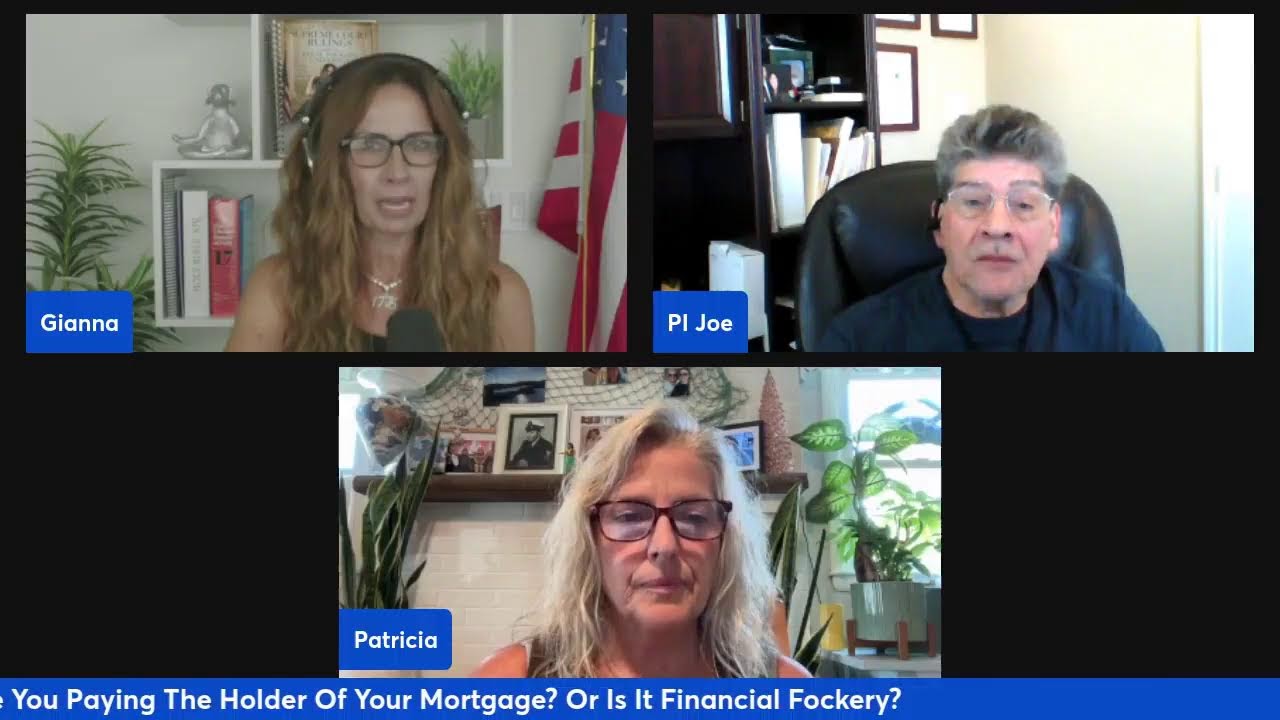
Forensic mortgage analyst Joe and plaintiff Patricia discuss a real case against Truist Bank, explaining why borrowers must verify who actually holds their promissory note. A forensic audit compares the original closing documents to servicer copies, checking endorsements and chain of title. Servicers rarely produce the original note and are not legal owners under federal law.
Chapters
Hello everyone, I'm Gianna Miceli. Welcome to Legal Fockery Friday Show. That introduction just gets me fired up, right? I am here with Patricia the Silver Stacker, and we have a guest. Look at Joe, I love his title, P.I. Joe. So this show is about mortgage fakery, chain of title analysis, and Joe is the person on the Legal Fakery University team that does the forensic mortgage analysis. Say hello, Joe.
Hi, how are you doing?
Joe is wonderful. So what we'd like to do today is have a real live case and like tell you how it works. And Patricia is actually in the case of challenging her mortgage. And basically this is a process that stems from like, who have you been paying and do they really own the chain of title for you to be paying? Is that correct, Joe?
Correct.
All right, I've been only doing this for a couple years now, so let's lay out the case. This is Patricia and her husband. They are pro safe pro se plaintiffs against Truist Bank in the U.S. District Court. I'm not going to get into her states and everything. And so the kind of case that it is is a declaratory judgment. They're not suing for money and they are not in foreclosure. This is not a foreclosure help process. So they're asking the court to declare one thing: who is actually entitled to enforce the note? And their posture is that they are current, they have kept paying, and they are on the offense asking the question, not on a defense trying to stop a sale, which has happened in some other cases. We don't do that. We don't support challenging them and not paying your mortgage. And so the standing, in one breath, is that her state commercial law— I'm not going to tell the sections— says a payment only discharges the debt if it is made to the person entitled to enforce the note. Please drink that in because this is legal fuckery, right, Joe?
Correct.
Okay, so if I have been paying a party that cannot prove it holds my note, my debt may not be discharged and I could still owe the true holder. And that's a real risk of paying twice. And so a concrete risk of harm like that is what gives her standing in the federal court. Patty, you're a genius. The court exists to settle who I must pay before that harm ever lands. And this is the whole standing. So this is a class in the Legal Focker University. It's called Mortgage Fockery, and what it does is investigate the chain of title command, and that's where Joe comes in. So let's just do a couple more things, and then we're going to start to, uh, ask Joe lots of fantastic questions that I'm sure will clear everything up. Section 3-302 defines a holder in due course. That is a holder who took the note for value in good faith. In good faith is a huge part of legal things. And without notice of any problem, a holder in due course can enforce free of most defenses. And here's the point that helps Patricia: before anyone can be a holder in due course, they first have to be a holder at all. And a holder of a note endorsed in blank has to possess the original. So even the strongest form of holder status still comes back to the same demand: show me the original note. Now we've got some Supreme Court backing, which I think would be a little, um, confusing for people right now. I'll say one thing, that Carpenter v. Longen is an 1872 Supreme Court ruling that held that the note carries the security with it, and an assignment of the security alone without the note, it is a nullity. And there's more for the declaratory judgment, and maybe I'll get to that later, but right now we want to start talking to Joe. Patty, why don't start with— you have the questions in front of you, right? Yes, yes, go right ahead because you are Joe's client and my member. Let's take turns with the questions. Go ahead, sweetie.
Yeah, sounds good. All right, Joe, so tell everyone what a mortgage audit actually is in plain language. What are you looking for when you open the file?
All right, so first off, the first thing that we're going to look at is Um, we're gonna go through your docs, okay? Because basically everyone signs very similar documents, okay? When you go to closing, you sign a note, you sign a deed of trust or mortgage, or security deed if you're in state of Georgia, all right? And then once you sign those documents, so you're going to sign between 80 and 100 docs, and then Shortly after that— I'm sorry, not me.
I'm sorry.
That's all right. So then they take your security instrument and they record it in public record. So we have to understand first, what is the purpose of public recordation? The purpose of public records is to give constructive notice to the world. Hey world, look, transactions are taking place right now. I understand everyone's going to say, well, Joe, I've got all those docs already. I understand that, but the documents that you have are the ones that you sign, right? So we're looking for very specific docs, right? Because what we want to do is compare the documents that have been filed in public record, okay, along with the greatest and latest and greatest copy of the note from your loan servicer, right, along with any assignments that may or may not have been filed into public record. Okay, and understand, we're asking for a very specific copy of the note.
Why?
Well, because the copy that you have in your file, I mean, it could be there 5 years, 10 years, it doesn't matter, right? That is your copy, right? While the original was supposed to be allegedly sold through endorsement, negotiation, transfer, and delivery pursuant to 3203. Okay, and 99.999% of the time it does not happen. So what we do is we look at your documents, we look at your chain of title, and we say, okay, what has happened, what was to happen, what did happen, and what did not happen pursuant to statutory requirements of law. So that's why, again, we're going to look at a copy of the latest and greatest version of the note. Why? Because that note evidences the debt. The note is not the debt. Your debt, right, is your promise to pay. So on the very first paragraph for that document, this is promissory note or note, or again, whatever document it is, right, of your governing docs, it says something to the effect of, for a loan I have received, I promise to pay. Okay, that is the verbiage that gives value to this instrument. This instrument is called a unilateral adhesion contract, meaning this is a contract written by Party A and signed by Party B. So what we want to do is find out, is did they do what they were supposed to do pertaining to commercial transactions? Because understand, we've got what's called the Uniform Commercial Code, okay? And prior to the Uniform Commercial Code, we had Negotiables Act, okay, of 1881, right? And then understand, the Carpenter v. Logan, right, which was an 1871 case, no, opined in 1872. And then 9 years later, we had Negotiables Act, right? And now we've got the Uniform Commercial Code. And all 50 states have their own version of the Uniform Commercial Code. The Uniform Commercial Code is a set of codified statutes and codes pertaining to commercial transactions so that you can transfer paper, right, negotiable instruments, as easily as money, as paper money. That was the whole purpose, right? Okay, so when we're looking at your documents, right, the first I'm going to say is, all right, are there any endorsements to the note? Okay, because this is how you're going to transfer it. Because when we look at statutory requirements of law, okay, understand we're looking at what does it say needs to be done. Okay, now for example, if I go to the state of Maryland and I go to Maryland Commercial Code 7-501, okay, That is the document, right? Or that's a statute that says form of negotiation and requirements of due negotiation. A says the following rules apply to a negotiable tangible document of title. One, if the document's original terms run to the order of a person, the document is negotiated by the named person's endorsement and delivery. So what we need to do is find out, is are there any endorsements to the note?
Okay, so that's what you're looking for when you open the file. Okay, we gotta keep it because the people are always thinking, what's in it for me? You know? Okay, it's a little too high level for them. So, you know, basically you're looking for legal fuckery.
I'm looking, I'm comparing the difference. Okay, what has changed from their original closing docs to the version of the document that we got from the loan servicer, being the note. Okay, without any difference, those items.
Okay.
Yeah. Okay, question 2: What is the difference between a payment history audit and a chain of title or securitization audit? Why are you laughing?
All right, let's just— let's just break this down. Okay.
Again, let's keep it simple.
Payments, right? A payment history, right?
Yeah.
How many payments did I make? All right, so for example, if you're in bankruptcy, they put in a proof of claim and they say, here is Joe's payment history, here is Patty's payment history. That says nothing other than you've made payments. Okay, an investigation, right, into parties that should have been named in public record, that should have been named to the instrument, is what we look at. What were the transactions that were to take place? Did they take place? Did they not take place? Because understand, when we reverse engineer your loan One of the things when we locate where your data is stored, okay, you're going to say, oh my God, I know where it is. So understand, in addition to knowing where your debt is, understand what else you know. You now know where your debt is not, okay. Because 90% of the time, the parties that are coming for enforcement is your loan servicer.
Of course, right? But we have lots, we have lots of questions, so can we just stick to each one? Because we're going to get to this, you know. Patty, go ahead with the next one.
When a loan gets sold and resold, what actually happens to the, the original wet ink note? Where physically go, right?
So one, you're saying loan. Loan consists of many documents. So are you talking about selling the note, assigning your deed of trust, transferring the debt, selling the debt as a transferable Article 8 record?
Well, the average layperson does not know all those things.
Okay, so loan, right? I would tell everybody to don't use that word. Right? Because when you use the word loan, loan in its entirety, you're talking about a bunch of documents, more than one. Okay, so if you're saying, Joe, they sold my loan, well then you're telling me, Joe, they sold my note through endorsement, negotiation, transfer, and delivery. Joe, they sold my debt as a transferable record. And Joe, there was an assignment of my deed of trust or mortgage. When in fact, very seldom does any of that happen proper, right?
So, so what happens to the original wet ink note? Where's it— where's that original?
We really don't know. Normally it is in the collateral jacket, okay? And that collateral jacket, right, it's an actual folder, okay? So when you went to closing, all them documents have to be saved. Okay, and again, that's like 180 to 100 docs: original warranty deed, original title, you know, the name of the investor. And if you have a GSE such as Fannie Mae, Freddie Mac, Ginnie Mae, within those— for example, with Fannie Mae, right, Fannie Mae has specific verbiage, all right, that says a document is to be prepared in recordable form and not recorded. Well, that document that they're talking about is an assignment of the deed of trust or an assignment of the mortgage, and it is prepared in advance when you're at closing, and it sits in your collateral jacket folder.
Where does the jacket folder go?
That goes with the custodian of documents.
Was that the county recorder?
Who would know? Custodian of documents. That means, sir, so that is the party that has been given the right to hold on to these physical documents. Okay, who would that— it's like a guardian of the physical pieces of paper.
Is that— is that an agency, a bank?
It can be in a warehouse. Okay, okay. So, but it is a— there is a custodian that stores all of the physical documents because they have to keep the physical documents because the laws were written for the tangible, not the intangible.
Very good. Next question. You ready? Yep. Okay. How often in your experience can a servicer actually produce the original note when someone asks for it?
Well, they can produce it. The question is, do they want to? And what is the reason for it? They don't want to.
Well, why not? Why not?
I would— because I want to go to that custodial warehouse and dig it up, right? Is that No, that—
no, because if you do a QWR properly, again, that's one of the things you can ask for, to see it. You know, I'd like to see a copy of that. You know, when we put out an ER letter, again, that's one of the things that we're asking for, is to see it. You know they're not going to give it to you.
Why?
Well, because there's an eccentric value to it, and last thing they want you to do is to hand you this physical document that you can just tear in half and suddenly, oh my God, it's gone.
Do you know that our friend that is no longer with us is actually making a claim to court that the signed original document, because it has the signature of the deceased original owner, is a family heirloom?
Oh my God, come on, that's ridiculous.
He's taking that to court and getting shut down so fast. No, it's not. The daughter inherited the house.
Yeah, it's okay.
Yeah, go ahead, go ahead. Next question, Patty.
All right, how often in your experience—
no, no, next one. 5, 5.
I'm sorry. If a note is endorsed in blank, what does that mean for who can claim to hold it?
All right, this is good, and I like this, right? Because I— what— this is what they cite every single time. Right? They cite 3205, right? And they say if an endorsement made by the holder of an instrument, and it is not a special endorsement, it is a blank endorsement— when endorsed in blank, an instrument becomes payable to bearer and may be negotiated by transfer of possession alone until specially endorsed. You notice that that word there said possession. Non-ownership. Okay, right now understand, a blank endorsement is what they're calling this, right? But if you were to jump down to 3205, right, which says the holder may convert a blank endorsement that consists only— all right, I'm going to use that word again— only of a signature into a special endorsement by writing above the signature of the endorser words identifying the the person to whom the instrument is made payable. So when it says paid to the order of, imagine you have a check with no one's name on it, right? You possess it, right? You only possess it. You're not the owner, okay? As a matter of fact, we've got case law that supports what we say. This is an incomplete stamping. Ivan created a document over a decade ago right, showing what bearer instruments are, right? Because the minute you added the words 'to pay to the order of,' right, you've made this order paper. The minute you added the words 'without recourse,' you know, I tell everyone, go ahead and Google the words 'without recourse.' The words 'without recourse' mean without representation, without warranty. It's used in real estate transactions. So what it means is that they have released rights to the note without naming a payee, right? Now they've also opened up a can of worms, right? Because now you have the named mortgagee in public record, correct? And the purpose of public recordation, right? So the purpose of that mortgage or deed of trust is to attach itself to the debt evidenced by the note. But understand, there was no one named to the note. So now you're running into agency problems. Why? Well, because you have an agent in public records. The mortgagee is acting as agent, okay, for a principal that is not named to the note. Okay, so now we say, Your Honor, there is a lack of agent-principal relationship. Why? Well, because the mortgagee cannot take instructions from an as-of-yet unnamed payee. Basic contract law.
Right. Okay. Why is a photocopy of a note not the same as possession of the original? What could go wrong between one or the other?
Oh my goodness, this is so fun. Well, if you had a picture—
keep it for the lay people.
We could have— again, a picture is just a picture. You know, it can, it can be changed, it can be manipulated. This is why we're always asking for— we want, excuse me, copies of the original, right? And understand, when your lender sends you a copy of the original, right, treat it as if it is the original.
Why?
Well, because the servicer wouldn't lie. They say, Gianna Miceli, this is a copy of your note as it exists today. Okay, you know what, I'm going to accept that. Why? Because you're a bank and you understand securitization. So even though it looks just like the copy note I've got in my file box, right? No endorsements, no nothing. They said that was it. I'm going to attack it as if that is what my copy looks like, because now we've shown you where your debt is, as well as now you know where your debt is not.
Not right. All right, so let's move on to number 7 here. What do you think for— no, look for number 7. What do you look for on an endorsement or an allong that tells you whether it was done properly and when? What does allong mean?
I don't even know.
All right, so in an allong is supposed to be used when there is no more room on your document for the endorsement. That is how it's supposed to be used proper. And this, a launch, is a separate piece of paper that is to be so firmly affixed so not to come off. So firmly affixed, meaning it needs to be stapled, cemented, whatever. So what's interesting is whenever they send copies of this launch and you're like, Joe, why are there holes on some of the pages and there's no holes on the other pages? Basic proof that they're just taking pieces of paper and trying to put them together. Wow.
Okay, okay. Next is me. What is robo-signing and how does it show up in the audits you have done?
To be honest, we don't get into robosigning a lot, and I'll explain why. Because ever since we got into the consent decrees back in 2010 and they did all of those orders, the courts stopped looking at robosigning. Because if you understand that the purpose of an assignment is to memorialize transactions pertaining to the sale of the tangible promissory note and acquiring of rights It does not cause the sale, nor does it cause the acquiring of rights, as those are done pursuant statutory requirements of law which haven't taken place yet. So we don't need to say Donald Duck signed this, Daffy Duck signed this. It doesn't matter who signed it. What was the purpose of it is what you need to understand.
Okay, now we're going to get in some meat and potatoes.
Yes, the chain of title and securitization. Walk us through on how a loan travels into a securitization trust. Where do the breaks you happen?
Okay, so understand, in the last 10 years, over 90% of all deals are sold to GSEs, government-sponsored enterprises such as Fannie Mae, Freddie Mac, Ginnie Mae, FARMER MAC. All right, that is where over 90% of all loans are sold to. Why? Well, because if you understand, after our recession, recession in 2010, okay, the bulk of the entities that used to create the RMBSs went out of business. IndyMac, Lehman Brothers, Bear Stearns, okay, they all went by the wayside. So after that happened, this is why we have $80 billion that went into Made in Lane 1, Made in Lane 2, and Made in Lane 3. So right now, the bulk of the deals are sold to government-sponsored enterprises.
Okay, what— I, I, what does— what role does MERS play, and why do people say the note and the deed of trust can end up on separate paths?
All right, um, Mortgage Electronic Registration System is an electronic registry, period.
Like a filing?
It, it's a registry. Imagine having a notebook, except this is an electronic notebook, and it keeps track of the loan servicers Okay, period. And where do the loans go? The debt. That's what it's supposed to do. Okay, but that's it. Understand, it doesn't operate in the real world.
It doesn't really have a role, just— no, registering. Okay.
Oh yeah, that's interesting. When a bank merges into another bank, does the note automatically follow, or is that something that has to be proven?
No, understand, your debt is bifurcated, right? Your debt is sold minutes, days after you've had that initial signing, all right? The debt is sold, right? And the debt is sold before the bank has gone out of business.
Okay, I do have a question. So when you, when you don't pay your mortgage for 3 months, let's say I was in foreclosure and I didn't pay my mortgage for 3 months, does that debt get pushed back to the first bank?
Like, so no, no, no, no, no. So understand, all right, so you signed the note, you signed the deed of trust, they've recorded the deed trust. Now they say we've got a proper mortgage-backed encumbrance. And for that moment in time, they do, right? Now they sell the debt to Freddie Mac, all right? And we know the debt is with Freddie Mac because again, we went into the Freddie Mac single-family loan level data set and acquired the data. But when we look to the note, there's no endorsements to the note. So if there's no endorsement to the note, that tells you what? That the note was never transferred proper. And if there's a stamping on it that says paid to the order of with an as-of-yet unnamed payee, again, it's an incomplete stamping. We know what they intended to do because it says paid to the order of, but until the payee is named, no one will acquire rights to the instrument pursuant to 3203.
Okay. Is it difficult, wrong, or arduous for the borrower to ask the simple question of the bank, who is entitled to enforce my note? Are we disruptors? We— they hate us, right? They hate anybody that's, uh, questioning their situations, right? Isn't that a fair question to ask if I'm paying you? And people always talk about, oh yeah, I got a notice, my my— well, I'm not sure if it's the servicer, the bank. That would, you know, people have a perception that the loan was sold, and, you know, we already know what the loan encompasses, the 80 papers. But, you know, why are you looking for Pete?
Person Entitled to Enforce. That's it, right? Pete's missing. Where's Pete? Right, true, true. That's what you're talking about. Well, Pete's gone. He is not around. Why? Well, because if you understand, rights to the note do not extend to the deed of trust. So if no one is named to your note, no one has acquired rights of enforcement.
Okay, Patty, next question.
Has been paying for years. How would they even begin to find out whether they have been paying the right party?
Well, first they take the class in the Legal Focker University, right? Because you have to under— I know it's very high level, but we break it down in the class. There's a 90-minute video of Joe explaining it in detail. Um, there's, I don't know, easily 100 people in that class, and it's a community, so you're not just doing this all by yourself, and you can ask questions, and everybody's in this together. Go ahead, Joe. How can people find out? They hire you from my class. And what do you do? What do people need to bring to you to hire you once they've been in my class? Which Joe has complimented me saying that everybody who sends him people, mine are the most qualified and educated.
So it's really quite simple. All right. We're going to ask for a copy of the promissory note. Right, the latest and greatest version from their loan servicer. Why? Well, because the servicer services the loan. That's it, no more, right? Now understand, when they do foreclose, it is the servicer, right, that comes to foreclose. But what everyone needs to understand is Write this down, right?
Get your pencils.
Here we go. 15 USC Chapter 41, Section 1641F, and that goes to treatment of servicer. I'm going to repeat it one more time. 15 USC Chapter 41, Section 1641F, treatment of servicer. Why, people, this is one of the most important things you need to understand, because this says in general, a servicer of a consumer obligation arising from a consumer credit transaction shall not be treated as an assignee of such obligation for the purpose of this section unless the servicer is or was the owner of the obligation. They've sold the debt, they're not the owner. To servicer not treated as owner on basis of assignment for an administrative convenience. It says a servicer, a consumer obligation arising from a consumer credit transaction, shall not be treated as the owner of the obligation for the purposes of this section on the basis of an assignment of the obligation from the creditor or another assignee to the servicer solely for the administrative convenience of the servicer in servicing the obligation. That is the only reason they're assigning it to New Res, to PHH, to Rushmore Servicing, to Rocket Mortgage— just to service the loan. They're not the owner.
Well, they sure are.
Why do they act like it? And would that not demonstrate that every foreclosure is a fraud?
It's called greed. Greed. Because understand, all right, there is— if you understand that prior to the inception of MERS It would take, say, from 6 to 9 months for a note to go through the parties, right? Seller, sponsor, depositor, trustee, right? Because they need to go from A to B to C to D.
Well, what about if MERS, your servicer, files a corporate deed of assignment 9 years later?
Oh, I can tell that's a genuine Right, it happens. Oh, it happens more than not, understand. Yeah, the assignments, right, are not filed usually, usually, okay, unless there is a default. Why? Because they just kicked the can down the road.
You see, that is juicy.
Now, so when Once you've gone into default, right? So what happens when you are in a deed of trust state? Okay, understand the difference, right? So we've got both deed of trust and mortgage, but they're two completely different animals, right? So if you have a deed of trust like Texas or Maryland, okay, you've got equitable title and the bank has legal title because there is a trustee name. But if you're in Florida, say for example, right, you have a mortgage, right? So the difference is there is— that is a lien theory where the only bank's recourse that they have is a proper lien, all right? But in order to have a lien proper, what must you own? The debt. Oh my God. So if you do not own the debt, you cannot claim to be a secured creditor.
Okay, what is the single most common thing you find that surprises homeowners about their loan? You know, people hire you, you give them the documents, and they might email or call and say, Joe, what the freak? What are they saying?
Well, they're actually surprised that we actually are able to show that the loan level data that we pull matches their instruments. Because that's the first question I get: Joe, where's the evidence to support your claim that you're saying?
And could you describe— you get something from— you get data which probably the average person could not decipher, and then you put it into an affidavit. It's just a talent that you have because you're obviously obsessed with this, like I'm obsessed with traffic tickets and Patty's obsessed with silver. So you take that data, what does it look like? Well, this is in the class, but just if we can talk—
sure. So for example, if you have a loan and you're with, say, Fannie Mae, Ginnie Mae, Farmer Mac, okay, or Freddie Mac, right? So when we get the data, we're going to get like 4 or 5 lines of just raw data, right? Just numbers and letters. All right, so what we're going to do is we're going to take that data and we're going to extrapolate it, meaning we're going to open it up into a single column running north and south. And then we're going to take the information from your note and your deed of trust, or your, uh, security deed if you're in the state of Georgia, right? And we're going to cross-index that data. Because when you look at the— your instruments, right, on your note, there may or not be an account number, a loan number, an interest rate, amount of loan, the date of the loan, maturity date, payment date, payment amount. These are all data indicators. Right, by your specific loan. So we're gonna cross index to show you this is yours. Here you go. It doesn't belong to no one else. And if you have an FHA, VA loan, okay, there's also an additional indicator information is you have what's called a— either a VA case number or an FHA case number that follows all of your documents around. And that's also in the loan level data if you had to say a Ginnie Mae deal.
Okay, Patty, you have a parting question since you're actually in the process. Like, how does it end? How, how does someone get a release of the lien because they've done this process?
Or quite—
yes, well, I've been through this. Myself through bankruptcy, okay? And I discharge my debt as an unsecured debt. I list my assets on Schedule F as in Frank. I went into a full-blown Chapter 7. I'm not going to go into it, but understand, for 2 years they were unable to lift my stay. I won every single motion that was filed.
Yes, good for you.
But there are other ways, such as what Patty's doing, correct?
But understand, the whole purpose is to show it is unsecured, period.
And through your way, did you get a release of the lien from the bank?
How did I get— um, they had a release of the deed of trust, and I put a renter into my house for the next 5 years.
Is that pertinent?
Well, yeah, because I was forced to leave the state because the DAG came after me, wanted to arrest me.
Oh, okay, okay.
So I had to leave, so I put a renter into the house.
Okay, but you still own the house?
Yeah, yeah, yeah.
So, okay, now Patty, you are in the phase where you have sent the request for the bank to prove this and that and the other thing. And they— you start in the state court and they try to get you to go to federal court, which usually favors the banks. But you have been— are you in federal or state? Wasn't it kicked back?
No, I'm still in federal court right now.
Okay, I'm sorry, it's harder to keep track of everyone. Oh, we lost you, we lost you. Yeah, don't go through those. Yeah. You're way better, whatever this is. Yeah, we can hear you.
Oh good. So we have filed a remand to get it moved back to state court.
And did you originally file in state and they tried to— the bank tried to put it—
we originally filed in, uh, state court.
That's what I said. Yes, and the bank wants it in federal because the federal favors the bank, which is legal falconry.
Correct.
And now you are Go ahead, pick it up from there.
And so now, now we're trying to get it back in, into state court. And if they, you know, we've asked for one of two things: you either agree to the remand to have it moved back, or disclosure, you know.
No, discovery, right?
Yeah, discovery, disclose, you know, something that they, you know.
I don't think that's the same thing.
Yeah, so yeah, you know, so we'll, so we'll see.
And so it stands right now in your case that If the judge does not choose one or the other, the judge is breaking the canons, as in is up to no good and will risk their pension.
What do you think, Joe?
I'm excited because understand the whole purpose of getting a declaratory judgment is to render decision prior, right? To the client title.
But they immediately popped it over to federal court and asked for a dismissal. That's what they did.
Oh, of course. I mean, I understand that totally, because they cannot show that any transaction was done proper. That, that's the whole point. What they did is they put the cart in front of the horse because they tell everyone these are mortgage-backed securities. Nothing could be further from the truth. It was more a proper encumbered mortgage prior to the sale of the debt to Freddie Mac, right? Right. Because if they only sell the debt, there is no assignment. Okay, what was sold? A payment stream, a cash flow, right? That's it.
Now, how long has this fuckery been happening? It's not always I think we've discussed before, somewhere around the 2000s or so.
Well, understand, securitization has been around, you know, for a while, okay? It was started by the Salomon Brothers, but it's, it's gone more rampant in the last 15 years.
And a lot of this caused the 2008 problems, right?
Oh my gosh, it was everything.
I mean, it was everything. There's a movie called The Big Short that I've watched watched at least 6 times. It's, it's very high level. You have to really pay attention to understand the movie, and what they do in that movie is what this is, and that demonstrates how there could be a catastrophe.
Oh, there was.
Yeah, well, you know, another one. If you want to learn about this and what people may have fear of— Patty's not in court in front of a judge. This is the court's paper. It's on paper. It's all done for you. So you'll take the class and then you understand the process. It's, it's very high level, but you know, you can take your time with it. And then if you decide to move forward, we have an outside team that handles this. They specialize in this, and the paperwork is done for you. But of course, you want to read it and you want to understand what's going on because you are a pro se litigant. You are filing it on your own behalf with your own signatures, but you're not writing the papers, you know. There's things that mostly you just supply the papers and the documents are done for you. But of course, you have to be cognizant, and it could take up to a year. Yeah, it's not overnight. It used to be shorter, but it's not. I think because there's a lack of people doing the discharges.
That's reality.
What does that mean?
So the number of people that used to Employees? Yes.
So in the courts or in the banks?
In the courts, not the banks.
Yeah, the courts.
So yeah, yeah, they're very short. And the way that people are starting to do it now is catching the courts off guard.
Yeah, it does evolve. It has evolved. And we've been doing this 2 years now, almost the end of 2 years. And Patty's been in maybe 9 months, I think. Patty?
Yes, it's been, it's been, yes, it's been a journey for sure because they're, you know, they're doing, they're just filing document after document to try to get it dismissed.
Yeah, we laugh because we understand this now, and that's the fun of being in Legal Focker University. And if you want to join, you go to joingianna.com. There's a 3-day free trial. You'll meet Joe and Patty, and it's a community of like-minded people. There's hundreds of people in there, and you will lose the fear when you are around the right people because this is what we do, this is what we say, this is what we talk about. We only talk about real tangible things.
Oh yeah.
Any, any parting words, Mr. Joe?
Yeah, so understand, right, so this is all about title, period. Okay, what is title? This is what people need to understand. So title is a union of all elements constituting the legal right to control and dispose of property. Title is a legal link between a person who owns property and the property itself. Title is a legal evidence of a person's ownership rights or interest in the property. Title is the manner in which the right to real property is acquired, the conditions necessary to acquire a valid claim to land. Title is the right itself, the legal consequences of such conditions. That is what this all amounts to.
No, Joe, thank you. It's always a pleasure to have you. You are just a superstar of this. Joe's not reading that, you guys. That's just how Joe speaks. Joe knows this.
Thanks everybody. I appreciate everybody being on this call as well.
We have Joe about once a month, so we're gonna see you in like 4 weeks. All right.
Yep.
Bye-bye.
Thanks everyone.