Agentic AI And The Future Of Communication With Grant Lee
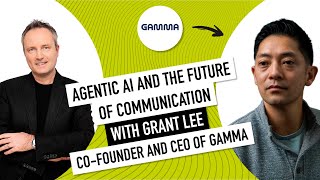
Grant Lee, CEO of Gamma, discusses how his AI-native presentation platform challenges PowerPoint with card-based design and embedded AI. Gamma has $50 million ARR and 50 million users while maintaining a profit-first approach. Lee argues the real barrier to adoption is behavior change, not technology, and warns that AI could leave workers behind without proper upskilling investment.
Chapters
Okay, welcome to another episode of my podcast on the future of business and technology. I'm Bernard Marr, your host. Today I'm joined by Grant Lee, co-founder and CEO of Gamma, a fast-moving AI-powered platform that's reimagining how we create and share presentations in the digital age. Welcome, Grant.
Thank you so much for having me.
It's so lovely to have you with us. Maybe we can start by you giving us an overview of what Gamma is and what made you want to start Gamma.
Yeah, I think the easy version of this is to think about Gamma as being the anti-PowerPoint. In many ways, we're trying to create new tools so that people can shape and share their ideas with the world. You know, I think PowerPoint slides We've all learned this since we were kids. It's a format we're used to, but in many ways we feel like, you know, a tool that was invented 40 years ago, you know, we deserve a chance to kind of reimagine what that could be today with modern tooling, with anticipation for how, you know, communication just has evolved over the years. And so we're trying to do that. We're also powered by AI. We're trying to really dramatically simplify the way people create content and are able to share that content with the world.
So how is it different to PowerPoint?
Yeah, so there's a few different principles. You know, we with slides, you know, we're used to something that is, you know, 16:9 fixed in sort of aspect ratio. When you enter a tool like PowerPoint, you're dropped into this canvas and you're instantly forced to be something that many of us are not. We're not designers, so we are faced with this canvas where we have to resize boxes, align things, think about the layout and the design immediately. And our approach is different. We focus on the content. So you get dropped in, it's much more of a writing-first approach, so you have this sort of card-like concept which allows you to be much more flexible. The card sort of expands as you add content to it. It's intended to be multimedia-rich, so you can add beyond just text and images, you know, video, you can embed other links, other websites even, directly into your presentation, and it's intended to be mobile-friendly. So if you have content that does need to be shared with other people, whether they're on their mobile device or their iPad or, you know, they're actually on their, you know, widescreen monitor, they can view that and the presentation itself sort of will mold to the shape of the screen. And so just like, you know, modern websites allows you to have much more flexibility in how you present that information.
Sounds great. What I like about your story and the story of Gamma is that you are actually a profitable company. I, I, and you have millions of users already and, and you haven't overreached in terms of funding. That is a really interesting approach because what I'm seeing at the moment is I, I almost go back to the early dot-com bubble where we had thousands of new companies starting every day. Uh, many of them completely overhyped, many of them never making a profit. Um, obviously out of that came the emergence of some amazing companies. So why do you think your story is so different?
You know, I think, you know, a lot of what sort of AI startups are kind of grappling with today is what it means to kind of build and scale a team just feels like it's fundamentally different. You know, when you look at, like you had mentioned, kind of these previous generations, the dot-com, even the mobile era, I think when a lot of startups reach this feeling of product-market fit, you know, users are pulling product out of them, the immediate reaction was to, I guess the term used to be called like blitzscale, you'd immediately grow the team as quickly as you can, try to dominate the market, and really go after kind of a multi-pronged approach to like building out the sort of business. And I think what we've seen today is many AI startups are much more resistant to trying to do that because they recognize that their product can grow organically in many ways without having to just add much more headcount. And in addition to that, I think what we're seeing is like, The ability to integrate AI tools into their own workflows makes it such that each team member can actually do 10x, 20x, maybe more of what they could have done in the past. And so rather than scaling up your headcount 10x, you take a step back and ask, how might we actually increase our efficiency 10x over the course of the next couple of years by investing in the right tooling, by investing in the right infrastructure, by changing our mindset in terms of how we build? And I think that's where people are being much more patient today. And the sort of benefit of that is just extreme efficiency.
So in terms of scale, then, just to give people an overview in terms of users, subscribers, income versus employees, what are the current numbers?
Yeah, so, you know, we passed $50 million in ARR earlier this year, over 50 million users around the world, um, you know, millions of monthly active users. And I think when it comes to some of these, uh, traditional metrics, you know, I think when you looked at things like ARR per employee, uh, what used to be good in the prior generation was something like, you know, $200,000 ARR, you know, $200,000 revenue per employee. And that basically means, you know, when you get to around $100 million in ARR, you have roughly 500 employees. I think what we're seeing today is maybe, you know, 10x in the efficiency there. So we're maybe 1/10 the size we would've been in this sort of previous era. And so our team is significantly much smaller. We're over $1 million in ARR per employee. And I think that just leaves the team with much more optionality. We can take really big swings. Feel like we're in control of our own destiny and can kind of pave our own path to how we want to grow the business over time.
Absolutely amazing. Well done. Um, you talked about the fact that it is AI-enabled. Um, I would love to understand how you're using AI in the platform, what the key AI benefits are that you give users. But before we do this, maybe we can even look at the wider picture. Um, where do you think we are currently with AI? Some people feel it's overhyped, some actually feel it's underhyped. What's your opinion?
I feel like we're still very early in the cycle, and I think the reason I believe that is, you know, we spend a lot of time talking to users, and I think AI is something that is both super exciting for some but a little bit daunting, and maybe, you know, there are areas where people just don't know yet how to embrace it and can be overwhelming. And I think that's natural because it is a very powerful new way of working. And when I look broadly, I think there's certainly early adopters, there's the power users, but the vast majority of the world is still early in understanding how do I actually change the way I approach work, the approach, my own productivity, my way I collaborate with others. And I, so that's where I think in the sort of even adoption curve, very, very early in that journey, ChatGPT obviously is helping kind of actually educate the broader market and making it less intimidating and overwhelming for the average person. And then when I look at just the AI, the technology itself, we all know that every week it seems like another milestone is made or another breakthrough, and that's on multiple different fronts. It's not just large language models. We're looking at images, videos. It's across the board, and a medium like ours can actually benefit from a lot of that underlying advancement. So obviously a tool that is multimedia rich like Gamma, text, images, video, audio, those are all things that we will be able to benefit over the long, over a long time horizon. And so when I look broadly both on the technology side and the adoption side, it really does feel like early days. And I think, you know, it's not going to be the year of AI, it's going to be the decade of AI. It's going to take a lot of time for the tools to mature a bit more, the sort of kind of mindset of most folks to be able to actually embrace and be more willing to adopt. I think this is where it's going to be very, very exciting.
Yeah, I agree. And so how are you using AI within the Gamma product? What are the types of AI you're using? How are users benefiting from it?
Yeah, I mean, it's really sort of embedded throughout the product. It's woven into the core, you know, of the product today, and it touches today on a couple different areas. So certainly on the text side, you know, we're leveraging many different large language models to be able to power everything from initial, you know, outline generation to doing web search to being able to like craft the structure of your presentation to help you synthesize a lot of information. So if you are, you know, uploading an existing document or working with an existing outline, how might how do we take that and help you shape that content? So there's a lot going on there. On the image side, we're powered by some of the world's best image models. So we're taking, you know, the context you have in your presentation and allowing you to say, okay, how might we, you know, complement that with the right visuals? And that could be anything from like something that's more suited for infographics versus something that is more, you know, abstract, just helping you set the tone in the sort of visual direction for your presentation. Much more that we're gonna wanna do there. And then there's things that we'll be exploring at kind of the next frontier, which is around, video, how might we help people create content that is transforming their existing presentations into multimedia-rich video content that might even include audio, it might include avatar voiceover. There's a lot of things we're exploring there in the early days of integrating other cool use cases directly into Gamma.
Yeah, this is amazing. What are the risks of companies like Microsoft who obviously own PowerPoint, but they also have Gemini, OpenAI, they're trying to build generative AI capabilities into all of their products. What's the risks for your business of Microsoft just bringing some of those capabilities into their products?
Yeah, I think anytime you're faced with, you know, large incumbents, they have massive distribution. So certainly, you know, they are both a brand and a tool that everybody knows. It's ubiquitous. And for a startup to win, we really have to overcome the inertia, right? Like everyone is already used using these tools. Behavior change— we always talk about behavior change is actually our biggest competition. It's not necessarily another startup or, you know, another tool. It really is the fact that people are used to PowerPoint, they're used to slides. To get them to try something different, you really need to deliver on the promise of it being significantly better. And so that's, you know, what we're focused on, just making sure we can live up to that promise every single day, innovating, pushing it further along. I think the benefit of our position is that we aren't necessarily constrained by the rules of our predecessors, right? Slides as a format have been created in such a way that there are certain constraints and rules that, you know, 16:9 slide needs to follow, and we don't necessarily need to follow that. We can actually break away from that and say, if we were to really build the best tool for the job today, what would that look like? And we are AI-native, so we can say, how do we actually embed the right infrastructure, the right tooling, in directly into our product so that our users get to take advantage of all the AI goodness out there and we can pass maximum value directly to our users. That's honestly the equation we're trying to continue to balance every single day. How do we make sure we pass as much value to our users as possible?
I see this across so many industries where we now have so many different AI startups completely reinventing the products, the services, and being AI native. Much smaller, much more flexible, connected with your customers. It makes you more nimble and hopefully you will succeed with this. It's an amazing story. I believe you're joining me from London today, right?
That is right. Yeah. And the fun story there is, you know, when I first started Gamma, I was living in London. So we were here for actually my wife's job and got to meet an amazing community here. Definitely inspired me to, you know, get get Gamma going, and fortunate to have had the, you know, the benefit of, uh, you know, early supporters here to get us going.
Yeah, so what was that like? I believe you lived in California before, then you moved to London. What was it like moving country, um, starting a new company, and I believe raising a newborn as well?
Yeah, uh, I would say, you know, the— it was quite the adventure, um, not least of which we were also trying to navigate COVID along with the rest of the world. So the world was in lockdown and it was definitely a different time. But I think it's during those tough times where you as a founder can really ask yourself like, what are the things you want to commit your life to? What are the sort of things that could truly be your life's work? And for me, when I thought about all the things we could possibly work on, the idea of augmenting how people communicate and how communication is truly one of the highest points of leverage. If you can change how people communicate, you can really change the world potentially. And so those were the sort of things that really inspired me. And so when I was locked away in the room trying to fundraise initially, we had a small flat. And so for me, this was fundraising in the sort of storage closet we had next to the laundry room. And so doing this at midnight, you oftentimes are asking yourself, is this worth it? And for me, the answer always was yes. So that gave me conviction this was the right move. And despite being in a different part of the world and a very different environment, it just felt absolutely right, right thing to do.
Yeah, very inspiring. Um, what if you look back now, what lessons have you learned that you would want to pass on to other founders and other people trying to start a business or trying to change the world?
Yeah, I mean, I do think, you know, for us, we took 5, 6 months to build conviction for the sort of startup we wanted to build, and I do think most founders oftentimes rush into either something that seems on the surface interesting or maybe is the technology, like certainly with AI, playing with something might feel magical and just rush into that space. But when you think about most startups, to succeed, you have to build over a very, very long time horizon. And so you really owe it to yourself to build conviction and going back to, is this something I can see myself working on 5, 6, 7 years down the road and knowing that there's going to be obstacles coming. I think that's important. So for me, you know, what that meant was with my two co-founders, they were still working full-time jobs. I was doing consulting. Nights and weekends we were doing and prototyping Gamma. And so that was what it took to really say, could we work as a team on this space in a way that we felt like we actually make progress quickly, that we had good intuition for what people would need, and that over the course of working together, we actually felt like you know, this is a company we'd be excited to build. That 5 months led to us taking that initial prototype that we built into, into our first pitch deck. So our prototype was our pitch deck. We used that to raise money. And I think, you know, that, that really proved that what we had kind of early on as even just like proof of concept was something that investors were excited about, that we were excited about building, and gave us confidence that this is something that was going to be, you know, meaningful for the long haul here. So I would just encourage most founders just to not rush it. I think it's so tempting today because AI capable that you can pick up an idea and it feels like, oh, you know, I can do a lot with this. But really imagine, like, what is— like, play this out for a few more years, and is this still something that, you know, gives you energy? Is it something that you'd be excited to pursue?
Yeah, they're good tips. Um, you mentioned the fact that you believe employees nowadays are 10 times, 20 times more effective and efficient by leveraging AI tools and other things. What are you looking for in employees? What are the skills that I think will make people attractive in the future?
Yeah, I think there's a few things. So definitely just, um, oftentimes we'll start with, you know, management or leadership. So first, being bought in that, hey, things are actually changing, and for the leadership to set the tone that every team now has a chance to be an AI-first team. The way you you might have done work 5, 6, 7 years ago needs to be completely, you know, you should rethink that, the workflows, the processes. And so if you can set the tone that, hey, as a team, for instance, as a marketing team, we're going to be AI first, having the dialogue with the team is really important. And for the leader to embrace that, I think is absolutely critical to have the mandate to say, hey, we are going to be AI first and what are the implications of this? I think it's the only way to get started. Without setting the tone there, then almost nothing else matters. You can't have it necessarily just be bottoms up because there'll be too much resistance. And so what I think, what we've noticed is that when leaders try to set the tone, what you need to do is actually then be willing to really experiment broadly with all the AI tools out there and understand like, you know, the adoption curve might look different. It's interesting because a lot of leadership in general is oftentimes most resistant to change because they're used to doing it a certain way. And so overcoming that initial hurdle, I think, is probably the biggest challenge most companies will face. Can you get leadership bought in and you get, can you get that bought in kind of wall-to-wall and across the entire organization? Because really that's where the magic happens when other leaders are sharing tools and techniques and things that are working within one function and allowing that to spread, you know, organically throughout the rest. I really think that's where, you know, most of the unlock really happens.
Interesting. And how do you personally use AI? Are there any tools that you couldn't live without other than Gamma?
A lot of it is converging to, you know, ChatGPT and Claude and some of these tools where, you know, with context and memory, you can just do a lot more. And they can be your thought partner, they can be someone, uh, to, to brainstorm ideas with. They can really kind of jumpstart a lot of the things where people get stuck in their own heads, not even knowing where to start, and avoiding kind of the tougher, you know, uh, problems or the tougher things that, you know, it just comes with, um, needing to allocate more time. So for me, that's kind of where I've seen the most. And of course, of course we use Gamma on a, you know, daily basis. So for me, that is my communication tool. It's how I both communicate internally to our team as well as externally to our customers and users. And so, you know, those are my two power tools. I'm constantly experimenting though. Like I love using a lot of the other, you know, image tools out there. Midjourney is obviously, you know, a favorite and super powerful. Inspired by them also being a lean team and all the magic they've been able to harness and build over the years. And so, So it's certainly a fun time just to try to keep up with it all and on a daily basis being able to explore and see what else is coming out.
And as someone that is exploring those tools and is always trying to figure out what's coming up, what are the key trends you're seeing in the AI space?
Well, there's so much. I think what's happening now is, you know, there are are tools that I think are providing a much, you know, broader general approach to how might you leverage AI, you know, ChatGPTs, the super agents like tools where a lot of different kind of potential tasks can all be bundled into one. And those are all worth checking out. And each kind of, each platform kind of has its own flavor of what they're good at, you know, whether it's, you know, the research side of things or, you know, finance. And so it almost feels like you should explore them all and say, on your daily use cases, like which ones actually provide you value. If you are someone that is really analytical, certain platforms might be better. If you're someone that is much more into writing and creative exploration, maybe you might find value in others. And so it really is kind of like finding your tool of choice. And then what I am starting to see more is certain tools kind of being more narrowly focused on specific verticals or use cases. Cases. And, you know, there are like the Harvey AIs of the world that are very going deep into, you know, the legal space. And so, um, if you have a profession where, you know, a certain type of model very fine-tuned or trained on your specific use case, it's always worth trying to explore whether or not the, you know, vertical-specific solution is actually much better for, for your use case than, you know, the, the more generic, you know, ChatGPT. Um, and I think more and more of these sort of verticalized solutions are going to be coming out. And so it's always worth kind of making sure that, um, again, you're choosing the right tool for your your job and being willing to experiment and kind of test that kind of over, over and over. Because honestly, even what might have been— you were unable to be successful using ChatGPT maybe 6 months or a year ago, it may have changed already. It's always worth kind of refreshing that and going back in and trying again. And I found that, um, that's sort of kind of the state we're in today is like things are moving fast, uh, you have to remain adaptable and be willing to try new things.
Yeah, I very much agree. What role do you see agentic AI playing in your industry?
Yeah, I mean, for us, we, we think it's going to be a huge part of our own future just because, um, you know, we've always envisioned Gamma to be like your design partner, as if you had like an expert designer sitting right next to you, next to you, and you can tap the designer for any question you anything you might need help with. And I mentioned, you know, our target audience, you know, the vast majority of our users, you know, they're not designers, they don't have design resources, they may not be technical. And so they may not even know how best to shape their ideas. But if you had your expert design partner next to you, they can help you really explore very broadly what it means to, you know, take your ideas even further. And we're excited about that. I think that comes in all shapes and forms. Like we can, you know, help you with much more of the research side of things, digging deeper into the content and how you might structure ideas. We can really help you visualize your content differently. So depending on, you know, whether you want to be able to, you know, present something for to be a visual aid for a live presentation, or you need something that could be really information dense for a more async presentation, you know, being able to describe that, you know, your need and your use case to your AI partner, I think is critical. And that's where most people don't even know the possibilities until they're presented them. And I think we have an opportunity to kind of really open the aperture for the average user. And that is particularly exciting for us. I think with us, you know, we're just starting to kind of do more, much more on the agent side, and really just excited for the future and the possibilities there.
And you talked about making communication more interactive, making it possible to have different formats, possibly integrating video in the future in a better way. What role do you see more immersive technology like virtual and augmented reality playing in the future of communication? And is this something you as a company are looking into?
Yeah, it's a great question. I think when it comes to like VR, AR, the timeline has been impossible to predict. I think we all know it's coming and it's going to happen at some point, but whether whether that's next year or 5, 10 years from now, I think that's the harder part because what's really difficult to anticipate is the broader sort of community's willingness to adopt this technology. And are they able to wear a device for a long period of time and feel like it feels immersive enough or has the sort of benefit of the trade-off of having something actually on your head for that many hours. So I don't know, I don't yet know. I don't think this is an area where we need be the first to enter that market. I do think when the technology feels right and where there's a strong pull for, hey, there is actually a need for this. And oftentimes when it goes back to communication, it's a two-way street. You need somebody on the receiving end. So it's not just enough that, you know, you want to create this experience. Someone else needs to want to consume that experience in that way. And so this is where I think we can afford to be patient. It's coming in years to come, I'm sure. But, you know, for us, We don't perceive us as having to push the boundaries there or lead the frontier of that adoption.
So what's next then for Gamma? What are the areas that you are really focusing on in terms of development right now?
Yeah, so there's a few different things. One is, you know, we think of our sort of entry point into this category broadly, you know, presentations has been has been the entry point. But what we really are excited about is that kind of can be the wedge to a much broader set of communication tools. You know, many of our users have other challenges where they want to create more content, they want to build their digital presence, you know, and that could mean creating, you know, their own website or microsites or other things that can be shared and distributed broadly. And most of them don't have the technical skills, the design skills to pursue that just yet. But Gamma's making it easier. One of the most requested features early on was, I have this presentation, how do I actually publish this to a custom domain? Because I want to share it much more broadly. And we've now enabled some of that. We're still very early in sort of our website set of capabilities, but there is clearly a need there that needs to be addressed. And there's been other tools that are website builders historically that are similar, that present a similar challenge as a PowerPoint, they can be a little bit intimidating. They're not always the easiest to use. And for the average user, if you're not a designer, it's hard to continue to update the content because the actual layout is so fragile. And as soon as you try to update something, everything else breaks. And so we will almost want to take the same building blocks we have for our presentations, enable people to create all forms of content such that we can really be the center of gravity for where people's digital content could live. And so whether you're creating something that is more traditional presentation or a proposal or something that's actually a landing page or a microsite, all that should be done in one place. And we want to actually open people's eyes to the possibilities there. And presentations is a great entry point, like I mentioned, because it's ubiquitous and everyone's learned PowerPoint since they're kids. Not everybody has their own website. And so can we use that as the entry point to actually help them discover way more capabilities than they even know that they can do themselves today?
Yeah, an exciting pathway. I'm always keen to look into the future. So if we look 10 years into the future, um, what predictions would you be comfortable making about how business and technology are going to evolve over the next 10 years? What are some of the major shifts that you, you expect to see?
Yeah, I mean, I think one thing that we need to keep an eye on is just how does the sort of early workforce kind of embrace and adopt these tools and what does it mean for their roles? One thing I'm worried about is, you know, a lot of junior roles when they come in, they're doing a lot of the manual work. That's how they learn, you know, the processes and workflows. And then when they progress in their careers, they become management and they oversee everything. Um, one thing that we're starting to see is that, you know, oftentimes management now is more thinking about, okay, instead of hiring the, the junior, um, hire, what if we just tried to replace that with AI? And I, I think generally that's the wrong move. Um, I think we're actually, um, too early to make that call. Um, what would be better off is to make sure you do have like an AI roadmap. And I think most companies are going to come around to this and that they will continue to hire junior folks. They will find a way to arm them with AI tooling, and then they will include them in the sort of broader AI strategy of how do we actually do this over a long time horizon such that we do get all the promises of efficiency gains. But I do think in the next couple years, we're probably going to go through a, a tough learning experience where we're probably going to swing the pendulum too far the other way where, you know, we aren't necessarily investing enough into, you know, junior people people coming straight out of university or college. And so the next 2 years might be a little bit painful in that sense, but I think we're going to quickly course correct after that and realize that we can't underinvest in the next wave of future workforce.
Yeah. And do you think the future workforce, people that are coming out of colleges and universities now, are ready for this shift?
I don't think so yet, mostly because a lot of it is out of their control. Leadership still has— is still trying to grapple with, you know, what are the implications of this technology and the technology moving fast. And without that, you know, someone entering the workforce today, they're still kind of— they need to basically kind of navigate accordingly. Like, they'll be handed down kind of the answers by leadership, and until that's in place, you know, there's not much they can do. It's only waiting and seeing how sort of broader leadership and like companies kind of basically roll this out over the coming years.
So if we look at the future then, and especially AI and technology-driven change, where do you see the biggest risks and where do you see the biggest opportunities?
Yeah, I think the biggest opportunities are that this is going to create new types of jobs. And for people that are willing to learn, you know, they're going to be ahead of all this and they have a chance to kind of really truly kind of lead and be the sort of at the frontier of how these jobs evolve. And if you're anytime you're able to do that, you know, I think there's a lot of benefit and a lot of upside for those individuals. Nobody can really yet anticipate what those jobs may be. You know, people can speculate all they want on the technical side, you know, developers, coders, how those jobs might change, but I think being in it, being willing to use the tools, understand the tools' limitations, and knowing where there's gaps in kind of the, you know, what companies are anticipating, I think that's the only way to kind of stay ahead of it. But I do think new jobs will be created, and hopefully those will be jobs where humans get to spend much more time at what they're good at, you know, the creativity, the sort of strategic and structured thinking, and less time time spent on the mundane, tedious tasks. You know, in our world, that would be manually formatting slides. And so I think there's gonna be much more of that, and I think that's gonna be exciting. I think the big concern is that some people have not yet maybe woken up to the fact that, you know, things are changing pretty fast. And so if you're not anticipating, you know, these roles to evolve quickly and you're stuck in doing things the old way, then I think in a few years from now, So you may be in a position where the workforce may not have a need for those traditional work skill sets. And you are the person that is used to doing the manual and tedious work, but AI has replaced that. So how do you grow quickly enough? And so I think that's the concerns. If too many people or a vast majority of the workforce today isn't ready for that, then they may get left behind. And I think they'll have to really quickly catch up once I realize that things are moving in a different direction.
Yeah, I completely agree with everything you've just said. My hope is that it will make our world a better place, a more human place, and hopefully we can bring everyone with us. That was a really fascinating conversation, Grant. Thank you so much for spending time with me today. Anyone who ever wants to rewatch this conversation, simply head to any podcast platform or my YouTube channel where you can find this conversation as well as hundreds of others like it. Thank you very much.
Thanks for having me.
Pleasure.
More from Grant


From 0 to $100M ARR in 2 Years: Gamma’s Growth Playbook | GROW EUROPE 2025 | HubSpot Live
“Dumbest idea I’ve heard” to $100M ARR: Inside the rise of Gamma | Grant Lee (co-founder)



Rethinking Team Building: how a 30-person Startup serves 50 Million Users — Grant Lee, Gamma