Change the World! | Magnus Grimeland | Part One & Two | The BOSS Podcast with Gregory Shepard
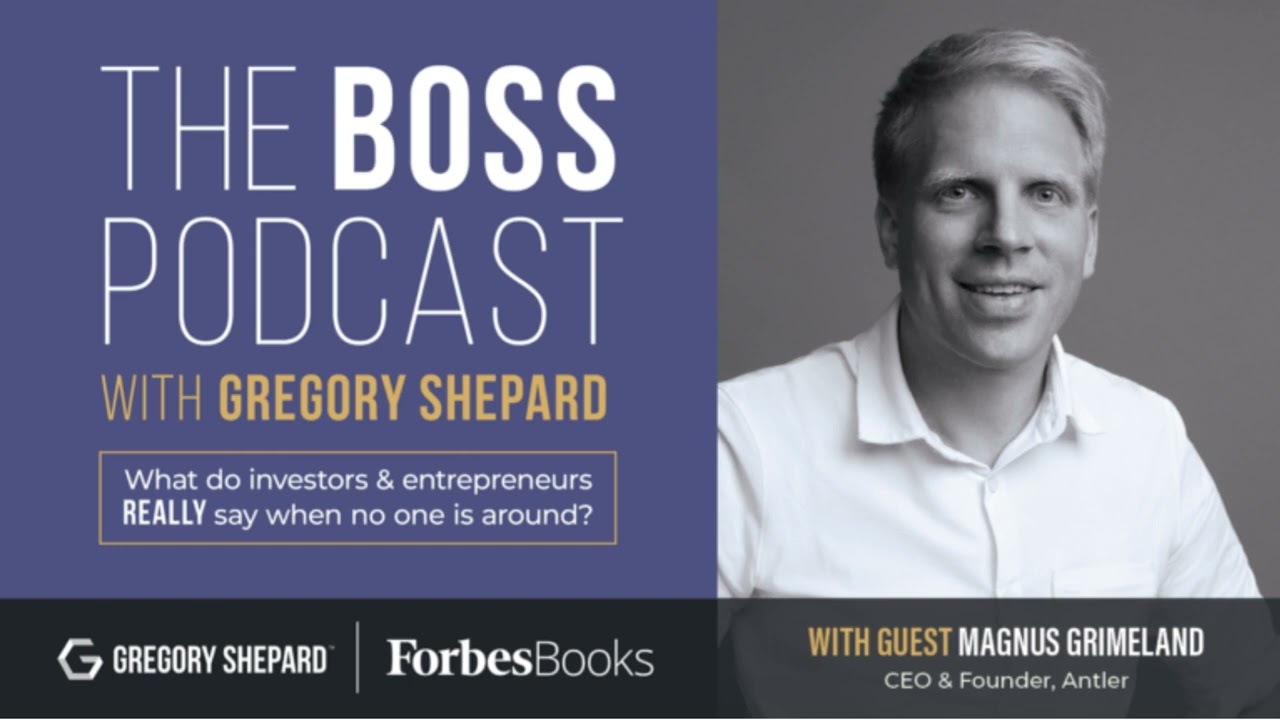
In this episode of The BOSS Podcast, host Gregory Shepard interviews Magnus Grimeland, founder of the global early‑stage venture builder Antler. Grimeland recounts his personal journey from a humble Norwegian farm, through elite education, special‑forces service, and a stint at McKinsey, to launching Zalora, Southeast Asia’s largest fashion e‑commerce platform, which he later sold. He explains how those experiences shaped his shift from micro‑level impact (military rescues) to macro‑level impact (building ecosystems). Grimeland describes the Antler residency model, emphasizing investing in people rather than ideas, the importance of assembling a “kick‑ass” co‑founder team, and rigorous product‑market fit validation. He contrasts startup ecosystems across the US, Europe, and Asia, noting the democratization of entrepreneurship and the rise of unicorn cities worldwide. The conversation delves into the traits of successful founders—unique skill spikes, drive, grit, and solving real problems—and how Antler selects and supports the top 3% of founders. Grimeland shares his personal performance measurement framework (professional, personal, health) and the use of ambitious OKRs to maintain a “day‑zero” mindset as Antler scales to 23 markets and hundreds of investments per year. The episode concludes with advice on preserving inspiration and ambition in growing organizations.
Chapters
Gregory Shepard, an entrepreneur who's built and sold 12 businesses, a recipient of 4 private equity awards, TEDx speaker, and Forbes author. This is The Boss Podcast with Gregory Shepard.
I must say, folks, I had a chance to talk to this guy a little bit before the podcast, and I was just so excited to have him On the podcast. He is the CEO, special forces guy, amazing guy. My guest this week is Magnus Gremland, the founder of Antler. Antler is a global early-stage VC and investing company enabling thousands of entrepreneurs worldwide to realize their dreams and change the world, similar to what I'm trying to do with this podcast. Magnus, welcome to the show.
Thank you. Very excited to be here.
Oh, man, it's just really great to have you. I mean, you know, I think of you as an icon in our space and your background as I looked into you was just really— I mean, it's really impressive. I'm excited for the entrepreneurs and investors, you know, listening to this to listen to you talk about some of these things that you've done and some of your experience. It's just dynamic stuff. Magnus, your goal is to help aspiring leaders to build businesses that can positively impact economies. How did you start down this path? And the second part of that question is, when did you realize that it wasn't just about making money? And I want to just say this real quick because I was really impressed with this. You know, you served in the Royal Norwegian Navy in special operations, so basically the Navy SEALs of Norway. And you served as captain on the Royal National Lifeboat Institution. and received several certifications in mountain rescue. It goes on and on, folks. He worked with developing projects in Zimbabwe targeting clean water, electricity, and basic healthcare and training for sustainable businesses. I mean, I don't even know where to start. Let's start with how you started down this path.
Yeah, so I mean, that's—
it's a big question, but basically quite early on in life, my great-grandmother died and And I started thinking a lot about the meaning of being on Earth, and I thought at least we should do something to ensure that being around made the world a little bit better. And in the early days of my life, I took every opportunity to do that. So the Royal National Lifeboat Institution was in the UK, and we had a rescue boat which would go out if, you know, a ship capsized or somebody fell off a cliff, or basically anything related to kind of maritime rescue. And then Norwegian Navy SEALs, obviously similar. But, you know, during that period of time, actually, one of my teachers— I went to United World College in the UK— one of my teachers there was, was a former SAS operator, you know, the Special Air Service in the UK. And I remember talking to him over Christmas one time when I was in the Norwegian Naval Special Forces, and, and we had this conversation about having impact on a micro level versus having an impact on a macro level. I think both of them are incredibly important, right? So if you're a surgeon, you will save a life there and then. If you're one person in the military, especially in the special forces, you do kind of micro operations. So you have like a specific impact there and then. Now that micro impact might have a bigger impact being leveraged, right? Like, you know, you never really know. how a micro action will affect the wider world. But one of the things that we spoke a lot about is like, how can you have, you know, more impact on a bigger scale? And that's what kind of brought me out of the military and to Harvard and then later McKinsey. And then we built obviously Zalora.com, which is the biggest fashion e-commerce company in Southeast Asia. And now obviously with Antler, trying to enable thousands of incredible leaders all across the globe to solve important problems and build great businesses around it. So, it's kind of a move from From micro impact to macro impact, I think both of them are insanely important.
I agree. I agree. One of the things that you say that many of the people that you met while studying at Harvard play an essential role in your life. I wondered if you could talk to me about that and how these people have played a role and in what way in impacting you. And then I wonder also along the lines of what you just described, if there's other folks that you've met that also impact what you're doing now?
Yes. So I think this has always been something which has been very important to me and I think should be important to everyone is if you try to seek out environments, it could really be anywhere where you meet other exceptional people, you enter into conversations and inspirational conversations that, that will affect the path you take going forward. And obviously at the Harvard days, you were kind of lucky to meet so many different people from so many different countries and so many different backgrounds. But it was the same when I was, you know, in high school. Um, I was lucky to, to apply to this scholarship, and we were people from 82 nations who lived together in, um, in a boarding school in the UK. In the military, right? Different type of exceptional people who You know, it was about 1,000 people who started, and, you know, we were 8 or 10 people each year kind of get through. And, you know, the people you're with there, you get very close to. When you're in those environments, try to find people who are doing something exceptional in their small or big way will influence the world. And obviously we were at Harvard in the days, kind of, I was there 2003 to 2007, and it was a kind of second wave of tech growth. After the dot-com, a lot of people ended up going into tech and building new businesses. So for example, we have Josh Kushner who built Thrive Capital out of the UK. We have, you know, the Winklevoss twins who, you know, was part of building up, you know, it's murky, the kind of social network early days, but obviously they were onto that idea, later on to the cryptocurrency idea and You know, they were quite leading in the NFT space in the early days. Bill Gabrick, who was part of building up Stripe. Sam Teller, who was Elon Musk's chief of staff for a very long period of time. Mark Zuckerberg, obviously, who built Facebook. Bib Moore, who's one of our partners here, who was Zuckerberg's roommate in college, actually, who, you know, went on after college instead of being part of building up Facebook, he ended up doing a master's in Dutch Indonesian. history and ended up building one of the biggest e-commerce companies in Southeast Asia called Lazada, which was sold to Alibaba for $3.5 billion. So, like, people from all types of walks of life doing really interesting things that you were very lucky to spend time with in the early years of your life. So, I feel very grateful to have been able to spend time with these types of people.
It's clear that you associate yourself with exceptional people like yourself. And in early days, the rumor is that you had a chance to join Facebook in the beginning. And as a partner at McKinsey, how did this sequence happen? Was it Facebook and McKinsey, McKinsey, then Facebook? How did this unroll? Because these 2 things are pretty big deals.
A lot of people had the option to join Facebook in the early days as an intern. And I think a lot of people who ended up joining as an intern ended up doing incredibly well because this was obviously at the time where there was just a few thousand people on the platform and people were paid in equity. I chose to join McKinsey and obviously Facebook was started in 2004. I left Harvard in 2007, so these were a few years apart.
Yeah.
You know, I come from the countryside in Norway, grew up on a small farm there. Both my parents are nurses. So my mother, she works with refugees and helps— so all the refugees who are coming to our country in Norway, you know, to get the right vaccines, get integrated into society, start learning Norwegian, get into school, all that stuff. That's what she worked with. And my father's a psychiatric nurse, so he works at used to work at the suicide ward in the county. So, I came from a background where, you know, it's a humble background, but obviously in a very well-off country, Norway. And after, you know, 4 years in college and student debt and so on, at the time, I felt like I need to go into a job where I could pay that back and, you know, get started on solid financial footing. Knowing that at some point in the future we'd build something. So I wanted to pick something where I'd learn as much as I possibly could around business. And I think McKinsey there is just a great place to start because you get to work with, you know, if you pick the right space and you pick the right office, you get to work with incredible CEOs in a lot of different companies at the early time in your career. So you just learn a ton. So, I joined McKinsey, started working with tech companies all across the globe. So, I spent about one-third of my time in Asia, one-third of my time in Europe, one-third of my time in the US just working with tech companies, the whole value chain from semiconductor companies to consumer electronics companies to media, telco companies, and loved it and learned so much every day and took that network and that those learnings into building my first business. Now, yes, it did delay me launching my first kind of big business myself, but, you know, ended up then launching that from, I think, a more solid footing.
Let's talk about that a little bit. You know, you are a real entrepreneur. I mean, the story is fantastic. I also come from a really humble background, you know, with my family didn't have any money and, you know, we worked our way up from nothing. And I have really mad respect for that. And a lot of entrepreneurs are doing the same thing. And they want to hear from folks like you that are out there doing this on their own. I wonder if you could kind of give us a little review of what the company was and just kind of take it from one to done real quickly. I think that your story is unique because of the path that you Would you mind talking about that a little bit?
I think there are many ways towards what one wants to kind of achieve in life, but one of the things that the way I've been driven very much is you want to ensure that over time what you're passionate about doing and what you're excited about spending your time on gets closer and closer to what you're actually spending your time on. And there's probably a phase in life which is more preparatory, right? If you, let's say you want to, if you want to be like, if you want to be a heart surgeon, you can't just go out there and start operating hearts. You need to kind of prepare, prepare on that journey, right? And that's been a bit my thing is that, you know, when I was at Harvard, I loved it. It was amazing because I learned a lot, met a lot of great people, but academia wasn't my life.
Right.
When I went to the military, you know, I loved that as well, but that wasn't my life. When I went to McKinsey, I loved that as well, learned a ton. And as I kind of moved forward, I got closer and closer to what I was passionate around. And, you know, there's been kind of 2 steps after McKinsey. One of them, we launched this fashion e-commerce company called Zalora.com. And the background of that is we saw this amazing growth of e-commerce all across the globe and in Southeast Asia. Vertical was still quite nascent. So, for example, if you wanted to buy a specific brand in Indonesia, an international brand, you'd have to buy that off a US site or a European site or a Japanese site, and you never know if the product would arrive, how much you'd have to pay in customs, whether it would arrive at all. It was a terrible customer experience, completely opposite of what you now expect from Amazon where you click, You get it whenever you're supposed to get it. So, we saw it as a huge opportunity, right? So, we just launched the biggest fashion e-commerce platform across Southeast Asia, and that was an interesting experience because when you build an e-commerce company in the more developed part of the world, you can tap into existing logistics networks, you can tap into payment systems. We couldn't really tap into any of that, so we had to build our own logistics network, we had to build server parks, we built roads and warehouses. It was, you know, pretty gritty job. We would clear ghosts out of warehouses in Indonesia. You know, we, at the beginning, we couldn't take— only there was 3% bank card penetration in Indonesia, so only 3% of customers could pay. So, the only way to check out is you'd need— you'd have to go on the site, get a code, go to your bank, pay in cash, get that code, go back to your computer, and, you know, finish the checkout. It was obviously a terrible way to buy stuff. So, we launched cash on delivery across Southeast Asia. So, it's 450 million people, hundreds of thousands of islands. And we had, you know, when we launched this cash delivery system, we had 109 days' worth of working capital out.
Wow.
somewhere in Southeast Asia. Money that people had paid for stuff that was making its way from like one island back to an airport, to another airport, on the road, back to a warehouse so that we could get the money for the clothes that we sold. So, it was a super exciting journey where, you know, we were solving all these really hard operational problems while building a tech company. And that became the inspiration of Antler really. Since we hired, you know, so many great people who became the logistics experts in Southeast Asia, the tech experts in Southeast Asia, the performance market experts in Southeast Asia, and so on, they would go on to build the next generation great companies here in the region, like Gojek, who just IPO'd as GoTo, $25 billion valuation. You know, the founders of that used to work in Zalora. Like Shopee, who's part of Sea Group, which is now a $45 billion business. peaked at $200 billion during the pandemic. And these people, you know, really learned their task and their trade in the Solana days and went on to build all these new great businesses. And that's what we're now doing with Antler basically is enabling these people. So, you know, it's a long way to answer your question, but throughout that journey, you know, I got closer and closer where you wake up every morning, spend your time on what you're very passionate about, And, you know, the fashion business was great. It was one of the biggest exits in Southeast Asia when we sold it. However, you know, I didn't want to spend the rest of my life making people better dressed. Now, finally, we launched Antler when I was 38. So, I guess at 38, suddenly I wake up every day spending 100% of my time doing what I'm very passionate about, which is enabling great people all across the globe to kind of solve important problems and build great businesses around it.
That's just the greatest story. I just think that's fantastic. It's just such a great story. Now, you grew up in Norway, and I'm just always curious about entrepreneurship and founders and the general ecosystem and how it varies from place to place. But even though you grew up in Norway, you're still very savvy on Western Europe, North America, and obviously where you are out there in Asia. I'm wondering what the differences are? I mean, you described some of the differences in the early days of commerce. What are the differences from these different regions with regards to accelerators and early-stage startups and how that whole ecosystem works?
The US very much obviously has been pioneering this, this whole industry, you know, in many respects over a very long period of time, has kind of attracted some of the world's best talent to come to the US and build alongside the best US talent and, you know, being able to take that risk and if you fail, you start again. The rest of the world has followed a bit slower and I actually do think that Asia, you know, came kind of second there. So, you had obviously a lot of innovation in Europe for thousands of years. that when it comes to kind of the later stages of innovation, the US has very much been in the forefront. After that, you know, you saw a lot of great things happening in China. You've seen a lot of things, you know, happening in other places across the globe. But Europe really only recently have seen the ecosystems grow really large and more and more people pursuing entrepreneurship. So now I think we live in a world where Entrepreneurship has become more distributed. So if you go a decade back in time, there was only 37 cities in the world that had supported a unicorn, so meaning a company that started up to hit more than a billion-dollar valuation. If you look at it today, there's almost 150 cities across the globe. That helped build the unicorn. And part of that is that you can access these great competency centers all across the globe from any location. Globalization, we've been talking about it for hundreds of years, but it's really only now that the world is truly global, right? It took the airline industry 68 years to get 50 million customers. It took the TV industry almost 50 years. I think it took the radio industry 38 years to get 50 million customers. Think about that. So, it's like almost half a decade to get to 50 million customers. It took Pokémon Go 14 days. It took Twitter 1 year. So, you can launch these businesses now really anywhere in the world where you can serve, you know, billions of people or hundreds of thousands of small businesses or thousands of big businesses really from anywhere. And that has never existed before. So, you see these amazing SaaS platforms coming out of places like Sydney. You have challengers to Google and Apple coming out of places like Stockholm through Spotify and Atlassian in Sydney. So, like, great businesses can now be built anywhere. Now, if you combine that with the situation we're in now where you have dozens of technologies maturing at the same time, whether it's biotechnology, genome technology, or blockchain or AI or IoT. You have all these technologies maturing at the same time, meaning that they're coming out of labs and they're coming out of science fiction books and they're actually being used to solve real problems. And you combine that with the prices of building a business going down through the cloud, through rapid prototyping, through, you know, rent-the-lab technology, as you can now build deep tech companies B2B companies, B2B sales companies much cheaper than you did before. So, you have globalization, technology is maturing, you have all these technologies, you have the cost of building businesses going down. That has led to this world where you can really build great companies out of anywhere. So, in the US, what's happening there is companies are being started in more US cities. In Europe, it means that Europe is getting this revival in terms of innovation. In Asia, you know, with a growing population, growing middle class, and the fastest digitalization ever, you know, 2.5 billion people going digital in a short period of time, this has led to this tremendous kind of revolution in innovation. So yes, the last 2 years have been kind of quite stimulus-fueled, and also the tech space benefited a lot from that, and there's going to be a contraction right now, but the fundamental growth drivers And the ability for great entrepreneurs to really influence the world is just bigger than it's ever been. And that has led to this tremendous disruption, right? If you go 50, 60 years back in time and you look at the world's 500 largest companies, they were all half a century old on average. So like if you became one of the world's largest businesses, you would remain so for half a century. Now that's down to 12 years. And we think about these big companies today, they're all going to be disrupted in the future. And for the first time ever, you don't know if that's going to be from the Valley or from New York or from Austin or from Boulder or from London or from Sydney or from Singapore, right? So it's very, very exciting times.
Yeah, I agree. It's crazy. You never know where deals are coming from these days. Sometimes they're coming out of tiny towns in Arkansas. It's, it's really interesting. Well, hang on, Magnus. We have to take a break. But coming up in the second part of my discussion with Magnus Grimlund, the founder of Antler. Magnus shares some advice on what every startup entrepreneur should do first.
The number one thing is you need to build a kick-ass co-founder team. A great operator, you need to— you probably benefit from a great technical co-founder. If you're a great technical co-founder, it's great to get a great operator on board.
Learn more about the BOSS Business Operating Support System at bossstartup.com. Or you can reach Gregory Shepard at GregoryShepard.com. This has been a production of Forbes Books. Gregory Shepard, an entrepreneur who's built and sold 12 businesses, a recipient of 4 private equity awards, TEDx speaker, and Forbes author. This is the Boss Podcast with Gregory Shepard.
Thanks for joining me once again for my talk with Magnus Grimlund, the founder of Antler, a global early-stage VC investing and enabling thousands of entrepreneurs worldwide to realize their dreams and change the world. So Magnus, you and your team do not define Antler as an accelerator. Because you don't incubate ideas, but rather support exceptional individuals on their journey to entrepreneurship. Can you tell us how it works and can you talk a little bit about your Antler Residency Program?
Yes. So, what we do is we invest in people. So, if you're thinking about starting something or building something and you raise— you want to raise your first bit of capital or you want that kind of first partner to come on board, Antler is the right place. So what we focus on is very much that first money in, helping to build companies from scratch. Now, if you compare us to the rest of the ecosystem, you'll have accelerators such as Y Combinator, which typically invests in companies that are 1.3, 1.5 years old. So it's a little bit later on in the journey. It's when the company's already incorporated and they will help kind of build early traction. And obviously you have VCs like Sequoia who invest at any stage of the journey. And then you have late-stage investors. So, what we are focused on is where that first money is. So, we want to be the best partner to great founders as they're just getting started. So, if you're thinking about building a business right now, you should go and check out Antler at antler.co. Now, what does that really mean? Well, so, when you're starting a business, the number one thing is you need to build a kick-ass co-founder team.
When you try to find your co-founders, everyone will have their own network, so you need to obviously leverage that and get people on board that you know. But unfortunately, it is such that you tend to know a lot of people that are similar to yourself. And we know that the best startup teams out there are quite diverse teams, especially in terms of competencies. So if you're a great operator, you need to— you probably benefit from a great technical co-founder. If you're a great technical co-founder, it's great to get a great operator on board. And we look at about 50,000 founders per year. We select the top 3%. And have this co-founder network of about 3,800 co-founders from all across the globe that are working on disrupting specific industries. So you can get access to other great co-founders to build a kick-ass team. And that I think is the most important to succeed because the team really determines everything, what you're gonna build, how you create that momentum, the next people you hire. So finding the best co-founder team really determines a lot of the success. The second thing you need is product-market fit validation. So let's say you're building a cancer drug, you want to ensure that, you know, as much as possible the technology that you're working on is validated, that you break it down into milestones. You should talk to people who are, you know, deep into the industries, know what competitors are doing, know what people tried that didn't work, so when you get started you build on top of what every other person in front of you has built and don't start from scratch and reinvent the wheel. If you're building something in B2C or B2B, similarly, like how can you get as much momentum as possible early as you're building your business? You know, how can you get the product out there, get customers, leverage that momentum to hire great people, get more capital on board, get more customers on board? So those are the 2 things we're very focused on is like great co-founder team, great product-market fit. So you know that if you've been through kind of the Antler process and you've been accepted here, you will have access to a great amount of co-founders and spend a lot of time with the Antler team validating your business model. And then we also come in with the first bit of capital. So we invest in people and not in companies. We're also long-term investors. So if we back you in the the first round, we want to back you all the way to your exit. So we can put tens of millions of dollars into your business while we start off with a few hundred K in the first investment. And we do that anywhere across the globe. So we're in South America, North America, Europe, Africa, Asia, in Australia, in 23 countries. So chances are, you know, wherever you're listening to this, we'll have a hub close to you.
And if you're thinking about building something, we'd love to be a partner of you So the Antler residency program, is that like an internship program or can you talk a little bit about what that is?
Yeah. So let's say a founder's journey typically starts with them thinking, you know, let's say you're working at Spotify in Stockholm and you're thinking about, okay, now I want to leverage my competency to build something new. Then typically you would start thinking about what that is, start looking for co-founders, Then at some point you quit your job and you start building. That's the time when we want to start working with you is you can then come to our office, you can spend 6 months with us there. Most people come before they incorporated their business and there will be around 100 other people there working on interesting stuff. Plus we have 10 full-time Antler people in that city, plus about 70 advisors in that city, plus you get tied into the global network of founders who are also building. And out of that, you know, will come a co-founder team and a great business model that you're working on. And if you get to that level where you have a great team and you're working on something that really makes sense and you're solving a real problem, we will back you with capital. So that's how that process really works. It's like when you leave your job and you're thinking about building something, you know, you have a free office space. If you don't have If you need money to pay your rent or living costs and you've been selected into Antler, we will also— you can apply for a grant. So you can also get paid throughout this process, which really helps, I think, democratize the whole entrepreneurship journey because you can access a similar type network that I was lucky to have after my McKinsey and Harvard career through the network that we built. And it's a true global network. So we end up just working with a very diverse set of founders, right? Like some people come from very humble background. Some people have, you know, been to all the right places before they joined. You know, we have 35% of our teams have a female co-founder, people from all nationalities and backgrounds. It's just a true kind of collection of exceptional people that are the top 3% that we could find who are there working for 6 months on getting their next thing off the ground. with, you know, the best professionals we could find in the game.
So we started off talking about you and then we went into Antler and I want to go back to you a little bit because I'm just fascinated. If you were to list the most frequent success stories, is there a pattern that you see when you look back on companies? Like, is there any pattern that's a recurring pattern that you notice with the successful startups that you guys back?
There are 2 big patterns. One is the right team. And there are 4 factors of the right team. So, A, the founders themselves have a spike. So there's something that they're better on than most other people. And that spike can be anything really. It's just something that you're better on than most other people. And, you know, you all have friends like this who perhaps they go into an elevator and there's 12 strangers there and they become friends with everyone before before the elevator hits the bottom floor, and they have that personal connection, or perhaps sales is their strength. Other people will like to go home on Friday night when other people go out and just spend time solving a deep technical problem, or they're experts within a specific field. So you need, you know, A, that spike, B, you need drive, which is a combination of passion and ambition and the ability to execute, C, you need grit, which is the staying power, right? Like, think about Elon Musk and how many times His companies always went bankrupt, or you know SpaceX blew up all the rockets before they had success. He almost had to mortgage his house. Tesla went bankrupt almost six times. A lot of people would have just given up on the way, but he had that staying power and great power. Great founders have staying power, and then you need two or three of those, right? Like most businesses thrive when you have two or three quite diverse founders, especially in terms of skill set. So that's A B C D A. Being a spike, B being drive, 3 being grit, and then a combination of these people. And then the second thing is you need that team to kind of address a real problem, right? There are a lot of startups out there who are kind of building something because it's kind of cool to be an entrepreneur, or they're building something because they're very excited about that specific technology, or They're building something because they didn't have the kind of opportunity to do something else. We very often see that these companies don't succeed, and I think it's partly why 99% of startups fail. But if they're solving a real problem and they spend real time identifying that this is a real problem and they spend real time thinking about how technology could solve that problem, combined with an exceptional team, then you will succeed. Then actually the whole startup journey doesn't become very risky. And this is why you see some serial entrepreneurs, they're succeeding again and again and again and again, because they think really hard about putting together an exceptional team. They think really hard about solving a real problem, utilizing, you know, a new technology or a new way to solve that problem.
It makes perfect sense. As a leader for you, How do you measure your own performance? I mean, you know, we use leading and lagging KPIs and valuation drivers, et cetera, et cetera, for the business. And, you know, different project manager software allows you to sort of check performance on your people. How do you measure your own performance?
Great question. I do this in 2 ways. So one is, I believe there are kind of, there are 3 frames of life that are very important for me. So A is what I'm doing professionally, B is, you know, my family and friends, and C is, you know, health, wellness, excitement, adventure, right? So it's kind of 3 categories like this. And I think that— and I'm not recommending everyone to do this, but I at least think kind of on this lens is quite long-term. So there's— I always have like a 10-year plan I have a 5-year plan, I have a 1-year plan, I have a 3-month plan and a 1-month plan. And I want to ensure that what I'm spending my time on this month somehow will get me closer to where I want to be 10 years from now. I get excited about thinking about that, right? And, you know, what those things are are kind of different in each bucket, right? So I know what I need to achieve at work, I know what I want to achieve with friends and family and my my children. I know what I want to do adventure-wise and how I want to challenge myself this month, but I also know how that is tied into kind of a longer 10-year journey. And that 10-year journey is always very— it was almost like unachievable in a way, but exciting to think about. So that's one aspect. So I can very kind of clearly see how I'm developing towards that. And the second thing is, I'm at work, I'm quite data-driven. So what we do is we We try to ensure that we have a mission-driven leadership, myself included. There are 2 or 3 kind of KPIs that everyone should think about as their most important thing to achieve, and we check in on that on a weekly basis, and I do that on myself as well, and there are certain milestones when I hit them that we celebrate, and if we don't, we try to kind of rethink how we can get there faster.
One last question I wanna ask you, and then I'll give your day back to you, and I really do appreciate you taking the time to talk to talk with us. It's really fantastic for entrepreneurs and investors to hear from people like you that are thought leaders in the industry. As an organization gets larger, there can be a tendency for the institution to damper the inspiration. How do you keep that from happening as the company starts to scale up?
I mean, there is this expression that I think you know, Jeff Bezos is most famous for, but I think everyone should think through is like, you know, it's always day 1 or always day 0. I think you need to build an organization as it grows that maintains that type of mindset. The only way to do that is to, I think, talk about it quite consistently, is the targets are always to a certain extent unachievable and you're always working on solving kind of new important problems in your journey as a business. So for example, we obviously now operate across 23 markets. We invest into about 400 new businesses per year. You know, we've been growing pretty large and we are now, I think, the world's largest venture builder or investor into talent. So we're in a much different position than we were 4 years ago when You know, we made 13 investments and we only operated in Singapore, but I don't think anyone feels that we are further than 1% on the way on our journey. I think everyone very much feels that we're at the same stage as we were 4 years ago because we've lifted the ambition. Every quarter we create new OKRs, and the OKRs we create for everyone, both personally and for the whole organization, are almost unachievable. So, you know, we're quite happy if we hit 70% of our targets. And by maintaining that, that way of thinking and always kind of raising the ambition, you always feel you're very early on in that journey. So I think building that day zero, day one type mentality into the organization and into everything you do and building the reinforcing mechanisms around that will ensure that you maintain that mentality. And if you don't, you're going to get outcompeted because it's just so easy to To kind of replicate and attack, you know, any type of business model from anywhere in the world these days. You need to have that mentality no matter how big you are as a business. Otherwise, you will slowly become one of the ones that gets outcompeted.
Yeah, I agree 100%. Thank you so much for being on the podcast.
Thank you.
Thank you so much. Really appreciate it.
You're welcome. He's Magnus Gremlin, the founder of Antler. And that wraps up the This episode of the Boss Podcast. If you enjoy the show, please make sure to take a second and subscribe so you automatically get updates on the new shows when they drop. Also, if you have a minute, I'd love it if you left us a review so more folks like you can discover the show. I'll see you next time. Namaste, my friends.
Learn more about the Boss Business Operating Support System at boss. Or you can reach Gregory Shepard at GregoryShepard.com. This has been a production of Forbes Books.
More from Gregory







Why you Might Want to Keep your Camera on During Remote Work Meetings | Minute Mentor


Same Side Selling | Ian Altman | Part One & Two | The BOSS Podcast with Gregory Shepard