Find Out the Steps to Build Your Ideal Customer Profile! | Webinar
In this 45‑minute webinar, Randall Laveau, co‑founder and CRO of Boss Startup Science, walks founders through the concept of an Ideal Customer Profile (ICP) and why it is a foundational, strategic asset for a startup. He begins by framing the market hierarchy—TAM, SAM, SOM—as the first layer, then narrows to ICP accounts as the second layer, and finally hints at buyer personas as the third. Laveau explains the three outward‑facing competitive advantages (product, price, experience), urging startups to pick one primary advantage that aligns with their resources and to structure their organization around it. He then introduces “customer user stories” (problem, solution, impact) as a tool for product, marketing, sales, and support teams, emphasizing a continuous feedback loop. The webinar shifts to the exit‑strategy angle, describing the valuation driver “customer attachment rate” and how matching an acquirer’s ICP can accelerate a strategic sale. He outlines three acquirer‑validation pillars—customer, product/service, and culture—and shows how the ICP informs each. Throughout, Laveau promotes three related courses on Boss Startup Science and provides a registration code (BCP123). The talk is instructional, persuasive, and enthusiastic, aimed at early‑stage founders who need a practical, repeatable process for defining, validating, and leveraging an ICP.
Chapters
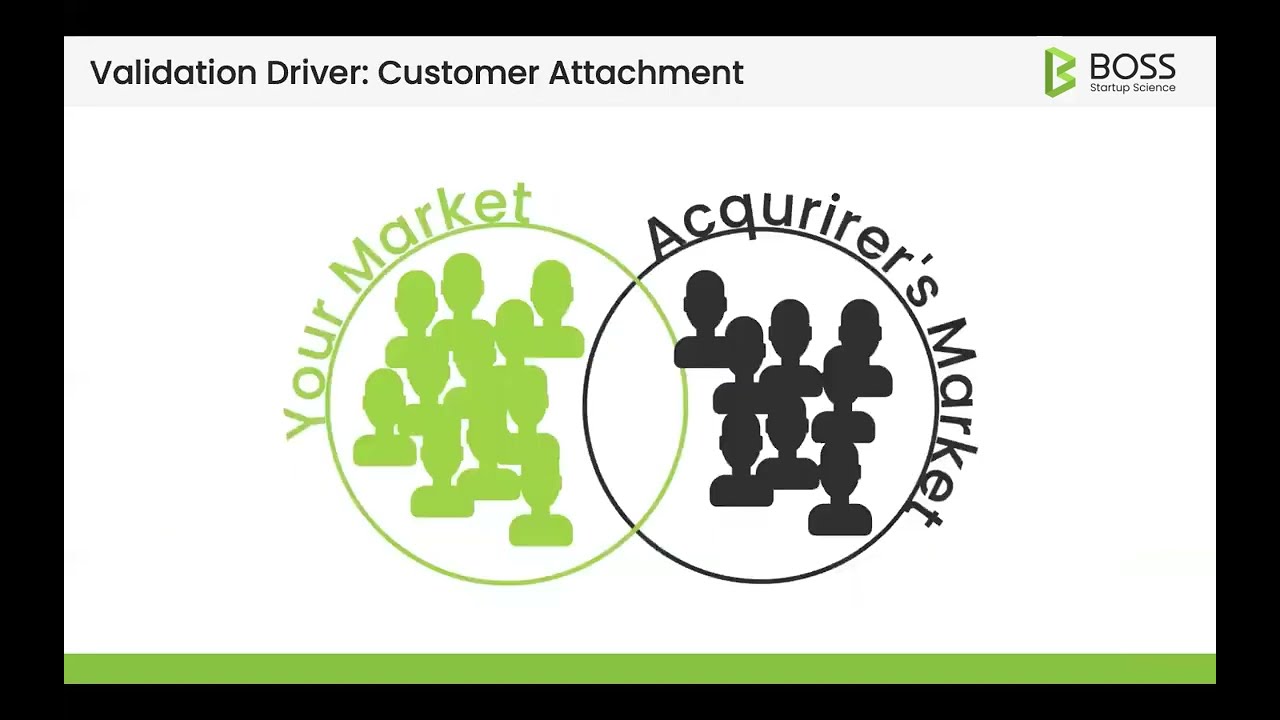
Hello, this is Randall Laveau. I am the co-founder and CRO of Boss Startup Science. Excited to have you here today to talk about the ICP, otherwise known as the ideal customer profile. Now, before we jump in, you could find the aligned or matching courses to the ICP at Boss Startup Science. There are 3 corresponding courses. The first is Building Your Ideal Customer Profile. The next is Your Competitive Advantage in ICP User Stories, and then that's followed by Building Your Buyer Personas. So today we are going to talk about ICP in length, covering the advantages of ICP, including product, price, and experience validation. Identifying and developing your customer user stories, as well as the big one for the ICP, which is its alignment to your exit strategy and how important one of the main valuation drivers, customer attachment rate, is to identifying your ICP and aligning it to your exit strategy. Now, before we jump in specifically to ICP, I want to walk you through the foundational aspect of defining who you are selling to. Now, this is very important and often overlooked. You think of this, this is considered breakfast, right? This is the first thing you do starting a business, just like breakfast, first thing you do starting a day, and might be one of the most important and often overlooked things. All right, so let's walk through that. The foundational layer of this which is also the prerequisite to ICP and taking the ICP courses, is markets. This is your TAM, SAM, and SOM. Essentially what markets is, is identifying the target markets, industries, and ecosystems that you will be servicing with your startup. All right, that is layer 1 and foundational layer. Again, very important. You will be doing things throughout your company such as identifying the growth rate of the markets, right? A mark of a great company is one that grows faster than its market, as well as the competitors in the market. Another mark of a great company is one that grows faster than its competitors, right? So starting at markets is extremely important. Now, today we're gonna be talking about ICP accounts. This is the next layer. So think of ICP accounts as your target accounts within the target markets, industries, and ecosystems that you serve. So if the, the market is the biggest layer, you want to siphon that down to the specific accounts that you will serve. And again, you will not serve all the accounts within a market. The propensity to buy, the ability for people to actually buy when they may be using a competitive solution, so on and so forth. There's a lot of reasons as to why all accounts won't be viable. That's why it is important to identify the specific type of accounts, which is your ICP. Now the final layer, and one that we'll talk about in future webinars, is personas— buyer personas. Think of these as the target buyers, users, and influencers within your target accounts. Alright, so now we're getting down from a market to a company to an individual, right? First identifying the markets, then identifying the accounts within the markets, and then identifying the people within the accounts within the markets, right? This is the formula to defining and validating exactly who you are selling to. Again, today we are just gonna be talking about ideal customer profile, ICP, which is that middle layer. There are many, many advantages to getting your ICP Again, like I said, this is a foundational aspect of your business and I implore you not to overlook it and turn it into a check-the-box exercise. What we're gonna do is walk through some, what I believe are some of the 3 largest components to prompt someone to say, hey, I either wanna revisit my ICP and make sure I got it right, or ahead of me developing it, I'm gonna put extra effort into making sure it's right 'cause it's gonna be a precursor to me achieving many other growth milestones in my business, right? So first one being product, price, and experience validation, defining what type of company you are. Next is the customer user stories, your ability to build a product based off of the actual problems, solutions, impacts, and needs that a customer may have. And then finally, like I said, is the exit strategy, specifically looking at the valuation driver of customer attachment rate, which is, in short, having the same ideal customer profile as your potential acquirer. And we'll show you how this speeds up your ability for a successful transaction in a timely manner. Now jumping into the first one, this is one of my favorite. I come from a growth side. So I really am interested in the branding aspect, especially of young startups and how they choose to introduce themselves to the market. Now, product, price, and experience, these are typically looked at as one of your 3 advantages for a startup or for a company. Again, this is not what you think. This is an outward-in aspect of how the market identifies you. Let me give you a couple examples. In terms of product, If I were to mention Apple, people would definitely agree that they have a superior product in many ways. The reason that this is validated is because people will pay more than the average price to receive this product, and in some cases will even tolerate long wait times or the inability to answer troubleshooting questions because They are so interested and loyal to that product. Now price, you could think of Walmart, right? Walmart may not have the most superior products, nor do they aim to. They may not have the best experience in terms of customer service or support. However, it is pretty guaranteed that they're gonna have some of the lowest prices, right? And the market knows that. The market is not going to confuse Walmart with having superior products or superior service. They know they're going to get the lowest price, and Walmart markets themselves as such. Right now, for experience, you could think of— one that comes to mind is Nordstrom's. They have a return policy. If you've ever shopped at Nordstrom's and tried to return something, you'll have the lowest amount of resistance at that store out of all places. not to mention personal shoppers, right? They really have a white-gloved experience to treating their customers. Therefore, you will pay more and you will not worry as much about the product because you are interested in that service, right? People continue to come back there because it makes them feel good and they enjoy the experience. This is extremely important to identifying how the market, specifically the buyers and the accounts, are going to look at your company. Now, one of the ways to do this is to identify specifically what else is happening in the ecosystem. Where are other people competing? Now, by identifying your ICP very early on, you could determine where the product market fit is within that ecosystem. Where do you show up? Are you a nice to have, or a need to have? How are other competitors and services and solutions pricing themselves? What type of revenue model are they using? What kind of contracts are they using? What type of terms do they typically agree on? Right? This is going to help you to define the type of price or pricing that you're going to use. In addition, what is the experience? Is there— are there competitors with a very high level of customer support and experience? Or are most of the competitors transactional and using chatbots, right, to support customers? These are going to help you identify areas of differentiation. Without knowing your ICP and what ecosystem markets they serve, you will not know what their current experience or status quo is like in the market. When you're creating your startup and you're bringing your message to the market, you don't want to fall in line. You want to be able to differentiate yourself by understanding what's happening within the ICP, within the ecosystem. You will be able to attach yourself to one of these 3 advantages, and the market will start to recognize you as such. Now, of course, I always include this when talking about these 3 advantages. If you're thinking to yourself, why isn't it all 3? Why can't I pick all 3? You're, you're absolutely right. You should be able to do that. However, at the stage most startups are in, early in their maturity, they do not have the resources— and I define resources as people, money, and time— to be able to be great at all 3 of these things. So what we recommend is that you pick one that has the least resistance and lowest barrier to entry and use that as your primary advantage, wrapping your company around that. Now I'm going to spend a little bit more time on that. What does that look like, wrapping your company around one of these advantages? Well, let's say for instance that your company you choose because of the, the lack of other options in the marketplace or ecosystem, and one of your main points of differentiation is going to be your experience. There is a problem in this market and the right type of support and experience does not exist and you believe you can make a breakthrough by doing that. Good on you and, you know, we fully support that. However, you have to be prepared for what that means from an execution tactical standpoint, right? What will your company look like if your primary advantage is experience? Well, it's going— you are going to have More of your budget, more of your resources dedicated to customer-facing and customer-supporting activities. So the obvious is this is going to impact your org chart, right? The way you build out your company. You are going to have more dollars allocated to the support and service of an existing customer than to the attraction of a new one. Right. On the other hand, if product— if you are going to excuse price and support and experience because you are just going to build a superior product that does not yet exist or is better than the ones that do exist, your org chart is going to reflect that as well as your resource allocation. More people, money, and time are going to be spent in R&D, product development, For the product than in the other areas of the business, right? So you could start to see how identifying this very early on is giving you insight to how you need to build your company. When you go out to investors now, when you go to raise funding, you understand what you're trying to build internally, where those dollars need to be put in order for you to realize your advantage, whether it be product, price, or experience. Now, the second aspect of an important thing when identifying and validating your ICP is the user stories. There are 2 specific departments that will benefit from this. One is the product team, and not only from the inception of the product, from taking the vision, building requirements, testing those requirements, releasing an MVP, and then continuing to do future updates and releases, the user stories are the genesis of all of that. And I'll explain that in a second. Now at a high level, also looking at the marketing side or growth in general, which growth would be sales, marketing, service support, service delivery, anyone who's in the revenue chain, so to speak, is going to be able to take advantage of user stories as well. This is your positioning. This is whether you are developing a piece of content that someone's going to read virtually online, or you're preparing one of your sales reps to meet a new prospect and convince them to buy your service, or you're supporting either a happy or unhappy customer who has questions about why they should continue forward. The user stories are going to help you understand and anticipate the buyer within the accounts and what the accounts may be dealing with ahead of time. So there is a formula to building this, and there's 3 core components you could see up here in the bolded sections. As a type of user, I want to achieve a type of goal so that I could have a type of outcome. And how I would frame this is, What is the problem? For who? What is the potential solution? And what impact will that solution have? Right? So as you start to build these user stories, you're covering every aspect of your business, every aspect of your product or service, right? So let's say that you sell to multiple people within an account. It is important to have all of their user stories. Let's say that you sell to someone who's in line of business, meaning they're not technical or financially focused. This would be a sales or marketing type person. It is important to not only understand for them what their user stories are, but how their user stories impact the other lines of business within their company. So we've all been there before. where we are selling to line of business, and in the last moment, someone from the technical or product or IT side comes in and spoils the sale, right? It— we realize at the 11th hour that the environment was not right. By understanding and compiling and building out your user stories, you are going to understand every aspect from an outward-in component Outward-in meaning the market telling you, not you making assumptions and dumping them on the market. From an outward-in perspective, you're going to be able to understand truly what problems exist, how to solution them and solve them, and then if the impact is valuable enough to pursue that idea or that product or solution, right? And that goes— cuts both ways. That's on the customer side and also internally. So developing these user stories is extremely important. Again, if you look at the progression from the lifecycle, the way I would approach this if I'm a new entrant to the market, I am a startup that's just getting off the ground, I would first take my vision to a couple people, both industry experts and potential users of my solution, and test my vision with them. Do they think that this is something worth pursuing? If they said yes, likely I would take that idea, I would go to an accelerator. That accelerator would then give me funding in order to build a product or service helping to realize that vision, right? Well, if you're at a 30,000-foot view, which is where your vision is at, it is going to be hard to pull that vision down to specific product requirements that you should now go out and build. So what the best thing to do, again, rather than being inward-out and making assumptions and then dumping them on the market, you should go to the market and verbatim get them to fill these out for you. What type of goals are you trying to achieve? What type of problems are you experiencing? What type of outcome do you hope to have? Then you could take that internally and determine make some trade-offs. What features will go into your product or service as an MVP and what features or services you could hold off on and use for future roadmap development, right? This is gonna make sure that you're not spending too much money, that you're not wasting money on something you don't know if it's a viable product or solution and will work, okay? And then again, the marketing messaging, the whole growth side, Everything from developing your content, determining the channel in which you will distribute your content through, preparing your sales team to talk to prospects and convert them, and then also preparing your service and support team to deal with every aspect of how a user is using the software, service, or solution and how to improve it. The last aspect to this is user stories are not something that are done once and stop. Markets change, behaviors change, consolidation happens within markets causing new problems to arise, right? There's many things that could happen out there. In order to make sure that your company continues to be outward-in, you want to establish a feedback loop with your user stories. What this would look like is anyone who is customer-facing, primarily going to be on the growth side— marketing, sales, service support, and delivery— they should be identifying and keeping an eye out for additional user stories, additional behaviors that they're seeing from the customers, accounts, and users that they could then relay back to the product team. This is going to help with future product releases, for fixing bugs within existing services and solutions. And it's going to allow your company to constantly be on the forefront and predicting future behaviors of your clients, prospects, markets, and ecosystem. Now, the last piece of this is the exit strategy component of identifying your ICP. What you're seeing up here, this slide is titled Valuation Driver, Customer Attachment. Customer attachment is a primary valuation driver. What's a valuation driver? A valuation driver is a KPI metric or benchmark that you use to determine the viability of your ability to exit by a specific strategic acquirer. Now, different acquirers have different valuation drivers. Let's talk about a couple of those. Some acquirers are buying companies based on growth rate. Now, there's 2 aspects to this. It could be revenue growth rate or number of customers. That's a specific reason that acquirers make acquisitions and will use that valuation driver to determine the multiples in which they will pay for a business and the valuation that they will give that business. Another valuation driver could be margin, right? It could be retention. In fact, retention is often a very high valuation driver. No one wants to buy a company with a leaky bucket. Now, one of the most interesting valuation drivers, and that is used most often in strategic exits, is what's called customer attachment rate. Quite simply, this is saying, I have the same customers as my potential acquirer. We service the same people, right? In different capacities, however, we service the same people. The reason this is important is because acquirers, if they are Expanding in a current market want to increase their share of wallet within a specific customer base, right? By you servicing the same customer with a different product or service, now all of a sudden that customer that if they acquire you is now— is the same— is now paying them more money. An example would be every customer in your ICP, let's say, has $100 potential of wallet. Meaning they could spend $100 on services within your ecosystem to you or competitors. Your acquirer, let's say, has— is a large company and has 50% of that potential wallet, meaning their share of wallet is $50. If you have a $5 share of wallet for that same customer, that's a reason for them to acquire you. Right? You are now— they are going to inherit that, and now their share has gone from 50 to 55, right? Across thousands, tens of thousands, hundreds of customers. That's a big deal. So it's very important to understand what play your potential acquirers are after, and this would be what type of market play. Now, there's 2 or 3 types that you could really focus on. The first being share, right? Think of airlines. A share market, there are not a lot of new entrants, meaning new customers. So customers are typically being passed back and forth from competitors, right? And this is— you see this in airlines all the time through heavy promotions, sales, discounts, right? They're passing the customer base back and forth. The 2 that we're focused on specifically here are expansion and exposure markets. So in an expansion market, it means I am going to expand my reach within the current market I am. Essentially what they're saying is I am trying to increase the share of wallet within the current market. Now an exposure market is a different play and is not as attached or aligned to customer attachment, but I'll cover it so you understand it. Exposure means I would like to expose myself to a brand new market, right? In either case, this— the ICP is important. Let's say it's an exposure. Your potential acquirer is going to expose themselves to a new market. They would be interested in your company because you would likely have a large customer base in that market or a stable customer base that rather than them building out a product or service, then hiring a sales staff to go out and bring in those customers, they're going to stand idly by while you do that and then buy your company and bring those customers in. That's a strategic play for them where they're very interested in the technology and the customers. They want to pull those in very quickly. Now, on the opposite end, if it's an exposure market and they're They're trying to expose themselves to something new. They are going to want to know that you have a different customer base than them. All right, very important. Versus an expansion, the customer base needs to be identical. Meaning if you identify your ICP and then get to your potential acquirer and realize that they have a completely different ICP from you, that play is not going to work. And you are likely going to be very disappointed when you attempt to shop your company to that acquirer. Okay, so customer attachment rate. Quickest way to a strategic exit is ensuring that you have the same ICP as your potential acquirers. Now, in going through this, and I'm just going to stick on this exit strategy for a little bit more, there are 3 forms of acquirer validation. Meaning, if I'm an acquirer and I want to purchase a company, there are 3 things I'm going to want to know unequivocally and validate. The first is if it's an expansion play and I have the same ICP, I need to validate the customers. I need to know that the customers that I serve are going to be interested in this new product or service and that they already have a I'm sorry, a substantial amount of them. The second would be product or service validation, right? Now that I have the same— I have validated that I have the same customers, does my product or service integrate nicely? Do they complement each other? Are there any areas of competition? Are there any areas of misalignment where information cannot flow back and forth? So product and service validation, very important. And the next is culture validation. Can our teams work together? Now, the reason I mentioned these 3 forms of acquirer validation is this is all tied directly to identifying the right ICP. If you identify the right ICP and it is the same as your potential acquirer's, customer validation, you could cross that off. you've done that, right? Now, product and service validation. Do I know that my products and service can work together? Well, one of the best ways to determine that is to partner with your potential acquirer. Start working within the same environment or have your customers work within the same environments, yours and your potential acquirer's. This is very quickly going to help them understand and probably put you on their radar. as a potential acquisition for them if they could validate through partnership that your products and services integrate and align together. And then third is culture validation. Now, this isn't as much as the personalities of individual people, but going back up to product, price, and experience, choosing what your advantage is, the advantage helps you identify and typically breeds your culture, right? If you are a company that has a product advantage, a certain type of profile, a certain type of people with certain types of personalities are likely going to be more frequent within your company, right? You're going to have more engineers, more technology-minded people. Versus if your advantage is experience, you are going to have a bunch of extroverted, people who have the ability to delight your customers through written or spoken word, right? It is going to change the culture of your company. This is important to understand by your potential acquirer. Do our cultures fit? Are we after the same thing, providing the same solutions, products, and impacts to the marketplace? So that is an overview of the advantages of going through identifying and validating your ICP very early on. As I mentioned, all of this information and more is housed within Boss Startup Science, specifically the 3 courses: Building Your Ideal Customer Profile, Developing Your Competitive Advantage and ICP User Stories, and then Building Your Buyer Personas. You are welcome to use this link to register using code BCP123. We'll help you get you in. And we will be revisiting this topic, the, the last component of this topic, buyer personas, within the next week. So again, I thank you for your time. Best of luck, and please visit www.bossstartupscience.com for more information. Thank you.
More from Gregory







Why you Might Want to Keep your Camera on During Remote Work Meetings | Minute Mentor


Same Side Selling | Ian Altman | Part One & Two | The BOSS Podcast with Gregory Shepard