Startup Program for Founders | Allesandro Marianantoni | Part One & Two | The BOSS Podcast
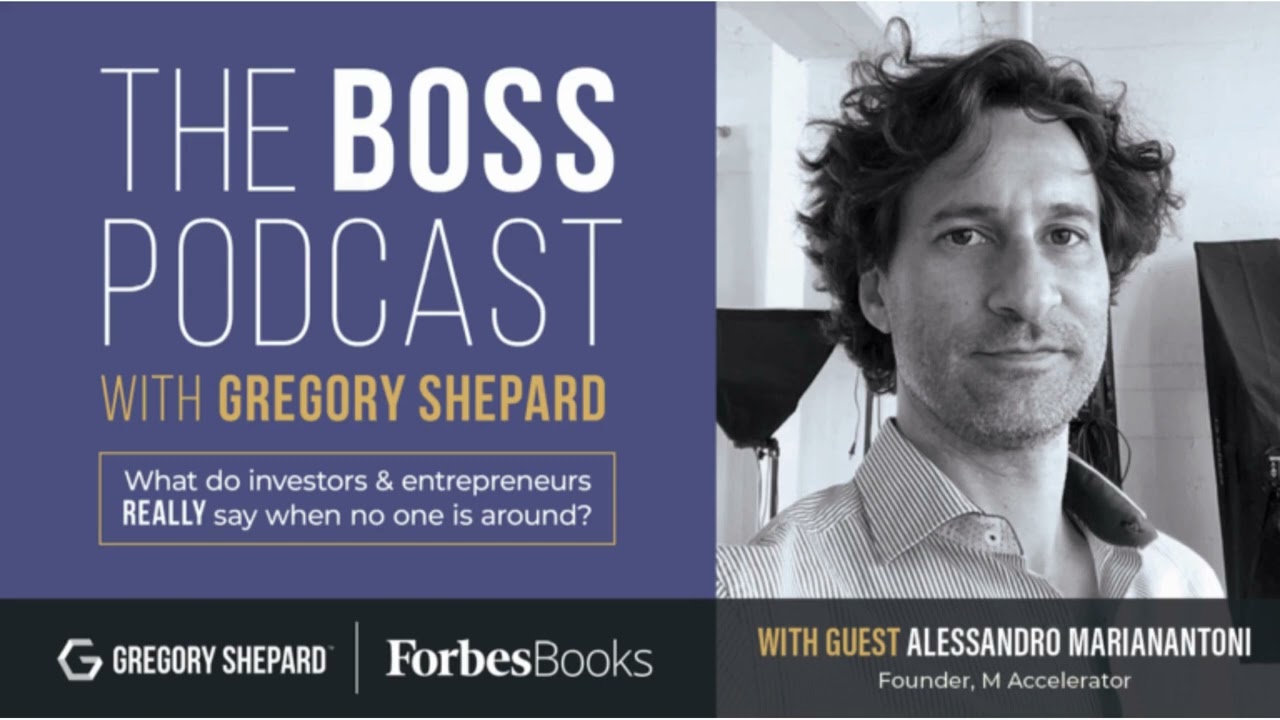
Gregory Shepard interviews Alessandro Mariano Antoni, founder of M Accelerator, about his hands-on startup program. The accelerator provides six hours of weekly coaching, workshops on business models and go-to-market strategy, and customer-journey work. Mariano Antoni discusses how M Accelerator differs from VC-style programs and warns that founders often lose focus and accountability after the program ends.
Chapters
Gregory Shepard, an entrepreneur who's built and sold 12 businesses, a recipient of 4 private equity awards, TEDx speaker, and Forbes author. This is The Boss Podcast with Gregory Shepard.
My guest this week is Alessandro Marianne Antoni. Alessandro is the executive director and founder at M Accelerator in Los Angeles. M-Accelerator offers programs to serve Southern California and international startup ecosystems and provides students, early-stage, and later-stage founders with the skills to grow their startups. Alessandro, welcome to the podcast.
Thank you, Greg, for having me over.
You're welcome. You're welcome. And my wife is Italian, so I'm excited to interview somebody else from her motherland.
So at least you may get my accent then.
Yeah. Yeah. The accent is more than welcome. Warm and friendly. You've said that despite the name M-Accelerator, it isn't like any other startup program that's out there. And I'm wondering if you could describe the difference between M-Accelerator and the other accelerators that are out there.
Yeah, definitely. We have a number of points where we distinguish ourselves from a typical accelerator program. So one of the most common things is that startups or founders that are joining our program, or planning to our program, they are not necessarily looking for funding, for example. So what we like to work on with them, it's on their business model, business strategy, and go-to-market strategy. So we have probably half of the startups joining, joining because they are fixing or reviewing their business model and they are pushing even further more their go-to-market strategy. And the other half is actually looking for fundraising. So that's one of the main distinctions. Then there are others, such as our approach is very far from the VC portfolio approach, which means that we select only a few startups every year, about 30 to 35 startups, and we work with them putting time and putting our time. So it's more like a coaching program, 6 hours a week of working with them. and giving to each one of them the same attention. So we're not looking for the unicorn, right, that will save our revenue, one out of a few thousands, but that's what we do, putting the time in working with them in very, very different ways. So we also have a lot of mentors and we do have meetings with our mentors, but another thing that I don't like on the many programs is that a founder end up meeting 100 mentors within the next 3, 4 months. And all of those meetings are really kind of shaping different conversations based on the background of their mentor, on the way the mentor and their experiences of these mentors. So leaving the founders with a lot of eventually doubts and not a clear direction. That's also what I hear from the founders. So I wanted to build a program that is able to through certain discussions and workshops, giving a lot of direction to our founders. So I would say that these are the main points that would make M-Accelerator different from other programs out there. Yeah, I couldn't resist to call it M-Accelerator because at that time there were a lot of programs bootstrapping from other companies and they were just adding the word accelerator. So I did the same. with my company, which is Mediarz, and so I call it M Accelerator.
Okay, okay. I mean, that is different. So, you know, I spent quite a while, as you probably know, a tremendous amount of research on the ecosystem and all of its components. And when I evaluated the accelerators and you break out, you know, the independent private accelerators from the corporate accelerators, from the accelerators with VC and All the little parts in between. One of the things that I noticed along those same lines as what you said is that there's, you know, these entrepreneurs are drinking out of a fire hose, right? They're— they get, you know, 5 different mentors telling them 5 different things or 50 different things, and they're not necessarily stage appropriate. And a lot of the accelerators' value, they even— to them is resourcing capital. But capital is an outcome. It's not a goal, right? You get the capital when you have a good plan.
Yeah.
Yeah.
And when you pitch well and you have a good idea and all that stuff has been iterated and ideated down. So, I think that your approach is— I mean, I'm for it. It sounds fantastic, especially refreshing after spending 5 years researching all this stuff and seeing a lot of this stuff that I'm just, oh, man, this is not pretty. And so, let me ask you a couple other questions about this. So, you mentioned that 50% of it is raising cash and 50% of it is Actually going out there and helping them get to the point where their justification for raising cash is there. Can you talk to me a little bit more about this 6 hours of coaching sessions that you provide, you know, this guidance and these several stages of a startup development, ideation, bootstrapping, traction, funding, and growth, etc.? Can you kind of give us a little more, unpack that a little bit? It's kind of a big thing, you know?
Yeah. Yeah, it's one, I would just say, a loaded question, but let's try to have some clarity. Right. So first of all, I'm not doing this on my own. I'm not doing just this. I'm not doing this just myself. I mean, I have a team of coaches and a team at the company, essentially. So like I was contextualizing in the previous answer, essentially the main problem we're trying to tackle here is to help these founders and startups to enter the market, right? And that's more like, that's, if I remember correctly, it's for almost half of the startups that are failing in the US, they're failing because there are some issues with entering the market, right?
Mm-hmm.
It's either because they are not ready, either because they're looking at a different market, maybe it's about messaging. It could be many different things, right? But something with the go-to-market is not doing well. And in many cases, what we know is that the main issue happens to be at the level of the business model. So our program is structured in a way that we tackle these aspects and the 6 hours of coaching that I mentioned before are structured business model strategy and go-to-market strategy. So in the program with me since the beginning of M Accelerator, I'm working with Scott Hindle, a decently known business consultant here in Los Angeles, but he also has a great experience as a coach and as a money manager in the past, and even as a professor because he's a He's teaching at UCLA Extension here in Los Angeles. So I believe that when you know how to explain things, right, you have a very strong experience in the field, you have some potential of being a great coach. And that's— I'm really lucky to have him in our team and work with him. And Scott is our lead coach in the program. So most of the— he's a business modeler. So most of the strategy sessions are with him. We worked on a number of series of workshops, essentially. from clarifying the problem that these founders are solving with their startups to clarifying also who they're solving it for. And the combination of these 2 elements, these 2 business factors, I mean, the problem you're solving and who you're solving it for, they're already giving a lot of clarity to our founders. And then after that, we start integrating and developing some, sometimes we call it persuasive tactics. So it's about messages, it's about building a landing pages? So it depends on the stage they are at. We have different stages based on the founders we work with. If they are at the idea stage, of course, you can imagine already what it means. It means that they are crafting for the first time some copy or some value proposition, some headlines for their landing pages. If they passed the MVP stage, they're already acquiring some early customers. Eventually, we are opening up that funnel, the flow, the deal flow for them. And if they are at a different stage, which means past the product-market fit, for which we have another program, that's a little bit more articulated case. But often the issues they are trying to solve are in the articulation and the clarity of the business model and the problem they're solving and who they are solving it for. So this is, I would say, the first third of the program, the first half of the program. drilling into what I call the customer journey. So this is actually one of my favorite workshops in the program. It takes a couple of sessions to be done. And M Accelerator, I didn't mention it before, but right now is entirely online. But we still have a space here in Los Angeles. Hopefully before the end of this year, we'll start doing some more in-person and again, some more in-person programs. When we were doing it in person, I would have taken like 6 hours to do completely. So, I mean, I really like it. I worked a lot of interactive design, so it's like designing with our founders the way their business is interacting with their customers from the beginning, from really like the awareness stage until past the sales or the revenue. And then, of course, I mean, we move into each week our founders are working on a different business factor of their company. And towards the end of the program, they are kind of consolidating the whole work, putting together their pitch deck if that's their goal, right? For others, it's more like perhaps increasing their sales. So we'll focus more on reading and helping them out with the metrics and optimizing those metrics. You know, you're working in this space, so you know that it's complex building a business, bootstrapping, scaling up. It's complex work, so there are so many elements into that, right? And something that I like to say to our participants when we are selecting them is that working with us is like making— become more aware of the stage they are at, become more aware of the opportunity and the intuition they had in order to discover their opportunity. And we're just helping them out in clarifying a number of opportunities, a number of choices that are going to be around the corner, right? We help them to create this map of choices along their journeys. And during the programs, we help them clarifying the opportunities and the choices they have to make.
So you talked about the selection process, and typically it's between, you know, the average accelerator accepts between 2.5% and 4%, sometimes 5% at the highest. Some of the Larger accelerators that accept more people in, but typically it's like 2.5% of the applicants actually get into an accelerator. Is that part of what you— does that fit into your model? Is that about right, or is it more or less? And then the second part of the question is, what is the criteria for an entrepreneur to get into the accelerator?
So it depends. I mean, it's been 5 years now. At the beginning, we definitely had less applicants. In 2020, because everything went kind of online, right, in the world, especially our job also, we received about 2,000 applications in 2020, almost the same number in 2021. And then over these 2 years, I decided that we needed to change something because we couldn't handle too many applications, right? It's a small team here, but essentially those years we were still selecting about 30 companies. So, I would say much less than the 3% that you mentioned. So, this year, it's a bit early, but we're getting about 100 to 150 applications for each cohort, and for each cohort, we select between 5 and 6 companies.
Yeah. So, I always tell entrepreneurs, I'm like, listen, the first thing you have to focus on is getting into an accelerator. It's kind of like getting into a good university. And the accelerators that accept less are usually the ones that you want to get into more than the ones that accept more. And then when you look at, you know, this, the program that you have, I really like the way that you sort of spell out the lifecycle and then you spell out sort of what are the decisions you need to be thinking about along the lifecycle and then what are the How do you process those decisions? How do you think about the decision itself? And I think this is really a good thing. One of the things that I studied for years with a whole group of people was why and when and how do entrepreneurs fail? And there's this 90% failure rate that seems to show up everywhere. I couldn't help it. I had to put it in the book and all the reasons in there. And when I looked at that, the reasons why a lot of these entrepreneurs failed actually started early on. They started usually during— either before the accelerator or during the accelerator. And that led to about a 51.7% failure rate within a year of leaving an accelerator. So, in your program, it's a little different, right? In your program, you're literally helping them through this process. That failure rate was attributed in my experience and in the 5-year study to a lot of the accelerators trying to rush them to get money for their own reasons. And then after that, trying to get that next investment to relieve the pressure for the accelerator. It sounds like your approach is completely different than that. And I wonder if you could unpack that a little bit for me. Yeah, yeah.
I mean, sometimes with Scott, we joke about it and we're saying, actually he's saying that we should have called it decelerator instead of accelerator. And yeah, you're perfectly right. I mean, at the end, not because it's a bad thing, but investors, they make money when there is a liquidation event, when there is an— right? So, and in our— because that was not our business model that we started with, we definitely not push our founders in raising capital at any cost.
Mm-hmm.
We are aware that there are so many, and somewhere, I don't know if you found it for your book as well, but somewhere I read that there are only 0.05% of the companies are getting money from VCs. So there are really a lot of other opportunities out there, right? Especially for a company that there is a lot of, um, let's say there are growing, uh, customer base and there are lots of, uh, invoices, or is there issue— there are many different issues, right? But, um, yeah, to be— to go to your point, we're definitely not pushing towards the fundraising. What we want— what we want to do is to make them viable for a fund— for a fundraising. If that's the way to go. I mean, businesses are called businesses, right? Not necessarily startups. Not all businesses should be considered startups. And also, I don't really like definitions, but a startup is a company that really needs— it's pretty much always fundraising. It's always in need of capital. Not all the companies that are working with us want to be that way, or not all the founders that are working with us want to go to that route. Eventually, at a certain point, they would really probably scale up, they will need extensive funding. But often we work, I mean, we work typically with pre-seed and seed stage startups. So they're at that stage where there's still a lot of things to fix in the business model. And then the, let's say, the matchmaking game of finding investors for them, it becomes much, much easier. Um, I always, uh, tell to our founders that they are going to— we, we, we went for this route of creating a couple of events every year where we promote our founders and we create a sort of a summit with speakers and investors. And we only select the companies that are ready for that route, right? So no, not all the companies in each cohort are going to be ready for that after the 3 months or 6 months of working with us. Um, some, some of them, they may need much longer time into generating some initial early customers. And again, I mean, each— it's really hard to speak generally because each business has a very different, uh, business model, I would say. But yeah, uh, definitely we are not that accelerator that has the equity as a sort of, uh, integrated in the business model. So we, we are not pushing for a fundraise at any cost. I'm very aware of that, uh, trend that is still ongoing, I would say. with, uh, pushing founders with fundraising as much as they can. I believe that at the end of the day, fundraising for startups, for a founder, it's very expensive, especially at the pre-seed and seed stage. I mean, it's true that these founders are taking equity— money, I mean— but they're giving away equities of the company, right? So if on average at each fundraise you're giving away 20% of your company, I mean, there's only 100%, right? So how much are you gonna be left? I like a point from one of our mentors, multiple founders, multiple exits. He always tells this story to our participants. He managed to get to the IPO, and I don't remember for how much it was launched in the IPO, his company, maybe $200 to $300 million, but he only owned 1% by then, you know, when they got to that, right? The other version, there's another story over there that you could do the same, you could still build the company but sell it within the next 4 to 5 years eventually if that's within the scope of, if it feels right for you, I mean, but eventually you may own a different percentage, right? Of course you're selling it for a much much smaller check, but you may get to own even more than 60 or 70%. So 2 different stories, but I believe that the founders, they're so busy in their running and building the business that sometimes they don't consider at all how there could be different fundraising journeys.
Yeah, for sure. I mean, the Dropbox founder ended up with less than 5% at the end of the Uh, after raising cash. So, you know, the guy had sold this massive, you know, decacorn and still had to do another startup.
So, uh, yeah, and it's fine. I mean, at the end, if you're doing it, you're not doing it because of the money, because you— we know that it requires a lot of work. I mean, you're sacrificing a lot of your life, right, in building a company. So I don't believe that, uh, I don't believe that the majority of entrepreneurs are just doing it because of the money. Um, but, uh, it's also something that you want to put in your right economy. I mean, hours that you're spending with you, with your life, with your family, and, and so forth. So I, I know a lot of founders that went to reach the IPO and owning less than 3% of their company. Um, so that's why I'm saying, uh, the fundraising sometimes it's expensive for founders, especially at the very, very early stage. So we're trying to be a little bit more hands-on and building the, uh, let's say, the go-to-market approach. I'm, I'm really, because my background, very, very into technology, so I like to work on those aspects with our founders, and that's where things are getting really practical, I would say.
Well, hang on, Alessandro, we have to stop right here. But coming up in the second part of my conversation with Alessandro Mariano Antoni, the founder of M Accelerator, Alessandro provides some guidance for startup entrepreneurs.
I think that you really have to be somehow in love with your target market. If you don't have that passion, you don't have the, the energy, the enthusiasm in helping the group of people probably you're not looking at this right, right? Maybe you're not looking at the right target market, or maybe the problem— I would say that the combination of the 2 things is not the best match.
Learn more about the BOSS Business Operating Support System at bossstartupscience.com, or you can reach Gregory Shepard at gregoryshepard.com. This has been a production Gregory Shepard, an entrepreneur who's built and sold 12 businesses, a recipient of 4 private equity awards, TEDx speaker, and Forbes author. This is The Boss Podcast with Gregory Shepard.
Welcome back to my conversation with with Alessandro Mariano Antoni. We've been talking about how his M Accelerator program provides students, early-stage and later-stage founders with the skills to grow their startups. So Alessandro, in my research, I noticed that 51.7% of entrepreneurs fail within the first year of launching. And I'm wondering, in your experience, why do you think that is from your perspective, through your lens? And how does your program help these entrepreneurs avoid those landmines?
That's not an easy question, Greg, but— I know.
All the questions are difficult.
I believe that we, because of, they're building something in, when you are on your drawing board, when you're doing the exercise with the, let's say, say the graphics and building a deck, it may be easier, but as soon as things become really practical, it's where we start hitting the real difficulties, right? So I believe that our founders are going through that during our program, being so practical and ultimately having basically going through so many scenarios will help them. It's a sort of an exercise. so that you simulate so many different scenarios and opportunities and then choices that you have to take along your design journey. The design journey doesn't end. It continues even when you are acquiring your initial customers, right? So there is an iteration going over there that is happening and it's pretty much never-ending. But I believe that the approach is a practical approach with the multiple iterations approach that we have in our process. Program, our programs, because we have multiple, it helps our founders into testing and rehearsing and evaluating at the end of the day in multiple funnels, to be more specific, multiple target markets, to be a little bit more specific. So, and I've worked with, we worked with more than 350 founders across all the programs. A lot of, uh, at the beginning were from, for idea stage, but over the past 3 years I would say primarily seed and pre-seed stage startups. And I'm— and I see that it's, it's hard to do this on your own when you're bootstrapping and building. I mean, you really need somebody else where you can talk about your strategy, validate some assumptions, and then after you validated the assumptions analytically, you have to start validating it practically, right? So that's, that's the aspects that I believe, uh, contributes the most to the entrepreneur's journeys for our founders and we can have them the most.
And when you— going back to the question about getting accepted into M Accelerator, when you look at new deals, what are the top 3 things that you focus on when you're interviewing candidates to get into the accelerator?
Yeah, depends on the stage, right? So right now working a lot with Pre-MVP, post-MVP, and post-product-market fit, right? So generally at these stages, which are very early regardless of these names, we are looking at will and capabilities, right? Those are fundamental things that I look into the founders, right? So there is— I have a team, I work with them, so we receive— we tend to receive We still receive a lot of decks, so they are going through a first filtering of those decks. Then I end up talking to maybe 100 to 150 of these founders every year, and out of those interviews, we select, right? So definitely I want to see real capabilities for the founders, and they can— it's a very, I would say, humble conversations, the open conversations that we are having. Them to talk to me about how they're working on their business, how they did it, what, how, and the choices that they needed to take. So I really like to hear them talking about their business. It's really important and to, to, they're really specific, right? Sometimes the words they're picking, the way they're talking about things. So those are the things that I really look at. And of course, then I also look at the verticals and the actual traction, if they've built some And sometimes if it's because of the different stages, of course I'm much more open when it's about idea stage. But still, I'm still selecting participants that are really open and they're really aware of the things that they know and the ones that they don't know. Because that's for sure that there's still a lot of learning, even for somebody that passed the product development stage. Product-market fit, that's just at the beginning of the journey. There is so much work to do after that, that if I don't see some kind of openness into learning, I don't think there's gonna be opportunities for us to work together, especially at the beginning. I was talking to founders that they feel like— they felt like they knew already everything. And I said, so if you already know, I mean, there's not really much room for us to work. I mean, that's not And there are lots of founders that manage to work on their own without the help of any accelerators. So many companies, right? And access to, let's say, investors nowadays is much, much simpler. Once a month, I run a meeting with the founders that are interested in our program, and I even showed them how to find investors on the platforms from Crunchbase up to LinkedIn. So I really tell them, right, you know, it's not our value proposition to do the matchmaking with investors. We focus on something that happens before. And of course, I mean, we also have a network, right? We've been in the business for 5 years, so we developed organically a network, especially here in Southern California. So I will be more than happy to make that introduction, but definitely it's not the exercise that I'm interested in.
Okay.
I'm interested more in something that is more related to working out their business model. And so those are, yeah, hopefully I answered. Those are the things.
Yeah, no, I mean, that's fantastic. I mean, you know, a lot of the things that personally sort of, I guess, gets on my nerve is when I see all of these entrepreneurs going into some of these accelerators who their value proposition is almost solely based on raising cash for them. And these entrepreneurs not understanding that there's a lot of work to be done before you go raise cash. And that is what's key to getting the round. It's not just going out there and pitching a bunch of people, but it's what you say, how you say it, and who you're talking to. I wanted to ask you another question with regards to the cohorts that graduate. After they graduate and then they go out into the field and they start running their Can you give me 3 things that you see that they make mistakes on when they leave the accelerator and they get out on their own?
Accountability, it's a big thing, I would say. Of course, I mean, I've seen idea stage teams leaving the program not having somebody like us, like, that would keep them accountable on milestones and work that needs to be done.
Yeah.
But also I've seen also startups much later stage after the fundraise or just before the fundraise when they were ready. So during the program, in a way, we kind of spoiled them a little bit too much with having us available, right? And we spend a lot of time with them in having conversations. Sometimes it sounds like brainstorming sessions, right? Where there are ideas that they are bouncing off to us and we are helping them out in clarifying it. And I believe that that's something extremely valuable. But at the same time, we're trying also to give, put on their availability, our framework, right? So, but still accountability, I believe it's one of the main thing that it's hard to maintain. Also in founders, I mean, especially even more at the later stage, they are organically receiving a lot of opportunities, right? Because of current customers, from so many angles. When you pass some of the early, very early stages, you start getting a lot of distractions because it's hard to kind of validate all of the opportunities, right? So it's getting kind of your brainpower and time at the end of the day distributed across too many things. It's also another issue.
What would you say, you know, one of the things that I, you know, in the book I talked about this a lot. It required a tremendous amount of research. I did 1,200 in-person interviews with entrepreneurs, accelerators, investors, and so on. And during that process, one of the things that I was trying to understand is the difference between a good accelerator and a bad accelerator. You know, the entrepreneurs in the interviews, you know, had a tremendous amount of data come in from the other people on the team for the research that had conversations with entrepreneurs that said, oh, they charged me $10,000 and they took 5%, or they gave me $100,000 and then I had to give all the money back to them for fees or whatever. And, you know, and all of these sort of stories. And some of these scenarios, it was like, okay, well, you know, they introduced you to people, or they, uh, they took the, the $100,000 that you invested and gave it back to them for trade shows or participation in, you know, the accelerator or whatever it is. Some of these things had, you know, positive things, but a lot of them, you know, the entrepreneurs were saying, you know, I don't feel like it helped me, and I wish that somebody had told me, you know, the difference between a good accelerator and a bad accelerator.
Mm-hmm.
You know, some sort of delta between, or some sort of red flags or signals or something that would help me me, you know, decide if I'm a brand new company and never done this before, you know, they're not all the same. And what's the difference and how do I choose? And I wonder if you could, you know, talk to the listeners, the entrepreneurs out there about how they should go about the selection process of who they apply for in the first place.
Yeah, that's definitely interesting for founders that are dealing with accelerator at the for the first time, right? I think that it's like when you're purchasing, right, any other thing. What happens today is that before buying something, eventually you go and if you have a little bit of time, you go and look at the reviews, right? So it's just the same thing can be done for accelerators. At the end of the day, regardless of the business model, it's not going to be for free, right? It's either equity or cash or fees or so many different ways on agreements. It's never going to be for free. So you're giving your— you know, you're taking this service in exchange of certain— some value. So I would go and check out other multiple accelerators at the same time. Our founders in our— and I've learned this one through running an accelerator that at the same time, founders are taking, especially nowadays, multiple programs. Maybe there is one remote program and then an in-person program, or maybe they are an international— this happened often to me— there are international businesses taking a local accelerator, but then also taking, for example, our program because we focus on the go-to-market in the US. So there are, right, each accelerator has its own specific value proposition and benefits that could help founders. So it's always good to have an idea of what is in the market, what you can find in the market. And in general, I would say if it's equity, I mean, you want to be aware of what equity means when there's somebody helping you in the role or in an advisory role. So typically, I wouldn't give more than 0.5 equity to an individual and not more than more than 3% to an accelerator. But there are other aspects, right? Are you, like I said before, what's your goal? Are you at the idea stage? Are you at the— I would try to frame it based on the stage that you are at. What I don't like is to charge for accessing the network. It's something that I suffered a lot with growing up, especially in Italy in the mid-'90s and then later. That's why we don't We don't focus on the matchmaking with the investors, right? Try to build more like an organic approach.
I think that's really wise.
The quick answer is that I would look at— I would try to do a little bit of an accelerator before applying. So I would try to do what is it that I'm really looking for to find in an accelerator. Actually, this is one of the questions we have in our application. What are you looking for and what are you expecting to achieve at the end of the program? It's kind of a reverse question because if we find something that we know what is the correct answer, but of course we are not giving it. And when we find it, it's kind of, okay, we're interested, let's talk. For example, something that I don't like, there are information and education is accessible many places nowadays. Think about what Google has done with the Startup program, I think they're calling it, right? So so many thousands or hundreds of hours of sessions for free over there. So if you're looking for a very base level education, there are so many sessions available over there. But then the question is, what are you really looking for, right? I'm sure that if you're considering an accelerator, you have a specific goal. You have already an understanding of the business you want to build. And on the other side, there should be the right fit in terms of where are the— what stage are the companies? What is the stage of the companies that I'm gonna find in my— the same cohort, right? Are we on the same stage? I mean, are we all going for fundraise or for go-to-market? What is the problem that I'm trying to solve?
So I guess in closing, one of the things I wanted to I wanted to just ask you about is when you're out there and you've been doing this for like 5 years and there's different types of advice, right? There's advice that has to do with what should you watch out for when you're choosing the accelerator, which we spoke about. And there's advice on what are the 3 things that an entrepreneur does wrong after they leave the accelerator that causes them problems. But there should be some overall advice. So if you are, you know, sitting down, let's say you're in an elevator and you're riding in an elevator with an entrepreneur and they click the button on the elevator and they have until the next floor for you to give them some advice on what to think about as an entrepreneur, what advice would you give them in that short amount of time?
I like to think about the entrepreneur journey as the journey of somebody helping someone That's what really triggers my passion and enthusiasm. And if you don't have enthusiasm in helping your target market, it's really tough. I mean, if you don't have that enthusiasm, then you're not going to be able to hire, then you're not going to be able to find investors, right? And then you're not going to be able to solve those problems for certain people, right? So, I think that you really have to be somehow in love with your target market. If you don't have that passion, you don't have the energy, the enthusiasm in helping the group of people, probably you're not looking at this right. Maybe you're not looking at the right target market or maybe the problem. I would say that the combination of the 2 things is not the best match.
Alessandro, I really appreciate your time and energy and wisdom. I know you're a busy person, so thank you so much for the time you took to be on the podcast.
Thank you, Greg. Hopefully it was useful. I mean, it's hard to listen to myself when I'm talking, so hopefully ended up being an interesting podcast for you and for your audience.
Absolutely. He's Alessandro Marianne Antoni, the founder of M Accelerator. And that wraps up this episode of the Boss Podcast. If you enjoy the show, make sure you take a second to subscribe so you automatically Get notified of when new shows drop. Also, if you have a minute, I'd love it if you could leave a review so more folks like you could discover the show. Until next time, namaste, my friends.
Learn more about the Boss Business Operating Support System at bossstartupsience.com, or you can reach Gregory Shepard at gregoryshepard.com. This has been a production of Boss Business. A production of Forbes Books.
More from Gregory







Why you Might Want to Keep your Camera on During Remote Work Meetings | Minute Mentor


Same Side Selling | Ian Altman | Part One & Two | The BOSS Podcast with Gregory Shepard