The Art of Communication | Carmine Gallo | Part One & Two | The BOSS Podcast with Gregory Shepard
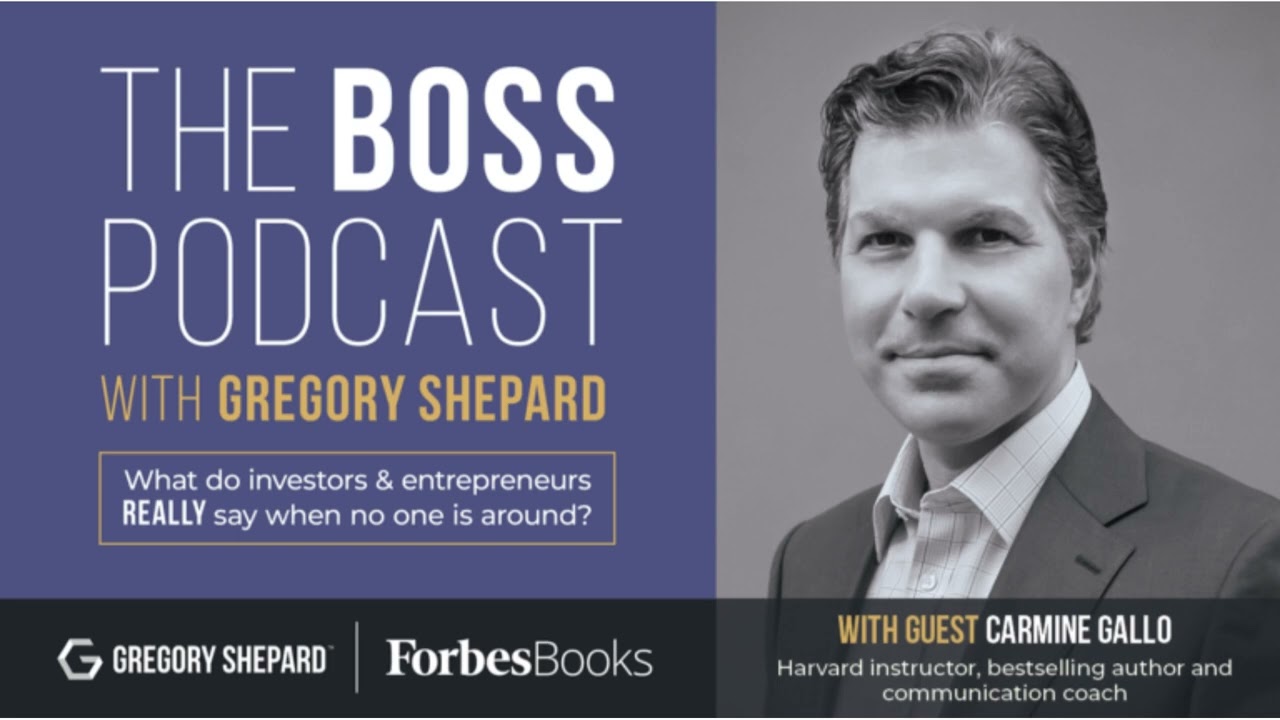
In this episode of The Boss Podcast, host Gregory Shepard interviews communications expert Carmine Gallo, author of Talk Like TED and The Presentation Secrets of Steve Jobs. Gallo explains what he calls "transformative communication" – the ability to elevate ordinary speaking into a persuasive, clear, and emotionally resonant experience that can change an entrepreneur’s trajectory. He argues that effective pitches are fundamentally stories, urging founders to start with a concise, headline‑style "logline" that captures the big picture in one sentence before diving into details. Drawing on examples from Google’s early pitch, Canva’s founder Melanie Perkins, and Steve Jobs’ iconic iPhone launch, Gallo illustrates how storytelling, the hero’s journey, and vivid metaphors engage audiences. He introduces the "Rule of 3," noting that short‑term memory retains only three core ideas, and recommends structuring talks around three take‑aways, three feelings, and three actions. Gallo also stresses that presentations should be treated as performances: sketch the narrative on a whiteboard, create a storyboard, then use PowerPoint as a visual complement, and rehearse repeatedly, recording oneself and seeking honest feedback. Throughout, he debunks the myth that great speakers are born, emphasizing practice, collaboration, and the use of metaphors. The conversation concludes with practical advice for entrepreneurs to think like performers, focus on the "why," and apply the three‑point framework to make their ideas memorable and compelling.
Chapters
Gregory Shepard, an entrepreneur who's built and sold 12 businesses, a recipient of 4 private equity awards, TEDx speaker, and Forbes author. This is The Boss Podcast with Gregory Shepard.
So you've come up with a great idea, but what are you going to do next? Well, my next guest might be able to help you. His name is Carmine Gallo, and he's been called the communications guru. Carmine is a keynote speaker, Harvard instructor, and bestselling author of books like Talk Like TED and The Presentation Secrets of Steve Jobs. Carmine, thanks so much for joining me on the podcast.
Oh, thanks, Greg. Thanks for inviting me. It's a great audience— investors, entrepreneurs. That's who I write for.
It's perfect. It's perfect. That's why we were so happy that you accepted the invitation. I'm a big fan of your Twitter feed. And your profile says that you're number one in transformative communication. And I wondered if you could just break down what transformative communication is for the folks.
Transformative, meaning to transform an individual or a company or a startup or an idea. Most entrepreneurs or leaders who I work with are good or average public speakers or communicators. But if they can take their skill to just another level, not significantly better, just let's just take it one more notch higher so that everything you pitch and present is more persuasive, clear, specific, concise, it makes a dramatic transformative difference in their careers and in their companies, especially given our audience. When I work with entrepreneurs who are pitching during IPO roadshows, Mm-hmm. Venture capitalists and analysts and bankers and investors tell me that that makes a big difference because you can explain a cloud computing company, for example. I worked with a big Silicon Valley cloud computing company last year that was one of the few IPOs last year. And they can speak very well to their peers. They can grow very well internally, But once they're in front of bankers who don't understand the very complex nature of what they do, then it becomes imperative that they are clear, understandable, concise, emotional, inspiring, you know, to generate that enthusiasm. So I believe so much of success in entrepreneurship comes down to how well you can talk and express your idea. Right, Greg? I mean, you can have the best idea in the world. If you cannot express yourself in a way that moves people to action, then who cares? What does it matter?
100%. I mean, you know, it's interesting you say that because I look at probably, I don't know, 100, maybe 200 investments, you know, on a monthly basis. And a portion of those I have conversations with. And the large majority of that group, it's very difficult to get them to answer the questions precisely. You know, everything is really broad and you end up having to say, I can't tell you how many times on a phone call I have to say, can you unpack that for me and give me the details? I agree with you 100%. This is a critical misstep that entrepreneurs make all the time.
It's interesting that you still get that reaction, that you still have to say that. That's the point. You should, as an entrepreneur, you should be doing your homework well ahead of time. People want to know what's in it for them. Why should I care? The basic questions that go back to journalism school. When I went to— I got a master's in journalism at Northwestern many years ago. That's Journalism 101. That's the first day of class. Answer the question, why should I care? It's amazing to me how many entrepreneurs and anyone with an idea They start in the middle. They get into the details. They talk about their solution because they are enamored with their solution. It's the greatest thing in the world. But they never answer, who cares? What is the problem you solve? Why should I care? What does it mean to me?
Yeah.
Basic questions. Answer those up front and at least you'll get some— you'll get interest. You'll get someone like yourself, like Greg, to say, that's interesting. Tell me more.
You know, this is a really interesting topic for me because what I've done is over the past, you know, 5 years, we did a study to find out why entrepreneurs failed. We had like 5 people, we did all these interviews and all this data and everything. And one of the places they fail is right up front. And one of the reasons why they fail right up front is because they can't explain their business to people that don't understand their business in a concise way. I think what you bring to the table helps out with that. And one of the questions I wanted to ask you By the way, I'm a huge fan of your Talk Like TED. Before I did my TED Talk, I did the audiobook probably 5 times. So, just to throw that out there.
Oh, you poor man. You actually had to hear me speak in your ear for all those hours?
I thought it was fantastic, actually. I just put it— I had a long drive and I just put it in and I would just play it over and over and over again. So, I think it's fantastic. I would advise any entrepreneur to read that book and look at the advice and then apply it. Just to throw that out there, it's really—
Can I bring up one thing about Talk Like TED that applies here? So I wrote a book, like you mentioned, it was called Talk Like TED. It was based— it is based on the TED conference, but it's not necessarily— I'm glad you used it for your TED Talk. It's not necessarily a book— this is not where I intended it to go— to be a book that's meant for people who speak at TED. It was intended to capture some tips and advice and techniques from people who are among the best speakers in the world. What have they learned? But as it turned out, you know, Greg, it brings up a lot of interesting tips and techniques that anyone, especially entrepreneurs, can use to pitch their ideas because When you have to create a TED Talk and it's only 18 minutes, you have to be clear and concise and interesting in 18 minutes, which is the same techniques that apply to an entrepreneur who's pitching investors.
100%, especially, you know, they do a lot of these pitch competitions and they have like 8 minutes, 10 minutes to pitch an entire business and unpack that and get investors' interest. And I found that, you know, after I went through the book, You know, I think 10 times or something. And then, I wrote all these notes and everything. I went to TED and then, they give you a coach, you know, a coach to help you out. And the stuff that the coach brought up was similar to the things that you brought up and I already knew them and it was kind of fun.
Oh, great, great. You know what's amazing though, what I've learned not only after writing a book about the TED Conference but writing a book about— years before that, I wrote the first book on how Steve Jobs gave. Presentations. So that was called The Presentation Secrets of Steve Jobs, which a number of companies, startups, and even unicorns have used to create their pitch decks and presentations. So it's still really relevant. But whether or not you look at TED or Steve Jobs or other speakers in a number of different areas, they all are arriving at the same conclusions. I just— I read a book a couple of years ago by Alan Alda. The actor is really into communicating science. Well, I read his book. He had a lot of studies that I've talked about in Talk Like TED. He uses very much the same approach. We reached the very same conclusions. I came at it from working with entrepreneurs in Silicon Valley, and he came at it from acting, and we reached the same conclusion, exactly the same conclusion.
That's fascinating.
I think there's a formula here, Greg. I really don't think it's something that we have to overthink.
There's a formula to it which you've mastered. Let me ask you a question. When you look at these entrepreneurs that are pitching or anybody doing, you know, keynotes or any speaking engagement, is there a commonality between why their speeches aren't good and are good? Is there, you know, you're talking about this formula like an algorithm. Right? Is there an algorithm on both sides that you could help the listeners with in terms of what makes a good talk and what makes a bad talk?
Algorithm. I love that. Spoken like a true startup investor. Show me the algorithm.
I'm a tech nerd, so I—
That question isn't always phrased that way. But yeah, I think it— what's remarkable is the tools of communication have changed. So here we are on a podcast, or we're using PowerPoint, or you're using online tools as well. They didn't have those tools 2,000 years ago when Aristotle was roaming the planet. But the same tools of persuasion that Aristotle wrote about 2,000 years ago are the same ones we're using today. We just use different tools to get that information across. So my whole idea is that the formula has remained the same and consistent for thousands of years. We know how this works. We don't always implement it, but we know how it works. So one thing I've really gotten into, Greg, recently— I don't want to use a cliché, but storytelling. And storytelling, really storytelling narrative, it's crucial to any type of pitch or presentation, um, or to grabbing people's interest. When I wrote the book on Steve Jobs, I used presentations. That was the word I used— how to deliver a better presentation, how to create a better presentation. And not too long ago, Tony Fadell, who went on to build Nest, you know, and sell it to Google for billions of dollars, he worked with Steve Jobs side by side for many years. Tony Fadell was on a podcast, another interview and they asked him, what did you learn from Steve Jobs? And Tony said, storytelling, storytelling, storytelling.
Wow.
And it dawned on me, Greg, that even though I wrote the book on how Steve Jobs created presentations, I never used the word storyteller. So, I think that— and then after TED, I started using storytelling. I think storytelling is the key. And most venture capitalists I've talked to, and I've talked to some of the top ones in the Valley, They're even the ones who bring up storytelling, especially for early entrepreneurs, because if you cannot bring them into the journey with you, if they don't understand the journey, the hero's journey— why is this taking place? What is the adventure we're on? What are the hurdles and the obstacles that we can encounter? What is the end goal? What is the reward at the end of the movie? If you can't bring them on a journey, it's really hard to convince them to invest in the company or to take action on your ideas. So this whole idea of storytelling has become a central focus for what I'm— for what I write, for what I look about, and the whole lens now of looking at pitches, presentations, communication It's all through the lens of story now. I'm sort of obsessed with storytelling.
You could probably help me out with my story.
I am not good at storytelling. This is creative. This is the creative stuff. And PowerPoint is not a storytelling tool. You open PowerPoint, you start filling in bullet points. That's not narrative. It's not storytelling. So, I've been going back to analog, you know, and I get my— these entrepreneurs or clients who I work with, let's get on the whiteboard. Let's do sketches like a director would before they even start filming a movie. They're still— they're called— it's called storyboarding in Hollywood, right? It's all about sketching out the scenes. What story are we trying to tell first? Then we can use PowerPoint to complement the story.
Instead of the other way around, right?
Yeah, that's the algorithm. Algorithm is Don't start by opening PowerPoint. Start by sketching out the story, the journey that you want to take people on. The tool PowerPoint is going to complement the journey, but it's not creating the journey.
So let me, let me sharpen that a little bit. So when it comes to speaking, you emphasize that it's important to always express the big picture before you go into detail. Because some people get lost in the minutia. So, how do we focus on the big picture in a more tactical way?
Oh, okay, good. Uh, that again, that everything we're going to talk about, Greg, falls under story, which is why I begin with story. Okay, but how's it— what's a good story to start with? Okay, um, a good story sort of starts with the big picture, a headline. If you read any newspaper column, what's, what's the headline? What's the one thing that this story is about? Well, why don't we do that in a business presentation? Why do we bury the headline in the middle of the presentation or wait till the end? This is not a novel. Okay. You're not Hemingway. You're not waiting till the last page for the big reveal. An investor has very limited time. They just want to know what's in it for me. And give me the story right up front. Then you can back into it with the details once you've got me hooked.
Oh.
That's why I say let's start with the big picture. And getting back to story, in— I think I wrote about this in Talk Like TED for the First Time. I like to speak to screenwriters, Hollywood screenwriters, because I learn a lot from them. They're great storytellers. In Hollywood, and this is a real thing that happens, if you are a screenwriter and you have a film to pitch, and those guys go through pitch meetings, you know, multiple times a day for new movies, they want to know in one sentence, and they call it the logline, in one sentence, what's your logline? The logline is the movie poster, Greg. It's the poster. It's in one sentence, what is this movie about? Every movie that's ever pitched in Hollywood has to have a logline. They even have books for screenwriters. So, that's how hard this is, Greg. It's you have to distill your movie in one sentence. So, how does that apply to entrepreneurship? I remember having a— you'll know this name, Michael Moritz at Sequoia Capital.
Yeah.
Right? One of the great investors who backed Yahoo and Apple and Airbnb and so many other startups. So, Sequoia Capital, one of the biggest firms in the Valley. He told me this story. He said the Google guys, Sergey Brin and Larry Page, walked into his office one day and it was a Friday. He remembers this because I think they invested by that Monday. Brin and Page walk in and they say, Google— and they said, look, we've got this idea for a company, we call it Google, that it allows anyone to access the world's information in one click, right? So make the world's information accessible, which I think is still very much part of their, like, mission or vision statement. Make the world accessible. Make the world's information accessible in one click.
Mm-hmm.
And Michael Moritz says to this day, he still remembers how clear they made that message. So, his next question is, well, that's interesting. Let me see how it works. So, now he's interested.
Yeah.
But then— and here's the key, Greg. Michael Moritz told me that after that day, he always demanded of entrepreneurs who walked into his office, I want to know what your idea is in one sentence. And then he said, if they cannot express their idea in one sentence, I'm not interested, period.
Yeah, that Bezos follows the same logic.
Yeah, yeah, you're absolutely right. It's like, give me, give me the big picture, the big picture in one sentence.
So when you're crafting a story then, right? So are you basically taking the journey of your business into a byline, if you will, right? Like a trailer, a movie trailer, that poster that you mentioned, and then that's your opening to the conversation, right? That's your opening. And then do you wait then for them to ask the next question before you go on, or do you— what do you do now? So, you've got their interest, you've done the byline, now what?
Often you can start with that personal story and tell that story in 60 seconds. Right now, just in the past few days, I've been reading more about Canva. Melanie Perkins, who I've interviewed a couple of years ago. So Canva has just become the most valuable female-founded startup. It's valued at $40 billion. They just got a new infusion of $200 million a couple of weeks ago as we're talking on this podcast, a new round of infusion. So they are all about online design. Well, from day one, Melanie Perkins' mission was to, quote, democratize design, to empower anyone in the world to make beautiful simple designs easily and quickly. If you're listening to how I'm trying to articulate that, Greg, sometimes my words could change. I don't work for the company, so it's not exact, but just by reading her interviews, I understand, I get it. In one picture, I understand what they're trying to do. And I love this whole term democratized design. Then only once she gives you the big picture, this is what, who we are, this is what we are trying to do. Online design to make it easy for anyone to make beautiful designs. Okay, I got it. In one sentence, I understand at least where your company or startup falls into. Now I can categorize it. But almost immediately, Melanie goes right into, let me tell you why. She tells you the why before the how. She doesn't pitch it by saying, this is how it works. Yeah, we'll get to that. First is why. And now, almost always, in every interview I've heard her in the last few months, she always goes back to the story. In 2007, so, you know, most of your listeners may have heard this by now. In 2007, she was teaching Adobe Photoshop and other design programs at a university in Australia. And she realized just how frustrating and how difficult it is to teach and to learn those programs that were still based on the desktop. Why couldn't this be remarkably easy online? Like other social media sites are making things easy. Yeah. Easy online. And that's where it was born out of that frustration. And anyone can understand that frustration. So she goes right back to that story. That's what I mean, Greg, by first give me the big picture. What is this company about? What does it do? Just so I can have a mental category of where you fit. But then she gets into the story. And it's that story that draws you in. Because as she has said, if people don't understand the story, and they don't know my background and why I started Canva, they will not understand the why. And then we'll be getting right into the how. Well, the how can be confusing until you learn why it's even necessary. And the best vehicle we have to transfer that knowledge of why is through story.
I think that's impressive, to say the least. All right, unfortunately we have to stop here, but coming up in the conclusion of my conversation with Carmine Gallo, In an 18-minute TED Talk or a short presentation, you cannot bombard people with everything you know about the topic.
Give them 3 things to take away. Give them 3 reasons to invest, 3 reasons why this is going to be a multi-billion-dollar category, not 28.
Learn more about the Boss Business Podcast at bossbusinesspodcast.com. operating support system at bossstartupsience.com, or you can reach Gregory Shepard at gregoryshepard.com. This has been a production of Forbes Books. Gregory Shepard, an entrepreneur who's built and sold 12 businesses, a recipient of 4 private equity awards, TEDx speaker and Forbes author. This is The Boss Podcast with Gregory Shepard.
Thanks for joining me for the rest of my talk with communications guru Carmine Gallo. He's written some of my favorite books on public speaking, including Talk Like TED and The Presentation Secrets of Steve Jobs. Carmine, you're an amazing speaker. You're the go-to guy for entrepreneurs and CEOs. So what are some of the common misconceptions when it comes to public speaking?
Oh, great question. The most common one that— and this is every— almost everyone I speak to has the same misconception— that great speakers are born. No, not one of them. Almost anyone that you see today who you can say inspires me or is a great speaker or a great TED Talk or a terrific communicator like Steve Jobs was Every single one of those people worked at it. Great communicators are made. They're not born. They work at it. And so I am tired of hearing people, and I tell them this, you got to stop saying, oh, I'm not as good as so-and-so. Oh, I don't have the charisma of Steve Jobs. Oh, I would never be. I, I'm not that good. I'm not as good as so-and-so or that person or this person. Well, neither were they. They worked at it over, sometimes over months, over many, many years. It takes time. Public speaking is a skill, and like any skill, it can be sharpened and improved. There isn't one person you look at historically, Greg. I mean, there really isn't. I've studied this. Steve Jobs was not naturally gifted on a stage. And in fact, there's some really early video in the early '80s, and even the Macintosh introduction, 1984, still on YouTube. He's like holding on to the podium for dear life, man, the lectern. And I've heard he was very nervous early on.
Was he as bad as Elon Musk?
Okay, so Elon Musk is the most interesting— gosh, I wish I could talk to him. He is very interesting. Because there are parts of his personality and his presentations that I think are sensational. He pushes the envelope, but it doesn't look like he rehearses very much. And so it's kind of like it's rambling, it's rambling, and then it hits you over the head and there's something amazing. Almost every public presentation that I've seen from Elon Musk has an element of one of the just an awe-inspiring presentation. He does crazy things. He loves these crazy demos. Sometimes they work, sometimes they don't. So he's, he's just a fun character. Uh, just wish he would rehearse it more to tighten it up a little bit.
So back to Steve Jobs for one second. What do you think made him such an amazing public speaker from your point of view?
Oh, do you know? He, well, first of all, he was, um, He was dedicated and creative. So, he worked with his design team to refine every slide, every introduction. There would always be that wow moment, most famous being 2007 iPhone introduction. And I would encourage anyone on this podcast, go to 2007 if you are really interested in improving your business presentations.
Yeah.
In my world, the 2007 introduction of the iPhone is probably one of the best business presentations of all time. Because at the beginning of the presentation, people were skeptical. The news headlines were like, why is Apple getting into the phone business? 90 minutes later, everybody was saying, I want one. Give it to me. Give that to me now. And he had those real interesting moments that he didn't have to do. He could have just walked out and said, hey, Apple's getting into the smartphone business and we're coming out with one we're going to call the iPhone and here are the specs. Let's go to the PowerPoint. Let's go to the slides. He used Apple Keynote, of course. But he didn't. He kind of laid out the history of Apple and Macintosh and their history of design and improving things and making things easier to use. And then he created the villain. And he introduced the villains. He goes, now let's look at the smartphones, the current smartphones on the market. And he said things like, here are the usual suspects. You know, he was even using the language of narrative. Here are the usual suspects and here's the problems with them. So what do you do? Well, we've decided to introduce 3 new products in this category. An iPod, a phone, and something brand new you've never seen before, an internet communication device. And he paused. An iPhone or an iPod, a phone, internet communicator.
Yeah.
And he says it like 3 times.
Says it like 3 times. Yeah. Aren't you getting it? This is one device. Whoa. You know, it's— you don't have to do that. That was creative. That was Steve the performer. And that's what people remember. They don't remember slide number 32, but they remember that because that was a moment that was created. He was intentional about it. Steve Jobs sat with his team, sits with marketing, sits with designers, and most of it was his. Most of those presentations were his ideas. Let's do something that will get people talking, that will grab their attention. So he didn't just open up a slide deck and start filling in the information. He was a storyteller. And here's the other little-known fact about Steve Jobs, and it's absolutely true because I've had it confirmed by 2 different people who have worked side by side with him, he relentlessly practiced and rehearsed for every one of those presentations for weeks on end.
Really?
He would gather— Ken Kosienda told me this, and he's the guy who was involved in, I think, the original iPod, but also the iPhone keyboard on the iPhone, one of the engineers. But he was with Steve Jobs in those rehearsals. For the iPhone. And he said it was like a performance. He said it was weird. Like, Steve would come in, there's only me and a handful of other people who could only watch that part of the presentation. And he got up on stage in the auditorium and raised his voice and used gestures and talked like he was speaking to 5,000 people. And there were like 3 people in there. And then he would stop Step out of character. That's what Ken said, stepped out of character, walked down and started getting, okay, tell me how this line worked, or what do you think of that line or the way we present it? So here, that tells me, Greg, that Steve Jobs was intentional.
He—
this was not a presentation, it was a performance.
So that's the key, right? Is that you're not presenting, you're performing, and you're performing this story that you mentioned earlier.
And, you know, I love that. I mean, you just read it, cut to the chase. It's a performance, not a presentation. And there is a difference. And what do all of us do, myself included, for many years when I was in corporate America? Oh great, I've got a presentation. I'm going to open PowerPoint and start filling in the text. That's not a performance. Or you flip through your slides on the way to the pitch meeting. You haven't Presented it the way you would in the real world. That's part of practice. And so when people say, well, I'm not as good as so-and-so, or I'm not as charismatic, or I'm not as good a speaker as so-and-so, well, they probably practiced and you're not. How many times have you practiced this presentation on a stage in front of an audience? When is the last time you put yourself on video and recorded yourself and looked at your mannerisms and your body language And your delivery? Oh, uh, well, never. I don't do that. Okay, that's why you're not as good, but you can get there with practice. It's a skill.
So it's just like acting. I mean, you, you know, you see these actors that get in the mirror and they act over and over and over again the role, and they fall into the role. So this allows you to step into character, right, and tell the story from the perspective of the Of the storyteller, the main character in the story. Is that—
Yeah, I like that. It absolutely is transforming yourself. It's contrived, right? It is a little contrived. This isn't just a natural conversation. A presentation is in many ways a performance. So I'm not trying to get you to be anyone or to act like anyone you're not. You have to be authentic to who you are. But let's at least bring out some of your strengths and your skills and make it more creative and interesting.
I love this. This is— I'm actually learning a great deal here just right now. I can't wait to follow up with you. Oh, I love that.
I learn something new every day too. So, I enjoy this.
So, let me ask you, you know, you mentioned earlier on to rehearse and look in the mirror and look at your performance. If you are an entrepreneur and you're sitting there and you're all by yourself, How do you measure your own performance in those scenarios?
Well, you know, Greg, I'm not sure if that is the most effective way. Steve Jobs asked for feedback. What's wrong with that? I think communication should be more collaborative. You may not be the most creative person in the room. Maybe someone else has a much better analogy or a metaphor that you should be using in your next presentation. Metaphors, getting back to storytelling, are very powerful. And people like Warren Buffett use metaphors all the time. You know, I'm looking for an investment that's surrounded by a moat, like a castle with a moat around it that makes it hard for competitors to enter the industry. That's a metaphor. It's an analogy. And really good speakers are heavy users of metaphor. So maybe you're not the best at that. Be more creative. You've got to Start expressing yourself and pitching and presenting to other people. Get some feedback. Maybe they're seeing things about your delivery or your body language that's maybe off-putting that you don't even realize that you're doing. I'm not sure how effective it is to just critique yourself. I like communication being a little bit more collaborative. Get a trusted advisor. a friend, someone else to watch because often you won't get an honest opinion from people. They're too nice. So, you know, you get a trusted peer and practice. Try that presentation. How did it come across? Ask for feedback.
So, you said something I found really interesting. This concept of like sort of— I think of the story as a tapestry. And these metaphors sort of weaving in and out of the tapestry. And so that means there are other elements to the tapestry, which you mentioned is why should I care? So why should I care? You can use metaphors for that. Are there other ingredients that you can mention for the listeners to sort of consider when they're putting together their talk?
Yeah, absolutely. Storytelling is one. Tell your story, tell the background story, use case studies.
Okay, case studies. That's another one.
They're stories. They're stories of other people and how they're benefiting from the product. So, think about yourself not as a presenter but as a performer who's sharing stories. Take people on that journey. Answer the one question on everybody's minds. So what? Why should I care? Is this going to make me money? Is this going to improve my life? Does this have a valuable demographic of potential customers? Why should I care about this stuff? Your technology sounds interesting, but you're in the weeds. Uplevel it, big picture. But here's the other thing I've become a real big fan of, and you might know this, Greg, through one of my books, the Rule of 3. The Rule of 3 simply means that in short-term memory, people can only carry or consume A few points. In an 18-minute TED Talk or a short presentation, you cannot bombard people with everything you know about the topic. Give them 3 things to take away. Give them 3 reasons to invest. 3 reasons why this is going to be a multi-billion-dollar category, not 28. You'd be surprised at how hard it is for people to get their mind around distilling their content into 3. They'll, they'll, they come back at me and they say, oh, but Karma, there's so much more. Yeah, but people can only remember about 3 points. There's a lot of research on this now, Greg, that 3 is a really powerful number. Uh, 1, 2, or 3. Once you start going over 3 points, like 4, 5, 6, people start to They're incapable of remembering everything, which is why there's research on the telephone number. This is why we chunk the 7-digit number. We chunk it into like groupings. There was a— speaking of TED, there was a quantum physicist. He gave a really cool TED Talk. I think his name was Dominic, Dominic Walliman. And he gave a TED Talk on how do you explain quantum physics, which is one of the most complex Topics to explain. How do you do that? And when he was asked, he said, well, first you don't tell people everything you know. You tell them maybe 3 things. So he even— he was thinking about 3.
Wow.
I'm going to give you 3 things I know about this topic, 3 reasons to invest, 3 features about this product. To a customer, maybe 3 reasons to buy the product. Once you start going over 3, It's confusing and it's hard to follow. I'm really into this whole groupings of 3. And now that I'm seeing 3s everywhere now, you know, it's sort of the way we naturally group things and the way we talk. You know, Declaration of Independence, life, liberty, and happiness, right? Just 3.
So, speaking of 3, let me ask you this. So, when I did my TED Talk, I had this coach who helped me. And what she told me is she said, Think about these 3 things. What do you want them to think? What do you want them to feel? And what do you want them to do? Is that something that you've heard before? And if so, can you shed some light for everybody on specifically what that means?
Well, it's interesting to me. I'm focused on the 3. See, she didn't give you as a TED speaker 32 things to keep in mind. She gave you 3. So, we naturally talk in 3. And then, I help these entrepreneurs with new product launches or a CEO with a big keynote and they want to add so much material. And I try to tell them that a really good concise talk is not so much about adding material, it's selecting, selecting the material that you want to talk to people about. And then you can group things under the rule of thirds. Feel is where I focus. What do you want people to feel? Obviously, what you want them to do is to take action on your idea. So, if you're not specific about it, then yeah, they're confused. I've seen so many presentations like that where at the end of the presentation you say to yourself, well, that was interesting. That's about it, right? That's interesting. What am I supposed to do with it? So, it never really answers the question, why should you care? So, part of that is, what do you want me to do with it? So, I agree with her. Think, feel, and do. And feel— how do you get people to feel? That's why, once again, I'm so passionate and obsessed about story, because story is the only vehicle that we have through which we can get people to feel our emotions. And that's why I think I wrote a whole book just on storytelling in business called The Storyteller's Secret. And I'm still learning about storytelling every day. It's a big area. It's a complex area. There's always something new to learn. But I think the big takeaway is let's get people to start— stop thinking of yourself as a presenter and start thinking of yourself as a performer who has a story to tell. And you'll find that just by reframing the way you see yourself as an entrepreneur who wants to express an idea, just by reframing the way you look at it, the content's going to change. And the way you— express your idea will change.
This is incredible. Thank you so much. We have a keynote speaker, Harvard instructor, international bestselling author, one of my favorite people right now. I just— on this conversation, I cannot wait to just have follow-up conversations with you. All these books that you have, I've been through them all because after I did the TED Talk Like TED one, I was like, okay, this is good. And then I just went in and did them all. And I would highly recommend this to everybody. And I really, really appreciate your time and energy and all of the wisdom. And I'm sure the entrepreneurs do as well. Thank you so, so much.
Greg, thanks for inviting me. Again, terrific audience. And I would encourage anyone to keep in touch with me through my website. If you can remember a good name, a good Italian name like Carmine Gallo, contact me anytime.
Thank you so much. Have a really great day. Appreciate it.
Thank you.
You're so welcome. And that wraps up this episode of the Boss Podcast. If you enjoyed the show, please take a second to subscribe so you automatically get my new shows when they drop. Also, if you have a minute, I'd love it if you left a review so more folks like you can discover the show. I'll see you next time. Namaste, my friends.
Learn more about the Boss business operating support system at bossstartupsience.com, or you can reach Gregory Shepard at gregoryshepard.com. This has been a production of Forbes Books.
More from Gregory







Why you Might Want to Keep your Camera on During Remote Work Meetings | Minute Mentor


Same Side Selling | Ian Altman | Part One & Two | The BOSS Podcast with Gregory Shepard