The Next Generation of Entrepreneurs | Umran Beba & Korhan Beba | Part One & Two | The BOSS Podcast
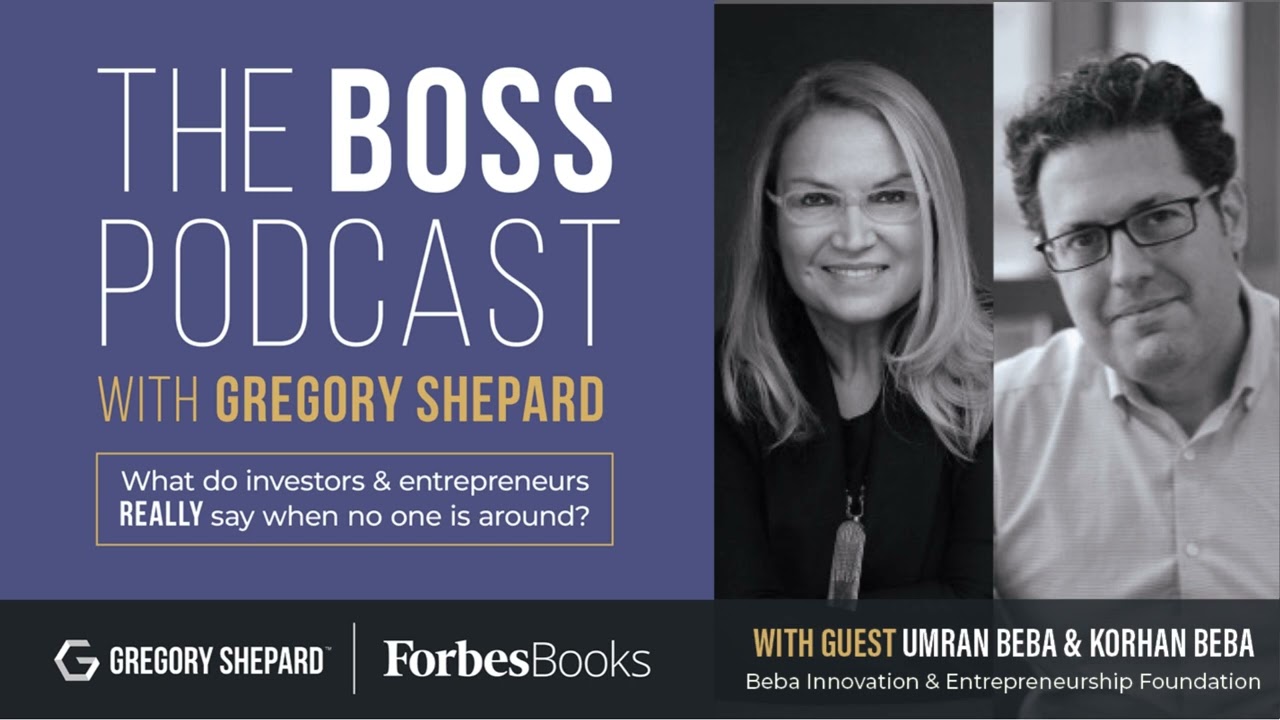
Umran and Korhan Beba run a foundation training entrepreneurs in Turkey through mentoring, competitions, and STEM outreach. About 60% of startups fail after accelerators end. They say the first year is critical, and founders need market validation, resilient teams, and real mentors to survive.
Chapters
Gregory Shepard, an entrepreneur who's built and sold 12 businesses, a recipient of 4 private equity awards, TEDx speaker, and Forbes author. This is The Boss Podcast with Gregory Shepard.
My guests this week are Umran Beba and Korhan Beba from the Beba Innovation and Entrepreneurship Foundation. Umran is the founder and Korhan is the executive director. Together, their mission is to assist aspiring entrepreneurs to turn their ideas into applications, commercial products, or services for global markets. Umran, welcome to the podcast.
Hi, thank you so much for inviting.
Oh, you're more than welcome. Koran, thanks for being here. I really appreciate it.
Oh, I appreciate it too. It's great to be here. Thank you.
So let's just dive right in. So Koran, listeners will notice that you and Umran share the same last name. Can you tell us a little bit about that background? It might be interesting. I see that— I say that because a lot of the time entrepreneurs are working with other people and these sort of things are unusual, but they also can be a really big catalyst for growth and expansion because you're kind of always talking about it, you know, so you're working when you're not working.
Yes, absolutely. You're right. So, yes, we do share the last name. That's because we're a family. Imran is actually my stepmother. And, you know, we've been working together now since the beginning of 2000 as part of the foundation work. But in particular about my background, I have now over, I don't know, like 25, I guess, years now that's been spent in a lot of major international corporations like Unilever, Procter Gamble, and then most recently at Johnson Johnson, mostly in the marketing department managing international global brands. I also was involved in small startups as well. So I do have the one of the unique or rare opportunities where I was able to see kind of both sides of the spectrum. Since the beginning of 2020, I have been the executive director of our family foundation that's based in New York.
And Umran, your CV is also impressive. You've worked in HR and diversity positions with major brands like Pepsi. What kind of changes have you seen in the course of your career in those areas?
Yeah, many, many. Absolutely, you are right. So I have 35 years of experience in corporate life and 25 in one company, PepsiCo. So during those years, I worked in business as general manager, president, but also in HR, talent, and diversity roles. And even if I was not in a diversity role, actually I was working on diversity on the side as a project because I was the only woman in most of the rooms throughout my career. So for me, it started actually looking at the gender agenda, especially in the countries where I was operating, starting with Turkey and then Southeast Europe. Asia Pacific, Middle East, Africa. And every time, you know, I wanted to improve the numbers, but especially for the gender agenda and women in general management roles. That was my kind of focus on the side. And of course, it is not only about gender, this whole diversity agenda, the multicultural aspect, because I worked in, in many different countries and 4 different locations. You know, I had to really understand the multicultural aspect of business talent and inclusion became a very important part of the agenda and my work. And moving to US, of course, the ethnicity became another important dimension. And especially in the last couple of years, ethnicity agenda has been top of the charts. I mean, it has been there forever maybe, but not at this level because not much was done. There was frustration and we have seen it throughout the pandemic. but also with unfortunate events, the city agenda became very, very critical. And also the equity side of the equation, you know, how can you have equitable processes, systems? So it is moving, I should say, with a good speed and change. And I was very happy doing that work.
It feels like, you know, for me, you know, I did a ton of research on this, right? So, I was trying to level the playing field for those of us that had nothing to begin with or those of us that are diverse. I'm from a diverse family myself. And then, also, the gender issue, right? I mean, these things are— the numbers during the research that I did back in 2016 up until last year was incredibly disappointing in terms of the number of founders that are women and the number of founders that are women So the impact that you're making, do you feel like it's starting to increase? Do you feel like it's getting better? Do you feel like we're going in the right direction?
I mean, absolutely, it's top of mind today for organizations, for governments. Now, do we see enough progress? I think we unfortunately, it is not immediately visible. Visible in the top positions, but throughout the pipeline, especially in the corporate, yes, you see. In entrepreneurship, I think with the pandemic, we have also seen more positive change. Now the question is, it is not the number of women and, you know, multicultural women in these fields, but can they get funding? I think that's the critical question. Now, yes, there is a lot of interest from those cohorts But can they get the funding? Therefore, how can we support them to have the right training, mentoring, and go for, uh, go for and ask for the funding? I think that's going to be the focus, or should be the focus, I believe.
I agree. I, I want you to unpack the Innovation and Entrepreneurship Foundation that you founded 4 years ago and tell the listeners a little bit about what it is, what your mission is, and Why you did it?
So we originally come from Turkey, then as a family we lived in Hong Kong, Dubai, and we moved to US in 2016 with my role. And my husband has been a professor of entrepreneurship and was teaching in many, many prestigious universities around the globe. So when we moved here, he said, I don't want to go to another university, but it's time to really return. You know, he always says like it's learn, earn, and return. So he said now it's time for return, and we decided to establish this Beba Innovation and Entrepreneurship Foundation, him being the lead and me, you know, like a co-founder. And later Korhan joined us, and our objective was really to focus on women and youth in terms of entrepreneurship and how we can support them with trainings, mentoring, and also competitions. So bring those ideas out and support them, give mentoring and training. So that's the way it started. And in the last 2 years, I should say, we have been definitely very active and enjoying the work and creating a difference. I feel.
That's just so cool. I just love that. I mean, it's just so great. So, Corinne, you started to work with the foundation in 2020, right? What made you get involved in, you know, sort of switch And pivot to this end of the side of business and get— I mean, you're really involved now, right? I mean, you're a big part of this. So can you tell maybe a little bit about what made you make the switch and why did you get involved and what you're seeing now?
Absolutely. So as Imran was saying, in our family, we do really believe in this cycle of learn, earn, return. And I also felt, you know, after so many years in the corporate world and you know, making a decent living, I figured, especially with also the start of the pandemic, you know, in 2020, we said, okay, how can we use our foundation in a much more active way and really start to make a difference and touch some people's lives? So at the time, you know, the foundation was there, but we weren't really very active. So I made the switch and took on the role of executive director to be, you know, full-time responsible for all the operational work. at the foundation. And that's really how it all started. And as Imran was saying, for the past 2 years now, we're trying to increase our reach and we're trying to basically come up with different types of work and projects to try to make that difference. As the foundation, we're trying to really reach out to those most underserved, especially young and women entrepreneurs. Right. And our work is really kind of revolving around 3 key pillars. One of them is trainings. Like Umran was saying, we work with small business development centers, women enterprise development centers, for instance, the one in White Plains. We provide trainings there like how to write a business plan and, you know, business plan canvas, things of that nature. We have another pillar which is around mentoring. And the 3rd key pillar is really working with younger people, as I said, you know, We do want to support younger entrepreneurs. We work with Mercy College and also with other colleges around the globe, you know, in Turkey and even high schools. We did have an atelier program, a workshop program at a high school in Istanbul, for instance, for the whole of last year, which did create a lot of, I believe, excitement in the school and the 16 kids who attended.
So this is a tremendous amount of support and it's all focused on a group of people that don't get any support really. And so you're trying to level the playing field, right? So are you focused more on the founder side, more on the mentor side, more on the investor side? Like if you look at this whole industry, you know, you see sort of like a cube and there's all these different angles. Are you guys more favorable to one side than the other or do you just play the center?
So I would say we're kind of more in the center and the founder side, if you will. For instance, you know, the business competitions that we run with Colombia, we are providing some, you know, seed money, if you will, some investment from that point of view. But that's not our, you know, main focus. We're not in this to, you know, give out funds and be an investor. For instance, we don't take any equity at all. Honestly, we don't also, you know, look around for investors to get these investors with the entrepreneurs. We don't really do that that much either. Our main focus is mostly on the training and the mentoring side of things. And, you know, be and work as, you know, guides really for these people who may not really have, you know, such a support in their life otherwise.
Yeah. I mean, it's crazy because when you get into this industry and you really start to focus on it, you start to see that these entrepreneurs come in, they raise their hand, I have an idea, and the first thing they get hit with is like 4,000 people trying to sell them things and offer them advice, and they don't even know where to start. So, groups like yours Really come in handy to make sure that they get some focus, right, and some direction, and they aren't susceptible to all of the people out there trying to sell them things that they're too naive to understand they don't need at that point in their business career, you know, in that, in that point of their startup.
Absolutely right. I mean, a lot of the women, for instance, that work with the Women Enterprise Development Centers, to your point, they don't really know where to start from. There's so much out there, and they get you know, I guess bombarded by, you know, these types of things that you were mentioning. So, yeah, I mean, I think it's really good to be able to kind of show them the way, if you will, in a bit more focused manner.
Yeah. I mean, from my perspective, you know, when I started 30-whatever years ago, I started building businesses, it was like that, right? It's like you're sitting there and you have— I have this idea and, well, back then you didn't even have search engines, but even now, I don't even know if it's It was that much more helpful because now you go online and there's like a million things and you can spend months just going down different rabbit holes trying to figure out where you are in this ecosystem. So I think the guidance that you had mentioned that you do with the mentors and sort of sherping their way through this is just really, really cool. What are some of the biggest challenges you guys have?
So I think one of the biggest challenges is, I don't know if you would call this a challenge really, but as we have been talking about it, you know, we have been really active in the past 2 years and we only want to increase our reach and our impact as we go forward. So, so far, you know, we were formed in 2017 based in New York as a family foundation. So all the funding really comes from our, you know, family basically.
Mm-hmm.
So as we go forward, one of the challenges that we'd like to tackle is How can we start bringing in outside contributions in a more impactful way so we can actually increase our reach? And, you know, in terms of touching more people's lives and also maybe also creating a more significant impact.
This is just so cool. I love that you guys— I love how you're giving back and you're doing it, you know, you're doing the teach a person to fish method instead of just giving them the fish. It's really— it's some of the things that I really focus on is that You know, when I was coming up, there wasn't a lot of help for me. You know, so in my life, just like your husband, I turned around and said, okay, I need to give back. I need to make sure that these entrepreneurs don't have to go down the minefield, the gauntlet of booby traps that I had to go down.
Absolutely.
Amran, I want to ask you if you could tell me a little bit more about the Million Women Mentors Program and how you're supporting these female students and young entrepreneurs. And all these different professionals that seek careers in this STEM program in Turkey. I'm really fascinated by this.
Yeah, I think if I just summarize what we discussed, so we are basically reaching out to younger people, try to encourage them with the understanding of entrepreneurship, and then make their decisions to have it as an option. Versus you know working in an organization. So there is that option. We give them that inspiration, and if they are interested, they can come up with ideas, join competitions, get coached and mentored, and even win some seed money. So that's kind of the whole idea of you know reaching out early. And why do you have STEM in this equation is because what we have seen around the globe and also in Turkey. We don't have a lot of women in STEM fields either. And if you look at the future with the digital automation, AI and everything, we need more definitely women in STEM areas so that they can have decent earnings, they can have decent livings, right? I mean, I was part of the Million Women Mentors program in the US when I was in PepsiCo. And I said, we should take this program to Turkey. and establish a group of founders who can really invest in this program. Our objective is in 10 years to reach 1 million girls and also young women in STEM fields and support them with mentoring. And as you can imagine, during this mentoring program, they can be professionals, they can be students, and they can be entrepreneurs, right? We can still reach out to the entrepreneurship aspect of the game And as you know, most of the ideas really come in the STEM fields these days. And then we will be able to really mentor them, help them in their, let's say, journey. We already left behind a year and we have an incredible set of founding partners, big organizations, Turkish and global. And they're all, you know, giving their time and resources to support young professionals, women in Turkey in the STEM area. So that's one part of the equation. But if you look at also the Turkey context, this program with the high school and entrepreneurship, you know, program, and then at the end there was a competition again. So at the earlier age, we make them think about, you know, entrepreneurship as an option. So that's the fun part of the game. So you will later maybe talk about the education system, but we believe earlier the better.
I think it's really neat. I think that I hear a lot about the— with the women movement and with ethnicities, I hear a lot about, even myself, about leveling the playing field and trying to bring these people up to a level where they should be. And on the other hand, I had a conversation with somebody the other day and she was telling me that, you know, this is not just about raising these people from a certain level to another level. But also getting a perspective that you can't get from other people. You know, you get a perspective from women and you get a perspective from people of ethnicity that you just don't get from— so they add value that is unseen, like shadow value. So, there's another important component to this outside of just leveling the playing field, right? And that is getting this other perspective. Do you agree with that or what are your feelings about that?
Oh, absolutely. I mean, I am also mentoring, you know, women for boards. I mean, that's another level, you know, like, so you have the entry level, you have the highest level. And the reason, as you say, the whole idea of diversity and diversity of thought, how you can make businesses better, either a startup or an established corporation. But if you have diversity in a board from a multicultural background, gender and ethnicity background, veterans, LGBTQ, you know, I mean, all those different life experiences actually matters in terms of innovation. So that's the starting point really, not just to have 50/50. I mean, yes, of course we should, but they bring something different, you know, like let's accept it and take care of it.
Yeah, especially when you're looking at the whole idea of entrepreneurship, right, is to solve problems. Well, you know, if people aren't experiencing those problems, they're blind to them. So the people that grew up the way I did and other people that have other challenges similar to that are the only people that are even aware of these challenges, let alone have the capacity of even thinking about solving those problems.
Absolutely. Yeah.
Koran, everybody loves a little bit of competition, and this Greater Good Challenge has my attention. Can you tell us a little bit about what that's all about?
Absolutely, Greg. Yes. So this actually really started in 2020, again, with the pandemic. So as I came on board as the director, we were looking at ways to really, you know, make an impact, as I was saying. And Imran is also on the board of Columbia University School of Professional Studies. So, you know, we were talking with them and exploring different ways of opportunities, different opportunities that we can partner with. And with the pandemic, we said, okay, look, I mean, there's obviously a big problem here. Why don't we think of a business ideas competition, a business plan competition where we can, you know, ask anyone who's interested within the school to come up with their ideas to solve some specific problems? So that's how it really started. We decided we really want to focus on 5 main areas. And some of those areas were things like sustainability, supply chain and logistics. Obviously, that was a big issue, as you may all have as we have all experienced with not being able to find any toilet paper, you know, for a while. So we said, okay, let's identify those main areas or main categories that are really, you know, hit in the most major way and ask the students to come up with their ideas, business ideas to solve these specific problems. That's how it started and it went really well. That's why we are actually in year 3 in 2022. The way it works is really once we open the submissions window, students have about 10 weeks to come up with their ideas, put them in a certain context, basically a condensed business plan, and then submit it. In the first year, we got over 60 submissions from across 12 different countries. Obviously, Columbia has, you know, the satellite programs that people from other countries can also enroll in. So, you know, out of the 60+ submissions, we were able to bring those down to 10 finalists. And then the 10 finalists basically, so far it's always been virtual due to obvious reasons. Those 10 finalists make their pitches on a specific day live. Every team has about 3 minutes for their pitches. And we are very specific about how they can pitch so that it's kind of like, you know, to level the playing field, if you will. Because, you know, sometimes people get creative, come up with like different films and stuff like that, videos.
Mm-hmm.
So we really want to be as fair as possible to everyone. So they each get 3 minutes to pitch and then at the end of the day, we decide on the top 3 winners through a collection of esteemed judges. There were 5 judges, like for instance, in the first year. And we determine, we decide the top 3 places and we also do get an audience pick as well. We get over 200 people live watching the competition on the average over the past 2 years. So they also do vote for their favorites, and we also get to pick a 4th audience winner. So, so far it's been going really well, as I said. Actually, a couple of the entries— the 2020 first-place winner is a company called Microterra, and they are a company that is actually founded by 3 young entrepreneur women in Mexico. Oh, cool. Yeah, what they do is, you know, they are looking to come up with solutions to make inland fish farms much more efficient. I don't want to get into all the details. Obviously, we don't have time. But if your listeners would like to learn more, they can obviously email us or they can just go ahead and check their— check out their website. They're making a significant impact. After they actually won the competition in 2020, they went ahead and got some significant funding through a couple of series of investing pitches. They, I believe, so far were able to collect about $2.5 million on top of the $12,000 they got from our competition. So I think we're making a big impact. We're very, very excited for 2022. And as I was saying earlier, one of those challenges you were asking about, we would love to make this much more impactful as we go forward. We do want this to be a continuous activity. It's not just a one-off. So I think it's going well. And we took that program and we have actually been in talks with other universities across the globe to see if we can kind of do a copy-paste type of an approach to, you know, bring something that's working very well to other places.
Man, that is awesome. I can't wait to get into more of what you're doing, but we have to take a break. Coming up in the second part of my conversation with Omran Beba and Koran Beba, From the Beba Innovation and Entrepreneurship Foundation, Koran talks about the importance of building a strong team.
You really need to have a good team of people that kind of complement each other, you know, because you cannot just get to everything yourself. You need— obviously you need to be disciplined, you need to be on top of things, but, you know, subject matter expert is, is, I think, an important thing to have in an entrepreneurial setup.
Learn more. Learn more about the BOSS Business Operating Support System at bossstartupsience.com, or you can reach Gregory Shepard at gregoryshepard.com. This has been a production of Forbes Books. Gregory Shepard, an entrepreneur who's built and sold 12 businesses. A recipient of 4 private equity awards, TEDx speaker, and Forbes author. This is The Boss Podcast with Gregory Shepard.
Thanks once again for joining me for my conversation with Umrah Beba and Koran Beba from the Beba Innovation and Entrepreneurship Foundation. We've been discussing how they're helping aspiring entrepreneurs to turn their ideas into applications, commercial products or services for the global markets. Omron, you've been very active at an academic level. You've been involved with Purchase College in Columbia. Now, speaking in broad strokes, how do you think entrepreneurship education is being handled at the university level? This is something I'm greatly fascinated by because I run into these folks who graduated from these programs, but they don't even understand how entrepreneurship works.
I mean, there is definitely a long history of some sort of entrepreneurship education in the US. I mean, they are even referring to Harvard University in 1947 and then several other universities. And today in 150 institutions you find such programs. I think like any other course, the whole idea of, you know, getting an education or a course versus real-life experience. I think more and more the education system should move into this collaboration between the business world and the academic world. And the entrepreneurship students should have early on opportunities to test their ideas. For example, this competition thing is an incredible help. In Mercy College, we do the same, for example. So they have chance to bring their ideas, they have chance to present it, get ready, coached, mentored, present, and then— Maybe get some seed money. So these opportunities are very good because if you just get the training, the education, I think perfect. It's a good base. But in any area without, for example, the— if you are getting education, let's say in engineering, I'm an engineer, industrial engineer, the internships are very valuable. You have to go and do something about it. You have to see what it means. Do you like it or not? So working with the real, you know, machines and factories, you have to see it. It's the same with entrepreneurship. So how can we change our education systems or academic world more into the co-op programs where you have the opportunity to test these ideas in real life, in real settings? I think that's still missing in my opinion, and it can be better. I mean, there is some, but not fully, you know, satisfactory. Therefore, programs, uh, like our programs or similar, you know, uh, programs from different foundations, I think, are very helpful. They bring a practical perspective to test their ideas, to see in real life, you know, if it can work or not.
Yeah, you make a really good point because when you think about this, you know, a doctor doesn't get out of school and start treating patients right away. They go through an internship And lawyers and pretty much every industry. And when you look at these entrepreneurs, the thing that breaks my heart is that they have this idea, they come out, they don't know what they're doing, and they use all their savings, their family's money, you know, and then it doesn't work. And it's all because they didn't have any experience to start out with. So, I embrace what you said deeply.
Yeah.
I think it's very wise.
Thank you. Thank you.
Corann, if you were to list the most frequent success stories And if there's a pattern that you could point out, what would that be?
Well, I think when you, you know, look at some of the most successful stories out there, firstly, there is the common characteristics of successful entrepreneurs, right? I mean, you know, there's a question: Are you born an entrepreneur, or can you be taught? Obviously, it's probably a mix. But you do have to have certain characteristics, such as you know you need to be determined. You need to be a curious person to be able. to look out there and identify problems, you know, that you can bring unique solutions to that people actually will pay for. You need to be an optimist really, you know, because as you were saying, you know, people have an idea, they start out, their entrepreneurship journey is not like a linear line, right? There's so many ups and downs and loops and all that kind of thing. So, you know, you have to have a certain mindset first of all as an entrepreneur. I think the other is having a great team. Yes, there's solopreneurship and that's getting even, you know, more and more widely available nowadays, I guess. But you really need to have a good team of people that kind of complement each other, you know, because you cannot just get to everything yourself. You need— obviously you need to be disciplined, you need to be on top of things. But, you know, subject matter experts is, I think, an important thing to have in an entrepreneurial setup, in entrepreneurial teams. So, you know, team is very important. And obviously, I mean, one of the key other things is you know, having a product service, product or service and market fit. You know, a lot of people come up with these great ideas, quote unquote, that they think is going to solve an incredible problem. But in many cases, those problems are not really other people's problems. Or maybe there are already solutions out there, you know, that are much more practical. You know, so people don't really want to pay for this person's idea. So having a, you know, Having a good understanding of that is also, I think, vital. And when you look at entrepreneurs that have been successful so far, I think those are some of the things that I can point out in terms of the pattern.
What do you think about this? One of the things that for me anyway, and maybe this is just because I came up the hard way, but I always tell entrepreneurs, I'm like, you need to be prepared to take a beating to get the crap beat out of you. Because it is not— I mean, you know, I think people think it's this glamorous thing, but if you've actually, you know, whenever you've actually been an entrepreneur, you realize that you take a beating, right? For— it's like a 5-year constant beating. And I'm wondering, Imran, if you could tell me a little bit about your thoughts about that side of it.
Yeah, I think in general, uh, the perseverance and resilience, we call it good leadership skills. are definitely needed in this case of entrepreneurship. Because if you have an idea, if you found that, you know, right positioning for your service or product or solution, then things may not happen in the first year or 6 months, right? So you have to keep iterating, keep finding different ways of succeeding. And during that journey, you will get the beating. And therefore, I think the whole idea of perseverance, resilience, and having your support system just beyond the regular team. I mean, who are your, let's say, mentors, coaches? Sometimes they even call it your board of, like, board of directors, but in a more personal and informal way, right? So who are those people giving you the, I think, the encouragement? Sometimes it might be also maybe in terms of funding. But most of the time it's about guidance, encouragement, advice. So I think that's critical. I mean, everything starts with, of course, the passion and determination, but there is a lot of good work you have to do. I mean, some research, some understanding, some data. And sometimes we see that faster the better. I think entrepreneurs, you know, would like to just go ahead without checking some of those things and understanding the market.
It's a very big mistake.
Yeah. Competition and let's go and do it. Of course. I mean, that kind of needs then the adjustment, the iteration, and you have to get some beatings and learn. So trial and error, we call it in old terminology, I think becomes part of the game. But I would say perseverance, resilience. I mean, that's, that's what I have seen also in business world, but in entrepreneurship, I think you need at least 2 times. Yeah, for sure.
I agree. I feel like, you know, for a lot of entrepreneurs, you know, if you think about the average— because, you know, they'll— sometimes I'm on these podcasts where I'm on the other side of the mic and they'll ask a question like, what's a day in the life of? And I tell them, well, let's see, you go through depression, stress, fear, elated happiness.
You know what I mean?
Yeah. You know, it's a roller coaster ride up and down all day. Every phone call, some are happy and Some are like, oh, no. You know, investor says something good, the next one says your idea is horrible, and you're going through this roller coaster ride. And I always tell them, I say, you know, you have to constantly maintain homeostasis, you know, and stay at one level the whole time and try to keep yourself together.
Mm-hmm.
I'm wondering, Amran, if you look at the other side of the question that I asked Koran, if you think about why the entrepreneurs fail, right? Done this really big study on why entrepreneurs fail at this 90% rate for like the last 20 years. It's incredible. And it hasn't changed. What sort of patterns are you seeing in terms of why they're failing? The opposite question as I gave Koran with regards to why they're succeeding, right?
Yeah, I think that identification of the problem or the pain point and really understanding what are the solutions in the marketplace. Are you going to be unique or not? And how are you charging in terms of pricing? That becomes like sometimes, you know, it's driven too much by passion, but not enough, let's say, data and analytics. So I think that balance is very important. You have to really do some due diligence or preparation work before jumping in and, you know, bringing your passion to life. Maybe it is not somebody's need. It might be your passion, but it might not be the need of some other people. So how do you bring that together, the personal passion, I think, and the need of consumers or need of organizations, let's say, whatever is the target group? So that's, I think, one, one aspect. So pricing is another very critical aspect, and the cost structure, you know, sometimes underestimating the costs and focusing too much on optimistic revenue numbers might lead you to some mis— I mean, like misforecast, let's say.
Mm-hmm.
So which will then, you will be out of cash. And if you don't find investors at that point, this unplanned out of cash situation, you know, will be the end of that, I think, passionate start. And as mentioned, you know, the team, but also the support system. And also we talked about the women and the multicultural people, you know, different ethnicities. How can they get more funding? You know, finding the money and having equal chance in this environment, I think is the critical one. I mean, failures, you know, as I said in the beginning, you might have some seed money, but then if you don't get in the second round, third round, the support the others are getting, And to that point, Quoran, when you think about this, do you feel like there are certain areas, you know, they have that term, the valley of death.
Do you have— do you think in terms of the lifecycle that there are certain areas in the journey that these failure points have the most impact?
Yeah, absolutely. So, you know, according to a lot of studies, and obviously, you know, you've done a major study yourself, like you were mentioning, I've been seeing that within basically the first three years, most of the most of the startups fail, and that's really due to those things that Imran was talking about. You know, because that's at the beginning of the journey, really. That doesn't mean that you know after year three you're like everything is the grass is green, you know, and everything. Obviously, you're going to have you know pain points all along the journey, but it really is at the beginning where you know this thing is either going to look like it's going to have a life or not. is where you run into these problems more frequently. After you cross that threshold, I would say, you know, of course, you know, they're like you were saying, I mean, you take a beating regardless as an entrepreneur pretty much all along the journey. But the beating, the level of the beating or the frequency obviously changes, you know, as you go forward.
Yeah. And the impact it takes on you, right?
Exactly. And then, yeah, you grow a thicker skin and then you know what's coming. So, you're more prepared, I guess. You know, You know how to defend yourself, if you will.
Yeah.
But yeah, I mean, you know, as you go forward along the journey, you still have to always be able to, you know, make adjustments, iterate, you know, whenever you need to, you know, and obviously when you get to that product lifecycle, you know, when it plateaus, you need to come up with other ways to, you know, start it again. But that's true for pretty much anything, not just for entrepreneurship, but for major corporations as well. So I would say it's really, you know, to answer your question, it's really happening more at the beginning than in the end.
So, let me ask you a question. I'm coming off script a little bit because I really want to ask you guys this question because I'm actually just having a good time on this podcast. So, when I was doing the study, right, I found out that the far majority, over 50%, closing in on 60%, drop out or fail after the first year right after leaving an accelerator. And so, I started to study this and I was like, okay, well, what is going on here? And is there any connection to what the accelerator is teaching them or is it just that they sort of get dropped after an accelerator and then fall off a cliff and lose everything maybe because of the support that they don't have or the mentorship or whatever happens? And I'm still trying to figure this problem out. Why is it happening right there? So, what you learn is that it's like 58.7% drop out right after, within a year of leaving an accelerator, usually within months, 6 to 8 months of leaving the accelerator. And the reasons why they fail in the following 3 years over the 5-year study that I did had to do with the things that also happened during the first year. So, it seems like this first year is critical, critical, critical.
Yeah.
To understand. And I'm wondering for the listeners if you can shed some advice for them, you know, on how they make it through this first battle, you know, because there's all these little battles and the war is over when you exit, you know. And this first battle seems like a lot of people just can't make it past that. I'm wondering if you guys can provide some advice for the listeners on how to get through this critical period.
Like Imran was mentioning earlier, one of the key things that any entrepreneur has to keep in mind before they start this whole journey is spending enough time for preparation. You know, the more prepared you are before you, you know, you turn the key or you push the button, the better you will be, you know, expecting all these things that will come up, especially like you were saying in the first year. What usually happens is people come up with this idea. They don't really spend a lot of time in terms of analyzing, you know, if there's a need out there, how they're going to tackle some problems, like, for instance, if they run out of cash, that kind of thing. And then they jump in. And then within the first year typically, or after the accelerator period, they do see all these problems and they get hit by these things very quickly and very frequently. And all of a sudden, you know, either their drive falls or they really cannot solve the problems anymore. There may be team dynamics that go south. I mean, for instance, an example, one of the teams that have entered the competition, the Greater Good Challenge competition. They were shortlisted and they did get the second place. But within about 8 months after they got the seed money and, you know, the recognition and the mentoring and all the other support, they just dissolved because they realized that actually, you know what, there really wasn't that big of a market for their product. There were a lot of challenges in terms of supply chain that they have not figured out prior to entering. And then, you know, the team basically said, you know what, there's the opportunity cost of doing things. I'd rather be doing something else than spending more time and more effort and being stressed out. So what I would personally recommend is do spend enough time to do your due diligence to make sure of— obviously you're not going to be able to anticipate all the problems, all the questions, but the more prepared you are, I think the more easier the journey will be, especially in the first year and the couple of years.
Yeah, I agree. I tell them, I usually tell entrepreneurs, I'm like, let's say you're Crossing a street, you look both ways before you cross the street, and you're looking both ways as you cross the street. And I said, starting a business is like crossing a freeway.
Absolutely. Yeah.
You're absolutely right.
It's more like a German, you know, freeway where there's no speed limit.
Like the Autobahn? You're trying to cross the Autobahn?
Exactly.
Cars are coming at 100 miles an hour.
Yeah.
I think the whole idea of What is the first year? I think we have to define the first year, right? So after pushing the button and launching the service or product, because there is always, I mean, ideally a year or maybe year and a half preparation time, right? So you can't just go ahead and push the button. We are not talking about like 5 years of prep time. Maybe the product deserves that, but I mean, you need some preparation time and during that period, even iterations or Small-scale trials, you know, has to happen if possible.
I agree. I think you guys are so great. I want to come back to you, Imran, because there's something that I read about that I just was really moved by. Back in May, you gave a commencement speech where you received an honorary degree from Mercy College, right? And you told the students that mountaintops and summits shouldn't be enjoyed alone. And That we can all shine together. And I just was like so moved by this. I actually put it on my machine as a screensaver. And I was just like, this is just so moving, especially when this struggle to become an entrepreneur is so difficult. You know, I do these things like run marathons and stuff. And I do those things to keep myself sharp on struggle, you know, just kind of get through it.
Yeah.
And I'm wondering what What did you feel like? How was it to talk to these future entrepreneurs and future people that are gonna be creating the world that we're gonna live in? I mean, it must have been just incredible.
Yeah, that group is very special also because Mercy College students' profile, you will see a lot of students working while they're actually studying. So they might be having one job or two jobs, to get things going. So it is not an easy at all period for most of them. So when they sit in that, you know, seat after 4 years, it's an incredible achievement. I mean, Yeah. because they achieved it despite everything, their family support. I mean, some of them are married with kids and they came back and did this study, you know, while after many years of work and now they want to be an entrepreneur maybe. So a lot of emotions in that specific event. So my speech was basically about, you know, how do you take care of yourself also within all the things you have been through and expecting you out there? So that care element starts with yourself, but also caring for others. And then I was talking about the community aspect, right?
Mm-hmm.
So they succeeded because of some other people. I mean, it was not always just them alone. It was their family, friends, community managers, whatever. So I think that's very critical. You know, we, we don't succeed alone. If you look at any entrepreneur or any individual, I don't think it's a story of one person. There are always others and we need to appreciate that, but also we need to get support. Ask for support. Ask for help. Yeah, that's my philosophy.
Yeah, it's beautiful. I mean, I always say namaste because you know I like the idea of us all being one and we all come from the same place and we each see each other. And if we do see each other, we realize that when the tide comes in, all ships rise. You know?
Yeah, yeah.
And I think it's I was really moved by that. You know, when I was young and I was coming up as an entrepreneur, I was working 4 jobs literally 7 days a week, 24 hours a day. I was sleeping on the nighttime job, to be honest. But so, when I read that, I was just like, this is just so— you guys are just really beautiful, kind, giving people. And what you're doing for this environment is incredible. Like, you know, the future of our world comes from these entrepreneurs. Large companies don't even innovate anymore. They just buy innovation. You know, 75, 80% of them outsource their innovation to accelerators now.
So true.
Um, yeah, I just can't say enough about how great you guys are and what you're doing. And, um, yeah, it's just really— I'm grateful that I was able to talk to you, and I'm grateful for what you're doing every day. Thank you so much.
Thank you. Thank you for the opportunity.
And Greg, thank you. And by the way, I did watch your TEDx talk, and my, my hat off to you. I mean, I think, you know, you're a brilliant person. The challenges that you tackled throughout your lifetime, what you're doing right now is very adorable. And really, I'm personally very grateful to be on this podcast with you, and I hope it helps, you know, some of your listeners. But it's been great meeting you and talking to you. Thank you, sir.
Thanks so much. That means a lot. To find out more about Amran and Koran's work, go to bebafoundation.org. And that wraps up this episode of the Boss Podcast. If you enjoyed the show, make sure you take a second to subscribe so you automatically get notifications of when new shows drop. Also, if you have a minute, I'd love it if you could leave us just a little review so more folks like you can discover the show. Until next time, namaste, my friends.
Learn more about the Boss Business Podcast at bossbusinesspodcast.com. Operating Support System at bossstartupsience.com, or you can reach Gregory Shepard at gregoryshepard.com. This has been a production of Forbes Books.
More from Gregory







Why you Might Want to Keep your Camera on During Remote Work Meetings | Minute Mentor


Same Side Selling | Ian Altman | Part One & Two | The BOSS Podcast with Gregory Shepard