The Spirit of Houston | David Cook | Part One & Two | The BOSS Podcast with Gregory Shepard
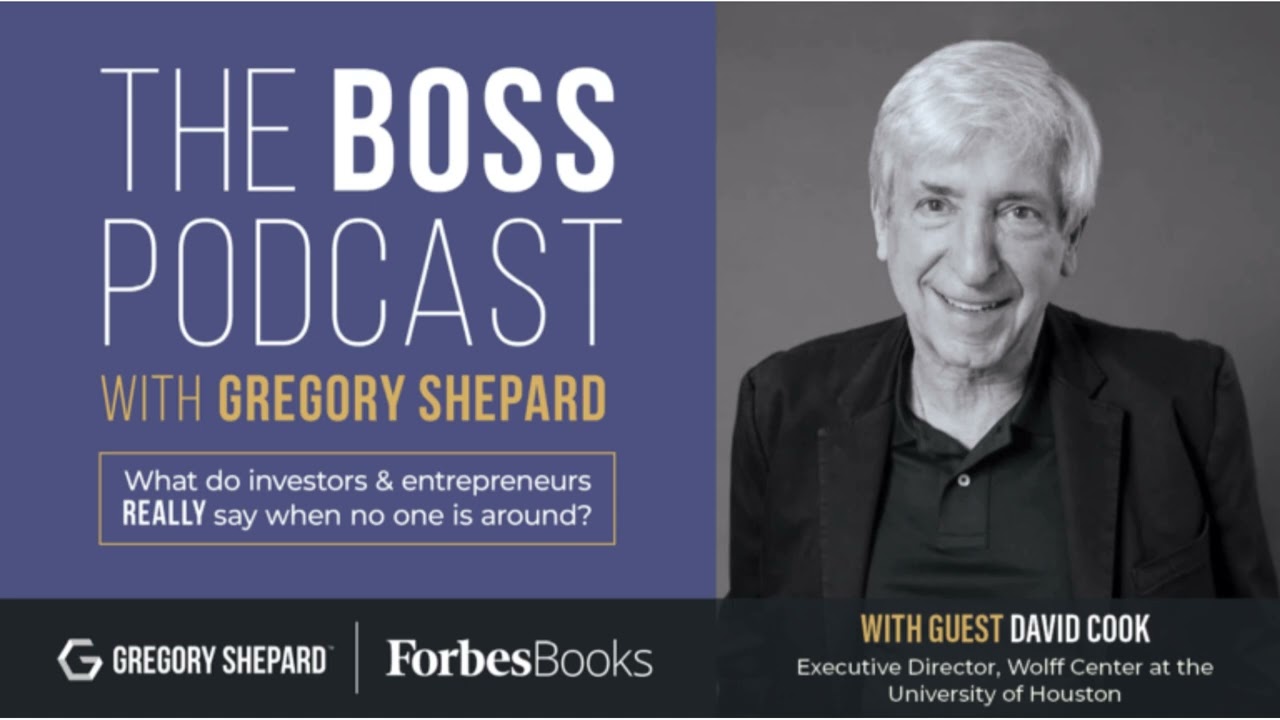
In this episode of The BOSS Podcast, host Gregory Shepard interviews David Cook, executive director of the Wolff Center for Entrepreneurship at the University of Houston. Cook explains how the Center earned the Princeton Review’s #1 undergraduate entrepreneurship ranking for three consecutive years by leveraging a 25‑year‑old, community‑driven ecosystem that pairs a small, highly‑mentored student cohort with over 500 mentors and a university‑wide culture that values integrity, purpose, relationships, action, and discipline. The conversation highlights the Center’s people‑first curriculum, which starts with personal character development before business ideas, and notes a shift among students toward social‑impact ventures. Cook outlines the program’s biggest challenges: lack of gender and racial diversity among mentors, limited access to major tech hubs and emerging technologies, insufficient funding, a need for stronger idea pipelines, and difficulty integrating AI, robotics, and machine learning into the curriculum. He then details the 40+ hands‑on experiences the Center offers, including innovation projects in restaurants, IP commercialization competitions, the pop‑up “Wolf Fest” restaurant venture, Empowering Women Out of Prison (EWOP), summer camps for local youth, and mock term‑sheet negotiations with real lawyers and accountants. Faculty members are active entrepreneurs who co‑teach and directly support these activities, blurring the line between classroom theory and real‑world practice. Cook shares his own entrepreneurial path—from a food‑brokerage business to technology commercialization at Texas A&M—and how mentorship became his calling. The episode closes with a discussion of the Center’s “Living the Dream” culture, symbolized by student photos and a plaque celebrating a graduate’s dream, underscoring the program’s focus on personal growth, community impact, and lifelong mentorship.
Chapters
Gregory Shepard, an entrepreneur who's built and sold 12 businesses, a recipient of 4 private equity awards, TEDx speaker, and Forbes author. This is The Boss Podcast with Gregory Shepard.
On multiple occasions, we've discussed what academia is doing to improve the entrepreneurial failure rate. And this week I wanted to highlight one of the best in the country. The University of Houston's Wolff Center for Entrepreneurship has been named the number one undergraduate entrepreneurship program in the United States for 3 straight years. So how did they pull off this great feat? Joining me this week is the program's executive director, Dave Cook. Dave, welcome to the podcast.
Well, I'm delighted to be with you, and thanks for having me, Greg.
Well, let's dive in, Dave. We have to start with this incredible achievement. Uh, the Princeton Review ranked the Wolff Center as number 1 in undergraduate entrepreneurship programs 3 years in a row. What's in the water there in Houston? How are you pulling this off? What's happening over there that gives you the ability to rank number 1 3 times in a row?
I think it's a long runway for us. We have started this 25 years ago. At a time when it was uncertain whether or not you could teach entrepreneurship. And so over the years, we have created a culture here in the university, and we're lucky enough to be in a city where entrepreneurship is revered and where lots of people come out of the woodwork to help us do it. So if, if our success is more a reflection of our community and the stakeholders than it is anything that we personally are doing here, for instance, you know, I've got a cohort class of 38 students, and last year we had 544 mentors come and work with these kids. There's no place else on earth. that you're going to have that energy and commitment from mentors working with a small cohort. It is a long runway, something we've built over the years, and it is now spreading in the university to where last year we educated over 3,100 students who are taking some course Wow. Good students, good community, and a very supporting university.
So we talked about this a little bit before we started the podcast in terms of, you know, my mission and your mission are very similar in helping these entrepreneurs be successful. And what I'm wondering is what sets the Wolff Center apart from other entrepreneurship programs across the country?
We have a more holistic approach that when we look at the major ills that have befallen our society, our nation, they aren't because people weren't smart or they didn't have good business plans or models. It's because somewhere along the line, the people lost their direction and that their integrity was compromised, and so forth. So our mission is to create the next generation of entrepreneurs with the highest integrity. That's where we start, highest integrity, who can think, lead, and connect. And when you do that, it creates a whole different dimension of what you're trying to do with students. You are putting them in leadership roles. You're worrying about their ethical choices. You're worrying and concerned that they have people around them to advise them and to sort of be there when the question is, do I pay payroll taxes or do I make payroll? That there are people in their lives and support around, and that to the best we can, we simulate those experiences and those hard choices. But that's our difference. We start with core— 4 core values. You got to have purpose in your life, relationships, action, and discipline. There's 16 behavioral competencies we put under that, and we build curriculum around it. But by the time a student leaves our program, yeah, they've got everything that a typical business school would give you— marketing and accounting and presentation skills. But they also, every one of them, will have led a team. They also will have done a myriad of assessments. They'll know themselves. They'll know who they are on a team, and they'll have the ability to create visions and/or plans to get ideas into markets. And, but it's the human side that I think that differentiates us most.
So you start out with the person. And then you move into the business instead of starting with the business and moving into the person.
Absolutely, and what we— there are a lot of places where you can go and say, I want to study entrepreneurship, I want to do case studies, I want to do whatever. We absolutely, Greg, start with we're concerned about you as a person, and we're not particularly concerned with the idea you have. We want you, when you leave this program, to be able to take an idea 5 years from now. If you bump into a great idea, that you will have the confidence, the ability, the relationships to get that idea and take it into market. So yes, absolutely, we start with the people.
So you began your mentoring work in the University of Houston in 2007, and in 2 years you became the director of the Wolff Center for the mentoring programs. What are some of the changes that you've seen from student entrepreneurs in the last 14 years?
It's been an interesting flow. I mean, there it is, a reflection, I think, of the economy and the culture and But we are a reflection of what goes on in the country, and for, you know, when I started, it was all of students coming in wanting to become wealthy and wanting to sort of have a big splash. More and more as time has gone on, there's a social element to the people that come into our program. It is not enough to make a bunch of money. They want to make a difference, and so when we, when we take our program, we accommodate that sort of duality. When I started a number of years ago, a young lady came in and said, I want to start a company and I want it to be a nonprofit, and, and the director and I at the time said, hey, we're here to help you make money, not to And now, so she promptly went out and did it anyhow, created a great company, Good Sparrow, which does wonderful work providing documentaries for nonprofits and so forth, but that whole world now, it's table stakes that you're going to do something good in the world and that you're not in it for yourself, and that has been the most dramatic shift That I think has occurred over time.
Yeah, that's interesting. I've seen the same thing. It's a lot of even on the investor side, you know, you see social impact sort of investing and social impact entrepreneurship. I think that I agree with you 100%. It's definitely changing, and I think that's a great thing. When you look at entrepreneurship and the value of entrepreneurship to not just small businesses, but to cities, states, even the country itself. When you're teaching this, what sort of values do you see after the entrepreneur is out there and building a business that you think directly reflects, you know, in terms of contribution to cities, states, and neighborhoods?
The guy who is the name that we're named after was a guy named Melvin Wolfe, and he had created Star Furniture here in Houston, and he began working with our students and fell in love with the work that we do in this character development idea. The Wolfs sold the business to Berkshire Hathaway, and because of his friendship with Warren Buffett, I got to take the students every year to go spend— have lunch with Warren Buffett in Omaha and so forth. And when we were touring that His office is up there. I think at the time he had like 19 people working for him. That was his organization. And so, you know, we have a guy, Brooks Bassler, who graduated from our program, who started BB's Restaurant, and he's got a payroll of over $10 million and hundreds of people working for him. And, and so when, when I look at this, A lot of what I look at is how many jobs are you creating? How many— not just financially, how are you making money, but what's your impact in the community? Are you creating good jobs with people who are looking forward to going home with their family at night and are paying taxes and are pushing innovation in a very healthy, holistic way into the community? So, you know, it is important to us that we not just look at innovation, but that we look at entrepreneurship as how it's going to impact not only the community, but the families and the entrepreneur himself in changing lives. And we believe strongly in that.
What are some of the biggest challenges your organization faces in supporting entrepreneurs down this journey? When you think back and, and you say, okay, well, our biggest challenges in getting an entrepreneur from I have an idea to I have a business, what, what would you say like the 5 top challenges are?
Uh, one is, uh, women. Uh, we, we do not have, uh, effective Role models or participants in our program, we need more women. In my opinion, a lot of the successful women are right in the middle of their careers and they're thriving. And to be involved with a program like ours in any capacity, to teach, to mentor, to be engaged with our program, is very time-consuming. And so as a result, we get disproportionately a great number of people who look like me, old guys who, you know, have the time to go invest, have kind of made their fortune and have their lives. So one would be clearly that I think we need women, and you could expand that to we need better diversity. We need We need to have people in our program and in our communities. You know, I have a young lady graduated from— Amanda Moya graduated from our program, went to work in the startup world, and is now working for Div Inc. here in town. And, and they are specializing in working with minorities and helping them start businesses. If we want to grow this diversity, it's going to take investment, and that is not only financial investment, it is investment in leaders and role models. So I put that over there. The second thing that I would say is we need to figure out where we are in relation to Boston and Silicon Valley, and we are not in the biotech game, and we're not in in the— we're not in Silicon Valley. And how do we create internships and how do we get into those 2 spheres is something that for people in the middle of the country and most of the country, I think, are some pretty big barriers. And so we're focusing and doing a lot of development activity, but it tends to be around small businesses and/or smaller-scale things that were not in the game out there. 3 would be financial. We need to get more money that when we see ideas, they're not being held to some— the venture capitalists of the world have got to be able to engage universities and tap into ideas in a way that they are more willing and eager to take a risk. That's particularly true with us as an undergraduate program. The 4th thing I would say is we need better ideas. We have great entrepreneurs. You can take a team of my kids and with an idea, send them anywhere, and they will compete with anyone. We had 2 years ago, we had a team that went to MIT and finished second in the competition, and this was clean technology contest. And the team that they won the competition were 6 PhDs from MIT. So even though we're an undergraduate program, because of the mentoring, because of what we're doing, we absolutely can compete with anyone. Well, What we need to compete is we need better ideas. We need access to emerging technologies, and we need the ability to and the investment of researchers to trust entrepreneurs. And right now, there's so many good ideas that are kind of bottled up as inventors are waiting for funding or grants. that if we can figure out how to unlock that, I think it would be a game changer. I think finally, there are— I think we're maybe a little slow to the party of the emerging world that's coming up in front of us. And you look at artificial intelligence and robotics and machine learning and all the rest of that stuff, stuff. I don't know that we are connecting different parts of the university and our business community to prepare us in a way that we can take that entrepreneurial energy and put it into what is coming down the road very, very quickly. We're in work with Intel right now. I just finished training course where we will be able to give certifications in artificial intelligence to get common people. Hundreds of thousands of people are going to lose their jobs as these forces come through the economy and being able to train them to deal with the cloud and so forth. So there's a lot of big forces that are moving through and And I don't know that we're doing a particularly great job of integrating entrepreneurship, the community, and the technologies together. So I'd say those are my top 5.
Yeah, I think it's dead on. I mean, if you start even from the beginning when you were talking about women-owned businesses, 10% of VC funds go to women-owned businesses, 1% goes to Black-owned businesses. So you already look at it and you say, okay, what percentage of The startups with $100,000 in funding are white-owned, 82%.
Yeah.
So, there's definitely a huge discrepancy between those haves and have-nots that are, you know, but they have the same ideas. You know, we all have the same hardware. We just have different software shaped from our experiences. And that sort of answers the next question I was going to ask you. If you were to wave a magic wand, and change anything or ask for anything to help out your program, what would it be? And it sounds like more diversity and more mentors with ideas outside of the ecosystem that you're in, more tech-savvy ecosystem ideas and that sort of stuff. Is that accurate, or would you like to add more to that?
No, I think that, you know, I think that's, that's it. I mean, that if you can put the pieces together The other thing I would say is I need better people. I need every class. My hope is that they will be more driven, more passionate than the class before them. I hope that every professor that comes in here will be better than the ones, and that, I mean, the world is changing out there rapidly. This COVID thing is, I mean, I think in '21 there were, you know, 4 or 5 4.3 million Americans went out and opened businesses, and a lot of them don't know what the hell they're doing. And so being able to kind of provide resources for these folks and to take that energy that people want independence, they no longer want to necessarily go and sit in an office from 8 to 5. And to kind of recharge the American dream that you can start a business, you can be your own boss, you can make a difference in the world, you individually, is something that is, if we handle it right, we're in a very, very good time as a nation to reconnect with that spirit.
I couldn't agree more coming from that background myself. You know, I've done 12 startups and, you know, I came from nothing. So it's definitely a dream that can be achieved. And on that note, let's take a break. But coming up in the second part of my discussion with Dave Cook, the executive director of the Wolff Center at the University of Houston, Dave talks about what he's most proud of.
I mean, it is an amazing program that When you look at that number one, there's so many great people who come here and invest their lives in changing the lives of students. Learn more about the BOSS Business Operating Support System at bossstartupscience.com, or you can reach Gregory Shepard at gregoryshepard.com. This has been a production of Forbes books. Gregory Shepard, an entrepreneur who's built and sold 12 businesses, a recipient of 4 private equity awards, TEDx speaker, and Forbes author. This is The Boss Podcast with Gregory Shepard.
Welcome back to my conversation with Dave Cook. The executive director of the Wolff Center at the University of Houston. We've been talking about why his school was named the number one undergraduate entrepreneurship program in the United States for 3 consecutive years. Dave, when you think about your entrepreneurship curriculum, I'm interested in understanding what hands-on activities you incorporate into the program. Can you break down what they're doing more tactically versus strategically?
Yeah, I'm not sure we have enough time to do it. I will tell you that we're running 40 programs outside the classroom. I can take you— I'll try to do it quickly. When you come into my program, you do an innovation project. You got to go to a restaurant, find a pain, find a solution, go, and tomorrow night the class will be— 10 teams will be pitching their solutions. In April, the University of Houston opens their intellectual property portfolio. They present them to my teams. My teams pick the 2 they want. Over the summer, they do sort of a technology assessment report. They pick the one technology they want to go forward with. In the first week in December, they pitch it to VCs. If the inventors, the university, and the kids are happy, They form a company that has the exclusive rights to that technology, and they go compete in business plan competitions raising money until they graduate in May. We're in the process of an event called Wolf Fest, where every kid in the program will go out, find a sponsor. They'll operate restaurants for pop-up restaurants on campus for 3 days. Right before COVID In that 3-day period, the last class raised $311,000. That money funds our retreats, funds our trips, and so forth. You know, where I want you to kind of hear is that you can go a lot of places and study entrepreneurship. If you come here into my program, you will be an entrepreneur, and you also learn how to give back. We had a couple weeks ago, we graduated our first class EWOP, Empowering Women Out of Prison. So my kids get on a bus, we go over and work with women in prison in over by Austin and in the Lockhart Unit, and every one of these 100 women has a business plan that they want to— when they want to leave prison, they want to open a business. So They don't have access to the internet, and so our kids do the research, try to do customer discovery and so forth, and come back and give it to them. We're running summer camps. Baker Ripley, great stories of kids who came to a summer camp when they were in the 11th grade who are now graduating from my program that are going to go back and teach the summer camps with Hispanic kids in the north side of town. You know, 40 of these programs, we do mock term negotiations. We go to a bank and, and we— you want to have the class in teams wants to sell the business, the other half want to buy it. You have real lawyers, real accountants, and you film it. And you see if you can do a term sheet and make a deal. Every kid in my program is on a dream team, and they are charged with having 100 dreams and having goals every semester to achieve those dreams, having a 5-year plan. Most of my kids, when they leave here, have a personal board of directors where they don't ever have to worry about hey, I wonder if I have a legal question, who do I call? Or an accounting question or a human relations question. And I think when you say what is your original intent was how do we lower the failure rate, it's that kind of infrastructure, it's that kind of texture around entrepreneurship that will shorten the time it takes to get you to where you can be successful by eliminating the mistakes that you would ordinarily make if you didn't have the mentoring, if you didn't have the experiences of being in these safe simulations, that I think we're sort of staking our bet on. That's how a good way to affect the outcome you're talking about.
So when you talk about like faculty and professors, it sounds like there's a difference between what the professors teach and what your program— your program is more, you know, on the street, meat and potatoes. This is exactly what you're, you know, more tactical. This is what we're doing versus the classroom is more strategic. Is that a correct way of seeing it? Or how would you separate the difference between what they learn in the classroom with a professor and what they learn in your— your program?
Yeah, your, your sort of assumption there would not be correct. We have a guy, Bill Bobora, who works for Third Coast Bank. He co-teaches the implementation class along with a guy named Keith Rassen, who was head of Houston Angel Network. That class implementation is Wolf Fest. So they bring people into that class of here's how to raise money, uh, here's how the operational aspects, and all of that teaching in that class then gets put into place when we do this 3-day startup. And everything that you learn in the program then kind of is a showcase for that. Do you know how to handle the operations? Do you have the financials under control? Do you— did you get the fire marshals to sign off on your operations? On and on and on. And you do it in a way where that professor is absolutely a coach, not only setting up, here's how the accounting systems are going to work, here's how the software and credit cards integrate into all this, but you come away with it Where seamlessly what you're doing in the classroom flows directly into what you're doing in the, in the, in the pop-ups. The same way when we do the intellectual property, that is the basis for when you do your financial work, when you do your marketing work, that is the classroom that then flows into the competition in December. So, and the professors are not like, hey, I'm the academic professor and that's the entrepreneur over there. Every one of our professors is an entrepreneur, has been there, done that, and are intimately involved with these 40 programs that are operating outside the classroom. I mean, it is an amazing program that when you look at that number one, there's so many Great people who come here and invest their lives in changing the lives of students, and you know, as you point out, I've been doing this a long time, and I— when kids leave my program, I sit with each one for an hour, and over the course of all these years, 100% of the students say this program has changed their life. Well, it changed their life, yeah, educationally. But it also changed their lives in terms of the relationships they have, the mentors they have, the confidence they have to go into a bank or to stand in front of a bunch of investors and make a pitch. And I think that's what I'm most proud of is, yeah, we have a great program here, but I'm proud of the commitment that students in my program make to really come here and change their lives.
Yeah, that's a really unusual thing. I mean, I speak at universities and do curriculum for them and all this stuff, and, uh, I— it's really rare to see professors teaching classes that have actually been real entrepreneurs. Um, that's very unique, and I can't tell you how, how much I can commend the university for that. That's incredible. Most of the time you don't see startup-oriented classes taught by accomplished entrepreneurs. What you see is People that understand the theories and are teaching the theory. So, I think that that's amazing. And I hope that the listeners are paying attention because if you're in that neck of the woods or want to go to an area that actually has real entrepreneurs teaching real entrepreneur classes, this sounds like the place to go. I'd like to step back and talk to you about your own entrepreneurial journey. What were some of the most important stops you had along the way? As you were making it on your own?
Yeah, so I had— I went to work for Scott Paper Company years and years ago with an intent of when they interviewed me, I said, I want to go to work here for 2 years, learn how to sell, and then I want to go start my own company. 15 years later, I finally went out and started my own food brokerage business, and that morphed into supermarket consulting business that I ran promotions all across the country and the world. And, um, and then it, uh, and that really was led me into a bunch of startups all around the supermarket industry where we would have exclusive rights to a private label line, create a company around it. We received an asset of a company, uh, supermarket went out of business. We got a $10 million milk plant that we would take over and figure out how to do it. And that led to me retiring. And the first time I retired, a friend of mine was head of— he was the chancellor at A&M and said, would you help us look at setting up a technology department up here? So For a couple years, I worked with A&M helping them set up their Office of Technology Commercialization, and they had figured that they had given away like $4 billion worth of technologies by people just publishing it, and now it's turned into a 2-story building up there that's chugging along. Guy Dietrich and John White were the 2 guys that were, in my mind, instrumental in totally changing that. And then they wanted me to stay. Do you want to stay and help change the culture at A&M? And I said, I'm not, I don't think I'm going to live long enough to change the culture at any university. But I came to the University of Houston with no intent other than mentoring a student. Who do you want to mentor? Well, I'm big into entrepreneurship. So that's how it started. I had retired and just wanted to mentor. a kid, and, and then here I am, you know, years, years later running a program that is being driven by incredible students, incredible stakeholders and mentors, and it's been really a good ride.
Yeah, I mean, you live a great story, that's for sure. And one of the things that I noticed is that the walls of your office are papered with photos of students. And you've got a large sign between your desk and the wall, and it says, Living the Dream. Can you tell me a little bit about that? I think that that's just so cool and insightful of the culture that you've created.
Well, first of all, the pictures are a constant reminder of why I'm here. It is awful easy to get distracted, particularly in a university, with let's raise money or politically, or, you know, there's a thousand things that go on here. In a university, and this is a constant reminder, this is the only reason I'm here. This is what my life is about, is these students are, are why I'm here. And so it also is when I bring people into this office, it's a testimony that we don't have first-place stickers all over the walls and we don't have trophies around. We have pictures of students, and that's why we're here. The second part of your question, which in, in this case has to do with living the dream, is that we do believe in living the dream. And I got this plaque that you referred to. I ran a summer camp, and in that summer camp, I had 700 applicants from all over the country, and I took 30 kids. And these were juniors in high school. And so at the end of it, you know, come on, you're coming to the University of Houston and let's rock and roll. And these— so many of these students said, hey, would you write me a letter of recommendation to get into Stanford? Would you write me a letter of recommendation to get into Yale? And I would write these letters of recommendation. But, but in my own mind was, you're not going to get a better education in entrepreneurship than you would here. So anyhow, one of the students who went through the program and asked for a letter of recommendation, I wrote it and he got in the university he wanted to. And he sent me this as that had been his dream to go to that university. And so as a way of thanking me, he gave me this plaque. And his letters on the back of that plaque, but it is what we live here is that you can live your dreams if you have integrity, relationships, purpose, and you're good at something, you're competent, and you're in control of your life. You can live your dreams, and it is it is that one plaque. That's the only plaque I have in my office along with. pictures of the students, which I think is a pretty good summation of what we do here.
Wow, what a great way to end the podcast. Thank you so much for joining us. I really appreciate it. Much respect to what you have accomplished, and thank you for sharing your wisdom with, with the audience. I appreciate it.
So thanks so much for having me, and best of luck to you.
Thank you. His name is David Cook, the executive director at the Wolf Center at University of Houston. And that wraps up this episode of the Boss Podcast. If you enjoy the show, make sure you take a second to subscribe so you automatically get updates when new shows drop. Also, if you have a minute, I'd love it if you left us a review so more folks like yourself can discover the show. I'll see you next time. Namaste, my friends.
Learn more about the Boss Business Operating Support System. at bossstartupsience.com, or you can reach Gregory Shepard at gregoryshepard.com. This has been a production of Forbes Books.
More from Gregory







Why you Might Want to Keep your Camera on During Remote Work Meetings | Minute Mentor


Same Side Selling | Ian Altman | Part One & Two | The BOSS Podcast with Gregory Shepard