What Investors Actually Want to See in Your Pitch Deck? | The Perfect Pitch Deck | Webinar
In this CINDA Thought Tuesday webinar, Gregory Shepard (CEO of BOSS Startup Science and BOSS Capital Partners), co‑founder Randall LeVeaux, and Head of Partnerships Marty walk founders through the nine essential elements that make a pitch deck compelling to investors and explain why most decks fail. They describe the startup lifecycle (pre‑seed to exit), the importance of market analysis, Ideal Customer Profile (ICP) and persona, Ideal Acquirer Profile (IAP), go‑to‑market strategy, key performance indicators (KPIs) and valuation drivers (growth, margin, retention), use‑of‑funds, product demo timing, and exit strategy. The presenters stress the need to understand the investor’s thesis, keep decks concise (8‑10 slides plus appendix), avoid overvaluation, and treat fundraising as a disciplined, data‑driven process. They also introduce BOSS Startup Science’s academy, which provides step‑by‑step tools and courses (e.g., the ABLE framework – Alpha‑Beta‑Launch‑Experience) to help founders build each deck component, validate milestones, and communicate progress to investors. The session ends with a Q&A on raising money before a prototype and a call to action for CINDA members to use the free resources.
Chapters
So I'm going to start. So welcome, welcome to CINDA, and today is kind of the Thought Tuesday. Usually we have these sessions on Thursdays and we call them Thought Thursdays, but this week we have a special event for our CINDA members, a virtual conference coming up on Wednesday and Thursday, so we thought we'd kick off that event with a really exciting topic from our partners, Boss Startup Science. And the topic has to do with the event that we're having for the CINDA members that revolves around startups and the startup nation of Israel and the startups that are there. And that's gonna be later this week. And we're kicking it off with The Perfect Pitch: Separating Winners from Losers from our partners, BOSS Startup Science, that we're very excited to have as a partner with us at CINDA. And I believe Greg Shepard, the CEO of BOSS Startup Science and BOSS Capital Partners, is going to be leading this session for us today. And Greg, I saw in your slides that you're introducing your team. So I won't do that. I'll just say that we're very excited to have you, and I'm going to stop my screen share so that you can put up yours. And yeah, really excited to have you guys, and please go to the chat, give us questions, and we'll just want to really have an interactive session today. So Greg, with that, I'm turning it over to you.
Thank you.
I really appreciate it. We'll start out with a little bit of background on me. I, I started building businesses about 25 years ago. I've done 14 transactions, 12 of my own businesses where I founded and drove them all the way through to an exit. Won 4 private equity awards for transactions between $250 and $1 billion. I've done 100 articles that are published in 25 international magazines. So this is like Forbes and Fortune and Entrepreneur and various magazines all around the country. I have a Forbes radio show and I appear on podcasts all the time. The other thing is I'm a TEDx speaker, Forbes author. I have a book coming out. at the end of this year. And I'm a Forbes Technology member and just got invited to a new council. And so, you know, I have this, this background. I wanted to touch on something. When I started building businesses, I didn't have any money. I didn't have any experience. I barely graduated from high school. And I have dyslexia and autism. And I was able to do this by putting together a process, a process that consisted of several micro and macro algorithms that helped me understand how to move through business. And that was the fundamental foundation of BOSS, something that— a process that people can follow to make sure that they don't land into the minefield that everybody else gets into. We spent about 5 years with 5 people studying why entrepreneurs failed and then added that to the equation as well as interviewing fighter pilots, Navy SEALs, fire department, police departments, CIA, and so on and so forth to find out how they handle emergencies and different processes. So that's my background.
It's always hard to follow Greg in the background arena, but my name is Randall Leveaux. I am a co-founder and CRO of Boss Capital Partners, our investment fund. As well as CRO and co-founder of Boss Startup Science, our academy and curriculum to help entrepreneurs mature through the startup lifecycle very quickly. So my background and experience is on the growth side— sales, marketing, service delivery, support, pretty much all of the revenue lifecycle. I have experience leading both sales and marketing organizations. I've been a CMO for many organizations. At one point, took a company from $100 million in revenue and within 3 years exited to Adobe for $1.8 billion. I started a marketing and sales consulting practice focused on startups, entrepreneurs, and private equity companies, so very familiar with turnaround, change management, cleanups. within entrepreneurs. And I'm also a contributor to BOSS, Business Operating Support System, on the go-to-market and exit strategy side. So a lot of experience there and very excited to share this topic with you. Of all the topics we talk about, the pitch deck and securing fundraising and preventing a company from running out of cash is one of our biggest topics and we get the most or give the most value. So very excited about today. And Marty is also on with us. Marty is our Head of Partnerships and Product Manager at Boss Startup Science. Marty has a ton of experience in Silicon Valley. He's been through, I believe, at least 6 exits. He's been on the founding team of several companies, worked as an advisor, mentor, and also has held several corporate positions dealing with customer service and partnerships. And so Marty's an invaluable asset here at Boss Startup Science and one of the key contributors to BOSS itself and the development of the curriculum.
It should be said also that Marty has used BOSS for over a decade, so that's another, another added bonus there.
And via our partnership, the CINDA members will, will definitely have a lot of exposure to Marty, so take his contact information down and reach out to him anytime. All right, so Greg, we are going to be talking about the pitch deck, and I know one of the reasons this topic is so valuable for us is the fact that we both have experience being an entrepreneur. requesting fundraising and being an investor handing out fundraising. So why don't you talk about why this is one of the biggest pitfalls for an entrepreneur and their success rate?
Well, you know, being an entrepreneur, you're always on the hunt for money. In fact, about 50% of your time to 75% of your time, typically 50% on average, is spent trying to raise capital. That's 50% less time in your business. After you raise capital, you spend another 40% of your time doing that. A lot of entrepreneurs don't realize that after you raise capital, it's just 10% less time managing your investors unless you educate and train them right. If you educate and train them right, then you can spend less time on that and you don't spend as much time trying to raise capital in the first place. The thing that I know is from being an entrepreneur and then being an investor now, Is that the majority of the time I probably look at about 100 deals a month. And the majority of the time, both in my interviews and my own personal experience, the entrepreneurs don't understand that the investors don't understand what they do. So a lot of times, and I'm probably 80% of the time, I get on the phone with an entrepreneur who has a deal and they start using industry jargon. They start skipping over important pieces, and you have to understand that you have to be sold yourself first before you invest in anything as an investor. And so that means you have to understand it, and you have to understand it clearly. So a lot of entrepreneurs, they're so quick to try to get through the deck or get to certain areas of the deck that they miss the most important thing, which is making sure that the investor understands their ecosystem. and where this entrepreneur is in the overall ecosystem. So when you look at the ecosystem, you put it all together and you say, okay, here are the players in my universe and here's where I sit into that universe and how I interact with those players. This is, I can't, no investor's gonna invest in anything that they don't understand. Just start with that. There's just no way somebody's gonna invest in something they don't understand. So your first objective is to make sure that they understand what it is that you're trying to do and the outcome you're after. So, you know, when we look at the data, you see that about 1 out of every 10 investments actually succeed. So you have a 90% failure rate. So as an investor, there are 2 types. There's the type that makes very boutique investments into things they know are going to work, and there are the majority, far majority of them that count on 1 out of 10 working and paying for the 9 that didn't work. And so to understand that as an entrepreneur is very important, that you're sitting there and you're trying to say, I can be 1 out of the 10 out of that. And this is really important to understand. They know not all of them are going to fail. And for you as an entrepreneur, it's very important too. You're just a number to them, but you may have your whole life in this thing. So you need to be very particular about who you choose as a partner, an investment partner. Second to that, you have to understand that the investors are looking to 2 to 5x return in about 3 to 5 years on a typical basis. So they may tell you that they're in it for the long haul, and they may tell you all kinds of things, but the fact of the matter is an investor on average is 40 to 50 years old. and they can't do a 10-year investment. They won't even be around long enough to experience the benefit from that. So you want to limit the amount of time so that they can see that the exposure of their cash being in the market is over a shorter period of time. And the CAGR, the return over time that they get from the investment is less if you compress it into about 5 years. A 2 to 5x return is really important and it's even more important that you understand valuation. So if you say, for example, that you're coming in at a $1 million valuation, raising $2 million, so you have a $3 million post-money valuation or £3 million or £3 million, whatever currency, euro, it doesn't matter, right? Whatever the currency is, you have to understand that they think that that's going to be 5 times that. So for every million, it's actually $5 million. So you have to be very careful that you don't get overvalued. This is very, very common. You may be in your first round starting out at a $5 million valuation in pre-seed. By the time you get out to your A round, you're gonna be overvalued. So this is very, very important. We're gonna talk about your IAP, your ideal acquirer profile, which sort of offsets your risk there. The validation points are really important. So to make sure that the investor understands the cycles, so the cycle starting with pre-seed, seed, Series Seed, A, B, and so on, right? The reason why is because there are certain areas of validation that are important at certain points. In the beginning, you're validating your vision. Then you have a proof of concept and you're validating that you have an MVP. Then you start going to market, you get paying customers, and you're validating your Series Seed and so on. So it's important that you make sure that the investor and you are on the same page when you're talking about these validation points. It's extremely important.
And the other thing— The investor may not be an expert in your business. They're an expert in investing, and they know the life cycle of a company. And through either their legacy previous experiences or or seeing things that they've seen as current trends in the market, they have an expectation of where you are in the time that you've been in business and what you're doing with the business. And so Greg called these out, some very important key milestones that investors thinking about. Do you have a product? Is it an MVP product that your ICP, your ideal customer profile, can use? and will provide retention for? Are you generating revenue? Have you gotten to the point where people are now paying you for this service? Are you at profitability? Have you covered your burn that it takes to run the business so you can now be profitable having to have less— you're not focusing on the investors as much. You could do it with your own cash. And then the last one is to exit. Are you starting to look at your potential acquirers and are you positioning the company to be sold to an acquirer? So by using these maturity milestones, saying what round you're at and where you're going in your maturity is going to help the investor understand where you're at and what the life cycle of the company should look like.
And to understand the type of investors that you're talking to. If you're talking to a more active investor that's an angel investor, they're going to understand some of these things. If you're talking to a later-stage investor, they understand numbers. That's the black and white, right? So they come in and they're looking for KPIs, they're looking for performance drivers, valuation drivers, things that are going to show that what you're saying early on is obvious in the numbers that you present later on. So you have to be careful what you say in the beginning because you're going to be held to those things later on. A lot of investors, a lot of investors, including me, will look at a deal early on, have a conversation, and then come back to it 3, even 6 months, even a year later, and then pull up the old numbers to see if the, if the business is performing as planned. So this is extremely important. The other thing is that these, these common questions that these investors ask And what I see the failure points all the time are things that have to do with the IAP, so ideal acquirer profile, the go-to-market strategy, the exit strategy. It's surprising to me how many entrepreneurs don't understand that when they go into a business that the investors don't get their money unless you exit, and they don't get their money until you exit. And in between then, that money is placed, meaning it's not making money somewhere else. As an investor, your money works for you, so you put it to work. Typically, we just say we're putting it to work. You put it to work, it's supposed to return something back. So one of the elements that have to do with this is, what are you doing and why are you doing this business? One of the things that I always ask entrepreneurs is, how did you get involved? There are different types of entrepreneurs. There are subject matter experts. These are people that are in a space, see a problem that only they can see because it's an inch-wide, mile-deep opportunity. Those people are different than visionaries, those people that see a broad market and want to take advantage of an opportunity. So those are different. The other thing is that there are businesses that are saving money and there are businesses that are making money, and the economy can be a tailwind or headwind depending on where you are in that world. So if you're in a market where the economy is declining, you don't wanna be selling and make money, take advantage of an opportunity type of product. You wanna be selling something that is saving money because that's what the tailwind is at that moment. So understanding the ebbs and flows of your market, when it's appropriate to raise money and how to message it is extremely important. That narrative that you talk through, the talk track that shows passion. One of the things on that topic that's really important is that A lot of times, a lot of entrepreneurs just give up or they're not willing to work as hard. And if you're an investor, you have to put yourself in our shoes. You put $1 million into a deal and the entrepreneur just decides they're done. Now you're in a bit of a bad situation. The market analysis is really important to understand what the KPIs or valuation drivers are surrounding the market analysis, TAM, SAM, SOM. And your acquisition costs, you know, your— the amount of money it costs you to acquire a company and the amount of money you're going to make from them, and what kind of demand type. These little components give the investor a worldview on the ecosystem that you're operating in.
The ideal customer picture too, in terms of the opportunity, right? And a lot of the things— and we kind of moved through this a little quick, but The common questions from skeptical investors, the hardest questions to answer are likely the easiest ones, right? And that's because people overlook it and are not diligent and disciplined in the must-haves in order to paint that picture of the opportunity for the investor. So as you look across these 9 elements, these aren't all the elements that are included in a pitch deck, right? You're going to have your founding team in there. You're going to have a little bit about your vision. A lot of that stuff is important as well. But from our perspective, these are the 9 things that entrepreneurs often get wrong, don't follow through enough on, or don't provide enough supporting data and information around that leaves the investor to be skeptical.
Yeah, we're giving you the things that you need. These are the landmines that everybody steps on. So when I'm looking at a deal and they go, they don't have an ideal customer profile, Well, I know that most, most acquisitions are because of a strategic, right? There's some synergy between 2 companies and that's why they buy you. Usually those synergies are customers, meaning they have 50,000 customers. You've proven that you could get 100 of the same exact customer. So they see an upside in acquiring you because they've already absorbed the customer acquisition costs for their customers. And now what they need to do is grow their lifetime value Thus growing the CAC to LTV ratio. So if you don't have an ideal customer profile, you already, you're like, well, how is there any alignment with this acquisition strategy? It doesn't exist because you don't share, you don't even know what your profile is, let alone your acquirer's profiles. And these are done in user stories. So I am so-and-so, I work at such-and-such company, I'm trying to do this so that I can that. That's the simple story, right? So I am persona, I work at ICP, I'm trying to so that I can. That's the format. If you can answer those questions and put those questions in your deck, it's a very easy way to convey the problem, solution, and impact description, feature, and benefit stack to an investor quickly, because they want to hear the user story. Now, The persona analysis is the person you're talking to. The ICP is the company that you're talking to. So the reason why the persona is extremely important is you have a lot of scenarios where you see these startups come in and they're solving a huge problem for the ideal customer, meaning the company that they're selling to. But they have to get past the persona. They have to get past the person in order to make that happen. Oftentimes that person either is at risk at losing their job, or it's a lot of work to put your system in play with that business. So you're essentially causing the persona work. So even if it's really good for the company, that doesn't mean you're gonna be able to sell anything to anybody. You have to get past the person, the persona. So that means you have to understand them. So once again, you have these user stories that allow you to understand who this person is. Is this gonna help them? Is this gonna hurt them? Is this gonna be extra work? Is this gonna be scary? What's their fear? Do they have to go to their boss and get a contract signed on? Do they have to go get budget? Is a bunch of— are a bunch of people gonna lose their jobs? It's just hard to understand. These things are really important. A lot of times I see entrepreneurs that have an incredible solution, but they can't get past the persona and then they fail. So it's really important to put those 2 together. The competitive analysis is part of the ecosystem. And what you're trying to learn is not necessarily who directly competes against you, but what are the other options that your ideal customer has available to them, which includes do nothing, right? Keep things exactly the way it is, or go with another solution. And if there are other solutions, what are they doing? How are they approaching the prospect? Are they— what's their narrative? How are they speaking about the problem? So on and so forth.
One of the best ways to do that is to quantify the cost of doing nothing. And there is a number associated with that, you know, doing nothing or the status quo. And yeah, there's definitely a lot of work that entrepreneurs could do that is available to them without having to go do extensive interviews that can understand this competitor.
There's ways around this persona problem. But if you don't address it, if you don't know that it exists, the investors are going to know, right? These things, remember, these are things that people miss, right? Like their market analysis. They have the market analysis, but it's missing pieces and it's not validated, meaning they just pulled numbers out of nowhere. There's no sources. How do they know it's true? So on and so forth. The ICP— I rarely see ICPs in DEXs. I mean, like 1 out of 100. The persona, I never see. The competitive analysis, I see, but a lot of times it's leaning one way or the other. So what they're trying to prove with the competitive analysis is they're the best thing instead of that they understand the space. It's more important that they understand the space. It's just like when somebody says, oh, give me a reference when you're finding a job. Of course it's going to be a good reference when you call. So everything in the deck, of course, it's going to be convincing that your business is the best. We as investors aren't looking at that. What we want to know is if you know what you're talking about. If there are competitors, that's fine, and to a certain extent, that's validation. But if you don't address it, or if your whole stack is just, we're the best, we're the best, we're the best, it just shows that all you were doing is putting together a slide to prove that you were better than everybody else, not that you know what you're doing. Or that you understand the ecosystem. And if you move it—
building a supportable case too, because as you look at this market analysis, not only are we determining what the total addressable market is with the TAM, but we bring it down to the SOM. Okay, what could you realistically do today based on the annual contract value, based on the growth rate of the market, Right? The growth, the market should be growing at a certain percent and your competitors should be growing at a certain percent. One of your benchmarks should be, and one of the identifiers of a well-built company is one that is growing faster than the market and faster than their competitors.
Mm-hmm.
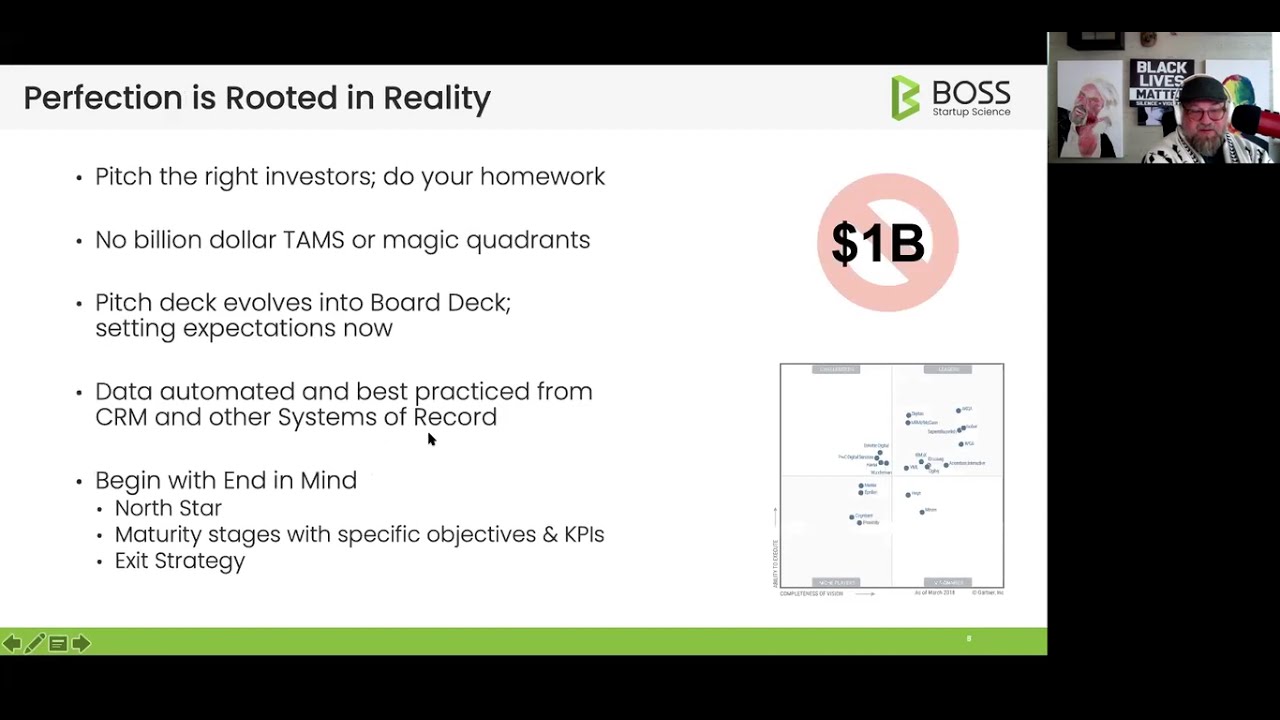
Also, when you understand this, you get rooted in reality with what the actual opportunity is for me based on how much of the market is already captured, how much the market is growing, how much greenfield space there is, I could now start to paint a picture for the investor that this is an attainable number that we can get to in X amount of years. But I also wanna be looking through the segmentation of that revenue. Is it all gonna come from the same type of ICP, meaning maybe a mid-market or enterprise account, or do I have multiple segments where I can go after SMB potentially? So when you start to build the deck like this and put all of this data in there, you're pulling the investor along with you to build a believable and defensible story as to why you can be successful, not just painting this rosy picture of my TAM is billions of dollars. And if you look at me compared to my competitors in this magic quadrant, I'm all the way in the upper right-hand corner, even though I really haven't sold anything yet or haven't gone to market. That's not going to inspire confidence for your investors.
The other thing is the ideal acquirer profile. And an ideal acquirer profile is just like the ICP. It has the ICP and the persona inside of it. So this is who's going to buy your business, why are they going to buy your business, when, how much. All of these things are— you can find out. You can go online and you can search and you can find out what acquisitions this company had made in the past. How much they were for, what sort of approach they have. There are very obvious patterns. You can see if they're doing a walled garden approach, you can see if they're doing a roll-up, you can see if they're trying to isolate a market or if they're trying to fill in a gap in their overall strategy. So this is extremely important. A lot of times I'll see decks and I'll see here's the journey of the customer with regards to all the people in the ecosystem, and then I see the company that I'm thinking about investing in right in that path. Now that makes it work. The other thing is that, like I said earlier, if you're doing a synergy, which you should be trying to do because they're the highest multiples, making sure that your ideal acquirer's customer and your customer are the same. Big companies buy other companies to grow their lifetime value to the current customers they've already paid to acquire. So your whole business is just a product. Now, would you ever build a product without having a customer? So why would you build a business without having an acquirer? If you're an investor, you're thinking, how am I going to get my money back? When am I going to get my money back? And what's the return? And the plan for that to happen is your exit strategy, which includes your ideal acquirer— who is going to buy this business, when, how much, all of that stuff. So even if you're off on that, at least to the investor, you have a time horizon, You have a ballpark range, which is really, really important. It also helps you out with making sure that you don't get into a situation where you're overvalued. If you've done your research on your IAP and you can see that the pattern is that this— that your acquirers are buying companies for, let's say, $50 million, and you look at your rounds and the valuation, you can find out if you're going to be overvalued before it happens. In the last 3 years of a business, the 40% of the businesses that fall off the wagon at that point, a lot of them are overvalued businesses, meaning they raised money early on and they continued to grow their valuation. And they got themselves to the point where the investors can see that they're not going to get their money back because the company is already overvalued. Remember, if you raise $1 million If you raise $1 million at a million-dollar valuation, it's $2 million, it's $10 million to the investors. So if you're at pre-seed and you're thinking, I already have to sell my company for $10 million, and you've got 5 years left and multiple other rounds, you can see how quickly you can get overvalued. This is a very— number 6 is really, really, really important because all the investors are looking for this. Because it happens all the time. It's better as an entrepreneur to go in at a low valuation and then hike up your valuation based on validation points, which is what we talked about earlier, right? So every time you validate something, you go, okay, now I have a 20% increase or a 20-25% increase or a 30% increase, depending on what the validation point was and what you accomplished. This is extremely important. Now there are value Go ahead.
Just a heads up here for all of these elements. Boss Startup Science— and you may remember this from the last webinar— we have an academy that provides education and curriculum around growing, scaling, and exiting a startup. And we use a startup lifecycle to do that. What we offer in this curriculum are individual courses based on these specific topics that you're seeing right here. So each one of these numbers has a course associated with it that has a how-to video, an instruction manual, a tool that you use, and the tool helps prompt questions around these topics. And as you input your answers into that tool, You're sent a PowerPoint slide or 2 that encompasses your output from those questions.
Yeah, so if you go through market analysis, at the end you get a PDF in your inbox that says, here it is. So you actually do the exercise in the platform. Yeah, it's got best practices. I mean, it's got everything, right? We essentially wanted to make sure that if, if an entrepreneur went through one of these, and they're also set up so they're like 20 minutes, Some of them are a little more time, so there you can just drop in and hammer one out and get what you need and then go back when you need the next thing. It's designed for entrepreneurs by entrepreneurs. And you guys are all going to get free access because we're doing our alpha. So everybody gets— everybody on the call gets to get in for free and play with it and give us their feedback before we start charging. And when we do start charging, it's going to be inexpensive because the concept is to help entrepreneurs succeed. And a lot of entrepreneurs don't have a lot of money. So part of it is to make sure that it's affordable. I want to dive into the KPIs. So key performance indicators and your lifecycle are really important. So when you're talking about KPIs, the stack goes like this. You have a valuation driver. Valuation drivers are growth, margin, and retention. Okay? All the time in every business— growth, margin, retention. Growth— I can get the customers. Margin— I could do it profitably. And retention— I can keep the customers. Most of the time retention is going to be a huge value driver. And that's because growth is to be expected if they do an acquisition and they have the same customer. In other scenarios, margin is going to be lower than retention also because they're just going to squeeze out a lot of the costs and integrate them into their existing cost structure by— and that's going to just dilute the overall cost. So retention is your really, really important value driver. KPIs come in 2 forms. You have leading and lagging KPIs. A lagging KPI is anything that it's too late to do anything with. So financials are the ultimate lagging KPI. The way that your KPI stack works, and we actually have all the KPIs pre-written for you in the course, you just look at them, and is to make sure that your KPIs align with the functional areas and that all of that aligns with your value driver stack. So having a KPI for sales and marketing, which is one of your functional areas, service delivery, shared services, and product and engineering, having a KPI stack for each one of those functional areas that lead to the valuation driver, which is why those functional areas are designed that way, because you got to make sure everybody has a number on their head. So making sure that the KPI is there. Lifecycle is time too. So time to product, time to revenue, time to profitability, and time to exit. And this cycle tells you how far away you are and how you're trending towards that exit. This includes time to product and time to revenue. These are things that people don't usually think about, especially time to revenue. And what I mean by that is if you're selling a service, but it takes you 3 months to get through contact to contract, or 6 months to get from contact to contract, you need to account for that when you're thinking about the amount of money you're raising. 'Cause a lot of times I talk to entrepreneurs and they're like, yeah, we're gonna have customers on this date. And then they'll go, yeah, the product is available on this date, but there's a 6-month cycle time from contact to contract that they didn't account for. So right there, they're 6 months short on their cash. So it's important to make sure that you understand the cycle times, the amount of time there is from stage to stage. So it's contact to contract, contract to active, and active to cash. Because you could have 3 months of a cycle time or 6 months of a cycle time from contact to contract, and then from contract to active, if there's implementation, could be another month, and then to get paid could be another 30 or 45 days. There's a drastic difference if those things get missed in your cash. So it's very important to pay attention to those things. This leads us into funds and use of funds, right? So a lot of entrepreneurs, they say, okay, our use of funds is gonna be this percentage to this, and they have the pie set up and it's like, this is going there, is going there, but they have no data behind it and they don't support it with the investors along the way. When you communicate with your investors, you have to say, this is what we're going to do. And then along the way, you have to say, this is what I told you and this is what's happening. In other words, if you say 20% is going to sales and marketing, 20% better go to sales and marketing. The other thing you need to be aware of is that we can tell just by looking at your financials, regardless of what you say, where your business is. If I see a business is spending 40% of their burn in the product engineering sector, to me, they're still building their product. Even if they say we're done, to me, you're still building your product. Otherwise, it would be 40% in sales and marketing. So where you put your money tells us where you actually are. So it's not just for investor confidence and that sort of thing. It's also for yourself to understand, because the money tells the truth. Where the money is going, that's where the energy is going, and that's where the company is flowing. Does that make sense? It's extremely important that you understand this. Product demonstration. You need to be able to demo the product. And when I say demo the product, at whatever stage is valid. If you're doing If you're an MVP, just say later stage is gonna be this, right now we're selling this. You don't wanna be a waterfall company. A lot of these companies, they do analysis paralysis and they keep building and building and building and building, and they're just burning cash while they're building before they even find out if somebody's gonna buy it or not. You never know until somebody actually buys it. So you wanna be able to do a demo that's relevant for the stage that you're at in the cycle, and then show them what later things are going to happen and why that's relevant. It's also really, really important that you don't fall in love with your vision. You want to execute your vision until it's a minimal viable product, and then everything else should come from your customer, not from you. So many entrepreneurs, they think they understand everything, even if they're a subject matter expert. You don't know until you start getting feedback from other people. A perfect example of that is we're doing all these webinars and we're letting everybody into Boss Startup Science for free. Because that data is so valuable to us. The feedback is so valuable to us. It outlines the roadmap of future product development. So that's another thing to really pay attention to.
Next slide. There was a good question in the chat too about the order in which these elements should be covered. And to answer that question, we do advise that you use this order. Because of the story it tells. And, and when you look up at the top here, not only what you are and why you're doing it, right, that kind of sets the stage. The market analysis— this covers high-level markets. ICP analysis— these are the accounts that exist within those target markets. And the persona is the individual and the level of effort it will take to convert that persona within the account within the target market. And then everything else flows in order from there.
So yeah, go ahead, Randall. Sorry.
No, I was going to say it's okay to bounce around a little bit. Um, from our perspective, this is the right order, uh, to present this information.
Yeah, and if you are an early-stage company, you don't have KPIs, don't put them in there. If you're a later-stage company and you have KPIs, then put them in. It's also really important— one of the things that I just realized we're missing here is the go-to-market. I see very few decks that have a go-to-market. So these, these elements, these 9 elements in here are part of your go-to-market. The go-to-market is an aggregation of these things that says, this is— I know what I'm doing, I know who my customer is, I know what my buyer is, I know the person I'm dealing with at the company, I know who the competitors are, and I know what my KPI should be. And based on that, I'm designing a go-to-market that's executable. This is really important. A lot of people, they build go-to-markets, but there's nothing— there's no action items on it. It's all, we're gonna go do X, and X is a really broad thing, but there's no actual execution. The other thing is that a go-to-market strategy is not a sales strategy. A sales strategy is part of the go-to-market, but not the go-to-market.
Randall, before you move on, I have another question that came to me in the direct chat on this slide, so I think it's appropriate to do it now. Not just the order of these elements, but also the length of the pack came through. How long and how big should it be?
You design your deck so that you— I mean, 10 slides is like a typical pitch deck, but you can have an appendix. So you can have other slides if they want to dig. You can just go into the appendix and pull up a slide. You need to be prepared for that in the areas that they want to dig into. So if you're in a slide, you can ask the investor, would you like to go deeper, or is this good enough for you? They say you want to go deeper, go into the appendix, throw up the other slide, right? So some investors are going to be— depending on the stage in the lifecycle you're at, some investors are going to want to dig in more. So if you are at a stage where you are past MVP and you are in Series C, meaning you have customers and your KPIs are turning on, they may want to show the KPIs. So you want to pull them up. Here are the— here's the KPI stack I have for each functional area, and here's how we're performing. All of those things are always actual, plan, better or worse, right? So plan is enable, and that's a separate conversation. Actual is what actually happened, and better or worse is the difference between the two. So you're showing the investor that not only you know how to put out projections that are actually achievable, but that you're doing it real time. It's one thing to say, this is the goal that I set, and then show that you're hitting the goal every single time, than to preset the goals, make it transparent to the investor, and then show them that you're hitting the goals so that they have confidence in your ability to forecast.
Okay, 8 to 10 slides, no animations, no builds. Um, and, and typically, and I think Greg is the same, if it takes more than, uh, 3 slides to understand what the company does, why it's important, and how they make money, it's, it's not a good reaction after that because you're typically digging at that point.
Yeah, and when we get into the next slide, we'll talk a little bit about understanding the investor and who you're talking to. So this is the— this slide talks about, you know, making sure that you understand who you're talking to. Every investor has a thesis, meaning every group of investors invest into a certain kind of company at a certain stage, and sometimes in a certain vertical. And if you don't understand who you're talking to, you can waste so much time. I get all over our materials as we work with software companies, and I get Hundreds of deals that are outside of that space. And while I don't mind seeing the deal flow, it's certainly inconvenient for the entrepreneur. They're spending all this time following up and sending things out to an audience of investors that are just not going to invest in just because it's not in their thesis. So it's a waste of time. The other thing is that even if you get one of those investors and they don't understand your space, you're going to spend a lot of time trying to make sure they understand the space. And that time could be spent on people that do understand this and understand the space and the benefits of whatever you're offering. So it's— you have to be very selective about who you talk to in the first place. Find out what kind of companies they invest in. Do a little bit of homework before you get on the phone and start sending out emails, because there's nothing more than, you know, I have an email that goes out when they fill out a form and says, this is the kind of companies we invest in. When they go to the form, it says that. And then I get something that says, we're starting a pharma business. And I'm like, all right, already you're disqualified because obviously you didn't read anything I sent you. Even if I was interested, now I'm not interested because you're not paying attention and you're the CEO trying to raise cash. So it doesn't bode well. So you want to make sure that you pitch the right investors and do your homework on who you're talking to. The other thing is, is that about 0.1% of the companies that try to be a unicorn— I've written 2 articles on this because I'm so passionate about it actually succeed. Meanwhile, the other 99.9% actually not only don't make unicorn status, they fail altogether because they've set their company up for unicorn, meaning they're raising cash on a unicorn valuation and they get overvalued because they're not going to be a unicorn and then they're done, right? So this is a really important subject because a lot of times this is a one-way road. There's no out and back. You're down that path, you make it or you're done. And it's a very big risk to take. Unicorns aren't something that somebody says in the very beginning, this is going to be unicorn. If you ask the people that have built unicorn companies, they didn't know it was going to be unicorn. It did that on its own. So you should not be thinking that way unless the business tells you that it has that kind of potential. If you do, then investors are going to be running for the hills because they're going to look at this and go, this person is going to value this thing as unicorn and their eyes are way bigger than their brains. They have huge aspirations to do big things, but the reality of the situation is, is that 1/10 of 1% of the people that do that are going to succeed and everybody else loses. In that race, there's one winner. Everybody else is a loser. So be very, very careful about that. Make sure that you're paying attention to your TAM, your SAM, your SOM, and that you're realistic about what is there. It's extremely important that you're realistic about what's there. The next thing is the pitch deck evolves into the board deck later on. So what you want to do is you want to make sure that the data that you're putting into your pitch deck sort of dovetails into the board deck that you have later on. From the moment you start pitching an investor, from that very moment, You're building investor confidence, and investor confidence is what gets you follow-on rounds and what makes investors easy to communicate with. If you don't communicate with them, if you don't tell them what to expect and then show them that you're delivering on what your promises are, you're going to start losing confidence. You're going to spend more and more and more time working with an investor. And what happens when you spend more and more time working with investors? It's more and more time to make a mistake. And you can easily get yourself into a situation where you are overvalued, or you promised things, or you said things, and believe me, they're writing down everything. So communicate during— with email so you can think through everything. Make sure that there is a carryover, that one thing dovetails into another, and make sure that everything is actually actionable. Don't put something in front of an investor that you can't do anything about. That's just, just reckless. If you put something in front of there, you better have an action item that you can show the investor is going to result in the projection that you're promising. So the data— this data automation and best practice from CRM to other systems of record is to make sure that you have proof. So if you are running a sales channel and you don't have a CRM and you have it in a spreadsheet, I'm immediately going to go, what is this person doing? Doing sales management and customer relationship management is, is an intensive, complicated process. That's why CRMs exist. That's why companies like Salesforce are the biggest companies on the planet, because they're so important. So if you're ignoring that, it doesn't bode well for you. Most of all, starting with the end in mind, and this is what I've been talking about the whole time. Where do you want to end up? What does success look like to you? And then start thinking that way so you don't go down a path that ends up in the wrong place. You would never leave to go on a vacation or a holiday with your family without a plan. Why would you do that with a business when everybody's got so much at stake? Visualize, plan out the whole process, and then back into it and validate as you go along. The North Star begins with the end in mind. All this stuff is in the North Star, which you guys will see when you go in to take the courses. And the maturity stages are also in there. So are the objectives and the KPIs and your exit strategy. All of these things you have to think about before you even get on the phone with an investor. It's extremely important to make sure that you understand these things and you can explain these things to the investor in a very clear way, in a very short amount of time. And there's a trick to that. We don't have time for this. This is the principles. But that— it's all inside of the lesson. But it's, it's very, very important that you start with the end in mind. Remember, we don't get our money unless you succeed. So what we're wondering is if you're going to succeed, and if the answer is yes, that's one checkbox. And the next question is, if you succeed, what do I get as a return? Second checkbox. And when do I get the money back? Third checkbox. The fourth is What are the probabilities that this is going to work out in that order and with that stack, meaning you're going to succeed, it's going to happen at this time, and the results are going to be this type of a return? So put your, your mind in the eyes of the investor. It'll change your perspective. Think it's your money. Would you invest in your business when you go over your deck? Remove yourself from the situation. So you need to remove principle from position. Your position is where you are, and sometimes it's hard to see the forest through the trees. The principle is the, is the principle of the investment. If you had the money and you didn't know about your business and somebody went over this deck with you, would you make that investment? Very important. And if you are an entrepreneur and you haven't made that investment, it doesn't bode well either. Right? If you start a business and you raise money right off the bat and you haven't done any bootstrapping, you haven't raised money from anybody else, and you go to market, it doesn't show very well, right? Because you're saying, you're saying, I'm not willing to make the investment, but I'm willing to take your money. So it's, it's really important that early stage you can do, you know, there's a lot of funding websites now and angel money and all kinds of stuff that you can go out there, friends and family, Do something. Show them that you're— that you've got some skin in the game. Because from an investor perspective, we always think this way. We're like, this person could just walk away and go get a job, and I'm out my money, and they're out nothing. So it's very important that you put yourself in that— in that—
go ahead, Daniel. Again, these are all— everything you see on the screen here is available free to you via a course. in our learning management system, BOSS Academy. We're going to be sending emails out to all the participants and registrants from this webinar, and if there's any questions right now, we could address those. And while those are coming in, Marty, I'm going to turn it over to you, and Marty's going to kind of show you what the system looks like, just to set expectations for what the courses are.
Randall, we have a, we have a question from Himanshu. If you can unmute yourself, you're welcome to ask that question.
Yeah, thank you. Hello, everyone. Hello, my name is Himanshu, and I have this question. Let's say I'm working on a startup and looking for the funds. I have the idea, and based on that, we have customers and pre-orders as well, but we are working on the product. It's not actually ready. So can we approach the investors? Like we don't even have the demo or the product ready, but we have pre-orders and the idea. So just on that, can we approach?
Yes, you can approach investors before you have a prototype, like that's okay to do, but you're in vision stage, which means your valuation is gonna be really low and you want it to be really low. You know, the more you raise, the more you have to sell for. And this, this follows you around like a cloud. So you can raise money, just realize that you're in the vision stage and make sure that you set qualifications for your next round ahead of time. So you say, for example, I'm raising money to get to this point, get to that point, and then talk to the same investors. You can, it's just going to cost you a lot, you know, it's going to cost you a lot of equity. You can make it up though in the long tail. So maybe your first round, the valuation is low. I'm just using numbers here, so forgive me for that. But let's say the valuation is, I don't know, let's say $1 million, just because I'm not very good at math. Let's say it's $1 million. And now, after you get the product validated, and so what I mean by that, let me just dive into this just a little bit for you. In the beginning, you're trying to validate your thesis. You're trying to validate your idea, your vision. That's it. That's all you can promise to an investor. High risk, right? The second step is to validate the product itself, that you have a minimal viable product. During this period, which we call ABLE, there's a process in a process. During that process, what you're trying to do is you're trying to go from MVP, you're trying to go from there to alpha, from there to beta, and from there to launch. To provide an experience at the end to the consumer, to the customer. Once that you— once you have that nailed down, you can go back to the investors and you can tell them that you have gone through alpha, beta, and launch, and you have the customer experience nailed down. At that point, you're— you can start working on your go-to-market. So you just need to make sure that you understand the stage you're at when you're raising cash before you get to these certain points. There's a lot you're going to give away. If you do that that way, you're going to give away a lot of your company at the very beginning. It's best to get to a— just a minimal viable product or at least a prototype. If you can't get to a minimal viable product, just get to a prototype.
And so you'd be using that use of funds to build your product and get to product validation. And Boss Startup Science has a program that Greg was talking about, which is ABLE. alpha-beta launch experience. And that will really help the investors with their confidence to say, I know that I'm putting this money towards a product that's going to be built and tested the right way. So we know before we go to market and give them the next round of funding that the product is validated and we know it's going to be successful in the hands of our ideal customers.
Thank you, Randy.
Thank you. Before we move on to Marty, Just, is there anybody else who would like to unmute themselves and ask a question to do with the other deck before we go on to the demo?
No?
Okay.
That was a great question, by the way.
Okay, then Marty, it's all yours.
So I'll just spend a couple of seconds here. Uh, I know we've got not much time, which is fantastic, but we're going to send out an invite so everyone can get in here. You can see that checklist, what we're in the process of building out all of the courseware to address those things. And you can see what we're doing is here we're gonna talk about building an ideal customer profile. So what we've done, we think is a little bit unique where we are not only providing some general learnings where you have to, you know, Typically, you're going to sit through a session and pull out some nuggets. We're going to try to make this as fast as possible and get right to the meat of the issue. So we're going to describe here what an ideal customer profile is, how to build one, what's important— so what the investors are going to look for— and how it ties into your go-to-market strategy and ultimately your CAC to LTV ratio. Right. This is the basis of where you're starting. Then we're going to give you a video that will help you understand that. And on the first section, you can get that via audio as well, right? But then what we're going to do is, is take you into some practicum, because learning about these things are one thing, actually trying to put it together is difficult. It can be a struggle. So we're going to provide a little bit of a builder. And what you're going to do is go through and we're going to take you step by step Through building your actual ideal customer profile. And when you're done, like Randall said, you're going to have the output from this. We would expect that the output from this tool will change, right? What we want you to do is really get through the process of building it. And then you can circle back around and make adjustments, right? So I'm going to complete this. And we're going to give you a best practice so you can download this best practice and take your time and walk through it and do it the right way. And what we're going to reinforce throughout this whole time is when Greg was talking about the investor who is skeptical and wants to dig in, you need to have background information. You need to have documentation of what you've done. You need to be able to prove it should be repeatable.
Right.
This is not, we're gonna Google a couple of things and put it in a slide. We want someone to be able to take this away, believe in the story, demonstrate that you understand the market, and have them be able to test this on their own, because that's what really builds confidence with the investors. So I'm going to complete this and I'm going to get an output so I know where I'm at. And then I can move back into another piece that is important for my business. So we'll send out— this is free. Our partnership with Cinda is giving you guys access here. So we really appreciate Kimberly and Stephanie and everybody who's helped us get this information out to you guys.
And this is an exclusive free partnership through Cinda, right? So this unique offer to Cinda and We're just so happy to be a part of this association.
Yeah, well, we thank you guys, and we're really happy to be a partner. We're really excited about helping launch this here in Europe. And I, you know, we've— an hour goes by so quickly when we do things with you, so it's amazing. So I think just, you know, anybody else have any pressing questions, and right now, while we have Greg and Marty and Randall here with us? Okay, well, you're always welcome to reach out to them later, okay? And your, your contact is also on the CINDA website, so you can go to the CINDA website under the BOSS Capital section, BOSS Startup Science, and reach out to you guys through them, and we'll be sharing the participants list with you guys, and I think it's wonderful that everybody here gets to test this and be part of, part of the development of it. So, um, Steph, Vidi, do you have any closing words? And thank you so much again. Yeah, go ahead, Steph.
Thank you, everybody. I mean, just to say that, yeah, the, the, this partnership we're having is, is really a win-win, and, uh, we, we're just, uh, happy that, uh, you as CINDA members can benefit also from, uh, from some insights and some very tailor-made solutions for you. So I think this is very, very, very good, and we're really happy to be cooperating with the great team at Buzz Startup Science. I mean, it's great to work with you guys. And just to say that we're going to have a round of, you know, these regular webinars, and we already have planned the next one on June 10th, talking about exit strategies. So, Greg, I know this is deep in your heart, and this is really crucial for a number of— for everybody. So please tune in. We've already announced it on the CINDA website, and we will be doing some more communication on that.
One quick note, we together, and I mean all of us together, can fix this 90% failure rate. It shouldn't be like that. It doesn't need to be that way. When Boss Startup Science was created, it was created with that sole purpose. We can drop this, but we need to do it together. If you go to the website and you guys are going through the classes, and if there's anything that you're looking at and you're like, I don't understand, or what about this, just please tell us, because our mission is to help entrepreneurs succeed and drop that failure rate.
Great closing words. Randall, Marty, any last comments?
Just so excited to grow this relationship and partnership. Hopefully everyone here gets to see a lot of us, and I know people say that often, you know, reach out if you have any questions. We truly honestly mean that. Greg, Marty, and I all mentor companies and entrepreneurs. It's part of our passion and our individual missions, so nothing makes us happier than helping someone who's got a question. So please do reach out.
Yeah, okay, well, thank you everybody. And, um, next week we start with our CINDA Thursday Thought Leadership Series again. And as we said, June 10th we have the next series with Boss on exit strategy, and we look forward to having Everybody there, and thank you so much for joining us.
Thank you.
Thank you.
Have a very good day. Bye bye.
Thank you.
Bye.
More from Gregory







Why you Might Want to Keep your Camera on During Remote Work Meetings | Minute Mentor


Same Side Selling | Ian Altman | Part One & Two | The BOSS Podcast with Gregory Shepard