Harrison Rose - Bootstrapping To One Million Annual Recurring Revenue, With Zero Outbound
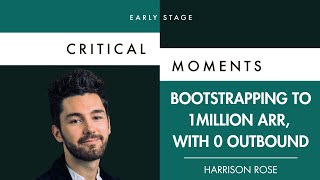
Interview with Harrison Rose about founding Good Fit — a bespoke data provider for commercial teams — and his journey from co-founding Paddle to running a bootstrapped company. He explains how Good Fit grew from data practices at Paddle, the decision to remain bootstrapped, current metrics (≈$1M ARR, ~20–30 clients, ~8 people), team building, founder-led customer discovery, cultural lessons from Paddle, and tactical advice for early-stage founders (ICP clarity, being capital-efficient, purposeful discovery vs. sales modes).
Chapters
Awesome. Harrison, thank you so much for joining. Give us an intro.
Yeah. So I'm Harrison. I'm the co founder of a business called Good Fit. Before that I co founded a company called Paddle. I ran it for about 10 years. Owning revenue, go to market strategy. Yeah. And happy to be here. Thanks for having me.
Awesome. So Taylors, what does Good Fit do? What's the business?
So GoodVit provide data to commercial teams, namely sales teams and rev ops. Unlike a lot of the data providers you may have experienced out there who give you access to this big data that you filter down from and try and find people to sell to, we build a bespoke data set for you. Basically we try and map the market of your right customer based on some criteria that you give us and then we give you all the context and enrichment on those companies. Again, it's all about the data that you want to know about them that's unique to you, essentially.
And why is that important for our businesses?
We actually, we realize it's important at PADDLE itself. Like the business was born out of what we're doing at Paddle. So Paddle now is like 300 staff, we've got 3,000 customers globally raised over 300 million do, most recently at like a $1.4 billion valuation, which we're all very proud of, whatever that means in maybe today's market. But we were using data in some quite interesting ways when we were going to market. I think some of that was because it was the first time I'd ever ran a revenue team, so just thought that was the way people did things. Turns out it wasn't. But we recognized the importance of truly narrowing in on the customers that were a great fit for your product. And doing so required really specific data that wasn't generic or available out there. And then the concepts really built from there and eventually became Good Fit. And we applied a lot of the principles and how we were using data at Paddle to now lots of other businesses like Clarity and Chili Piper and many others.
So what were the steps from using it internally at Paddle to then leaving Paddle to Good Fit? How did that come?
Yeah, it's an interesting journey. So we've been doing some quite unique stuff for data from the really early days at Paddle. Like we had a really tight criteria of customer that we could sell to, so we had to get quite innovative quite quickly. Outbound was our exclusive channel for the first five years of the business. We were growing at 300% year on year. Everything was going swimmingly. We continued on that track for a Long time. I eventually brought in a head of RevOps, a guy called Alex Berry. We hired him straight out of university. No experience, no nothing. Within about two weeks of him joining the company, he looked at what we were doing with data and a lot of it was being manually collected. And he was just like, this is rubbish. Like, I'm so bored. This is the worst idea I've ever seen. He's like, the data's awesome, but surely it's not my job to sit here and find this stuff for hours on end. And we had like a company hackathon, and he just like built a way to programmatically gather all of this data. And like, instantly I was like, you should probably just like hang out with me, like, stop, stop manually gathering some of this data. And then he very quickly moved from, like, what we were calling the lead development rep, this kind of manual researcher, into our head of RevOps. He had a team of like eight people. It was a real success story that we're super proud. And we got better and better and more programmatic and intelligent as to how we were gathering and using data over time. And it got to a point whereby we were going into fundraising and investment and the investors were more interested sometimes in what we were doing with data than they were PADDLE itself, which was a bit of a pain in the ass. But it got to the point where some of the investors effectively asked Alex to. They didn't explicitly ask him to leave paddle, but they definitely asked him to apply what we were doing at PADDLE to some other businesses. And it was just a great opportunity for him to go off and leave and run. Started by him leaving as our head of Revops. I was very happy for him, Very sad. I had to find a new head of Revops. So he actually left before me and ran the business for about a year. I was advising him in the background. Very brave. He did that in the middle of COVID And then I stepped back from full time from PADDLE last year, expecting to take a long break on the beach. But then when your best friend comes calling and asks you to come and give him a hand scaling and growing a new business that you're quite passionate about with your best mate, it's quite difficult to say no, basically. So that's how I ended up. That's ended up here.
Tell me about the impact that what essentially Good Fit has now become had on paddle. You know, in those days when you were growing 300% year on year, like what? Like what does it actually do for the business?
I mean, I Think it was the basis of pretty much the entire commercial go to market strategy. Even decisions we were making around what product we should build and why. Like, I think what's critical for any business effectively that's growing is to have a real understanding of their ICP and who their customer is. They need a real understanding of exactly how many customers are out there in the market that meet that criteria, that gets defined. And Good Fit will tell you exactly that. If you're interested in any company, say, hiring remotely, if you're like an employer of record solution, you need to know how many companies are actually out there that are hiring remotely because it's those customers you need to go and target. You need to understand that if there's not enough of those accounts, how do you change your product or roll out a new product range to go and decide to do something else. So that core basis of data determined who we were targeting our sales efforts at, who we're targeting our marketing dollars at, and understanding of the size of the market influence our product roadmap. Understanding our market deeply. We spotted opportunities like at Paddle, we do revenue infrastructure for software companies like checkout and payments and that type of infrastructure. And at one point, because we had such a good understanding of the market, we understood that there's a lot more companies out there doing invoicing than there are checkouts. So we started to invest in an invoicing product so that we could go and service that market and expand our TAM by five or six times. Right. So actually just having that set of data as a starting point to decide who you can go sell to, what you're going to talk to them about, which reps you going to assign to which accounts. But also how your product needs to evolve actually becomes the basis of a lot of your decision making, which I think was also reflected in my own journey at the company. So I was kind of like the commercial co founder. I started earning revenue, but over time it became a much more strategic role and I moved into an actual kind of chief strategy officer position because it was all about who understood the customer and the market the most. Like both the customers of yesterday, who are they, what's going to like them and what do they need? But also who are our customers going to be in the future and what do they look like and what are they need? And the starting point for those answers is always kind of like the data, if that makes sense.
You're now full time at Good Fit and kind of where's the business at in revenue and growth?
The business is two and a half years old. It's weird. Alex kind of started right a weird time kind of consulting and things at the beginning. I've been there for a year. So the business is just over a million dollars in revenue, 20, 30 clients or so, completely bootstrapped, very small team, very different experience running good fit to that which I had at Paddle. So there's probably about eight of us. So we're a pretty lean outfit. And it's very interesting and new for me to running, yeah, a bootstrap business as opposed to a heavily VC backed one like we were at Padel, but really enjoying it.
And that was our conscious decision to not go down the venture route.
Yeah, I think it was a really critical decision that, that Alex and I talked about a lot even before I came into the business. So Paddle. Yeah, we, we had to raise money before we started. Like we had to build the product in order to get any revenue like a lot of people do. Right. A lot of people go out and raise money because they need to buy, hire a bunch of engineers to build a product which they can ultimately sell. That's super normal. The other thing that VCs did for us was Christian and I, when we started and founded paddle 11 years or so ago were like 17. We never really run any companies before. So the VCs not only were backing us to build the product that we were going to go and sell, but they actually eventually funded our education of the market and how to be a SaaS operator. To be honest, they introduced us to now networks, to recruiters, to whatever. They really invested us in us as people. It was really important we really went down that path. And once you're on that kind of VC hype train, you continue on that path. With GoodFit. The situation was really different. So one, just like having run a company for a decade at an incredibly fast pace, as I said, growing at 300% year on year for the first five years. I wanted more control over the rate of growth that we were going to deliver and just more control over our own destiny, I guess. And in not having a board and investors, you yourself can make some of those decisions a little bit more consciously. So that was one consideration. The other was I just didn't think we needed the VC money. So there was a queue of people lining up to buy Good Fit before we even started. And we were relatively high AC and the tens of thousands of pounds. And at the start an incredibly lean team, even leaner than today. So I realized quite quickly we could get to Profitability and not need VC money in order to ship to build the product and start making revenue. So we decided against it largely because yeah, we wanted control over our own destiny. We also aren't necessarily sure even at this point we want to go on like a 10 year journey and sell and build this absolutely huge organization which you need to to want to do if you're going to raise money from VCs. So yeah, that's kind of the path that we took. I think we're really conscious that it is a privilege though we only have the ability to not raise money because I'd done so before and met all the VCs before who now refer to a bunch of business and it's through them that we built our network. So we're very privileged that it's like second time founder experience but all of the things that we did before enabled us to do that this time around.
Yeah, it's really interesting. So I think the. It's something like 95% of B2B software companies never break a million. Right. And the majority of them never get funding. Like what, what advice could you give to founders that maybe don't have the VC access but they are wanting to build their business and they are bootstrapped. Like what. What can you take from the journey even over the last 12 months that would be kind of tangible for. For them as well?
Yeah, it's really interesting and like in that naught to like Million Dollar Journey there's actually so many milestones even within that to be honest with you. So it will depend on where you're at in your journey. I think the thing maybe separating the funding piece for now because I can certainly relate to like having to go out and raise funding having I was like a 17 year old with Christian with no network. Like I didn't have a clue what I was doing. And Christian mainly led that piece which is fortunate. But I think in the early days it's just really important to make sure that you're building and solving a problem that one, you're willing to commit to for a decade. Like you're actually going to be solving this problem for a really long, long time. Like is this a problem that you care enough about that you can dedicate a good 10 years of your life to it? And then two, is it a problem big enough that is. That can be a big business over time or an investable business if you want to go down that route. Because a lot of people actually start businesses which never have the TAM or the ability to make the revenue that's required in order to be that billion dollar business that the VCs are after. So I'd sense check that. And then I'd also just make sure you're actually solving a problem which is pretty big enough and gnarly enough that people are willing to pay the money that you need them to in order for that to be a sustainable business. It sounds really obvious, but the amount of companies I go in and advise and I do some work with some of the VCs as well, and they just don't have an idea of who their ideal customer is, how many of them are out there, how much those people are willing to pay. And they're like a year and a half into the journey. And I'm like, you haven't actually established the core fundamentals as to whether you have a sustainable business here. So I try and optimise to answering those questions as quickly as you possibly can. And then only once you've done that and narrowed in on who your customer is and how many of them there are, it's going to enable you to be much more purposeful in about how you actually go and acquire them or become easier. But yeah, and everything else will follow when it comes to funding if you haven't done that for the first time. Like I think there's increasingly more and more people like angel investors willing to put money back into the ecosystem, which I think there was less of around when I. We were raising funding for the first time back in like 2012, which is really helpful. And a lot of those people have been operators and have been in your shoes and they're probably going to be a lot more helpful than trying to jump straight into institutional funding where their expectations of you would be like, you need to be able to produce a business plan and tell me what's going to happen over the next three years and have a board, I'd probably start with some people who looked like you not so long ago and they're probably going to be much more supportive and helpful for you along that journey. And there's loads of syndicates and angel investor events and stuff around where you could potentially meet some of those folks.
So when you say you go and ask some of those fundamental questions to the businesses, what would they be like for a founder right now that's got their business and it's kind of struggling to even sign their first client? They don't really know who they're trying to sell to. They kind of wake up every Monday thinking, okay, I'm Going to try these five. If they go back a step, what would you tell them to do? Yeah, I guess assuming they can't afford Good Fit.
Well, if they didn't know their customers, they probably aren't a good fit for Good fit just yet. To be fair, I think they've obviously had some hypothesis as to the problem that they're solving. Right? Like I imagine there's been some appetite from someone somewhere to solve the problem they've decided to dedicate their time to. Normally, I imagine there's more than one person that they've seen that in, in order for them to dedicate the resources and the time and effort that they have in order to build a product. But the questions I'd really be deeply asking are probably three things. The first is like, what is true about the people who really, really need my product? And so many people, when you ask them what does a good customer look like for you? They tell you like some gener and some random size of the organization that they're in the UK if they're UK based. And I'm like, well, none of those things are uniquely true as to why they need your product. Right now. Having a real deep understanding of who needs your product but also who doesn't is going to be really critical in the first instance and really interrogating them. And just like, what were you doing before you bought my product? What does status quo look like? When did you realize you had a need for it? What did you try and do internally to solve this problem before you found us? Like, it's that deep understanding of the customer which is going to set you up for success and being able to identify others that look like them, which you can go and run your experiments at. Or even more importantly, sometimes knowing who you shouldn't be actually experimenting with. That's probably what I'd think about to begin with asking those really hard questions. It was really on trend when we were starting paddle not Good Fit. So quite a long time ago that there was like this phrase which is like, it used to be like the product is king, like the best product wins. And then it became like on, on vogue to say like closest to the customer wins. But I think that one's really true. The more deeply you understand your customer and the pain that they actually have and how your problem relates to that, the more likely you're going to be successful. And then if it came to, once you've understood that customer in terms of extracting revenue from them from the first time, the things I then start to Explore are who are the users of my product within that organization and who are the buyers of my product within the organization? Because sometimes those things are distinct. And then how does the value that I'm actually delivering those two Personas, how do they relate? Right, like am I saving time for my user, what does that mean for the buyer? Are they saving money? Do they need a less lean team? And getting really clear on what is the value or actually delivering to the people using our product and buying our product is critical to be able to actually articulate that value to either one of those parties, the users in order to get it adopted, or the buyers in order to get it bought. And then once you've established that, it's all about trying to quantify what is the impact of that value that you're delivering. And this is also how you come up with your pricing. So TLDR deeply understand and establish what's true about the customers who need your product. This is kind of your ICP work. And then two, within those ideal customer profiles and I tend to do that at an account level, who are the users of our product and who are the buyers? And then what value are we actually delivering those two Personas within the organization and that should inform how you're pricing, how much you can charge, etc. Etc. But getting answers, clear answers to those fundamentals is what you should be focusing on in that kind of naught to million dollar range. I'd suggest.
I guess the challenges I see when I meet founders is that where they're trying to get this validation is booking a net new meeting for pipeline. I think there's sometimes an opportunity to maybe even pull back from trying to book a meeting to qualify that need more from a design partner standpoint or even just trying to get feedback from the market. Do you see that as well? And if you do, like how do you think businesses that can't even build pipeline to get that validation that maybe need to go back a step that they're not selling, they are researching.
I think it's a really good point. And people need to be really clear on which of those two modes they're in at any given time. I'm advising an AI copilot kind of solution right now called Glyphic. And for a long time they've been in that research phase. So they're just trying to speak to as many people as they possibly can to understand well or validate a lot of the ideas that they have and how they're going to solve some of those things. Having done that they're also now at the point though where they've built a product which we think solves some of those hypotheses. And yet they were still turning up to a lot of meetings and still in this complete discovery mode and just asking people about what their biggest pains were or whatever. And then they're really confused why a lot of those deals are requiring huge amounts of product work or weren't a good fit for the product they had right now. And I was like, have you tried asking some of these people about the pains that your product solves today and whether they have them and whether there's a need for your product? They're like, no, no. We just go in super generic and ask really high level questions. And I'm like, we kind of need to be really purposeful about what we're doing at any given time. Are you building a pipeline of customers that you want to do product discovery with in order to establish what are net new pains that you could solve for a particular customer? Or are we right now building sales pipeline of a set of customers that we think have the pain that we can solve? We're validating they have that pain and then trying to monetize and extract value from them. Being really purposeful about whether you're in customer discovery mod or revenue generating mode is really critical. And actually making that clear to your team I think is also really critical. And this is a mistake by the way that people make from the early validation phase all the way up to hundreds of staff phase. Being really purposeful on your team is here to do the thing which we know works and iterate on it. Go sell the thing that we know how to sell and do so really effectively. Your team is here to go and explore this net new opportunity for us. That level of clarity for people is really important from the start all the way through. So that'll probably be the advice that.
I give the AI company. When they were doing the research, how were they doing it? Was it they taking people out for lunch? Were they trying to have, I don't know, like still meetings, 30 minute like discovery meetings. Like what, what did that actually look like?
So that particular product is one that is feels, feels they have a market that's global and they wanted to understand how people's perception of their value would differ in different markets. So a lot of they were doing a lot of what they were doing, which is online video calls through warm intros usually. So looking for revenue leaders because they're sales kind of intelligence tool or AI copilot speaking to those people about what are their biggest challenges right now? How have they thought about driving efficiency within their team? Is that even something they're focusing on? So literally just looking for warm intros to customer profiles of that which they think they're going to be targeting over time. Obviously they're going to iterate on it and just running discovery. People tend to really enjoy talking to you about their problems, to be honest with you, is quite cathartic and a lot of people will have been in your shoes at some point. So I think people are normally quite forthcoming with their time to talk to you about some of the problems that they face because it's also in their interest if you work out a way to solve their biggest problem. So that's also sometimes how you then start to move into some of the design partner and POC kind of route that we could talk about if you.
Want the Good Fit journey. In contrast, like, you already had people wanting to use the product. Have you built an outbound machine? I know you said that was super important at Paddle. What have you done at Good Fit to build Pipel?
Yeah, it makes me feel really contradictory or awkward in that we're going to be best in class at identifying the right customers, gathering a bunch of data on those customers, using that data to score who's got the highest propensity to buy, and then delivering the very best messages that we can. This is the market education that we deliver. And yet we aren't actually doing a lot about ourselves right now just because the demand has been so high for what it is that we're doing. We will do it. At some point we have to practice what we preach. But as I said, we've been in the unique position whereby we kind of established ourselves a little bit as thought leaders within the space, at least within kind of like the London network, maybe some of Europe. So, as I said before we started, yeah, there was a queue of people who just wanted the type of data we were able to deliver at Good Fit. And then the real focus of the business became not on driving more Top of Funnel. Actually. It was like, how do we actually deliver a product to these people in a way that is scalable for us, a way that's not going to fall over in a way that we can deliver data in a timely fashion? Our biggest problems became not driving top of Funnel, but it's like, how do we make delivering someone's data not take six weeks? It was very, very different. So today we've grown exclusively off the basis of Referral. Both existing customers and people who are just like you should go and talk to Good Fit about the problem that you're facing. And Organic Inbound. We've not spent a dollar on marketing or sales just yet, which is pretty cool. We will at some point love it.
So when you talk about being close to the customer, so you've got about a million dollars in rec. Boring. A Good Fit. How are you staying close to them as the founder? Are you passing that responsibility on? Are you owning that? And what does that actually look like?
Yeah, that's a really good question actually. And again, I think it's about being purposeful. So I've built a really awesome team really quickly at Good Fit. It is a lot easier the second time around. I promise anyone who's struggling with that the first time. But it's really important to me to stay close to our customer, profile their problems, how they're thinking about the world. I think it's really important as a founder and a lot of the time you're involved in those early founder led sales, right? And you're in front of the customer and you're having to understand their problem in order to turn it into a product which can then be repeatedly sold. But at some point when people reach a level of product market for go to market, they just stop speaking to their customers and just pass on this responsibility to their team, to product marketers, whatever. And I think that's probably at the detriment to people's products and value propositions most of the time. Like, like nobody is ever going to be able to replace the kind of joined up picture you as a founder have on your market, your customer, your product, where it can go. Like you tend to have that quite broad understanding that it's just very difficult to replicate in others, particularly because you normally have a year or two's advantage on them. So I know quite a lot of companies. Like I've got a friend called Benedict who's now a founder of a company that's raised over $50 million out of Germany. And he still dedicates a few hours a week to customer calls. And again, he's very purposeful in what I was talking about before and he was like, these are customer discovery calls. He was like, I'm not ringing people to go and pitch them my product or my service. I just want to speak to people who look like the customers we want to sell to to understand how they're thinking about the problem that I'm solving. And he still dedicates time to that Every week and they're like a multi hundred person org. Lots of, lots of. Lots of VC money raised. So yeah, I'd encourage people to continue to stay close if you can. I certainly am doing so myself.
Yeah. And the team, like you mentioned that, you know, you were very lucky second time round. Did you take many ex paddlers to GoodFit or did they come with you on the journey? How did you think about building the team if it's only eight employees?
Yeah, I like how you nailed the paddle like collective pronoun of PADDLER straight away. We thought about the collective pronoun for people from Good Fit a lot, but GoodFitters just sounds like you fit blinds or like curtains. So if anyone watching or listening has any ideas as to what our collective pronoun could be, please tell me because I'm stumped. But yeah, we did actually. One of the mot for doing Good Fit was actually around some of the people that I could bring on the journey. Like having ran PADDLE for a decade, over a decade, my entire adult life, I was quite ready to just experience life outside of that context, outside of the context of running a tech company. If I'm completely honest, your entire identity, friendships, state of being becomes so intertwined with this thing that I was harrison@panel.com, not just Harrison, and I was really keen to actually experience the world through a slightly different lens. So I have no idea how I got here, but when I was talking to Alex about going to help him, I think Alex, who's the co founder of Good Fit, had a really profound impact on the success that we had at paddle. And I'm not sure that necessarily related in terms of his equity or whatever happened to him. So I really wanted to help him go and be successful and give him something back. Given how much of himself he'd given to me and the company at paddle, it felt felt like equitable for me to go and give this guy help as well. That was really important to me. I also think he's phenomenal. I really wanted to see how I could help him grow and be the best person he could possibly be. So that was certainly just a motivational factor in joining Goodfoot in the first place. But then the other person that I brought along, I brought others in from my network just generally that weren't necessarily paddlers. But the other ex paddler I brought in is a guy called Heat who I think you've met as well. And he worked for me for a long time at PADDLE in the commercial team. He did everything from the first person in the inside sales team to the first person in cs. He launched China for me despite not speaking a word of Chinese. I just used to throw him at mad problems. But again, he was one of these really brilliant ICs who was basically in their first job and just flew through the organization. I was so proud to open doors for profiles just like Alex and Waheed. But again, he never actually really quite got his shot at running a team or being the main person responsible for a department or whatever. And that was largely because there was things for us to work on with Waheed, to be honest with you. But again, I was like, wow, good fit is another great opportunity to actually help Wahid fulfill some of his career ambitions that we weren't quite able to do in our previous organization. So one of the biggest motivating factors for me, doing the second time round isn't necessarily going to build another absolutely colossal business. If anything, we actually don't want to build a business quite as big as we have at paddle. But seeing the growth in those individuals and helping them actually fulfill their career path and what they want to achieve, it's like super rewarding.
So, yeah, yeah, it's an incredible perspective. What is it that, like, what were they doing, you know, for any operators or maybe like AES or people in rev ops in big companies? What was it that Waheed and Alex were doing that you saw as the founder of Pado and said, you know what, like, that's the person I want to support beyond. So I'm sure there's loads of people listening that are like, in that place. Maybe it's not going to be their big break here, but what you've done is given this unbelievable platform to.
To.
Yeah. To a couple of team members. Yeah.
It's a great question. It's one that I don't necessarily know the answer to. I'll do my best. Like, I think I'm probably not the best manager of people. I don't know. I probably have a unique style. But, like, I think one thing I am good at is giving people the confidence and the belief to go and fulfill, like, their incredible potential. Like, I can take no credit for it. All I did with these people is spot they were incredibly talented with a really high ceiling and a really high kind of rate or rate of learning and tried to get as much out of their way and give them as much support as they needed to go be the best person they could possibly be. But in terms of the behaviors they were depicting or like, what was true about them or how I'd encourage others to either spot that level of talent or to, if they're one of those talented individuals, to kind of get themselves surfaced. I think in terms of skills or attributes, there is like a relentless and incredible desire to learn. Like I often thought I made this up. I'll see if I can find a link for you guys around the rate of learning. If you think about people's experience, rate of learning and quality on a line graph, experience goes up linearly year on year. You're going to get more and more experience and that does correlate with your competency to some degree. But if your rate of learning is faster than just your rate of experience, you can surpass the person who's got more years of experience on you if you're just learning at a faster rate than they can at some point. And I think that in Waheed analysis case, but it's true for many others within the organization, just the rate of learning was just phenomenal. Like the amount of stuff they were taking on. Alex taught himself basically to program in about two weeks and then did everything we were doing manually, programmatically. And I'd never seen anything like it. So that's really important. And then it's also just like an absolute. I have done a lot of personality tests and things like that. Sometimes you have to do them as part of the VC stuff. Sometimes it's really helpful to work out how you can manage an individual. But one thing I've scored really poorly on in a lot of these tests is tradition, if it's even evaluated. And I don't know if it's just me, but I don't really care what was true before or how things were done before. It's great that it happened, but it's basically just data to inform what we can do in the future. But it doesn't mean it was right, it doesn't mean it was wrong, it doesn't mean it was done well. And I think they also have some of that where it's just like it's cool that this is how we were doing something before, but having experienced it, here's the five different ways that we should be doing this fundamentally different and go and change it. Right. I think it's a lack of acceptance of status quo, which is going to be the thing which can really step change your influence within a business. If you're one of the drivers behind one of those changes and you can spot one in the first place, that's often how you come of jump up or really kind of surface yourself above the water. So some of leadership and then it's leadership's job to actually listen and be vulnerable and not have any ego around the person giving you suggestions, hear them, determine whether you also agree that that's something worth trying and give these people the support and the shot that they need to actually drive that change. But it's all about like speed of learning, speed of change, spotting those opportunities for change and then backing those individuals to make it in the first place.
At Paddle, did you have that, that intention on culture? Like, was that something you were like living and breathing every day to give people that, you know, belief that they could push on and could achieve?
Yeah. We went on a real journey with culture at Padel. Like I vividly remember in like our series a investment round, which was like our hardest investment ever with a company called Kindred, them asking the question of Christian and I, I think CFO I'll CFO Hugo was there as well. Like, so tell me what the culture's like Paddle. It was Tracey, a good friend of mine now who asked a question who was a partner at Kindred and I was like, what do you mean, what's culture like? I generally just didn't understand what she was asking me at all. And it seems so ignorant now, having done this for a long time, but as a first time founder who's just not got any experience and it was a slightly different world, I was just so bemused as to what on earth she was even asking about. And we went on a huge journey and I became so proud of just like this weird, wonderful, mad set of people we cobbled together at Padawa and then helped in their own careers. It's probably the thing that I'm most proud of. On reflection, I used to describe the culture we built as electric. I wanted people to walk through the doors and feel this intensity and be really excited to be there. And I asked people to set the standard of just like, I want every single person we speak to in an interview to want to work here whether we want them or not. I want every single customer we speak to to be absolutely shocked and overwhelmed as to how useful we were compared to their expectations. I want every single person who comes to our booth for it to be the best fucking booth they went to and had the most fun at compared to everyone else. If we set these standards for ourselves, it's going to be an amazing environment to be in. But it also wasn't for everyone. When you pitch it like that during like an interview People are like so hyped about it and want to be a part of it, but in reality it's like I was trying to use it actually as a warning to them because it was relentless, like it was really intense. And for some people it just like ate them up and just like, like threw them out. Whereas others really thrived in that environment. I think that Persona probably did. But I'm thinking about that very differently at Good Fit actually for a lot of different reasons.
We can maybe touch on what are some of those.
There's a lot that goes into it. Like one, we're not a fast growing VC backed business, right? So the way you run the business, the speed of change, the speed of growth that layered in with some of the macro conditions that we're seeing within 2023 really do influence the type of business that you're running. So where we were previously growing at whatever 300, 400% year on year and spending millions of dollars to get there, we're a bootstrap company. Not growing, still growing in the six figures year on year, but not quite as fast. So the speed of change is slightly different, the speed of execution is slightly different, the expectations on growth are slightly different, the expectations on the amount of money you're going to spend are slightly different. And actually unlearning how your MENA behaves has been quite difficult, I think for a lot of people within the business. I brought in a CTO who was previously successful co founder and CTO of a business that got to tens of millions of dollars in revenue and he was getting really frustrated with speed of execution. And I was like, what we have to recognize is that we aren't in 2020 anymore. That was the blue world and we're now in the red world. And what was normal then isn't going to be normal now. And that's true not just of like the funding environment or how difficult it is to close a customer, but it's true of just like your expectations of just like speed, for example. Like you actually just need to run your business I think in a slightly different way in order to sustain these people. And I think the most powerful thing that we did because I kind of joined Good Fit full time around the time some of this stuff was starting to kind of come, come off the tracks, was just set the expectations of some of these people, even like a Waheed, right, who's joined the business. His expectations just to how quickly he was going to fly through the organ and build a team and gather some responsibilities fundamentally changed with the market conditions and how we're having to operate right now. But confronting that and talking about it and talking about what that experience now is going to look like based on what we know is really, really important. But, yeah, it is culturally very, very different.
How do you manage that conversation with an employee where they have those expectations? Because I know that's true across a number of founders that I've met. Like, what kind of way are you approaching it?
I think with just complete and utter genuine authenticity, to be fair. Like, it sounds really obvious, but just be really honest about what you're learning and what reality is going to look like based on what you know. Like, genuine honesty gets you really fucking far. Like, when you're managing people, just as a tip for anyone, like, if you made a mistake, tell them you made a mistake. If you set them at the wrong target and you need to change it, tell them, like, if they genuinely believe you're not here to, like, mess them around or eff them over, and, like, you actually want to be supportive of them and, like, do the best job you can for them, you're going to get a long way. Just as a side point. But with someone like Waheed, I think the thing that I told him, and this is where that genuine kind of honesty came in, was just like, despite the fact that the rate of your trajectory or the rate of the business growth or the speed at which we may exit the business is going to be slower based on what we've learned in these macro conditions, I still think this is the best environment for you based on what it is that you want to achieve. And if I didn't, I'd encourage you to go somewhere else. I'm like, I still think this is going to be the place in which you do all those things fastest. It's just that we have to ignore knowledge that everywhere, the rate at which you'd be doing those things is now slower. It's my job to make sure we're still providing you the very best environment we possibly could compared to everyone else on the market. And that's my responsibility. But in my head, that is this place. So it's being honest that in this case, the rate of change or the rate of development or the rate of whatever he was seeking was different. But ultimately, still being the best environment for that individual was how, at least I convinced myself that we were still doing the best job we could for him.
Do you have to you sometimes convince yourself, like, you've come from 1.4 billion valuation, like, total glory, child of UK tech with the growth and the Deloitte recognition to then moving into a bootstrapped environment. Like, do you convince yourself or do you seek mentorship? Like, how do you get over that?
There's loads of it, right? It's so weird. Like people are really confused. Like sometimes I go on like an initial call with someone, like a complete prospect and like we do like the background thing and they're just like, sober muse. I remember, I remember doing an issue call with someone the other day and I was like, oh, I actually interviewed your boss from my role at Paddle and he was like, really? He was like, no, you must be thinking of someone else. And I was like, no, no, I really did. And he was like, why are you calling me then? And I'm like, well, I'm in like an eight person company now, man. Like, it's cool. But again, I just think having no ego is like really important if you're going to make that jump from late stage to early stage. Because if you think you're too good or too important to speak to your customers, one, you're probably not, like, just FYI. But two, you're going to suffer for it, like both in terms of spend and your understanding of the customer, whatever. So I quite enjoy the change. Like, it doesn't bother me at all. But in terms of the support that I've had around me, both making that jump and throughout, like, that's been quite important. So when we first started, Padel Krishna had never really run a business before, so we had mentors quite early. A guy I'm still good friends with right now. I had one mentor from about just before, well around series A, through series is B and just slightly beyond, which was really awesome. It was like a real trusted advisor that I could be really vulnerable with. Like sometimes I was a bit nervous to be completely vulnerable with a board around the things that I didn't know wasn't capable of, which I think is kind of like some level of imposter syndrome that others might be experiencing. So having that person you felt you trusted and was on your side was really helpful for me to give me some confidence. So I had mentors in those early days. I stopped around the series, late, series B, series C, terminal time, and then started also to layer in an executive coach, which I'd encourage everyone to try and get as soon as you can possibly afford it. I think it's probably one of the best things that has ever happened to me, quite frankly, like having someone. We actually had an executive coach that we tried to roll out to the entire executive team. And this is something that Google have done before as well, so that they could not only help us as individuals, but also help the dynamic and the relationships between the individuals and the team as like a, a objective, like observer to some degree. She also, her name's Beverly. She's awesome. Would also come to our off sites and things like that, which is quite fun. But she's been brilliant, I think for a lot of the executive team at Padawan. For me personally, she just really helped me understand myself, quite frankly, and what I needed in order to sustain myself over that 10 year period. How my behavior changed in different environments under stress or joy or you know, when I needed a rest and how those behaviors are affecting other people. And then the more you understand yourself and how you're behaving and what you need to sustain yourself, you're probably going to do a better job for yourself and looking after yourself, but you're probably also going to do a better job for all of the people that are around you. And so this had just a profound impact on me and I think a lot of people who worked with Beverly at PADDLE and it was also one of the triggers for me to realize I actually was ready to take a step back. Like I was getting to the point where I was enjoying getting to know myself and what I needed in life more so than I was like about to go home, raise like a massive series D. And I was like, this is strange. And it was actually a bit of a trigger for me. But they would recommend 100%.
And for those that don't know, like an exec coach, like how much does that cost? What's the range? If people are seeking that, you'd be surprised.
At least Beverly's been really flexible with us. So she charged, I don't tell PADDLE more than she now charges. Good fix. She just used to really. She just really enjoys working with us and supporting those. So I imagine if you find the right coach and you talk to them about what it is you want to achieve, they probably can be supportive of you based on the budget that you have and the trajectory that you're on. So I think people can be quite flexible. And there's also ways to ramp this up, right? Like we rolled out some like mental health coaching and coaches to our entire organization. PADDLE through some great companies that support that type of thing, which is obviously slightly cheaper than if you get into the realms of exec coaches. I worked with one called Efat who'd worked at Facebook and with Paddle through who's going to be more expensive. So there are also different levels that you can go in at and you can see what works for you. So there's a lot of options out there, I guess that can probably suit most people.
Yeah. So you're going through this like crazy growth at paddle. You're also like on a revenue standpoint, but then you've got like a crazy growth trajectory in your own mind and like sense of self. How, like how did you deal with it? Like was it challenging? Did you find that easy? Like how, how did you, you actually manage that?
Yeah. I think it obviously is just like an absolute privilege to be able to go and be a co founder of a tech company and especially one that was then successful. I regret nothing and I'm so happy with how everything has gone and turned out. Even from the leaving. Honestly, it's been an absolute blessing. I think having reflected on that experience and even chatting to Alex who's now embarking on a similar journey, I think we're hearing more and more about. About. We've always heard a lot about founder success stories, which is awesome. I think we're starting to hear more and more about founder failure stories, which is also awesome. Although I think a lot of the time when we're hearing that stuff it's often from the perspective of why the company was successful or why the company was failing as opposed to what was the personal toll on the individual going along that journey, I guess. And there's actually not that many people who've done it over really sustained periods of time in one place. But I think, think the, the what's required of you personally is intense, man. Like it's definitely not for everyone. I would suggest to build a high performing business well and to do so every single day for a decade, like turning up every single day, learning, growing, being better, failing, going again, like is intense and to do that every day is like wild. Like Beverly, the person I chat to, I think she's publishing a book on it. I'd hope it's not like a, a secret that I'm giving there, but she's publishing a book which is relating. It just makes us sound really cool. So that's good. Tech executives to high performing athletes who think about marginal gains and things like this because it's like you are literally turning up every day highly paid to go and be the best you can be and get the best out of yourself and everyone around you. And doing so requires incredible discipline. I remember when I moved to New York in Covid Long story. Came back and had to move in with my dad for the first time in, like, probably five, six, seven years, whatever. And I remember him just being absolutely flabbergasted by, like, how I lived my life. I was like, I can tell you the minute that I'm gonna come down and grab coffee, salad. I'm gonna tell you the minute I'm gonna come down for lunch. I'm gonna tell you the minute I'm gonna come down for dinner. And I was like, I run my life to the minute. And like, he kind of thought I was joking. And he'd knock on the door and I'd be like, dad, I told you that I finished the call at quarter two, not 42 minutes past, like quarter two. And that's when I can run down for 10 minutes and then do another.
Cool.
And like, this has been amusing to him. I was like, I have three coffees a day. And he was like, what? And I was like, I don't know. I just, like, plan it in. Like, the level of discipline that you have becomes quite mental, I think, when you have, like, hundreds of people relying on you, right? Like, who have kids and mortgages and all this type of stuff. And you've. People have given you hundreds of millions of dollars that you want to give people a return on. Like, it's just a lot of pressure and requires a lot of discipline and self reflection and improvement every single day, which takes, it takes its toll. I think, think having been on the journey, like, there's some real high points and there's some real low points. And I think the thing that really helps, and this is maybe some helpful advice to anyone who's going through either those highs or those lows, is that as you get further and further along the journey and as less and less of it feels existential, like, as you feel less and less like the company's going to die next week or is never going to be successful, whatever it may be. It does become easier that the highs are less high and the lows are less low, slow. So it definitely becomes easier over time. But yeah, the. The constant pressure that just became normal was kind of wild. Like chatting to a parent, being like, oh, so what are you doing next week? It's like, oh, yeah, we got a meeting with someone, like, we need $80 million. Or like, oh, yeah, we had like a board meeting and they want us to spend, like, a lot more money every month, like millions of dollars more every month. And like, being responsible for spending that amount of money, like, it's Kind of wild when you think about it, but it just becomes completely normal. But it takes us to, over a period of time. So surrounding yourself with some of those people that we're talking about, great co founders, mentors, coaches, really helpful along the.
Way, I think, to go right back. So like you're 17 going on this journey. Did you come from a world where spending 50 million a year to, you know, grow by X percent was normal or was that foreign to your father?
For example, I literally had no idea about the tech world when we started PADDLE at all. So Christian, my co founder, really, I think, always wanted to run a tech company like his whole life. He knew everything about it. He knew everyone's cap tables. At the age of 17, I didn't know what a cap table was. I barely knew what profit was, let alone a cap table. So, no, not at all. I didn't even know I was getting into, quite frankly, and really just enjoyed the fact that I was running a business and learning every day. And then one thing led to another, quite frankly. Even when we started paddle, I still thought I was going to go to uni and only deferred for a year before I probably cancelled. Cancelled. So I had absolutely no idea this world existed or what I was getting into. I'm very grateful that I did and that's something I'd also like to do something about, like knowing that these opportunities exist. I'm not sure we as society have done a good job of like actually sharing with others and people who are thinking about what they can do in their careers or whatever. So that's something we could probably do better. But yeah, I had no idea at all.
The interesting thing I think, think, you know, certainly when I was looking more into Pado was that the, the last five years, the growth was like exceptional. The funding, the, the trajectory, the awards. But there was this like period at the start which I think isn't maybe talked about enough. I think it was like four years going from starting the business to even your, your A round, which in today's terms was like relatively small. A couple of million raised. How hard was it and how prepared should people be at the hardship going from zero grow to that point where you have the choice to either become profitable or to go and raise venture capital.
Yeah, I think there's two sides to the question, right? I can't emphasize enough that we didn't know what we were doing. We were 17, we were backed by an angel investor called Mark Pearson, who will internally be grateful for. And he basically, as I said, funded us working out how to run a business and what was going on. So I think for the first two years of the business we were just finding our feet. We spent a year building a marketplace of B2C to B software and tech and music and games with no customers and no revenue before realising that business wasn't super sustainable or working and then pivoted. So I think in our case there was a real period of time where we were just working out what on earth we were doing. Quite frankly, I think less and less people are willing to fund that, to be honest with you, in some of these market conditions. But that's probably why we were quite slow in the early days until we really found our feet with a business that actually had legs and answered some of those questions we talked about. There was a tam, there was an ideal customer profile, they did have a big pain, they were willing to pay to solve it. It took us quite a while to get to that point. In terms of some of those folks, I did a lot faster with good fit, right. Very, very quickly, quite frankly. But it's like the quicker you can answer some of those questions that I talked about, the faster you're going to get there. And sometimes it's going to take you a really long time to work some of those things out. But having worked them out, you're going to grow really fast. Sometimes you're going to get there really quickly, like a good fit. We deeply understood the customer because we were the customer before we even started. And it's just like a huge head start for the AI copilot business that I'm advising. They're kind of in a new space, so this is quite a new thing that's emerging, that they're trying to work out its place in the world and it's going to take them longer, I think as quickly as possible getting the answer to those questions. And if you can, finding someone who's going to support you in working them out is going to make it better. But I'm not sure there's a. Any tips and tricks as to how to accelerate that or silver bullets.
You said to me something that stuck with me, like, don't let fear paralyze you. Did that relate to business and is there context around that?
Yeah, I think we were talking about, like, what were some of the lessons you learned along the way? And I think this is applicable to some of those early stage considerations talking about, but also a late stage and I can talk about both. So I think one thing that I really see that probably Helped us at paddle because we didn't do it too much in the early days maybe certainly later was like, I think people get really worried about making decisions, which sounds mental when you say out loud. Maybe I should rephrase it. But people obsess over should we do A or B. And they spend ages trying to gather incomplete data to convince them of a bias they probably have by the way or whatever trying to make a decision. And the time it takes them to even try something A or B is huge. And ultimately they're doing so under the assumpt assumption that decision A or B is going to be binary. Like A is successful and B is unsuccessful. The likelihood is if you've got to the point where you've worked out the A and B are options, it's probably an incremental gain difference in picking either one of those paths. And in any case having picked one, the way you actually make that decision successful is with a subsequent hundred decisions which iterated towards the right thing over time. And I think in those early days it's really easy to get hung up on trying to decide your value prop or your customer when in reality you're actually making a series series of subsequent small decisions repeatedly to get to the point that you need to as opposed to getting paralysed by anything. But that's also true at a late stage. We got to the point at one point at PADA where every single member on the exec team was in the biggest job of their lives and they got to a point of real paralysis. People were worried about making some of the calls that we were making, having never made them before. And I think would have been a lot better off if they just made the decision then iterated their way towards making it as successful as possible. I think it's just going to be a more much more efficient way to operate for people, to be honest with you.
You mentioned obviously the AI copilot you're working with. Are you using AI internally for efficiencies?
So not internally for efficiencies, not just yet. We use it quite a lot in the product at Good Fit. So from a long time back we've done a bunch of stuff with like text based machine learning at Good Fit when we were solving the data problem for Paddle. Paddle sells to software companies with the checkout out and if you just try and find software companies or filter for them by industries anywhere, it really doesn't work very well. So we built a text based machine learning model really early trained on a bunch of accurately labeled data to identify software companies. It basically takes the text from a homepage of a website, runs it through a model. It spits out a probability based on the way it's described itself as whether it's a software company or not, with massive accuracy. This is actually how we solve the data problem for Paddle. And then we applied that concept to a lot of our other businesses and ideas and we've iterated on that concept in a lot of different ways. Now with the increased sophistication of LLM, we're building things like similarity models for lots of our clients, whereby we take all of the customers they're having success with, take all of the way they describe themselves across all sorts of different places, and then we spit out a score as to how similar another company is to the ones that they've been successful with. And this is the way you kind of have your Tinder level, just like swiping on the ones that are really good, that are similar to the ones that we've been working. So there's lots of different ways that we're using it within the product, but less so actually with our own internal efficiencies. I think sometimes people are trying to shoehorn this stuff into their workflows or their products just because they can or it seems like a really good idea. But I think being really specific on the problem you're trying to solve is probably going to result in the biggest and best outcome, I'd say.
Awesome. All right, so final question is obviously we've mentioned a couple of times the markets change 21 to 23 is very, very different for a lot of reason. Reasons. What would be your advice to founders that are at the early stage to try and survive and grow through what this period is? If you could give some focus advice on that.
I think what's true in this environment, I guess one capital scarce or being deployed at a slightly more conservative rate, more similar to the times in which we were starting. Padawich is quite interesting, maybe slightly worse. So capital is scarce and it's really hard to get people to part with their cash and their budget. So actually buy your products. So they're kind of the problem statements, I guess. So the first thing I'd be doing is one, trying to be as capital efficient as possible. And this is advice you'd have got from everywhere. But the thing that, and I've harped on it about five times today, but this because it's the biggest problem that I'm seeing in the market right now is that people are spending so much money on a bunch of potential customers or opportunities or things that they could do which just don't actually relate back to the problem that they're solving for the group of people that they should be targeting that it's just dollars down the drain. The amount of people I see, like running ads, for example, at just companies you can never buy their product is like most companies and it's just like, you can't afford to be doing this anymore. Like, you need to make your CAC as low as you possibly can, otherwise you're buggered. But, like, just trying to be really, really refined and specific as to where you're spending your money and your time, given it's a scarce right now is important. Like asking yourself the question every single day day, like, is this the very best thing I can be doing with my time and money right now is the level and the standard you need to hold yourself to when you don't have a lot of time or money anymore to go and work things out along the way. And so that's one thing I think, when it comes to actually winning customers, it's just like really make sure that you're catering for your buyer Persona. Again, it's a common mistake that I see of founders who, particularly those that are products or from technical backgrounds, who have identified a problem potentially they've experienced themselves and have been really obsessed with solving it for the user, the person who was them who experienced a problem, as opposed to the person who needs to sign off on that expenditure. And more so than ever in 2023, we're seeing more people involved in decisions to buy stuff and more and more justification needed than ever before for people to part with their cash. So getting really, really good. Articulating the value that your product delivers to that type of Persona is a skill that I think most people could probe, probably flex a little bit better and we'll probably yield some better results as a. As a result.
Awesome. All right, thank you so much. Where can people find you?
And GoodFit, what's the so@goodfit IO come. Come and check us out. You can request a demo, you can chat to me or the lovely Waheed and then I'm on LinkedIn as well. Just stick Harrison Rose in. Happy to connect and chat with folks. Thanks for having me, man.
Awesome. Thanks so much.
Cheers, mate.
More from Harrison
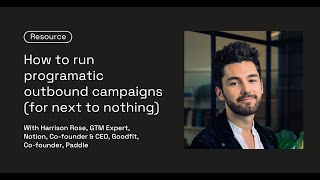
SDRs on Autopilot: How to run programmatic outbound campaigns (for next to nothing) - Harrison Rose
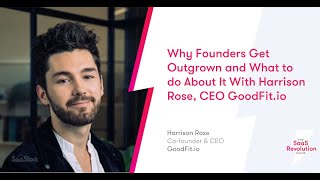
Why Founders Get Outgrown and What to do About It With Harrison Rose, CEO GoodFit
The New Growth Lever You Can’t Afford to Ignore with Paddle Chief Customer Officer Harrison Rose