Dr. Gabrielle Lyon: The Battle of Plant vs Animal Protein for Strength and Aging | TUH #064
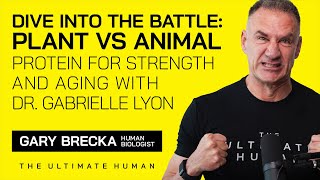
This short Ultimate Human podcast episode (guest: Dr. Gabrielle Lyon) introduces the concept of "muscle span" — the years of healthy skeletal muscle across life — and emphasizes that muscle can be built or rebuilt even in older age. The speakers contrast primary vs. secondary sarcopenia, highlight resistance training as the largest stimulus for muscle (with dietary protein as an essential cofactor), and give practical guidance: higher-than-RDA protein intake for aging adults, per-meal protein targets (40–50 g first/last meals), one gram per pound of ideal body weight as a rule-of-thumb, plant proteins require higher total intake (approx. 1.6–1.8 g/kg), and creatine (~5 g) as a helpful supplement. The segment directs listeners to Dr. Lyon’s website, podcast, and book.
Chapters
I think people believe that at some point it's too late, they've lost too much muscle. Maybe they're in their 60s, maybe they're in their 70s, and they're like, this is what it is, and I can't stop it. I can't reverse it. The truth is, neither of those is true.
You can always build muscle. You can always get stronger. When we see studies, 70s, getting stronger, building muscle, if you were to pick, is it dietary protein or resistance training, which is going to have a bigger impact on skeletal muscle, it's absolutely. When you think about what could an older person do or someone who's listening to this to improve their muscle span? Well, number one, it's understanding that.
Ultimate Human. Hey, guys. Welcome back to the Ultimate Human podcast. Today is another short, but we are going to take a deviation from our normally scheduled shorts because we have a very special guest in the house, and I thought that you guys would really like to hear from her. She's spending the night here at the Biohacking palace, and we started talking and she brought up a new concept that she was working on. And I'm like, this is so good. Even though we have a podcast out there and you guys have probably seen it, maybe even read her book, I just thought that this was such a unique thing that we should put it out there in one of my Thursday shorts. So I hope you guys enjoy this. Welcome back to the ultimate human. Dr. Gabrielle Lyon.
This is so fun. And by the way, your place is so big. We're yelling for each other at the other Gary. Gabrielle.
She's in there checking out my cold plunge. And, like, so where do I find her when I get to my house in the gym?
I am very jealous about your cold plunge. I mean, this is a never ending. It's just gonna never die. The cold plunge.
Yeah, we just, we just gave. We just gave the guys at plunge. Ryan just got a nasty gram from Dr. Gabrielle because she's like, you have a nicer cold plunge than I do. Don't talk to me. I love those guys. But, you know, you talk about a concept. Everybody knows you as the muscle doc. And you know, you talk a lot about muscle in your. In your book and how it is linked to everything, longevity and everything, and how it actually functions as an organ. Most people don't think about muscle as an organ. I think we would think about skin, liver, lungs, pancreas, kidneys. We don't think about muscle. And I love this new term that you've coined, and I want to share it. With the audience today. So talk a little bit about that.
Well, first of all, you're the first person that I've ever spoken about this.
So me and my million subscribers on.
YouTube, but I actually haven't brought this forward because, um. So my, my book Forever Strong is all about this concept that muscle is the organ of longevity, that it is above and beyond. You know, you found me in the gym. I'm very interested in exercise because that's fun. But skeletal muscle, your survivability from nearly every kind of disease and just in life is going to improve with the more healthy muscle you have right now. My new concept, so my original concept is muscle centric medicine that diseases.
Very familiar with that. You opened the first muscle centric clinic.
It's, it's actually in the process. Okay. But my new concept is something called muscle span. We have the idea of lifespan, which is how long you live. And then of course there's health span, which is how long you live in good health. And then there's muscle span.
Yeah. Which I loved it so much. I was like, have you trademarked that yet? She goes, yes, I already did.
The idea of muscle span, the amount of years you have healthy skeletal muscle and really it's in three parts. It's when you're young, as you're growing up, you're training, you're building tendons and collagen and skeletal muscle.
Right.
Then of course, midlife, where you are maintaining and hopefully putting on skeletal muscle. Right. Really training that system. And then the last portion of muscle span is obviously what you are doing.
To prevent sarcopenia, age related muscle wasting.
That's right.
You know what's astounding is, you know, in the mortality space, which was my previous career, you know, we, we, we knew that frailty in older ages was a tremendous risk factor for mortality and it increased the risk of all cause mortality. Peter T. Talks about this in his book when he talks about grip strength. You talk about it in your book. And I think that I'm really excited that it's coming to the forefront because I think people believe that at some point it's too late. Right. They've lost too much muscle. Maybe they're in their 60s, maybe they're in their 70s and they're like, it is what it is and I can't stop it, I can't reverse it.
Yeah.
But the truth is neither of those is true.
That's true. Right. You can always build muscle. You can always get stronger. You can always build muscle. We see studies, 70s, 80s, 80, year olds.
That's what's really getting stronger, building muscle. We take it such for granted in, in younger ages, you know.
Yeah. And I, I think that there's a way that we can prevent that. I, I, there's primary and secondary sarcopenia. Primary sarcopenia is likely from some kind of genetic issue, right? Genetic issue.
Oh, just general muscle wasting at any age?
Well, I would say genetic or. Yeah, I suppose it would be any age. And then secondary sarcopenia would be really. This idea of lifestyle causing sarcopenia, lifestyle decrease in physical activity, unhealthy skeletal muscle, sedentary behavior. You know, sedentary behavior is not the opposite of activity. Sedentary behavior is a disease state within itself. And so there are things in which people can do and interject earlier that I think that we're missing the boat. So most people start worrying about sarcopenia. So you'll see at age 50, you might see, you know, men seem to lose it quicker. You might see 10% loss of skeletal muscle mass in a decade. So there's skeletal muscle mass loss, there's cross sectional area changes, there's all kinds of changes.
Right. Those are scary because you actually see the diameter of the thigh, for example, doesn't change much. The ratio of fat to muscle really changes much when you see these cross sectional images and of the same thigh 10 years apart, 15 years apart, 20 years apart. And it looks like the muscles literally just melting towards the center.
And, you know, you get fat infiltration. I think that this is all preventable. The thing about muscle span is that I think that there are some indications for youth sarcopenia.
Wow.
Which is crazy. Two separate phenotypes. We don't have a standard classification of it. This is a new concept. And I think that because of how sedentary our behaviors are and the way in which our nutrition is that sarcopenia has a youth phenotype, meaning it can start much earlier.
Wow.
Now, when you think about what are the most impactful preventions? Their diet and exercise.
Right.
And the other thing that I was thinking about is we wait until menopause or we wait until our testosterone decreases that we begin to think about skeletal muscle mass. But what happens if we thought about this five to 10 years earlier?
Yeah, yeah. You know what, you know what's amazing? In 2013, 14, 15, 16, I was an investor in a CrossFit gym. And one of the things that they did for community outreach was they invited all the grade schools and grammar schools for free that, you know, bring kids in and they would do basic fitness tests, like basic things like sitting down on a, on a box jump that was 12 inches off the ground, standing up. They would do, try to do fun things with the kids, you know, dead hangs and jump jump lunges and things. What blew my mind, literally blew my mind. It's seared in my mind to this day was we brought in a class of sixth or seventh graders and all they had to do was squat down and touch their butt to one of our little box jumps that was 12 inches off the floor. So it's 12 inches off the floor and then just stand up. The number of kids that could not squat down and touch their butt that looked healthy could not just squat down and touch their butt to a 12 inch high box jump without rolling to the side and putting on their hand on the floor or without pushing up off the box jump. They, they couldn't get up from this hyper squatted position below 90 degrees. And man, the light bulb went off in me and I was like, wow. First of all, what happened to physical education in public schools? That's a whole different issue. You know, we exchanged it for God knows what. But we're not really doing pe. I had PE when I was, it was mandatory when I was in grade school. And, and just I, I just thought about, wow, man, these kids are so deconditioned.
Yeah.
And they look healthy. So I wasn't talking about obese kids, relatively healthy kids. And they were all excited about it and they would come in and some of them popped down and popped up. But, but there was 30% of them or so that could not squat down and touch their butt and stand up. And I was absolutely astounded by it.
I mean that's something that you'll probably never forget. And we are, I don't remember the, the number, but the, the rates of childhood obesity. It's it 45.
Yeah.
Continues to grow.
Pre pubescent children are obese. Yeah. I actually just had a podcast before you got here today. So it's sitting on a stat on, on the floor right here. And, and the study is cited in my previous podcast with Justin from, from Kettle and Fire put. So this concept of muscle span, which I love that because it, it's sort of linking lifespan and muscle and I think there's a increasingly more evidence and thanks to people like yourself, it's becoming more well known because I think we think of muscle as vanity and we don't think of muscle as a functional organ. And to change our concept of, of muscle is healthy. So what is, what does muscle span really mean?
It means that the length of time we have healthy skeletal muscle, the length.
Of time we have healthy skeletal muscle.
You know, and it's interesting because people think that we age in a way that is a linear decline and it's not a period of catabolic crises. And Doug Patton Jones was one of the original individuals that really put this together. And so when we age, it's moments of intense insult. So someone might get pneumonia, be on bed rest for five days, or break an ankle or a hip, there's a series of catabolic crises. And as people age and if they don't train, you know, training is a much bigger stimulus than diet. But 100% of people eat.
Right.
If you were to pick, is it diet resistance, is it diet dietary protein or resistance training, which is gonna have a bigger impact on skeletal muscle? It's absolutely training. You cannot, however build and maintain healthy skeletal muscle without dietary protein.
Right.
So the two go hand in hand. But when you think about what could an older person do or someone who's listening to this, what could they do?
Right, that's exactly what I was going.
To ask you to improve their muscle span. Well, number one, it's understanding that resistance, that all movement has to be incorporated daily.
Right.
It's not. You don't work out for an hour a day and then you sit, you're moving, you're walking, you're doing whatever it is that you're doing, as active as you can be.
Right.
Understanding that when you do activity, you have now sensitized your muscle to dietary protein.
You know, the hormetic stress causing the muscle to call for protein, call for technically for amino acids.
Well, from my understanding is when you contract skeletal muscle, right. There's this four real inputs into skeletal muscle for muscle protein synthesis, which is in essence what we would consider a biomarker for health. Which is, you know, we don't directly get muscle protein synthesis and then put on muscle. It's not a one to one, but what we believe is if you do resistance training, and it could be something very simple, it could be just stretch.
Related body weight, exercise.
So yes, and then have dietary protein. Older muscle responds like younger muscle.
Really?
Yeah.
So it engages in hypertrophy and hyperplasia.
It has a muscle protein synthetic response like a younger individual. And really the hallmark of this was Kat Sanos work really showed that a young individual will respond to, let's say protein, dietary protein will respond to nearly any stimulus of protein. Maybe it's 10 grams, maybe it's 20. But an older individual, when you give them 20 grams of protein, they won't respond. But if you exercise them first and you exercise their muscle and then give them dietary protein, their muscle responds like a younger muscle.
Wow.
And so it then goes through this, it has this muscle protein synthetic response and it helps overcome what we call anabolic resistance or aging.
Right.
And so old muscle can respond like young muscle.
I mean, it's, it's, it makes a lot of sense. If you don't load a bone, it doesn't strengthen. If you don't actually strain a muscle, it doesn't grow.
Right.
If you don't challenge the immune system, it weakens. And so this is back to the basics of a hormetic stress causing the body not only to strengthen, but causing it to call for certain nutrients. And, and it sounds to me like in older ages it's increasingly more important to not just feed yourself protein. And I think there's some indications that I've been reading lately that we actually need more protein in older ages. Even, even Dr. Valter Longo, who I interviewed a few months ago at University of Southern California, talked about the increased need of protein in older ages. And not just the need for protein. The increased need for increased protein in older ages.
Yeah. And so that's absolutely right. We know that. Right. The current recommendations are based on 25 year old healthy males, 0.8 grams per kg or 0.37 grams per pound of body weight. That is the minimum to prevent deficiencies. And one has to recognize it doesn't take into account the quality of the protein, where the protein comes from, doesn't take into account the various amino acids that we need. And so as we age, the big thing with aging is impaired protein turnover. Protein turnover is muscle, is enzymes, is, you name it, hormones, anything, any structure, any compound in the body, but made from amino acids. From amino acids, a gut hormone, you know, gut turnover, liver intestines, impaired protein turnover is a real problem with aging. We turn over around 300 grams of protein a day, we might ingest 100, which means the body's responsible for making up the rest. And as we age, that process becomes less efficient.
So it's making up the rest by assembling that protein from amino acids.
Right.
So if you're amino acid deficient, it can't assemble a person.
That's right.
Very good point. You know, I was telling, I was talking to someone the other day about, you know, target specific protein and saying that you really can't target tissue in the body with protein. You know, for example, we don't eat our nails to grow our nails or we don't eat our hair to grow our hair. We can't eat collagen and have it show up as collagen. You know, it will show up as amino acids, but not as collagen. But then we got into the whole discussion about the, the protein turnover, if that's the, the right term. You take in 30 grams away protein, you assimilate about a third of that roughly. And so do you think that there are certain proteins that people should be eating that have higher bioavailability? What about people that are vegans or vegetarians? Should they be supplementing with protein? Should they be supplementing with amino acids?
I think that these are all good questions. And I would say we digest and absorb all the protein that we, we take in. So if someone takes in 100 grams of protein, they digest all hundred. Where I think the concept of a meal threshold or an amino acid threshold comes in is really targeted skeletal muscle, for example, to simplify this, if someone eats 55 grams of protein, let's say 50 to 55 grams of protein, then you've now maximally stimulated skeletal muscle because of again these different amino acids. We'll say leucine is the primary, which is an essential. When that happens, is there any benefit above that 55 gram, not for muscle per se, but for the rest of the body. But you certainly absorb all of it. Now the question becomes how do we design a real life diet that's valuable? And could you eat plant proteins and get enough? You could, as long as you eat more. And maybe closer to 1.6 to 1.8 grams per kilogram. If I was going to give a number.
And why would you say more? Because it's less.
That's exactly bioavailable.
It turns over to essential amino acids.
Both of those reasons. So you have less bioavailability. You also have a different amino acid profile. Whereas for example, the bioavailability from eggs would be roughly 100%. You are. It's highly bioavailable protein that the protein from meat or fish. It's all highly bioavailable. Plant protein is typically, aside from an isolate, which an isolate has a higher bioavailability because it's just an isolate is bound to fiber, right? Bound to some plant source. So when we think about what is practical information that we can tell people to improve their muscle span, it really is twofold. Pre treat the body with resistance training. Always do resistance training. And, you know, we can come back to zone two cardio. I don't necessarily believe that the kind of volume that people are talking about is going to be healthy for aging. I think the joints and things wear down. The other component is how do we design a diet that is meaningful for muscle span? And that would be, you could easily say one gram per pound, ideal body weight.
One gram per pound?
Yes. The next question would be, how do you dose it? And the evidence would support that first and last meal being the most important. First meal between 40 and 50 grams. Last meal could be the same. That middle meal is really just to get your protein in. And then the third component would be, where is the quality of your protein coming from? Can you stimulate skeletal muscle purely by plant proteins? Absolutely. Okay, you just need more. And then the next question is, is it just a protein conversation or are there things like creatine and zinc and B12?
I just recently started taking creatine and I gotta say, I do feel pretty good. Just five grams.
So five grams is good for muscle. And Darren at Kanda's work would say that 10 to 12 grams is good for brain.
Really? Well, I'm gonna triple my creatine.
Creatine for sure. He would actually be a wonderful guest. Dr. Darren Crandau. He's amazing. Dr. Darren Krant.
You see this shout out.
He's a creatine expert.
Oh, is he? He's a creatine expert, yes.
That is what his research is in. So I think that we have to think about how do we design a diet that is important and manageable for muscle span, and that is clearly based on dietary protein, whatever the source is. And then thinking about if you are aging, then the nutrient density has to be higher. Where are you getting the protein? I think that when you are younger, you know, and this is just my perspective, if you are younger, you have more flexibility to be vegan or vegetarian.
Right.
As you age and your calorie consumption goes down, then you really have to think about how are you going to design a diet that perhaps is easy to follow and has a lower total calorie load with high quality protein.
And in the case of being vegan or vegetarian, just develop a supplementation regimen that helps you make up for the deficiency in protein. It's not that you can't do those things.
That's right. You can absolutely do those things. And then the other thing is, you know, we don't train to becoming. To become better at exercise.
Right.
Train to become better at life. And so how do we design a training program that will take us through the different phases of muscle span. When you're young, you can pretty much do whatever it is really important to train tendons and be, you know, like functional movements.
Right. So where can my audience that hasn't seen the podcast that we did together? Where can my audience find you?
You can find me@drgabriellelline.com and that's L, Y, O N. That's right. I have a great podcast, the Dr. Gabrielle Lyon Show.
Okay.
A New York Times best selling book, Forever Strong.
Thank you for your support, which is great. And we have hosted you about your book on the show.
Yes, thank you for the support. So my website. Oh, you know what? I also have a clinic with providers and nutritionists and they can learn all about it. And we actually have a community which was inspired by you.
Oh.
Last time I was here, remember?
Really? That's amazing.
You're telling me all about the community that you have.
I've got the rule breakers.
So we have. So it is remote.
Okay.
We have a remote clinic. We're opening one in.
Wonderful. Guys, please check out Dr. Gabrielle Lyon. Check out the podcast that we did with her and her podcast show. The Dr. Gabrielle Lyon Show. And as always, guys, that's just science.
More from Darrian


How to Balance Female Hormones Naturally: Blood Sugar, Estrogen & Cortisol | TUH #250


Sahil Bloom: On Social Compounding, All-Cause Isolation, and the Five Pillars of Wealth | TUH #249






