Dr. Rafael Gonzalez & Brian Pla: Unlock the Future of Anti-Aging & Longevity | TUH #037
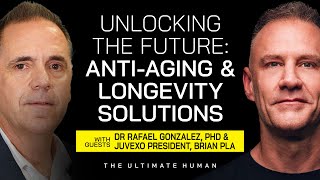
YouTube episode (Ultimate Human #037, Feb 13, 2024) where Gary Brecka interviews Dr. Rafael Gonzalez (PhD, regenerative medicine) and Brian Pla (president of Juvexo) about practical longevity strategies and emerging biologics. Key, actionable guidance: caloric restriction and low-glycemic diets, intermittent fasting (recommended 16:8 start), periodic prolonged fasts (e.g., 3-day) and hormetic challenges (cold, sauna, red light). Clinical/technical topics: exosomes (nanoparticles secreted by stem cells) as the active messenger/secretome with cosmetic uses (hyaluronic acid, collagen, LL37 peptide); primary stem-cell source described is umbilical cord (cord tissue over placenta/amnion), cultured under low-glucose/keto-like conditions to increase high-molecular-weight hyaluronic acid and growth-factor profile; product is frozen and used topically (often delivered after controlled skin injury such as microneedling or lasers). Immune focus: inflammaging concept, important blood markers (hsCRP, TNF-alpha, IL-6), and research on removing senescent cells by activating/expanding natural killer (NK) cells (authors report a paper published end of 2022 and a related patent). Regulatory and access notes: many systemic stem-cell/exosome therapies are more accessible outside the U.S. (medical tourism); topical cosmetic uses treated as cosmetics. Overall tone: optimistic/entrepreneurial with practical, cautionary emphasis on testing and addressing root causes (gut health, toxins) before biologics.
Questions this video answers
February 13, 2024
16:8 (16 hours fasting, 8 hours feeding)
hsCRP; TNF-alpha; Interleukin-6 (IL-6)
They said it was published at the end of 2022
Approximately 0.5 cm (half a centimeter)
Chapters
They found a small lesion on my prostate. Getting cancer in a stage one versus a stage four uphill battle.
Game changer, game changer.
All these thoughts come into your head like, oh, my God, what does this mean? Is it cancer? What do I do? I will not be caught off guard.
One of the biggest things that we target, autoimmune diseases. And autoimmune diseases are on the rise.
Yeah, they really are.
Yeah, it's crazy. There's new ones popping up.
We have multiple clinical studies on go. Hopefully with the clinical studies, once it gets drug approval, we're pretty confident we're going to get one of those. Across the goal line.
What are some practical steps that they they could take to slow down the biological clock?
But ultimately, you look at the key thing to longevity is caloric restriction. And genetically tested them all the way through until they die. And we'll do this. And people don't do this. Let's take a step back, grow it one more time. The aberration appears again. We'll say, oh, then we got to contact mom. We have to contact dad. We need you to test baby 100% of the time. There's something wrong. Wow.
We predicted it.
Ultimate Human.
Hey, guys. Welcome back to the Ultimate Human podcast. I'm your host, Gary Braca, human biologist, where we go down the road of everything, anti aging, longevity, biohacking, and everything in between. And today, we are going down the longevity and biohacking road in a brand new direction. I've invited two guests onto the podcast today. I'm happy to call both of these guests close friends of mine. We've had a long working relationship. They're two of the most interesting, intelligent human beings in the entire industry. I can't wait to delve into the nuggets of of wisdom that they're going to drop on the podcast today. First, Dr. Raphael Gonzalez, a PhD in anatomy and neurobiology. He spent the last 20 years in the sector of regenerative medicine and lately has had an intense focus on keeping a healthy immune system and slowing down the biological clock both inside and out. And I know all of you are interested in slowing down the biological clock, so stay tuned. Maybe even take out pen. And I've got Brian Pl, very good friend of mine. He is the president of Juvexo. They are a manufacturer of exosomes. And if you don't know what an exosome is, then stay tuned because you're going to want to know what exosomes are. You probably heard of stem cells, but the next Generation of treatments in the biologic world is exosomes, and they have so many uses that we're going to go down the road of what we're using them for and how they might benefit you on your anti aging longevity journey. So welcome to the podcast, guys. Dr. Gonzalez, great to see you again.
Pleasure.
You too.
Yeah, another day at the office.
Yeah, another day at the office. But you know what's, what's been amazing about this, this journey, and I kind of go around the world and I find all these anti aging longevity biohacking experts. But Dr. Gonzalez, you have kind of a unique expertise in the world of, of biologics. So for those folks that are listening that don't, don't know what biologics are, don't know the difference between a stem cell and an exosome, and certainly how these things might impact biological aging, everybody's interested in healthy immune systems and, and turning back the biological clock, as you say, both inside and out. So tell me a little bit about what, what can people do to turn back the biological clock?
You start off, I mean, you essentially know you can start off with the baby steps, the stuff that you're doing right now, which is fantastic. You know, focusing on diet, focusing on, you know, specifically nutrition, because only thing you have most control over is what, what you put in your mouth.
Yeah.
You know, supplementation the right way. Exercise, if you're able to exercise, exercise in the right way. There's so many, there's a ton of studies out there just focusing on what does exercise do, what does nutrition do? You know, we've talked about before in the context of longevity, slowing down cells from dividing, which is what's key to longevity.
My slowing down cells from dividing is a key to longevity.
Yep.
Okay.
So, yeah, because if you, since the day that you go and eat that delicious slice of pizza, what transpires when you have one slice of pizza and then don't you have the urge to have another slice of pizza the majority of times? And then your guts on overdrive. What has to happen? Cells have to divide in the gut. Cells have to, you have that not only there, but metabolism starts playing in place. The liver, now you have cells involved in the liver. There's a lot of cells that have to come into play. And ultimately what ends up happening is cells have to divide. And when cells divide, it causes aging. Remember, every cell in our body only has a finite amount of divisions at one point. They become what everybody calls a senescent cell or a zombie cell.
Right.
Occupy space, cause havoc Cause cancer, autoimmune diseases, all neurodegenerative diseases, cardiovascular disease, all this. This is general aging.
Right.
And you slow down basically the cell division and you get to where.
So, so what are some practical ways? So, so, you know, not eating pizza and junk food, fried foods, you know, high, high glycemic carbohydrates, processed foods, I get that. But if you're listening to this podcast and you're like, how do I put a longevity plan in place for my nutrition or for my activities? Because I think there's so many options out there now. There, there's, there's cold plunging and there's red light and there's oxygen and there's, you know, half the, you know, Internet is telling you to do cardio, half the Internet is telling you do weight training. Some say only carnivore, some say only raw food, vegan, some say only vegetarian, some say paleo keto. What's your opinion on what an average person could do to slow down the biological clock? Like, what are some practical steps that they could take to slow down the biological clock? And then of course, I want to get into some of the things that they have access to, maybe that are cutting edge in the stem cell and exosome world.
I mean, one of the first and easiest things is fasting. We all know this because what happens when you fast is basically you slow down cell division. The body just basically goes into a mode of, wait a second, I need to stop, I need to slow down and I need to conserve and preserve what I have right now. So what does that require? It basically requires, number one, cells are not going to divide. They're going to communicate with each other, which are exosomes, these bioactive molecules, and they're going to basically say, whoa, wait a second, we're going into preservation mode. We're going to stop division. And another thing you look at in the context of ag is basically igf, insulin growth factor, which is also, everybody knows it as, you know, for instance, you can raise IGF using growth hormone, but at the same time that causes excess cell division.
All the studies you're kind of borrowing from your future.
Correct. Using to feel good now growth hormones.
You get this short term benefit and you're just. Eventually the future is going to show up.
Yes.
Okay.
And you can no longer borrow, you.
Can no longer buy, and at one.
Point you can no longer borrow, which is the key point of all of that.
Yeah.
So slowing down cell division is number one. Number two is maintaining the key of everything that is in our body, what is everything formed when you put a piece of food in your mouth? Anything, it doesn't matter what, ultimately it all goes down to glucose. You know, it's, it's got to be formed consistently when you are basically breaking down food, no matter how you do it, whether it's, we talked about keto, whether it's vegetarian diet, whether it's a vegan diet, all of it ultimately forms one thing, glucose. Maintaining that glucose level is the key to success.
Because when you have maintained it at the appropriate level.
Correct.
Right.
When you have that spike, what transpires? Metabolism kicks in, cell division kicks in, and you have issues.
So overall you're a fan of lower glycemic diets, lower sugar diets, maybe not necessarily being all keto for the rest of your life, but lower glycemic diets, which you could accomplish with a vegetarian diet, a vegan diet, carnivore diet, obviously a keto diet, paleo diet. So. So you would be less of a fan of following a diet category than maybe a diet strategy of just being low glycemic. Am I right?
You're 100 on. And, and the other thing is, no matter what, at some point you have to challenge the system. So all the studies that you look at of individuals that are over 100 years of age, all of them have one thing in common. They, they've all basically did some form of caloric restriction. Whether it be. What we just discussed is basically it can be a keto diet, it can be a, you know, even a low carb diet, as long as the carbs are correct, it can be a vegetarian diet. But ultimately you look at the key thing to longevity is caloric restriction.
Okay, because, you know, we did. I had about 50,000 people that joined me for a three day water fast last month. You were actually a guest on the water fast. And we started talking about what happens in the body when you, you actually do a three day water fast, when you actually deprive the body of food. And people are like, I can't not eat for three days. And what was astounding was the vast majority of people, more than 90% of those 50, 000 people made it all the way through the three day water fast. And I tried to describe some of what was happening in the body and we talked about cellular senescence, these zombie cells. And is it appropriate to kind of say that the body eats itself from the weakest part forward? Is that a good analogy or how would you describe what happens when we go into A prolonged fast. And by prolonged fast I'll just say three day water fast, for example.
Number one for instance is if you think of the cells, every cell in your body has some form of waste. Somewhere along the line that waste will be consumed as energy. So that's a form of autophagy. So it's basically cleansing the system, cleaning the system of what's transpiring. If you look at studies, there's actually documented studies out there actually show that you can have cancer. Basically go on a fast. And if you think about it, it makes sense. What does cancer feed on? It feeds on sugar, it feeds on bad nutrition. It's the number one consumer of your nutrition. When you have cancer, if you think of halt the eating, what is it going to do? You're going to starve that cancer, you're going to slow down that progression.
Because it's a shift in cellular metabolism, right? It's a healthy metabolic cell becoming a sick metabolic cell. And I know that there's evidence that sick metabolic cells can actually go back to being healthy metabolic cells where we can even get rid of these sick metabolic cells. But what's making the decision like is it the immune system that's going into the body and saying okay, well we don't have any food, so we don't have an external fuel source, so we got to turn internally and we got to figure out what we're going to eat and we got to eat ourselves. So who's making that decision? Is it the immune system?
One of the keys is the immune system. And there's probably nothing more important than that. That's our focus actually at our company is what we actually look at working on the immune system, maintaining immune health. Every single disease in the body has an immune component to it has whether it be a pro inflammatory or an anti inflammatory component to it. Because if you look at the context of aging, all of it talks about what's called inflammaging is when you're in a chronic inflammatory state. People that are obese have a bunch of other diabetes, all these other sclerosis, arterial sclerosis, all these issues are essentially are in a chronic inflammatory state. And you look at specifically there's three key markers that you can actually look at. You know, you look at hscrp, you can look at TNF alpha, which is one of the strongest controllers of the immune system of the pro inflammatory, that inflammatory immune system. And then you look at Interleukin 6, those are the three ones that you actually look at. And if those are Elevated, you are at risk of having some form of cardiovascular disease, neurodegenerative disease, something that is in the context of aging.
So somebody, somebody wrote those down and said, okay, I'm going to go talk to my doctor about looking at those three markers. Would an average physician know that those.
Three, they can send out panels for that? Absolutely, yes.
And then you get that panel back and one or two or three of these are elevated. What's, what's the action step you got.
To start off with, Number one we just talked about is what are you missing as far as supplementation? What are you missing in your diet? What are you taking? The same diet's not equal for everybody. Everybody's completely different. Somebody can tolerate a vegetarian diet, Another one can tolerate a keto diet, another can you tolerate a vegan diet. It just depends on the individuals. We're all unique and we have to find. That's why a lot of the testing that you do will help find those parts. What is ideal for that individual to slow down that basically chronic inflammatory state and keep the immune system in check.
Okay.
Because if you don't keep the immune system in check, guess what we're not talking about. If you have a pro inflammatory response, you're going to age, you're going to cause all these issues, which is called inflammaging. But guess what, if you don't have that appropriate pro inflammatory response, what happens? The immune system can now not pick up that mutated cell.
Ah. So some inflammation is good because it actually allows the immune system to identify it.
All cancer patients that we look at, guess what? They have an exhausted immune system.
Really?
Yep. They have an exhausted immune system and they have a really high profile of something called Interleukin 10, which is an anti inflammatory cytokine that helps keep it like, I need to heal, I need to heal, I need to heal, I need to heal. But guess what? There's no attack. There is no killing, transpiring, there's no pro inflammatory response.
So the immune system doesn't really notice that this, this metabolic shift has happened in these cells and it's sort of leaving these cells alone even though they're sick and, or cancerous.
Correct. Doesn't recognize them, doesn't see them, doesn't know how to kill them, doesn't know how to attack it because it doesn't have a functional immune system.
But we can sharpen that immune system by putting ourselves into a caloric deficit or doing them how, how long? If somebody's saying, okay, where would I get the biggest benefit, 24 hour fast, 3 day fast, 7 day fast. Is there a difference between dry fasting and water fasting? I can't imagine doing a dry fast. First of all, I could, you know, you know, just no water, no food. I mean that, that's no nothing. I'm like, at least I can have black coffee and, and some spring water.
Yeah, yeah.
And a bone broth on the first day and. But you know, you know, again, when we, when we did this three day water fast, you know, I really wanted to introduce people to the simplicity of fasting. And I think, you know, we looked at some of the history of fasting. Every major religion in the world is fasted or incorporates fasting. Catholicism, Judaism, Buddhism, you know, Muslims, I mean they, they all have some kind of fasting component. And they fast for a couple of reasons. One, because they say it makes them sharper, more attentive to God. Right. They're able to have it. So it's a spiritual reason. But a lot of them, you know, also fast for health reasons. Right. They get these health benefits. So three day fast versus a seven day fast, you know, are there major benefits to extending from three days to seven days? What, what's your opinion on that?
My opinion is I think at some point you start wasting muscle.
Okay.
That's my personal opinion. I don't think it makes that much sense. I'm all about hormesis is basically challenging for a positive impact. So challenging. The context of what we talk about, cold plunge, infrared saunas, lights, and fasting on a regular basis, whether it be actually just caloric restriction through fast mimicking diets, things that actually don't basically raise your glycemic index, things that don't cause basically cell proliferation, slow down the system and challenge it frequently.
So you are a fan of intermittent fasting?
Intermittent fasting, yes.
And what would you say is a good window? 12 to 8, 8 hours of a feeding window. What's, what's a good safe, average window that somebody could use as an intermittent fasting guideline?
I think for somebody that's interested in doing long term fasting, the good start is, you know, basically I would say 16, 8.
Okay.
Is a good start.
Okay.
To get used to it for a little while.
And then 16 hours of fasting, eight hours of eating. So 12 to 8 noon to 8pm let's say.
And I think also the, the important thing about the fasting is keeping the body guessing.
Right.
So it's not doing the same intermittent fast. So I think one of the, one of the, one of the strategies also. So you could maybe do four or five days of that, 16, eight, and then do one full feast and one full famine, right? Because the body's kind of, you know, you have a kind of guess on what that is.
And that brings in that component of what they call metabolic flexibility, right? So you're not always doing the same thing all the time. So it doesn't get used to it and you have some metabolic flexibility. So fasting and caloric restriction, one way to slow down aging, cellular division, autophagy, and maybe even take advantage of cellular senescence, meaning where we go in and actually consume the cells that might be sick or might make us sick. That metabolic shift where it's becoming a cancer cell. And if somebody wanted to take the next big step and said, okay, I'm pretty woke to diet, exercise, fasting, what are some other roads that I could go down? I know that you guys are, you know, very well versed in the stem cell and the exosome world, and I'm fascinated by exosomes. So I mean, what, what if, what is an exosome? I mean, for those of you who have never even heard that term, what, what is an exosome? Why should we be thinking about it?
An exosome is so if you think of it's 1,1000 the size of the cells, it's a nanoparticle, so it's secreted by the stem cell. And what we feel, as we know a stem cell is an undifferentiated cell that is, is releasing the exosome and is sending that message to a damaged cell to basically do what it has to do to right itself. So we're seeing is that the exosomes now are carrying this. And kind of the way that our science works is that we're not just a pure exosome product. Because I like to use the analogy, right? If I'm putting a soccer jersey on and I'm putting you on a soccer field, you're going to play soccer. So we're conditioning the exosome to do perform a particular function. And in this case, we're promoting it for cosmetic purposes. So our exosomes are very rich in hyaluronic acid, collagen, type 1, type 3, elastin growth factors. And it secretes a peptide, which from those of you in the bio hacking world is called LL37, which is a big antibacterial antimicrobial, which is one of the reasons we feel it works very well on things like acne and and that type of blemishes.
Okay, really well, and blemishes of the skin also.
So you can, you, you, you. So you, you take these exosomes, you spray them on, do you put them in creams? Do you micro needle them? Like, what can you do to put them into the skin?
So you. We could deliver them over a variety of ways. In fact, my joke is, if I was going to have a third kid, I'd call them exosome because I'm just so excited about that. We were calling it for a while in the lab. We were calling it Liquid Gold because we didn't have a name for it before anyone got into the. I think we're seeing the exosomes have come, have gotten more mainstream. But we didn't just jump into the space, we evolved into the exosome space because of our extensive history of stem cell research and the great science that this man has done, right? So we just took a product that was a byproduct, and for a while they thought exosomes was garbage. There was no value in it. And we came to see in time that it's extremely valuable potentially. It's the whole reason the stem cell works is because the exosomes carry the correct message.
Well, I know a lot of times when you have an inflamed cell, for example, you know, you bring nutrients and other things to the wall of that cell. It doesn't let it in. You know, it's almost like having a heart attack on the floor with the paramedics locked outside your door, right? Their proximity doesn't matter. But an exosome being roughly the size of a virus, a thousandth the size of a cell, it would just pass right through the cell wall, right? So it can carry growth factors and hyaluronic acid into the cell.
Basically, it binds exactly what you just said. So if an area is inflamed, everything in our system sort of works as a lock and key system. There's a complementary sequence on a lock and key. It's actually a ligand and a receptor. Ligand, let's say, is the key. The receptor is the lock. And then what it normally does is actually binds to a receptor on the outside, and then it'll either internalize it and it'll take that message into the cell and it'll tell the cell, produce xyz, for instance. Let's just say I need you to produce hyaluronic acid. I need you to produce collagen. In the context of what we're doing for skin care, do that. But priming them to force that outside because there's not enough evidence out there, you know, on basically collagen. Collagen is the most abundant protein in your body. There is nothing more important. Your body. I mean, this 3D that we live in is primarily collagen.
Okay.
Yeah, it's crazy. I mean it's just a crazy thing to think about. And secondarily to that you think of hyaluronic acid. It's the second most abundant that you'll actually see in your body too.
Really?
Even though it's not a protein, but it, but it's, it's still the second most abundant thing that you actually see in your body. So it's really, really important. I mean, all your joints are full of hyaluronic acid. It's what actually causes the cushioning, the ability to, you know, to maintain the fluidousness in the joint.
WD40.
Yeah, it's exactly so WD40 of our joints.
Is it true that hyaluronic acid holds 1000 times its weight in water? I read that somewhere, but it wasn't in a peer reviewed journal.
It's, there's different forms of it. The high molecular weight one will.
Will.
Okay, yes. So it's, it's a, it's massive. We're talking.
So obviously if you put this onto the skin, right. Then it's going to help the skin stay moisture.
Correct. Okay, and back to the question. You're saying how do you, how do you apply it? So we could get it. The idea is to make injuries to the skin. So we could do it via micro needling, we could do it via thermal devices, you know, machines like Morpheus ablative lasers, kind of to create that injury to the skin to help the exosomes penetrate, to get down to where they need to get to.
Okay, so. So you create controlled trauma.
Correct.
You put exosomes onto the skin and when it heals, it heals.
Yeah. And, and it's amazing the amount of downtime that it minimizes when you're seeing. You know, usually when you've done, you've seen traditionally you're doing a micro needling or a laser procedure. You're really red for, for a while.
I remember what was Kim Kardashian's famous like vampire facial that went so viral because it looked like your face burned in a fire. And then like, you know, and then of course it looked beautiful afterwards. But so, you know, that was what. Massive micro needling. That was actually with trp. So that's kind of yesterday.
Correct. That's a tar.
And, and so now could you take your.
We're now on PlayStation.
Oh, Raph made a funny. The scientist made a funny. He's not just smart, he's also funny.
But yeah, we, we, we've moved on. You know, we moved on, on, on that front. And, and now, like I said, it's become so mainstream. And also, you know, what we're seeing in hair. And you know, I know for many years you would see that commercial. You're like, I'm not only the hair club president, I'm also a member. I mean, I've, I've. Actually, there's nothing that I won't try myself. And so we came out, you know, he came out with a new, a new version with recombinant hair proteins. And what we're seeing is, I'm like geopet, if you see on that sense and how it's being applied. So a lot of these doctors are, are turning on to it and seeing how now we're, we're regenerating without the.
Use of hair follicles and thickness. And so, so, you know, where my mind goes is like, okay, well, you say that these things come from a stem cell. So first of all, where do the stem cells come from?
Great question.
And, and how do. Because stem cells contain DNA. Yeah, right. But exosomes don't. Right.
You can, you can remove the DNA.
Okay, so, you know, my first question is, where do they come from? Are they safe? You know, if they came from another human being, how do I know I'm not getting what they had?
Right.
And are they legal? I mean, are they FDA controlled? Are they done in laboratory cosmetic?
Walk me through the process. So for cosmetic use, anything. If you use for topical use, it's just a cosmetic use, and that's about it. It's just used topically, sprayed on.
But talk about the source, the stem cells.
How do we get an exosome?
Well, an exosome comes from any cell in the body. If you think of the simple thing of what we talked about, that slice of pizza giving you a stomachache, and then you feel like crap because your head hurts and et cetera. How did that signal get from the gut to the brain? It's that neural access that we actually have. And basically it's a communication that's basically gone from here to there. It's a protected communication. Similarly to, you think of, you need more testosterone in the testes. A lot of times, you know, the pituitary gland signals all the way from the pituitary, all the way down. It's protected, right? It's protected. Every cell in your body actually has an exosome. Produces an exosome.
Okay.
So they have to produce an exosome to talk to their neighbors. Cells like to be in homeostasis, be happy, be feeling well on a consistent basis. How do they do that is by communicating with each other and exchanging needs. So if I need, you know, Gary, give me a hand. I need some help picking up this package. It's similarly what transpires actually in our bodies with cells. I need help. I want to stay alive, and I want to be happy and healthy.
Okay.
And the exosome is what does that with every cell in the body?
So my question is, where do. If they're derived from a stem cell, where do you get the stem cell that's a good. Produce the exosome? Like, what's that process?
So the process that we've undergone has been arduous and very, very lengthy. And essentially what we looked at, we spent years in probably about, I think it was like 2007, 2008, studying all the different types of stem cells. So we have stem cells from fat in our body, we have stem cells from bone marrow body, we have brain stem cells. We just talked about earlier about placenta. Hey, yeah. Placental stem cells, amniotic stem cells. But what we try to look at was what is the most abundant, number one. And think of what transpires when a mom has a baby. So you have the umbilical cord. The umbilical cord is the best that's out there. The reason why, if you think about this logically, what does it do? It's the conduit of life, right? It's basically what supplies the correct nutrients from mom to baby. Not only that, if you think about it logically, how is it possible that dad's DNA is in there and it's able and the baby's not rejected? It's because the immune factors that can help it so it's not rejected. So it basically suppresses an immune response that transpires. So the baby's getting nutrients from mob that also contains dad's DNA.
Wow.
So this conduit of life is full of essentially life, and it's mostly compulsive. You think it's a hard rope for those women that have had babies. You've seen this for dads like us that we've actually cut before.
Yeah.
You said, how hard is it to cut that thing? You're like, whoa, what the hell's going on here? Yeah, it's mostly hyaluronic acid, but they.
Give you bad scissors sometimes.
So you harvest the placenta.
Right.
You harvest the cord. We don't use the placenta because the.
Placenta is a filter.
Okay.
So we avoid the placenta because it's a filter. It filters out anything that's bad. That's why we avoid that.
Okay.
The amniotic fluid and the amnion. Amniotic is basically. The amnion itself is mostly epithelial cells. It's also somewhat of a barrier filter. And then the amniotic fluid contains mostly, if you think about what it's supposed to contain, is a bunch of antibodies.
Right.
Is what it mostly contains.
Wow.
So it helps with all the cushioning. The cord itself is the conduit basically of life. And all the nutrients, most majority of all the nutrients, we harvest the cord itself. And our technology, we spend years developing this technology. We actually have clinical studies actually here in the United States, and we license this technology to an outside entity in Mexico that does some of these therapies too. And we just take a section of cord this big and it's all about the diet. What we ended up doing was putting these pieces of this cord and we call it diet.
That you're going to put the stem cells in, that we're going to put.
That we feed the cells. So when you look at science, and for those that know cell culture, those. Those that know science well is what they would normally feed cells and all cell types, skin cells, liver cells, that we would grow up artificially, that we grow up in petri dishes. They normally feed them a high glucose diet. And the reason being is, and you'll see this in culture, which is pretty neat, these cells will multiply like this. You just feed them the sugar and they're multiplying, multiplying, multiplying. You got the cells that you want. But what we did was looked at various different formulations of how do we slow down the aging process of the cells. And what we looked at is looking at telomeres in the cells. And for those that don't know what telomeres are, it's essentially. These are basically like the ends of the shoelaces on DNA. Yeah. They're the caps on the outside of it. Yeah. And then they unwind as a cell divides and they're cleaved. A certain amount of base pairs are cleaved and then they're rewound. And with time, your telomer shortening and then at some point Your telomeres are so short that you have something called critically short telomeres. And your age, you have neurodegenerative disease, heart failure, all these different diseases of aging. We looked at that carefully and looked at how ourselves have him.
Guess what diet the cells.
Keto.
Keto. Low glucose.
And you put stem cells on a keto diet?
We put them on, yes. We put them on sort of somewhat of a caloric restricted diet and on a keto diet. And it's very, very low glucose. And it ain't cheap. Yeah, that's the thing. And we ran various different formulas and then we looked at, especially in the context of the exosomes of what they're releasing is how do we get them to release out more hyaluronic acid. The crazy thing is that you would see like, you know, diabetics or individuals like us are looking at what happens when I eat a food. Let me check my glucose, let me check my ketosis. We were doing this in culture and looking to make sure that the food was optimal, that there's no spike in. In glucose. Looking at glucose from a stem cell to produce that product. Then we actually went above that and actually worked with a group. A group at Cleveland Clinic started measuring HA for us. We wanted to make sure that we have high molecular weight. Ha. We don't want the low one because that degrades high molecular weight.
Hyaluronic acid.
Hyaluronic acid, correct.
Yeah.
And we achieved it. That's where we captured that product. And then we put it in a phenomenal amino acid blend that works fantastic. And it maintains it really well. And we maintain it frozen.
So you. You harvest the stem cell from the. From the placenta, then you take from the umbilical cord and then you put that in. In a culture to grow it. And it's growing on a keto diet, so it must be. It's under certain type of stress that stress produces high molecular weight hyaluronic acid, which is great for the skin.
Yes.
Growth factors. And then you take the exosomes from that media and we take all of it.
Oh, you take all of it. Because it's not only exosomes. Cells also basically secrete out. And we actually call it a secretome. Ah. So they secrete out different things. The 3D matrix. How do you think the 3D matrix is produced? You have cells everywhere. They're all bound together, they're all happy. And then there's a 3D matrix that's produced. A lot of that stuff is just secreted out and it's actually produced. So we take that. But not only that, we've taken it a step further. When is your skin, besides when you're a baby, when is your skin look fantastic when you're like 15 years of age? The cells that we produce, we have evidence, are about 15 years of biological age. Wow. That's when we capture those signals.
So then you stop them there and what, freeze them?
What do you do? Correct. We freeze them.
Okay.
And then.
And then somebody would take that vial of exosomes and microneedle it into their face, for example. And then that's going to help.
The practitioner will apply.
We, we've looked at, for instance, even the donors that we have completely viral free. No Epstein Barr virus. That's 85 of the patient population. No cytomegalovirus, that's about 80 of the world population too. Actually taken the cells before we actually expanded them massively and genetically tested them all the way through until they die, until they aged to make sure there's no chromosomal aberrations. You'll be surprised how many cords we've actually gotten. And we'll do this and people don't do this. And then all sudden we'll get an aberration and we'll say, oh, let's take a step back, grow it one more time. The aberration appears again. Then we got to contact mom. We have to contact dad. We need you to test baby. 100% of the time there's something wrong. Wow. Yeah. Which is pretty crazy.
We predicted it.
Yeah.
Wow.
And we've actually helped mothers with this because now the moms know what they and the dads know what they need to do. You know, they got to be prepared. For instance, we've seen cases of Turner syndrome. It's an extra X chromosome, which is rare for a baby actually to be born like that. But we've seen cases that. But guess what? When the baby now goes through development, they know that they're going to start seeing the baby's not growing as much. The ears might look unusual. The jaw and the head actually starts looking. They now have to put them on hormone replacement. They have to put them on specific medications to make sure they develop normally.
Wow.
So it's a pretty intense.
All just in the process of extracting exosomes so you can use them topically.
So now. So I think what we're trying to do is create that appreciation where everyone's trying to see from the exosome, but the process really starts at the stem cell front. And no one's asking, hey, where is the source? What have you done to test the source of these stem cells?
That right. It seems like some articles asking, you know, is there any way to test if, if the, if the host has been vaccinated, does that have an impact or not? People are asking about stem cells, the three cell.
So we have three qualified cell lines that we actually use. They were prior to Covid, any form of COVID And from those three cell lines we can actually produce 1 million doses of 100 million cells that are 15 years of biological age. Wow. Trillions of cells.
So all of this happens even though you're culturing these things and you're expanding these things, they don't lose their viability. For lack of better word, they don't.
We freeze them in specific formulations. We've even, I mean we, we go down to how do we keep them, maintain them frozen in that chronological state? What do we use? What formulations were best, what is the best way to thaw them out? You know, how do we displace basically the dimethyl sulfoxide that's actually put into it, that displaces the water correctly, how do we thaw them correctly, how do we maintain them after correctly, what types of formulations? Everything. The feeding, the before and after, all of it, following freezing to make sure that they're healthy, vibrant cells that work well.
So somebody that's on this anti aging longevity journey, you know, caloric restriction, you know, clean dieting, intermittent fasting, maybe even a few times a year, prolonged fast. They're really interested in their skin collagen, lasting fiber and improving the tone and texture of their skin. Exosomes applied topically, you think is the next revolution of skin care.
As long as it's the right exosome.
Right.
And where else, you know, down the road 10 years from now? Because I know you have several clinical trials underway here in, here in the States. Where are we going to start to see exosomes and stem cells in the world of longevity aging, you know, bio optimization. Where are we going to see that in 10 years? Because I know there's restrictions right now.
Well, I think the idea is hopefully with the clinical studies, we have multiple clinical studies ongoing, so we're pretty confident we're going to get one of those across the goal line. So what happens is that once it gets drug approval, then kind of like drugs like a Viagra, right, you're able to use it off label potentially for other benefits.
Okay.
And since we've already seen so Much of those anti aging and mitigation of chronic inflammation, we're very confident that we will be able to see that more. And the idea is to have off the shelf stem cells, not stem cells that you're getting from someone for, for as young as we may be that, that is, that are older in quality.
Right, Right.
Yeah, yeah. Because I mean our stem cells are the same age as we are. Right?
Correct.
Yeah.
And so down the road we could see this branch into things like looking at treating the inflammatory conditions that go with aging. Correct.
Inflammation. Yeah. One of the key things that we actually learned with one of the studies that we actually did was we know that our cells, the cells that we use can help regulate the immune system. And if you think of which is what something that's. There's nothing more important than that. And when we talk about that, you talk about, remember you have an immediate immune response which is NK cells, natural killer cells, which we'll talk about a little bit.
Yeah.
Macrophages, neutrophils, a bunch of some other cell types, dendritic cells, which is a fantastic cell that presents and basically orchestrates the entire army. But the secondary, the strong massive response is T cells and B cells. But T cells either can be a pro inflammatory cell, a regulatory cell, a suppressor cell, or an anti inflammatory cell. One of the most important ones is that regulatory one. Why? Because what does it do? We talked about we have to have that balance. It regulates that balance. If there's too much inflammation, which you don't want too much inflammation, it'll regulate it and basically cause it to come down and cause the anti inflammatory response to come up.
Wow.
So help regulate it. So it's so important to keep the system regulated because if it's not, guess what? One of the biggest things that we target, autoimmune diseases and autoimmune diseases are on the rise.
It's. Yeah, they really are. Yeah.
It's crazy. There's new ones popping up. There's over 100 autoimmune diseases.
Wow, I didn't know.
It's a crazy number. There's over 100 of them.
And what do you credit that to? Pesticides, herbicides, insecticides? Like what, what, what is it about modern day living? Because for the, you know, as somebody that studied, you know, mortality for, for decades, in the first decade of our measured lifetime, where life expectancy is going backwards. You know, we've never had a decade where mortality tables are actually taking life expectancy backwards. I mean, what are, what are causing this sudden rise in autoimmune conditions, I think we're seeing.
We're seeing it. We're getting bombarded from all sides. Right. It's in our water. Right. We're seeing the microplastics and all the toxins in our water.
Talk about that.
Yeah.
We're seeing it in our air. Right. We're seeing it in our food source significantly. I mean, look at what a good job you do at kind of relaying the message that we're even organic. I mean, what is really organic? How can you really vet. Like, we can do more vetting on our stem cells than you can on your organic food to that level. Right. But no one's really testing that stuff. So if we're being bombarded, we can only do the best job possible. But it's mitigating all of those environmental factors, and we feel that ultimately. I think you touched on it earlier, which is the diagnostic testing.
Right.
So we have to go back to what is the source? Some people may be more sensitive to particular toxins than others. Right, Right. So if you run heavy metal toxin panels, you. You're testing for microplastics, you're testing for, you know, molds, and you get a very wide panorama of what's going on with a patient. You're trying to identify two things. What are the deficiencies and what are their goals. And you're not going to be able to fix either if you're not removing the source. So we have to get to the source first because the best stem cell, the best exosome, the best keto diet will. Will only do so much if the ground is polluted.
Right.
And if you think of our computer, I always love to give this analogy. Right. Where our. Our computer over time starts to slow down. Right. Because what happens, we keep putting more and more and more crap into it.
Right?
Right. So it starts accumulating. The cash starts to build up. So sometimes you take it in and just by clearing cash, removing the source of the clogging is sufficient for that computer to speed up.
So it goes back to.
That goes back to the fasting.
Yeah.
So what are some other things that we can do to improve the immune system and slow down the biological clock?
Well, one key thing is you talk about it every morning. Sunlight.
Wow.
Vitamin D. I mean, that's like one of them.
I used to have a PhD back me up on sunlight.
There's nothing. But there's nothing in more important. Important than that because, I mean, going. Even going back to that. The question is viruses. We've now Been challenged with another virus. We're now going to be challenged soon, probably with another virus that's coming on horizon and the immune system gets tapped. You have to, you know, diet supplementation is important. People are like, oh well, wait a second, there's I don't know how many people. You've probably seen a ton of people. I spent all day in the sunlight. And then you go test them. They're vitamin deficient. Yeah, they're vitamin D deficient.
Right.
It's because you're not absorbing, your gut's not working correctly. You have gut issues. You got to fix, you got to fix the source, what you just said. Yeah, find a way to fix the source so you can absorb those things. And if you can't absorb them correctly, hey, do an IV right of, you know, go get some vitamin D supplementation or whatever, IV nutrition to make sure that you're getting the right supplements into you.
Yeah, I, I'm a huge believer in targeted supplementation. So we have, you know, fasting exosomes for topical skin. We know that aging is a inflammatory condition, inflamma, aging, caloric restriction, you know, non processed diets. But now this world of biologics, stem cells and exosome, which I think is advanced more outside of the U.S. right than it has in the U.S. 100%. Is that just be the regulatory framework.
Environment here in the United States makes it difficult to do, to do work here. And many countries out there are allowing stem cells. They're regulated in other countries. You know, we actually gave our licen license to a, a place in Mexico, in Cancun, one soon to be in Cabo that actually works with the cells that we actually use. And people think, you know, first of all, where do you go on vacation? People talk about I'm going on vacation to Cancun. I mean it's, you know, then some people say, well, wait a second, it's not safe. No, Detroit is not safe. And many places or many places not.
Very safe right now.
There's a lot of places, places that are not really safe. You know, in the United States, they're not really talking about these type of things. Yeah, but people go consistently there's millions and millions of tourists that go hang out at the beach and it's really not third world there. And I know for fact, and I mean I've taken so many people and we've gone down there to look at facilities and they'll be like, wow, these are state of the art facilities. We got one of the original guys that has started working some of the first MRIs. He went down there and he was like, why? These guys have, you know, two million dollar piece of equipment.
Here's a change of perspective. They see machines they don't see in the US and it really changes that, that, that dynamic.
I know medical tourism is big. It's down there.
Yeah.
And the vast majority of the doctors over there are American trained. They've done some form of, you know, postdoctoral training, some form of, you know, official training in the United States, speak perfect English. They know everything. They actually collaborate with American doctors on a consistent basis. So it's not like you're going to, you know, people think, oh, it's third world. Why would I go there for medical tourism? Because guess what, a lot of stuff is.
We see a lot of these stem cell clinics. Cancun, Colombia, Panama. I mean they're, they're in, in other countries, but pretty renowned people go down there and get these, these, these treatments. I mean, so if we were to peek behind the curtain a little bit and say, what is, what is some of the most promising, prolific research that you're doing that you think will be on the horizon? I mean, whether it's on improving the immune system, whether it's on stem cells, you either have to get it done outside the country or maybe it's going to be available here in the states in five years or 10 years. Like, what's some of the most promising? Like what makes what blows your mind and gives you that Perry Mason moment? Like, ta da. This is freaking awesome.
We just did ourselves with a Perry Mason reference. Yeah, yeah, yeah.
Oh, you did, you did. We published a paper in end of 2022 of something that we spent eight years studying. And it's senescence, the zombie cells. And if anybody looks up natural killer cells, you'll type these things on. These are the first responder to a virus, to a mutated cell, and then to a senescent cell, this mutated cell.
Which is a potential cancer, cancer cell. Okay, so the first responders in NK is this.
Unfortunately, as you age, these things also age. And they're no longer natural killers. They're dormant. Office workers, government workers, whatever you want to call them, I don't know, but they're not, they're not doing what they need to do. They're not washed up.
Police officer, no gun, whatever.
Yeah, okay, so these guys, these are.
The Navy seals of the white blood cells. Okay?
These are the guys that come in, attack, target, kill. And we actually took the line of everybody looks at cancer in the context of natural killer cells, we looked at senescence and natural killer cells. We were the first to look at senescence and natural killer cells. We published a paper last year, we actually got a patent on it about a year and a half ago. I read that on this too. And what we showed is we can remove senescence in the immune system. But if people think about this, wow.
Meaning the zombie cells of the immune system.
Yeah.
And you do that by turning the immune system safely on itself.
Like what removes those cells, the natural killer cell. We take natural killer cells from you, we will actually grow them up, activate them, then put them back into you. And they will remove senescence. They will target and kill senescence. We can lower that senescence. But then people think, so what, you lower the senescence, what happens? Well, guess what, you now have the right signals. Because you only have a certain amount of cells in your body. The signals in the bone marrow now are saying, I need to release fresh, healthy cells in there. Senescence isn't consistently happening.
When you remove cells, you know, remove red blood cells from the bloodstream replaces those red blood cells. So you're saying that if I remove senescent immune cells, like dysfunctional, sick, old, tired, non functioning immune cells, I'm going to replace them with healthy, functioning immune cells. So to rewind the immune system.
I mean, if you, if you think of every day, every single day, we lose over 300 billion cells. That's a crazy number. Every single day. It's mostly red blood cells, but it's still, it's a lot of cells. And your system just turns them over and produces new ones.
Right.
This is going to be similar to. You remove that and now the system has to regenerate. And ultimately this actually started off with. In 2010, it was a publication that came out that they essentially took a senescent mouse model and they took that senescent mouse model that couldn't walk the maze, had no hair, had no muscle, then they took a healthy one and they basically.
So that's just an old mouse and.
It'S, it's a model, it's a knockout model that basically has a gene missing that causes it to be senesced.
Ah, okay.
Then they actually took a healthy version, connected to it, and then they noticed something about this. Yeah. Yes. So it's remembering this, it's an experiment that they connected to. And what this mouse that was unhealthy, grew hair, grew muscle, was able to walk the maze after. Right. Basically got younger when they went back and looked at what had transpired with the organs and everything is. The senescence was gone.
Wow.
And the mouse.
The mouse that was healthy, it's its immune system went in and fixed the sick mouse. Is that essentially what happened? Wow.
Yeah.
So why Brian Johnson is putting his son's blood into his body. Did you hear about that?
That's plasma. Yeah. He's using the plasma proteins. Yeah. There's evidence that actually plasma works well too.
Okay.
Yeah.
So I wanted to ask you a question. Obviously, if I would have told you.
This is my podcast, dude, I'll ask the question.
But if I would have told you you had the weight, look at how much good you've done, how many people you've got in your message.
Stop it.
No, no, no, but listen, what I'm getting is that, imagine if I told you you had to wait eight years, 10 years to see the results of that. You would have said, no way, I'm not getting into this.
Right.
So that's what happens with a traditional drug route. So if we have to wait that amount of time to get some of these things across the goal line, then, you know, we're in this, we're passionate. We want to help people just like you. And so being able to have these licensees, technologies outside the US that could get these treatments to people, okay, we're changing lives every day, day.
So those are the kind of things that are available outside the country. You can go to Cancun, rewind your immune system, you can get some of the, some of these biologic treatments. I mean, I, I, I think it's just fascinating because what's, what's interesting about all of this science is that we're actually just finding ways to enhance the body's ability to do what it does best.
Exactly.
Which, which is a really interesting thing that continues to strike me, being in this industry and in this business, is that a lot of the science seems to be coming full circle. And we're not like looking at chemicals and synthetics and pharmaceuticals. We're actually looking at how do we better tap into the body's resources to heal itself.
Totally.
Right? You know, so platelet rich plasma, prp, most people have heard of, you know, putting it in knees and hips and shoulders and joints to kind of accelerate healing. Now you're talking about taking exosomes from stem cells, putting them back into the skin to regenerate. Regenerate the skin. Maybe even using our own stem cells. What about all those people, all those, you know, moms that froze their cord when they, when they gave birth? 5, 10 years ago when they started freezing the court. Is there a possibility they can unfreeze those and, and get stem cells from those? I mean, they're the promising treatments with those kinds of things. I have people ask me all the time.
I mean, well, maybe the context, I.
Think it's fear based, like, yeah, oh, shoot, well, if I'm having a baby, I should freeze the cord.
But let me tell you, it's smart. It is because it is smart. And the reason why it's smart is because you never know. Your baby can born with a blood deficiency, a cancer, or it can happen within six months, a year, whatever it may be due to, who knows, you know, you don't know a genetic. That was. That's gone bad. And it can happen and it gives you, it affords you the opportunity to have something there that's naive, that God forbid, your child has to basically, you know, get chemotherapy, get radiation. We can now rebuild that blood system to make it healthy.
So you're a fan of mothers if they can.
But there is a freezing.
But there's, there's a. There's. Correct.
Yeah. There's a caveat.
There's a caveat to it because it only works up until a certain amount of weight. There's a formula to reconstitute the blood system. So once a child hits about five years of age, that formula no longer works. And you basically have to find other units and other matches. You have to find what's called the compatibility matches.
Okay.
To actually do it, you know, if Your child is 10, 12, 15, you might need three units, you might need four units. You have to dig outside to find matches.
I got you.
Yeah. And you also cannot ask your. Wherever it's being held. Hey, could you just send me back the cells and I'll take care of it. It has to be for a range of conditions that are approved by the.
FDA for that blood conditions.
And it will never be shipped to you as, as the client. It'll be shipped to a medical facility only under one of those conditions. So it's very important to understand that anything outside of that, you will not be able to use it. And as Dr. Gonzalez said, after a certain age, it's also not sufficient because they're not expanded cells. It's only the. I mean, you're really only collecting about 6 inches worth of cord or blood.
But they can't, they can't unfreeze that and send it to a lab and expand it.
No, no. So those cells, those are basically the blood stems.
No, no, it's crazy talk. I mean, wow. We always talk about expanding cells.
Then I asked about you guys, but that.
But it's like I just dropped a.
Fart in the room or something. How dare.
That was crazy talk. It's. It's a different stem cell. And that's where people get confused.
Ah.
It's a blood stem cell and blood stem cells. Nobody has really successfully been able to expand the blood stem cell, which is actually the mother stem cell. They call it the mother stem cell. It's floating in your bone marrow. We have them in our bone marrow, and then they actually circulate outside our body. It's crazy because if you think of. There's evidence of patients that have cardiovascular issues, they have more stem cells floating in their system than we do. If you're healthy.
And why.
If you think about is the body wants to repair itself, but the signal's not there to make that repair, you know, because if you would think that it would repair itself, then all you would do is. There's a drug that you can take. It's Neupogen. You can actually treat, stimulate the bone marrow to secrete out all these progenitors and stem cells into circulatory system. And there's been a study done on that. The heart should heal, right? Doesn't heal.
Wow. And why is it signals.
The signal's not there.
The signals signal themselves to recognize to say, I need to make the change.
To, you know, to. To increase vascular church or release the right exosomes to make the right changes that are needed to help heal the heart are not there.
Right. So then it, you know, somebody that's on this anti aging, this longevity journey, you know, they're really. There's a lot of topical skin kind of options available for them. But if they really want to look at improving the immune system or exploring stem cell therapies, they really got to.
Go outside the US I would suggest. Okay.
Because even stem cells from yourself, what the second you try to use it systemically, it's. It's also considered a drug anyways, so you would not be able to apply.
It that way because again, they can get stem cells from your fat. Right. They get stem cells from your bone marrow. They do bone marrow aspiration.
It's a small amount, though.
Yeah, right.
It's.
But as for the FDA guideline, it's the cells. There's three real kind of conditions that you could use. It has to be homologous, which is same type of use that the cells were doing before they got pulled out, it has to be autologous from yourself and then minimal manipulation. You cannot manipulate the cell in any way, shape or form. And those, if those three caveats are met, you could apply.
That's why if I got, if I've got a bad knee, can I take stem cells from my hip and put them in my knee? Is there any benefit to doing that?
There's definitely.
It's a trick question.
There is no, there is benefit. But you have to think of it as, once again, they use that key term stem cell, they use that key term exosome. But what you're really getting is a needle in a haystack. But ultimately you look at the factors that are contained in that needle in the haystack because there's growth factors in there. You know, for instance, if you look at bone marrow, you extract bone marrow out and the percentage of, you know, you have a glass of bone marrow and that glass of bone marrow, the percentage of stem cells you were having there for an average 40 year old person is going to be 0.000001% of.
Stem cell, of stem cells. If I pull them, the bone marrow.
If you pull the glass of bone marrow, that's, that's how much stem cells.
You have in there.
It's like what we are.
So then what is the benefit of tapping my bone marrow and doing bone marrow aspiration, putting into my joint.
There's other cells there. So you have immune cells there, you have naive immune cells there. You have an endothelial cell that's actually the cell that lines the vasculature. And all those have proliferative effects. They have healing effects that can actually work too. Even though there may not be that many stem cells. But there's factors in there that can help heal.
Okay, beautiful. Well guys, that is fascinating discussion. I mean I think that this whole world of biologic stem cells ex, like the new frontier. Just. I wish we could accelerate it, you know, somehow. But just in, in, in summary, like, what are some of the key takeaways? You know, you, you, you speak a lot about fasting. You speak on, you know, improving the immune system. You speak on rewinding the biological clock. What are the big takeaways that you want people to know if they're interested in longevity, quote unquote, anti aging bio optimization. What are the key takeaways you want them to have to.
For, for me personally, I mean, for me personally, it's number one. Think about what you put in your mouth. Because even individuals that go get any form of Cell therapy. I say you're basically putting our band aid on an issue that you've never solved. Get yourself healthy. Because guess what? If you're going to put a cell into an area that's not healthy, cells are going to die.
Yeah.
I mean, these things people think like, oh, it's going to go inside of me. It's going to regenerate all this. No, it does not. They only last us.
It gets lost in the inflammation and everything.
And your and your own immune system will eat it up and remove it. Get yourself healthy first, then go get that done. Because essentially what you're doing is investing in yourself. It's not cheap.
Yeah, I agree.
Yeah. And I would just add, you know, you know, with all the precision and advanced diagnostics is get a wide diagnostic testing. Right? Like I said, from the blood work to the, you know, gut health, the gut's huge, right? As you said, many times, a big percentage of our immune systems in our gut. If that's off, I mean, you've even, You've even spoken about, you know, the dopamine release, right. And the benefits of that. So 70, 70. Get your gut, right? Do the advanced diagnostics. I mean, there's. There's now companies out there that are offering full body MRIs where you could do. Because early detection is such a key sometimes in mitigating a condition. Right. Getting cancer in a stage one versus a stage four uphill battle.
Game changer, right? Pre metastasis.
Right. So, I mean, for my personal, you know, just a quick anecdote on my personal story. Like, I. I recently did a full body scan with, With. With Pernovo, and I. They found a small lesion on my prostate.
Right?
So this is my personal story that I haven't shared. And immediately all these thoughts come into your head, like, oh, my God, what does this mean? Is it cancer? What do I do immediately? You know, get on the phone with a urologist. So, you know, they found it was half a centimeter, which may or may not be. May or may not become cancer. But the point is, I've now got a clean bill of health on the rest of the body. I have one area of focus. I will not be caught off guard. I will continue to monitor this and not beat myself up, keep living my healthy lifestyle. But check this periodically, and God forbid, if it ever does become something, I've already seen it so early where I have a mitigation.
Amen. That is great. You know, so I end every podcast the same way, and there's no sort of Right or wrong answer to this question. But I ask every guest that comes on the podcast when we wind down, what does it mean to you to be an ultimate human?
You want to tackle this?
What does it mean to you to be the ultimate human?
It means basically aging gracefully and feeling fantastic.
I love that you, yeah.
You don't feel fantastic, forget about it. I rather not be here.
Amen.
And yeah, I would just say I think you touched on it earlier is, is in essence keep accelerating the, you know, my body to, to use as much of its resources to, to be optimized and not borrow from the future.
So that's great.
Later on, I'm not being taxed.
All right, well guys, stay tuned. I'm, I'm absolutely going to do a follow up podcast with these guys. As some of the research comes to fruition, some of these clinical studies that they're involved in come to light and get published. I'll definitely keep you guys up to date. I'll put links to their clinic and their, and their products in the show notes below. If you have any questions about those, I'm sure you can contact their team. But as always, that's just science.
Testing that stuff. So if we're being bombarded, we can only do the best job possible. But it's mitigating all of those environmental factors and we feel that ultimately, I think you touched on it earlier, which is the diagnostic testing.
Right.
So we have to go back to what is the source. Some people may be more sensitive to particular toxins than others. Right? Right. So if you run heavy metal toxin panels, you, you're testing for microplastics, you're testing for, you know, molds, and you get a very wide panorama of what's going on with a patient. You're trying to identify two things. What are the deficiencies and what are their goals. And you're not going to be able to fix either if you're not removing the source. So we have to get to the source first because the best stem cell, the best exosome, the best keto diet will, will only do so much if the ground is polluted. Right. And if you think of our computer, I always love to give this analogy, right. Where our, our, our computer over time starts to slow down.
Right.
Because what happens, we keep putting more and more and more crap into it.
Right?
Right. So it starts accumulating. The cash starts to build up. So sometimes you take it in and just by clearing cash, removing the source of the clogging is sufficient for that computer to speed up so it goes back to.
That goes back to the fasting.
Yeah.
So what are some other things that we can do to improve the immune system and slow down the biological clock?
Oh, one key thing is you talk about it every morning. Sunlight.
Wow.
Vitamin D. I mean that's like one.
Of the nice to have a PhD back me up on sunlight.
But there's, there's nothing. But there's nothing more important than that because I mean going even going back to that. The question is viruses. We've now been challenged with another virus. We're now going to be challenged soon probably with another virus that's coming on horizon and the immune system gets tapped. You have to, you know, diet supplementation is important. People are like, oh well wait a second, there's I don't know how many people. You've probably seen a ton of people. I spent all day in the sunlight. And then you go test them. They're vitamin deficient. Yeah, they're vitamin D deficient. It's because you're not absorbing. Your gut's not working correctly. You have gut issues. You got to fix, you got to fix the source what you just said. Find a way to fix the sores so you can absorb those things. And if you can't absorb them correctly, hey, do an IV right of you know, go get some vitamin D supplementation or whatever, IV nutrition to make sure that you're getting the right supplements into you.
Yeah, I, I'm a huge believer in targeted supplementation. So we have you know, fasting exosomes for topical skin. We know that aging is an inflammatory condition, inflammation, caloric restriction, you know, non processed diets. But now this world of biologics, stem cells and exosome which I think is advanced more outside of the US right than it has in the US 100 is that just be the regulatory framework.
Environment in the United States makes it difficult to do to do work here. And many countries out there are allowing stem cells. They're regulated in other countries. You know, we actually gave our license to a place in Mexico and can Cancun1 soon to be in Cabo that actually works with the cells that we actually use. And people think, you know, first of all, where do you go on vacation? People talk about I'm going on vacation to Cancun. I mean it's, you know, then some people say, well wait a second, it's not safe. No, Detroit is not safe. And many places, or many places, Portland.
Oregon is not very safe right now.
There's a lot of places that are not really Safe. You know, in the United States. United States, they're not really talking about these type of things. Yeah. But people go consistently, there's millions and millions of tourists that go hang out at the beach. And it's really not third world there. And I know for fact, and I mean, I've taken so many people and we've gone down there to look at facilities and they'll be like, wow, these are state of the art facilities. We got one of the original guys that has started working some of the first MRIs. He went down there and he was like, why? These guys have, you know, two million dollar piece of equipment.
Here's a change of perspective. They see initially, they don't see in the US and it really changes that.
That, that dynamic medical tourism is big. It's down there.
Yeah.
And the vast majority of the doctors over there are American trained. They've done some form of, you know, postdoctoral training, some form of, you know, official training in the United States, speak perfect English. They know everything. They actually collaborate with American doctors on a consistent basis. So it's not like you're going to. People think, oh, it's third world. Why would I go there for medical tourism? Because guess what, a lot of stuff is.
We see a lot of these stem cell clinics. Cancun, Colombia, Panama. I mean, they're, they're in, in other countries, but pretty renowned people go down there and get these, these, these treatments. I mean, so if we were to peek behind the curtain a little bit and say, what is, what is some of the most promising, prolific research that you're doing that you think will be on the horizon? I mean, whether it's on improving the immune system, whether it's on stem cells, you either have to get it done outside the country, or maybe it's going to be available here in the states in five years or 10 years. Like, what's some of the most promising? Like what makes what blows your mind and gives you that Perry Mason moment? Like, ta da. This is freaking awesome.
We just aged ourselves with a Perry Mason reference. Yeah, yeah, yeah.
Oh, you did, you did. We published a paper in end of 2022 of something that we spent eight years studying. And it's senescence, the zombie cells. And if anybody looks up natural killer cells, you'll type these things on. These are the first responder to a virus, to a mutated cell, and then to a senescent cell, this mutated cell.
Which is a potential cancer, cancer cell. Okay, so the first responders in NKC is this.
Unfortunately, as you age These things also age. And they're no longer natural killers. They're dormant. Office workers, government workers, whatever you want to call them, I don't know, but they're not. They're not doing what they need to do. They're not washed up.
Police officer, no gun, whatever.
Yeah.
Can't do anything.
Okay, so these guys, these are the Navy SEALs of the White blood cells.
Okay?
These are the guys that come in, attack, target, kill. And we actually took the line of everybody looks at cancer in the context of natural killer cells. We looked at senescence and natural killer cells. We were the first to look at senescence and natural killer cells. We published a paper last year. We actually got a patent on it about a year and a half ago. I read that on this, too. And what we showed is we can remove senescence in the immune system. But if people think about this, wow.
Meaning the zombie cells of the immune system.
Yeah.
And you do that by turning the immune system safely on itself. Like what? Removes those cells.
The natural killer cell. We take natural killer cells from you, we will actually grow them up, activate them, then put them back into you. And they will remove senescence. They will target and kill senescence. We can lower that senescence. But then people think, so what, you lower the senescence, what happens? Well, guess what, you now have the right signals. Because you only have a certain amount of cells in your body. The signals in the bone marrow now are saying, I need to release fresh.
More from Darrian


How to Balance Female Hormones Naturally: Blood Sugar, Estrogen & Cortisol | TUH #250


Sahil Bloom: On Social Compounding, All-Cause Isolation, and the Five Pillars of Wealth | TUH #249






