Why Polymaths See It Coming (And Why Nobody Listens Until It's Too Late)

The video essay examines why people with polymathic minds repeatedly spot problems before others, why their early warnings are routinely ignored or punished, and what psychological and organizational costs this incurs. It explains that polymaths integrate multiple domains, allowing them to complete patterns and predict outcomes that specialists miss. The essay outlines the social mechanisms that label early warners as negative, arrogant, or crazy, illustrated through historical examples such as Ignaz Semmelweis, Alfred Wegener, Clair Patterson, and Harry Markopolos—each an outsider who saw a flaw before their field accepted it. It describes a feedback loop where early warnings are dismissed, the warners are later asked to clean up the fallout, and over decades they become silent to preserve relationships. The piece then critiques common but counterproductive responses (louder warnings, adopting a prophet identity) and offers practical communication tactics: ask probing questions, let others discover the flaw, keep a quiet dated record, choose a single critical issue to raise, and allow small failures to demonstrate the problem. It advises polymaths to seek roles where early input is valued—participating in the design phase, small teams, or projects without a single owner—while leveraging their personal record of past correctness and cultivating a few trusted allies. Finally, it reframes the Cassandra myth, asserting that being right early is not a defect but a measurement of the world’s lag, encouraging viewers to embrace their early‑seeing ability without self‑censorship.
Chapters
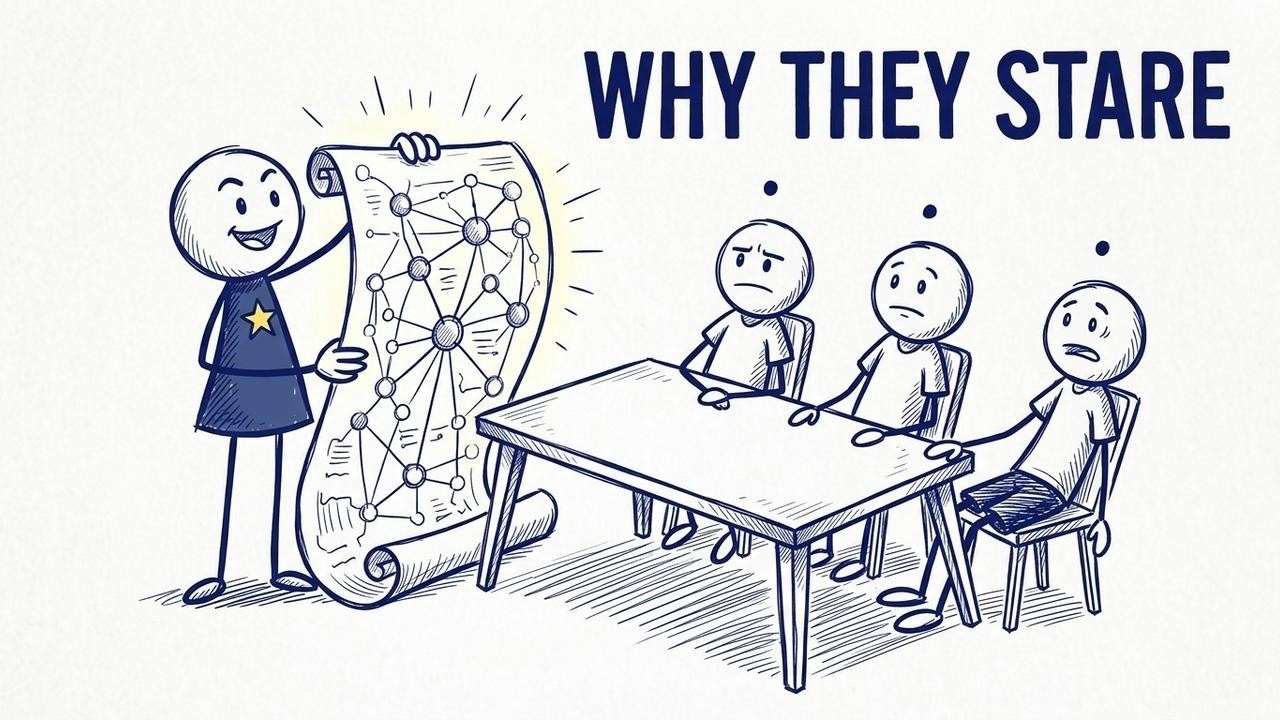
There is a very specific kind of tiredness that only arrives after you were right. A plan gets presented, everyone is nodding, and somewhere around the 3rd slide, your mind quietly finishes the story. You can see the month it falls apart. You can see which department carries the damage and roughly how much it costs. You say something carefully, a small question about what happens in month 2. The room pauses, someone smiles, and the meeting moves on. Then month 2 arrives, and it falls apart exactly the way you saw it. Nobody remembers that you said it. Or worse, they do remember, and they like you a little less for it. If you have lived this more than once, maybe for decades, you probably learned to call it a flaw. Too negative, too intense, always finding the problem. But that is not what is happening in your head. Your mind completes patterns before other people have even noticed there is a pattern. It is an early warning system that nobody asked for. And it runs in a world with a very old rule. About the person who sees it first. This is a film about that rule. Why you see things coming. Why being right too early is treated as being wrong. What that does to a person over 20 or 30 years. And how to be heard without being hated for it. Because here is the strange truth: the problem was never that you saw it. The problem is what the world does with the person who did. Start with how the seeing works, because it is not magic, and it is not mood. A specialist holds one domain in their head, and they hold it deeply. When a plan is presented, they check it against that one domain, and if it passes, they relax. A polymathic mind does something different. It holds several domains at once, and it cannot stop them from touching each other. So when the new software rollout is announced, one part of your mind is already in the training room. It is counting how many people will actually learn it. Another part is in the support queue 3 weeks later, watching the tickets pile up. Another part is in the accounting spreadsheet, where the tickets turn into overtime. And the overtime turns into the number that will make someone angry in the spring. None of those are separate thoughts. They are one shape seen from several sides at once. Pattern recognition across fields is really just pattern completion. Your mind has seen this curve before in a different costume. It saw it in a history book, in a biology lecture, in a failed restaurant on your street. It saw it in the way a friendship ended. When the first 3 points of a familiar curve appear, your mind draws the rest of the line. It does not wait for permission. It does not have an off switch. You are not choosing to be the person who notices. You are simply the person whose notebook has enough pages in it. Picture a dam. Most people look at the water. Because the water is the point of the dam. You look at the wall, because walls are a thing you have read about. And on the wall, down near the base, there is a hairline crack. It is nothing today. It is almost nothing next year. But you know what water does to a crack over time, because you know what time does to everything. So you point. And this is the moment that the rest of the film is about. Because in that moment, you are not wrong. You are early. And to almost everyone standing next to you, those 2 things look identical. Being right has a timing, and the timing is everything. If you say the dam will fail and it fails next week, You are a genius. If it fails in 5 years, you were a pessimist who happened to get lucky. If it fails in 10, nobody connects the 2 events at all. The truth did not change. Only the distance between you and the proof. And in that distance, people have to decide what you are. They get 3 options, and none of them is early. The first is negativity. You are the person who always finds the problem, who cannot just enjoy the plan. The second is arrogance. Who are you to see what the experts missed? The third, if you keep insisting, is something close to madness. The person who sees cracks in every wall. Consider a doctor in Vienna in 1847. Ignaz Semmelweis noticed that women were dying after childbirth far more often in one ward than the other. The deadly ward was run by doctors. The safer one, by midwives. He noticed that the doctors came straight from the autopsy room. He connected 2 things that nobody had connected. He asked the doctors to wash their hands in a chlorine solution. Deaths in his ward collapsed. He had the pattern, he had the numbers, and he had the result. The doctors were insulted. A gentleman's hands could not possibly carry death. He was mocked and pushed out of the hospital. He spent years writing furious letters to the men who ignored him. In 1865, he was committed to an asylum. And he died there 2 weeks later. 20 years after that, germ theory made him obviously, boringly right. Today, there is a name for what happened to him: the Semmelweis reflex— the instinct to reject new evidence because it contradicts what you already believe. But notice what the reflex really protects. It is not protecting a theory; it is protecting a self. Every true warning contains a hidden accusation. If you are right, then they missed it. If you are right, then the plan they are proud of has a hole, and their hands are not clean. People do not defend data. People defend who they are. And a polymath, without meaning to, keeps handing people a mirror they did not ask for. Now look at what this does to the person on the inside, because the damage is slow and it has a shape. Here is the loop: you see it, you say it, you are dismissed, politely or not. The thing happened. There is no apology. An apology would mean admitting you were right, and we have just seen why that is impossible. Instead, you are often asked to help clean it up. You are, after all, the one who understands it. Then the next plan arrives, and you have to decide all over again whether to say anything. Every turn of that loop takes something. The first few times, it takes your patience. After a few years, it takes your willingness to speak in the room. After a decade or two, it takes something more expensive. It starts to take your trust in your own eye. There is a trap waiting inside the loop, and almost everyone falls into it at least once. The phrase, I told you so. You cannot say it. If you say it, you have confirmed every story they told about you, and you have given them a reason to feel wronged instead of wrong. So you hold it. And And holding it has a cost too. It is a very specific kind of pressure, sitting in your chest with nowhere to go. Comment sections on films like this one are full of the same sentence. It is written by people in their 50s and 60s. I told them. Nobody listened. It happened. I stayed quiet. Thousands of people. Each one convinced they were the only one. And then the quiet arrived. Many polymaths describe the same thing happening somewhere around 50. They stop pointing at the crack, not because they stopped seeing it, because they ran the numbers on being heard, and the numbers were bad. From the outside, this looks like wisdom or peace or finally learning to pick your battle. Sometimes it is. But often, it is something sadder: a mind built to see early, teaching itself to look away. The warning system is still running, it just stopped being allowed to speak. It would be easier if this only happened at work, because you can leave a job. But the loop follows you home. You see where a friend's new relationship is heading, by the second dinner. You see which of your parents' decisions is going to cost them in 5 years. You see that your brother's business plan has the same hole as the last one. And you have learned, usually the hard way, that none of these things can be said. At home, the 3 readings are harsher because the people are closer. At work, you are negative. At home, you are controlling, or cold, or you think you are better than everyone. You're overthinking it becomes the family's phrase for you. It is said with love, mostly. It still means, please stop seeing. So you develop a second skill, and it is a strange one. You learn to watch things happen that you could have named. You sit at the table and you do not say the sentence. You let the loan be signed, the move be made, the job be taken. You tell yourself this is respect, and sometimes it is. Everyone has the right to their own mistake. But there is a version of this that is not respect. It is a person who has decided that being close to people requires being blind on purpose. The comment sections under films like this tell the story in the same words over and over. The grandmother who saw the divorce coming a decade before anyone else. The son who warned about the investment and was not invited to the next holiday. These are not people who enjoy being right. They are people who could not stop seeing. They paid for it in one currency that matters most, which is closeness. Here is the thing worth holding on to: the seeing and the love are not opposites, even though it often feels that way. The question is never whether to see. You cannot choose that. The question is what to do with it in a room full of people you would like to keep. That question has an answer, and we will get to it. But first we need to understand the system around you. It is built very precisely to reward the person who ignores the crack and to punish the one who points at it. If this were only about individual egos, it would be easier. But the pattern is built into the structures we work inside, and it is worth seeing exactly how. Organizations reward People reward what they can see. A disaster that happens is visible. It has a date, a cost, a meeting about it, and heroes. A disaster that never happens because someone caught it early is invisible. There is nothing to point at. There is no story. The prevented fire leaves no ashes. This is sometimes called the firefighter problem. The person who runs into the burning building is celebrated. 6 months earlier, someone said the wiring was wrong and asked for it to be replaced. That person was a nuisance with a budget request. Both were right. Only one of them gets a plaque. And people learn very quickly which role gets rewarded. So the system fills with people who are excellent at putting out fires. It runs short on people willing to be the nuisance. There is a second mechanism, and it is about who gets to speak. A plan usually belongs to someone. It carries their name, their quarter, their reputation. The person who made it is now obliged to defend it. In a hierarchy, the plan and the person are the same object. So your warning is never received as information about the plan. It is received as information about them. The more carefully you explain the crack, the more precisely you are describing their mistake. And a third mechanism, quieter than the other two. Specialists are often the gatekeepers of their field, and your warning crosses a boundary. You are a geologist's problem being raised by a meteorologist. You are an accounting problem being raised by an engineer. You are not in the club, so the club does not have to answer. The structure was never designed to carry a warning from the side. It only knows how to carry orders from the top. Put the 3 together and you get the rule we started with. The system is not stupid. It is doing exactly what it is built to do. It just was not built for you. History keeps a long list of people who were right too early. 3 of them are worth a closer look because they share something that matters for you. In 1912, Alfred Wegener proposed that the continents had once been joined, and had drifted apart. He had noticed that the coastlines fit. The same fossils appeared on both sides of an ocean. The same rock formations continued from one continent to the next. Geologists dismissed him for decades. He was not even a geologist. He was a meteorologist and a polar explorer. He died on the Greenland ice in 1930, still mocked. The theory of plate tectonics confirmed him in the 1960s. In the 1960s, a geochemist named Clair Patterson was trying to measure the age of the Earth. To do it, he had to measure tiny amounts of lead. He kept finding lead everywhere. In the air, in the snow, in the ocean, in human bone. He realized that leaded petrol was slowly poisoning the entire planet. The lead industry fought him for 20 years. He was removed from committees, his funding was threatened, and he was called an alarmist. Leaded petrol was finally phased out in the United States in the 1990s. Blood lead levels in children fell by around 80%. In the year 2000, an analyst named Harry Markopolos was asked to replicate a competitor's returns. He sat down with the numbers, and within hours, he knew they were impossible. He wrote to the regulator, then again in 2001, then again in 2005. That document was titled, more or less, The World's Largest Hedge Fund Is a Fraud. He was ignored every time. The fund was run by Bernard Madoff. It collapsed in 2008. taking $65 billion with it. Now, look at what these 3 have in common. None of them was an insider of the field they warned. Each of them saw the problem because they stood slightly outside it with knowledge from somewhere else. Wegener brought weather and ice to geology. Patterson brought the chemistry of ancient rocks to public health. Markopolos brought simple arithmetic to a world that preferred story. That is the polymath's position exactly. The outside view is why you can see it. And the outside view is why nobody has to listen. When you have been ignored, there's one response that feels obviously right. It is the one that makes everything worse. You explain harder. You gather more You build the bigger spreadsheet, the longer email, the deck with 40 slides. You think the problem is that they did not understand, but we have already seen what the problem is. A warning is received as an accusation. More evidence is a louder accusation. Every extra slide tells them with more precision how wrong they were. You are not clearing the fog. You are sharpening the knife and handing it to them handle first. There is a second trap, and it is subtler. After enough years of this, being the one who sees it coming can become an identity. The prophet. The person at the back of the room with the folded arms, waiting. It feels like integrity. And partly it is, but a prophet who is never surprised has stopped looking. People can feel the difference between someone worried for them and someone waiting to be proven right. So what works if explaining harder does not? A few things, and none of them is loud. Ask the question instead of making the claim. What happens to the support queue in week 3? Lets the other person discover the crack themselves. A crack you found yourself is a crack you can fix without losing faith. Give them a way to be right by adjusting, not by surrendering. People will change a plan long before they will admit the plan was wrong. Write it down quietly with a date, not as a threat. As a record. A single dated note does more over 10 years than 100 speeches. It proves to you that your eyes are fine. Choose your crack. A mind like yours sees 20 of them, and if you point at all 20, you will be heard on none. Pick the one that matters. Say it once, and then let it play. And sometimes let a small thing fail. A small failure that is allowed to happen is the only argument that has ever convinced anyone of anything. There is one more question, and it is the real one. What do you do with a mind like this for the rest of your life? The first answer is about where you stand. There are rooms where early is a problem, and there are rooms where early is the entire job. A plan that is still being drawn can take a warning. A plan that has already been announced cannot. So the question is not how to be heard. It is where. Move toward the drawing, away from the defending. Move toward the people who build things, the small teams, the work you own yourself, the rooms where nobody's name is on the plan yet. The second answer is about the record. If you are past 40 or 50, you have something the young version of you did not have. You have been right, on the record, many times. You do not have to say it. You just have to know it. That record is the cure for the quiet. It lets you point at the crack calmly, once, without needing anyone in the room to agree. The agreement already happened years ago. It happened in all the rooms that fell apart the way you said they would. The third answer is about numbers. You will never be heard by the whole room. You do not need to be. One or two people who listen is a lot. Find them, keep them. Over a life, they are the difference between a prophet in an asylum And a person who was quietly useful. And the last answer is the one this film was really about. Cassandra was cursed, the story said. But read it again. She was right every single time. The city was warned clearly, repeatedly, and it chose not to hear. The tragedy of that story belongs to Troy. It was never hers. You were not built to be ignored. You were built to see early. The lag between what you see and when the world catches up is not a defect in you. It is a measurement of the world. So the next time your mind finishes the story on the 3rd slide, do not apologize for it. Point once, write it down, then stand somewhere the crack can be If you found yourself nodding through this, your mind is not broken, and it never was. Tell me in the comments what you saw coming that nobody believed, because I read every one of them. Subscribe, and in the next film, we look at the one kind of leader a polymath will follow anywhere, and why they are so rare.